James Lippincott GoodwinBiblio.com

8 969 résultats
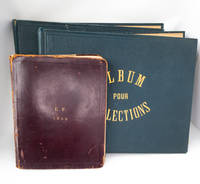
18950002437GROTON MASSACHUSETTS HYDE PARK CHICAGO. Good. 1895. Full-Leather. On offer is an extraordinary collection of diaries that give incredible insight into young Franklin Delano Roosevelts years at Groton--one of the most exclusive preparatory schools in the United States at the time--from the perspective of his closest schoolmate James Lippincott Goodwin. In these six diaries a young J. L. Goodwin chronicles his daily life from 1895 to 1898 and 1903 and features a cast of characters whose family legacies live on to this day. Classmates mentioned include Robert Rutherford "Colonel" McCormick who went on to become owner and publisher of the Chicago Tribune; J. R. "Tadd" Roosevelt Jr. nephew to both FDR and Colonel John Jacob "Jack" Astor IV; Lathrop "Jake" Brown who was FDRs roommate at Harvard and who would go on to become a member of the U. S. House of Representatives; and most significantly Franklin Delano Roosevelt who became 32nd president of the United States and who along with Winston Churchill would lead the free world through its darkest days in WWII. Goodwin himself was also part of a well-connected family. His father owned a railroad and two insurance companies and was the cousin of American financier J. P. Morgan. Goodwins brother Philip was one of the architects of New Yorks Museum of Modern Art. J. L. Goodwin and FDR were both new to Groton School in 1896 and these outsiders became fast friends as they adjusted to student life. Both boys were prolific writers and FDR mentions Goodwin in his letters home. Similarly FDR appears often in Goodwins diary entries. For example: "Passed with Riggs and Franklin Roosevelt during our time after school but it was very disagreeable on account of the ground being so wet" May 3 1897. "This is a legal holiday being Lincolns Birthday. Mrs. Roosevelt is visiting came up today" February 12 1898. "Franklin Roosevelt was down from Harvard. Saw him at the fence a while" May 18 1903. J. L. Goodwin graduated from Groton in 1900 and Yale in 1905. He later pursued a Masters in Forestry and was a noted conservationist and pioneering forester. Although the diaries do not bear his name there are ample contextual clues to determine that they were indeed kept by Goodwin. His collected papers reside in the James L Goodwin collection at Yale University. In this archive there are six personal diaries of J. L. Goodwin: 1 1895: 5.75" x 3.5" 122 pages 100% complete good condition. 2 1896: 5.75" x 3.5" 183 pages 80% complete good condition. 3 1897: 5.75" x 3.5" 183 pages 70% complete good condition. 4 1897: 8.75" x 4.5" 198 pages 50% complete fair condition. This diary was kept at the same time as the other 1897 diary. Some entries overlap but it contains entries that were not entered in the 5.75" x 3.5" 1897 diary. 5 1898: 5.75" x 3.5" 365 pages 75% complete good condition. 6 1903: 5.75" x 3.5" 365 pages 85% complete good condition. Also included in this archive is a first edition copy of the 1947 book "F. D. R. His Personal Letters: Early Years." It is the first in a 3-volume series collated and published by FDR's son Elliott. Many of these letters were written by FDR from Groton School at the same time as J. L. Goodwin was writing his diaries and the volumes are a wonderful complement to each other. This exceptional archive offers historians scholars and collectors valuable information about the formative years of F. D. Roosevelt J. L. Goodwin and many of their prestigious contemporaries who went on to shape the history of the United States. ; Manuscript; 5.75" x 3.75"; Keywords: J. L. Goodwin FDR History of Groton Franklin D. Roosevelt President of the United States Pre World War I Groton School Yale Robert R. McCormick James Roosevelt Roosevelt Tadd Roosevelt Hyde Park Eleanor Roosevelt J. P. Morgan Americana handwritten manuscript autographed authors document letter autograph keepsake writer hand written documents signed letters manuscripts historical holograph writers autographs personal memoir memorial personal history archive diary diaries journal log primary source first hand account social history personal stories living history antiquité contrat vélin document manuscrit papier antike brief pergament dokument manuskript papier oggetto d'antiquariato atto velina documento manoscritto carta antigüedad hecho vitela documento manuscrito papel biography biographical autobiographical autobiography personal narratives . hardcover
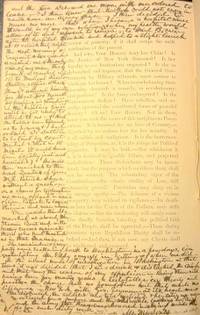
18790002377UTICA NEW YORK WASHINGTON DC OLD CAPITOL PRISON 1879. On offer is a sensational original manuscript Civil War relic of no little significant historical content. The author Morven M. Jones 1815-1886; Utica New York was a key player in one of the Civil War's most notorious scandals: allegations of election fraud vote tampering conspiracy leading to the brutal arrest and incarceration of three men; a Union Colonel a Major and the author a middle aged Lieutenant cashiered out as an officer due to the ill effects of his time as a POW working under the auspices of the Governor of New York whilst trying to follow unclear regulations. The case details were published in a pamphlet and researchers and historians will treasure the fact that Mr. Jones wrote his 50 page or so memoir in the broad margins of an early printed edition of this booklet about him and his co-defendants case and the trial: The United States of America vs. Samuel North Levi Cohn and Morven M. Jones the published work names him as Marvin which he corrected in pencil. Writing retrospectively we note his signature at the close of an entry near the end dated 1879 he writes a commentary following the published parts of the trial and at great length about his arrest incarceration and his time and terrible treatment at the Old Capitol Prison especially by the warden William Wood. He also writes about his time during the war conversations he had with President Abraham Lincoln and much much more offering page after page of historical narrative. Here are some snippets: North Jones and Cohn were arrested by Military Police Oct 27 1864 and at once placed in separate close confinement in Old Capitol Prison The cells were close and sultry during the day but the nights were cold and chilly One day I burned a broom handle slowly nearly from end to end for fear of entirely losing fire to kindle with While in the cells we were not allowed to look out of the small windows not even to place our faces to the lower part of the window .Several times when I had my face close to the lower end of the window trying to inhale a little fresh air did I see a musket pointed at my head with the order from the sentinel to get away from that wind several of our soldiers being shot for looking out of the windows of the prison. The windows were the death line and if a prisoner could be seen looking out the order or the practice was to shoot him My wife was one of the most fearless women I had ever known she could assist in an amputation of a soldiers limb with as much coolness as any surgeon in the army while all the tender sympathies of the mother wife and sister combined .soon after our imprisonment Col Foster told my wife she might as well go home that she could do her husband no good by staying in Washington and he would be convicted and sent to state prison whenever she went in the street was under the surveillance of male and female spies and detectives. Her private baggage and clothing was searched several times once by men with shoulder straps she told these that her husband had been an officer He suspected someone was preparing to attempt to escape that evening and if he saw anyone trying to get out there his orders were to shoot him. The attempt was made and the prisoner was shot dead and then Wood after telling the story would laugh at it as a good joke Bill Wood superintendent of Old Capitol Atheist and generally a brute as he was sometimes had good streaks in him at one of the times when North Jones and Cohn had been taken from their cells and put in the large favored room with some 20 to 30 other gentlemen he said to us you damned New York ballot box stuffers have no business here didn't do half as bad things as I did at Baltimore on Election day for I and the other fellows I took with me voted early and often One prisoner by a bold reckless effort escaped in broad daylight although the prisoner was surrounded by 3 lines of sentinels One day an old man and his daughter a good and respectable looking young woman were brought to the prison from West Virginia as hostages for a son and brother who was accused of a crime and with being in the rebel service. The girl was placed in one end of the block alone and there were seldom any but very few females prisoners in that part of the building. Wood used to visit her room ostensibly to obtain some state secrets but it was well known that he was a beast in his passions soon it was known that the girls was very ill of brain fever and was a raving maniac about a week after the body of the poor girl was carried from the prison in a rough box the father was weeping in the prison yard he had not been allowed to visit her during her illness nor was he allowed to see her remains and all of this within almost a stones throw of the Capitol of the United States At one time a colored soldier was brought to the prison under sentence of death by court martial for shooting his wife. He was to be hanged in two days this was the first he had heard of his sentence. He was placed in a cell close by where I was and a colored preacher was sent to prepare him for his doom. Bill Wood said it looked too damned bad that if his death could be put off for a week he would find whiskey and beef steak and the nigger preacher could pray the poor devil right straight into Father Abraham's bosom. Early next morning the day of execution Wood sent the colored preacher in his carriage to ask President Lincoln to defer the execution for a week but the preacher returned saying he could not see the President. wood said no one could keep him out of the White House and he and the preacher started putting the horse to his speed saying the President would very likely interfere and compel them to come again that it would be just as well to hang the man that morning. Wood came back jubilant over his success in seeing the President Lincoln and told the preacher to do his best and pray the nigger in Abraham's bosom When arrested October 27 I was put in a cell with a man charged with passing Confederate money here I was buried out of sight Nov 1 a prison official opened my cell door and ordered to proceed to the prison office as I did with a guard of a soldier with a fixed bayonet On our trial we called for the order for our arrest and it was then By Order of Abraham Lincoln President by HA Stanton Secretary of War a forged or substituted order died the next day after we were in prison May 17 my wife and self with Dr Coventry and Merit Peckham started for Washington on a telegram from JF Seymour this was soon after the slaughter of the Wilderness My wife and myself devoted our time and strength to the 50000 wounded and sick soldiers in the hospitals at Washington. They died there by thousands many recovered or were removed to distant hospitals or were sent home discharged but the places were filled from the battlefield the 50000 cots were full. This was true while Republican soldiers in the hospitals in Washington had no difficulty in having their voting papers certified by officers detailed of the purpose every obstacle was thrown in the way of Democratic soldiers An Oswego Captain whose arm was shattered so that he could but barely write his name and that with much pain and difficulty being a Democrat came from his hospital to the NY agency and for a day or two and took a few votes. For this he was at once dismissed from the service without any ceremony only for helping some wounded democratic soldiers to send home their votes for the old Gen Little Mac and Gov Seymour The next Monday Jones and his traps were taken to cell No 8 where he was put in with a Cincinnati engraver arrested on a charge of counterfeiting in a few days Jones was taken from No 8 and put in cell No 6 where he found Col North alone and Sick The next day Wood called for Cohn and invited him to take a ride took him to the Treasury where they stopped fora few minutes and then drove on to the White House with as much freedom as tho he had owned the White House Bill Wood invited Cohn upstairs to see Old Abe they were shown into a small room and there Cohn found the President Col Foster the Judge Advocate and Clephane the recorder of the military court the two men who had imposed themselves upon Jones in the Prison Office 25 days before. The whole trick and conspiracy were apparent at a glance After an Introduction President Lincoln with Foster Clephane and Wood present says President Lincoln you Mr Cohn are one of these New York prisoners arrested for fraud as to soldiers votes now if you will make a full statement of all you know about those matters you need not go back to prison but shall be discharged from this moment. Cohn replied that he knew nothing in regard to those matters but what he was willing to tell there or anywhere. Pres Lincoln then repeated what he had said that if Mr Cohn would then state what he knew he should then and there be discharged Mr Cohn then gave a history of all he had known or see with regard to voting at the NY Agency and elsewhere When Mr Cohn had completed his statement President Lincoln said Mr Cohn I don't see as you have hurt anybody nor could I if I told the truth was Mr Cohn's reply. The President then dismissed Cohn and Wood and Cohn started downstairs supposing that he was free according to Pres Lincoln's promise Oh No says Wood you will have to go back to prison until your statement is written out for you to sign and then you will be discharged The McClellan meetings seemed to be the largest and most enthusiastic a large portion of the soldiers were for little Mac on one evening the Republicans had a very large torch procession helped greatly by niggers and as it passed up Pennsylvania Avenue one of the helpers at Old Capitol Prison set fire to and burned the large National Flag hanging across the avenue in front of the Democratic Headquarters Toward the latter part of Oct President Lincoln became quite confident of carrying New York. in cases of outrage in cases calling for sympathy or investigation President Lincoln heard and ears were more open than any member of his cabinet and yet no one democrat nor republican was allowed to approach him in regard to North President Lincoln was made to see and feel how much he was indebted to the Sewards Fenton and the few other arch conspirators and to be made a tool of as in Cohn's case bringing down the dignity of the Presidency to the dirty work of a detective The President and those below him made such efforts to find or invent something which might be used in getting out of the dilemma The prosecution had sent its spies all over the state of New York to find if possible some weak point in the characters or records of the Defts it would be policy not to produce before a court of decent Army officers had stakes its reputation upon being able to prove monstrous frauds as to soldiers votes.one the day the trial was concluded Maj General Doubleday President of the court pronounced the whole thing a farce Half of Grant's army would have been transferred from Petersburg to Albany the plans were formed to capture Gov Seymour and only failed in execution the object was to carry the state for Lincoln and Fenton. Suspicion and doubts were thrown around the democratic soldiers votes sent home I then took passage for Fortress Monroe with one assistant feeling disposed to fight out the question of a NY agency on that line if it took all summer arriving in James River. We were all stopped by Gen Butler's orders. After being arrested by a lot of drakes as a Virginia rebel because I wore a light gray suit I made my way back to Washington with six physicians and four assistants and over six hundred dollars in hospital stores I started for City Point intending to establish an agency where New York soldiers would be looked after and cared for some as soldiers of other states on arriving at City Point obstacles were immediately thrown in the way of landing my good s and storing them. We arrived at City Point in PM of 22nd and were directed back a mile or two to the main camp where are found lodgings in tents. The next morning all of the physicians were ordered to duty as common nurses in various corps hospitals and our six physicians were assigned to duty as such Our guards kindly marched us aboard the steamboat and with many curses against those who had treated us in that manner at that time it was decided that I was drunk and sutured the camp and that was the reason for my expulsion " Overall G. BIO NOTES: Morven M. Jones fought in the Civil War for the Union in the 2 New York Heavy Artillery Regiment. He entered the war with the rank of 1 Lieut. and left with the rank of 1 Lieut. Company M mustered in December 12 1861. Jones was the former Chief Clerk Office Secty of State NY; one of the founders and organizers of the Oneida Historical Society; "attorney autograph collector and victim of one of the most scandalous political trials of the Civil War." HISTORICAL NOTES: Wiki: Old Capitol Prison 1861-1867 With the start of the Civil War in 1861 the Union repurchased the building to use as a prison for captured Confederates as well as political prisoners Union officers convicted of insubordination and local prostitutes. Many people arrested following the assassination of President Abraham Lincoln were also held here. These included Dr. Samuel Mudd Mary Surratt Louis Weichmann and John T. Ford owner of Ford's Theater where Lincoln was shot. The adjoining row of houses Duff Green's Row was also used as part of the prison. Famous inmates of the prison included Rose Greenhow Belle Boyd John Mosby and Henry Wirz who was hanged in the yard of the prison. Good. 4to - over 9¾" - 12" tall. Manuscript. hardcover
18960002337FEZ MOROCCO CASABLANCA SAHARA DESERT NORTH AFRICA. Very Good. 1896. On offer is a simply sensational riveting original very intriguing significant manuscript autobiography dated Dec. 27 '96 1896 of a young Muslim boy who recounts over 69 or so pages his birth on the sands of the desert near Fez and his enslavement and eventual repatriation. The details of his life a nothing short of remarkable for readers in the 21st Century: his parents; a father of immense piety his mother an outcast of her tribe and himself a young boy who would eventually watch his father and his mother be murdered separately. Historians and researchers will find a fascinating and arguably an unparalleled first-hand account of this boy's life under Islamic Code and his utterances provide a full understanding of his beliefs and the guidance they provide his humanity. Even a casual read reveals an eyebrow raising narrative: after the murder of his father by the Sultan's soldiers and his mother by robbers he was taken captive as a slave and apprenticed to a gunsmith who finished guns for the Sultan's army. The unidentified author and some other slaves were apprenticed to the Sultan's gunsmith and were at one time sent to America where they were to work in what appears to be the Winchester Gun Factory in order to learn the art of gun making - to provide better guns for Sultan's army. The details of travels suffering and cruelty are all related but in a quick paced to the point manner. After returning from his training he was returned to his master at Casablanca. It appears that the author escaped slavery around this time and eventually returned to his homeland in the Sahara Desert where he had a deep religious experience and felt the call of Allah on his life to become a hadji like his father. With this call he sought out the place where his father had lived to claim that dwelling as his own. The manuscript begins: "I was born on the sands of the Sahara where the caravans come up from Timbuctoo. The white sands that stretch away from the mountains on the West toward the end of the world behind these mountains there is nothing and no one has been there but towards the East one may go as far as Mecca and become a Hadji as was my father. All this is the land of the true believer where he may hear and obey the call of the Prophet and live in the true faith. The sun shines there always and there are no rains as in other lands to torment the faithful. If clouds come it is but to chase their shadows on the sunlit sand. My father was a saint and lived in a white tomb overlooking the plain and near the ___ of the great caravan . . . . He was a holy man who made the journey to Mecca many times. Sickness and death did not molest him so that he knew he was accepted of Allah and waited only the call of the Prophet. . . . . It was caravans from the south that were the most interesting for thy brought the slaves that should serve the faithful at Fez and Wazan. As true believers we could rejoice at their captivity for they would be converted. They were mostly in chains each with a heavy ring about his neck from which a chain extended to a ring upon the neck of his neighbour and there were always some rings without necks by counting which you might know how many had died in coming through the desert. My father thought that all should be killed as infidels hateful to Allah intolerable to the faithful but the people of the caravans thought not so claiming the example of Mohamad who spread the faith by conquest." We learn that his father's piety was also his downfall as he was enraged by an infidel Englishman travelling under the Sultan's protection and after he raised a knife to attack the infidel he was summarily destroyed by the Sultan's troops. His mother died within days at the hand of robbers who stole the camel she was given as a blood libel payment. The boy's description of the Englishman's attitude of the blood libel payment is near comedic if it was not so insensitive to the local custom. Toward the conclusion of the 69 page manuscript is the following interesting statement regarding the author's account of his experiences. After describing his having found a place of safety in the mosque of Edris he writes "Not far away is the house of the books of a thousand years near which dwells the scribe who has written this for me to send to the head man a Lida Winster Winchester gun house. A gun maker in the old street goes shortly to see Caid Cobb at Cassablanca. I know not why he has promised to give the Caid this writing to be sent to the head man also to say to the Caid that the man who made it was dead." The work closes with the following: "Soon the rains will be over and then I will walk southward to the place where my father dwelt and seize the tomb in which he lived for it is my right. There only is the land of the true believer where he may hear and obey the call of the prophet. There he needs neither mosque nor Caid for he has the protection of the white sand of the desert and its rainless sky." We note there is what we believe is a later ownership inscription with the name J.G. Bennett 258 Church Street. Research suggests this was likely the noted Islamist John Godolphin Bennett who may have received the book after as the book relates it was sent to the head man at Winchester. The manuscript is written in a ledger style book with black boards and red morocco spine cover and corners. The spine cover is missing. Wear to extremities and fading in one area on the upper front panel corner. The early pages are alphabetized followed by 245 pages of very thin paper. The biographical account is written on the first 69 pages are upon this thin stock. With a few exceptions the back of each page is blank. The work is entirely in pencil with corrections made here and there as will be noted in the accompanying scans. The pages are all intact with only the first page showing a small separation from the inner hinge. The last page blank is mostly missing---no writing evident on this page. The covers are loose and there is weakness in the spine but nothing that affects the text. Occasional light brown age spots otherwise the pages are quite clean. Overall G.; Manuscript; 4to - over 9¾" - 12" tall; KEYWORDS: HISTORY OF J.G. BENNETT 258 CHURCH STREET JOHN GODOLPHIN BENNETT MUSLIM SLAVE BOY RABAT FES MEKNES SLAVERY WINCHESTER FIREARMS 19TH CENTURY SLAVERY TRUE TALES OF BONDAGE SLAVING SLAVE MASTER LIFE IN BONDAGE GUNS GUN MAKING WINCHESTER GUN FACTORY SAHARA NORTH AFRICA MOROCCO WINCHESTER REPEATING ARMS COMPANY NEW HAVEN CONNECTICUT FEZ ISLAM ISLAMIC ISLAMISTS SHARIANOMADS NOMADIC PEOPLES NOMADIC TRIBES BEDOUIN HANDWRITTEN MANUSCRIPT AUTOGRAPHED AUTHORS DOCUMENT LETTER AUTOGRAPH KEEPSAKE WRITER HAND WRITTEN DOCUMENTS SIGNED LETTERS MANUSCRIPTS HISTORICAL HOLOGRAPH WRITERS AUTOGRAPHS PERSONAL MEMOIR MEMORIAL PERSONAL HISTORY ARCHIVE DIARY DIARIES JOURNAL LOG PRIMARY SOURCE FIRST HAND ACCOUNT SOCIAL HISTORY PERSONAL STORIES LIVING HISTORY ANTIQUITÉ CONTRAT VÉLIN DOCUMENT MANUSCRIT PAPIER ANTIKE BRIEF PERGAMENT DOKUMENT MANUSKRIPT PAPIER OGGETTO D'ANTIQUARIATO ATTO VELINA DOCUMENTO MANOSCRITTO CARTA ANTIGÜEDAD HECHO VITELA DOCUMENTO MANUSCRITO PAPELBIOGRAPHY BIOGRAPHICAL AUTOBIOGRAPHICAL AUTOBIOGRAPHY PERSONAL NARRATIVES . hardcover
18900002593SOUTH AMERICA PERU BOLIVIA VENEZUELA CHILE. Good. 1890. On offer is an original historically significant 1890 to 1891 manuscript diary handwritten by prominent New York businessman and author E.C. White E.C. White was the son of Dr. Emerson White who was president of Purdue University. His brother was Albert Blakeslee ''A. B.'' White he was West Virginia's 11th governor serving from 1901-05 who traveled and lived in South America. The keen eyed and erudite diarist Mr. White does a superb job detailing his adventures by steamship horseback Alpaca and train. But his experiences and downright good fortune to be in the right place at the right time to witness and participate in some extraordinary events in South America most particularly the civil war in Chile. White was in Venezuela Peru Chile Bolivia and points in between and among his experiences are the finding an Incan "ruined city" on top of a mountain in Peru spies hiding on board a steamship remains of a torpedoed ship and travel by train through the Andes. As noted on the cover of the diary is "South American Notes - E C White. Kal- Blanco" casual research finds E.C. White was a wealthy businessman he owned E.C. White Co in New York City. White traveled the world and spent most of his time in South America. In fact he spent so much time there that he was offered the appointment as Minster to Chile by President Harrison. He declined the offer due to business considerations. He had a close association with McKinley who at the time was his main supporter for the position. McKinley wrote of White to President Harrison "Mr. White has spent several years in Spanish- America. He is a gentleman of high character education and refinement". The book contains about 150-165 typed and handwritten pages sketches mimeographed bulletins business contacts in South America. He may have been in the pharmaceutical business there are lists of doctors pharmacists herbal medicines and cures are noted. We note some pages are onion skin and faded but all can be read with patience. As an expert on South America he periodically wrote articles in a number of publications. He wrote under his pen name "Kal- Blanco" and some of his original articles are on the web. There are several typed stories in this diary that appear to be rough drafts he later published. These stories are about his observations and travels and are nonfiction and include original corrections. There is even an original story he did for the Home Maker Magazine titled "Among the Venezuelans" with some hand written notations in the margins. This story includes photos. Entries begin in New York Oct 8 1890 as White boards the Steamship Muriel in route the ship stops at St George St. Kitts Dominca Martinique Granada and Trinidad. He would eventually reach Columbia Venezuela Peru Chile and Bolivia. Included are three mimeographed bulletins 2 titled" Manavi's Bulletins" and one titled "The Esk's Daily Bulletin". Historians and researchers will find a treasure trove of material. White writes about the socio political aspects of each country and examines cultural traits with a keen eye for observation. His diary entries as well as his articles are extensive and in many cases fill the entire sheet. Other items found between the sheets are advertising flyers one photo negative and travel notes. Here are snippets: Note: interestingly White writes in the third person throughout the diary. Peru - March 8 1891 We had our first earthquake this morning. The servants thought that it was quite severe to M. It seemed quite a respectable shake. M.was tired and did not feel like going to church and Mr. W. Allowed his wife's indisposition to impose him so both stayed at home and Mr. W. bad man printed blue prints. In the afternoon we studied a little Spanish and took a walk. Retired early as usual. Peru - March 10 1891 Mr. W. Worked all day on the type- writer and M. extremely busy cleaning up everything after the journey to Huaca Puno In the evening we went to the circus by Mr. Pacigalupi's invitation and found it very good and that the theatre was very pretty. Peru -March 26 1891 Mr. W. Went to Callao in the morning to arrange to go on Saturday but found that there was no steamer left until the next week. In the afternoon there was a procession of 250 of the militia the army numbers 15000 all Indians & these Indians control the country. In the evening everybody promenading the streets: the ladies dressed their best. Children men woman all Going to church. Peru -March 27 1891 Great feast day. The militia surrounded the plaza and expect a grand procession. The people devote themselves to fasting and prayer what time they are not on the street and Mr. Basigalupi is very much put out about it as it is a check to all business. Bolivia - April 14 1891 Arrived at Chililaya - in Bolivia last night but on account of the Cana could not enter the port until daylight The town has about 40 houses and the chief export is potatoes silver and tin ore. The Grand Hotel where we stopped for the night is kept by a lady in high heeled shoes short dress and log earrings. The Amiras wear lose under drawers from the knee down and pants with a slit in the back of each leg. They bundle up their heads and necks with knitted goods and go barefoot. The women wear skirt a little below the knee and never change their clothes from one years end to the other. They very rarely wash. All dress in bright colors. Bolivia - April 23 1891 Left Puno for Arequipa early in the morning and arrived in the pm Mr. McCord has everything arranged for us to stay there. The ride was rather tedious as the scenery was the same as before except when we reached Arequipa- The moon rising between Mista- & Potosi was a beautiful sight. Bolivia April 24 1891 Took the train for Mollendo- after bidding Mr. McCord goodbye. Had a crowded car and rather unpleasant journey as it was very dusty. Arrived at 3 pm and found Mr. Turner waiting for us at the station to tell is that the" Bolivia " would sail that night and that they could not tell when there would be another steamer. We went up the company house and rested for an hour and than went to the steamer. The Purser gave is his room as the S. Was full but it was small and uncomfortable when we got to the S. We found Mr. Allen A. Swimmingly awaiting us. Chile- May 11891 Stopped at Autofogasta- and went ashore with Mr.S. and Mr.W. and appointed agents for all parties.Had a good time.At all of these ports there have been officers of the Revolution on board to search the ship for Government officials and we carry spies with us. It is supposed that there is one man hidden in the ship who is an officer of Balmaceda's. His wife is very cool collected even sleeping in the same cabin with the woman spy.There have been several parties arrested on suspicion and brought back but one was arrested and kept because he was known to have 50000 dollars concealed in his cabin. We are now past the Congressionalist's District. Discovery of the Ruins of a Pygmy city in the Andes. On the 26th day of April 1885 I arranged with a friend of mine who lived in Callao Peru to ascend Huaca Puno Dead Point and explore a ruined city said to be at its summit. The descendants of the Children of the Sun warned me against such an undertaking. Their superstitious ideas of Huaca Puno were not pleasant I must admit. They informed me that this was the home of bad spirits and that wild beasts only were allowed to exist there prowling around the streets day and night. They told me that no white man or Indian had ever been in this city since it was depopulated during the pre - Inca times by the cannibalistic tribes who leagued themselves with Satan against these wicked people who had rebelled from Satan and exterminated them. As we ascended our guide seemed to gain courage and decided to accompany us to the city. We found it walled egg shaped about one mile in length and one eighth of a mile in width and admirably fortified. Huaca Puno is in the Pacific range of the Andes and about 15000 ft. In elevation the tropical ocean breeze melting white frost that comes in July. I heard my friend hallooing for me to come up the Citadel Then it dawned upon us that it was a pygmy city. Columbia- Dec 1 & 2nd 1890 I contracted with the following papers viz. El FonografoLas Noticias El Zulia Illustrarado M Los Escos del Zulla. All of which I send to C.H.Gould. On the evening of the 2nd I left for Curacoa by the steamer Maracaibo. The cost of a passage is $ 15.00. Dec 3rd& 4th - I arrived in Curaacoa on the 4th and went to the hotel De Leon. Paid $ 1.60 per day and the food was so poisoned could hardly stand it. The maggots crawled out of the warmed over beef when brought on the table. I watched to see how many partook of the same and saw them all eat it the same as if it had not been alive. I went on the Philadelphia as soon as the steamer arrived. Mrs. Chambers and Miss Randolph were with the Caption Chambers. I met a druggist from Cucuta Gonzales Bona Hermanos who gave me the following doctors: List of doctors in Cucuta Columba. Among the Curacoans & The Maracaiboans excerpts from a 3 page story written in Venezuela The poor of Curacoa live entirely by their commerce as the Island produces only limited products. The island produces only a limited amount of agricultural products. The houses are constructed as in Holland roofed with red tile and very quaint in appearance. The people of this country believe that all North Americans are wealthy they know that our people tip them freely and from this they draw the rather erroneous conclusion that we are all millionaires. To them a little money means great luxury. For the lower classes are very destitute. Traveling is expensive in these countries on account of the excessive rates on steamers and the continual robbing of the boatmen and custom house officials. The later we might dispense without the former we must have the steamers being compelled to anchor one to five miles from shore. What a contrast: This evening I am writing on a table in the hotel parlor which has an old brick floor and naked whitewashed walls but lighted with an excellent Edison Electric light the only mark of advanced civilization around me. In one corner are crickets singing joyful songs under the new Star in Maracaibo- In another corner the lovers of evening light the lizards are blinking and twisting their heads to see if any person is intruding upon their possessions. Frequently these little innocent cold blooded vertebrates amuse themselves by running over your shoulders or the table where you are writing. However they are perfectly harmless and the larger species the Iguanas are eaten by the natives. In the early morning the market and the streets are full of Iguana vendors who are very persistent in their endeavors to sell you a string of live Iguana for the small sum of one real. There are 6 sketches. Two small sketches are executed in pencil: One mimeographed sketch titled "This Great Sea- Monster discovered by the Captain of the Muriel Oct 10 1890 off St Kitt's Island". The diary is bound in a leather folio sized journal 10.5 x 8.5 inches and overall G.; Typed Manuscript; 4to - over 9¾" - 12" tall; KEYWORDS: HISTORY OF E.C. WHITE CHILE LOST INCA CITY PERU BOLIVIA COLOMBIA ESPIONAGE STEALTH DIPLOMACY LATIN AMERICA SOUTH AMERICA VENEZUELA PYGMY CITY IN THE ANDES INCA INCAN CHILEAN CIVIL WAR PHARMACEUTICALS MEDICINE IN SOUTH AMERICA PURDUE DR. EMERSON WHITE ALBERT BLAKESLEE ARCHAEOLOGY PALEONTOLOGY EXPLORATION KAL BLANCO HANDWRITTEN MANUSCRIPT DOCUMENT LETTER AUTOGRAPH WRITER HAND WRITTEN DOCUMENTS SIGNED LETTERS MANUSCRIPTS DIARY DIARIES JOURNALS PERSONAL HISTORY SOCIAL HISTORY HISTORICAL HOLOGRAPH WRITERS AUTOGRAPHS PERSONAL MEMOIR MEMORIAL ANTIQUITÉ CONTRAT VÉLIN DOCUMENT MANUSCRIT PAPIER ANTIKE BRIEF PERGAMENT DOKUMENT MANUSKRIPT PAPIER OGGETTO D'ANTIQUARIATO ATTO VELINA DOCUMENTO MANOSCRITTO CARTA ANTIGÜEDAD HECHO VITELA DOCUMENTO MANUSCRITO PAPEL . hardcover
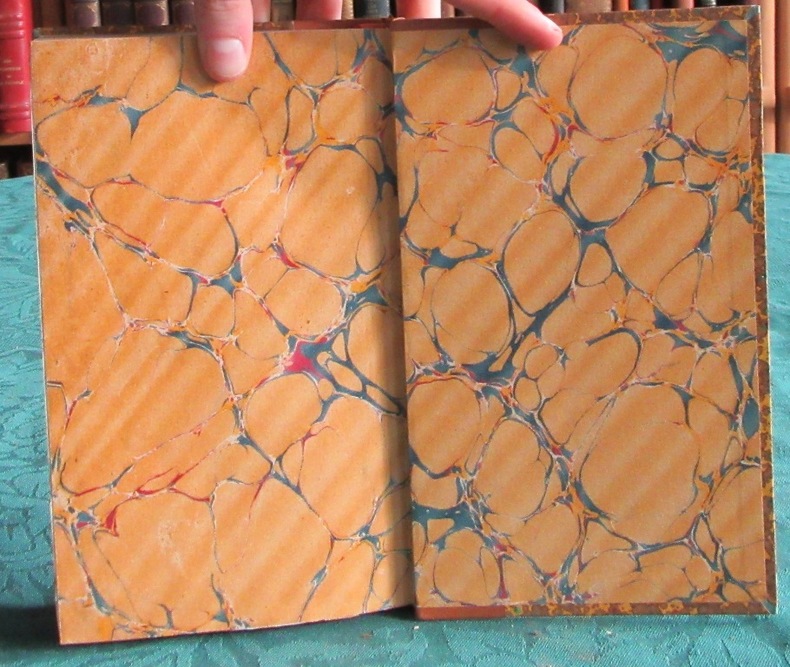
18990002596BOLIVIA PERU SOUTH AMERICA. Very Good with no dust jacket. 1899. On offer is a superb pair 2 of original manuscript diaries handwritten by an unidentified American adventurer and gold prospector in Bolivia and Peru circa 1899 - 1901. The diaries inscribed #4 and #5 with the others lost to history tell the incredible story of the author's adventures and encounters with Indigenous Bolivians thieves highwayman soldiers and expatriates. In many ways the times and places nted evoke Butch Cassidy and the Sundance Kid. Historians and researchers will be delighted given the long detailed and keen-eyed observations of the author. While this is non-fiction and a personal account it reads like an old-fashioned novel full of intrigue and adventure. For example our author actually pulls his revolver on a group over a mining claim. In another entry he believes he is being followed and writes his location for friends in case he is murdered and his body is found. In another entry he finds an Indigenous man who fell off a treacherous mountain trail into a box canyon and helps in his recovery. Almost every entry mentions his interactions with the Indigenous people of the area and he is often asked to administer help or supply medicine to those he encounters. He also mentions the Federal Revolution of 1899 in Bolivia and battles in the mountains towns etc. There is so much more. In addition to those events he writes about his mining explorations in the Andes on foot with mules and his battle with the elements and fellow miners. There is lots of cheating and double crossing taking place from those he encounters which makes for intense drama. In most cases the author hires Indigenous guides and travels with Anglo companions. They are frequently on the lookout for gold and attempt to make contacts with the local population. Our author had some connection with and worked directly for The Inca Mining Co and Santo Domingo gold mine in Peru. He mentions both several times the diaries also a mill. RESEARCH INFO: "The Santo Domingo mine is located in that zone of the great rivers known in Peru under the name of 'Montana' and situated on the east of the great Andes Cordillera. During the bonanza Mr. W. L. Hardison from California a well-known American engaged in the oil industry happened to pass Santo Domingo on his way to other mines further in the interior and seeing the great output of the mine he made a contract with the owners to buy it. Six months afterward the Inca Mining company a corporation organized under the laws of the state of West Virginia with a capital of $1000000 acquired the property and began workings on a larger scale. Nearly 18 months were devoted to the proper development of the mine and in July 1898 the old mill was completely modified and started continuous running giving good profits and insuring the success of the enterprise." The diaries contain approximately 140 very well-filled pages each. The 1900 diary begins April 7 1900 with a final entry May 14 1901. The 1899 diary begins March 5 1899 with a final entry April 5 1900. Both diaries are bound in hardbound covered boards with red marbled paper and measure 5 x 3 inches. The handwriting is immaculate and easy to decipher. Here are some snippets: "March 5 1899 Borrow twenty four Bolivianos of Recardo. He can give me mule but no Indian. Want to sell him farm to Adams or don't think he would be as accommodating as he is. Also urges me again to employ his daughters husband and he offers me his sisters son of 9 years to cook & do chores for board or an adopted boy. Water reported high on Juliaco- road and likely impassable. Hire Indian to go with me and Bonito to finish drying peaches and prepare garden." "March 7 1899 I can get neither breakfast or mule and in noon before I get started stop with pleasant gentleman in Charzani- He informs me the revolution is not over and Alonzo is still supported by the army showed me good gold ore and offers me half to prospect it for him. Takes no pay." "March 11 1899 Wait long but finally start without breakfast. Bring bread at Jrancame- Pay Indian to let mule feed on her grass. Cross river in boat called balsa- and swim the mule. Road under water and return for guide. Again swim mule much difficulty in reaching Taracos Accommodation with Governor Sugar for two cups of coca. Early start swim two more rivers and hire guide where road is under water. Egbert has not been here. Mr. Carmichel gives me interesting details of the war and present doings of our glorious country." "March 15 1899 Mr. Carmukel arrives from Arizona to take charge of the Santo Domingo Mill. We help him find Mr. Pool ask for the Santo Domingo mine. Attend business. Go to Depot to help Mr. Carmichel get off. Also see an officer and wife off. See Dr. Hunter who advises us to be vaccinated. Pool boys draft with draft on Jose Sanchez. Much interested in information I give him and invite us back tomorrow." "March 191899 Rise early and take train for Juliaca- Gentleman reports battle at Charizami and all killed by the Indians. It startles me but when I learn date I know its a false report for it is since I passed Charizami later on other reports the battle near La Paz. Call on Mr. G. Cannon who expresses interest in out prospecting and wants us to allow him a second chance of good." "March 27 1899 Egbert tried and wants to sleep late. Sanchez brothers start for Puno for school. They especially Philipi very friendly to me. Indian woman sells us burros and I take them from the purchaser. See Governor to get Indian who tries to and called on another price. Calls in a friend and ridicules me because I cant speak good Castillano. I soon lose control of myself and want to fight them both and two Indians that enter but Indians turn tail. Firm all over and the curs want to make amends but I move them aside and walk out." "March 29 1899 Indian steals my old poncho sheep skin and rope from back saddles. Jose warms me to have no business transactions of importance with Frederico Franch. Mule and burro escaped from the corral. Indian started in pursuit but returns with them late for which I compensate him. However it causes a late start. Hire Indian on the road who knows the river crossing. Put clothes on top of cargoes and cross river. Cold as the snow mountains it come from. Find some of our bread was stolen at Cojata. Stop at Indian house and well smoked." "April 9 1899 Many little things to be done today but interruptions result in my accomplishing nothing. Bonito comes with potatoes send medicine to a sick woman hunt the mule Indian comes to sell cheese and guinea pig and wants treatment for what appears to be a light paralytic stroke. Bonito comes again and wants medicine for a burro and so the day passes and all I get done is the washing of my clothes. Bonito tells me a man fell of the bridge just below here and was swept away by the current." "April 16 1899 Egbert sleeps late while I wash clothes Bonito helps get mule across river. Hire him to show me good timber tomorrow Bonito describes trouble between Recardo & Flores most empathically Saze Florio was whipping his wife and would have shot Recardo had the latter shown his heels." "May 1 1899 Blast blown out in crevice and Recardo cries because it did no good. Send Indian for dynamite and pull Recardo back in time to keep stone from hitting him. Go to work without breakfast and by noon can eat two dinners. Blast does little good and Recardo cries again disappears and finally returns and tells me next blast will do better for he went into bush and prayed but the next one also blows out in a crevice. Run a line for him. He wants me to help him sell his finca to Winslow or Glass. Sent mutton down to camp for which I paid well." "June 6 1899 Glass sees one deer. Glass delays travel by leading way himself instead of letting Benito who knows the country lead. Leads us over a dangerous mountain peak. G shoots Piscacho- for supper." "June 241899 Glass leaves us in evident depressed spirits. Pass Recardo and almost have to strike him to make him settle fairly. Thinking he has called on his Indians for help draw my revolver to make them stand aloof in which I committed a grave and foolish error for my temper should not be trusted with the control of my revolver. Egbert and I discuss pro and con the advisability of seeking work and decide to go to Santo Domingo mine but first prospect the Nuicor- so we will know if it will pay us to return to it when we have saved up some cash." "June 301899 Continue washing Egbert returns and reports being well entertained. Girl puts her arm around his neck to induce him to remain for breakfast. Glass has reported us as taking out lots of gold and the whole town is excited. A jug full of gold is credited to us. Numbers of papers and letter from uncle Scott and very friendly one from Mr. Laughlin in which he relates winning the title sent of Easton grant over T. B. Canton." "Sept 29 1899 A letter from Al Lee written last June in answer to my letter and hinting for interest in my claim as he hears I have a good claim on Camata. Want a companion but on experience is enough. Leave Savage rifle with Marcos. Marco's child dies at noon. Indian music and dances going on since sundown yesterday. Three bands of Indian masqueraders appearing on the plaza in turns and at intervals all together when child is entered. All bands in different forms of dress and having brand of music and clowns. Want to describe dress as too varied for short description. This lasts till Monday morning without cessation night and day." "Oct 3 1899 Cold and get late start stop on good grass some time. Mazordoma- of Accacunco pay $5.00 for Indian to linbani- I won't pay it and he wont give me directions so I go it alone and as former directions were take right had trail at Acconco and trail six leagues to Linbani I take trail right. Travel till night and am told in yet another 15 leagues to Limbani- trade for Indian guide for $ 2.00 and instructed to wait 400 yards further on till Cholorizomi near there. Wait till long after dark have been warned repeatedly and am afraid something is up so travel on half a mile and seek camping place. Arrange call with care so it is difficult for anyone to get near without making noise or fuss and am not afraid of any of them when awake. Don't think trouble is intended but no harm to prepare for it . Will write up diary every day at evening and if I do fall a victim to foul play this may perhaps fall into the hands of another or countryman if so tell where I last camped am now below the trail and above the little settlement the first on the East side for mountain track." VG. ; Manuscript; 32mo - over 4" - 5" tall; KEYWORDS: HISTORY OF; AMERICAN GOLD MINER PROSPECTOR BOLIVIA INDIANS BOLIVIAN ARMY REVOLUTION PERU INCA MINING CO & SANTO DOMINGO GOLD MINE ADVENTURERS BUTCH CASSIDY AND THE SUNDANCE KID LATIN AMERICA SOUTH AMERICA CENTRAL AMERICA ANDES BANDITS BANDITO INCA INCAN MAYAN AZTEC ANCIENT PEOPLES OF THE ANDES AMERICANA HANDWRITTEN MANUSCRIPT DOCUMENT LETTER AUTOGRAPH WRITER HAND WRITTEN DOCUMENTS SIGNED LETTERS MANUSCRIPTS DIARY DIARIES JOURNALS PERSONAL HISTORY SOCIAL HISTORY HISTORICAL HOLOGRAPH WRITERS AUTOGRAPHS PERSONAL MEMOIR MEMORIAL ANTIQUITÉ CONTRAT VÉLIN DOCUMENT MANUSCRIT PAPIER ANTIKE BRIEF PERGAMENT DOKUMENT MANUSKRIPT PAPIER OGGETTO D'ANTIQUARIATO ATTO VELINA DOCUMENTO MANOSCRITTO CARTA ANTIGÜEDAD HECHO VITELA DOCUMENTO MANUSCRITO PAPEL . hardcover
18370009111BOSTON TO KRONSTADT TO BRAZIL STATION. Good. 1837. On offer is a journal recorded during a fascinating time in General American and U.S. Naval History. The journal is written on the U.S.S. Independence as she travels from Boston to Portsmouth England onto Copenhagen and Kronstadt to receive a visit from Russian Emperor Nicholas I. The Independence then leaves Russia for Rio de Janeiro where she becomes the Flagship of the Brazil Station tasked with the duty to guard American commerce along the eastern seaboard of South America during the war between France and Argentina. A page in the very beginning of the book states Private Journal of A Cruise in U.S. Ship Independence During the years 1837 1838 1839 and 1840 Under Commo. John B. Nicolson On the Brazilian Station. Another a bit later states Cyrus E. Joy. U.S. Ship Independence. Cyrus Joy is presumably the author of the journal. The ship leaves Boston on May 20th 1837 in presence of thousands of spectators who crowded the adjacent wharves to witness our departure. On board the ship is the Honorable George M. Dallas who at that time had served as Mayor of Philadelphia U.S. Senator from Pennsylvania 183133 and would eventually become the 11th Vice President of the United States in 1845 under President James K. Polk. According to the journal author he is said to be a man of exalting talents sound discriminating judgements. At the time Mr. Dallas had been recently appointed Minister to Russia. The ship crosses the Atlantic in what a soldier would call quickest time and the ship reaches Portsmouth England after 22 days. On the 20th of June the King of England William IV dies and the next day Queen Victoria his niece ascends the throne. All colours in the harbors and most likely in the kingdom were displayed at half mast and we fired guns in honour of the deceased. Soon after this firing ceased we manned the rigging cheered ship and fired a Royal Salute on the occasion of Queen Victoria's daughter of the Duke of Kent and niece to the late Sovereign. The ship moves on to Copenhagen then Kronstadt situated at the head of the gulf of Finland. The ship is visited by the Emperor Nicholas and wife. We were by no means in condition for such a visit. We had been up the greater part of the preceding night and after coming to anchor pulling sail &c. We proceeded to holy-stone the decks washed and dried them down in the neatest manner. After this we ___ our topmast rigging in afresh and the utmost exertions were used by all hands to put the ship in the best order for the expected visit though she was after all very far from being in first-rate condition. The author describes the Emperor as a tall stout well made man with light reddish hair blue eyes high forehead and high cheek bones and has a remarkably loft and commanding appearance. The author speaks very highly of Nicholas and the visit goes smoothly and enjoyably. The whole event is a thoroughly enjoyable portion of the journal. The author spends time comparing the Danes and the Russians before the ship leaves again this time heading for Rio de Janeiro. This section of the journal ends as the ship reaches Portsmouth England again. The journal begins again in 1839 as the ship is in South America protecting American commerce. Feb. 9th 1839. Here we found our presence much needed for the protection of American property. When we left the first time the French had nothing like a respectable force on the station.Their forces however have been increased but are also too weak for the a blockade of more than the port of Buenos Aires. The entries in this portion are spread out with long periods in between each entry. The ship seems to go between Rio and Montevideo providing protection of American trading ships in the area. The author also speaks of the reasons for the war and the Independences role in helping mediate the conflict as well as thoughts on the role of the American Navy in the formations of a character abroad as well as at home. The soldiers also seem fairly unhappy on the ship after a while. Jan 1st 1840. At Montevideo and little prospect of leaving soon. More than 100 of the men have completed the full term for which they entered the services and are clamorous to be sent home.Under these circumstances no ship can hardly be deemed fit for actual service. The ship finally leaves the Brazil Station after being thirty five months on this cruise. I think I shall stop at home a few months at least. The journal continues with the next entry explaining that after three months of doing nothing Mr. Joy joins the Montezuma Capt. Christiansen bound to Liverpool. Having heard of such a thing as Happy England he is struck all aback to see the number of prostitutes beggars ballad singers &c. I do believe that in this single place there is more persons of the above description than in the whole of the U.S. You can not walk from the docks up in the city without being accosted every two or three minutes by a female with I say Jack wont you treat us or Shipmate give us a chew tobacco will ye or God bless your honour you havnt got never a penny for a poor fellow have ye. The entry ends with a list entitled U.S. Ship Independence. List of Officers 20th May 1837. John B. Nicolson. The list contains more than 3 dozen names of all the men on board including midshipman on the ship. There is also a list of Salutes fired during the years 1837 38 39 & 40. with the columns Date No. of guns Quantity of powder and When and on the opposite page On What occasion. The list is 12 pages long and provides a fantastic and comprehensive list of where the Independence was during the years of the authors journal and the special occasions on which it fired salutes. The journal also contains a hand drawn portrait of the face of Emperor Nicholas I with the date July 29th 1837 written underneath. The drawing is amateur but very well done in a number of colors. The book is roughly 220 pages in which there is writing in approximately 70 or 80 pages. The handwriting is easy to read and legible throughout in black ink which is rarely faded. The pages show some discoloration and wear but nothing that affects the legibility of the writing. The cover shows a good deal of wear and age damage but is still very structurally sound. A number of the pages with writing have come loose from the binding but are still gathered together so they are not loose from each other. There are two major gatherings detached and the rest of the book is still in the binding. Overall: G. Sample Text: May 19th 1837. All ready for sea and people in crowds visiting our ship. Some probably to see and be seen but many very many to take leave of friends and comrades dear bound on a long and tiresome cruise. Such numbers came off in boats that it was impossible to admit all and numbers were compelled to return without bidding their friends farewell as gratifying their curiosity by inspecting our kindly beautiful ship.; July 4th. We fired a National Salute but had no merry making on the occasion. It was in fact the dullest Fourth I have ever witnessed.; June 23rd 1839. We have been nearly 18 months from Boston before we were allowed to go on shore and many of us have been almost two years on board without having been out of the ship.I am of opinion the men should have had liberty much oftener: and I believe they might have had it without detriment to the service or themselves. Background: The USS Independence was a wooden-hulled three-masted ship originally a ship of the line and the first to be commissioned by the United States Navy. Originally a 90-gun ship in 1836 she was cut down by one deck and re-rated as a 54-gun frigate. Independence recommissioned on 26 March 1837 and sailed from Boston on 20 May 1837 as flagship of Commodore John B. Nicholson. On board for her record passage across the Atlantic Ocean to England was the Honorable George Dallas Minister to Russia. She arrived at Portsmouth England 13 June called at Copenhagen; then proceeded into Kronstadt 29 July 1837 to receive a visit from the Emperor Nicholas I of Russia. Two days later a steam boat arrived to transport Mr. Dallas and his family to St. Petersburg. Having received marked social courtesies from the Russian government Independence departed Kronstadt on 13 August 1837 for Rio de Janeiro where she became flagship of the Brazil Squadron to guard American commerce along the eastern seaboard of South America. This duty continued into the spring of 1839 when Commodore Nicholson attempted mediation to end the war between France and Argentina. The Independence returned north to New York on 30 March 1840. She was laid up in ordinary until 14 May 1842 when she became flagship of Commodore Charles Stewart in the Home Squadron. Based at Boston and New York she continued as his flagship until laid up in ordinary on 3 December 1845.; Manuscript; 8vo - over 7¾" - 9¾" tall; KEYWORDS: HISTORY OF CYRUS E. JOY U.S.S. INDEPENDENCE FLAGSHIP THREE MASTED SHIP SHIP OF THE LINE UNITED STATES NAVY U.S. NAVAL HISTORY RUSSIAN EMPEROR NICHOLAS I COMMANDANT JOHN B. NICHOLSON HONORABLE GEORGE M. DALLAS MINISTER TO RUSSIA DEATH OF WILLIAM IV KING OF ENGLAND DIPLOMACY FOREIGN SERVICE ASCENSION TO THE THRONE OF QUEEN VICTORIA PRE CIVIL WAR ERA UNITED STATES U.S. FOREIGN POLICY FLAGSHIP BRAZIL STATION WAR OF THE CONFEDERATION FRENCH BLOCKADE OF THE RIO DE LA PLATA AMERICAN COMMERCE IN THE 19TH CENTURY AMERICANA HANDWRITTEN MANUSCRIPT DOCUMENT LETTER AUTOGRAPH WRITER HAND WRITTEN DOCUMENTS SIGNED LETTERS MANUSCRIPTS HISTORICAL HOLOGRAPH WRITERS AUTOGRAPHS PERSONAL MEMOIR MEMORIAL ANTIQUITÉ CONTRAT VÉLIN DOCUMENT MANUSCRIT PAPIER ANTIKE BRIEF PERGAMENT DOKUMENT MANUSKRIPT PAPIER OGGETTO D'ANTIQUARIATO ATTO VELINA DOCUMENTO MANUSCRITTO CARTA ANTIGÜEDAD HECHO VITELA DOCUMENTO MANUSCRITO PAPEL . unknown
18490002575LEIDEN HOLLAND THE NETHERLANDS. Good. 1849. On offer is the fascinating original 1849 through 1850s journal and letter copy book of the renowned Dutch instrument maker Julius Theodoor Leopold Hoefftcke. Born on 12 March 1800 in Berlin he moved to Leiden at age 26 and within two years he was appointed as the instrument maker of Leiden University. He supplied the academic world with instruments until his death in 1875. After which his grandson took over the company and moved to England. The book is a superb source for researchers and historians as a rare insight into the world of Dutch instrument making which was a growth industry and for which the Dutch were ferociously proud. This book contains all the financial agreements of Mr. Hoefftcke around 1850s to 1860s. For every individual borrowing the instruments or goods he noted how much should have been paid when it had to be paid and once paid he confirmed it in his book. From his letters one could conclude that he did not only loan out his goods but also sold them. The book shows that the financial agreements do not only limit themselves to the University of Leiden and in fact his instruments were shipped long distances. We note a letter shows that instruments were sent to J. Pohl who was an instrument maker located in the Hague since 1820. Besides the financial agreements there are also some formal letters to the clients and suppliers. Based on the letters one could say that some or perhaps all of the letters were just a written copy of an original letters. Many letters point out the author was German born as narrative is peppered with 'mit' and 'und' but most of this material dates about 25 years after he moved to the Netherlands so his Dutch is excellent and definitely understandable. The book proper is somewhat shaken but otherwise G.; Manuscript; 8vo - over 7¾" - 9¾" tall; KEYWORDS: HISTORY OF JULIUS THEODOOR LEOPOLD HOEFFTCKE UNIVERSITY OF LEIDEN HOEFFTKE MUSEUM BOERHAAVE LEIDE SCIENTIFIC INSTRUMENTS MEDICAL INSTRUMENTS H.RIJFSNIJDER J. HOEFFTCKE EN ZN. CHIRUGALE INSTRUMENT MAKERS PRECISION MEDICAL INSTRUMENTS OF THE 19TH CENTURY J.POH HOLLAND NETHERLANDS DUTCH GERMAN BORN DUTCH INVENTORS SURGICAL INSTRUMENTS SURGICAL TOOLS MEDICAL MEDICINE INNOVATION HANDWRITTEN HANDWRITTEN MANUSCRIPT AUTOGRAPHED AUTHORS DOCUMENT LETTER AUTOGRAPH KEEPSAKE WRITER HAND WRITTEN DOCUMENTS SIGNED LETTERS MANUSCRIPTS HISTORICAL HOLOGRAPH WRITERS AUTOGRAPHS PERSONAL MEMOIR MEMORIAL PERSONAL HISTORY ARCHIVE DIARY DIARIES JOURNAL LOG PRIMARY SOURCE FIRST HAND ACCOUNT SOCIAL HISTORY PERSONAL STORIES LIVING HISTORY ANTIQUITÉ CONTRAT VÉLIN DOCUMENT MANUSCRIT PAPIER ANTIKE BRIEF PERGAMENT DOKUMENT MANUSKRIPT PAPIER OGGETTO D'ANTIQUARIATO ATTO VELINA DOCUMENTO MANOSCRITTO CARTA ANTIGÜEDAD HECHO VITELA DOCUMENTO MANUSCRITO PAPELBIOGRAPHY BIOGRAPHICAL AUTOBIOGRAPHICAL AUTOBIOGRAPHY PERSONAL NARRATIVES . unknown
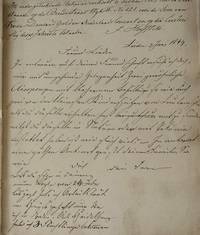
18490001508Donaueschingen Germany Southhern Germany. Very Good. 1849. On offer is a very unique historically significant 1849 - 1859 manuscript relic of the Revolution of Baden. There are fifty three 53 pages in German handwriting containing the journal entries of an unidentified 'rebel' and citizen of Donaueschingen Germany who was arrested as part of the Rebellion. While the participant is unidentified local historians researchers or collectors of the era may have enough clues to ascertain the writer's full identity. The entries are dated 6th of July 1849 the day before his arrest until the 25th of June 1850 the day the sentence of the Royal Court was handed down. The accused describes graphically where and how his accommodations were by whom and when he was interrogated and for which accusations how he responded and gives such an informative picture of that time and those circumstances from the point of view of someone who at the end of the Revolution of Baden was arrested by the Prussians as a supporter of the revolution. Here are some snippets: 6th July 1849: "Friday night at about 11 pm marched the troops and the guards under the leadership of Siegel Werner Gögg and so on off toward Hüfingen." 7th July 1849: "On Saturday marched against them the Hessians the Prussians the Bavarians the Mecklenburgers the Frankfurters and the Nassauers about 6000 men towards Donaueschingen a small city in the Black Forest region where 3000 men mostly Bavarians were stationed. On this day I got 20 meters of accommodations " In the evening at 7 o'clock I was by the Brigadier and the Hessian Provost on orders by the Civil Commissioner Refanie supposedly because of favouring the revolt arrested. There follow descriptions about the type and place of his accommodation observations about the high number of men stationed in Donaueschingen speculation that he could only have been arrested because of a denunciation; on the 9th of July he was apprised of the accusations against him; there follow the days of the hearings with exact descriptions of the proceedings: "on the 2nd January 1850 I had my final interrogation " "Tuesday the 25th June 1850 they revealed the royal court's verdict upon which I on Monday appealed to the upper court registered." With this last sentence the entries end. The first 45 pages are in a 45-page stitched notebook at the approximate size of 15.5 x 10 cm. and a further 8 pages of the same size are loose. Historians collectors and researchers will recognize the the utter uniqueness and rarity of this manuscript. Overall VG. DEUTSCHER: Im Angebot ist ein einzigartiges und historisch bedeutsames Relikt des badischen Aufstandes 1849-1850 in deutscher Handschrift. 53 Seiten deutsche Handschrift auf Papier enthaltend die Tagebuchaufzeichnungen eines Bürgers aus Donaueschingen der am 6. Juli 1849 wegen "Begünstigung des Aufstandes" verhaftet worden war. Die Aufzeichnungen sind in der Zeit vom 6. Juli 1849 dem Tag vor seiner Verhaftung bis zum 25. Juni 1850 dem Tag der Urteilsverkündung durch das Hofgericht erfolgt. Der Beschuldigde schildert anschaulich wo und wie er untergebracht war von wem er wann zu welchen Vorwürfen verhört wurde was er darauf erwiderte und gibt so ein aufschlußreiches Bild der damaligen Zeit und Umstände aus der Sicht eines am Ende des badischen Aufstandes von den Preußen als Begünstiger der Revolution Verhafteten. Einige Textpassagen: 6.Juli 1849: "Freitags Nachts ungefähr 11 Uhr marschierten die Volkstruppen und Wachmänner unter Anführung Siegels Werners Gögg etc. nach Hüfingen ab" 7. Juli 1849: "Samstags zogen dagegen Hessen Preußen Baiern Mecklenburger Frankfurter & Naßauer etwa 6000 Mann nach Donauöschingen wo 3000 Mann meistens Baiern dort einquartiert wurden. an diesem Tag bekam ich 20 M. Einquartierung."".Abends 7 Uhr wurde ich durch den Brigadier und einen heßischen Provosen auf Befehl des Zivilkommissär Refanie angeblich wegen Begünstigung des Aufstandes verhaftet." es folgen Angaben über Art und Ort der Unterbringung Betrachtungen über die hohe Zahl von Einquartierungen in D.onauE.eschingen Spekulationen darüber daß er nur aufgrund einer Denunziation verhaftet worden sein könne und anderes mehr. am 9. Juli wurden ihm die Anschuldigungen eröffnet es folgen die Tage der Verhöre mit genauen Schilderungen des Ablaufs "am 2. Januar 1850. hatte ich Schlußverhör." "dienstags den 25. Juni 1850 eröffnete man mir das hofgerichtliche Urtheil worauf ich am Montag den Rekurs an das Oberhofgericht anmeldete." mit diesem letzten Satz enden die Aufzeichnungen. die ersten 45 Seiten sind in einer 45-seitigen fadengehefteten Kladde in der Größe von ca. 155 x 10 cm und die weiteren 8 Seiten in gleicher Größe lose vorhanden. eEine originale authentische Handschrift von hohem geschichtlichen Wert. VG.; German Language; 24mo - over 5" - 5¾" tall; KEYWORDS: HISTORY OF MECKLENBURGERS REVOLUTION OF BADEN BLACK FOREST DONAUESCHINGEN AUFZEICHNUNGEN PREUßEN ALS BEGÜNSTIGER ANFÜHRUNG SIEGELS WERNERS GÖGG HESSEN HANDSCHRIFT HANDGESCHRIEBEN MANUSKRIPT SÜTTERLIN VON HAND GESCHRIEBEN HANDSCHRIFTLICH UNIKAT EINZELSTÜCK DOKUMENT SCHRIFTSTÜCK KURRENT KURRENTSCHRIFT DEUTSCHE SCHREIBSCHRIFT OSTPREUßEN KALININGRAD NORDRHEIN-WESTPHALEN ADEL PREUßEN BAIERN MECKLENBURGER FRANKFURTER NAßAUER ZIVILKOMMISSÄR REFANIE REVOLUTIONARIES REVOLUTIONARY MOVEMENTS GERMAN HISTORY PRUSSIAN HISTORY 18TH CENTURY RELIKT DES BADISCHEN AUFSTANDES HANDWRITTEN MANUSCRIPT DOCUMENT LETTER AUTOGRAPH DIARY JOURNAL LOG KEEPSAKE WRITER HAND WRITTEN DOCUMENTS SIGNED LETTERS MANUSCRIPTS PHOTO ALBUM PHOTOGRAPHIC ALBUM HISTORICAL HOLOGRAPH WRITERS DIARIES JOURNALS LOGS AUTOGRAPHS PERSONAL MEMOIR MEMORIAL PERSONAL HISTORY antiquité contrat vélin document manuscrit papier Antike Brief Pergament Dokument Manuskript Papier oggetto d'antiquariato atto velina documento manoscritto carta antigüedad hecho vitela documento manuscrito Papel Handschriften . unknown
18810009157U.S. NAVY EUROPEAN STATION ALEXANDRIA EGYPT. Very Good. 1881. On offer is a thoroughly interesting and unique ships journal from the U.S. Navy Corvette the USS Quinnebaug and handwritten by its Naval Constructor a man named J.J. Woodward. The period covered is between June 24 1881 and March 14 1883. The journal begins with the Quinnebaug being outfitted in the New York Navy Yard. It sets sail on July 14 1881 sailing across the Atlantic and reaching the Strait of Gibraltar on August 9 1881 joining the U.S. Navys European Station. The ship makes numerous European ports of call including locations in France Algeria Tunis Tripoli Egypt Turkey Greece Italy Morocco Madeira Malta Spain and Portugal. Each day there are detailed daily entries include latitude longitude weather and sea conditions. Generally these leave out observations other than simple things other than descriptions for the weather. However there are a few where Woodward remarks on ships seen in passing and a few times on purely personal things such as one entry where he writes Read articles of War at quarters. Started gris for distilling and began to distil. The most lengthy observations come when the ship is in port. The journal ends on March 14 1883 at Gibraltar. Woodward logged a total of 19957 nautical miles during his voyage. Of particular interest is that the Quinnebaug was present for the Bombardment of Alexandria on July 11 1882 where the British fleet attacked Alexandria and invaded Egypt starting the Anglo-Egyptian War and beginning the British occupation of Egypt which would last until 1956. Amazingly Woodward created a detailed illustration of this battle including ship locations and Egyptian batteries. He also illustrated subsequent battles at Kafr-Dowar and Ramleh. Several other illustrations include a gun battery and a ship cross-section. These illustrations are truly remarkable works both for their relationship to the ship itself and to the historically significant events in which the ship participated in. Woodwards engineering background is obviously evident in these sketches. After March of 1882 the log book cedes to a journal section in which Woodward inserts his Professional Notes. The journal notes begin in July of 1881 and continue until March 14 1883. The tone of these notes is much more casual and personal than the log section of the book. It is in this section that the illustrations are located. Woodward describes in much greater detail the ports he visits and the observations he makes at sea and on land. It is also here that the report from the British attack in Alexandria is written. In an almost 20 page account of the Battle Woodward describes in excellent detail what it was like at the battle the positions of the ships especially the Quinnebaug and the tactics of the British and French ships. The bombardment begins on July 11th and ends with Alexandria in flames on the 14th. During the bombardment the American ships including the Quinnebaug opened their ships up to all refugees from the city who needed shelter or medical treatment. Woodwards illustrations of a Plan A and Plan B for the The Bombardment of Alexandria are truly extraordinary pieces of work. The book concludes with 16 pages of Miscellaneous Notes at the back of the book these being more observations and personal anecdotes of the cities and ports through which the Quinnebaug travelled including Gibraltar Marseilles Arles Algiers Alexandria Cairo. The journal has 166 handwritten pages. The remaining pages in the 288 page book are blank. The condition is very good. The spine and covers show some wear and the leather has come off the spine. The binding is still very tight. The pages within show very little signs of wear and tear or any age-toning and the handwriting is easily legible with very little staining in still very dark black ink. Bio Notes: J.J. Woodward would go on to lecture at MIT and publish works on ship design. Woodward was instrumental in commissioning the Navy's first submarines; The USS Quinnebaug was a screw corvette in the United States Navy. It was completed under contract by Neafie & Levy at the Philadelphia Navy Yard She was launched on 28 September 1875 but completion was delayed due to lack of government appropriations and consequently the vessel did not enter commission until 2 October 1878 when Commander Norman H. Farquhar took command. Three of her crew received the Medal of Honor for rescuing shipmates from drowning during this period: Landsman Patrick J. Kyle at Mahón Menorca on 13 March 1879 and Seaman Apprentice Second Class August Chandron and Boatswain's Mate Hugh Miller at Alexandria Egypt on 21 November 1885. Departing Gibraltar on 9 May 1889 Quinnebaug returned to the New York Navy Yard on 17 June 1889. She decommissioned there on 3 July was struck from the Navy List on 21 November 1889 and was sold on 25 March 1891; The Egyptian Expedition in mid-1882 was the United States' response to the British and French attack on Alexandria during the Anglo-Egyptian War. To protect American citizens and their property within the city three United States Navy ships were sent to Egypt with orders to observe the conflict ashore and make a landing if necessary. British and French forces heavily damaged the city so a force of marines and sailors were landed and they assisted in fire fighting and guarding the American consulate from insurgents. OVERALL: VG; Manuscript; 4to - over 9¾" - 12" tall; KEYWORDS: HISTORY OF J.J. WOODWARD NAVAL CONSTRUCTOR SHIP BUILDER USS QUINNEBAUG UNITED STATES NAVY USN U.S. NAVY CORVETTE NEAFIE & LEVY BOMBARDMENT OF ALEXANDRIA ANGLO-EGYPTIAN WAR EUROPEAN STATION EUROPEAN SQUADRON POST WORLD WAR TWO ERA NAVY BRITISH MEDITERRANEAN FLEET NAUTICAL MARINE NAVAL BATTLE OF KAFR EL DAWWAR REAR ADMIRAL JAMES W. NICHOLSON ENGINEERING NOTES AMERICAN INFLUENCE IN NORTH AFRICA AMERICANA EGYPTIAN EXPEDITION USS LANCASTER ADMIRAL BEAUCHAMP SEYMOUR CHANNEL FLEET COLONEL AHMED ORABI COLONIALISM IN NORTH AFRICA HANDWRITTEN MANUSCRIPT DOCUMENT LETTER AUTOGRAPH WRITER HAND WRITTEN DOCUMENTS SIGNED LETTERS MANUSCRIPTS HISTORICAL HOLOGRAPH KEEPSAKE WRITERS AUTOGRAPHS PERSONAL MEMOIR MEMORIAL ARCHIVE DIARY DIARIES JOURNAL LOG ANTIQUITÉ CONTRAT VÉLIN DOCUMENT MANUSCRIT PAPIER ANTIKE BRIEF PERGAMENT DOKUMENT MANUSKRIPT PAPIER OGGETTO D'ANTIQUARIATO ATTO VELINA DOCUMENTO MANUSCRITTO CARTA ANTIGÜEDAD HECHO VITELA DOCUMENTO MANUSCRITO PAPEL . hardcover
18400007018BARCELONA MADRID SEVILLE SPAIN. Fair. 1840. On offer is an original historically significant and absolutely superb first-hand account of an army officer travelling in 1840s Europe. Was he a tourist or was he a spy His journal takes the form of a pocket notebook measuring 7.25 inches by 4.75 inches. There are 54 pages and they are 100% complete. The handwriting is copperplate. It is hard but not impossible to read. The journal's contents more than make up for its condition. The covers have separated from the book. The pages themselves have separated into their several sections but all are present. The pages are not numbered but there are dates entered in places in his narration. It is the contents though that captures the imagination. Captain H. Herman is a British Army officer. In 1840 he travels from the northeast to the southwest of Spain. Visiting major centres such as Barcelona Seville and Cadiz he paints a detailed picture of the countryside its inhabitants and the customs he encounters. As befits a military person he has a sharp eye for detail and his notes are accompanied by a number of finely-executed ink line drawings. He notes other officers that he meets regiments including one that we would refer to today as 'off-the books' and notable personages. These were tumultuous times in Spain. Ferdinand VII died without a male heir. Prior to his death he changed the succession laws to enable his young 3 years old daughter Isabella to assume the throne instead of his more reactionary brother Carlos. This set off the Carlist wars that raged for years. Isabella's mother ruled as regent and eventually she found a winning general - Baldemero Espartero to help her drive back the Carlists. The country already devastated by the Napoleonic Wars sank further into poverty and destitution. The British government supported Isabella in her endeavours and indeed assisted in raising a regiment for her. The British Legion was a force of 10000 British military volunteers funded and paid by the Spanish crown. These British soldiers were placed under the command of Espartero. Espartero went on to become Prime Minister of Spain in 1840 and ruled the country with an iron fist for two years. Having a British officer travelling throughout Spain either on a personal trip or to report back to Whitehall was of clear benefit to Britain. He travels to Barcelona from Toulouse France in September of 1840. There he meets a Colonel Clarke of the British Legion who has with him 150 Dragoons and a brigade of legionnaires. He makes reference to Espartero receiving a civic crown: Espartero received a civic crown of delicately wrought gold and placed it on the colours of the 'Esparterists' present - 13000 men of his army they are all well made muscular fine men fit for army service. He dines with a newspaperman commenting: Moor who writes for the morning chronicle has £5.00 - he accompanied the army - as a favourite of Espartero often dined with him - has been in some actions with him and has decorations displayed - has seven or eight but the Major of one of the Reg'ts has some 13 I think !!! He met others in positions of authority or influence as well: the American Consul in Barcelona Mr McCulloch - splendid house dining bad champagne tolerable sherry bad port. At Taragonna he sketches the harbour including a ship under sail. notes crops grown in areas along coast. He describes one village as a vile place. Another area is described as : A dusty bad road - no view - no beauty. The populace poor ragged and ugly - not one good-looking woman . terribly dull place cheap houses. There is a 2-page ink and pencil sketch of Alicante with the Santa Barbara Castle on the cliff above and a description of the harbour. He refers to Sir John Murray and his defeat of the French General Suchet at the battle of Castallia Apr 1813 and then goes on to comment on Murray's disastrous attempt to take Tarragonna in June of that same year. He comments on the quality of Spanish troops he encounters - very poor. His journey takes him south to Cartagena and Almeria - and includes 2 excellent ink and pencil sketches. His descriptions of these cities are detailed but quite disparaging - possibly reflecting both his class origins in Britain and his rank as a British officer travelling in country won by Wellington in the Peninsular War. There are 2 excellent drawings of the port of Malaga. He provides a detailed description of what he sees and experiences in Grenada the Generalife and the stunning Alhambra palace: "The whole is beyond all description". There are drawings of a number of notable locations in Granada. he frequently notes formations of Spanish troops: 10th Cordova Regiment review 3000 national guard . some fine men . well skilled . Captain Jml Llamos reviews From Grenada he carries on inland: the approach to Jaen is most beautiful lengthy gentle slopes covered with superb hues. Further west he passes villages where battles were fought in the Peninsular Campaign: The French General was a coward. He surrendered to half his number In Cordova he mentions of Espartero again: Espartero began his influence successfully by shooting half a dozen colonels for cowardice. In Cadiz he noted that Espartero was present for a review of 2500 troops accompanied by a few well mounted well looking lancers and about 40 lancers of the Horse Volunteers Also in Cadiz in December of 1840 he notes the arrival of the Captain General of Andalusia: Captain General of Andalusia here from Sevilla in anticipation of some disturbances of the Election which begins tomorrow. He noted as well that a French frigate came in to the harbour during the election. This is an utterly fascinating first-hand account of travels during the turbulent 1840's in Spain. It is a gold mine for historians especially those studying the Napoleonic Wars or Spain and Britain in the 1840s. Whether from a military or social history perspective Hermans' notebook offers a rich source of first-hand observations. The ink and pencil drawings carry an evocative power of their own. There is a sense of places frozen in place giving them a timeless existence. The constant revolutions and struggles between the traditional forces that supported an authoritarian government and a growing liberal faction were of keen interest to Britain as she had a long-standing ally in neighbouring Portugal. This turmoil was to continue in one form or another into the 20th century culminating with the brutal dictator Francisco France. It wouldn't be until the late 20th century that Spain and the Spanish people would see true democratic freedom.; Manuscript; 12mo - over 6¾" - 7¾" tall; KEYWORDS: HISTORY OF CAPTAIN H. HERMAN; NAPOLEONIC WARS; PENINSULAR WAR; DUKE OF WELLINGTON; ESPIONAGE BALDEMERO ESPATERO; CARLIST WARS; ISABELLA II; FRANCISCO FRANCO; BRITISH LEGION; BARCELONA; SEVILLE; CADIZ ESPANIA SPANISH PENINSULA ENGLAND POST TRAFALGER ESPANOL PORTUGAL HANDWRITTEN MANUSCRIPT DOCUMENT LETTER AUTOGRAPH WRITER HAND WRITTEN DOCUMENTS SIGNED LETTERS MANUSCRIPTS DIARY DIARIES JOURNALS PERSONAL HISTORY SOCIAL HISTORY HISTORICAL HOLOGRAPH WRITERS AUTOGRAPHS PERSONAL MEMOIR MEMORIAL ANTIQUITÉ CONTRAT VÉLIN DOCUMENT MANUSCRIT PAPIER ANTIKE BRIEF PERGAMENT DOKUMENT MANUSKRIPT PAPIER OGGETTO D'ANTIQUARIATO ATTO VELINA DOCUMENTO MANOSCRITTO CARTA ANTIGÜEDAD HECHO VITELA DOCUMENTO MANUSCRITO PAPEL . unknown
1867000060Colebrook Connecticut CT 1867. On offer is a superb archive of 59 original manuscript multi-generational family of diaries spanning the civil war era through the early 20th century. The Carrington Family Diaries 1867 - 1913. All 59 diaries from members of the Carrington Family of Colebrook Connecticut. The patriarch Edward Sr. wife Sarah Ann Terry Carrington sons Edward C. Jr. died in the Civil War and Edwin T. and daughters Sarah and Kate. Edward Sr. died in 1878 and Sarah Ann Terry Carrington died in 1881. Both are buried in the Colebrook Center Cemetery in Colebrook Connecticut. Sarah Ann Terry Carrington mother was the daughter of Eliphalet Terry of New York. The group breaks down as follows: Sarah Terry matriarch wife of Edwin: 11 diaries: 1867 1868 1869 1870 1871 1872 1873 1874 1875 1876 1877. typical diary entries; Edward Carrington Snr father of Edwin: 8 diaries: 1857 1867 1868 1869 1870 1872 1873 1874. sporadic point form entries for the most part business like records of day to day business and some personal content.; Edward Carrington Jnr: 4 diaries: 1855 1855 1857 1860. typical diary entries of an obviously young man.; Katherine Carrington a daughter: 2 diaries: 1868 1872. typical diary entries. Edwin Carrington patriarch after Edward Snr: 34 diaries: 1875 1876 1878 1879 1880 1881 1883 1884 1885 1887 1888 1889 1890 1891 1892 1893 1894 1895 1896 1897 1898 1899 1900 1901 1903 1904 1906 1907 1908 1909 1910 1911 1912 1913. like the father sporadic at tmes point form entries for the most part business like records of day to day business interspersed with personal content. ADDITIONAL BACKGROUND: Lieut. Edward Carrington son was killed in the Civil War in St. Marks Florida in the Natural Bridge Conflict on March 6 1865 but the family did not get the news until March 22 1865. In 1871 the son Edwin was married to Charlotte nicknamed Lottie born April 9. 1847 and the couple moved to Scio NY. Edwin then moved to Bay City Michigan it appears in 1875. His wife and son Winny born in 1873 did not move with him to Michigan but rather stayed in Scio NY. Edwin traveled extensively on business by train and then in the later years by automobile and visited his family about every two months coupled with his business trips. Edwin was Secretary and Treasurer of the Bay City Building Company Rifle Room Company and Ausable Lumber Company in Michigan. Edwin and Lottie's son Winny died at the age of two years and eights months on 2/15/1876 and father did not make it home in time. A daughter Sarah was born in 1876; a son Eddy was born in 1877 and a daughter Gracie in 1882. Some of the earlier years have diaries from more than one member of the family. Edwin's diaries of 1875 - 1913 are both diaries as well as his business day planners. All have notations at the back of expenses and costs. As a hobby he enjoyed duck hunting. In 1901 Edwin and Lottie became grandparents by Sarah. The diaries mention both the deaths of Lincoln and McKinley. Several diaries have newspaper articles tucked at the back. One is an article about Mrs. Abraham Lincoln. There are two articles about how the Edward Carrington Sr. family made their "fortune" in 1874. THIS IS A SENSATIONAL AND UNIQUE MULTI GENERATIONAL FAMILY HISTORY THAT WOULD BE THE PRIDE AND CENTERPIECE OF ANY SERIOUS DIARY COLLECTOR. Good. 32mo - over 4" - 5" tall. Manuscript. unknown
18150008043GREAT BRITAIN. Very Good. 1815. On offer is simply superb manuscript of a Royal Navy officer's exploits in the age of "Master and Commander: The Far Side of the World". From the Napoleonic Wars through the rest of the 19th century Britain ruled the world and her instrument was the Royal Navy. This outstanding manuscript details the service of one officer who sailed to 'the far side of the world' when the Royal Navy ruled the world's seas. The manuscript is 176 pages in length and is 100% complete. All pages are typed so legibility is total. Pages are 8 1/24 by 14 inches. The pages are in excellent condition. They are enclosed in a hard cardboard folder. There are several other papers with the manuscript including one of note that will be elaborated on below. John Fullerton joined the Royal Navy as a midshipman in May 1815 at 12 years of age. He began his service on HMS Larne a 20 gun corvette. Four days in he saw his first punishment: ". four dozen lashes the first punishment I had ever seen and I never yet met the person who could look upon the infliction without a shudder" p1. From that rather grim introduction he went on to serve in a series of HM ships and travelled the world. He describes his rite of passage when he first crossed the equator on Oct 11th 1819: ". All those who have not been across the Line now go below and the hatchways are guarded . and one at a time blindfolded brought up taken to the chair through a line of people who . "p. 6. He had plenty of adventures. Once after becoming acquainted with a woman in Rio de Janeiro he met a man as he left her home. After exchanging greetings: ". he politely put a knife into my left side and left it there. I gave him an equal portion of my sword and retreated to the ship hospital ." p11. With his friend Hack Hawthorn a Wild Middy p11 he often got into scrapes including one where he and some friends faced off with a Portuguese military street patrol: ". Our swords out and in less than three minutes had possion of their muskets and bayonets but obliged to decamp on board. . Jack generally got those who went on shore with him into similar scrapes." p.12. In 1821 he was commissioned a Lieutenant. His manuscript is rich in observations of places he travelled to and people he met. He mentions a collision with HMS Revolutionaire which was under command of the son of the great Royal Navy Captain Edward Pellew. p24 His descriptions are rich in detail: "I accompanied some Chilinoes to a fair in the country and races many tents with refreshments and dancing people from all parts of the country flocked and a very animated scene it was fair damsels under charge of their sweethearts or lovers and sprightly dame with her shadow not husband he playing the tender to some other man's wife" p77. He also keeps a constant mention of other ships they meet or travel with which provides a first-rate way of cross-referencing other ship's records. On Sept 9th 1827 Fullerton along with some other officers attended the theatre in Valparaiso Chile. He goes into a dispute with a Chilean sergeant which continued to escalate until he shot and killed the sergeant. After a bloody fight in the lounge area of the theatre he escaped wounded to his ship. In reprisal English officers ashore were rounded up and imprisoned. A week later he surrendered to authorities and a jailed until a Spanish court-martial could be convened. At length he was acquitted. What makes this account so historically interesting is that included with the manuscript is the typed statement of the British Consul John White who acted in his defense. The 13 page document is typed on 8 1/2 inch by 14 inch paper and is in excellent condition. It begins: "John White Esq Consul of His Britannic Majesty counsel for Lieutenant John Fullarton Royal Navy accused of having killed Sergeant Jose Maria Minos present the following to the court in justification of the act committed by the said officer ." p1. The defense makes for fascinating reading. It is accompanied by a 46 page packet containing 8 pages of handwritten notes which were part of the original draft. For a naval historian this is an outstanding description of service in the Royal Navy written by an officer with a keen eye for descriptive detail. Written at a time when the Royal Navy truly ruled the oceans of the world it is a treasure trove for information. Whether ship locations customs in foreign lands or life on board it is an outstanding primary source document. The court-martial defense is an excellent example of litigation argument in the early 19th century. It touches on key aspects of self-defense argument that forms the basis for the common law that governs millions of people today. A legal scholar or historian would follow John White's arguments with interest and pleasure.; Manuscript; Folio - over 12" - 15" tall; KEYWORDS: HISTORY OF EARLY 19TH CENTURY REGENCY MID VICTORIAN ERA LTN JOHN FULLERTON JOHN WHITE BRITISH COUNSEL IN VALPARAISO ROYAL NAVY GREAT BRITAIN ROYAL NAVY IN THE NAPOLEONIC WARS COURT-MARTIAL AGE OF SAIL AGE OF NELSON MARINE MARITIME LIFE IN A ROYAL NAVY SHIP NAVAL OFFICERS NAVIES NAVAL DISCIPLINE WARSHIPS CORVETTES NAVAL HISTORY VISITS TO FOREIGN PORTS EARLY 19TH CENTURY LITIGATION CHILE IN 1820S SAILORS - SOCIAL LIFE AND CUSTOMS HANDWRITTEN MANUSCRIPT DOCUMENT LETTER AUTOGRAPH WRITER HAND WRITTEN DOCUMENTS SIGNED LETTERS MANUSCRIPTS DIARY DIARIES JOURNALS PERSONAL HISTORY SOCIAL HISTORY HISTORICAL HOLOGRAPH WRITERS AUTOGRAPHS PERSONAL MEMOIR MEMORIAL ANTIQUITÉ CONTRAT VÉLIN DOCUMENT MANUSCRIT PAPIER ANTIKE BRIEF PERGAMENT DOKUMENT MANUSKRIPT PAPIER OGGETTO D'ANTIQUARIATO ATTO VELINA DOCUMENTO MANOSCRITTO CARTA ANTIGÜEDAD HECHO VITELA DOCUMENTO MANUSCRITO PAPEL . unknown
1861000615Chicago Illinois IL. Good. 1861. A wonderful archive of historically significant with detailed civil war content: 1 Two detailed Civil War diaries; 2 Ransom's first war letter home; 3 superb signed Ransom Civil War cartes des vistecdv; 4 Other photos: a tintype cdv gem photo and another hand colored cdv of his wife Louie Lucy Perham; 5 A book titled "Sacred Poems"; 6 Ransom's business card and property tag and lastly but of huge importance to genealogists; 7 Early name and address book of Dick Ransom mentioning many family members and Battery mates. Dick Ransom was from Chicago Illinois; enlisted on 8/7/1862 as a private. On 8/29/1862 he mustered into Chicago Mercantile Light Artillery. He was discharged for disability on 3/24/1863. Specifics: Diary #1 1861 2.5 x 3.5 inches full year January 1st through December 31st 1861 120 pages of which approx. 250 days with entries recorded dark brown period ink very legible. Great war content and a number of remarks made in great excitement; Lincoln as President; death of Col. Ellsworth and Steven Douglas. Battle excitement and the rout of the federal army at the first battle of Bull Run at Manassas. Diary #2 1862 : 3 x 5 inches entries from Aug. 7th 1862 through Mar. 6th 1863. 29 pages brown period ink very legible. Cover reads " Dick Ransom mercantile Battery Chicago Artillary 100 Washington Street Chicago". Signed in ink in Dick Ransom's hand on first page; "Dick Ransom 100 Washington Street Chicago Ill." Also included: 3 wonderful cdv/tintype of Lucy Ransom. Dick speaks of his proposal for marriage to Lucy in his 1861 diary. First is a tintype/cdv format of Lucy backmark Chicago dated Aug 19th 1866 and signed on reverse in Dick's handin brown ink "Louie Perham 1866 Dick Ransom". Secondly mounted Gem Albuman photo of Lucy on cdv mount ca. 1865. Cdv is handcolored image of Lucy dated Jan 23rd 1868. The address book includes all of Dick's friends and family and many of Mercantile Battery mates including Sinclair Willard Gunlock and Medal of Honor winner James Dunne. 3 x 5 inches many pages of entries mouse chew on cover edges. The date of 1883 can be found on the fep. Brown ink inscriptions this book is an important genealogy record and helps to identify all the people referred to in the diaries. Here are some snippets: " January 9th "my Birthday 19 years old born at South Woodstock Vermont""march 4th Abe Lincoln President of the United States"" Mar 19th " wrote a long letter to Lucy . with a proposal for marrige which I am sure will be accepted.I am in great anxiety for an answer". tintype of Lucy included "rec'd an answer alright = O.K."" April 25th -Intense excitement about . voluteers companies forming and drilling constantly all over the North"." May 2nd - douglas was received here by republicans and Democrates unanimously " May 3 - great war excitement for some time - volunteerism all over the country - great excitement". " May 5th - volunteers drilling in the streets "" May 8th - Lucy went for me to get a flag for the volunteers ."" May 9th - great war excitement companies guarding and driling". " May 24th - war message regarding the good and efficient commanders." " may 25th - Scott and President Lincoln col. Ellsworth the Zouave huro of Chicago killed in Alexandrea yesterday for tearing down a secsession flag. " June 3rd - Stephen A Douglas died at the tremont house this A.m. at 48. The city draped very very heavily mourning. col. Ellesworth funeral yeaterday at Bryan hall". " May 4th - Douglas laid in state at Bryan Hall all day." " May 5th - Douglas still in Bryan Hall ". " May 5th - Douglas still lies in state at Bryan hall is to be burried at Cottage Grove tomorrow ". "May 7th- Douglas funeral stores all shut up largest funeral ever in Chicago ". " June 10th - War excitement continues usual small battles and skirmishes but no large ones some expected soon". " June 20th - war and rumors of war some great battles expected soon in vicinity of Washington Sucession." " June 25th - Great riot in Milwakee yesterday - Dutch Mob attacks." " June 25 - all state banks in iowa Indiana and Eastern Missiouri counterfeits so plenty now". " June 30th - went out to Cottage Grove to see the camp" " July 8 - Telegraphs forbidden by the War department to transmit any war news of the intentions of the united states "." July 16 - the federal forces are beginning to move toward Richmond knowing where they will stop Gen. Scott don't tell everydody". " July 22 - At noon good news from the war high hopes night news the entire rout of the Federal army . and retreat back to Washington". referring to the first battle of Bull Run at Manassas " July 23 - News from war not encouraging - 600 killed ". " July 25- breacking accounts the battle and rout of the Union army though better than at first suspected ". " Sept. 25- think of joining T.E.G. Ransoms 11th regiment at Cairo had a letter from him wants me". referring to Gen. Ransom. " Oct 6th - another letter from T.E. G. Ransom still urges me. " " Aug 7th 1862 I enlisted in the Mercantile Battery of the Artillary of the U.S. for three years unless sooner discharges"" Aug 9th I was sworn in by capt. christopher U.S. mustering officer of Chicago". " Mr Sutter pastor presented each of the young men who had enlisted with a teatament". " Aug 11th - picked up duds to go to camp tomorrow- at 9 o'clock". "Aug 12th- at 9 o'clock at our headquarters at corner of Lake and State streets at the .Mercantile Association - marched to court house and examined by surgeon and then recieved our $ 60 ". " Aug 13th - arranged our camp as best we could not being organized . was on guard . skirmishing ." " Aug 14th -rec'd news that we were accepted by the government and were to have a full battery . powder smooth Bores . the Coffeemill . orders to fill up the company to 156 men. some photographs taken ". " Aug 25 - we elected our officers and then were visited by Adjutant General Fuller.Cooley Wilson Swan Bickford ". " Aug 29 - The Battery was mustered into service by lt. Knox ". "Sept. 1st- went to town to get more photographs". " Sept 23 - lient Wilson had a sword to be presented him ". " Oct. 3- went to camp and found that the Guns and all accoutrements and ammunition had come". . guns 2 .from riffle james cannon 2 to 8 ditto rebel guns -one made in Memphis and one in orleans which had been captured". " Oct 4th Seargents knights and Whitney Thomas and Throop drew cuts for the 4 bronze guns -knight & Thomas got the U.S. & Throop 7 Whit the rebels.". " Oct 5- had a great deal of company to look at the guns ." the Mercantile Association presented Crego with a sword . the accoutrements are being distributed and guns. today there was a sword Pistols presented to Capt. Cooley by the Mercantile Association." "Oct 15th " last evening the Asociation presented the Battery a splendid set of Colors. . to ft. Wayne.after the horses for the Battery ". " Oct 26th - we drill about 4 hours daily with our horses and guns on the prarie and five blank cartriges to break in the horses - we are almost ready mow for the field and fight". We are now likely to get our Captain Cooley to resign and have Morgan in his place. we have no guard around the camp now only on the horses guns ammunitionstores & officers tents and the boys go down town when they choose". " Dec. 25th - Vicksburg measels" "jan 2nd 1863. left Yazoo country- & Walnut Hills & c bluffs - Sherman's big retreat" . " Feb 14 - Arkansas Post- Sherman deserted - then back to Youngs Point". " Mar 6th Left Youngs Point for Hospital in Memphis on steame "City of Memphis". " April 1st 1863 - Mrs. Livermore brought me my discharge from the service- to Washington Hosptal Memphis.". " April 2 - left Memphis on Bostona -- homeward bound a free man". Remarkable archive.; Manuscript; 48mo - over 3" - 4" tall; KEYWORDS: HISTORY OF DICK RANSOM ALS CDV AMERICANA HANDWRITTEN MANUSCRIPT DOCUMENT LETTER AUTOGRAPH WRITER HAND WRITTEN DOCUMENTS SIGNED LETTERS MANUSCRIPTS HISTORICAL HOLOGRAPH WRITERS AUTOGRAPHS PERSONAL PERSONAL HISTORY MEMOIR MEMORIAL DIARY JOURNAL DIARIES JOURNALS LOG LOGS KEEPSAKE AMERICANA Civil War War Between the States VICKSBURG MANASSASS BULL RUN LINCOLN ILLINOIS MERCHANTILE ILLINOIS INFANTRY Zouave . unknown
18850001904SUAKIM SUDAN LAGOS NIGERIA AFRICA. Good. 1885. On offer is a superb significant manuscript relic of British military campaigns and expeditions to Africa in the latter half of the 19th Century at Suakim of the Sudan in 1885 and Lagos Nigeria in 1891 being an original diary of the two expeditions handwritten by Lieut. F. J. Davies a member of the distinguished military family based at Elmley Castle Worcestershire and attached to the Grenadier Guards the most elevated being Lt. General Henry Fanshawe Davies most likely F J Davies' father. Davies does a super job relating his life as an officer writing entries some brief others more detailed from the mundane: a cricket match deck football a dance and comments on places en route to Suakim and Lagos to the historically significant eyewitness accounts of Victorian warfare interspersed with lighter moments; descriptions of military engagements and observations on people places and politics with some of the comments being typical of the times but not politically correct today. The first section of the large approximately 9.5 x 8 inch album is related to Suakim the second British expedition following the fall of Khartoum in 1884. The Battle of Hasheen is described in some detail. Davies wrote the account in a different book of over 100 sheets oddly hand numbered starting at page 55 then single digits then through 229 obviously he did not transfer each page he wrote in the earlier book then a newsclipping and photo having been cut and transferred and then glued into this album and it includes a group photograph 200 x 150 mm showing the officers on the expedition. Davies has identified all in pencil below the photo. The Suakim diary dates from February 18th to June 4th and begins when they left England on the SS Australia. Here are some snippets: SUAKIM: Feb 19th " marched up to the Quadrangle at Windsor Castle Her Majesty appeared at a window and was received with a Royal salute we marched back to the barracks. The Eton fellows cheered us like anything." Feb 27th "African coast in sight played cricket on deck everybody has left off wearing great coats most of us wear our blue patrol jackets football on quarter deck in the afternoon." March 18th "There are rumours we shall go home as soon as Osman Digina is beaten leaving the line regiment to finish the work and cover the railway." March 20th A ten page account of fighting at Hasheen together with a sketch plan. Detailed timings and numbers of casualties. March 29th arrival of SS Iberia with troops from N.S. Wales. "Heard that govt were arming ocean steamers as armed cruisers and that a large number of ships were being commissioned for service in the Baltic." After Suakim and a few blank pages in the album the expedition to Lagos in 1891 begins. This expedition was motivated by action by the Ijeba tribe who were cutting off the residents of the Lagos district from up-country supplies of goods. Lagos had been a British Crown Colony since 1886. The diary runs to about 75 pages and covers the period March 26th to June 28th. The ship used was the British and African Co. SS Cameron. The pages in this sections are somewhat browned around the edges a different paste clearly being used from the Suakim sheets. Here are some snippets: LAGOS: 13th April Sierra Leone "The inhabitants comprise every possible species in every possible costume from a state of nature to a black coat and top hat." The officer of Frontier Police tells Davies of a skirmish. Their opponents "did not belong to any particular tribe but were a collection of bad characters and runaway slaves." "We took in 20 Kroo boys to work the ship - their dress is often very funny - the usually have a stiff billycock hat with heir name written on." 20th April arrival in Lagos. "Seems a healthy place No official has died here in the last four years." Davies is given charge of a company of Lagos Housas about 40 men. May 16th Preparations for battle - details of force listed. Details of advance terrain and fighting give. The military activity and its aftermath last for about 10 days and are covered in some detail. Accounts of looters being flogged. "I found Col. Scott standing in the courtyard with the 3 Ibadan chiefs lying flat on their stomachs in front of him if the chiefs' men did not give in their arms at once the chiefs would be hung." Contained in an album 240 x 200 x 40 mm the entries are written on sheets about 185 x 100 mm taken from a perforated notebook and pasted onto the thicker pages of the album. The album itself is sound though with varying degrees of wear to edges and corners. Overall G.; Manuscript; 4to - over 9¾" - 12" tall; KEYWORDS: HISTORY OF SUAKIM LAGOS BRITISH MILITARY CAMPAIGNS AFRICA BRITISH COLONIAL ERA AFRICAN COLONIZATION F. J. DAVIES LT. GENERAL HENRY FANSHAWE DAVIES KHARTOUM SUDAN NIGERIA WEST AFRICA EAST AFRICA BRITAIN BRITISH EMPIRE BATTLE OF HASHEEN GENERAL GORDON IJEBA TRIBE TRAVEL VICTORIAN WARFARE HANDWRITTEN MANUSCRIPT AUTOGRAPHED AUTHORS AMERICANA MANUSCRIPT DOCUMENT LETTER AUTOGRAPH KEEPSAKE WRITER HAND WRITTEN DOCUMENTS SIGNED LETTERS MANUSCRIPTS HISTORICAL HOLOGRAPH WRITERS AUTOGRAPHS PERSONAL MEMOIR MEMORIAL PERSONAL HISTORY ARCHIVE DIARY DIARIES ANTIQUITÉ CONTRAT VÉLIN DOCUMENT MANUSCRIT PAPIER ANTIKE BRIEF PERGAMENT DOKUMENT MANUSKRIPT PAPIER OGGETTO D'ANTIQUARIATO ATTO VELINA DOCUMENTO MANOSCRITTO CARTA ANTIGÜEDAD HECHO VITELA DOCUMENTO MANUSCRITO PAPEL . unknown
18610001316AMRUM SYLT FOHR HOOG NORDEROOG HUSUM DENMARK. Very Good. 1861. On offer is a remarkable original archive including a manuscript travel journal/log and related ephemera of an early 1861 voyage to the North Frisian Islands of Amrum Sylt Föhr Hoog Norderoog then Husum and Hamburg Germany by the noted author and ornithologist Rev. Charles William Shepherd. This historical archive consists of the personal handwritten journal map letters receipts and photographs all contained in a period archival portfolio and in very good condition: 1 Journal measuring approximately 12cm x 19cm written very legibly in pencil 52 pages together with itinerary of islands visited and list of birds seen; 2 two small photographs of a local fisherman and ship on a beach; 3 one color map 32cm x 45cm approximately showing the North Frisian Islands as part of Denmark; 4 3-page folio contract and cover letter to hire a ship with captain and crew; 5 three detailed letters 12 pp reporting on Amrum and Husum; 6 seven handwritten hotel receipts with itemized list of lodgings and food consumed; 7 a notecard with farewell poem being a tribute to the Islands as mentioned in the journal; 8 other various ephemeral items such as tickets vouchers etc. add further depth to this super relic of the historic area once the property of the Kingdom of Denmark now a German holding. Shepherd visited the North Frisian Islands aboard the ship 'Pauline'. His keen observations of the local geography and people as well as the bird life on these islands is totally unique as a eyewitness account of this interesting historical area. He also visits some 'halligen' salt marsh islands without embankments such as Beenshallig. He notes the abundance of bird life and quotes the Captain's observations that the islands get smaller and smaller every year. In fact Beenshallig which was located south of Gröde completely disappeared by the end of the 19th century. Researchers and historians of the area will note that while his main focus is on birds his journal is full of details of local colour: he is invited to a wedding party; notes the costumes of the locals; description of the unique thatched houses as well as a list of birds seen and ornithological work performed on this voyage. Shepherd kept much detail of his traveling expenses providing another parallel source of information and affords the reader with good insight into the practicalities of exploration during the mid 1800's. Of note are the 3-page folio contract to hire the ship and the hotel bills from Victoria Hotel in Tönning Groot's Hotel in Keitum auf Sylt and Thomas Hotel in Husum. BIO NOTES: Rev. Charles William Shepherd of Trotterscliffe and of Trinity College Cambridge was an ornithologist and traveler who traveled widely in search of ornithological specimens. Shepherd was also the author of the book The North-West Peninsular of Iceland: Being the Journal of a Tour in Iceland in the Spring and Summer of 1862 London: Longmans Green and Co. 1867. A rare and unique capture of North Frisian island life in the middle of the 19th century. Overall VG.; Manuscript; Folio - over 12" - 15" tall; KEYWORDS: HISTORY OF AMRUM SYLT FÖHR HOOG NORDEROOG DENMARK BIRDS BIRD WATCHING BIRDERS BIRDING ORNITHOLOGY ORNOTHOLOGISTS GERMANY NORTH SEA ISLANDS FRISIAN ISLANDS TRAVEL EXPLORATION BORDERS HANDWRITTEN MANUSCRIPT DOCUMENT LETTER AUTOGRAPH KEEPSAKE WRITER HAND WRITTEN DOCUMENTS SIGNED LETTERS MANUSCRIPTS HISTORICAL HOLOGRAPH WRITERS AUTOGRAPHS PERSONAL MEMOIR MEMORIAL PERSONAL HISTORY ARCHIVE DIARY DIARIES antiquité contrat vélin document manuscrit papier Antike Brief Pergament Dokument Manuskript Papier oggetto d'antiquariato atto velina documento manoscritto carta antigüedad hecho vitela documento manuscrito Papel Schleswig Holstein Husum Hamburg Halligen Beenshallig Trotterscliffe Trinity College Shepherd . unknown
18770002187AMERICA CHINA SHANGHAI. Good. 1877. On offer are a fascinating pair 2 of original 1877 - 1878 manuscript USA/China travel diaries handwritten by Charles M. Dawson the young 19 year old son and scion of an established successful English wool manufacturing concern. The books are fascinating as a substantive and significant historical record on numerous levels considering that while traveling as a young bon vivant an English gentleman on a fantastic sight seeing tour we soon learn what will be of particular interest to historians and researchers that the underlying reason for the young man's trip was industrial espionage! Touring and sight-seeing were a mere cover for Dawson's primary mission which was to study observe and gather intelligence on textile manufacturing processes using China grass hemp etc and trade opportunities with the option of whether to set up a factory in China or bring Chinese methods and products back to England. Undertaken at 19 years old a well educated now somewhat seasoned Dawson with one international trip under his belt having toured the USA and Canada the year before we list this diary separately Seller Id #0002186 he joined his father's firm 'Mark Dawson & Sons of Bradford England worsted spinners est. 1848' at an early age and later became a director of Henry Longbottom top-makers of Bradford. Book 1 has approximately 175 pages dated July 12th 1877 through October 28th and book 2 with about 90 pages dated October 29th through January 3rd 1878. A keen observer and a dedicated diarist Dawson records a treasure trove of interesting stories and observation of all he sees; places people customs culture industry and events from New York and his railroad journey across America to San Francisco the voyage to Japan and his fascinating record of China over a period of 100 days. Seeing such sights and making such observations as the Chicago riots Wahsatch Yokohama manufacturing activities prisoners Peking the Ming tombs smuggling skulls in pots a cat and rat market a brick tea factory grass processing factory and even tortures and executions and much much more. He writes while in Shanghai "I do not see much chance of putting up machinery here. First water power is impossible in Shanghai & coal is fearfully dear out of Shanghai you have no protection from the Government. If Johnny was to see what we were up to the grass "guild" would set the natives on & then good bye to grass machinery. When I get to Suchow if I can manage to get there "en guise" of traveller I shall be able to see how they prepare it & if possible buy it in a ready prepared state. If the Chinese even in the house here got to know my object in coming out I should not have the slightest chance of doing anything so I am merely here to look about & as I have taken a fancy to see some works I am going if possible to Suchow". Dawson negotiates purchases of China grass for export back to England as well as visiting manufactories. Adding further depth are a small number of illustrations by the young Dawson who is already quite and accomplished artist. We have a sketchbook he created much later in life. The covers 7 x 4.5 inch books have some general ageing overall the books are G.; Manuscript; 12mo - over 6¾" - 7¾" tall; KEYWORDS: HISTORY OF CHARLES M. DAWSON INDUSTRIAL ESPIONAGE SPYING COMMERCIAL ESPIONAGE TRAVEL CHINA TRADE SPINNERS WORSTED WOOL MAKES BRITISH INDUSTRY VICTORIAN ERA HEMP CHINESE GRASS CLOTHING MANUFACTURERS BRITANNICA HANDWRITTEN MANUSCRIPT AUTOGRAPHED AUTHORS DOCUMENT LETTER AUTOGRAPH KEEPSAKE WRITER HAND WRITTEN DOCUMENTS SIGNED LETTERS MANUSCRIPTS HISTORICAL HOLOGRAPH WRITERS AUTOGRAPHS PERSONAL MEMOIR MEMORIAL PERSONAL HISTORY ARCHIVE DIARY DIARIES JOURNAL LOG PRIMARY SOURCE FIRST HAND ACCOUNT SOCIAL HISTORY PERSONAL STORIES LIVING HISTORY ANTIQUITÉ CONTRAT VÉLIN DOCUMENT MANUSCRIT PAPIER ANTIKE BRIEF PERGAMENT DOKUMENT MANUSKRIPT PAPIER OGGETTO D'ANTIQUARIATO ATTO VELINA DOCUMENTO MANOSCRITTO CARTA ANTIGÜEDAD HECHO VITELA DOCUMENTO MANUSCRITO PAPELBIOGRAPHY BIOGRAPHICAL AUTOBIOGRAPHICAL AUTOBIOGRAPHY PERSONAL NARRATIVES . hardcover
18670002583ASEA/ENGLAND. Good. 1867. On offer is a superb group of original manuscript diaries handwritten by Lieutenant Albert Smith of the Royal Navy describing in vivid detail many important and historically significant scenes in British colonial and naval history over the course of 50 or so years in the Royal Navy from 1867 to 1921 as well as offering an intimate portrait of Lieutenant Smith through his lifetime. A dedicated diarist Lt. Smith chronicles his career over 10 notebooks totaling more than 1000 pages. Each diary is numbered accordingly from books 2 through to 18 1 7 and 12-17 are absent. The diaries give first-hand accounts of Lieutenant Smith's travels in the Royal Navy through England Europe Africa and the Middle East over the course of his naval career. Born in 1944 he was the child of Charles Smith and his wife Ann born Duffett of Wotton-under-Edge Gloucestershire. Historians collectors and researchers of the genre will delight in Smith's eye for detail providing specifics even in his genealogical notes on his nuclear and extended family down to the time of birth of each of his siblings and seven children! Fascinatingly the first volume of the diary tells of Albert's concerted efforts to find himself a wife. He writes that he has been in love with the daughter of a Mr. Gortley head of the Jews' Orphan School for three years. He also speaks of a 'Lizzie' and 'my little Jewess' and once again declares his love to a woman this time a 'Miss Hyde' but is rejected. Keeping with Smith's detailed diaries he gives the text of his letter to her. Smith eventually marries Elizabeth referred to as 'E B' on December 31 1870. Smith was a devout Christian and his religious sympathies and convictions are a common thread throughout all diaries. He describes himself often as a follower and believer in Jesus Christ and calls God "The Eternal Lord The First Cause The Father in Truth and Love." Despite his convictions Smith was also interested in unorthodox pursuits such as phrenology and astrology. The diaries also abound with passages of spiritual reflections and self-examination. The diaries commence on May 20 1867 off the coast of Algiers. Smith only 23 years old is serving on HMS Victoria the same HMS Victoria that he would see sink and take the lives of hundreds. The diaries begin on the day it sails from Malta for England. Smith then serves on the 'Boscawen training ship for Boys'. After serving on the ship he settles on the Island of Portland in Dorset until 1872 when he is promoted to Warrant Officer and assigned to the HMS Excellent. On the HMS Excellent Smith goes on tours of the East African Coast and the Mediterranean where on December 22 1892 he is promoted from Gunner to Chief Gunner. Also in 1892 during a tour in the Mediterranean Smith's ship the HMS Camperdown accidently rams into the HMS Victoria causing serious damage to the Camperdown and sinking the Victoria. The Victoria sinking causes the death of 21 officers and 348 men. The news of the accident caused a sensation and appalled the British public at a time when the Royal Navy occupied a prime position in the national consciousness. Smith's entry on the accident contains a two page printed clipping from some Naval publication which states "It is with an overwhelming sense of sorrow that we have to record the awful disaster that has happened to the 'Victoria.' on Thursday afternoon June 22nd whilst manoevering off Tripoli the 'Victoria' and 'Camperdown' collided. The 'Victoria' sank 15 minutes afterwards bottom upward in 80 fathoms of water. It is computed that twentytwo Officers including the Commander-in-Chief and about 348 men were drowned.' The clipping records the names of the officers drowned and a list of the men 'invalidated' and currently recovering in a Royal Naval Hospital. Smith writes that he lying in his cabin on the 22nd reading a 'tale of a young lady who has months after marriage died of consumption nursed carefully by her husband who never left her - her husband had received a letter saying that his brother had gone down in a ship off Smyrna and all hands perished when all at once I heard a commotion as tho the ship had grounded on shore. I hastily put on a coat left my cabin and rushed up the round the upper deck saw the life boats all carried We had run into the flag ship Victoria - at least we collided she crossed our bows we were going astern with our Engine but still had headway on the ship. I went down to the fore camp astrident - the water was pushing in fast. I then changed coat & cap put my watch in my pocket went on bridge asking that boats might be lowered & told the flag seat that we were making water fast I then went to my station general all at once she suddenly heeled over the sides of the ship was crowded with human beings struggling jumping hurrying to save their lives some jumped into the seas some ran down the bottom of the ship and some jumped over the quarter rail - on to the propeller which was now revolving with rapid rate out of the water. We were all staggered in a minute - she turned over went down bow first and left nothing but a mass of debris and struggling humanity in the water." Smith then writes of the lifeboats frantically trying to save as many men as possible and the carnage and horror that he witnessed as a result of this horrible collision. "Number missing 380 - saved 260." Smith writes another few pages on the cause of the crash and takes up a third of a page with a rough sketch of the Victoria's and Camperdown's actions that lead to the collision. The next few day's entries deal with the aftermath of the event including repairs on the Camperdown and the mourning for the lost men. "June 24 - a funeral procession passed by I shed tears over the brave fellows sunk beneath the waves" There are also pages describing Smith's time in the 'Malta Dockyard' as the boat is being fixed. Inventory: Diary 2 15 May 1867 to 1 September 1868; 3: 4 September 1868 to 19 September 1870; 4: 20 September 1870 to 7 September 1872; 'A diary written by "Albert Smith" G.M. & G.S. now serving on board HMS "Boscawen"; 5: 8 September 1872 to 27 November 1877; 6: 24 September 1877 to 31 October 1879; 8: 1 March 1883 to 31 December 1884; 9: 1 January 1885 to 15 March 1890; 10: 1 September 1892 to 7 June 1894; 11: 1 June 1894 to 31 December 1897; 'Work Book' while 'Serving as Chief Gunner on board HMS Camperdown Mediterranean Fleet Salonika ancient Thessalonika'; 18: 1 November 1914 to 16 February 1919; 'Diary of HM Lieutenant Albert Smith commenced at Dorking Surrey 1st November 1914 The Year of the Great War'. Overall G.; Manuscript; 8vo - over 7¾" - 9¾" tall; KEYWORDS: HISTORY OF LIEUTENANT ALBERT SMITH ROYAL NAVY EAST AFRICA THE SINKING OF HMS VICTORIA HMS CAMPERDOWN PLYMOUTH BROTHER QUAKER NAVAL NAUTICAL VICTORIAN ERA NAVAL OFFICER MARINE MARINER HORNBLOWER O'BRIAN JACK AUBREY HANDWRITTEN MA . unknown
18620002048FRENCHVILLE PENNSYLVANIA PA. Fair. 1862. On offer is an original unique 1862 manuscript relic of the American Civil War being a diary handwritten Louis P. Cayot sometimes Cayatt Cayott who was a French immigrant to the town of Frenchville Pennsylvania. Louis immediately enlisted into Co. B 3rd PA for 3 months mustered out on 7/29/61 and then he mustered into Co. G 51st PA on 10/17/1861 and in his own hand: General Reno Division General Burnside Expedition Camp Franklin New Berne North Carolina. Historians researchers and collectors of the era will find the book fully written and sometimes overwritten Louis never missing a day and even filling the memorandum section with more narrative. He participated in many battles with the 51st and relates the death of General Jesse Reno under whose command Cayot served. Recruited in Clearfield County with a small contingent of sixteen men and enlisted by Peter A. Gaulin who was promoted to captain of Company "G". A major portion of these were enlisted in October 1861 for the regular three years service. On January 6th 1862 the regiment embarked for Roanoke Island where they participated in the operations then the expedition of Newbern. Afterwards they were engaged at Cedar Mountain and the second battle at Bull Run. At Antietam they were under a terrible fire and made a gallant record in that battle. From Antietam it went before Fredericksburg and subsequently was ordered to Fortress Monroe. It then followed the fortunes and shared the hardships and privations of the Ninth Army Corps and participated in the Knoxville campaign. During the spring campaign it pushed forward where they again met the enemy. At Cold Harbor they sustained heavy losses. The regiment participated in: Poplar Springs Church Ream's Station Hatcher's Run Sharpsburg and in the final attack which resulted in the evacuation of Richmond. It mustered out on the 27th day of July 1865. After the War Cayot moved to Franklin Kansas. The 5 x 3 inch book is in poor shape but all accounted for and legible. Overall Fair.; Manuscript; 48mo - over 3" - 4" tall; KEYWORDS: HISTORY OF LOUIS P. CAYOT CAYATT CAYOTT AMERICAN CIVIL WAR FRENCHVILLE PENNSYLVANIA CO. B 3RD PA CO. G 51ST PA COLD HARBOR POPLAR SPRINGS CHURCH REAM'S STATION HATCHER'S RUN EVACUATION OF RICHMOND PETER A. GAULIN GENERAL JESSE RENO CEDAR MOUNTAIN THE SECOND BATTLE AT BULL RUN ANTIETAM GENERAL BURNSIDE EXPEDITION CAMP FRANKLIN NEW BERNE NORTH CAROLINA AMERICANA HANDWRITTEN MANUSCRIPT AUTOGRAPHED AUTHORS MANUSCRIPT DOCUMENT LETTER AUTOGRAPH KEEPSAKE WRITER HAND WRITTEN DOCUMENTS SIGNED LETTERS MANUSCRIPTS HISTORICAL HOLOGRAPH WRITERS AUTOGRAPHS PERSONAL MEMOIR MEMORIAL PERSONAL HISTORY ARCHIVE DIARY DIARIES ANTIQUITÉ CONTRAT VÉLIN DOCUMENT MANUSCRIT PAPIER ANTIKE BRIEF PERGAMENT DOKUMENT MANUSKRIPT PAPIER OGGETTO D'ANTIQUARIATO ATTO VELINA DOCUMENTO MANOSCRITTO CARTA ANTIGÜEDAD HECHO VITELA DOCUMENTO MANUSCRITO PAPEL . unknown
18880002161ABOARD USS INDEPENDENCE HAWAII SAMOA SANDWICH IS. Good. 1888. On offer is a super significant July 1888 to Oct 1889 diary and log book of an unidentified Senior Lieutenant aboard the USS Independence during a historic South Pacific cruise that touched upon many historic events including the Samoan War the Wilcox Rebellions visits by the King of Hawaii Kanlkaua and many encounters with British navy ships and much much more in this 240 or so page diary. While the writer is not named there are many clues that should lead the dedicated researcher to identify the author. The Lieutenant while dedicated to his duties is not always a happy man who notes his time served and his time before leaving the service to go back to his darling. At one point he swears never to board a ship again. That said he is a super diarist with an eye for detail whether it is the daily mundane routines of rifle practice high scores and all or the all too graphic description of the suicide of a shipmate or the disappearance of a sailor courts martial and reprimands for a Petty officer being out of uniform details of Hawaii in the year 1888 and 1889 wherein he describes the environment plantations missions volcanoes as well as abundant sea life. There is a section in the diary with lists of sailors and officers by name with regard to transfers swimming helm lead compass signals rowing etc. etc. The lieutenant also details down time away from the Ship when he went on several excursions on land for "mountain climbing expeditions" around Honolulu Hilo and Waikiki. As part of the Pacific Squadron aboard "The Independence" the Lieutenant made excursions to American Samoa and the Pacific he also wrote a number of entries relating to the Samoan Crisis which was a confrontation between the United States Imperial Germany and Great Britain from over control of the Samoan Islands during the Samoan Civil War. Here are some snippets: "Sun July 28th 1888 Capt announced quarters ship going to Honolulu soon as can get out of dock and take coal will sail do not leave any bills behind must pay all debts. Those who leave unpaid Bills will have to be reported to the Admiral. Sun Aug 26th 1888 Just 19 months today since I shipped aboard the old Independence seventeen more months to serve General muster in lieu of the one which should have been the first Sun of the month. Rigged church and read the Episcopal service but attempted so sermon we put on whites. Aug 29th 1888 Southerly breeze sprung up about 10 am now going by sail alone. A magnificent breeze all day about a 10 knotter Lat night crossed the line in about 115 degrees west longitude. 1st class Petty officers called to the mast. Reprimanded for being out of uniform sentenced to 10 days for punishment asked to see the Capt and wondered of their reprimand could be cancelled provided us Immediately on arrival at Honolulu. Thursday Sept 6. 1888 My darlings birthday today 34 years ago today there opened upon the light of the world a pair of eyes which have so often of late looked into mine with tender love god protect her and keep her from harm. Sat Sept 15th 1888 About 1 am we sighted island of Oahu and dawn found us 4 miles away point stretching far into the water. Bold and rugged and barren looking. Entering the point an entirely different scene. Beautifully sloping hills receding from coast and all covered with splendid growth of green residences and other buildings stationed all along the coast. Splendid mountain pass and broad plains reaching down to the water clad in moist bountiful green in this plain is Honolulu a delightful situated town. Harbor enclosed by coral reef passed one bed of white coral from 10 fathoms of water clear and crystal. Dropped anchor at 8: 47 am The" Frisco" awaiting us as relief H.M.S" Hyacinth" here. Received lot of ordnance stores power shell etc weather quite warm. Wed Sept 19th Valdiala approached and anchored about 10 am. Kings band on board a small steamer accompanied them from one of the harbors. Steamer from China the city of New York arrived. Fri Oct 5 1888 Burns absence not discovered until afternoon about 2; 30 searched everywhere for him and also his bag and effects but in rain than call to quarters and through search but without result. Reward of 20.00 dollars set for him no sleeping again last night on berth deck King returned from main steamer "Hall" 6; 30 pm. Brooklyn fired salute at 8 21 guns Chinese fisherman made several lines about ship. Thursday Oct 18th1888 Big steamer from China lying just outside the reef Archoia " of the oriental and Pacific line. Brings rumors of difficulties in China with regard to the Exclusion Bill. Rumors that we may be sent out there in all probability will be. Sailors from the came alongside This evening. Capt left ship in full dress going to some dinner on Fri Nov 9th 1888 English Admiral inspected "Cormorant "our guard turned not when passing both ways King entertains ours and Brooklyn's officers at dinner Brooklyn filled with all kinds of stores and provisions pigs ducks sheep chickens etc. etc. in preparations for trip around the horn. Tagaska Maru came in from Japan with 1080 Japanese laborers for the island. Fri Nov 16th 1888 King Kalakau 32nd birthday anniversary all ships in harbor dressed. Thursday Jan 10th this day has been a happy day for me and an unhappy one for many aboard the ship. This morning mail brought me two letters from darling and oh how much good dear musings do me. This evening about 4:15 Billy Daniels committed suicide by cutting his throat with a table knife. He stepped up to the table of mess No 1 as he stood set for supper and taking one of the knives from the table began sawing away on his throat and before anyone could reach him he had cut it past all redemption and died in a few minutes was there instantly but the doctor was ashore poor fellow that ends misery he was loaded and placed on" O" Deck with a screen. Sat March 2nd 1889 Day brings us within view of Diamond Head light and peaks familiar scenes break upon the view and by 7; 30 we are anchored again at Honolulu Bay nearly the same old birth The Japanese steamer Ouhio Maru came in from Japan with about a thousand Japs unloading them today. A neat orderly looking lot of people. Lat night about 8:40 we had general quarters and fired guns once each. There was to have been a balloon ascending today at 4:00. Tue Feb 26th 1889 Mr. Messer Greene and Gilmore and I left at 5 o'clock rowed for the volcanoes slowed by the surf but it was too much for me and bedsides I am not strong enough to undertake it Ship rolling and in a sickening manoeuvre I shall certainly be a dammed fool if I ever go to sea again if I ever get out of this alive. Thursday Aug 1st 1889 Getting pretty close to port will make it without doubt tomorrow water quite smooth Hurrah we are here! At anchor in Honolulu harbor once we came into port alone Niposec towed in by small steamer Adau still here kept on account of the outbreak of the 20th of last month. Quite an insurrection! 6 natives killed 8 wounded guard and militia called out." The marbled cover book with leather spine is titled 'Monthly register Department of seamanship is almost fully written in a cursive that takes some getting used to but overall G.; Manuscript; 8vo - over 7¾" - 9¾" tall; KEYWORDS: HISTORY OF U.S.S INDEPENDENCE SAMOAN CIVIL WAR APIA UPOLU SAMOA PACIFIC OCEAN MALIETOA LAUPEPA PACIFIC SQUADRON SOUTH PACIFIC SANDWICH ISLANDS HAWAII KING OF HAWAII KANLKAUA WILCOX REBELLIONS TAMASESE TAFA'IFA KING OF SAMOA MALIETOA LAUPEPA CHIEF MATA'AFA IOSEFO USN UNITED STATES NAVY NAVAL MARINE MARINERS SAILORS ACTIVE DUTY STEAMSHIPS BATTLESHIPS AMERICANA HANDWRITTEN MANUSCRIPT AUTOGRAPHED AUTHORS DOCUMENT LETTER AUTOGRAPH KEEPSAKE WRITER HAND WRITTEN DOCUMENTS SIGNED LETTERS MANUSCRIPTS HISTORICAL HOLOGRAPH WRITERS AUTOGRAPHS PERSONAL MEMOIR MEMORIAL PERSONAL HISTORY ARCHIVE DIARY DIARIES JOURNAL LOG PRIMARY SOURCE FIRST HAND ACCOUNT SOCIAL HISTORY PERSONAL STORIES LIVING HISTORY ANTIQUITÉ CONTRAT VÉLIN DOCUMENT MANUSCRIT PAPIER ANTIKE BRIEF PERGAMENT DOKUMENT MANUSKRIPT PAPIER OGGETTO D'ANTIQUARIATO ATTO VELINA DOCUMENTO MANOSCRITTO CARTA ANTIGÜEDAD HECHO VITELA DOCUMENTO MANUSCRITO PAPEL . hardcover
18370009161SIX MILE RIVER NEW JERSEY to ILLINOIS and Back. Good. 1837. On offer is a fascinating diary of one mans 3-month trip from New Jersey to Illinois and back in 1837. The content in this journal is unique; an early 19th Century 'Planes Trains and Automobiles'. The unnamed man travels from Six Mile River New Jersey with a group of people across 5 states finally ending in Liverpool Illinois on the banks of the Illinois River. This part of the trip is accomplished through the only means of over land transportation available at the time: horseback wagon and foot. A few days later he boards a steamboat and sails back home on the Illinois and Ohio River most of the way back finally taking a stagecoach at the end of the trip. The last day of his diary shows that he is just outside of Philadelphia and it is now January 11th 1838; one day shy of 3 months. The journey is a fascinating look at travel and life in pre-civil war America. The man describes a tremendous amount of what he sees hears and does during the three month journey including descriptions of many of the towns and cities themselves many of which no longer exist. As well there are mentions of the historical movement of people going West known as movers as well as a mention of Joseph Smith and the Mormon religion slowly making their way west. There is also a passage about time spent digging in Indian burial mounds and finding bones and trinkets of Native Americans buried there. The book consists of 52 handwritten pages in a handsewn journal. The author is a fairly detached narrator of his life not putting much emotion into the words but presenting a fairly straightforward view of what he sees and does. The sample text below will illustrate what I mean. The pages are frayed at the end and a few pages at the beginning and end are slightly detached from the binding. There are also a few pages in which foxing has occurred. However for the most part the book is in good structural shape. The handwriting is mostly in pencil though with some passages written in pen and is legible and easily readable. The pages in which there is more foxing make the words harder to read but still legible with slight effort. The journal entries continue to about halfway through the book and then the reader must turn the diary around and start at the other end in order to continue reading. The journal measures about 4 x 6 1/4. TEXT: October 12th 1837. Left Six Mile River for the West. Lodged at Lambertville New Jersey. 13th Rainy morning. Bill at L. Carharts N. Hope $1.06. N. Hope Bridge .18 ¾. 7 miles to Wilkinson 4 to Doylestown. Doylestown has the appearance of Princeton. Good Country. Apples plenty. Good S. Clover.Pleasant day. Finest corn I ever saw. Fine Country. Altho we saw log houses and log barns. Crossed one branch of the Brandywine at Downington and the second branch.To Lancaster fine corn and plenty of apples. Crossed the Conestoga larger than Milltown few churches.Lancaster County fine. Saw water reservoir. Butter and bread scarce. Fine day. Log houses in Lancaster. Population 8 or 9000.To Gettysburg.Has 6 churches 2000 inhabitants. Land not so good from Abbottstown.To Fairfield South Mountain. Scrubs and barren. Good corn in valley. We are surrounded by ridges which appear to be with the clouds. 6 Rail R. 12 R. Stake fence.; October 19th Hancock. The Potomac appears to have forced its way through the mountains. The mountains in Maryland has pine upon them. Timber stunted and Virginia shore appears to be one continuous scene of bluffs. Hancock has 12 or 7500. 2 churches. It lays between the hills and canal. Chesapeake Ohio bill .44 Black drinking out of the Potomac full at the first house at Hancock the 2nd no great ketch. A few bed bugs. Saw dog houses one old fashion roof all mountains. Pine on them. Look back saw three mountains we crossed South North and written on a rock Conclover Hill.; October 21st We crossed the line of Maryland into Pennsylvania. To Smithfield or Somersfield has 30 houses.It is surrounded by hills which is full of coal. Crossed Barren ____ and Laurel Ridges. Laurel ridge solid stone. Natural bridge cave &c. To Union Town passing through Monroe a small village 3 miles east of Union.Warm day almost suffocating. Building mostly brick yet the village is filthy. Owing the manure. Rested on Sunday.; To Wheeling inhabitants 7000 passing a monument to Henry Clay by Moses and Lydde Sheppard in 1820.;At Zanesville we crossed the Muskingum River a fair stream. Log houses plenty. Snow laid yet since day before yesterday. All these villages have sprung up in a few years and mostly lie too low. At Hebron I think a chance for speculation as a depot on the canal. All in Licking north of us good land.; October 29th. Columbus on the Scioto River. A lovely place wide streets and elegant buildings. It is the Capital of Franklin. Seat of State. Large penitentiary. 5 deep 380. Hold 700. Lunatic Asylum deaf and dumb institution. Also institution for educating the blind.; November 5th Bad road. Mare fell in ditch heavy wood. Distressing Sunday. Good land yet very slippery. People moving from York 8 children. No eats. Two more for dinner. Movers name Samuel Richards.; November 19th Sunday dull. Prayer meeting at P. Davis. Its affects my own feelings as regarded my duty for moving to the west are open door for usefulness .Monday dull day. John G. Daniel brought Abner Williamson also F. Traded blacks for lots.; November 23rd.To Liverpool. Many in number. Hard to find lodging and provisions. Slept on floor house open .Crossed in canoe 15 in a log. A lake before us come to the river 1 ½ miles wide. Antiquities.This island 1000 acres. Clear and cool day. Beds for keeping mosquitoes but gauze. My whole expenses to Illinois was 41.81. deduct 25.00.; Fine day. Spent some time in digging in mound. Found Indian bones. Saw kettle dug out of landlords cellar. Graves 18 deep. Landlord told of big skull in Missouri. Time tedious. Took turns at night to watch. My turn came from 12 to 2. Boat came ¼ after 12. On board ½ after 12 oclock. On board the steamboat Tide. Berths full double decker. Havana.; November 25th Seven oclock at Beardstown. Indian mound dug down. Found Indian trinkets.Passed by Naples a small town on the East of Illinois River as the others were also. High and sandy banks. Steam saw mill one fine house. A healthy looking place. Passed Philips Ferry an island. An unhealthy place. River in two. High bluffs on the west river but little bottoms on east side much bottoms.;.St. Louis 11 oclock. Did not see the mouth of Missouri River. Nov. 26th Bill 1.00. Passage to Louisville 12.00. Sabbath fine. Disappointed in Presbyterian Church. Went to Catholic church. Their church likes their doctrine kept dark a heartless form of worship. On Sunday in St. Louis along the docks. All week day saw a bible on our boat the first I saw. River water was as thick as mud. God forgive this day. Oh how I long to sit in my own seat in church and hear Mr. ____. Afternoon steam boat St. Louis for N. Orleans left. Crowded and hurried on shore to witness her departure while in the evening few had time to go to church. This the largest and finest I ever saw. Fine Day.; November 27th. Streets in St. Louis narrow sidewalks also. No posts in the streets but rings in the stones to tie on docks. 209 miles from Fairview to St. Louis. Saw one Indian but he was dressed in English stile and so he attracted no attention. Half after 4 oclock a sudden shock. Main shaft broke quite a consternation. We drifted ashore. Bless the Lord for his preserving care. This accident took place 25 miles below St. Louis. Passage money refunded. A rainy dark night. Altho disappointed still my trust is in the Lord.; December 6th To Frankfort. Fine day. Rolling land and some good roads outside the stage. Passed Simpsonville and Shelbyville. This is a pleasant place and fine situations. Frankfort capital of Kentucky. It lies below the hills and you cant see it till you are close by it. Legislature in session. Came by railroad to Lexington. Bill 1.50. Saw Henry Clays plantation and stock. Delightful place. By stage to Frankfort fine country. Rolling land and natural grass. December 11th Fine morning. Moderate. Four oclock left Middletown. Louisville. Cool day. Came on board L. B. Reliance 4.00. Fine boat cabin 125 ft. long. 11 ½ A.M. left for Cincinnati. Louisville a pretty place. Fine buildings and a place for business. Streets wide and square. Building a fine courthouse a fine tavern. Creek canal and rapids. Boat on rapids. Jeffersonville opposite Indiana.; January 11 1838. Cold. R. Road. Scared horses. Fine buildings and land. 62 miles from Lancaster to Philadelphia. Eagle Tavern. OVERALL: G; Manuscript; 16mo - over 5¾" - 6¾" tall; KEYWORDS: HISTORY OF 19TH CENTURY TRAVEL SIX MILE RIVER NEW JERSEY LIVERPOOL ILLINOIS ILLINOIS RIVER OHIO RIVER PHILADELPHIA STAGECOACH TRAVEL RIVER STEAMBOAT JOSEPH SMITH MORMON MIGRATION NATIVE AMERICAN BURIAL GROUNDS 19TH CENTURY MIGRATIONS PRE-CIVIL WAR AMERICA OVERLAND TRANSPORTATION AMERICANA HANDWRITTEN MANUSCRIPT DOCUMENT LETTER AUTOGRAPH WRITER HAND WRITTEN DOCUMENTS SIGNED LETTERS MANUSCRIPTS HISTORICAL HOLOGRAPH KEEPSAKE WRITERS AUTOGRAPHS PERSONAL MEMOIR MEMORIAL ARCHIVE DIARY DIARIES JOURNAL LOG ANTIQUITÉ CONTRAT VÉLIN DOCUMENT MANUSCRIT PAPIER ANTIKE BRIEF PERGAMENT DOKUMENT MANUSKRIPT PAPIER OGGETTO DANTIQUARIATO ATTO VELINA DOCUMENTO MANUSCRITTO CARTA ANTIGÜEDAD HECHO VITELA DOCUMENTO MANUSCRITO PAPEL . hardcover
18690002601ABBEVILLE MISSISSIPPI. Fair. 1869. On offer is an original significant post-Civil War manuscript relic handwritten in 1869 through 1878 by James L. Cousar of Abbeville Mississippi. Cousar was growing cotton and running a small farming operation on his own. Even a casual read of his diary entries give a sense to the struggles to keep his operation afloat. Cousar leads a rough life at times and seems quite depressed. He was likely a veteran of the War and we note a poem related to the war tucked in the journal. The diary is very well filled with approx 100 double folio sized sheets in a journal measuring 12 x 6 inches. Cousar fill's the entire sheet and cover boards. The diary is at times in three distinct parts one an account of his cotton business a record of weather and regular diary entries. Places mentioned include Shiloh Summersville Liberty and Cypress Creek. Cousar's writings range from one liners to short paragraphs but it is the content that makes this diary significant; almost all entries mention cotton; how much and fast he can get it bailed; mentions going to preaching deaths elections hunting game local life one entry mentions a possible war due to elections and how lucky the community is that they did not have an artillery duel in the streets. This references Republicans that were on the ballot during reconstruction; several entries mention paying 'Negroes' most likely former slaves to help on his farm picking cotton. Readers should prepare for 'period talk' being derogatory remarks in the text. He mentions issues with planting plowing and maintaining cotton. In 1878 he has some sort if major crisis and some entries are very personal. Here are some snippets: Nov 12 1876 At Shiloh warm cloudy took a bale of cotton to Alice to Anderson's Picked 125 & weighted 33.3 lbs cotton for Dr Call. 1872 Left Sammersville on the seven this morning and landed at Moscow at 8 am left mine junction 10 left at 2 pm arrived at Abbivile at four walked out and caught up with Mr. Alexander and drove his wagon to Mr. H. Took supper and went to John W and stayed all night. H. got home this morning warm and clear pulled a little cotton I am not well went to Pa's this evening. Went to Shailoh to preaching Mr . Pressley will be gone for some time. I am still sick hot looks dry.Cooler and clear raining south hoeing cotton January 1st 1872 I stayed with Mr. Bell last night he died this morning just after I left.Went to Liberty 1872 Raining at a distance I was at Pa's last night from there to Shailoh church. Mr. C. Varnarely was elected without war or an artillery fight. Very hot raining at a distance to today its still too wet looks like it will never get dry enough until it burns up. Hot enough to kill a thick sculled nigger. Raining off I was busy grieveing- my cotton the finishing took a while it is just getting dry enough to plow good. Alex with me last night we went to see the picture man Pierce he does very good work I took dinner with Alex today. It is getting hot again would like to see a shower of rain again I don't think cotton is very good. Sept 20 1872 Sanders store to get money to pay my cotton pickers got ten dollars it won't last long. I will haul out 800 ponds tonight. Oh how I wish I could pick. Pretty warm again the infernal negroes are about to pick all my cotton out and money too. Will be rather light we will be able to carry our money in out pocket next year without others knowing. Clear and cool I will have out about 2300 pounds tonight. I have not picked any yet but think I will be able to pick next week. Sept22 1872 Warmer and clear thundering north this evening Anderson's hauling out cotton for me this evening hot and clear raining west I picked about 25 lbs of cotton this morning. Sept23 1872 Clear and hot raining showers at a distance I was at Mr. Craig's last night went from there to Shiloh. Sept 24 1872 Clear raining west pretty hot I picked 65 pounds of cotton today. March 7 1873 Went to hear Mr CN preach at liberty saw several ugly girls and a few long nosed men. Looks like rain but still very hot and scattering of clouds flying above plowed today broke out cotton mills till diner than plowed my corn patches wind very high. March 7 1874 Went to liberty to hear Mr. Davis Went to Shiloh saw Capt.- Spence's wife. Jan 18th 1874 Hot with light dashes of rain I have been trying to collect money on land but did not get much took dinner at Woodwards. At home this morning went over the river on a hunt this evening walked a long ways for two squirrels cloudy light dashes of rain warm hot and hazy not doing a thing went to Coffey's this evening I and Calvin Chaning took snuffer with Alex Mc. than Calbrio came home with me. Jan 5 1878 I feel bad today and have felt it for several day. The snow has been on the ground for three days. I have the notion to leave some days but I hardly know what to do for I have seen so much trouble trying to get my business straight that I am becoming tired out living on this part of the world. Oh if I had a good home where I thought I would To stay I would be content to remain there for life. But I am tired living where people do not want me I have lost faith in almost everything and everyone that I need in this world. In addition to the diary there is an intriguing small sheet with family genealogy written in pencil a partial newspaper from Kentucky and a few receipts. The condition of the journal is rough it's hard to believe it survived this long. The binding is holding on but is very fragile. The paper is brittle and tears easily sheets show tears stains several are lose one was even taped together. Several sheets were removed at some point in the past. Extreme care is needed when turning the pages of the diary. Needless to say there are 100 double sided sheets every one of which is filled with content.; Manuscript; 4to - over 9¾" - 12" tall; KEYWORDS: HISTORY OF; JAMES L. COUSAR ABBEVILLE MISSISSIPPI COTTON FARMING SHILOH SUMMERSVILLE LIBERTY CYPRESS CREEK RECONSTRUCTION ERA NEGROES CIVIL WAR ERA SAMMERSVILLE FREEMEN FREED SLAVES POST ANTE BELLUM DEEP SOUTH SOUTHERN STATES SLAVE STATES AMERICANA HANDWRITTEN MANUSCRIPT DOCUMENT LETTER AUTOGRAPH WRITER HAND WRITTEN DOCUMENTS SIGNED LETTERS MANUSCRIPTS DIARY DIARIES JOURNALS PERSONAL HISTORY SOCIAL HISTORY HISTORICAL HOLOGRAPH WRITERS AUTOGRAPHS PERSONAL MEMOIR MEMORIAL ANTIQUITÉ CONTRAT VÉLIN DOCUMENT MANUSCRIT PAPIER ANTIKE BRIEF PERGAMENT DOKUMENT MANUSKRIPT PAPIER OGGETTO D'ANTIQUARIATO ATTO VELINA DOCUMENTO MANOSCRITTO CARTA ANTIGÜEDAD HECHO VITELA DOCUMENTO MANUSCRITO PAPEL . hardcover
18990001108CAMBRIDGE MASSACHUSETTS MASS MA PARIS FRANCE. Good with no dust jacket. 1899. Sensational 1899-1903 Belle Époque collection of two scrapbooks and one handwritten personal diary by a young singer named Ethel Fiske who studied under some of the greatest vocal instructors of her time. Fiske was the daughter of Harvard professor and author Dr. John Fiske. She lived on Brattle Street in Cambridge Massachusetts and was 27 years old when she began writing the diary. Sensational 1899-1903 collection of two scrapbooks and one handwritten personal diary by a young singer named Ethel Fiske who studied under some of the greatest vocal instructors of her time. Fiske was the daughter of Harvard professor and author Dr. John Fiske. She lived on Brattle Street in Cambridge Massachusetts and was 27 years old when she began writing the diary. Fiskes entire diary is concerned with her voice lessons in the United States and in Paris. She records what happens in her lessons names the songs that she sings and comments on and critiques her music teachers. When Fiske lived in Cambridge her teacher was Mademoiselle Avigliana a Dramatic Soprano who had once worked at Covent Garden and the Royal Italian Opera. There are several long letters from Avigliana to Fiske included in the diary. The following are excerpts taken from Fiskes dairy: I took a lesson. I sang all the lessons through. Mlle gave us a new arpeggio several notes longer than the second one . Then I sang Thou That Tellest. She said this is a good lesson February 22 1899. I sang to Miss Willis and Mr. Frank Lee in Nichewaug music room without accompaniment. Mr. Lee said it was delicious September 7 1900. In October 1900 at age 28 Fiske travels to France with her friend Francis Ames where Fiske along with a successful young student named Miss Dodge becomes the student of Paul Marcel. Fiske hopes to become a singing sensation and her diary is full of the compliments and words of praise that she garners. Her father dies and she returns to the United States for several weeks. She then returns to France to become the student of famous German mezzo-soprano Mathilde Marchesi at her school on Rue Jouffroy. There are two original handwritten letters from Marchesi tucked into the dairy. Fiske does not explain why she left the tutelage of Marcel. Marchesi is known today as the teacher of a significant number of great singers including Nellie Melba Emma Calvé and Frances Alda. One entry indicates that by 1903 Fiske had established her own salon: I sang in my salon to Mr. & Mrs Hallett. Sallia played for us LEselave. . Mrs Hallett said my voice was magnificent October 29 1903. Tipped in or laid in the diary are seven music programs eleven original handwritten letters nine news clippings seven original photographs including two of Ms. Ames and six miscellaneous pieces of ephemera. The diary ends somewhat abruptly. There is a short section dated 1904 which indicates that Fiske is still in France and has a salon at which she sings for very small audiences. Fiskes scrapbooks contain extensive clippings of opera and theater performances in Paris during the 1902 1903 and 1904 seasons. The covers of both scrapbooks have separated from the binding but all pages are intact. Included are numerous playbills and magazine clippings regarding shows and actresses. Fiske has recorded the dates of every performance she attended as well as many of the restaurants she dined in she includes names or initials of her theater and dinner companions. The newspaper clippings and theater programs are in excellent condition. Examples of items preserved include detailed restaurant bills calling cards invitations and personal notes and letters. There are several news articles about a famous criminal fraud case involving the notorious Therese Humbert as well as photographs of various theater stars including Sarah Bernhardt. There is also a 1902 map of the Paris Metro. Fiskes scrapbooks offer a comprehensive look at the cultural and theatrical life in Paris over a century ago. This collection is a valuable piece of Belle Époque history with first-hand accounts of Ethel Fiskes interactions with some of the most famous vocal instructors of the time. 1899-1903 Diary 8.5 x 6.7696 pages100% Complete Good conditionlegible text with many blank pages at end maroon leather with initial E. F. 1899 on front. 1902 Scrapbook: 9 x 12 60 pagesCover has separated from the book; pages in good condition95% complete1903 Scrapbook: 9 x 1260 pagesCover has separated from the book; pages in good condition95% complete ; Manuscript; 8.5" x 6.76"; 96 pages; WOMEN STUDIES GENDER STUDIES PRE SUFFRAGE AVIGLIANA MARCEL MARCHESI HARMONICS SINGERS SOPRANO MUSIC COMPOSERS OPERA SYMPHONY OPERATIC HANDWRITTEN MANUSCRIPT DOCUMENT LETTER AUTOGRAPH DIARY JOURNAL LOG KEEPSAKE WRITER HAND WRITTEN DOCUMENTS SIGNED LETTERS MANUSCRIPTS HISTORICAL HOLOGRAPH WRITERS DIARIES Systematic Physical Training JOURNALS LOGS AUTOGRAPHS PERSONAL MEMOIR MEMORIAL PERSONAL HISTORY AMERICANA ANTIQUITÉ CONTRAT VÉLIN MANUSCRIT PAPIER ANTIKE BRIEF PERGAMENT DOKUMENT MUSIK . hardcover
181418974Suivies d'une vie de Mozart, et de considérations sur Métastase et l'état présent de la musique en France et en Italie. Par Louis-Alexandre-César Bombet.Edition originale rare du premier livre de Stendhal.Paris, de l'imprimerie de P. Didot l'ainé - 1814 - 468 pp.Belle reliure demi veau postérieure. Dos lisse orné d'une harpe dorée, avec auteur, et titre dorés. Tête dorée. Signet. Quelques rousseurs. Très bon état. Format in-8°(20x13).À son retour à Milan en 1814, Angela, sa maitresse, veut mettre un terme définitif à leur relation. Il hésite à se brûler la cervelle. Finalement, il termine vies de Haydn, Mozart et Métastase dont le titre complet de la 1ère édition est "Lettres écrites de Vienne en Autriche, sur le célèbre compositeur J. Haydn", qui sera publié en janvier 1815 sous le nom de Bombet. Il est rapidement accusé de plagiat par le musicologue italien Giuseppe Carpani, auteur d’un essai sur Haydn.
18070001437OXFORD ENGLAND. Good. 1807. On offer is an exceptional early circa 1807 manuscript travel journal of an unidentified man we suspect an American traveling extensively throughout England. Historians researchers and collectors of the era will find an astonishing amount of detail from this keenly observant and near obsessive writer who is in effect writing a combination encyclopaedia of facts details and observations relating to the history and relationships of all he sees and encounters plus he has also created a census mentioning the number of houses in each and every town village and city he passes or visits. He writes in a 7 x 5 inch soft leather book with over 220 closely written pages and only a few blanks. We have never seen a more detailed almost obsessively detailed account of travels. Beginning as a 'Journal of a Trip to Oxford' it morphs into a comprehensive state of the nation. Historically significant and not without intrigue. From the language that we believe the author is from America and given the time is 'Between the Wars' the manuscript would be well placed as an intelligence report. Besides the details of the country he writes about his journey's successes and failures his encounters and even struggles and much more. On several different occasions he encounters military units or men and he records great details including soldier's complaints and dissatisfaction. He also seems to court danger at least on one occasion he believes he is in danger as two "black men" begin walking with him or falls or gets bogged down. Here are just a few snippets: "I arrived at Rochester about 3 o'clock and having taken a view of the bridge I proceeded to the Cathedral. Rochester Bridge is a handsome structure and was completed in about the year 1392 but is now very much disfigured owing to some accident in the middle The river in this part is 560 feet broad of the bridge is only surpassed by those of London and Westminster Having proceeded another mile with my companion I turned off to go to where formerly King Alfred had a palace. The town is small but neat and is governed by a . There is a good oyster fishery in the Swale and at Kings fleet about 4 miles distance overtook my old companion who acquainted me that he was an Irishman and about 4 years ago in company with 4 people 1 of whom was a young woman had walked from Minihead to London a distance of 169 miles in 3 days The waterman who keeps a public house there wished me a good morning. In stepping into the boat a sad disaster befell me for it being rather wet and my feet covered with mud I slipped and fell to the bottom not so much hurt but that I could make shift to walk to the public house Having walked about the town for some time I proceeded to Mr. Shadgett's to obtain my pass to the castle they insisted upon my taking breakfast and soon after doing so forth with Miss Shadgett who was so good as to offer to lead me to the town we walked upon the beach as far as Sir Sidney Jolly the habitation of Sir Sidney Smith it is a curious range of low buildings and may parts are in ruins The church near which is erected a monument of Capt Hanson the officer of company of his Majesty's ship Beazen lost near this place on the 26 Jan 1800 105 men were lost only one surviving to bear the news of this melancholy catastrophe. The monument is surrounded with iron rails and is adorned with naval troopers shells . We parted and making towards a house seated in a bottom to enquire my way and asking for a glass of water the woman insisted on my taking a pint of beer and would not let me make any return. I ascended a very steep hill to the lighthouse which is a low building but seated naturally so very high I arrived in Exeter about ½ past 9 and proceeded to the Cathedral walking about the body of the church and was addressed by verger asking if I would walk up the tower. To this I assented he informing me that from thence is a fine prospect of the city which I found to be the case the city from the tower looks very neat the roof of the houses being all covered with a kind of grey slate. This tower is 130 feet high the ascent is by a flight of the steps very much like those of the monument but much smaller Two chimney sweepers who were sitting by the wayside on my passing immediately joined me enquiring if I was going to Which I could not deny He observed that he had seen my face before this I thought did not look at all well knowing he had not. After walking a little farther in which time I bore a rather silent part of the conversation he said perhaps I was afraid of 2 such black fellows but he was sure there was no reason. In this way we walked for about 4 miles and during this time his behavior seemed to indicate some bad intentions. I parted with them saying I was going to the lead mines this was the place we were to stop having seen them safe in the house and thinking I had made a lucky escape. I went to the lead mines. My way to these mines which are rather small is over a very steep mountain one of the workmen got to accompany me he led me into a very narrow passage I was obliged to sleep in the same room with the Man and his wife which was not very agreeable and I don't think I should have stopped had I known this soon enough to have provided myself with another In Exeter I saw several very curious machines laid across the horses as a saddle by means of which they carry immense weights. I now proceed on my way to Bath then to the town of Callumpton .this day tho very lame walked about 32 miles. The Inn I chanced to stop at was but an indifferent one but they paid me great attention. I had for supper some veal pork and mashed potatoes cheese beer and cyder and in the morning I had about 1 qt of mead for which I paid 2. Here I overtook a little boy who was going to Bexhill and offered to show me the way across some fields which saves a great deal of ground he amazed with several little anecdotes of the Hanoverian Regiment and gave me an account of the loss of the Spanish vessel near Bexhill. To the left of Bexhill are more fortifications and to the right are the remains of Bulver H castle where King At Bexhill is the 40th regiment the Hanover and a few artillery. The ships were all open as on another day this being Sunday A sergeant knowing which way his interest lay asked me from whence I came having answered him very dryly he requested me to join his regiment but I very soon undeceived him and he retired with great humility stood the shrine of Sir Thomas Becket. Part of the floor is curiously inlaid with mosaic work. It contains the monuments of Henry 4th & his queen Edward the Black Prince . In the opposite side of this isle is the place where Becket was killed. I crossed the fields to Winchester . intended to have slept but could not procure a bed being all occupied by the military. Winchester is the prettiest place I have yet been to.You enter the town by a curious old gate over which over which are 4 towers. The Church I believe was formerly an abbey of which are some remains exclusive of part now occupied as a Church.but here appears to be only the walls remaining here is a pretty house belonging to Mr. Dent. From Stilton to Homan Cross I walked with a soldier of one of the York Regiments he informed me everything about the Garrison and complained much of the strictness of their generals there were then 3 regiments 1/3 of which was on duty every day. Both persons and barracks are very indifferent buildings. The prisons are very old and at a distance have the appearance high barns. I believe there are 8 of these buildings each containing 2 or 3 stories and are enclosed by a double wood fence between it the sentinels walk since their attempt to escape about 3 months after my being there they have begun to erect a high wall " Just an astonishing record of England seen from a super diarist's eyes over 200 years ago. The book's cover is loose and well worn some edges are exposed and there is some wear to the pages but otherwise and overall G. ; 12mo - over 6¾" - 7¾" tall; KEYWORDS: HISTORY OF ENGLAND GREAT BRITAIN UK UNITED KINGDOM OXFORD URBAN STUDY CENSUS PRE WAR OF 1812 HANDWRITTEN MANUSCRIPT DOCUMENT LETTER AUTOGRAPH DIARY JOURNAL LOG KEEPSAKE WRITER HAND WRITTEN DOCUMENTS SIGNED LETTERS MANUSCRIPTS HISTORICAL HOLOGRAPH WRITERS DIARIES JOURNALS LOGS AUTOGRAPHS PERSONAL MEMOIR MEMORIAL PERSONAL HISTORY TRAVEL 19TH CENTURY antiquité contrat vélin document manuscrit papier Antike Brief Pergament Dokument Manuskript Papier oggetto d'antiquariato atto velina documento manoscritto carta antigüedad hecho vitela documento manuscrito Papel . hardcover
187992531879 Paris/ Bruxelles, V. Palmé, 1879 - In 8 - Broché - 2ème édition augmentée de nouveaux documents inédits - XXIV-541 pages - rousseurs éparses aux 20 premières pages - Bel exemplaire