36 530 résultats
1936000125NJerusalem British Mandated Palestine. Good. 1936. Original Cloth. Evidential to the roots of Middle Eastern terror this is the extraordinary handwritten diary of Miss Doreen M. C. daughter of General and Mrs. J. C. sister of Cynthia. This British family witnesses the very beginnings of the modern era of Middle East tensions and terrorism having been residents of Jerusalem from January 1st to mid-June of 1936. Doreen writes a significant extraordinary insightful and well written diary. A young girl of 16 or 17 we estimate too young for boys - she detests them - and too old for the usual games that girls play paraphrase she writes of her time spent traveling throughout British mandated Palestine recording daily her comings and goings and all that goes on around her. She also does a great job drawing maps and other illustrations. Doreen sums it up in her own hand: in a handwritten copy of a 1963 letter to the famed Leonard Mosley of the Sunday Times found in the book Doreen admits to having in 1936 "a passion for keeping a large diary; I wrote down incidents of the strike riots and daily murders and ambushes like a recording angel!" She is modest. 1936 was a very intense very interesting and very disturbing year - Mussolini advancing against the Abyssinians in Africa Hitler on the rise in Europe Franco tearing apart Spain the King of England dies Edward VIII rises and starts to fall and Palestine is in foment as the Grand Mufti of Jerusalem has made a heinous pact with Hitler and called on the arab populous to strike - politically and through armed conflict murdering British soldiers and Jewish civilians and many many of their own people. Doreen is a "recording angel" to all this and more. From January 1st until mid-June she is for the most part based in Jerusalem living first at the King David Hotel before moving to Talbiyeh Colony in Jerusalem. There are very few idle days; many day trips visits shopping and when they move residence on 'Murhurrem' Jerusalem's famed moving days which date changes yearly and her description of the movers and hubbub are a delightful counterpoint to the atrocities she documents. Everyday she fully details her travels around the country and the news/politics of the day - even a trip to the dentist is fraught with danger given the times. Her father was highly placed at Air Headquarters research has found he ends his service a General and OBE recipient with the British Air Department. He meets frequently with generals and 'big bugs' as she calls them. She even admits that he is doing the "hush-hush work". Doreen names many of the British Colony and quite frequently makes comments - Mr. Such and Mr. Other 'complete scoundrels'. Doreen is an information and current events savant. She reads the papers listens to the radio and pumps the transient English men and women who travel throughout the Middle East and North Africa in service of Britain for the inside info and stories. A short wave ham radio operator Doreen diligently records calls and conversations as she reaches out for more news. She can quote to the day a year before when 'Mussy' promised not to go to war. Abyssinia is very important to her. The Italians the Germans and the plight of the Jews under Hitler disturbs her to no end. Many times in her writings she makes mention for example; PC 459 police constable said such and such giving her info which she then reports: "contrary to the newspaper reports" this is what really happened. She coalesced all the info and records the real story as she sees it. Here are just a very few snippets: "Mussolini is the greatest liar on earth. Hitler is number 2. Hitler is "bats" or something for he is daring to order every German Jew youth back to Germany those who have been turned out included for conscription." "I was told a few tales of storm troops that dared not to be published. They may sound a little far fetched but I do believe them as true. Poland is treating the Jews disgustingly." "I don't know what the Arabs have to grumble about.they were only too glad to sell their land to the Jews because they thought them useless and unpaying and were glad.then they saw the Jews making them pay they get wild and demand them back. More Bombs thrown." "Arab watchmen bumped off by the strikers for not stopping work." "When I look at the finely built young Jewish blokes I cannot help wondering what holds them back they could make mince meat out the Arabs. I cannot make sense of the Jews won't retaliate." "Every one of us knew there would be trouble in Acre. Two days ago the Grand Mufti was there he addressed a large crowd and said 'The Jews are doing their best to get us out of Palestine they are killing our brother Arabs and burning our homes' up to date not a single case has occurred of an Arab home being burned but tons of Jews are homeless through arson and looting. He must be stopped." "An Arab tried to blow up a bridge today up near Nazareth and blew himself up by mistake.I expect PC 239 is chasing round finding bits of ears and toes." "Big show at Acre the Jew shot early this morning had been in the police station all night for breaking curfew and had just been released." She asks the page in front of her - how can a child in this world today care about getting married and having children when the world is so full of detestable tyrants seemingly bent on war and chaos So much is happening around her to report she has taped a number of pages of paper to the days that she has run out of space. Doreen pumps her dad for info all the time: he quite pointedly informs Doreen that he 'has specific proof the Italians are funding the Arab uprising.' She adores her father but she rightly disagrees with him at times: 'Father believes the Germans are not a worry. With the way they are spending money re-arming themselves they will be bankrupt in a year or two.' Maybe her father is trying to save her from worry but Doreen is near clairvoyant in comparison. Toward the end of June Doreen her mother and sister Cynthia are off to England and though life in London is different lacking the daily horrors of terror in Palestine Doreen continues detailing her daily life and report on the conflict. Sensational significant historical diary. The book is an indexed monthly journal that she faithfully records at the start of each month the books she has read the trips she has taken. Rarely will one find as diligent as thoughtful as opinionated and as colorful a diarist as this young lady. A number of pieces of ephemera are included with the book as Doreen inserted them - one piece is a copy of a letter she writes in 1965 from her home on the Isle of Wight. Save for a loose hinge and the crack that comes with it this book is in great shape.; Manuscript; 8vo - over 7¾" - 9¾" tall; HANDWRITTEN MANUSCRIPT DOCUMENT LETTER AUTOGRAPH DIARY JOURNAL LOG KEEPSAKE WRITER HAND WRITTEN DOCUMENTS SIGNED LETTERS MANUSCRIPTS HISTORICAL HOLOGRAPH WRITERS DIARIES JOURNALS LOGS AUTOGRAPHS PERSONAL MEMOIR MEMORIAL PERSONAL HISTORY GREAT BRITAIN WORLD WAR I WW I WORLD WAR TWO II GERMANY ITALY JAPAN MIDDLE EAST T.E. LAWRENCE ARABS MUSLIM MOSLEM MUFTI SYRIA LEBANON PALESTINE BRITISH MANDATE MUSSOLINI HITLER ABYSSINIA HAILIE SELASSIE TERRORISM ISRAEL JUDAISM ZIONISM IRGUN STERN KING DAVID JERUSALEM JUDEA DEAD SEA EGYPT HAM RADIO SHORT WAVE WIRELESS KING EDWARD INTIFADA ARAB UPRISING ASSASSINATION TERROR STRIKES WORK STOPPAGE ZION ZIONISM . hardcover
19050009182ABOARD THE HMS PEGASUS AUSTRALIA STATION. Good. 1905. On offer is a sensational historically significant manuscript relic of British naval history being the handwritten journal of F. G. Hedingham a sailor on the British Royal Navy cruiser the HMS Pegasus working in the Australian Station. The back of the front cover reads: Rough notes on the Commission of H.M.S. Pegasus. On the Australian Station. F. G. Hedingham. January 31st 1905. The journal begins Commissioned in Sheerness dockyard on 31st January. 1905. Left the dockyard on the 24th of Feb after repairs to boilers were finished.proceeded straight up to Chatham and into Dry dock the same day.Took in 250 tons of coal in the morning of the 9th and went down the River to Saltpan reach in the afternoon. Raised steam on the morning of the 10th and left Sheerness at 2.20pm and proceeded down Channel. The ship faces rocky weather almost immediately: .had a rough passage all the way out at times in the Bay of Biscay we were only doing about 2 knots an hours. The ship arrives in Gibraltar takes on more coal and see the Duke and Duchess of Connaught. On the way down to Australia the ship stops in Malta Aden Suez Colombo and Batavia. Hedingham gives pretty quick and to-the-point accounts of each day stating larger and more straightforward observations such as weather events ships seen ports left from or sailed to rate of the ship's progress etc. In Batavia a man on the Pegasus dies: Weds: May 10th. We were going to sea at Daybreak this morning but the stoker in the steam-boat got sun-stroke and was carried inboard about 6pm last night he died at 9am this morning. I went to his funeral on shore this afternoon he was buried about 3pm about 1/4 mile from the harbor. The next day it is back to normal going on towards Albany Australia described as a large harbor but not very deep water. With hills all around. The ship moves on to Sydney where the Pegasus gets a number of repairs done on it a process that takes about six weeks. In the meantime Hedingham spends his days in town going to see sports walking around the city going to the National Gallery taking day trips to places like Manley. His days are easy and enjoyable. On September 26 Admiral Arthur Fanshaw hoised his flag as full admiral on the flagship for the first time this morning and the ships in harbour fired the salute. The ship leaves Sydney and goes to Jervis Bay for military exercises then back to Sydney. The ship leaves again a couple weeks later for Noumea the capital of New Caledonia which Hedingham reports: Noumea it has a population of 6000 of which 2000 are blacks. The majority of the houses have only one story can hardly call the town pretty but the country about is very nice. The cemetery is large and well kept with a lot of expensive wreaths. A fire starts on the dock shortly after the Pegasus arrives in Noumea and there are a number of days of a court of inquiry into the cause of the fire. The ship moves on to Port Sandwich at one of the Islands in the New Hebrides. Hedingham continues We have 5 nrs on board as prisoners since we were at Noumea we are taking them down to the Islands for exile as they have committed a murder. The ship leaves Port Sandwich and arrives at the Island of Mallicolo. The Pegasus joins a French ship on the island. What happens next is a sad legacy of European colonialism. Hedingham and a party of about 80 men and officers land on the island and proceed to massacre the local population as revenge for alleged recent murders of French members of the schooner Lily by the natives of this small island. The event is harrowing but is written with the same cool and calm demeanor as all the other entries: .we carried two Maxim guns and the men armed with rifles and bayonets and some with cutlass and revolvers each man carried 120 rounds a small party landed at the same time from the French ship we all line up on the beach and the whole marched off together into the bush the party passed through a friendly village about a mile from the beach and about two miles further on they came to another village a halt was made and about 100 rounds fired from the Maxim and when they came into the village it was deserted.again to another village with the same result the natives firing one or two shots. The village which was called Billias was then set on fire cokeonut trees and fruit trees were cut down and all the wooden idols blown up after.the party marched back again to the other village which was also burned down.steep hills all the while. The ship then moves on to another part of the island landing another armed force on the village and threatening that we would blow the village up if they do not fetch off two others that escaped this afternoon. The natives deliver the men the next day. The ship leaves and goes back to Noumea where Hedingham reports: one of the last two nr prisoners that we took on board jumped overboard in the night and tried to escape but they lowered a boat and brought him back. About a month later another raid and massacre on the natives occurs: As soon as the natives saw that they had got to go with us they started resisting one of the broke away and they shot him down as soon as they heard the shot all the lot made a rush in all directions down the hill they fired at them as quick as they could and several of them fell they ceased firing and all we had was four men and two women. We left those that were shot where they fell and marched back about 2pm. On the way down 2 of the men broke away at different places and were shot. So when we got to the beach we only had two men and two women. The French take the prisoners off with them. Another landing happens a few days later at the town of Atchin in Malekula island. They demand the natives give up their pigs and rifles and the natives give in bringing all together about 24 pigs and about 60 Snider Rifles. This is the last landing as the ship soon goes back to Sydney harbor. There is shore leave in Sydney where Hedingham takes the train to Menangle Australia to shoot rabbits. 1906 begins with more of the same patrolling the Australian station doing military exercises with other ships and remarking on the occasional shore leave regatta or holiday. In April Hedingham gets appendicitis and is holed up in the sick bay for a couple days. There is more patrolling and the occasional landing in New Hebrides or Vanuatu to capture alleged criminals. For example: Wed. June 5th. Landed an armed Party this afternoon and brought off two chiefs to be punished for stealing canoes. Gave them a dozen strokes each in their own village. Beginning in November 1906 the ship begins to head back to England arriving at the end of January 1907. The book is approximately 260 pages in length of which close to 200 pages have writing in them. The covers are marbled paper over board and are faded and speckled especially at the corners. The spine is in fair condition showing wear and tear at the top and bottom. No pages are fully detached from the book but many are detached from the spine. The book still holds together but should be handled with care. The paper especially in the beginning and end shows some foxing and age-toning but not enough to affect the legibility of the content. The handwriting is crisp and clean throughout and the ink is still quite dense fading only at a few points throughout. Background: The HMS Pegasus was one of 11 Pelorus-class protected cruisers ordered for the Royal Navy in 1893 under the Spencer Program and based on the earlier Pearl class. The ship was sunk at the Battle of Zanzibar in 1914. OVERALL: G; Manuscript; 8vo - over 7¾" - 9¾" tall; KEYWORDS: HISTORY OF F. G. HEDINGHAM H.M.S. PEGASUS AUSTRALIA STATION BRITISH ROYAL NAVY PRE WORLD WAR 1 BRITISH NAVY COLONIALISM IN OCEANIA VANUATU NEW HEBRIDES NOUMEA ENGLISH COLONIAL EMPIRE DOWN UNDER OZ AUSSIE SOUTH PACIFIC ANGLO-FRENCH JOINT NAVAL COMMISSION ENGLISH SUBJUGATION OF NATIVE PEOPLES PELORUS-CLASS PROTECTED CRUISER ENGLAND UNITED KINGDOM BRITISH NAVAL DOMINANCE PRE-WW1 OCEANIA BRITANNICA HANDWRITTEN MANUSCRIPT DOCUMENT LETTER AUTOGRAPH WRITER HAND WRITTEN DOCUMENTS SIGNED LETTERS MANUSCRIPTS HISTORICAL HOLOGRAPH KEEPSAKE WRITERS AUTOGRAPHS PERSONAL MEMOIR MEMORIAL ARCHIVE DIARY DIARIES JOURNAL LOG ANTIQUITÉ CONTRAT VÉLIN DOCUMENT MANUSCRIT PAPIER ANTIKE BRIEF PERGAMENT DOKUMENT MANUSKRIPT PAPIER OGGETTO D'ANTIQUARIATO ATTO VELINA DOCUMENTO MANUSCRITTO CARTA ANTIGÜEDAD HECHO VITELA DOCUMENTO MANUSCRITO PAPEL . unknown
19470008116Jerusalem Israel British Mandated Palestine. Good. 1947. On offer is a unique historically significant journal handwritten during the final days of British Mandated Palestine most entries made immediately prior to the Declaration of Independence. This is a one-year page a day journal for the Jewish year of 5708 September 1947 to October 1948 has about 50 entries with most entries made between September 1947 and December 1947 and few brief records scattered over the next few months - the last one is dated June 7. It measures 7' by 5' the hardcover is slightly soiled but otherwise the journal is in very good condition. The text is in Hebrew the handwriting is mostly legible. Author's name is not identified but there is a note on the front page: "Vaad Hakehilla. Hanala Klalit" Local Community Council. General Management. It is clear from this note and from the context that the journal was kept by a member of the Hebrew Community Council in Jerusalem the body that was established in 1917 and coordinated and represented different groups of Jerusalem Jews during the British Mandate. Vaad Hakehila was responsible for different aspects of Jewish life in the city including economic and social assistance to the residents. It had a social services department and a society of assistance to kindergartens issues related to them are mentioned in the journal several times. Most entries are the minutes of the Council meetings. Some entries deal with organizational and financial matters taxes elections complaints dispute settlement work of social services purchase of fire engines but most meetings reflect increasingly tense situation in the city and concern food and fuel supply food rationing security and organizing Mishmar ha'am National Guard - unit of volunteers established in September 1947 in Jerusalem for maintenance of public order. The Council was constantly in contact with the state authorities political and religious leaders various Jewish organizations trying to solve various problems facing Jewish community in the city. Among the names mentioned in the journal are Yitzhak Ben-Zvi David-Zvi Pinkas a Zionist activist politician a signatory of the Declaration of independence and a future minister Mordechai Shatner a signatory of the Declaration activist and politician one of the founders of Yad Va-Shem who then was a member of the Jewish National Council Ben-Zion Meir Hai Uziel the Sephardi chief rabbi of Mandatory Palestine who appeared before the Mandatory government as representatives of the Jewish community and on missions on its behalf Itzhak HaLevi Herzog the first Chief Rabbi of Ireland and then the Ashkenazi Chief Rabbi of Mandatory Palestine and of Israel Menashe Elassar a noted Jerusalem businessman and many other. The first entry is dated September 15 and mentions a meeting with Mr. Ben-Zvi who had been the President and a member of the Vaad Haleumi the National Council a post in which he served as the chief representative of the Jewish community vis-a-vis the mandatory authorities. His name is mentioned several times throughout the journal in relation to various matters. A council meeting on September 17 dealt with several issues including social work and house confiscation order of the Babayoff family: "Military Commander refused a request to postpone confiscation order for the Babayoff's House till after the holidays . Chief Rabbi Uziel was asked to speak with the commissioner about postponement of the confiscation order. Rabbi Herzog was also asked to speak with the Military Commander regarding the same matter". Many entries mention searches conducted by the British Army in Jewish neighbourhoods one of such searches on Yom Kippur Eve finished with desecration of a synagogue: "Search in Nachlat Zvi Jerusalem neighbourhood. After we received information regarding the desecration of the synagogue by the army during their search R' Nattan and I went to check if the information was correct. We reached the location after the search had finished and the army left the place. All the synagogue benches the tables chairs and pillows were upside down. All of the study books Mishnayot Zohar Gemaras were scattered on the floor. The holy ark was open and the Torah scrolls were open ." Some of the entries refer to property damage caused by bombings that the council members were assessing: "After the two nights that passed in Jerusalem Shabbat night and Motzei Shabbat when tens of thousands of bullets were shot towards the all the Jewish areas of the city I got up early . to visit the places that were the primary targets of the bullets of the police and soldiers. The primary target was again the homes near the police dormitory in the hospital of the English Mission. The view of the horrifying sight of the destruction caused to these homes and the miracle that nobody's life was taken . testimonies were collected from dozens of people."Nov. 16. One of the constant subjects was ensuring food and fuel supply in the city: "Meeting of the supply committee with bakery owners to ensure sufficient flour supply in case of emergency" ".To bring all wholesalers and demand from them to increase supplies in Jerusalem." they meet with members of the Jewish National Council JNC and devote many meetings to this matter. As part of their activity they meet with mukhtars heads of Arabic neighbourhoods. Va'ad had limited means to cope with the worsening situation and in December the Jerusalem Emergency Committee was set up that took upon itself civil administration of Jewish Jerusalem which explains why there are almost no entries after November. Though it includes only about 50 entries of varying length the journal provides a lot of details from the months preceding the Declaration of Independence and contains names of many people who played an important role in creation of the Israeli State. Overall it's a fascinating document of the life of Jewish community in Jerusalem during the last months of the British Mandate and activity of the Jewish Community Council in Jerusalem.; Manuscript; 12mo - over 6¾" - 7¾" tall; KEYWORDS: HISTORY OF 20TH CENTURY 1940s POST-WW2 ERA MIDDLE EAST ISRAEL JERUSALEM JEWISH QUARTER CREATION OF ISRAEL JEWS OF JERUSALEM BRITISH MANDATE DECLARATION OF INDEPENDENCE MANDATORY PALESTINE BATTLE OF JERUSALEM 1947 BOMBINGS IN JERUSALEM JEWISH SELF-GOVERNING BODIES IN MANDATORY PALESTINE MISHMAR HA'AM NATIONAL GUARD IN JERUSALEM LOCAL COMMUNITY COUNCIL IN JERUSALEM VA'AD HAKEHILA VAAD HAKEHILA JERUSALEM LOCAL AUTHORITIES LEADERS OF JEWISH COMMUNITY OLD CITY PARTITION BRITISH ARMY IN MANDATORY PALESTINE SOCIAL SERVICES DURING THE BRITISH MANDATE ISRAEL BEFORE INDEPENDENCE SELF-GOVERNMENT OF JEWS IN JERUSALEM JEWISH COOPERATION WITH BRITISH ADMINISTRATION IN PALESTINE YITZHAK BEN-ZVI DAVID-ZVI PINKAS MORDECHAI SHATNER END OF THE BRITISH MANDATE FOOD RATIONING IN JERUSALEM FOOD SUPPLY TO JERUSALEM ZIONISM ZIONIST ACTIVISTS JEWISH NATIONAL COUNCIL JNC VAAD HALEUMI 1947 JERUSALEM RIOTS JERUSALEM RELIGIOUS LEADERS HEBRAICA JEWISH HISTORY HANDWRITTEN MANUSCRIPT DOCUMENT LETTER AUTOGRAPH WRITER HAND WRITTEN DOCUMENTS SIGNED LETTERS MANUSCRIPTS DIARY DIARIES JOURNALS PERSONAL HISTORY SOCIAL HISTORY HISTORICAL HOLOGRAPH WRITERS AUTOGRAPHS PERSONAL MEMOIR MEMORIAL ANTIQUITÉ CONTRAT VÉLIN DOCUMENT MANUSCRIT PAPIER ANTIKE BRIEF PERGAMENT DOKUMENT MANUSKRIPT PAPIER OGGETTO D'ANTIQUARIATO ATTO VELINA DOCUMENTO MANOSCRITTO CARTA ANTIGÜEDAD HECHO VITELA DOCUMENTO MANUSCRITO PAPEL . hardcover
19070001420PURNODE BELGIUM THE HAGUE NETHERLANDS GENEVA. Very Good. 1907. On offer is a sensational archive of historically significant original manuscript diaries of Stanley Thomas Cross an well placed employee of the BBC British Broadcasting Company acting as a 'switch-censor' at the League of Nations Permanent Court of International Justice and United Nations International Court of Justice at The Hague under Edvard Isak Hambro b.1911 - d.1977; was a Norwegian politician; the 25th President of the United Nations General Assembly 1970 - 1971 and also served on the UN's International Law Commission from 1972 to 1977. The historical significance of the diaries is inestimable as they provide primary information on the day-to-day inner workings of the Court of Justice over a period of 25 years spanning the Second World War as well as of the activities of a wartime BBC 'switch censor'. Cross does a super job of describing his employment at the League of Nations 'jet-setting' for the BBC between London England; Geneva Switzerland; The Hague Holland and Purnode Belgium plus other exotic locales. By diarizing his own life he also captures much of the work he does for Edvard Hambro providing an almost parallel `biography` of Hambro`s work. Over 35 volumes from 1907 - 1950 lacking 1914-1919 1940 1945 1946 Cross over writes most days misses some but collector's researchers and historians of the era International law and post-World War I Europe will find a treasure trove of insider details. The diaries are written by a cultured educated individual in international affairs though he is not afraid to let his prejudices` show: on November 15th Cross is present at the first session of the General Assembly at its new headquarters in Geneva 'I wore the old tail coat got for H T Cs wedding for the third time in my life'. On 12 May 1936: 'Council met 1700-1800 re Ethiopian affair. Ital delegation left Geneva!!' On 3 September 1924: 'Exciting day at Court. Election of President for 1925-7. Loder to be reelected & was exceedingly upset with result & in my opinion behaved in a contemptible & undignified manner. Moore was the best candidate but there were always 4 votes stoutly opposed to him I suspect coming from the Jap & the 2 S. American Dagos. . To day Thursday morning Loder who had been talked to by Finlay announced that he withdrew his candidature; Moore did the same that being the bargain between them. After several more ballots & another adjournment Huber was elected President much against his wishes.' He describes the effects on London of German bombing. On 11 May 1941: 'Left Blackheath 1630 had to take several trams & buses to get to town because of results of Blitz. Crossed Lambeth Bridge on foot. Most of London Bridges closed. Ho of Commons Westmr Abbey Deanery & other buildings have been hit. Also Big Ben but it still functions.' 13 May 1941: 'Had to do a Belgian transmission 9am Then for a walk to see results of blitz. Ludgate hill lower part S. Side K. William Street Gt Tower St Gresham St & Newgate especially. Old Bailey & "Divisions" blitzed. Also Bartlett's Buildings.' BIO NOTES: Stanley Thomas Cross c.1884 - 1950 was educated at Christ's Hospital London and Pembroke College Oxford. After a period as a schoolmaster and service in the Great War he worked as a translator at the League of Nations Permanent Court of International Justice at The Hague. On the outbreak of the Second World War he was employed at the BBC in London as a 'switch censor'; at the end of 1944. By 1947 he was back translating at The Hague where he worked closely with Edvard Isak Hambro later President of the U.N. by whom he was held in high regard. Thereafter he returned to the Hague where he worked at the Registry of the United Nations International Court of Justice until his retirement in 1949. In August 1949 Cross retired to Purnode where beset with money worries he died six months later. Loosely inserted in the last volume is a manuscript account 4to 1 p by Cross's wife Alice of his last day and death after an attack of angina. Mostly 12mo the first six are uniform by W. Straker Ltd of Ludgate Hill; the rest 'Boot's Home Diary' in various colours and slightly larger format from 1939. All in good condition: lightly-aged and with a few preliminary leaves not containing diary entries torn out by Cross from the volumes for 1920 and 1921. Later volumes with accounts at end. Overall VG.; 12mo - over 6¾" - 7¾" tall; KEYWORDS: HISTORY OF STANLEY CROSS LEAGUE OF NATIONS THE UNITED NATIONS BBC BRITISH BROADCASTING COMPANY EDVARD ISAK HAMBRO UNITED NATIONS GENERAL ASSEMBLY NORWEGIAN NORWAY CINEY-PURNODE BELGIUM THE HAGUE INTERNATIONAL COURTS GENEVA SWITZERLAND INTERNATIONAL LAW UN WORLD COURTS HOLLAND THE NETHERLANDS POST WORLD WAR I WORLD WAR ONE WWI WW1 WWII WORLD WAR II WORLD WAR TWO WW2 VADE MECUM HANDWRITTEN MANUSCRIPT DOCUMENT LETTER AUTOGRAPH DIARY JOURNAL LOG KEEPSAKE WRITER HAND WRITTEN DOCUMENTS SIGNED LETTERS MANUSCRIPTS HISTORICAL HOLOGRAPH WRITERS DIARIES JOURNALS LOGS AUTOGRAPHS PERSONAL MEMOIR MEMORIAL PERSONAL HISTORY TRAVEL 20TH CENTURY antiquité contrat vélin document manuscrit papier Antike Brief Pergament Dokument Manuskript Papier oggetto d'antiquariato atto velina documento manoscritto carta antigüedad hecho vitela documento manuscrito Papel . unknown
19090001418CHENGTU SICHUAN PROVINCE CHINA. Good. 1909. On offer is a simply super archive of three 3 historically significant manuscript diaries and journals authored and handwritten by Dr. Will P. Sheridan and his wife Mary W.P. dated 1909 1910 and 1911. Curiously inscribed noting that the diary is primarily Will's but Mary does the actual writing. The largish two-days to a page Grand & Toy 8½ x 7 inch journal style books sent by Toronto friend Ethel Cassidy are filled with this extraordinary Canadian missionary and doctor's narrative while in China at the C.M.M. General Hospital Chengtu. Rarely missing days though the 1911 book was delivered to China late but pages from another notebook are enclosed. The writings run from the mundane duties of daily life observations regarding Chinese medical methods comparing Western methods and all matters of day to day life like their 4th Wedding Anniversary on Oct. 16th 1911 their baby Virginia adoringly referred to as 'Little Girl Baby' plus almost daily fully written descriptions and opinions of this couple with a keen observant eye and obviously accomplished diarists. Adding a superb depth to the breadth of their mission are a number of ephemeral pieces including letter copies notes financials lists of visitors Christmas gifts recipes newspaper cuttings and Chinese Imperial decrees etc. etc. provide for an extraordinary detailed look into Christian outreach in China at the very moment of China's move into the Modern Era from just before the Wuchang Uprising and the ascendancy of Sun Yat-Sen. Some loss to the spine and detached covers on the 1910 and 1911 books with 1909 VG but overall G.; 8vo - over 7¾" - 9¾" tall; KEYWORDS: HISTORY OF MISSIONARY MISSIONARIES MISSIONS DOCTORS ON TRAVELS THE MIDDLE KINGDOM TRAVEL HISTORY OF CHINESE CONVERSION TO CHRISTIANITY WESTERN MEDICINE CHRISTIAN CHRISTIANITY OUTREACH TURN OF THE CENTURY CHINA MODERN ERA VADE MECUM HANDWRITTEN MANUSCRIPT DOCUMENT LETTER AUTOGRAPH DIARY JOURNAL LOG KEEPSAKE WRITER HAND WRITTEN DOCUMENTS SIGNED LETTERS MANUSCRIPTS HISTORICAL HOLOGRAPH WRITERS DIARIES JOURNALS LOGS AUTOGRAPHS PERSONAL MEMOIR MEMORIAL PERSONAL HISTORY TRAVEL 20TH CENTURY antiquité contrat vélin document manuscrit papier Antike Brief Pergament Dokument Manuskript Papier oggetto d'antiquariato atto velina documento manoscritto carta antigüedad hecho vitela documento manuscrito Papel Wuchang Uprising Wuhan Republic of China Nanjing Sun Yat-sen Yuan Shikai Qing government post Boxer Rebellion Chengdu Chengtu Sichuan Province Southwest China . unknown
19670002590ISRAEL THE HOLY LAND ERETZ YISRAEL. Good. 1967. On offer is a superb significant original manuscript diary of a visit to Israel mere weeks after the Six-Day War in 1967 when the State of Israel was compelled to attack her threatening Arab neighbours and thusly destroying their armies and repatriating her ancient homelands of Judea and Samaria and most importantly the Old City of Jerusalem. For a historian this is an exceptional primary-source document. Not only does it deal with the immediate aftermath of the war it opens the door to examining the role of Christian groups in the United States vis-a-vis Israel and the rise of the religious right in American politics. In her trip she confronts circumstances that underlie the critical issues that beset the region to this today. Mary Beth Foland is a 55 year old American tourist who travels to Israel 7 weeks after the conclusion of this war. Born in 1912 she was 55 years old when she made this trip Foland passed away in 1988 at age 76. She was part of a church group that organized this tour - the Eggleston Missionary Tour. For many Christians in the United States Israel has a special draw and the Six-Day war made many more biblical sites accessible. Her trip encompasses visits to Tel Aviv Haifa Akko a Kibbutz Jerusalem Rome Athens Create Rhodes Istanbul Belos Mykonos Lucerne Dublin and Cork Ireland. Foland's travel journal is packed with details. She is a keen eyed erudite observer and prolific note taker. She is free with her opinions and observations - even if they are at times less than accurate and coloured by her religious views Her comments fully reflect the social circumstances of the late 1960s in affluent merica/California. She writes about war torn sections of cities the ever-present military and refugee camps. She also writes about the historic aspects of each area with emphasis on religious sites and practices. In addition to her own observations she notes conversations with local people who experienced the conflict first-hand. She begins her trip account after flying from Los Angeles to Washington DC: Enroute to Intern'al airport of Wash DC. Talk with chauffeur negro of limousine are serving God avoiding nervous breakdown by going to church his idea He's Baptist. . Barbara told she was Schiziod - used Thorazine to come out of voices & Shock - still "sees" people they were "inside" now are "outside" Aug 1 Her day ends with a prayer group meeting. . In Boeing 707 with 129 others aboard. We rec'd a menu printed for Eggleston Missionary Tour and a red rose on tray of our grp . A grp of orientals from Hawaii with us enroute . Aug 2They stay in London for 2 days before heading off to Paris. Her notes are replete with descriptions of what she saw mentioning Hogarth's House Baden Powell statue Buckingham Palace a description of her visit to St. Pauls Cathedral Parliament St. James Palace and Westminster Abbey among many others. She comments that the Tower of London was "The Bastille of England" . She certainly packed a great deal into those 2 days. There is a longer passage summarizing a talk on the history the Jewish people including a reference to Thoedor Hertzl recognized as the "spiritual father of the Jewish State" Israeli Declaration of Independence. She spends a day and a half in Paris and is as much the active tourist as she was in London. Then on to Tel Aviv. 'Our carrier at Tel Aviv was rather disorganized and we were the last through the customs. We followed a thin ascetic Jew we had seem in Paris at 11:00 am with his Phylacteries- on head & wrist & wrapped in black & white prayer shawl. At customs he was declaring several wigs etc some of his bags broke under the load. 2 taxis took 10 of us to Dan Hotel - rather shabby and county looks poor drab & brown. We stopped in route to see where some of Gen. Patton's tanks were sold to Jordan & King Hussein had been stopped by Israel. Saw 6 or 8 there Cabby couldn't understand why L.B.J. sold them to Jordan in the first place. Aug 7 Her descriptions over the next few days are detailed noting meals eaten the geography of various locations archaeology history and conversations. Learn of pilgrimages of Israelis to places where their men reversed the tide of those coming during the 6 day war. They go to touch places saved. Tell of tanks in desert in sand of the naval base in Syria deserted by troops when Isr came in. Of the Kibbutz fired on by tanks & Israel building a road around them in the rear. Of fact that Isr. literate whereas Arabs can't read to fix machines when break down. I see buses filled with younger people in uniforms or partial uniform - very few oldsters out and about. On Old Joppa Street men play backgammon . Aug 8 Haifa - Megiddo - Nablus Jerus Road block of soldiers customs to enter Jordan & former Samaria. Bedouin black tents 1 pix in distance. See refugee camp with block houses out in rocky area. US pays 70 % of their bill via UN. They said 1 1/2 mill but counted dead and brot Egyptians to swell no 15 mill dollars. US to build Jordan airport now in Israel hands. Guide asked Arab why Jordan didn't help refugees more & he said if we did it would solve your problem Israel probl Propaganda better this way. . Aug 11 Jerusalem - Jerico Aug 12 1967 Meet at 8:20 to go to Collegiate Church of St. Geo the Martyrs Episc for welcome service Read psalm 122 & I weep. At oh pray for the peace of Jerusalem they shall prosper that love thee. This church been thru wars 1914 - 1948 etc. In 1899 it founded - William II visited recently Prince Phillip. school hit as it on Israel side. Shelled hard 48 hrs. got phosphorous bomb thru roof 6" in floor windows out. Had chapel services every day during war & still very uneasy. Both Jew & Arab Chris ask why Christians did not help them. Used to pray for King Hussein now they pray " Oh Lord save this land" sch will open in Sept - ot all out safety. Most Jordanians not hostile to Jews. Only thing notice Israelis say "those dirty Arabs" . Aug 12 Men at hotel shop say they well off as Christians & can work for either Jordanians or Israelis. But Holy places defiled Muslims not allowed in Holy places but Christians & Jews intermingle. In Church of Sepulchre a young Isr. girl in with only shorts & priest asked her to cover up - She talked back priest upset hit her - police called to take her to jail. They smoke loud talk go uncovered into holy places. The US must settle this - make an international city out of Jerusalem - this Arab Christian would like that "We depend on you & Pres Johnson to help us out "To save the city". I said we must depend on God & work out forgiveness for our brother. He said "You in U.S. more forgiving & don't know our problems here." . Aug 14 She leaves Jerusalem for Rome on Aug 15th. As in her other entries she makes detailed notes of what she observes. This is an outstanding first-hand account of the early days following the Six-Day War. The conversations she records such as the ones quoted above are eerily similar to comments made today over a half century later. The journal measures 6.5 inches by 4 inches. It contains 160 pages and is 60% complete. The cover binding and pages are all in good condition. The handwriting is dense but legible. HISTORICAL NOTES: The Six-Day War was the third military conflict between Israel and her surrounding Arab neighbours. Faced with their stated objective of destroying the Israeli state and the immediate circumstance of Egypt closing the Straits of Tiran to Israeli shipping Israel struck back and in 6 days smashed the combined armies of Egypt Syria and Jordan. The ramifications continue to this day. ; Manuscript; 16mo - over 5¾" - 6¾" tall; KEYWORDS: HISTORY OF MARY BETH FOLAND; SIX-DAY WAR; ISRAEL; BRITISH MANDATED PALESTINE; JERUSALEM; STRAITS OF TIRAN; KIBBUTZ; THEODORE HERTZL; CITY OF GOLD THE WAILING WALL JUDEA SAMARIA WEST BANK EGGLESTON MISSIONARY TOUR CHRISTIANS IN ISRAEL THE HOLY LAND JUDAISM JUDAICA JEWISH HOMELAND HANDWRITTEN MANUSCRIPT DOCUMENT LETTER AUTOGRAPH WRITER HAND WRITTEN DOCUMENTS SIGNED LETTERS MANUSCRIPTS DIARY DIARIES JOURNALS PERSONAL HISTORY SOCIAL HISTORY HISTORICAL HOLOGRAPH WRITERS AUTOGRAPHS PERSONAL MEMOIR MEMORIAL ANTIQUITÉ CONTRAT VÉLIN DOCUMENT MANUSCRIT PAPIER ANTIKE BRIEF PERGAMENT DOKUMENT MANUSKRIPT PAPIER OGGETTO D'ANTIQUARIATO ATTO VELINA DOCUMENTO MANOSCRITTO CARTA ANTIGÜEDAD HECHO VITELA DOCUMENTO MANUSCRITO PAPEL . unknown
19100002591COLORADO TO BROOKLYN BY RAIL. Good. 1910. On offer is a most unusual and utterly unique original 1910 manuscript diary detailing the adventures escapades and lifestyle of Fred Alexander and Roy Pinegar two young American men likely in their 20s who live as hobos travelling across the United States. Researchers and historians will find a trove of many first-hand accounts of unique experiences of a group of people unarguably a cultural phenomenon who existed on the fringes and in the shadows of normal life. To the Romantic this is a classic example of the 'quest theme' in literature referencing the cities and towns they wander too and through. And it is a thoroughly American experience part of the fabric of American life. Today it is a way of life that has for all intents and purposes vanished. Contrary to common opinion hobos were not simply aimless drifters. There was a hierarchy - hobos were men who travelled to find work essentially migrant workers; tramps worked if they were forced to and at the bottom of the scale were 'bums' who simply refused to work. The term originated in the western United States around 1890. The origins of the term itself are uncertain. By 1911 it was estimated that there were more than 700000 hobos travelling the railways and roads of America. The United States was experiencing a depression in 1910-11 which forced many men to travel seeking work. The life of a hobo was far from the romantic image presented in early silent movies or books. Hobos were exposed to serious risks of injury and ill-health often hungry poorly clothed and exposed to the elements. They faced violence from railway workers and distrust and hostility in many towns. This is the world that these two young men entered as they leave Denver CO heading to New York City. It is a trip full of adventures and escapades. Fred seems to be the recorder of their experiences. The ledger style journal is inscribed as found this book in Lamar Hotel Quincy IL the book had some pages both at the front and back torn out the remaining ledger pages repurposed as a journal. The pages are numbered and entry dates are noted: Left Denver on 9/19 - 10 On Cushions passenger train. Had a good time on train and arrived at Kansas City Missouri. Got a room at McGee St. ate in World Restaurant & went to Kansas City Kansas on 9/21. Staid all morning. Went to show at Empress Theatre and left K.C. on 9/22 arrived in Moberly Illinois at 1:30 P.M. Played pool and hung around the park all afternoon. Left Moberly at 8:30 P.M. on cushions . Arrived at Quincy at 12:30 P.M.on the morning of 9/23. p 21 In Quincy they seek out and find work. Fred is not happy with his 10 hour daily shifts in the steel foundry where he is working so he quits. However he can't find another job. Roy has changed jobs and as luck would have it is working in the freight yards. In nearby Fowler they have friends and family Spare time is spent hanging around with other people especially girls in local parks or downtown. They are back and forth between Fowler and Quincy where they work odd jobs. Eventually they decide to keep on moving towards family in Schenectady NY. They send their bags ahead to St. Louis and on Oct 3rd they are on their way again: Hate to leave Fowler had a good time there; the girls. Visited Uncle Fred's store in Fowler. Arrived in Quincy and it is raining like H.Got a room at 3rd and Vermont 2nd floor and took it for a week. Left our grips in the room and walked to the Post Office. Only 1 letter from the folks and from Dutch . pp 27-8 St. Louis is not as promising as it seemed and work is scarce. The work they do find is hard physical labour. In short order they are looking to move on: . came up to room. Played mouth harp and sang & talked then retired. Think we will ship our suit cases to Brooklyn Sat. afternoon unless we hear from Schenectady NY and then we will ship them to Albany. We intend to leave Saturday night. . Pin quit his job but he can't get his money til 5:00 tomorrow aft. Will keep us going some to get money and make 6:00 train .I walked over to & Palm sts to get my overalls and someone stole them. We walked back to the depot and went into yards to see how we would make the 24 hour New Yorker out of here. Think it will be easy to make but hard to get up to Engine as they don't watch it but there are so many ark lights it is awful bright. . Then took suit cases to Express Co and shipped them to Brooklyn . pp 37-9 He also notes: This book along with them his suitcases Can't write any more until we reach Brooklyn & get our suit cases out. p 39 Page 40 opens with them in Brooklyn. What Fred does is he then records his experiences from memory of the trip. And what a trip!. They hopped an east-bound train and hid in the space between the engine and baggage car - called a 'blind'. Out of town they climbed to the roof of the car and rode for 100 miles to a town called Effingham. In the yards they were caught by railroad police or 'bulls': . a railroad bull saw us and told us to come down off of there and as we would rather walk or climb down than be shot down we climbed down . p40 Over the next few hours they played a cat and mouse game with the bull including a chase through town. Eventually they eluded him and caught a night train leaving town: Ran quite a risk as it was going pretty good. . p 41 Eventually they reached Indianapolis and the train stopped with them right in front of the depot building. Eventually they were discovered: Just then a car inspector came up with a torch & saw us. I frowned at him and shook my head in a plea to not give us away. And he sure was a good fellow as he not only didn't give us away but closed the trap door and told us to close the top door. We did & were then pretty safe as the only way anyone could get in was thru the coach end. And it wasn't very likely that anyone would come thru there. Well we rode all night and ½ the next day and rode that same train a distance of 400 miles making a total of 500 miles in one night. Not so bad eh!. p 44 On another occasion he was nearly yanked off a moving train by a pursuing 'bull' but managed to hang on and escape. Coming in to Altoona his luck changed: as the train stopped we jumped right into the arms of a Rail Road Bull. He had an awful big pistol that he stuck in our faces and said "don't you run - halt." And as we didn't want the top of our heads blew off we didn't run. Guess we could have knocked the Devil out of him if he would only put away that big smoke-wagon gun but he didn't put it away until he had us handcuffed. He took us up 2 or 3 blocks to the City jail & there he locked us up. There was a bunch of fellows in there for the same thing as we were and we sure raised the dickens. We sang & hollered all night & almost all of the next day. Until the Detective came and got us and took us up to the Alderman for a hearing. The Alderman he wanted to know where we came from and then said being as we were a long way from home he would be lenient and give us 20 days apiece in the Hollidaysberg jail or a fine of $10.00 & costs. Wasn't he kind. Well we paid the fine and the handcuffs were taken off and we were free . pp48-9 And so it goes - one adventure after another until they arrive in Brooklyn. In November of 1910 Fred and Roy both started working at General Electric. Measuring 7.5 inches by 4.5 inches this journal has 146 pages and is approximately 90% complete. The cover is intact. The first 20 pages have been torn out as well as 43 pages at the back. The remaining 146 are complete. A few of these pages have separated from the binding and are loose. All however are in good condition. The handwriting is legible.; Manuscript; 12mo - over 6¾" - 7¾" tall; KEYWORDS: HISTORY OF HOBO; HOBO'S IN AMERICA; AMERICAN RAILROADS; FRED ALEXANDER ROY PINEGAR VAGRANTS VAGRANCY RIDING THE RAILS HOPPING TRAINS BULLS MIGRANT WORKERS TRAMPS ECONOMIC TRAVELERS BUMS HOMELESS DRIFTERS DEPRESSION OF 1910 DENVER COLORADO AMERICANA HANDWRITTEN MANUSCRIPT DOCUMENT LETTER AUTOGRAPH WRITER HAND WRITTEN DOCUMENTS SIGNED LETTERS MANUSCRIPTS DIARY DIARIES JOURNALS PERSONAL HISTORY SOCIAL HISTORY HISTORICAL HOLOGRAPH WRITERS AUTOGRAPHS PERSONAL MEMOIR MEMORIAL ANTIQUITÉ CONTRAT VÉLIN DOCUMENT MANUSCRIT PAPIER ANTIKE BRIEF PERGAMENT DOKUMENT MANUSKRIPT PAPIER OGGETTO D'ANTIQUARIATO ATTO VELINA DOCUMENTO MANOSCRITTO CARTA ANTIGÜEDAD HECHO VITELA DOCUMENTO MANUSCRITO PAPEL . hardcover
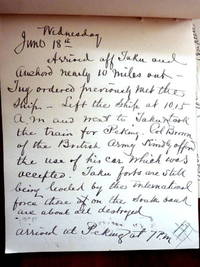
19020002347ABOARD THE USS NEW YORK. Good. 1902. On offer is a superb fascinating original soft bound 1902 China Station diary and personal log handwritten by Admiral Frederick W. Rodgers 1842 - 1917. Rodgers was a Rear Admiral in the United States Navy. He fought in the American Civil War and ascended to be the last commander of the Asiatic Fleet. He was a grandson of U.S. Navy Commodore Matthew Perry. In May 1901 Rodgers became Senior Squadron Commander within the Asiatic Squadron. On March 1st 1902 he became the commander of the entire Asiatic Squadron which was engaged in combat during the Philippine-American War at the time. He was the Squadron's last commander. At the end of his tour on 29 October 1902 the Asiatic Squadron was abolished and its responsibilities were assumed by the new United States Asiatic Fleet. This logbook documents his ship the U.S.S. New York while stationed in Amoy China and Nagasaki Japan during a critical time in the area's history. The log begins March 27th with a final entry on - July 26th 1902. The log recounts the daily workings of the ship and personnel deployments lists of repairs to various ships within the Asiatic Fleet. What is of real importance is Rodgers encounters with the Emperor of China and Prime Minister of Japan. He also mentions other naval vessels from Britain Germany and Japan listing the ship's numbers and armaments. This log contains important information about the fleet in this very historical period when the United States emerges as a world naval power. The 60 pages of handwritten narrative and notes make for some revealing entries regarding American efforts at diplomacy in the area; Rodgers' diplomatic contacts with the Emperor and Dowager of China are well noted as are intelligence reports on fortifications in China. He mentions brief reports from missionaries concerning conditions in the interior of China contact with British troops who are guarding parts of Peking. While in Peking Rodgers meets the British Foreign Minister and writes about the looting that took place at the summer palace blaming it on Russian and Italian troops during the Boxer Rebellion. Furthermore he discusses positioning gunboats along the rivers near Peking due to further disturbances. Rodgers also mentions meeting the Prime Minster of Japan encounters with the Japanese navy and various dignitaries princes and barons. Here are some snippets: U.S.S. New York -March 27th 1902 Cable arrived from Hong Kong French Cruiser Arriau called on the American Consul no information from him - he informed me that there was nothing new to report here. A missionary who had just returned from an extensive trip into the interior had informed the consul that he had been treated with much consideration. U.S.S . New York - March 31st 1902 Woosung China - Visited Chinese Cruiser Hai Chai cable from Widdes asking change of officers from G.C.M. not practicable - one case of Cholera in Cavite - condition in Manila improving. Glaicer arrived Cavite - Drake commanding Muntrey officially visited ship brought in 3 cases for G.C.M. U.S.S. New York April 2nd 1902 Left ship at 3 pm for Shaug Hai 30 min from ship to station Woosung road is bad anchorage . The tides were up to more than four knots - ships at single anchor are liable to drag. Went to French hotel De Collmines - it is fairly good but the rooms are most uncomfortable - Captain Tah of the Chinese navy accompanies us. Friday April 1902 Intelligence reports from Monterey Fortifications of the Yangsee River - Forts on Silver Island Black Dragoon forts -Forts at Chu San Knan Forts at Kiaung Yri Required examination of the county between Woosung and Shanghi copy of railroad maps mark chart examination of Woonsung river regards fortifications. U.S.S. New York- April 22nd 1902 New York sailed for Yokahma at 9am Weather raining: A German steamer came in last night with Prince Imperial on board - made preparations for a national salute address ship but found steamer had carried no distinctive flag boarding officer at 4am countermanded order for salute and dressing ship. U.S.S. New York Yokahama Japan Monday April 28th 1902 Rear Admiral Evens hoisted his flag exchanged salutes Went to Tokio Made official visits to US. Minister To Prime Minister of Japan To Minister of War Called on Baron Kaneko. Wednesday June 18th 1902 Arrived off Tokio and anchored nearly 10 miles out - Tug ordered previously met ship - left the ship at 10:15 am and went to Tokio took the train to Peking. Col Brown of the British Army Kindly offered the use of his car which was accepted. Taku forts are still being leveled by the international force those on the south side are all destroyed. Arrived at Peking at 7pm.was meet by a gentleman from the legation and a guard of honor from the 9th infantry. Went to the U.S. legation with my personal staff as a guest of Hon E.S.Conger. Thursday June 19th Visited the temple of Heaven discussed affairs with minister he informed me that the principal questions now between the Chinese Government and the internationals are: First as regards the transfer back to civil administration of the Tuiu Suen and Peking rail road and 2 the return of the city of Tien Sien to civil administration. The rail road is now under English military management. Called on the various foreign ligations - only met two personally the German and the Japanese. Friday June 20th 1902 Visited the Summer Palace of the Emperor. A special permission from the Foreign office was required to visit the Palace it is the most interesting place about Peking but the effects of the results of the trouble in 1900 is very apparent and the destruction was very great - Repairs have been made to a very limited extent this place was occupied by the Italians and Russians who must have looted it to the fullest extent. Peking Sunday 22nd 1902 Diplomatic dinner at the legation - meet the English Minister than the Austrian Charge of Affairs also the Russian Minister. Peking Tuesday June 24th 1902 By Previous arrangements was given was audience by the Empress Dowager and the Emperor at the Winter Palace. The logbook has one torn page one page detached from the binding and four blank pages and is overall G.; Manuscript; 8vo - over 7¾" - 9¾" tall; KEYWORDS: HISTORY OF ADMIRAL FREDRICK W. RODGERS ASIATIC SQUADRON LOGBOOK CHINA STATION JAPAN. TURN OF THE CENTURY EARLY TWENTIETH CENTURY NAVAL MARINE MARINERS WARSHIPS SOUTH CHINA SEA UNITED STATES NAVY USN FLAGSHIPS DIPLOMACY NAUTICAL PHILIPPINE-AMERICAN WAR POST SPANISH AMERICAN WAR COMMODORE MATTHEW PERRY U.S.S. NEW YORK EMPEROR OF JAPAN EMPEROR OF CHINA DOWAGER EMPRESS OF CHINA TOKIO TOKYO AMERICANA HANDWRITTEN MANUSCRIPT AUTOGRAPHED AUTHORS DOCUMENT LETTER AUTOGRAPH KEEPSAKE WRITER HAND WRITTEN DOCUMENTS SIGNED LETTERS MANUSCRIPTS HISTORICAL HOLOGRAPH WRITERS AUTOGRAPHS PERSONAL MEMOIR MEMORIAL PERSONAL HISTORY ARCHIVE DIARY DIARIES JOURNAL LOG PRIMARY SOURCE FIRST HAND ACCOUNT SOCIAL HISTORY PERSONAL STORIES LIVING HISTORY ANTIQUITÉ CONTRAT VÉLIN DOCUMENT MANUSCRIT PAPIER ANTIKE BRIEF PERGAMENT DOKUMENT MANUSKRIPT PAPIER OGGETTO D'ANTIQUARIATO ATTO VELINA DOCUMENTO MANOSCRITTO CARTA ANTIGÜEDAD HECHO VITELA DOCUMENTO MANUSCRITO PAPELBIOGRAPHY BIOGRAPHICAL AUTOBIOGRAPHICAL AUTOBIOGRAPHY PERSONAL NARRATIVES . paperback
19600001561Liao Village Yong Qing County HeBei Province PEO. Good. 1960. On offer is an extraordinary original historically significant 139 page manuscript archive of Mao Zedong's Cultural Revolution handwritten by a man named Liao Zi Yu of Liao Village Yong Qing County HeBei Province was born in 1912 worked as a proof-reader at the printing works the HeBei Agriculture University from 1951 to 1973. The Liao family owned 1400 Mu of the land before 1937 and it also owned a shop selling fabrics. Liao ZiYu inherited properties including land of 710 Mu brick house with 30 rooms mud house with 3 rooms 6 large animals and 2 man-powered vehicles. He started to manage the family affairs in 1934 together with his brother who was killed by the Japanese in 1938. He then worked alone till 1946 when the Land Reform reached the area. At the onset of Mao Zedong's Cultural Revolution landlords and capitalists in the urban and rural centres were identified and accused of exploiting and oppressing the working class. Overthrowing the exploiting and oppressing class was a primary concern of Chairman Mao and the Communist Party of China. Mao pushed the Chinese into a civil war in order to overthrow the Republic of China which succeeded and the result People's Republic of China in 1949. Mao then began to liquidate and suppress those persons who belonged to the exploiting class. This was known as the 'Movement of Suppressing Counter-Revolutionaries' in early 1950's in China. In this archive we follow Liao Zi Yu's attempt to avoid being suppressed as a member of the exploiting class and a counter-revolutionary by moving and concealing his real identity. He lived hidden and got work as a common labourer for more than ten years from 1949. But early on in the Cultural Revolution his real identity was disclosed as was his former life as a landlord. From that time on his was a doomed life: investigated jailed and forced to confess his crime this file recorded the complete process. RESEARCH NOTES: He was accused of 1 Exploitation of the workers: He employed 7 long term workers 6 monthly ones 4 to 5 short term ones and 4 others for the house duties. He owned 5 pieces of gun. He exploited the workers brutally. 2 Exploitation of the land rental: He rented out over half of his land holdings with rent up to 4 Yuan per Mu. The rent must be paid before October for next year's rental. He forced the peasants to pay the rent using the power of his uncle who was the town's Reeve. 3 Serving the enemy: He was the town secretary of AnCi County for a month by making anticommunist slogans such as "Welcome the Nationalist Army". 4 Escaping the supervised labour: He got a job at the HeBei Agriculture University by falsifying his résumé and hiding the fact that he was a land owner. He was put into the supervised reform by the revolutionary mass in 1966 soon after the exposure of him as a landowner. He was moved by the policies of the communist party and was able to admit his crime and made confession. He was not classified as the landowner but would be expelled from the University and be sent back to his home village to work as a farmer. The decision was reached by the committees of the communist party at the levels of the printing works the University and the District of BaoDing in a period from 1970 to 1973. The archive includes: comprehensive files regarding the investigation evidence confession 80 pages!! handwritten on People's Republic of China stationary. Overall G. HISTORICAL NOTES: As one online source succinctly sums up the times: "People's Republic of China from 1966 through 1976. Set into motion by Mao Zedong then Chairman of the Communist Party of China its stated goal was to enforce socialism in the country by removing capitalist traditional and cultural elements from Chinese society and impose Maoist orthodoxy within the Party. The most important yet naturally unstated reason for the revolution was the return of Mao Zedong to a position of political power after he lost most of his political influence after his failed Great leap forward."; Chinese Language; 4to - over 9¾" - 12" tall; KEYWORDS: HISTORY OF GREAT PROLETARIAN CULTURAL REVOLUTION CULTURAL REVOLUTION CONFESSIONS RECENT ANTI SOCIALIST ACTIVITIES ANTI CAPITALISM MAO ZEDONG MAO TSE TUNG GREAT LEAP FORWARD MAOIST SOCIALISM COMMUNISM MOVEMENT OF SUPPRESSING COUNTER-REVOLUTIONARIES MIAO ZI YU COMMUNIST CHINE CHINESE SINO POLITICS JIANG QING GRASSROOTS SOCIALISM PROPAGANDA POST FIVE YEAR PLAN 5 YEAR PLAN GANG OF 4 GANG OF FOUR LIN BIAO BEIJING PENG LUO LU AND YANG ZHONGFA 267 INDOCTRINATION RED CHINA CHAIRMAN MAO MARXISM-LENINISM MAOISM LIN YURONG HANDWRITTEN MANUSCRIPT AMERICANA DOCUMENT LETTER AUTOGRAPH DIARY JOURNAL LOG KEEPSAKE WRITER HAND WRITTEN DOCUMENTS SIGNED LETTERS MANUSCRIPTS HISTORICAL HOLOGRAPH WRITERS DIARIES JOURNALS LOGS AUTOGRAPHS PERSONAL MEMOIR MEMORIAL PERSONAL HISTORY antiquité contrat vélin document manuscrit papier Antike Brief Pergament Dokument Manuskript Papier oggetto d'antiquariato atto velina documento manoscritto carta antigüedad hecho vitela documento manuscrito Liao Village Yong Qing County HeBei Province . unknown
19350009004Yangtze River Shanghai Hankow China. Good. 1935. Unbound. On offer is a fascinating and significant handwritten diary that was found with other military items from a US 4th Marine Veteran George Mower who served in China WW II and Korea. The very unique diary was written by five Marines their rank and last names listed on the first page while on duty in China from Dec. 28 1934 through Feb 1 1935. The very first words of the journal are as such: "This diary of facts concerning a trip made up the Yangtzie River into the interior of China that mysterious and forbidding land of the Green and Yellow Dragon - by five marines detailed as armed guards for the Yangtzie Rapid Steamship Co. - an American owned and operated Co. - was conceived and written by Oscar Nelson and George Mowers with the help of the remainder of the detail. The trip and what is said about the country is described by Mowers. Nelson was the he located the different points of interest learned their names and their distances apart. All members of the group added the human interest which is committed to the pages. This diary was not kept for material gain but only as a souvenir. It is written in the simple words of those who made the trip so that as they ramble through its pages so they may live over again in the memory those days spent on the Yangtzie River." The men on detail are referred to as Lt. Hussa Sgt. Stevens Cpl. Nelson Pvt Mowers and Pvt. Sours. On December 28 they gather their supplies and embark "at 5:15 PM aboard Yangtze River Steamship Co. Ship I'Fung". During the detail there are many details on their trip often in the military way of breaking down the events by the time they happened "At 1700 it begins to darken - a cold rain makes visibility poor. The bleak and dreary banks of the river is now relieved by several hills crowned by pagodas and tall trees." On another day the diary states "The weather is cold and the wind still too high to allow us to venture out on deck to observe much of the country along the banks of the river. What I can see of the short from my cabin window looks to be cold beak bare and desolate. Occasionally I can pick out a small grass shack from which drifts a small lazy column of smoke. Then at other times I can see a Chinese farmer scurrying along the banks of the river or perhaps he's a fisherman. What a perfect setting for one who likes nature in the raw. I'll take mine after it has been refined." There are plenty of details about life on the ship and the dreary and rainy conditions which seem to be ever present. As well the authors of the diary seem to be slightly interested in Chinese history as there are some small passages on the history of China: "At the close of the Sung dynasty it was founded by refugees who fled from other parts of the country to escape the conquering Mongols." There is also writings about the little time off in Shanghai and Hankow. "Arrived at Hankow and anchored at 1600. Clean well built city from the river. Went ashore after dinner and walked up the - clean and well policed. Rickshawed and walked thru the city. A big prosperous city - modeled after Shanghai - but did not see much of interest. Their famed "Cabaret Row" was a flop. Was sober and the girls looked old and their teeth were dirty. The liquor was bad." There are also run ins with bandits and pirates "Now when you get on the land opposite your ship you run into some of the famous Yangtzie River Pirates in the guise of men. They demand 40 cents big money to bring you a hundred yards to your boat. And they get it or you swim." One of the trips ashore is described as "By chance we were witness to a very interesting sight this afternoon. We saw a number of Chinese soldiers forcing a number of Chinese civilians into service in the army. They must have had about a thousand of these recruits and they marched them down the streets four abreast. Some of the recruits were greasy and dirty looking as though they had been taken from shops or factories while others were a little seedy looking and indicating that they were farmers or fishermen. What a strange site they formed as they marched along.In age and size they ranged from mere boys to full grown men. Each one of them carried on his back a blanket or rag in which was roped all of his worldly possessions as a whole they resembled a herd of wild sheep being herded to the slaughter house. Such is life in China some Chinaman with a little money who has had the privilege of gaining a little knowledge and an education declares himself a general recruits himself an army - either willing or otherwise - and procedes to make himself master of all he surveys." The diary is full of these fascinating little observations of life and nature in China along the banks of the Yangtze River. There are also details on the military strife happening in China in the mid-1930s. "National Chinese soldiers are being sent up the river to Wanhsien and other towns in the Szechuan province for very obvious reasons. Szechuan theoretically is supposed to be a part of the Republic of China but in practice it is not. It is controlled by General Lu an influential and powerful General. Szechuan is the richest province in China is isolated from the rest of China due to the fact that it lies in the remote western part of the country and is surrounded by mountain boundaries which are almost inaccessible except by way of the Yangtzie river through the gorges . It is to this isolation and natural defence formed by the mountains General Lu in the past with aid of his powerful and well equipped army has been able to maintain control over Szechuan and levy and collect the taxes. The armored detail eventually switches from their original boat to the I'Ping and then to the I'Chang. The diary ends on Feb. 2nd with no mention of any transfer or change in duty only that they were close to Shanghai. It is unclear whether this diary is complete or not. Each page is numbered at the top so they are very easy to keep in order as the pages are loose and unbound. It ends with "We anchored for the night at 2200. Lt. Shaw said that the Captain told him we would be in Shanghai about 1000 tomorrow. Nelson is becoming more and more restless. He is longing for the dear old Shanghai nights." All pages of the diary are easily readable in a very accessible script. There are spelling mistakes consistently throughout the diary but they are not a barrier to understanding the words. Each page is in excellent condition.; Manuscript; 9" x 12"; KEYWORDS: HISTORY OF STORIES OF UNITED STATES MARINES EXTRA-MILITARY DUTY CHINA PRE WORLD WAR TWO PRE CHINESE COMMUNIST REVOLUTION YANGTZE RIVER HANKOW SHANGHAI BANKS OF THE YANGTZE RIVER GREEN AND YELLOW DRAGON YANGTZE RIVER STEAMSHIP COMPANY YANGTZIE THE SAND PEBBLES LIEUTENANT HUSSA SERGEANT STEVENS CORPORAL NELSON PRIVATE MOWERS PRIVATE SOURS USMC I'PING I'CHANG AMERICANA HANDWRITTEN MANUSCRIPT DOCUMENT LETTER AUTOGRAPH WRITER HAND WRITTEN DOCUMENTS SIGNED LETTERS MANUSCRIPTS HISTORICAL HOLOGRAPH WRITERS AUTOGRAPHS PERSONAL MEMOIR MEMORIAL AMERICANA ANTIQUITÉ CONTRAT VÉLIN DOCUMENT MANUSCRIT PAPIER ANTIKE BRIEF PERGAMENT DOKUMENT MANUSKRIPT PAPIER OGGETTO D'ANTIQUARIATO ATTO VELINA DOCUMENTO MANOSCRITTO CARTA ANTIGÜEDAD HECHO VITELA DOCUMENTO MANUSCRITO PAPEL . unknown
19420002595THE HUMP TAKORADI ROUTE. Good. 1942. On offer is a sensational historically significant manuscript and photographic relic of World War II service with the unusual and unique perspective of a 'blue collar' aviation machinist's mate who was employed by one of America's most important and key strategic resources: Pan American Airlines. Harry W. Snyder Jr. was an aviation machinist's mate for Pan American Airways - Africa Ltd. He created and compiled an absolutely rare and detailed retelling of his work service travels and observations and Harry proves to be a sensational keen eyed diarist. Adding further depth is a scrapbook filled with fascinating images. Of particular interest to historians and researcher to this vastly important historical niche of strategic resource relationships during WWII will understand Pan American's key involvement creating Pan American Airways - Africa Ltd. in 1941 between. It flew materials and personnel from Miami to South America across the Atlantic to Africa where it crossed the Sahara Dessert onto the Middle East and British India where it flew over the Himalaya Mountains "The Hump" as it was called into China. Harry is in an inviable position to witness history: the diary riod when the United States was just beginning its African campaign. He begins writing in June as he leaves the states and then spends some brief time in South America. His entries begin June 24 1942 with a final entry Dec 25 1942. The diary entries mention the issues with Pan American and how the lines were often blurred between civilian and military operations. It seems the company in Africa was going to be taken over by the U.S. Army. He also mentions many plane crashes or "crack ups" as he called them some with horrible results. An entry from the diary mentions a fighter plane losing control the pilot bailed out but his parachute failed to open and he dies on impact. His plane blew up on the runway ammunition exploded into the night. This is just one of the entries there are more crashes air raids and practice drills in case the Germans bombed having to carry a gun native troops with tanks machine guns etc. Snyder also writes about life in the Africa and the West Coast city of Accra Capital city of Ghana the bars and other establishments nightclubs prostitutes native people soldiers there is so much more. In addition to the diary there is an excellent photo album depicting scenes from Accra showing life among the native people local soldiers street scenes etc. The album contains 71 photos after his service with Pan Am Harry then joined Navy and earned several medals for his service in WW II. Here are some snippets: June 30 1942 Flight to South America than Africa. Up at 4:45 am breakfast & than to the airport. Plane checked up or 2 guys took off at 7:55 Flew through storms most of the way sighted boat once during break in storms. Over Brazil & hours of nothing but jungle. Some small huts along Amazon River only signs of life. Almost dark when we landed. Just missed a crash when we had to pull up to miss a boat. Circled again and landed at 5:45 pm Raining when we landed. One mans over night hit went overboard & had to be recovered. Took bus to Grand Hotel in Belium. Pera Everyone speaks Portuguese had trouble getting dinner using Mil Res= to about 0.5 took watch tonight and girls Both rode the trolley. This is a funny place to write this because I never forget it anyway. The hotel is lousy ants & lizards all over. Lizards will crawl up and down walls. I wrote to Sally & mom to tell them about the lousy dump censors will probably cut out half of the letters. I will tell them again when I get to Africa. I want to get mosquito nets tomorrow; they will cost 100 Mal I hate to go to bed here as I am afraid of getting jiggers or something worse. There are a lot of us sailors here they told us places to go. They are all liquor dives. Went to the "Wonder Bar" Its a wonder all right that anyone can stand it. Beer women don't like either. Women will hang all over you if you don't chase them. I kept moving around until we left so that could not sit down near me. They are all filthy I cant wait to leave here. July 6 1942 Africa Assigned to " Equipment" Easy job check flares pistols rations etc. Start in at 6:30am and finish at 4:00pm landed job today and checked plane out ok'ed by Lawson. Not hard to make the "Wogs" do all the dirty work. Rumors about army taking over are still persistent and I believe this to be true. Maybe here for duration yet. I hope not. Wrote 4 letters tonight saw movie "Ice Follies 39" old but good. Saw a Bristol Bear fighter on field today it as pained black. Sweet looking plane. July 10 1942 Africa Up at 5:45 ate breakfast than to airport worked on a couple of planes that had to go out and tan took it easy. Came in for dinner and found Tommy Olsen in Rec Hall he just got in late last night. The others are still in Natal. Back to field but nothing to do took it easy all afternoon al the near quitting time got a plane to ready for morning. A native boy killed a deadly viper under the Goodman's & brought it out on the field. Very ugly looking. July 13 1942 Africa Up into work at 7:00 We started new hours today I felt lousy all day. Very weak & had a stiff neck. Only 3 ships on field for us to check so I was lucky & didn't have to work hard. There were 5 B 24's on field today but 4 flew out. Two of out ships cracked up over weekend 085 flew out on Sat cracked up at Khatouw- and another ship cracked & burned some other place. Bad weekend for P.A.A. Army took over pilots today they were made Capt's & first Louis I supposed I will find out were I stand in a couple of weeks. July 17 1942 Africa Up breakfast & airport lots of work this mourning & found out they were expecting the 40's they had both fire eng. & meat wagon ready & also asbestos suits. However the 40s didn't get here. Ate lunch & got letters from Ma. July 21 1942 Africa Up and breakfast than airport. Read notes & went to work. Lunch and than back to work a bunch of B-24's have been coming in all day. English show this afternoon. Wrote to Sally & folks. Listened to phonograph & started talking with some B-24 pilots on their way out to Cairo. Lost a couple B-24s on way one at Roberts went in ocean 2 out of eight alive. I am wondering if I'll ever get home again ever. H. Told me that if we do go home we will be marked and drafted back into service right away if the army wants us. Don't know but what should try for Specialist. But I think I 'll go home if I get a chance. Join the navy if I have no other choice but draft. July 27 1942 Africa Up breakfast field worked morning on ships going out today and tomorrow- B 24's went out today & night noon time mail in but none for me. Heard rumor that Seattle was bombed but no proof. Back to field & worked until 4:00. A lot of B-25's came in today. Collected the ck after 4:00 pm than down to Barracks & shower. Aug 1 1942 Africa I have been away over 1 month now here in Accra for almost 1 month. This place is fairly nice the food is not so bad except once in a while when we got goat or something worse. This month has been hectic in that we hear so many rumors etc. It is a fact that the army is taking over but we don't know it what capacity & what our status will be. So there's nothing do to but wait. I never knew before how much mail can mean to a person & am glad for the friends who write me. Aug 21942 Africa Up at 8:45 breakfast -my day off so I decided to go to Accra went in rented a bicycle went to lumberyard - docks - got wet riding than along breakwater saw drummers wet out to Christian log castles saw dungeons went to court building & police station than native market & than back to Accra saw a chiefs procession. Than got on bus & went back to camp. Aug 31 1942 Africa This month sure has been a trying one. First were going to severe contracts than are not than were going home & latest rumor had it that we'll stay here either in the army of the U.S. or else in civil service I guess we'll get the real lowdown eventually whew they'll really tell each if us just what we can be if we stay here or if we can ho home at all. Every day brings a new confidential story on the set up and each one as far fetched as the other. Everyone has been broke for about a week already as they are holding up our pay checks for some reason. Rumor still has it that we will get a hell of a strafing here some night. Particularly since they bombed the convoy at Lagos. Well its almost 2 months Ive been in Africa and I'm not crazy about it. The food is getting worse every day and I miss my gal. Hope for better information in the coming month. Sept 13 1942 Africa An air raid siren woke me at 5:30 up & went out to see the score. Decided it was a practice when nothing showed up than breakfast and work. At 10:00 a couple of Blenkeims Hudsons & Beam fighters staged a raid on the field. Boy what a sight. Zooming lovely above the ground & between the hangers. We all made for the bush saw 100 native troops on maneuvers all clean & on for chop no meal back to field. The whole place is crawling with native troops tanks machine guns everything. Off early so back to camp. No lights no water bad situation. Nov 8 1942 Africa Up breakfast - wash Heard the American troops landed in French Morocco. All planes are grounded expecting air raid - everyone with a gun must carry it. Cleaned & loaded guns on all planes. Installed bomb racks lunch and back to field. Rumors of all kinds from Italy to Doha etc. Went to 4;00 movie fleets in "Saw it back home with Sally chop and shower than wrote Sally. Total black out tonight keep up until we see where we stand. Funny to be here & yet not know what goes on. People at home probably all know. Bed at 11:00.' HISTORICAL NOTES: Pan American Africa: Pan American Airways-Africa Limited proved to be one of the Allies' most important strategic resources during World War Two. The company was formed in July 1941 after negotiations between the governments of the U.S. and the U.K. following earlier British overtures to Juan Trippe. By 1942 Pan Am Africa's crews and aircraft were flying from Miami down to South America across the Atlantic to Africa's West Coast across the Sahara to the Middle East on to what was British India and across the mighty Himalayan Mountains the "Hump" to western China. They carried strategic materiel and personnel and kept an absolutely vital line of communication open between global theaters of war. Each leg of that route presented challenges to both humans and machines. The route across the fabled Sahara Desert had its own particular issues: brutal heat extreme isolation primitive or non-existent infrastructure and sandstorms to name a few. The route across Central Africa had been pioneered through British civil aviation efforts starting in the 1920's but the scale was limited. With the coming of the Second World War operations and infrastructure had to increase dramatically. In some ways opening and operating those remote airfields resembled the work Pan Am had undertaken when opening the transpacific route in the mid-1930s. Aviation fuel had to be trucked in from great distances over primitive roads. Food and water were scarce. Success demanded ingenuity and an ability to take advantage of local resources. Like the opening of the "Hump" route the success of the "Takoradi Route" as it was called remains one of the truly impressive achievements of Pan American Airways' contributions to ultimate victory of the Allied cause which by the close of the war was being identified as that of the "United Nations."; Manuscript; 4to - over 9¾" - 12" tall; KEYWORDS: HISTORY OF; HARRY W. SNYDER HISTORY OF FLIGHT AVIATION PAN AMERICAN AIRWAYS - AFRICA LTD. WWII WW2 ACCRA GHANA STRATEGIC RESOURCES AFRICAN CAMPAIGN TAKORADI ROUTE THE HUMP HIMALAYAS AMERICANA HANDWRITTEN MANUSCRIPT DOCUMENT LETTER AUTOGRAPH WRITER HAND WRITTEN DOCUMENTS SIGNED LETTERS MANUSCRIPTS DIARY DIARIES JOURNALS PERSONAL HISTORY SOCIAL HISTORY HISTORICAL HOLOGRAPH WRITERS AUTOGRAPHS PERSONAL MEMOIR MEMORIAL ANTIQUITÉ CONTRAT VÉLIN DOCUMENT MANUSCRIT PAPIER ANTIKE BRIEF PERGAMENT DOKUMENT MANUSKRIPT PAPIER OGGETTO D'ANTIQUARIATO ATTO VELINA DOCUMENTO MANOSCRITTO CARTA ANTIGÜEDAD HECHO VITELA DOCUMENTO MANUSCRITO PAPEL . unknown
194432352Washington DC: U.S. Government Printing Office 1944. First Edition. Hardcover. Fine in original vellum-backed marbled boards with gilt-lettered morocco spine label in original blue slipcase. Small quarto. 7.25 x 10.25 in. 10 pp. Printed beautifully with large calligraphic typeface title printed in red capitals in red and blue pages ruled in red. Limited edition numbered 61 of 100 copies. Inscribed by FDR to Jonathan Daniels on front free endpaper. Daniels son of Josephus Daniels was FDR's administrative assistant and served as his press secretary in the month before the president died. <br/><br/> (U.S. Government Printing Office) hardcover books
19090001621SERBIA YUGOSLAVIA BALKANS ALBANIA. Very Good. 1909. On offer is a very significant historical archive of ten 10 original manuscript diaries handwritten by Danilo Kalafatovic 1875-1946 former General and Chief of Staff of Royal Yugoslav Army. Dated from 1909 -1930 the author writes in Serbian Cyrillic script over 530 pages details containing military political and diplomatic notes from important historic events in Serbia Yugoslavia and the Balkans. This unique archive presents a one of a kind perspective from the cradle of conflict by one of the main players prior to World War I and then throughout the pre World War II era. The notebooks breakdown as follows: 1. 1909 - 1911 Appointed military attache in Bulgaria: 43 pp. with written text of 92 total pp. 2. 1913 Peace Conference at Bucharest: 51 pp. with written text 108 total pp. 3. 1914 WWI: total of 90 pp. with written text. 4. 1916 WWI - boarding of Serbian Troops at Vlore /Valona/ Albania: 60 pp. with written text of 72 total pp. 5. 1917 WWI - describes the condition of Serbian Army at Salonique line: 49 pp. with written text of total 120 pp. 6. 1918 some notes after the WWI has ended: 10 pp. with written text of total 56 pp. 7. 1920 Negotiations with Italy about Free State of Fiume: 100 pp. with written text of circa 140 total pp. 8. 1921 Negotiations with Czechoslovakia: 30 pp. with written text of total 70 pp. 9. 1923 Committee for Delineation with Romania: 74 pp. with written text of total 88 pp. 10. 1930 Inspector of Ground Defence: 25 pp. with written text of total 160 pp. Ranks: 1896 - 2nd Lieutenant of the Artillery; 1903 - Captain; 1 October 1915 - Colonel; 5 January 1923 - Divisional General; 11 April 1930 - Army General. Decorations: The order of the Karageorge Star III Class; The order of the Karageorge Star IV Class. Assignments: 1900 - company commander and orderly officer to the king; 1902 - Commander 5th Battery/2nd of howitzer artillery regiment; 28 March 1903 - Commander 3rd Battery/1st of Danube artillery regiment; 6 April 1907 - orderly officer to the king; 3 October 1907 - assistant to chief of staff of Danube divisional district; 1909 - chief of staff of Timok divisional district; from 8 June 1909 to 1913 - military attache in Bulgaria; also from 27 April 1911 to 1913 - military attache in Romania; from 2 September 1913 to 1914 - commander of 3rd Battalion of 7th Infantry Regiment; from 1 April 1914 to 13 July 1914 - commander of Bregalnica Infantry Regiment; from 28 July 1914 to 16 April 1916 - chief of staff of Morava Division 2nd Call; 1916 - president of Committee for troops embarkation in Valona; from 16 April 1916 - chief of Intelligence section of Supreme Command; from 25 July 1917 to 4 May 1920 - chief of Operational section of Supreme Command; 1920 - military expert in Paris and Rapallo; from 15 April 1941 - chief of staff of Yugoslav army. He died In Mozburg 1946. BIO NOTES: Born on 27 October 1875 in village of Konarevo near Kraljevo. Graduated in 26th Class of Lower and 8th Class of Higher School of Military Academy. From 1900 to 1902 went to School of Applied Artillery École d'application de l'artillerie in Fontainebleau France. In 1909 married Milica daughter of Dragomir Lazarevi from abac. They had a son Ratomir Ratko which graduated as first of the 57th Class of the Military Academy and daughter Vera. On 15 April 1941 Kalafatovi was named chief of staff of Royal Yugoslav Army and given power to negotiate surrender of the remains of the army he issued the orders for unconditional surrender. Various sizes: smallest 10 5 x 6 5; largest: 16 x 10 5 cm. Overall VG.; 48mo - over 3" - 4" tall; KEYWORDS: HISTORY OF DANILO KALAFATOVIC ROYAL YUGOSLAV ARMY PEACE CONFERENCE AT BUCHAREST SERBIAN HISTORY ALBANIA SERBIA YUGOSLAVIA MACEDONIA GREECE GREEK HELLAS WORLD WAR I WWI WW1 WORLD WAR II WWII WW2 BALKANS GERMANY SALONIQUE SALO . unknown
195020010292Duell Sloan and Pearce New York 1950. First Edition. Hardcover. Good/No Dust Jacket. Hardcover. 272 pages. PUBLISHING DETAILS: Duell Sloan and Pearce New York 1950. First Edition. CONDITION: This book is in good condition but dust jacket is not included. More specifically: Covers have superficial rubbing/wear. Edges of boards have superficial edgewear and corners are moderately bumped. Edges of pages are slightly foxed. Pages are reasonably tanned. Gift inscription in ink. Quantity Available: 1. Category: Biography & Autobiography; Inventory No: 20010292. Duell, Sloan and Pearce hardcover
19510001560ZhangJiaKou HeBei Province PEOPLE'S REPUBLIC OF C 1951. On offer is a significant historical manuscript document archive of 120 pages handwritten by a Chinese teacher named Wang JiYao who was a teacher at the Food Oil factory City of ZhangJiaKou HeBei Province in the era of the anti-rights struggle of the 1950's. Historians and researchers and collectors of the era will note the schizophrenic nature of the times so clearly displayed by the totality of these papers. The man in this archive was a teacher born in early 1930s becoming a teacher in 1951. As the Chinese government launched a call for intellectuals to give advice and even criticize the leader of the government in early 1957 this teacher gave frank and reasonable advice and criticism of the government. Later that year the situation reversed. He and thousands of other intellectuals in China who criticized their leaders and government were judged guilty of anti-socialist thought and right wing deviation. He was classified as a Rightist for what he said in his daily life. Some examples: "The brutality of the communist party is unsurpassed by the Qin Emperor"; "It should be fine to criticize Chairman Mao because he is an educated man"; "If the leader refuses the criticism then he should not be a leader". The writer was called to confess his so called crimes. The confession was written by Wang JiYao from 1951 to 1957 the material written before 1957 was related to his family because he was born to a landowner's family which was classified as the class enemy number one. Other reports were written by many coworkers to show Wang JiYao had the rightist ideas by revealing what he said in the past. No conviction material was attached. The 120 pages consist of more than 10 files including: his registration forms in early 1950s; three impeachment or disclosure files including testimony of co-workers; and five files of his confessions of guilt 70 pages! in 1957. This archive is a particularly interesting encapsulation within one man's experience of a sadly all too typical occasion in mid 20th Century China. Overall G. HISTORICAL NOTES: One online source provides: The Anti-Rightist Movement of the People's Republic of China in the 1950s and early 1960s consisted of a series of campaigns to purge alleged "rightists" within the Communist Party of China CPC and abroad. The definition of "rightists" was not always consistent sometimes including critics to the left of the government but officially referred to those intellectuals who appeared to favour capitalism and class divisions and against collectivization. The campaigns were instigated by Chairman Mao Zedong and saw the political persecution of an estimated 550000. The Anti-Rightist Movement was a reaction against the Hundred Flowers Campaign which had promoted pluralism of expression and criticism of the government. Going perhaps as far back as the Long March there had been resentment against "rightists" inside the CPC for example Zhang Bojun. The first wave of attacks began immediately following the end of the Hundred Flowers movement in July 1957. By the end of the year 300000 people had been labeled as rightists including the writer Ding Ling. Future premier Zhu Rongji then working in the State Planning Commission was purged in 1958. Most of the accused were intellectuals. The penalties included informal criticism "re-education through labour" and in some cases death. One main target was the independent legal system. Legal professionals were transferred to other jobs; judicial power was exercised instead by political cadres and the police. Good. 4to - over 9¾" - 12" tall. Chinese Language. unknown
19190009030QUINCY ILLINOIS. Fair. 1919. On offer is a truly remarkable Civil War document: A deeply detailed and fascinating retrospective journal of Matthew Jansen Captain of the Union Army's 27th Illinois Regiment during the Civil War. It was handwritten in 1905 by one of Jansen's brothers Theodore who served alongside of him. It is over 60 over sized pages long and very densly filled with original content some of which was published in "The Biography and Reminiscences of Matthew Jansen 1905". The manuscript was oddly created; some portions in a cardboard folio some sewn and otherwise attached forming double sheets. The brittleness of the paper resulted in some loss to the edge and joins but since we received the item a master conservator has made repairs and stopped the losses. It gives significant first hand details about the life he lived and the many battles fought with the 27 Illinois Regiment. It begins the years before the War in Quincy Illinois where Jansen and his brother were from to the enlistment of Jansen as a private until 1865 all the way to fighting with General Sherman in Atlanta. It is an incredible piece of American history with in depth and vivid descriptions of battles fought lives lived and sights seen. Theodore writes lovingly and engrossingly about his brother constantly praising his skills and acumen in battle and in life. Much of the diary are the facts of battle but there are also passages that speak of why the brother's are fighting the war in the first place. They seem staunchly anti-slavery. Speaking on the Emancipation Proclamation the journal reads: "no thank God its dead yes slavery now from this day over is dead Lincoln's Proclamation killed it one an undivided Democrat and Republican Volunteer Soldiers who are now going to give a backbone to the Emancipation Proclamation by going on Picket Guard " There are also passages that describe in horrid detail the horrors of war death hunger and disease. There are harrowing passes of the suffering brought up all soldier civilian and even the horses during the bloodiest war in U.S. history. Here is a very small portion of what is in this incredible journal: "Kansas border ruffianism was republished daily and constantly inferred to either for or against both political parties until October 13th 1859 the great political orators Abraham Lincoln and Steven A Douglas arrived in Quincy and next day they engaged in a joint debate which attracted thousands of both parties from far and near and the amount of light their joint debate defused subject was certainly of the greatest value to all who heard it understandingly as it clearly defined the position of the south and the north Brother Matthew had the advantage of most young men of that age as his experience at the P House at Leavenworth Kansas had taught him many things and when abruptly after the Lincoln and Douglas debate a polished club known as the 'Wide Awakers' was organized become one of the principal aids in formation and was thereafter elected by a large majority as its First Lieutenant " The Wide Awakes was a teen and young adult organization cultivated by the Republican Party during the 1860 presidential election in the United States. "The Captain of this Wide Awake Company was Joshua R Wood son of Gov John Wood of Illinois a man of fine military training and almost daily did he drill his military company during the spring and summer of 1860 The election of Abraham Lincoln to the Presidency did not at all quite the public of the South nor a very large number of our people here in Quincy " The Civil War begins shortly after: "three days later came the Proclamation of the President calling for Seventy Five thousand volunteer soldiers and at once the Old Mexican War hero Captain B.M. Prentiss of Quincy began the work of enrolling young able bodied men on that same Saturday afternoon Thousands of people accompanied our march to the train and the city of Quincy seemed aflame with patriotism cheer after cheer was given for the first company of soldiers starting out for the war " Matthew and his brother Theodor enlist as privates and are mustered into the 27th Illinois Regiment Company A. "we began our first march to Camp Butler " Here the Regiment would be mustered into Federal Service on August 10 1861. "Captain Prentiss remarked It would be strange indeed if in a military company as large as this one or two cooks could not be found but remember boys that Uncle Sam is not running a hotel at 6 o'clock awaking us for roll call and on looking Eastward the Ohio River disclosed to us the heavily timbered western front of Kentucky while directly westward across the broad expanse of the Mississippi River we could plainly see the Confederate Camp on Birds Point Missouri just established there with the intention of crossing over and fortifying Cairo Illinois had not our little army been sent here before they could do so " And so begins the lead up to and the actual 'Battle of Belmont' in early November 1861 in Mississippi County Missouri. In addition to this being the Jansen Brother's first combat it was also the first combat test in the American Civil War for Brigadier General Ulysses S. Grant the future Union Army General in Chief and eventual U.S. president." Jansen writes detailed and engrossingly of the battle and no action is taken without being remarked up: "we Plainly could see several large rebel flags floating over their camp and then out past our Picket Guards extended fully a mile up and down the river At 9 o'clock the bugles sounded the Guard for both Camp and Picket guards as soldiers must not be allowed to stray away into the many saloons and other demoralizing places Expedition to Cape Girardeau Missouri Regiment was sent out under command of Col Tilson on an expedition up the Mississippi River on the Steamer Alex Scott left Cairo at 6 AM passing the Rebel garrison on Birch Point which never as much as hailed us evidently under strict military orders as ourselves arrived at P Landing on the Missouri Side disembarked and deployed as skirmishers hiding behind bushes rocks and trees and had not waited long before we heard approaching quite a body of rebel cavalry some 200 or more were allowed to come quite into our semi-circled net spread for their reception they were disarmed and put on board the Alex Scott guards placed over them shot being fired another complete surprise.these prisoners were also taken on board the Alex Scott with these prisoners we decided our three days rations when it became supper time which was only appreciated by all these unfortunate confederate boys " "Evacuation of Birds Point Missouri by the Confederates Accordingly a reconnaissance from both above and below Birds Point that the enemy had departed and immediately General sent 8000 troops from Cairo to the place and also on the Kentucky side opposite of Cairo was placed of 5000 around Fort holt Meanwhile twenty four gunboats and several monitors had been built at St Louis and were sent to Cairo was soon as complete Commodore Foot in command of this naval squadron kindly insisted all the troops at Cairo Fort Holt and Birds Point to visit "; "November 1st 1861 while on Picket Guard our boys spied a small white flag being waved across the Ohio River on the Kentucky side. they met a in Confederate uniform who proved to be a deserter from the rebel army at Columbus KY this deserter asked in broken english if any of their number could speak. Sherman requested to be taken to General Grant's headquarters. he was not tell why but insisted on seeing General Grant first on being conducted to General Grant the remained there about half an hour when he emerged with one of our corporal with a written order from General Grant to be conducted to Capt Schmitts Company A 27th Illinois and then questioned more definitely He stated his name was William Allie and he had deserted from the rebel army at Columbus Kentucky and now wanted to enlist in the Union Army and asked for the proper officer to administer the oath. This being down a uniform and rifle was furnished him for at least ten days he would tell us anything about the rebel army at Columbus but simply said General Grant knows all and commanded me not to tell others for at least ten days Comrade Allie proved to be a good soldier " "Battle of Belmont Missouri. November 6th our entire brigade suddenly received marching orders at 6 o'clc came the call in undertones Fall In and off we marched directly to the wharf where lay the Alex Scott Col Buford saying twenty seven Illinois Rise! Fall in take arms shoulder arms prepare to load Attention Battalion Soldiers we are about to attack the enemy your Colonel hopes that you have prepared your minds and hearts for the worst if this day slain in battle now commend your souls to God because we are less than two miles from the enemy at Belmont General Grant is our commander but the Lord of Hosts is our leader and our Guide Battalion! Attention! Soldier Arms! Right Face! Forward March! about half a mile from our landing a halt was ordered as it was still too dark to make the attack we are commanded to crouch behind bushes to avoid being seen by their camp or picket guards. No our Colonel is in our midst and gives instructions to our captains to keep the men all together Just at this moment on our right our battery of six cannons opens fire with shells.we now see the rebel guards retreating and though fleeing for their line we catch up with them and overtake them they throw away their guns and surrender we can see the shells from our battery burst directly in their camp between the line of battle and the rebel camp is a deep hollow of considerable width we rush down the sides and quickly cross and up the steep east side are met with terrific rifle fire from the enemy who though taken on a surprise and had not even time to dress yet make a determined stand and load and fire as the fall back hundreds of the rebel soldiers rush on board the boat to escape our rifle balls others unable to get aboard jump down the river banks and open fire Col Buford mounted on his horse leads the charge and in about five minutes the batter is ours Vast sheets of flame forth from the Confederate batteries General Grant dashes forward with cigar in mouth and sword in hand calling out follow men brave boys we'll take those rebel batteries and down through the deep hobos and over to the other side we go. under General Logan is being charged by a larger rebel army camped below Belmont and soon our entire rear is threatened.despite all warnings our Brigade was at this time badly beaten. Now a large body of rebel Cavalry is seen approaching from the woods " After the victory Grant ordered the camp set on fire. In the confusion and blinding smoke wounded Confederate soldiers in some of the tents were accidentally burned to death. This is referenced when Jansen writes "On Return to Cairo Illinois the entire city was illuminated in honor of our little victory at Belmont." Stock is taken of the battle and specifically of the 27th Illinois: "of the entire company only William Allie the rebel deserter and Fred Worman slightly wounded our entire 27th Illinois had only 5 killed and 28 wounded of the entire brigade and cavalry killed 26 wounded 219 while some 65 men were missing " "Battle of Stone River at Tennessee Friday afternoon the onslaught of the confederate became simply furious and their attempt to break through our center where over three hundred cannons were massed the slaughter was awful again and again did these trusty brave men charge terrible indeed was the slaughter for the space of three hours when at last darkness closed the scene it was quite evident to our commanding officers that they had exhausted their greatest strength in these successive charges and would now seek to retreat the order came from General Sheridan's headquarters to double our picket line to guard against a surprise or night attack. The order fell upon the 27th Illinois and at once we moved from Company A filing to the right Captain Jansen was seeking to protect his men against the hundreds of minnie balls still flying from the rebel lines he placed a squad of ten men being in the darkness " "Battle of Chickamauga Tennessee Our line of march extended along the Lookout Mountain chain for 4 miles Meantime General N had been sent from Bridgeport Alabama to attack Braggs Army at Chattanooga from the north keeping the enemy busy while our army corps made this flank movement in the rear to draw the rebel army after us into the open Chickamauga valley where both armies would have an gun show On Thursday Sept 17th our advance reached R Georgia within 30 miles of the rebel rear Accordingly General Sheridan ordered Captain Jansen to take his reliable Company A and scant well and carefully along the river bank. We had not proceeded over half a mile when we heard splashing in the river and land talking of negroes nearer by. Our Corporal as usual several steps in advance carefully crept in the bushes to within forty or fifty feet and plainly saw a group of negro cooks engaged in cooking dinner or supper the poor negro cooks some twenty in number were so badly frightened and surprised most of them turned almost white with fear In the river battling some 75 or 100 rebel soldiers officers and all too late their arms were in our possession and all they could do was to surrender in the nude condition This company of high toned Georgia Soldiers had been sent out several miles in advance of the main rebel army to watch for the approaching Union Army but the day being warm they could not resist the temptation of a bath which of course led to their capture Lieut V with about 25 of company A boys now took charge of these prisoners and conducted them to Sheridan's Headquarters Next Day Friday Sept 18th our advance reached Ringgold Georgia and there met the enemy's heavy skirmish line soon our field artillery was brought forward and engaged the rebel artillery in duel which continued for hours. Now was begun the stubbornly contested Battle of Chickamauga which continued with unabated furry from Friday afternoon till Sunday night On Monday Oct 10 our first Lieut Joseph Voelinger died from the effects of his wounds greatly lamented by his comrades and all the officers of the regiment.the boys would drink double quantities of Tennessee River Water with many of them becoming quite sick from its ill effects. Our poor horses starved to death by hundreds their emaciated bodies swaying to and from for hours Despite these sad surroundings and the fierce bombardment from Lookout Mountain and Missionary Ridge our brave boys generally sought to amuse one another in various ways Arrival of Shipment from Vicksburg the advance of Sherman's army arrived from Vicksburg Mississippi and crossing the Tennessee river immediately behind us at once took position on our left The coldest day was January 1st 1864 when seven of our picket guard were found frozen to death scant clothing only half rations for several months had greatly us all " "Atlanta Campaign or Sherman's march through Georgia The deadly carnage followed the onslaught of a great army under General WT Sherman of more than 100000 soldiers and the rich army of fully equal in numbers under the campaign of General Joseph Johnston fought the battle of Dalton Big Shanty Kennesaw Peachtree Creek and Atlanta each of these were genuine battles in which hundreds yes thousands were slain Right manfully did the confederate army contend with us every step of our advance to the Chattahoochee River but our right and left flanks were under the able management of General Kilpatrick and General Stoneman compelled the enemy to fall back or be captured On leaving the city of Atlanta the force battle of Peachtree Creek occurred made one more desperate move to break our army in two since Thursday June 21st our Captain Jansen had been acting Commander in place of Col Schmitt who was overcome by the intense heat and was the commander of the 27th Illinois Regiment at the Battle of Peachtree Creek ten miles north of Atlanta. The great fight began at 2 o'clock the 27th Illinois was the first to cross the long covered bridge spanning the deep creek which at once gave rise to our suspicion that the enemy had set a trap for us. Soon as our regiment crossed Captain Jansen gave orders to deploy as skirmishers and filed to the right closely followed by the 22nd 42nd and 51st Illinois we heard the Rebel Yell making the full bayonet charge. Instantly Captain Jansen commanded lie down and the advancing rebel columns were met with still on they came charging and yelling determined to drive us into Peach Tree Creek Our losses were also great " "Bombardment of Atlanta.Active preparations for the destruction of the rebel stronghold before a single shot from our heavy ordnance was fired into the great city full of non-combatants helpless women and children the aged and feeble and ever considerate human commander in chief General Sherman sent notice to General Johnston commander of the confederate evacuate all non combatants in 10 days offering free transportation to all desiring to go north but these offered at first were rejected This order from General Sherman brought the desired result and in short notice and in a day or two our railway trains became quite busy carrying these unfortunate families northward Bombardment did not begin until Tuesday August 6th 1864 when suddenly after sunrise our four hundred cannon hurled their missiles of death into the doomed city charge after charge with bayonets was made unto our line with determination to dislodge us only to be repulsed with terrible slaughter. Meanwhile the enemy flanks were driven back and communication with his interrupted heavy explosions of their magazines could be distinctly heard followed by immense balloon like clouds of smoke as the result of our vigorous bombardment and on September 4th the order was given for our general advance over the rebel works into Atlanta we met with only slight resistance as most of the rebel army had fallen back to Jonesboro Georgia Soon we marched to the W and A Depot and running northward now had a better view of the many battlefields on which we had contended with the rebel hosts had lost so many of our comrades whose graves were now covered with reminders of the awful battle." Background: Matthew Jansen and his brother enlisted on August 20th 1861. Theodore was commissioned as a corporal and Matthew as a 1st sergeant in the 27th IL Co. A. The promotion would not be the last. Theodore was promoted to sergeant while Matthew rose in the ranks to captain by April 16 1862. Together they fought in over 17 battles and 100 skirmishes. The 27th Regiment Illinois Volunteer Infantry was an infantry regiment that served in the Union Army during the American Civil War. The 27th Illinois Infantry was organized at Camp Butler Illinois and mustered into Federal service 10 August 1861. The regiment fought in the Battles of Belmont Missouri Island No. 10 Corinth Farmington LaVerne Stone's River and the Tullahoma Campaign; at Chickamauga the Battles for Chattanooga the Relief of Knoxville and in the Atlanta Campaign including the Battles of Buzzards Roost New Hope Church and Kennesaw Mountain where the 27th Illinois spearheaded the uphill assault. Pulled out of the line at Atlanta 24 August 1864 the regiment was sent via Nashville to Springfield Illinois where 20 September 1864 it was mustered out. However 90 reenlistees most reenlisted 1 January 1864 at Blain's Cross Road today Blaine Tennessee of the 27th Illinois Infantry were kept together at Atlanta as the 27th Illinois Veteran Detachment under the command of Capt. William B. Young 1st Lt. Isreal Heaps adjutant and were attached for logistic purposes to the 79th Illinois Volunteer Infantry Regiment as Company I. Armed with 20 new Henry repeating rifles the 27th Illinois Veteran Detachment distinguished itself at the Battles of Spring Hill Franklin Heaps was captured in the debacle of Wagner's Advance Line and Nashville Young was killed in the impromptu and successful IV Corps charge up Overton Hill. The 27th Illinois Veteran Detachment was disbanded 26 May 1865 with its survivors assigned to Company G 9th Illinois Consolidated Mounted Infantry essentially dragoons. A few of the 27th Illinois Veterans elected to remain with the 79th Illinois Infantry. Most were discharged in June 1865.; Manuscript; Folio - over 12" - 15" tall; KEYWORDS: HISTORY OF THEODORE JANSEN MATTHEW JANSEN RETROSPECTIVE BIOGRAPHY CIVIL WAR ERA UNION ARMY CAPTAIN 27TH ILLINOIS REGIMENT COMPANY A QUINCY ILLINOIS GENERAL ULYSSES S. GRANT GENERAL WILLIAM TECUMSEH SHERMAN MARCH TO ATLANTA CIVIL WAR ATLANTA CAMPAIGN ILLINOIS DURING THE CIVIL WAR WIDE AWAKES JOSHUA R. WOOD CAPTAIN B.M. PRENTISS BATTLE OF BELMONT BIRD'S POINT MISSOURI CAIRO ILLINOIS BATTLE OF STONE RIVER TENNESSEE BATTLE OF CHICKAMAUGA CIVIL WAR IN GEORGIA BOMBARDMENT OF ATLANTA BATTLE OF KENNESAW MOUNTAIN LIEUTENANT JOSEPH VOELLINGER BATTLES OF THE CIVIL WAR UNION OFFICER BIOGRAPHY HORRORS OF WAR ILLINOIS HISTORY AMERICANA HANDWRITTEN MANUSCRIPT DOCUMENT LETTER AUTOGRAPH WRITER HAND WRITTEN DOCUMENTS SIGNED LETTERS MANUSCRIPTS HISTORICAL HOLOGRAPH WRITERS AUTOGRAPHS PERSONAL MEMOIR MEMORIAL AMERICANA ANTIQUITÉ CONTRAT VÉLIN DOCUMENT MANUSCRIT PAPIER ANTIKE BRIEF PERGAMENT DOKUMENT MANUSKRIPT PAPIER OGGETTO D'ANTIQUARIATO ATTO VELINA DOCUMENTO MANOSCRITTO CARTA ANTIGÜEDAD HECHO VITELA DOCUMENTO MANUSCRITO PAPEL . hardcover
19290002430MOSCOW USSR RUSSIA OAK PARK ILLINOIS. Very Good. 1929. On offer is a super historically significant manuscript artifact of early Soviet Russia and American relations being the handwritten journal of Adele Rice Mrs Owen R. Rice Oak Park Illinois dated April 10th 1929 titled "Our Trip to Russia"; a member of the American Delegation sent on an educational and fact finding mission to Russia a mere 12 years after the Russian Revolutions. The findings and observations of this group are research suggests what the book "Russia and the United States" was based on. The book's first entry of the 185 or so pages of narrative was April 3rd then sporadically filled until the last entry Oct. 22nd which we note was exactly one week before the Black Tuesday stock-market crash. The diary is filled with detailed entries of her personal experiences entries cover politics delegation business Russian history and social commentary and her journeys whether shopping for antiques and jewelry or to the many parties. She takes numerous lessons on Russia while also teaching them. She also does a super job providing specifics with names times dates including; E. Gordon Fox head engineer of the group the diary refers to who wrote 'Russia and the Communist Challenge'; Miss Tolstoy grandniece of the immortal author Count Leo Tolstoy; the Secretary to Swedish Consul; mention of the funeral of Kutlikoff "The Communist head of finance"; Kshesinskaya Danseuse; Mr. Miller of the Hamburg American Line; Sir Perry Chief Engineer at Ford Motor Company this was the time Henry Ford signed an agreement with the Soviet Union to produce cars there; Bill Orr William; Naberezhnaya Krasnogo Flota the Red Fleet; talks about VOKS a cultural society for relations with foreign countries and much much more. Here are some snippets: Saturday April 20th Passport official ordered us off the train because we had no visa in Chicago we were told a visa was unnecessary. Had we been passing thru Holland a visa would not be required. However as we were returning to Germany one was required. Official very mean. Wouldn't return out PP until we were seated in return train. Damn those Dutch! Monday April 22nd - Went down to lunch. Became acquainted with an aristocratic old lady. After I left the dining room she sent the head waiter after me to ask if she could show me around town. I accepted with pleasure. Frau Tipplekirch took me around in the old section where there were a number of antique shops especially on wall Str. Everything was expensive. Monday April 29th - At 1:40 PM We arrived in Moscow where we were met by Miss Tolstoy grandniece of count Leo a man of the legation. Our baggage was locked in the compartments and train switched on another track. Went on a tour of the city in 4 automobiles. Saw the summer palace of Catherine the great but we were so cold we almost froze to death. Tuesday April 30th - Took an automobile and went to the Europa Hotel. Went out to find a restaurant but none were open so we returned to hotel and ordered breakfast which was served at 11:30. I never could bear a soft boiled egg but this morning I ate two! Then we had a business meeting. After which Manus arranged with a Druski driver to take Mary and myself out to see #48 Naberezhnaya Krasnogo Flota our new home. Sunday May 19th - Up at 9 AM for breakfast. Came back and built fire. Heard the band coming down Naberezhnaya Krasnova. Opened our double window and watched the band escort over 200 sailors to the transport boat. A large crowd had followed many wives with little children also sweethearts and parents. One little boy about 2 yrs old cried bitterly to go to his father who was in the ranks. Saturday May 25th - Walter Leck Ed Everhard Willis Cleminult Vance Cronk Earl Collister & Leo Mandeville left for Kharkov tonight. Gipromez sent a touring car for baggage. No one is allowed on train cars with more than one bag. Most of the fellows had two. They'll be gone for 4 or 5 weeks. Saturday June 1st - Cold and rainy. Sinus headache. Our housekeeper says meat is very scarce. No beef until after the 15th and perhaps no pork. Only veal and fowl. This is because the peasants have no fodder for the cattle and so they are killing them for their own use. Friday June 7th - After dinner walked over to see the Eisenbergs a very pleasant evening. Mrs. E walked part way home with me. Promised to take me thru Prince Yusupov's Palace next week. Monday June 10th - Got two cards from Owen - one from Kharkov where he said there were great quantities of Ukrainian Embroidery work. He bought two Emb blouses for himself. The second card was mail in Enakievo. Wednesday June 19th - Had my dinner at 5 instead of 5:30 so I could attend the funeral of Kutlikoff the communist head of finance. Very interesting. Vola Mrs. Fincke and I watched the procession of thousands of people soldiers and sailors a short distance from the palace of Labor. Sunday July 21st - Most of the boys worked today so we had tea and sandwiches at noon and dinner at 5:30. Mrs F. & I took a walk as far as the winter palace. The way was crowded with people who came to see the submarines & nine destroyers or cruisers that are here on holidays. In the evening Owen and I went up to the summer gardens rested a while and then walked down to the church of resurrection. Monday July 22nd - Bill Orr Mr. Thomas Hartog and Ed attended banquet at Europa tonight for the American Delegation. Miss Helen came at 9:20 to give us a lesson. We all laughed and joked quite a lot. Further talk about a dinner with Sir Perry chief Engineer of Ford Motors. Friday August 16th - Had a busy AM got a long letter from sister. Phoned "Voks" - Cultural Society for relations with foreign countries about permit to go thru Kremlin. Friday August 30th - Arrived Moscow 9:20. Took a taxi to Savoy. Ed went directly to Metropole where Freyn and Thomas were stopping. Gordon had wired to Miss Tolstoy to reserve two double-rooms but seemingly it hadn't been taken care of. Could get only one single-room which we took deposited our bags washed up and phone Miss Tolstoy to make arrangements for her services as guide. She arrived at 11 am and soon after we started off for the "Voks" to join group to go thru Kremlin." The 5¾ x 4¾ book is VG. ; Manuscript; 12mo - over 6¾" - 7¾" tall; KEYWORDS: HISTORY OF COMINTERN ADELE RICE MRS OWEN R. RICE OAK PARK ILLINOIS RUSSIAN REVOLUTION SOVIET UNION E. GORDON FOX KUTLIKOFF KSHESINSKAYA DANSEUSE NABEREZHNAYA KRASNOGO FLOTA RED FLEET VOKS KREMLIN MOSCOW USSR UNION OF SOVIET SOCIALIST REPUBLICS RISE OF COMMUNISM COMMUNIST COMMUNISM AMERICANA HANDWRITTEN MANUSCRIPT AUTOGRAPHED AUTHORS DOCUMENT LETTER AUTOGRAPH KEEPSAKE WRITER HAND WRITTEN DOCUMENTS SIGNED LETTERS MANUSCRIPTS HISTORICAL HOLOGRAPH WRITERS AUTOGRAPHS PERSONAL MEMOIR MEMORIAL PERSONAL HISTORY ARCHIVE DIARY DIARIES JOURNAL LOG PRIMARY SOURCE FIRST HAND ACCOUNT SOCIAL HISTORY PERSONAL STORIES LIVING HISTORY ANTIQUITÉ CONTRAT VÉLIN DOCUMENT MANUSCRIT PAPIER ANTIKE BRIEF PERGAMENT DOKUMENT MANUSKRIPT PAPIER OGGETTO D'ANTIQUARIATO ATTO VELINA DOCUMENTO MANOSCRITTO CARTA ANTIGÜEDAD HECHO VITELA DOCUMENTO MANUSCRITO PAPELBIOGRAPHY BIOGRAPHICAL AUTOBIOGRAPHICAL AUTOBIOGRAPHY PERSONAL NARRATIVES . unknown
19660001555TIAN JIN CITY PEOPLE'S REPUBLIC OF CHINA. Good. 1966. On offer is an original significant 1966 manuscript diary and journal handwritten by a student of Nan Kai University in Tian Jin City. Over 200 pages in the 13cm x 18cm book the author who we believe is recorded within the pages details his part in the Communist movement and life at the University as the process of Mao Zedong's Cultural Revolution began. As one online source succinctly sums up the times: "People's Republic of China from 1966 through 1976. Set into motion by Mao Zedong then Chairman of the Communist Party of China its stated goal was to enforce socialism in the country by removing capitalist traditional and cultural elements from Chinese society and impose Maoist orthodoxy within the Party. The most important yet naturally unstated reason for the revolution was the return of Mao Zedong to a position of political power after he lost most of his political influence after his failed Great leap forward." There are a small number of handmade craft items glued to some pages the odd loss of characters from glued spots but overall G.; Chinese Language; 12mo - over 6¾" - 7¾" tall; KEYWORDS: HISTORY OF TIAN JIN CITY NAN KAI UNIVERSITY GREAT PROLETARIAN CULTURAL REVOLUTION CULTURAL REVOLUTION MAO ZEDONG MAO TSE TUNG GREAT LEAP FORWARD MAOIST SOCIALISM COMMUNISM COMMUNIST CHINE CHINESE SINO POLITICS GRASSROOTS SOCIALISM PROPAGANDA POST FIVE YEAR PLAN 5 YEAR PLAN GANG OF 4 GANG OF FOUR LIN BIAO BEIJING PENG LUO LU AND YANG ZHONGFA 267 INDOCTRINATION RED CHINA CHAIRMAN MAO MARXISM-LENINISM MAOISM HANDWRITTEN MANUSCRIPT AMERICANA DOCUMENT LETTER AUTOGRAPH DIARY JOURNAL LOG KEEPSAKE WRITER HAND WRITTEN DOCUMENTS SIGNED LETTERS MANUSCRIPTS HISTORICAL HOLOGRAPH WRITERS DIARIES JOURNALS LOGS AUTOGRAPHS PERSONAL MEMOIR MEMORIAL PERSONAL HISTORY antiquité contrat vélin document manuscrit papier Antike Brief Pergament Dokument Manuskript Papier oggetto d'antiquariato atto velina documento manoscritto carta antigüedad hecho vitela documento manuscrito . unknown
19430010036Italy. Good with no dust jacket. 1943. Full-Leather. On offer is a truly remarkable find from World War II: a small autograph book kept by a Canadian soldier named Herbert John Busch while he served in Italy. Busch was born in 1919 in Calgary Alberta. He enlisted in the Royal Canadian Artillery RCA and served in the Italian Campaign as part of the Central Mediterranean Force CMF. After the war he returned to Alberta where he lived until passing away in 2002 at the age of 83. This autograph book contains pages with dates signatures brief comments addresses and sometimes even short poems or songs by numerous soldiers from across Canada who were serving in Italy. At the top of many pages there are Italian town names written in a different hand than the autographs we presume these were added later by Busch. For example: "Gravina / Some where in Italy 16/12/43 / Dear Herbie / I cook for tomorrow so you can look forward to some Flapper Jacks / Bdr Bombardier Blake Ft McCallum Newfoundland." Several entries were dated in Ortona Italy where the Canadian 1st Division fought a brutal eight-day battle in December 1943 which took many casualties. "Ortona / Some where in Italy. 1./3./44. / Dear Herbie. Here we are in Italy with all its mud and snow. On to Berlin we hope to go. But when the leaves fall again I hope we are back home where we wont have to dig in. / Bill Saunders." "March 1/44. Somewhere else in Italy. Ortona / Dear Herb / Take us back to Canada The place we long to be; To get us clear of Italy. Would be good enough for me. / Sgt M Neil T. A. C. / Spryfield PO / Halifax NS / Canada." This book measures 4 inches by 5.75 inches and contains 44 pages. It is 100 percent complete. The soft leather cover is in excellent condition. It bears an embossed and colourfully painted head of an Indigenous man wearing a traditional feathered headdress of the First Nations peoples of the Great Plains and Canadian Prairies. The cover and the pages are punched with two holes and they are all secured with a lace. The pages are in good condition and the handwriting is legible. This is a superb artefact of Canadian World War II history. With the words and handwriting of over three dozen young men the pages of this book bring to life the experiences of soldiers who fought to liberate Italy from the Germans. The names dates and mailing addresses contained within offer an abundance of detail about the specific Canadian individuals who served in the Italian Campaign at the time. ; Manuscripts; 4" x 5.75"; 44 pages; Keywords: Herbert J Busch; Royal Canadian Artillery; Battle of Ortona; Canadians in WWII; World War Two; Alberta; D-Day; Gravina; Godo; Italy; RCA; Central Mediterranean Force; CMF; Italian Campaign; Allied Forces; Handwritten; Manuscript; Document; Letter; Autograph; Writer; Hand Written; Documents; Signed; Letters; Manuscripts; Diary; Diaries; Journal; Personal History; Social History; Memoir; Memorial; HANDWRITTEN; MANUSCRIPT; ANTIQUITÉ CONTRAT; VÉLIN; DOCUMENT; MANUSCRIT; PAPIER ANTIKE; BRIEF; PERGAMENT; DOKUMENT; MANUSKRIPT; PAPIER OGGETTO D'ANTIQUARIATO; ATTO; VELINA; DOCUMENTO; MANOSCRITTO; CARTA ANTIGÜEDAD; HECHO; VITELA; DOCUMENTO; MANUSCRITO; PAPEL . hardcover
19190001417SPITZBERGEN GREEN HARBOUR NORWAY. Very Good. 1919. Manuscript. On offer is an exceptional archive of two 2 significant historical handwritten note book and diary of Herbert W. Leech Manager of the Marble Dept of The Northern Exploration Company NEC in 1919. It is very interesting reading of the troubles this operation had as the books entirely describe through letters notations and diary entries all the work and grief his operations suffered. Herbert Leech the Manager reports in the letter copies to his superior Mr. W. Holmboe in Tromso from the MINA I Spitzbergen Recherche Bay or Green and King's Harbors. It appears right from the start that Leech was in a sad way as he reports of the ship being unsatisfactory breakdowns continual delays everywhere and always problems with the staff or contractors carpenters especially it seems and he complained of near open mutiny with staff some calling in sick for no reason others barely maintaining a guise as it appears this summer venture was ill-advised or doomed for other reasons. He writes the details of his needs and progress during the expedition including the never ending problems with the ship and his men as well as requests for supplies and spare parts for the engine etc. There are letters telling of the men refusing to work after disagreements over contracts and the continued intoxication of the steward. There are some details of their geological discoveries and the conditions they had to endure. There is a list of expenses incurred on the journey to Tromso Norway and other expense lists including wages of the men etc. The daily diary kept for approximately 3 months of the expedition during July to September in 1919 include details of the mineral deposits they had found in each area with estimated mining output and estimates of the cost of plant and buildings required to open a mine. The area they are surveying is around Spitsbergen including Green Harbour and Kings Bay. There are also geographical geological and technical notes throughout too. The NEC the famous explorer Shackleton was a large shareowner and involved in operations was a British firm firmly established in Norway's Northern and Arctic mining and exploration activities. These books are placed in a very important time as WWI had just ended and the rise of Bolshevism are pertinent as part of the historical backdrop. This is an entirely unique grouping and intimate glimpse into early 20th century arctic exploration and a rare look into their lives as historic explorers. The script is mainly in pencil and reasonably clear to read. HISTORICAL CITINGS: A: Shackleton now became involved in an undercover enterprise. A company the Northern Exploration Company was preparing an expedition to Spitsbergen. Shackleton was asked to be the leader. Ostensibly the company was going to mine mineral claims owned since 1910 by the company. Since 1910 the Germans had a meteorological station at Ebeltofthaven in West Spitsbergen which was only withdrawn at the start of the war. Spitsbergen was a delicate issue as it was administered by Norway a neutral country. With the backing of the British Government the Northern Exploration Company could establish a British presence on the islands. To prove it's commitment the government provided the expedition with an armed merchant ship the ELLA. Frank Wild now commissioned as a temporary lieutenant in northern Russia was selected by Shackleton as his assistant. By the middle of August Shackleton was in northern Norway at Tromsø on his way to Spitsbergen; it was the first time he had crossed the Arctic Circle. It was in Tromsø that Shackleton suddenly became ill. He "changed colour very badly" as McIlroy put it. He suspected a heart attack. Shackleton refused to undress so McIlroy could listen to his heart. This was the first hint that Shackleton might be suffering from heart disease. Shackleton had to turn back arriving in London in early September. Meanwhile the leadership of the expedition was placed under Frank Wild. The northern Russia campaign said General Ironside "was a side show of the Great War". Soldiers could hardly be spared from the front lines so troops were scraped from the bottom of the barrel to be sent to Russia. At this point no one was going to worry about the condition of Shackleton's heart. Early in October Shackleton sailed for Murmansk. As Shackleton wrote it was a "job after my own heart.winter sledging with a fight at the end". As he crossed the Barents Sea he wrote to Janet Stancomb-Wills "All is sheer beauty and keen delight. The very first.snow-squalls bring home to us the memories of our old South Lands. There is a freshness in the air a briskness in the breeze that renews one's youth". "This day 3 years ago the 'Endurance' was crushed in the ice" Shackleton wrote to his younger son Edward on October 26 "and we all were.sleeping on rather moving about on the moving ice with no home to go to. I have been to many places since then now it is the other end of the world". Shackleton had just landed at Murmansk. A fortnight later on November 11 the Armistice was signed. The war with Germany was over. However war in northern Russia was not yet at an end; the Allied forces were now fighting the Bolsheviks instead. The north Russia force had attracted various polar explorers: Macklin Worsley and Hussey from the ENDURANCE EXPEDITION; Stenhouse from the AURORA branch of the Trans-Antarctic Expedition; Victor Campbell the leader of Scott's Northern Party; Dr. Edward Atkinson from the Scott camp and Dr. Eric Marshall from the NIMROD EXPEDITION. Shackleton's official job description was "Staff officer in charge of Arctic equipment". In all actuality he was a glorified storekeeper. He had done most of his work in London and the outfits he now provided were doubtful; his own expeditions had been struggles against poorly designed equipment and clothing. The American troops in the region discarded the Shackleton clothing and boots and reverted to their own. Shackleton was now kept at headquarters in Murmansk with little to do. Shackleton wrote to Emily "I have not been too fit lately. I am tired darling a bit and just want a little rest away from the world and you". The strain of a divided self was showing itself in Shackleton. "I am strictly on the water wagon now" he wrote to Emily at the end of January 1919. He got thoroughly drunk on Christmas Day and in his own words "after a thought I have cut it right out it does me no good and I can tell my imagination is vivid enough without alcohol it makes me extravagant in ideas and I lose balance.I did not upset my superiors everyone was awash only it seems to take different people different ways. If I had not some strength of will I would make a first class drunkard". Shackletons' affairs were in a poor state; money was in short supply. Emily was fending for herself while Cecily was at Roedean and Ray the eldest boy was at Harrow. Shackleton hoped to cover the school fees from selling shares of his stock in the Northern Exploration Company but the transaction never happened. By the end of March 1919 Shackleton was back in London and demobilized after five months in the field. He was regarded well enough by The Times that an interview was requested. In that interview Shackleton stated that nearly half a million people "threw in their lot with us.against the Bolshevist menace. It is thus not merely a question of saving our own troops but a moral obligation to civilization.No domestic or political consideration should be allowed to interfere with steps being taken immediately to prevent anything in the nature of a reverse to our arms in these regions.In Murmansk as elsewhere the peasant is not a Bolshevist.but without armed support he is helpless.do not let us be too late.the British people do not yet realize what Bolshevism means.it is.becoming far worse than German militarism". CITING B The Northern Exploration Company NEC which annexed large expanses of land in Svalbard is engraved into Svalbard history. NEC's land annexations were concentrated where the most profitable mineral deposits were thought to be found. The company was founded in 1910 and was most active in the years around World War I. The background for the activity was the numerous occupations carried out by Ernest Mansfield in Svalbard prior to 1910. NEC bought his land occupations in 1911 and started the construction of Ny-London and the promising marble quarry at Blomstrandhalvøya in Kongsfjorden. NEC owned and operated many mines and prospects in Svalbard most of which were to exploit coal. Other mineral deposits were also prospected such as zinc asbestos iron and marble. Optimism prevailed despite frequent loss of capital in prospects that never materialized. They were big landowners but produced close to nothing. This was the era of Neo-Industrialism and in Svalbard there was a Klondike-like atmosphere in which everyone was affected by the fervour for mineral deposits. Investment capital was readily accessible. The optimism and vitality of the NEC has left many cultural remains. The NEC annexation signs can be found in all the areas they were active with text in three languages to make sure everyone understood this was NEC's land. Transporting equipment to Svalbard was long trying and expensive and the work seasons were short and hectic. The value of the buildings and equipment itself was often less than the cost of disassembly and transport back to the mainland. Installations were therefore often left on site and can today be seen as a witness to dreams for quick profit in enterprises that were discontinued after only a few years of trial operations To summarize: An historic first hand primary account and telling of the 1919 Summer season for the Northern Exploration Company through the manager's diary and letters including: 1 a book of letter-copy letters to head office some suppliers with tucked in notes receipts 60 pages; then 2 a book of financial dealings 30 pages and lastly and most importantly his diary 65 pages. This is a 7 x 5 inch flip style notebook and has some scattered technical geographic technical notes. OVERALL VG.; 8vo - over 7¾" - 9¾" tall; KEYWORDS: HISTORY OF NORWAY NORWEIGAN ARCTIC EXPLORATION FAR NORTH MINING SHACKELTON HANDWRITTEN MANUSCRIPT DOCUMENT LETTER AUTOGRAPH DIARY JOURNAL LOG KEEPSAKE WRITER HAND WRITTEN DOCUMENTS SIGNED LETTERS MANUSCRIPTS HISTORICAL HOLOGRAPH WRITERS DIARIES JOURNALS LOGS AUTOGRAPHS PERSONAL MEMOIR MEMORIAL PERSONAL HISTORY AMERICANA HANDWRITTEN MANUSCRIPT AUTOGRAPHED AUTHORS DOCUMENT LETTER AUTOGRAPH KEEPSAKE WRITER HAND WRITTEN DOCUMENTS SIGNED LETTERS MANUSCRIPTS HISTORICAL HOLOGRAPH WRITERS AUTOGRAPHS PERSONAL MEMOIR MEMORIAL PERSONAL HISTORY ARCHIVE DIARY DIARIES JOURNAL LOG PRIMARY SOURCE FIRST HAND ACCOUNT SOCIAL HISTORY PERSONAL STORIES LIVING HISTORY ANTIQUITÉ CONTRAT VÉLIN DOCUMENT MANUSCRIT PAPIER ANTIKE BRIEF PERGAMENT DOKUMENT MANUSKRIPT PAPIER OGGETTO D'ANTIQUARIATO ATTO VELINA DOCUMENTO MANOSCRITTO CARTA ANTIGÜEDAD HECHO VITELA DOCUMENTO MANUSCRITO PAPEL HANDSKRIFT AUTOGRAFER EGENHÄNDIGT HANDSKRIVET HANDSKRIVEN MANUSKRIPT BREV SIGNERAD SIGNERAT SIGNATUR NAMNTECKNING AUTOGRAF HANDSKRIFTER Spitzbergen Recherche Bay or Green and King's Harbors Blomstrandhalvøya in Kongsfjorden Tromso Northern Exploration Company Holmboe Svalbard Blomstrandhalvya . unknown
19510002446KIMBLE ENGLAND AFRICA SAHARA CONGO SOUTH AFRICA. Good. 1951. On offer is a sensational original manuscript diary that details and documents an epic 10000 mile journey by truck for the most part that begins in Little Kimble Buckinghamshire a small town north-west of the Greater London area to Europe and then moves to North Africa across the Sahara through the Belgian Congo to the final destination South Africa. Remarkably the expedition was undertaken by 17 year old Sylvia Bond-Smith the author and her 20-year old brother Derek. Driving through much dangerous and wild terrain their difficulties deprivations and triumphs are retold by this erudite and intrepid traveler in this very detailed journal; from the practical and mundane day to day details of their journey to a wealth of keen eyed and charming observations of this very young woman on the adventure of a lifetime. The 300 pages or so 7" x 4.5" book is rife with experiences from mileage numbers to describing an elephant and gorilla hunt. Midway Sylvia and her brother meet up with their father who is exploring in the Belgian Congo. Adding further depth to the super narrative are the tipped in and some tucked in ephemera; train tickets stamps hotel ephemera news clippings the intrepid Smith-Bond siblings meet mid journey two journalists who become attached to the Smith's and document their story: "A boy a girl and a truck and ten thousand miles of adventure. That is the thrilling prospect facing Kimble brother and sister Derek Bond-Smith 20 and Sylvia 17. Very soon the Bond-Smiths embark on their biggest journey yet - 10000 miles by truck to Cape Town. Their route lies across 2000 miles of scorching Sahara - where they will follow a faint track marked every 60 miles by a petrol can through to the steaming Congo Nigeria Kenya and down through Tanganyika and Rhodesia." and a number of hand drawn maps and illustrations litter the journal. With great amusement we read an entry of their accommodations at one point: 'cheap not very clean but a nice old girl running it' then a later hand a one word note in pencil on the top margin with an arrow to the passage reading 'brothel'. Here are some snippets: Dec 6th 1951 To the Spanish frontier at La Jungesa - Gathering Kit getting official forms etc we drove on a bit and found a perfect camping site just off the road. Smooth grass and a kind of Oak tree and little cub bushes and mountains all around very beautiful. Got tent up and found water from a nearby stream and got meal. While eating too Dutchman came up whose signatures above. Cycling to South Africa so they hope through Spain and down West Coast of Africa. Algers Laghanek Dec 23rd 1951 Land flat at first than came to Atlas Telliem it became very rocky. Steep rocks very steep road cut right down. Very sleepy and couldn't keep my eyes open for long come out to a plateau passed through Boyhem in village stopped to talk 3 women and two men French bitterly cold stopped for lunch on desolate plain. Dec 30th 1951 Up at 6:15 supplies very short and all have been hungry for a few days very little breakfast. Jan 4th 1952 Up at 6 after about 4 hours of sleep got booked in what turned out - to be a very nice place with running water hot bath etc. Consists of several buildings and got nice room with bath around corner no sights nets above bed. First we have seen like this. Little would I have thought a year ago I would ever be in Nigeria so far its a very nice place were in now. Not much vegetation but lots of English colonist about which is pleasant like being home again only Colonial atmosphere I soon get into a bath and how I needed one never been so dirty in my life & had a good splash around. Felt really good to be so clean again first time I have had clothes off since we left Alger. Jan 14th 1952 Up at five it was still dusk found then & Skye sleeping in sleeping because of animals on the road. On road at 6:30 just as sun was rising beautiful sunshine. Saw several groups of guinea fowl several of which Derek blasted away and missed- saw no game - except 3 small Gazelle and two big monkeys. At Kobo we stopped at the road and bought two Pawpaws papayas and stopped for breakfast had my first Pawpaw which was quite good soon after Kapo came upon several cry neatly laid out and constructed villages some buildings still use leaina foundations leashed together with creepers. One deserted village rather impressive. Bush in this area very thick and road narrow. Jan 21st 1952 Captured several gorillas from the Rinzori mountains - The biggest gorillas in the world - Mal Shot one weighing 1/2 a ton with Teryizi large dimensions & black & hairy & strong It immediately wounded 2 of the natives while itself was wounded and dying on the ground. It grabbed one of them by the hand and flung him for 30 meters and the natives hand stayed in the gorillas grasp his bones crushed like butter. Another native the gorilla hit in the face which was completely torn in two. Jan 25th 1952 Up at 7 had breakfast than got picked up some of Ron & Skyes kit. Left Stanleyville at 9 after saying goodbye to Ron & Skye which was horrible having come so far with them Boys at Sebana Hotel - dreadful service bad. Good to be on the road again & walking quietly along Enuno & Ura rivers by and also Tslopo river and then through Baywaboli - not very big place. Population fairly dense natives all wearing white and proper looking than around Baywaboli where Govt patrol passed by - Avakabi & over the Kuri river by bicycle - a fast flowing river with lots of flat rocks after Ikani river the forest rather dense - tropical like vegetation all around palms tall trees and think undergrowth 5 monkeys around the road about us about 20 bands bigger baboons & thought for an instant they were gorillas which is quite possible as we are near gorilla county. At Elephant Station at Andudu on Nepoko river. Pygmies are very cruel as regards animals. One way they kill elephants is to smother themselves with the smell of the elephant and creep up on it while its asleep and cut its trunk off so it cannot eat or drink & is in great pain until it dies in about 4 days." The binding is not great but overall G.; Manuscript; 12mo - over 6¾" - 7¾" tall; KEYWORDS: HISTORY OF SYLVIA BOND-SMITH DEREK BOND-SMITH THE SAHARA BELGIAN CONGO KENYA AFRICA TRANS AFRICA EPIC JOURNEY BROTHER AND SISTER EPIC TRAVEL SAGA TANGANYIKA RHODESIA ZAMBIA ZIMBABWE THE DARK CONTINENT SOUTH AFRICA TRAVEL YOUNG TRAVELERS GINETTE LITTLE KIMBLE BUCKINGHAMSHIRE TRANS-SAHARA HWY/N1 PYGMIES HUNTING ELEPHANTS GORILLAS CAPE TOWN ALGIERS AFRICANA HANDWRITTEN HANDWRITTEN MANUSCRIPT AUTOGRAPHED AUTHORS DOCUMENT LETTER AUTOGRAPH KEEPSAKE WRITER HAND WRITTEN DOCUMENTS SIGNED LETTERS MANUSCRIPTS HISTORICAL HOLOGRAPH WRITERS AUTOGRAPHS PERSONAL MEMOIR MEMORIAL PERSONAL HISTORY ARCHIVE DIARY DIARIES JOURNAL LOG PRIMARY SOURCE FIRST HAND ACCOUNT SOCIAL HISTORY PERSONAL STORIES LIVING HISTORY ANTIQUITÉ CONTRAT VÉLIN DOCUMENT MANUSCRIT PAPIER ANTIKE BRIEF PERGAMENT DOKUMENT MANUSKRIPT PAPIER OGGETTO D'ANTIQUARIATO ATTO VELINA DOCUMENTO MANOSCRITTO CARTA ANTIGÜEDAD HECHO VITELA DOCUMENTO MANUSCRITO PAPELBIOGRAPHY BIOGRAPHICAL AUTOBIOGRAPHICAL AUTOBIOGRAPHY PERSONAL NARRATIVES . hardcover
19300011013Omaha Nebraska: Omaha Nebraska Ford Motor Company Labor Relations Greatest Generation. Good. 1930-1945. Hardcover. On offer is a rare 14-volume archive of diaries that chart the course of an American boy's life through the Great Depression and World War II a classic member of 'the Greatest Generation'. This is an outstanding archive of diaries that document the life of a man throughout his boyhood in Midwestern America throughout the Great Depression and into WWII. The author of this archive is Richard Allen Metzler. He was born in 1920 in Omaha Nebraska where his father Clyde was a dentist. He married Doris Cuthbert in 1946. He worked his entire career with Ford Motor Company. His wife taught with distinction in the Dearborn Public Schools system. He passed away in 2000 at the age of 80. His diaries begin at age 10 and continue until he is 25. This is a terrific collection. It traces this boy's growth as a young child teenager college student and young man through some of the most momentous years of the 20th century. As would be expected his writing matures over the years as he begins to add reflection and nuance to his daily entries. Taken as a whole they offer a superb picture of growing up in the America in the pre-war years. The following excerpts will give a sense of the flavour of these diaries: "This afternoon Paul Richard's brother went downtown with Bob Muchow and went to a show. Tonight Eddie came over and we played down in the basement" Mar 28 1930; "Tonight Paul went to the drawing lesson all alone and staid up to Story's and ate supper. Today altogether I won sixteen snurts one glassy and three mossies nicknames for types of marbles May 1 1930"; "This morning Paul went caddying but didn't earn anything. This afternoon Lary me and Paul went swimming. We got a new car and went riding" June 11 1930. Two years later he has a paper route that he manages for the next several years and takes very seriously : "We had a short little moving picture on how to brush your teeth today at school. It snowed all day today. Story carried newspapers with me. Paul went to scout meeting. I made fudge did homework and played with Tag after supper" Feb 16 1932; "In homeroom assembly I had to get up and talk on "the industry of carrying papers". When I went to school this morning I locked myself out of the house so I ate up at 27th with Story . I had to come home from Scout Meeting and go over to P. T. A. At North and demonstrate how to do beadwork in front of a pile of people. "Was I mortified! " May 8 1932; "1 of us kids went on a hike to Stone Park this morning. The other 3 walked but I rode the bike and carried all the stuff. When I was going down a hill I was in a deep rut and didn't have any brakes and there was a log slap bang in front of me ." Nov 30 1934; "Paul Huntley and Bill slept out in Stone Park last night so I carried Paul's route. Snyder helped me carry my route and then dad took us out. Threw axes and knives at trees all day. Ate dinner out there. . Found out that Huntley smokes. . Typed some more chain letters" May 5 1935; ". Eddie Meents is in my Chem class. He flunked Chem 2 last sem. & is going to flunk again. Bob Bierworth is back from reform school. He looks like the sea hag's dad " Sept 23 1936; ". Went to A. Y. McDonald and applied for a job. Fred Hagly even phoned up here for me. He said to start tomorrow. So ----- . Paul left for Beresford to work for three weeks " Aug 14 1938. His entries focus almost exclusively on his immediate world. He does make a passing reference to troubles afar: ". Got a cottage on Lake Carlos with electricity so now we can hear the war nes - it started Thurs. I guess but we didn't know about it" Sept 2 1939; ". I haven't said a thing about the European War. Well there is one and a real one. In fact France is licked and Britain looks pretty sick. Looks like Hitler is on the way. Hadn't better come over here bless his hide." June 18 1940; ". Just started on a letter to Marj when I was called to the phone by Mrs S. I just sensed what it was before she called up the stairs - Paul was phoning that he had gotten a telegram from Dad that mother had passed away at 5: 30 this morning. At 5: 30 A. M. July 18 1941 my mom ceased to suffer and is now with the Lord and waiting for me and Paul and dad." July 18 1941. Clipped in to a back page is a newspaper clipping of the announcement of her death. He notes the Japanese attack on Pearl Harbor and the fact that America will be at war. His Dec 9th entry begins with the laconic: "Well they didn't bomb Detroit - yet "Dec 9 1941. He writes detailed entries about his life at college especially his life as a fraternity member. 1942 however finds him in Detroit working for Ford Motor Company - a place he would work for the rest of his life: ". Johnson and I walked over to the glass plant but got kicked out because its been completely converted into government tool & die ." Dec 5 1942And lest people thought that the war effort made other labour concerns fade away he records this: ". We struggled to keep ourselves occupied - the whole foundry was on strike. Don't like the swing shift. The stinkers should be slapped into the Army " May3 1943; ". Foremen on strike at the Rouge. A negro-white race riot started on Belle Isle bridge last night. Several dead lot wounded "June 21 1943. His last entry is rather poignant: ".Got a card from Dorothy Head. . She asked me why I broke it up & I told her - that I was getting way too much involved & I was too yellow to get married. She told me she loved me at the time & would have married me that I nearly broke her heart. I told her I had walked out on at least 3 other gals just the same way since. So we had quite a talk" Apr 2 1945. Within the next 15 months he would meet and marry Dorothy Cuthbert and they would be married for 50 years. For a historian this is a simply outstanding archive. Its rare to find a large group of diaries started by a young boy and maintained through to adulthood. The diaries chart the not only physical growth of this boy but the development of values and character. It is an excellent longitudinal study of life growing up in Midwestern America - a classic example of a member of what Tom Brokaw described as The Greatest Generation. For genealogists these diaries are a treasure trove. In many of them he keeps detailed lists of people he knows with in some cases phone numbers and addresses as well as class lists. This is a rare and certainly valuable collection of diaries. This collection includes 14 diaries from 1930-1945. Only 1931 is missing. The diaries vary in size most are hardcover all are 100% complete and in good condition. Please contact seller for chart with a breakdown of the size and number of pages in each diary. ; Manuscripts; 8vo 8" - 9" tall; Keywords: handwritten manuscript document letter autograph writer hand written documents signed letters manuscripts historical holograph writers autographs personal memoir memorial antiquité contrat vélin document manuscrit papier antike brief pergament dokument manuskript papier oggetto d'antiquariato atto velina documento manoscritto carta antigüedad hecho vitela documento manuscrito papel Richard Allen Metzler; Omaha Nebraska; Ford Motor Company; America in World War II; Labour Relations in World War II America; Tom Brokaw; The Greatest Generation The Great Depression strike laborers striking corporate America pre-war America intra-war years post-war America boyhood manhood; Signed by Author . Omaha, Nebraska, Ford Motor Company, Labor Relations, Greatest Generation hardcover
19400002096LUFT. D. CAMP IV STALAG GERMANY. Good. 1940. On offer is a sensational original World War II manuscript relic being the 50 page handwritten diary and ephemera of American Airman Marvin J. Miller who documents his capture and time spent in Luft. D. Camp IV Stalag considered one of the most violent and brutal German prison camps noted for bayoneting prisoners beating and mistreating them as a matter of routine in IV-D and after the war there were hearings on this camp in a rough notebook he traded for cigarettes from a camp guard. While Marvin a devout Latter Day Saint didn't smoke he did play Pinochle and he always had a supply for barter. The diary starts out with their ill fated mission; Marvin was in the top turret of a B-24 flying with the 464th Bomb Group in the 776th Bomb Squadron and was shot down on 24 August 1944 flying in "COM-BATTY" which was stationed in Pantanella Italy and was lost to enemy action on a mission to Pardubice Czechoslovakia. Marvin was on the February 6th "Black March" also called the "Starvation March" a long and arduous forced march from the Stalag that took 86 days and nearly 600 miles until liberated on April 26th 1945. He was very ill with dysentery and even while in the sick detachment and he names the men who died from pneumonia etc. Even amidst the horror of captivity by the Germans Marvin and his chums still have times for humor recording a few pages from letters of fellow POWs that had black humor to them. He also wrote several fine poems and thoughts on flying German Flak War Love Peace and Food! He meticulously records the contents of the various Care Packages that the Red Cross delivered: super detailed content and record of daily life in the Stalag and Liberation. Flak smoke in the sky enemy fighters and interrogations. Marvin does a super job with some very stirring and poetic words as well as just plain telling it like it was. Historians and researchers will appreciate Marvin's contribution to history recording the names and addresses of many of his friends that he's made in camp and acquaintances. Listing them by Stalag Building Number and then by room. Many are local Utah internees. Included are four photos taken in Halle of wrecked German ME-109 STUKAS an 88 and a girl on a bicycle and a letter written to Marvin while in captivity! Overall G.; Manuscript; 16mo - over 5¾" - 6¾" tall; KEYWORDS: HISTORY OF MARVIN J MILLER CATERPILLAR CLUB SWITLIK PARACHUTE PILOTS AAF ESCAPE EVASION SURVIVAL PRISONER OF WAR BLACK MARCH SURVIVOR POW STARVATION MARCH BATAAN DEATH MARCH WWII WW2 WORLD WAR II EUROPEAN THEATRE AMERICAN AIRMEN SHOT DOWN SALT LAKE VALLEY LUFT. D. CAMP IV STALAG GERMAN PRISONER HERO COM-BATTY LATTER DAY SAINT AMERICANAHANDWRITTEN MANUSCRIPT AUTOGRAPHED AUTHORS AMERICANA MANUSCRIPT DOCUMENT LETTER AUTOGRAPH KEEPSAKE WRITER HAND WRITTEN DOCUMENTS SIGNED LETTERS MANUSCRIPTS HISTORICAL HOLOGRAPH WRITERS AUTOGRAPHS PERSONAL MEMOIR MEMORIAL PERSONAL HISTORY ARCHIVE DIARY DIARIES ANTIQUITÉ CONTRAT VÉLIN DOCUMENT MANUSCRIT PAPIER ANTIKE BRIEF PERGAMENT DOKUMENT MANUSKRIPT PAPIER OGGETTO D'ANTIQUARIATO ATTO VELINA DOCUMENTO MANOSCRITTO CARTA ANTIGÜEDAD HECHO VITELA DOCUMENTO MANUSCRITO PAPEL . unknown
19600009005Geshen NY New York. Good. 1960. On offer are the powerful and significant letters of John Bruen Senior the grandson of an escaped slave and an exceptional chronicler of African American life and struggle in 1960s America. In these 12 letters all but one written to Bruen and with their original envelopes Bruen writes about and responds to the tremendous changes occurring in 1960s America and the struggle for civil rights for African Americans. All but two letters are complete. Most telling of the letters is the one in which Bruen writes. He writes it in response to someone asking for advice on how to inspire a young person. Bruen writes " Make him know that you are proud of him even though his skin is colored. So many times a worthy champion's deeds are recognized too late like bringing flowers to the dead when they cannot smell them. I hope this isn't too long to print in your and our We who love the Ring magazine. I want to show this to so many of the boosters I can't say all this to them because they won't give me the chance but they'll read it and I'll see that they do. Ever a Ring Reader John Bruen Sr." This is the last page of a 3-page letter. The first two pages are missing. The rest of the 12 letters in this archive were written to Bruen. Ethel Agnew of Beacon NY makes up a number of these letters to to Bruen. She sent along copies of her poems decrying the hatred of racism some of which were published in newspapers. One such poem published on Nov. 18 1960 was in reference to Mrs. Hattie Hallowell 83 who was detained in jail for more than three years for mishandling $2000. "Daily we read of those involved in the mishandling of far greater sums who never see the inside of a jail." In the other letter she sent to Bruen she writes " I like best the term 'colored' not solely because the NAACP sanctions it but in this modern day it is more correct. You for instance have a trace of Indian blood. I have also in my case and it shows only in facial structure high cheek bones and sometimes in my disposition.I note in 'Ebony' that Jallulah refers to the Negroes in the South and there is an article 'The Negro in Russia. You sure get around-quite a feather in your cap too to be chosen to cover such greats as Ingo and Rocky." This is in reference to boxers Ingemar Johansson and Rocky Marciano. In yet another letter she comments about a man of prejudice " I was thinking of writing him to say that most of the colored folks of my acquaintance are so busy with church work and with trying to make a living that they have not time to be vituperative-they leave that to such as he It was as well perhaps that I didn't write." Bruen received received two letters from Ernestine Manuel at Hampton Institute who was helped by the Du-Rite Club in the fall of 1941. Hampton Institute was a college for African Americans. " Words cannot be found to show you how thankful I am for all that you have done. Hampton Institute is a beautiful place " A 2 page letter from the Royal Jewel Club an organization apparently for African Americans at the time solicits funds for a "Bethany Chapel". The Du Rite Club with which Bruen was affiliated contributed $5. In a one-page partial letter written to Bruen about his column the writer takes issue with Bruen and his beliefs: " What is a white skin when underneath a person is rotten to the core. I have many friends among your people have worked with them for years and can understand their feelings toward us whites but acting with hate destroying property and looting doesn't make it any easier. I'm sure that the Colored people want the whites to fear them I'd like to have my people and yours being one and live together in peace. The preaching of Stokely Carmichael and Hubert Brown is just filling your people with deathly poison. Any intelligence and normal thinking persons would shy away from such teachings. Of course there are whites also who do the destroying and looting so the blacks get the blame And with the dope LSD and others no one knows what will happen next. And the leaders with their hate preaching doesn't help your people any." Despite being from a number of different people all the letters are easily readable and in excellent condition complete with their original envelopes. All of them are folded in some sort. Background: Bruen was born April 30 1906 and died on May 14 1998. He was a self-educated man who attended a school for African Americans in Goshen NY where he would live his whole life through the fourth grade then moved to an integrated public school. Bruen fed and groomed horses at the race track before school. He left school at 16 with an eighth-grade education and began working for the Erie Railroad working his whole life for them and finally retiring in 1971. In 1925 he married Gertrude Van Dyke and they had six children. Bruen's grandfather was a runaway slave who had shown John the scars on his back from the whippings he had received as a slave and which remained on him until the day he died. Bruen rose to prominence as a chronicler of African-American life and received many honors during his life. He became the first black columnist to write for the Independent Republican starting in 1959 and continuing until shortly before his death. Through his column "Bruen's Hash" he sought to eliminate discrimination and educate all people on the experiences and struggles of African Americans. He was an exceptional athlete in boxing and baseball playing on and coaching local teams. For several years he was president of the semi-pro Orange Ulster Baseball League. He was a sportswriter for the Middletown Daily Record and The Times Herald-Record for 20 years. By the time of his death Bruen had built a personal collection of over 2000 volumes of black history.; Manuscript; KEYWORDS: HISTORY OF JOHN BRUEN SENIOR SLAVERY IN AMERICA SLAVERY AFRICAN AMERICAN FAMILY TREE PERSON OF COLOR STRUGGLE FOR CIVIL RIGHTS 1960S AMERICA BLACK AMERICANA BRUEN'S HASH DU-RITE CLUB BLACK FAMILIES IN 20TH CENTURY AMERICA AMERICAN SPORTSWRITERS UNITED STATES RACE RELATIONS CIVIL RIGHTS MOVEMENT CIVIL WAR EMANCIPATION COLORED PEOPLE NEGROES RACE RELATIONS AMERICANA HANDWRITTEN MANUSCRIPT DOCUMENT LETTER AUTOGRAPH WRITER HAND WRITTEN DOCUMENTS SIGNED LETTERS MANUSCRIPTS HISTORICAL HOLOGRAPH WRITERS AUTOGRAPHS PERSONAL MEMOIR MEMORIAL AMERICANA ANTIQUITÉ CONTRAT VÉLIN DOCUMENT MANUSCRIT PAPIER ANTIKE BRIEF PERGAMENT DOKUMENT MANUSKRIPT PAPIER OGGETTO D'ANTIQUARIATO ATTO VELINA DOCUMENTO MANOSCRITTO CARTA ANTIGÜEDAD HECHO VITELA DOCUMENTO MANUSCRITO PAPEL . unknown
1955871G0085London: Allan Wingate. Good in Fair dust jacket. 1955. First English Edition. Hardcover. Signed and inscribed by author upon front free endpaper. 552 pages. Index. Black and white photographic plates. "One of the most important autobiographies of the post-war period for there can be few personalities still alive who have been so intimately connected with the march of world events for so many years. His first great triumph was to rescue the German Mark from the inflation of 1921. As the Nazi avalanche swelled Hitler persuaded him to occupy the Presidential chair at the Reichsbank. but Schacht soon saw that the Fuhrer was driving relentlessly towards war. A quarrel resulted and he left the Government remaining under a cloud until he was arrested towards the close of the regime." - from dust jacket. Schact was aquitted of war crimes at Nuremberg. Moderate wear to book. Binding intact. Several patches and touch-ups to dust jacket which is now preserved in archival-grade Brodart. Kehr & Langmaid 1217 Aldcroft & Rodger p.83.; 8vo - over 7¾" - 9¾" tall; My First Seventy-six Years: The Autobiography of Hjalmar Schacht Biography Nazi Germany Nuremberg Trials Reichsbank Central Banker German Democratic Party Weimer Republic Hyperinflation Bankers Montagu Norman Mark Inflation; Signed by Authors . Allan Wingate hardcover