13 728 résultats
19610001315ASEA ABOARD THE HIPPER. Very Good. 1961. On offer is the super original manuscript journal and travel diary of a young German sailor in training aboard school frigate 'Hipper' with an escort being the school frigate Spee the namesakes of both ships were scuttled during World War II - the Spee in 1939 the Hipper in 1945. Beginning January 5th until February 8th they are in "cadet training" in the harbor at Kiel Germany near the north coast east of Denmark. They do go to sea on training maneuvers but only for a few hours at a time. Each of the cadets rotates through various duties and watches. "Clean Ship" is mentioned a lot night watch on deck and the usual naval watches. There is mention of provisioning the ship and there are photos of beer being loaded. On Thursday February 9 1961 they get ready to leave the harbor - lots of relatives come to see them off. The writer of the journal's father brother and sister come - he mentions that his mother is in hospital. When they depart at 10 am there is a large colorful mass of people on the pier. From this point on he notes latitude and longitude degrees and the time 1200 with every entry. He mentions passing between Dover and Calais February 11 in the English Channel and Casablanca February 17 the Canary Islands on February 18. On February 21st he talks about crossing the equator and the ceremonies that take place There's a type-written memorandum dated February 23 1961 from the ship's doctor with cautions and tips on how to handle being in the tropics. On Thursday February 23 they are in Porto al Pedro then Porto Grande then Cabo Verde - where he writes about asking if Cabo Verde is a part of Portugal or a Portuguese colony. He makes a comment about the teacher saying something that he didn't understand. The teacher says it doesn't matter it's better that way. Then in English: "We cannot say and discuss all things we are thinking about because the walls have got ears." On Wednesday March 1 he makes a comment about the fleas they brought on board in Porto Grande - lots of the crew have bites. He learns that the next day the Admiral's flag is to be raised - Admiral Triton is to come aboard to see the preparations for the christening. There's a typewritten sheet with orders for Thursday March 2nd 1961 - with times and duties outlined. The ceremonial inspection etc. was to begin at 16:30. There's also an unused $10 stamp from Cabo Verde it's nested in that page. Penedos de Sao Pedro e Sao Paulo - an archipelago of cliffs that stretch out into the sea of the coast of Brazil. On Friday March 3 the "Equator Crossing Christening" by His Majesty Neptune is to take place at 9 am. They arrived in Rio de Janeiro on March 10. The following days until March 15 when they departed are descriptions of his impressions of Rio and the girls he met. A typewritten memo about shopping in Buenos Aires cautioning against shopping without knowing the shops and recommending that the crew accept the advice and help of resident Germans who would be able to suggest suitable gifts for loved ones back home. The memo provides names and addresses of shops restaurants and public transportation methods. There's a declaration signed by Mr. Behrendt on March 21 acknowledging that he owes the government .96 DM for losing 3 teaspoons. They arrive in Buenos Aires on Friday March 24. He's collected "souvenirs" - a menu with handwritten prices and daily specials cigar wrappers a city map Argentinian stamps a 10-peso note a candy or chewing gum wrapper and a post-card picture of the Admiral Graf Spee battle ship burning presumably in 1939 a price list from a liquor store a cardboard coaster some tickets addresses of women and a newspaper clipping a receipt and a type-written news report that says "for authorized use only". They depart from Buenos Aires on Sunday April 2nd Easter Sunday in the afternoon. There's a loose leaf inserted that one one side has the "Serenity" prayer in German and on the other side from a resolution of the German Catholic Youth Movement of June 19 1960 discussing the political correctness of the various names by which the former East German Republic which is on their list of no-no's was referred to and makes two recommendations for what would be acceptable and appropriate. By the entry of Saturday April 15 there's pamphlet about the Amazon region in German. Between pages 72 and 73 there's a type-written sheet that appears to be a variety-show program by the ship's crew. On Tuesday April 18 they are Belem do Para on the Amazon Estuary. There is a receipt from a hotel restaurant. They stop in Trinidad Port of Spain Porto Azul. La Guaira Venezuela. The last entry in the book is Sunday May 7th. There are later entries on other sheets of paper and it looks like Markus Behrendt was attempting to write about his experiences and publish or self-publish them. There are a number of beginnings of either short stories or memoirs and of course the letter he received from the printer which provided a quote for various quantities various page counts of a letter-sized A4 book including a linen-bound and embossed cover. His writing is articulate and insightful he's not just reporting what he's seen and done but also includes some commentary - his feelings about things and his thoughts about them. Superbly informative our writer using hand drawn maps colored flags tipped in photographs with explanations of his voyage and service. Littered throughout with letters postcards technical details ship's progress reports all presented with panache make for a first class scrapbook and relic of the Post World War II era. The book is overstuffed 12 x 8 inches with over 100 pages almost completely filled in the trip records the boats course: Kiel to Porto Grande to Rio Buenos Aires Belem Port of Spain La Guaira Port Royal Savannah Punta Delgadi and final return to Kieln makes for a near epic journey. Historians and collectors of this notorious ship will undoubtedly recognize the uniqueness of this journal. Overall G. ; German Language; Folio - over 12" - 15" tall; SOUTH AMERICA LATIN AMERICA ARGENTINA BRAZIL MONTEVIDEO GRAF SPEE GRAF SPREE POST WAR GERMANY WORLD WAR II WORLD WAR TWO WW2 WW II POST THIRD REICH GERMANY POST NAZI HANDWRITTEN MANUSCRIPT DOCUMENT LETTER AUTOGRAPH DIARY JOURNAL LOG KEEPSAKE WRITER HAND WRITTEN DOCUMENTS SIGNED LETTERS MANUSCRIPTS HISTORICAL HOLOGRAPH WRITERS DIARIES JOURNALS LOGS AUTOGRAPHS PERSONAL MEMOIR MEMORIAL PERSONAL HISTORY BRITAIN BRITISH BRITISH EMPIRE RAF World War I WW I TRAVEL GERMANY ANTIQUITÉ CONTRAT VÉLIN MANUSCRIT PAPIER ANTIKE BRIEF PERGAMENT DOKUMENT HANDSCHRIFT HANDGESCHRIEBEN MANUSKRIPT SÜTTERLIN VON HAND GESCHRIEBEN HANDSCHRIFTLICH UNIKAT EINZELSTÜCK DOKUMENT SCHRIFTSTÜCK KURRENT KURRENTSCHRIFT DEUTSCHE SCHREIBSCHRIFT OSTPREUßEN KALININGRAD ADEL . unknown
19290012224Reading Pennsylvania PA. Fair with no dust jacket. 1929. Softcover. On offer is a rare deep dive into the mind of a teenage boy in the interwar years through the jam-packed Boy Scouts of America diary kept by 15-year-old Martin William Popkin 1914-2008. Popkin was a 15 year old boy who was born in New York and grew up and lived in Reading and Allentown Pennsylvania. He joined the Boy Scouts when he was 14 and his diary keeps a careful record of his accomplishments. In his later years Popkin became the editor of his high school newspaper in Reading. He became an Eagle Scout and later on an extraordinary photographer. He had the good fortune to be able to travel the world visiting 110 countries throughout his life. When World War II broke out he joined the Army at 28 years old in November 1942. He was shipped off to England on the Queen Mary. Marvin participated in the invasion of Normandy at Utah Beach. On December 31 he was honorably discharged as a Captain in the corp. Of engineers. After the war ended he settled in Allentown where he built a successful surgical supply business. He had one daughter named Marjie. His diary is chock full of the things that would matter to a 15 year old boy things like school social life and fun activities. However Popkin spends a great chunk of his time working toward his Boy Scout badges and working. He records the badges he receives and when he reaches new ranks in the Boy Scouts. He also reports on his work and income on occasion. Some excerpts follow: Up at 8: 30. Went over to school and then up to Sr. H. S. Sat around and talked to girls. Ate lunch and watched kids practice senior play. Saw B. Miller. Ate supper and went to Troop 13s meeting. Was put in Lion patrol. Was to meet with Leaders. Came home with Russell Shull. Went to bed at 10: 05 Jan 21. Got 70 in Latin. Got sent to detention for throwing rubber. Played baseball. Determined to become Life Scout. In bed at 12: 00 May 9. Got up and put on my new suit Its a close knitted gray. Went to Philadelphia. Stayed at the Weinrachs. Had a nice time. Athletics won the World Series Had a good ride home. In bed at 10: 00 Sept 15. Walked 6 1/4 miles. Had to run 2 blocks Had my basketry paper signed. Passed remainder of Athletics Badge. Am now a Life Scout. Have 39 Merit Badges. In bed at 9: 30 Nov 6. .Am satisfied with this year for my health and that of all my scout advancement & I hope my next year school work will be much better and I hope I pass all my subjects. Am glad I was able to keep diary and hope I will continue to do so. I am thankful for a of success Dec 31. The diary also has nearly 100 additional pages of Boy Scout memoranda. These include first aid tips signaling information about plants and wildlife safety on the road etc. Popkin has added notes to some of these pages including keeping careful track of his finances and adding notes about the Boy Scouts. For a social historian this diary provided a detailed look into the life of a 15 year old boy during the inter-war years. While we have a lot of diaries written by young women a complete and consistent record of a young gentleman is less common particularly given how legible Popkins writing is throughout! This diary is detailed and shows how important the Boy Scouts youth program was to this teenager. It opens a fascinating window into a world so often closed to adultsThe diary measure 5.0 inches by 2.5 inches. It contains 122 pages and is 100% complete. It also has many many more pages of information and explanations as one would expect in a Boy Scouts diary. The covers are in good condition. The binding is intact but loose and there is wear damage on the spine. The pages are in good condition and the handwriting is legible. ; Manuscripts; 8vo 8" - 9" tall; 122 pages; Signed by Author . paperback
1864000085Blandford Massachusetts. Very Good. 1864. This modest archive of diaries belonged to Mary A. Herrick of Blandford Mass. Sometimes slow reading but legible each page details the incredibly hard life of this pioneer woman. We believe she is a young late teens perhaps as she mentions once she is making cheese for the very first time. woman married I think as I believe the girl Hattie was hers living with her brothers sisters and father. I have not found reference to a mother and I am not sure about the husband. Most of the chores fall to her each day toiling many days tragedy to report for example the year begins straight off; "A solemn New Year with the corpse of little Hattie lying in the south room. Aunt ____ and children gone home. Holden and Louisa worked for us all day. In my black duds." "Mr. Osborn brought home the coffin black walnut." The neighbor down the road assesses that Hattie's death is "from diptheria and then croup." Feb 14th "Went to church first time since Hattie died. I was very much affected not a child to sit with me". It takes Mary until July to pay Dr. Andrews the monies he is owed. Another entry states "chimney caught fire". "Little May is not well. Father borrowed Mr. Tiffanys machine as his is broke." "Went to __'s fraid he's got diptheria. carried up some medicine." The only direct mention of the Civil War is "We hear bad news from the Army." Other references are more subtle. This pioneer woman is too preoccupied with hard scrap times to worry about the war otherwise it seems. Father makes many occasional trips to Springfield. The last heartbreaking entry for Dec. 31st 1864 - "exactly one year ago today my Hattie passed away." Then there are ledger pages first couple of entries for cash accounts. Not much else there until the very end with a list of deaths for the years. Poor Mary was beset and pre-occupied on the subject the whole year. Other entries dealing with everyday life so many ending with how very tired she is. Only 4 days do not have any entry at all in 1864. 1867 is a little less written but not by much. The diaries measure 4" wide x 2.5" high. The cash ledger 4 x 6 in. is being held together by the strings in the binding. There is a 2.5" tear on the lower rear spine edge. Three of the pages are loose. 52 pages have entries. The name on the inside front cover appears to be A.A. Leffingwell of Massachusetts Barrington Making of cider selling of lamb charges for the use of a horse are among the transactions. Some of the names listed are Henry Chapman William Golden Henry Bigelo William Avery L.K.Bosworth Henry Woodruff Edward Pease John Aldrich E.B.Cole Charley Washburn Charley Bartlet John Campbell Elisha Avery Theodore Lyman William Johnson. We are uncertain as to the connection of the items but they came from the same estate and our policy is to keep items together. ; Manuscript; 64mo - up to 3" tall; HANDWRITTEN MANUSCRIPT DOCUMENT LETTER AUTOGRAPH DIARY JOURNAL LOG KEEPSAKE WRITER HAND WRITTEN DOCUMENTS SIGNED LETTERS MANUSCRIPTS HISTORICAL HOLOGRAPH WRITERS DIARIES JOURNALS LOGS AUTOGRAPHS PERSONAL MEMOIR MEMORIAL PERSONAL HISTORY AMERICANA Genealogy Civil War Pioneer Massachusetts Diptheria Civil War Era . unknown
1891000929ROCKBEARE EXETER DEVON ENGLAND GREAT BRITAIN UK. Good. 1891. On offer are two very intriguing English diaries for the years 1891 and 1892. There is little doubt that the author lives a life of privilege being a "well to do" family living in or actually on the outskirts of Exeter Devon England. Research suggests the family lives in the small village of Rockbeare in a manor that once belonged to Lord Canterbury. While the 1891 diary is written by a Mrs. Jane Troup formerly Jane Rose and identified through census records as she is otherwise unsigned. Written in the front of the diary by another hand it appears is "Thomas Potts James". An extremely active life she says Mr. Troup travels and lectures quite a bit and this is also extra work and staff as our author is also in a wheel chair of some sort part or much of the time and it also appears she had troubles with the birth of her son. She talks about the baby and the nurse going everywhere with her and when she goes down to the garden she's taken by one of the servants in her "bath chair". The first diary 1891 is full of handwritten entries save for 12 or so pages when she becomes sick and also plenty of entries in the back on the memoranda pages. The second diary 1892 is only about ½ full and it is written by someone else in the household. Her is some online census info regarding the author et al: "Rockbeare House John Rose TROUP born ca. 1850 in Bengal East Indies Profession/ occupation; "Own means" Frances B. TROUP born ca. 1860 in Philadelphia Pa John R. TROUP Jr. born ca. 1890 in Rockbeare Rose Andrews nurse Susanne CLAMPET cook LUCY MILLS housemaid Henry HIGGS butler Thomas YANDLE coachman. In the 1901 census Frances B TROUP is living with her mother Isabela JAMES born in the U. S. at Offwell House in Offwell Devon England. Elms the trouble maker is Henry ELMS a 50 year old farmer. Augustus R. PODMAN is Vicar of Rockbeare. Firhall was purchased by Captain Troup who married John Rose of Holmes daughter Jane. They had four sons all brought up at Firhall and all who entered the military service of the East India Company. Hugh retired as general; Colin became Brigadier-General; Robert had command of the 2nd Oude Local Infantry and Captain John Rose Troup married an Indian Lady of great wealth." Here are some snippets: 1891 "February 24th Went to the station in the morning for Mr. Troup at the 11 o'clock train. Told him of all the Elm's an old servant of theirs trouble and he decided to go out after lunch and dismiss him surtainly which he did with Yendle as witness forbidding him to come near our part. Mr. Turner quite decided and Elms found his match. We sent for a police man to see that Elms did not do any mischief but he went right into Exeter." "February 27th A beautiful day. I walked down into the gardens and found it very warm. Yendle and Higgs were both there. Higgs said it was the first time he had been in it for 12 months and Yendle the 1st time he had walked round it for 49 years; when Lord Canterbury lived here and he came as a lad. Drove with Frances Nurse and Baby to the station and to Mrs. Tollard's for clothes." "March 1st Mrs. Clanfelt went to church in the morning. Nurse Lucy and Yendle in the afternoon. Mr. Podmore preached all day about Elms wickedness to the great delight of the other servants." She just hired a new gardener named Mark Quick "March 20th A bright sunny morning and I went down to the garden with Mr. Troup. The new gardener has made a great change in the greenhouse. It is well arranged and delightfully clean so that I could set down in it with comfort and there are many flowers in bloom. It looks very bright and pretty." "May 11th A lovely day. Yendle went into Exeter to get champagne for me as the doctor says I must drink it. I walked outside the door when I at last got dressed and breathed the fresh air. Watched Zuck and Win doing the porch beds. Ceased the fires in my room I hope for the summer. I wore a thinner dress." "May 21st The man came out with the horse this morning and though the day seemed showery I thought I should get a drive this afternoon but at 3 o'clock it began to rain and though I sat in my bonnet for ½ an hour. I had at last to give up going out which I have tried to do every day for a week without success. I have almost given up expecting better weather. F and I went into the trunk room for an hour put away some things. Five in the evening in bedrooms and all day in dining room." "May 29th I had a letter from Mr. Cann that Elms summons me to the Castle of Exeter on Thursday the 11th to answer for breaking my contract " "June 26th Another day with heavy rain in the morning but a bright afternoon. I went down to the garden in my bath chair. Anna Sparks sent baby a little musical chair. It is very pretty. We could not go to Exeter on account of the storm. Very heavy thunder showers yesterday in many parts of England doing great damage." "July 23rd Had a statement of my _________ income at the guard and a draft of 194.18 pounds. They only charged me a half percent and Waskin's charged me 5 percent for nearly receiving the charges of my Cambridge and Boston property. I am glad our quarrel separated us. He would have made a good thing out of me." "August 28th Another day of terrible showers. I felt good for nothing all day. Higgs went into Exeter to stay over night and Quick to buy a gun to go out with Mr. Troup at my expense. Had a fire in the outer hall made immediately after lunch and sat by it. Dr. Lower came to see Mr. Troup who is still much out of sorts. Higgs took me down in the garden just after breakfast and before the showers began." "September 3rd Today was rather fine but cold. Had three partridges cooked for dinner they were excellent. Mrs. Troup and I went to Conn Alherton's garden party. St. Leonard's lawn is a charming place. Had a pleasant drive in and out. Called at the Drymond's as we went in. They had just returned from the Lakes. Saw the Addington's at the party very few people from this side of Exeter and few clergymen. Had a fire in the drawing room." "September 29th Did not go to drive as Yendle had to go after the clothes. Higgs took me down to the garden in the bath chair. My birthday present from Mr. Troup came today a beautiful wolf skin rug to keep me warm in the carriage or chair." "October 7th Better this morning. Wrote to Ella but went to bed with laryngitis cough and was kept in my room most of the time in bed until October 19th when I came down to dinner." She doesn't write from Oct. 8th to the 19th while she's sick "October 20th They went with lady and nurse this morning as it was bright. I came downstairs into the old little dining room to which they moved last Saturday. It seems very pleasant to get down and have my bedroom cleaned. I am weak but fell much better. Dr. Somers had made me 8 visits and 6 or 7 bottles of medicine." "November 12th Had a good room at the Rougemont in Exeter last night. Had good seats play interesting. Coffee tea and cake served between the acts. We did not take any. I shall another time. Went shopping and then to the flower show. Cann took me in before it was open." "November 16th I did not go out but lay on the couch and visited for the journey home. Carriage came for us at 4. Nurse and some baggage went in the train and got here soon after we did. Smith brought her over in his trap. I should have felt better had it not been for this tomaloe' beef I ate Saturday which disturbed my bowls. Went to the garden in my chair." "November 17th Glad on the whole to get home. Annie had done no end of work while we were away. She is a treasure and waits on me most faithfully. Keeping me in bed mornings and bringing up my breakfast. She put away some of my things and got xmas presents for most of the servants." Curiously the 1892 diary is that fact that when she talks about her two children she calls one of them Alfred and one "Boy" or "dirty creature". 1892 "February 29th Amy went with papa and Constance in the afternoon to see the children's costume ball at Walter's. She was out with Constance and Richard in the morning. Mammie out with Alfred in the garden in the morning." "August 3rd For two days I have put Alfred to bed without rocking him. Today he rebelled but I gained the victory in the end. He slept very well at night but woke up 4:15 and did not sleep afterwards but he is very good today. We all went up to the woods this morning. Boy fell off the bed but did not bruise himself. I think he fell on the pillow and then rolled off." "August 13th Both boys well and happy. Alfred slept until 7:15. He is improving slowly I think. Boy likes playing with the postman's ____. He always calls him "dirty creature" because I said he was so at first." Many names are mentioned: "Capt. Lionel Banon Dickinson Polard Sanders Drew Emily Goddard Burne Clampit Anna Sparks Kerr Maxwell Dymond Lord and Lady Dunboyne Lady Malcolm Gibbs Daw" and more. Each of the diaries measures about 4 ½" x 7 ¼" and the blue one has a stained cover and the red cover has completely fallen away from the pages but the text block is together and the cover is accounted for. G.; Manuscript; 12mo - over 6¾" - 7¾" tall; WOMEN STUDIES PRE SUFFRAGE GENDER STUDIES BLUE BLOOD EAST INDIA COMPANY BRITISH GREAT BRITAIN Hand Written Personal Memoir Handwritten hand written autograph autographs signed letters document documents manuscript manuscripts writers writer author holograph Travel personal Americanaantiquité contrat vélin document manuscrit papier Antike Brief Pergament Dokument Manuskript Papier oggetto d'antiquariato atto velina documento manoscritto carta antigüedad hecho vitela documento manuscrito Papel GENEALOGY . hardcover
19320008104ALASKA UNITED STATES. Good. 1932. On offer is a fascinating and unusual diary with entries covering decades in the life of an American nurse. It is the nature of these entries that gives so much value to this diary. The diary is hardcover and the cover is in reasonable condition with wear on the spine. It is a five-year diary with pages formatted for 5 entries per page. Measuring 7.75 inches by 5.5 inches it contains 365 pages and is approximately 15% complete. Natalie Franz Hewlett was born in 1907. She grew up in Stockbridge Massachusetts. She was 25 years old and living in New York City with her husband Arthur when she began her diary. They had one daughter Anna. Hewlett passed away in Juneau AK in 2004 at the age of 97. Although the diary is a five-year format she ignores the printed format when it suits her. For example her entry for Nov 3rd 1932 takes the entire page. In another departure she does not follow the dated format of the pages either: i.e. the aforementioned Nov 3rd entry is written on the page marked for January 5th. There are also huge time gaps in her entries. They range from 1932 to 1999. They are in no particular order. Where the value lies is in the snapshots they provide of her life over nearly three quarters of a century. For this perspective it is easy to overlook her unconventional use of the diary. The first seven pages of the diary contain entries for Jan 1 Sept 18 Oct 17 & 18 Nov 4 8 and 16 and December 25. The next few pages have their dates crossed out and instead an entry for November 8th 1936 is written which sums up the previous few years: "I hadn't realized how long it was since I last wrote in this book - so much has happened Notable events are - Nov. 1934 we had a fire in my dressing room - we lost all our clothes but everyone was so nice and I think we were better off than before . April 1935 lost a seven months baby boy I suppose I was lucky to escape with so little trouble. Of course we were disappointed as we have been married for five years" Nov 8 1936. In the same passage she notes that Arthur has started a business - Long Island Canine Catering a business that struggles. However she also notes: ". On this Nov 4 1936 we celebrated our sixth wedding anniversary. We went to town N.Y to dinner and then saw Helen Hayes in Victoria Regina. It is an excellent play and we thoroughly enjoyed it. Being married for six years" Nov 8 1936. In a couple of entries she makes her political beliefs plainly understood in the election contest between Herbert Hoover and Franklin D Roosevelt: "Election Day - Hoover & Roosevelt - Roosevelt won much to my disgust - Hoover has done so much for this country and seems honest which is more than you can say for most political men" Nov 8 1932. On Nov 4th was election day. Roosevelt vs Alfred Landon Governor of Kansas - As we were against Roosevelt and his reckless spending we were very disappointed when Roosevelt was re-elected by a sweeping majority Nov 4 1936. Trained as a nurse at St. Like's Hospital New York during World War II she worked as a nurse's aide for the Red Cross. Encouraged by friends who served as missionaries in Alaska and inspired after hearing Episcopal Bishop Peter Rowe speak of his experience the Hewletts decided to move to Alaska in the late 1940s. They settled first in Anchorage later moving to Homer where her nursing skills were invaluable. She delivered many babies. Her husband started the first Bank of Homer in their basement and customers often had to walk through the family laundry drying on the line to do business. Her husband died in 1953 and she eventually sold the bank and returned to Anchorage. This was a significant move for them as they were leaving all their family and social acquaintances behind. There is also a reference to the antisemitism that pervaded life in mid-century America. "We are selling all our household in preparation to go to Alaska to try our fortune there. We have felt that if we haven't made much progress here and living is so expensive that possibly Alaska will open up new business. . Too we would like to offer Nancy our precious daughter broader fields in culture which is definitely not here . I have no regrets about the house but I do mine very much selling some of our nice furniture to Jews. " Oct 12 1945. She and her husband built a life for themselves in Alaska with Arthur passing away there in 1953. She returned to Massachusetts for 15 years but eventually moved back to Alaska. Her diary entries are sporadic over those years mostly recounting the daily events of her life: "Sun. Rain - Went to museum at 11am very busy - don't know where everyone came from. Called Carol Hand in Greenwich N.Y. as A.A. died of cancer. Remember him so well when he was little. Then went to Tracy Ann's house - It was beautiful" July 24 1988. "Fri. Cloudy - Paid my I.R.S. quarterly - Can't believe I owe so much $695.00 - Went to Hannah Daniels house - Walked - Foodland - I was so exhausted and ached so by the time I reached Park Shore - It's not for either - Scares me how my legs are so bad - Poured rain P.M ."Sept 15 1990. All-in-all this is a wonderful series of 'verbal snapshots' of a woman's long life in 20th century America. She often references people by their full names which can make this a valuable genealogical reference. As well a social historian would find many of her entries interesting glimpses in the attitudes of middleclass Americans in the pre and post war eras of the United States.; Manuscript; 8vo - over 7¾" - 9¾" tall; KEYWORDS: HISTORY OF UNITED STATES NASSAU COUNTY 1930S GREAT DEPRESSION 1940s 1980s NATALIE HEWLETT; NATALIE CAROLINE FRANZ JUNEAU; ALASKA; HERBERT HOOVER; FRANKLIN ROOSEVELT; ST. LUKES HOSPITAL; ALASKA STATE MUSEUM ANCHORAGE LIFE IN 1930'S NEW YORK LIFE IN ALASKA IN MID-20TH CENTURY PERSONAL AIDE OF GOVERNOR BILL SHEFFIELD WOMEN IN 20TH CENTURY ARTHUR THOMAS HEWLETT AMERICAN MIDDLE CLASS IN MID-20TH CENTURY ALASKA LOCAL HISTORY NURSES IN ALASKA ST. LUKE'S HOSPITAL SCHOOL OF NURSING GRADUATES HEWLETT LONG ISLAND ALASKA IN 1940s AMERICANA HANDWRITTEN MANUSCRIPT DOCUMENT LETTER AUTOGRAPH WRITER HAND WRITTEN DOCUMENTS SIGNED LETTERS MANUSCRIPTS DIARY DIARIES JOURNALS PERSONAL HISTORY SOCIAL HISTORY HISTORICAL HOLOGRAPH WRITERS AUTOGRAPHS PERSONAL MEMOIR MEMORIAL ANTIQUITÉ CONTRAT VÉLIN DOCUMENT MANUSCRIT PAPIER ANTIKE BRIEF PERGAMENT DOKUMENT MANUSKRIPT PAPIER OGGETTO D'ANTIQUARIATO ATTO VELINA DOCUMENTO MANOSCRITTO CARTA ANTIGÜEDAD HECHO VITELA DOCUMENTO MANUSCRITO PAPEL . hardcover
18780001940PROSPERTOWN OCEAN COUNTY NEW JERSEY. Fair. 1878. On offer is an original 1878 manuscript diary handwritten by Peter H. Emley who lived in Prospertown Ocean County New Jersey. The diary starts on June 16th and there are only 137 days that have entries but in this short period Peter details an atypical life given the problems of his marriage that he hints at as it seems that Peter and his wife have marital problems. He frequently mentions being angry and "sleeping alone." Further research shows that Peter may have had some degree of success as a "Peter H. Emley" of Lakehurst N.J. filed for a patent number on June 22nd 1905 for a Cherry Picker. We are not sure if this is the same Peter but local historians or researcher should be able to flesh this out. Here are some snippets: 1878 "June 19th Clear and pleasant. At home the entire day. Edward W. Boins moved out of my house today. Gustis Johnson and Richard Parker moved him. I met at the schoolhouse with Charles Miller John Atkinson George W. Ivins and Isaac Stewart were present for the purpose of consulting about the new schoolhouse. Miller and G. Ivins were drunk so they were nothing done .July 7th Clear and pleasant. Started for Manchester 5 ½ o'clock A.M. Got there 9 1/3 A.M. Saw William Shinn the first one and then doctor the next and then Ornie I. Shinn and then went to church. Had a good time come back and found Susie and children there. They had been to take care of the drunken men or wife. Spent a pleasant day and night. July 18th Exceedingly warm. Commenced the yard fence. Mr. G. W. Ivins sent for me to come up to the schoolhouse. I went and signed on order of $5.00 for clearing building. We hired Susie E. Emely to teach 1 term for the sum of $100 .July 23rd Clear cool and pleasant. Susie opened school with 7 scholars in A.M. Working on the shed mother kept Willie and Marnie during school hours. Engaged Hannah Parker to work for me at 50 cents per week. Delia is homesick. Bought 1 qt. of milk of Mrs. Brady .August 14th Clear and pleasant. Made a bedstead for Willie. Hired Lottie Atkinson to work for me at 50 cents per week. Presented Mrs. Atkinson with 12 ears of corn .August 30th took Willie Sarah and Susie to Toms River. Sarah and Susie attended the teacher's examination. I took care of May. The road are fearful .September 15th Clear and pleasant. Took Dr. to Manchester. I was in one of my spells and wouldn't take Sue and the children. Susie Willie and Marnie called at Anthony Vankise's. Mrs. V. treated them to water melon. They drank tea with Sallie A. Emley .September 30th Dr. and Mrs. Shinn left about a quarter of 9 o'clock. Sister Annie made apple dumplings. I took her through the house and showed the house and furniture to her. Susie brought 3 letter stamps and the knowledge of it made me so angry that I slept by myself. November 1st Cool and blustery. At work on my coal pit until late in the P.M. when I went gunning and killed a quail. Gunning season opens today. November 8th Clear and cold. Tice Measure assisted me awhile in A.M. dressing my coal pit. Repaired Howard Wilbur's pump in P.M. Went gunning and shot a woodcock. Had a bed made purposely for myself and slept alone ." The 3½" x 6" diary and it's in fair to poor condition because the cover is torn up especially where the pocket is in the back. The pages are a bit foxed and the very first page is loose. Otherwise the binding looks good. Overall Fair.; Manuscript; 32mo - over 4" - 5" tall; KEYWORDS: HISTORY OF PETER H. EMLEY PROSPERTOWN JACKSON TOWNSHIP NEW JERSEY OCEAN COUNTY GENDER STUDIES 19TH CENTURY MARITAL PROBLEMS MARITAL DISCORD MEN'S STUDIES INVENTORS AMERICANA HANDWRITTEN MANUSCRIPT AUTOGRAPHED AUTHORS MANUSCRIPT DOCUMENT LETTER AUTOGRAPH KEEPSAKE WRITER HAND WRITTEN DOCUMENTS SIGNED LETTERS MANUSCRIPTS HISTORICAL HOLOGRAPH WRITERS AUTOGRAPHS PERSONAL MEMOIR MEMORIAL PERSONAL HISTORY ARCHIVE DIARY DIARIES antiquité contrat vélin document manuscrit papier Antike Brief Pergament Dokument Manuskript Papier oggetto d'antiquariato atto velina documento manoscritto carta antigüedad hecho vitela documento manuscrito Papel . unknown
19070001084TOPEKA KANSAS KS. Good. 1907. Hardcover. On offer is a terrific original 1907 handwritten diary and journal of Susie C. Staples of Topeka Kansas. This book hand dated by the author has over 300 entries for the year. The diary is a wonderful bit of western Americana as it provides a detailed inner look at this mature young 28 y/o at writing woman's life is like in early 20th century Kansas and is also a super travel diary of an extended mid-western road trip. Susie worked for the Santa Fe Railway in Topeka Kansas apparently as a senior clerk working on foreign account records passenger records training other clerks etc. but she doesn't go into great detail. She is an ideal diarist starting with mention of that day's weather and a synopsis of her day and evening mentioning names of calls and visitors and local historians and collectors will find a wealth of local history and genealogy. For transportation she still used a horse & buggy but also used the electric car and many trains to get around. At one time there is an entry that their horse got scared by an auto & fell & hurt his knees quite badly - the vet was called a day or so later and said not to use him for 10 days. They played a lot of Flinch after dinner sewed shopped went to parties Church visited relatives constantly she sometimes quotes what was served for dinner it seems someone in her family was always taking a train somewhere she mentions illness redecorating of their home attending parades and other amusements and much much more. Here are some snippets: Wed. Jan 2 - .Terrible wreck on Railroad only 43 miles west of Topeka this A.M. at 5:00. 30 persons killed. One a colored porter was killed lived just back of us. Thurs. Jan 31st. Ground one glaze of ice everything covered. Started to drive down - so slippery horse could not stand up had to get out & walk down so was 20 min. late. Told Miss Fauble the reason. Sun. Feb 3rd. Coldest day so far this winter.Gas pressure so low had to all live in kitchen not very warm there. Cousin Ivy started a wood fire up in her room and we visited up there. She came with me to depot. I left Kansas City at 4:30 arrived home between 6 & 7. Thurs. Mar. 14th. A lovely day first time the sun has shown for over a week. Mattie & I asked to get off to go to depot to see Cousin Agnes. We saw Cousin Agnes & her three children Lewis Mac & Elinor & Cousin Gertrude it was quite a satisfaction to even see them & we had a nice little visit. Just think they go from Penn. to Cal. take all their meals on the train travel in a drawing room section. C. Gertrude is not much larger than Minnie not any better looking she is so wrinkled & freckled & red hair but very pleasant.Mama Aunty & C. Anna went to a tacky party at Mrs. Shorts to sew carpet rags.Clarence went to "Alice in Wonderland" home talent play. Sun. Apr. 21. .saw Marvin at church this a.m. with his girl the preachers daughter. We had a lovely little trip to KC. Mr. Freeman knew the conductor so we got to go out on the observation car.We took trolley ride out to "Electric Park" as we had to wait till 9:00 train out. Met Mr. F at the depot. Had quite a Sunday lesson on the train. One of the girls from the office was on the train she bo't a pack of cards & asked Marvin & I to play cards with her. Oh how it made my heart ache for her & what a lesson it taught me on firmness of character. Tues. July 23rd. Hot July day. Word was rec'd in Topeka that two vessels on the Pacific Coast had collided & lots of passengers were drowned. Cora & Sadie Shull were on one of the vessels & are afraid they are among the missing - everyone is talking about it. Later entry confirms they died. Tues. Oct. 1st - .Mattie & I got off work to go to Kansas City a whole crowd from the office went. Left Topeka at 5:30. Had a jolly time going down. At Lawrence Mattie & I got a seat together "skinned" a fellow out of it. Met Geo. Rogers right inside the depot.Geo. took Mattie & I to the Telephone Office where he works he showed us through the office till Parade came along. Priests of Pallas Parade was fine only not long enough. Floats representing different objects outlined in colored electric lights. After parade went uptown to Penny Arcade.Went to depot at 11:15 found our Topeka crowd there - got in a terrible push while waiting for our train. Left KC about 12:00 on a special of 16 coaches. Our crowd all got in one car together. Haskell Indian Band on our car. Had Jolly time. Train stopped at every station. After 4:00! when Mattie & reached home. We took a hack. Vacation snippets: Sun. June 2 Sunday on Train - The sunrise was beautiful. I was not slow in getting up this Sabbath morning. We washed & ate breakfast then had nothing to do but enjoy nature & oh the different scenery we did pass today. Irrigation ditches; sage brush snow covered mts. & Mts. covered with Pines. Adobe villages & lots of Mexicans. Passed through a tunnel just before we got to Raton. Matties first experience in a tunnel. Had two extra engines to help us up Raton Mt. Our 3 young men - Buttinski - Flirt & Comic - One got off at Raton one at Las Vegas - one at Albuquerque. Trinidad Raton & Albuq. depots are so odd - Adobe style. Arrived at Albuq. on time 7:45 & cousin Will met us.left our grips at Hotel walked around business part of city then took trolley out to the casino. Am ashamed to tell the rest. Took car back to depot - not train time so wrote letter home from Albuq. Harvey house then C. cousin Will suggested we go over to Hotel & get our grips. Thurs. June 6 - Saw Mts. covered with cactus & Yucca's in bloom Mtn Goats Mexican cowboys & Horses Herds of sheep. Rode by the Rio Grande river a long ways. Saw Texas State line when we crossed into Tx. Arrived at El Paso about 2 hrs. late went to union depot & washed changed waists then went up town & got dinner stopped at The Eastern Grill had a fine dinner 40 cents. All Chinamen waiters. Friday June 7th - We are living on "Shady Side of Easy St." now so did not get up very early. Went out to a near Cafe to breakfast then took Trolley & went over to Old Mexico. A treat we little tho't of having a few wks ago. It is such an odd place so many curios shops & the buildings & people so odd. No americans over there. We walked around & saw several noted bldgs. custom house Jail Famous Bull Ring Cockfighting Pit. Bo't some pottery & postals & sent home from Old Mexico to U.S.A. We were a little cautious about buying anything to bring back as they inspect you & if you have any mdse. make you pay duty on it. But many do bring over lots of costly things we were anxious to try it so Mattie bo't a silk shawl & I a Mexican drawn work doily for mama she pinned hers to her under-skirt & I put mine in my skirt pocket. We took trolley back just at the end of the international bridge the US Inspector got on car & looked very sharp at everyone & said "Have you bro't anything over" & we said "Pottery" so we landed on Uncle Sam's land unmolested. Covers have a shallow vertical crack and the covers are rubbed and chipped but overall G.; Manuscript; 16mo - over 5¾" - 6¾" tall; KANSAS TURN OF THE CENTURY SUFFRAGE WOMEN'S STUDIES GENDER STUDIES PIONEER RAILROAD RR RAILWAY TRAVEL MID WEST AMERICANA HANDWRITTEN MANUSCRIPT DOCUMENT LETTER AUTOGRAPH DIARY JOURNAL LOG KEEPSAKE WRITER HAND WRITTEN DOCUMENTS SIGNED LETTERS MANUSCRIPTS HISTORICAL HOLOGRAPH WRITERS DIARIES JOURNALS LOGS AUTOGRAPHS PERSONAL MEMOIR MEMORIAL PERSONAL HISTORY ANTIQUITÉ CONTRAT VÉLIN MANUSCRIT PAPIER ANTIKE BRIEF PERGAMENT DOKUMENT . hardcover
18900001148MANCHESTER ENGLAND. Good. 1890. On offer is a very interesting 1890 manuscript journal and diary handwritten by an earnest young man we guess that he is in his early 20s in Manchester England. Mr. T. Dyson Howard is an extraordinary fellow who works diligently for Mr. B. his boss. The author mentions many many people by full name and where they are from but many times he uses initials only. They appear to run a very large mercantile operation which sells everything from pins broaches silks to rifles and guns. They deal with retail customers and also wholesale to other shops. They purchase end of lines other stores last season's goods and shop them to other merchants or sell retail. This is a very detailed look at this large business. Local collectors and historians will find a treasure trove of 19th century commerce business and trade. Mr. Howard is commendable in almost all ways - he deals with problem accounts with confidence and grace he handles all aspects of the shop with aplomb he practices arithmetic and takes courses and goes to lectures for self-improvement and expanding both his mind and soul. He loves football and is a huge fan of the Manchester U. team. He plays and sometimes works for the football club. A regular church-goer this is a man of tremendous work ethic caring for the store and its customers as if he was the proprietor. Another commitment to his personal being is the journal itself - the front of the book contains around 70 pages full of his thoughts songs and poems all handwritten in a very nice hand. He has some personal accounts for items and work done on a few pages and he starts the diary portion near the halfway mark of the book proper. From January 1890 through June that runs for 90 pages. The book is 230mm x 190mm x 20mm part leather and cloth bound. Exterior is somewhat rough but overall G.; Manuscript; 8vo - over 7¾" - 9¾" tall; ECONOMICS COMMERCE RETAIL MERCHANDISING FOOTBALL SOCCER MANCHESTER ENGLAND GREAT BRITAIN Social Studies Victorian Era HANDWRITTEN MANUSCRIPT DOCUMENT LETTER AUTOGRAPH KEEPSAKE WRITER HAND WRITTEN DOCUMENTS SIGNED LETTERS MANUSCRIPTS HISTORICAL HOLOGRAPH WRITERS AUTOGRAPHS PERSONAL MEMOIR MEMORIAL PERSONAL HISTORY ARCHIVE DIARY DIARIES antiquité contrat vélin document manuscrit papier Antike Brief Pergament Dokument Manuskript Papier oggetto d'antiquariato atto velina documento manoscritto carta antigüedad hecho vitela documento manuscrito Papel . hardcover
18490012219Bloomington Monroe County Indiana New Hampshire. Good with no dust jacket. 1849. Hardcover. On offer is a fascinating 19th century journal with an academic slant kept by a young American student. The diary was kept by Thomas Elwood Clark 1834-1909. Clark was born in North Carolina to parents William Clark and Louisa Worth He married Nancy Goodrich 1835-1882 on October 5 1862. They lived in Indiana where they raised their four children Mary Louisa Love John Nellie and Miriam. Clark was a merchant who owned a shop. It seems Clark was enlisted and fought in the US Civil War but this is not confirmed. According to online records Clark was 15-years-old at the time of this books writing and according to census data his family was still living in New Hampshire. However there are notations in the journal that imply he is at Bloomington IA University which is Indiana University. On the first page of the journal Clark writes that the journal is Commenced on the 1st day of May 1849 in the town of Bloomington Monroe County I. A. There is no obvious explanation for this seeming discrepancy. One might guess that Clark was sent to Indiana for summer school or early university admission. He does settle in Indiana and build his life there as an adult. This book is filled with fascinating academic notes written in a stunning copperplate script. Clark both writes his original thoughts and copies pieces of content in this book. The book opens with a summary of the state of cholera in the USA goes on to list several questions for polemics followed by a question of polemics selected and answered by Clark himself he provides his opinion on the question are secret societies a benefit to mankind . He copies impressive poetry of the time and creates and writes his own poetry and prose. Clark makes careful notes about the fine arts languaging a section on alliteration and how Latin contributes to English for example. Clark makes notes about how to complete various mathematical calculations and so much more. Some excerpts from the book follow: Read this my friends when Im away/And calmly think a youth this day/Long sat oer look in moody dream/Wishing praying some music theme/Would be obedient to his call/And store the minds love vacant hall/So on this page a youthful name/Might stands a record free from shame Excerpt of a poem by T. Elwood Clark July 4 1849. .Are secret societies a benefit to mankind .As it has been their imperative duty to promote the cause of virtue alleviate suffering humanity and fortify the bullworks of secret institutions. I say all those thus engaged have nobly served their day and generation and although their effort was but a feeble one yet many a disconsolate being as helped the cause which brought the hoped relief . Excerpt of T. Elwood Clarks response to the polemic question n. D. . There are Three Thousand Six hundred and Sixty Four known languages now in use in the world. Of these Nine Hundred and Sixty Seven are Asiatic. Five Hundred and Eighty Seven European and Two Hundred African. And the rest American dialects copied by T. Elwood Clark. The cholera is very bad at present. Washington Davis Co. Is deserted. There were seventy five deaths there yesterday. Nine reported here this morning. Two are dead Aug 1 1849. For a historian or an education researcher this small journal gives a picture of the type of topics and questions that were considered worthy subjects as part of a young persons education. While many reflect the times and current knowledge it is interesting how some still hold relevance to debates today. Measuring 7.5x6 inches this journal contains 148 pages and is about 35% complete. For its age it is in quite good condition. There are wear marks on the hard cover especially the corners. The binding is secure but loosening and all pages are intact. The copperplate script is legible. ; Manuscripts; 16mo 6" - 7" tall; 148 pages; Signed by Author . hardcover
19040002198SPOKANE WASHINGTON PACIFIC NORTHWEST. Good. 1904. On offer is an interesting original 1904 manuscript diary handwritten by a 22 year old young man who works and lives in Spokane Washington. The unidentified author worked for H. G. Stimmel & Co. Stimmel was established in Spokane in 1882 as the inland Northwest region's first agent for the Northern Pacific Railroad. He was an investor in mining and other local industries. He also was a "jobber" who dealt in fruits and vegetables. While unidentified there are a number of clues that local researchers and historians will find useful: the writer's family was based in Cheney Washington as he writes back and forth to his parents in Cheney. He mentions that his father selling their family home in Cheney and heading to Hood River Oregon. His mother's birthday is on January 28th and his father's birthday is on April 7th and he's 62 years old. Our author's birthday is on February 10th. He proves to be a dedicated diarist with chatty entries daily until October 10th and then the entries stop perhaps he goes to help his family move. Historians and collectors of Pacific Northwest Americana will find a treasure trove of early 20th Century details especially regarding Spokane. Here are some snippets: 1904 "January 11th Did not do very much business today but I was kept pretty busy most of the day. Drew $22.00 to pay up what money I had borrowed. Joe and John each packed up today with the intention of leaving for their respective homes tomorrow. Attended the 16th Anniversary of our Lodge this evening. Initiated 3 candidates and had a lunch. I was appointed Left Supporter to the Vice Grand for the evening term." "January 22nd A policeman shot a bugler last night while attempting to rob a safe. Had very little to do today. Was passing along the street and saw Dr. McRea from Hunter's. Had a friendly chat with him. Fred two other young fellows from the college and I went to see the play at the auditorium. The "Devil's Auction". The scenery was very good but the acting was nothing extra." "January 29th Received a letter from Effie. Mr. Anderson did not get back today. The city business was very quiet today but we had a big lot of freight to get off. Wrote a letter to Joe. E. at Chattaroy Washington. A little warmer today but still cloudy. Ate lunch today noon at the Model at the same table with "Col. Patrick Henry Winslow". Quite an honor!" "February 17th & 18th Pleasant out today and not very cold. Received a nice long letter from Effie L. at Colfax and one from Joe. Went down and took my music lesson this evening. Was kept pretty busy all day today. Got a $5.00 gold piece in change today of date 1835. It is also of a different color of gold .Pleasant out today. Received a letter from Effie and a letter from Howard. Read in the paper this evening that an old schoolmate of mine Ray Murphy had shot his wife with a revolver but she is still alive. He killed himself. Her name was Kittie Campbell. Also an old schoolmate at Tekoa Washington. Edgar Dry and I went to the play "Are you a Mason". It was very good." "March 27th Threatening rain. Had a good time today with Ralph and Roholt. Took a walk down to the Post Office. Escorted Miss R. to church this evening and we stopped in at the Negro Church as we were going home but we did not stay long ha ha! Spent a very pleasant evening with Miss A. her cousin and Mr. Rising. Snowing this evening. Retired 11:50 P.M." "April 3rd Cloudy and cool this morning. Wrote a long letter to mother and Effie. Called Miss A. at 1:30 P.M. and we went down and took the observation car and rode all over the principal part of the city then took a ride on the Spokane Traction Co.'s Line. We then had a hearty dinner at Devenport's. We then attended service at the First M. E. Church. Rained almost all the afternoon." "April 10th Arose at 5:30 A.M. Had a light breakfast and then Fred and I got the Quick Delivery Co. to haul our trunks etc. down to the Hotel Touraine our new rooming place room 225. Got straightened up and took a bath and went over and called on Miss A. at 2:40 P.M. We went down to Oakes and ate dinner then went up on the hill south of town and spent a very pleasant afternoon picking flowers but I got quite sick and had to hurry home at 7:00 P.M. Very nice out today." "May 1st Arose at 6:00 A.M. Took a bath and went down to the ticket office then up for Miss A. at 10:00 A.M. We took the Electric Train which left at 10:35 A.M. and got to Coeur d'alene at 12:00 M. Had dinner at the Banquet Café and then took the steamer Idaho at 2:00 P.M. for Harrison Idaho. It was a little cool but we had a fine ride. Got back to Coeur d'alene at 6:00 P.M. and as the car was crowded when we got to it we stood up for about 2 miles then the conductor got us seats and we rode in the baggage car." "June 17th & 19th & 20th Received a long letter each from mother Effie and Vera and a letter enclosed from Cousin Mollie. Quite warm out today. Had a little more work than I could do today. Anna and I went out to Liberty Park on the car and just as it was getting dark we saw two real robbers running just after they had robbed a young fellow. Heavy thunder shower this evening .Went to work at the office at 6:25 this morning and worked until 2:30 P.M. Wrote letters to Effie L. at Colfax. Uncle Em. at Mica and a seven page business paper letter to mother. Anna and I went out on the car and spent the evening at Natatorium Park after church. 13 holdups were reported to the police department as having occurred last night .Business was a little light today. 27 holdups and burglaries were reported as having occurred last night. Quite warm out today. Attended lodge this evening. Had a regular business session right through." "July 7th A little cooler today. Rained a little while this forenoon. Anna and I took the Tractine Co. Car and went up on the Hill and saw the ruins of the Mountview Sanitarium it's actually called the Mountain View Sanitarium which was burned early this morning. Nice and cool out this evening." Many names are mentioned: Anderson his boss Charles Ridgway Connor Professor Call John Gifford Koening Aunt Susan Dr. McRea Dr. Doolittle West Sam Warwick West Davidson Davenport Professor Thompson Staub Nancy Endicott Anna O'Neil McLean Little Echo Tyler Walter Long Young Ackerman Dr. Grieve Rex Buck and more. The 4¼ x 7 inch book is overall G.; Manuscript; 12mo - over 6¾" - 7¾" tall; KEYWORDS: HISTORY OF COLONEL PATRICK HENRY WINSLOW STIMMEL'S STORE CHENEY EARLY 20TH CENTURY TURN OF THE CENTURY SPOKANE WASHINGTON HOOD RIVER OREGON NORTHERN PACIFIC RAILROAD STATE OF WASHINGTON PACIFIC NORTH WEST WEST COAST AMERICANAHANDWRITTEN MANUSCRIPT AUTOGRAPHED AUTHORS DOCUMENT LETTER AUTOGRAPH KEEPSAKE WRITER HAND WRITTEN DOCUMENTS SIGNED LETTERS MANUSCRIPTS HISTORICAL HOLOGRAPH WRITERS AUTOGRAPHS PERSONAL MEMOIR MEMORIAL PERSONAL HISTORY ARCHIVE DIARY DIARIES JOURNAL LOG PRIMARY SOURCE FIRST HAND ACCOUNT SOCIAL HISTORY PERSONAL STORIES LIVING HISTORY ANTIQUITÉ CONTRAT VÉLIN DOCUMENT MANUSCRIT PAPIER ANTIKE BRIEF PERGAMENT DOKUMENT MANUSKRIPT PAPIER OGGETTO D'ANTIQUARIATO ATTO VELINA DOCUMENTO MANOSCRITTO CARTA ANTIGÜEDAD HECHO VITELA DOCUMENTO MANUSCRITO PAPELBIOGRAPHY BIOGRAPHICAL AUTOBIOGRAPHICAL AUTOBIOGRAPHY PERSONAL NARRATIVES . unknown
19360009143YELLOWSTONE NATIONAL PARK NEW ENGLAND CANADA. Good. 1936. On offer is a lovely little original handwritten travel diary of two pre-World War 2 trips. The first through Yellowstone National Park and the second taken a year later through New England and Canada. Written on the first page is the title 1936 Our Trip to Yellowstone Aug 1-16-1936. This trip takes up the majority of the book and contains roughly 45 handwritten pages. The next trip is about half the size and is titled 1937 Our Trip to New England & Canada. This tiny diary contains a treasure trove of early automobile information as well as lovely information and imagery of Yellowstone Park. The author describes in excellent detail what it was like to car camp in Yellowstone in the 1930s. This involves the usual hikes through the beautiful scenery but also more exciting encounters with wild animals and bears. There is also a fascinating section where the author drives through the Great Plains and mention how everything is" gone" & there are grasshoppers everywhere. This is the effect of the terrible dustbowl or Dirty Thirties that greatly damaged the ecology and agriculture of the American and Canadian prairies during the 1930s. There are some sections with pretty detailed writing that discuss the horrible drought destroying the region and the people who worked the land. The author mentions that they begin their journey by leaving the town of Nadine in heavy fog and then stop soon in East Liverpool where they continue to drive across the United States. I have been unable to identify where Nadine is but East Liverpool is located in Ohio leading me to believe that the author was probably from somewhere in midwest maybe Ohio or Pennsylvania. The unknown authors write comments about each town and fellow travelers along the way. The trip covers 4735 miles before we touched the route we started. In 1937 the author and same travel companions drive through New York Massachusetts New Hampshire Maine and Canada stopping at small towns Watertown NY; Old Orchard Maine and big cities alike Boston Montreal. They also spend much of the journey travelling through and camping in various parks such as Acadia National Park in Maine the Finger Lakes in New York and Franconia Notch in New Hampshire. Over the course of 12 days we covered 2866 miles on this trip. Both the first and the second trip have a few pages at the end of money expended on the trip. The diary is written is a small three ring binder and contains approx 100 single sided pages of entries. The cover and spine are soft black leather and free of any major wear or damage. The pages within are in good condition without significant age-toning or rips/tears. The handwriting is legible and readable throughout in black ink. It has faded at points but only a little bit and does not affect the legibility of the content. TEXT: Aug - 1936. The main highway here is one way traffic. I can reach out & touch trees either side of the car.Have passed the Black Hills now and are in Wyoming. Don't know where all the heat disappearing too. Sunday has been our only hot day to drive. The air here is very cool. Ralph has had his sweater on all day.The county is a little greener and creeks are almost full. Now we're crossing the Big Horn Mts. They reach higher than the clouds.Ralph & I laid down for an hour I had a headache. No Coffee or tea for breakfast. Harry washed and went out to buy cards. As soon as he came back we got up and washed wrote the cards and mailed them and went out to the bears being fed. These are all wild bears and the people are in a fenced area and the bears are loose. 21 black & Grizzly bears came in while we were there a Park Ranger gives a lecture while the bears are eating. Very interesting there are 1000 of these bears here.The scenery is very tiresome here all plains everything gone grasshoppers everywhere. We crossed the state of Missouri today St Louis is a very dirty city and the smell is nothing to brag about. The cattle has all been shipped out of South Dakota due to the drought there is nothing to eat or drink.It's now starting to rain crossed Cheyenne River the few trees in this state have barely a leaf on them. No concrete roads in S.D. all dirt. gravel & a few bituminous. The Cheyenne River is a fairly good size river but has no more water in it than a sandy creek at home.; Aug 14 - 37. Got started again and went to the Delaware Water Gap which is very scenic from there to the Bushkill Falls where we had a lot of steps to climb.we are staying at Middletown NY.The palisades are just as beautiful as Mother told me they were. It is a very pretty spot of the Hudson River.The signs in Boston are the hardest things to find. We were on Route 1 and suddenly found ourselves on 1A.Harry driving most of Boston but it never bothered him any.44 miles of hard city driving. Everybody mad. Such a day.I found a beautiful starfish alive and Ralph wanted to bring him home but was afraid the perfume would get too fragrant.We intended to get up this morning at 4 AM to see the sunrise on Mt. Cadillac but between 2 and 3 this morning we had a sever thunder storm with hail about the size of walnuts.Left N.Y. at Rouses Point and crossed into Canada. Went on to Montreal.All of Canada everybody and his cousin ride bicycles. OVERALL: G; Manuscript; 32mo - over 4" - 5" tall; KEYWORDS: HISTORY OF YELLOWSTONE NATIONAL PARK INTERWAR AMERICAN TRAVEL CAR CAMPING MONTANA WYOMING IDAHO PRE WORLD WAR II NATIONAL PARKS PRE EISENHOWER INTERSTATE SYSTEM TRAVEL DUSTBOWL DIRTY THIRTIES ACADIA NATIONAL PARK FINGER LAKES JOURNEY THROUGH THE UNITED STATES GREAT DEPRESSION ERA AMERICA AMERICANA HANDWRITTEN MANUSCRIPT DOCUMENT LETTER AUTOGRAPH WRITER HAND WRITTEN DOCUMENTS SIGNED LETTERS MANUSCRIPTS HISTORICAL HOLOGRAPH KEEPSAKE WRITERS AUTOGRAPHS PERSONAL MEMOIR MEMORIAL ARCHIVE DIARY DIARIES JOURNAL LOG ANTIQUITÉ CONTRAT VÉLIN DOCUMENT MANUSCRIT PAPIER ANTIKE BRIEF PERGAMENT DOKUMENT MANUSKRIPT PAPIER OGGETTO D'ANTIQUARIATO ATTO VELINA DOCUMENTO MANUSCRITTO CARTA ANTIGÜEDAD HECHO VITELA DOCUMENTO MANUSCRITO PAPEL . hardcover
19390009014BRONX NEW YORK NY. Good. 1939. On offer is a detailed and intriguing document the five-year diary of a young Jewish teenager passionate with theater movies and art. The diary starts in the beginning of 1939 and continuing to the end of 1943. Beginning when he is a high school sophomore the diary traces the life of as he graduates high school and begins college at Fordham University in the Bronx New York. For the most part every day of the five-year diary is filled in with the exception of the first half of 1940. The entries for 1940 start up around May and from then on almost every day has an entry filled in. The diary does an exceptional job of elucidating the life of a teenage boy growing up in the early 1940s. He sees lots and lots of movies goes to concerts and plays and he studies and groans about school teachers his parents and his friends. He also makes frequent trips to Brooklyn Manhattan and Queens. Most days include at least one title of a movie that he has seen. Many entries look like these: Went to Fordham and saw The Gay Sisters and Spy Ship. The Gay Sisters was swell. Just what I needed. Did some German homework.; Yom Kippur. Went to Fordham and saw Dive Bomber. Very beautiful in technicolor. Bessie and her sisters were here when I came home. Midterm tomorrow.; Went to Museum of Non-Objective Art with Chells and heard a faculty lecture by John Lennhower. Marvelous afternoon. Went shopping. Bought tickets for Rosalind. He comments little on things going on in the world around him but for a document of the quotidian and everyday life of a Jewish kid during WW2 America this diary is of exceptional value. The book also contains some memoranda at the end of the it with lists of presents received and given birthdays and a canary record which documents the death or escape of four canary birds owned by the author. In addition to the diary there is also contained numerous ephemeral items including five pay stubs from movies plays and the 1940 New York Worlds Fair newspaper clippings and a program from the July 1939 concert of the New York Philharmonic Symphony Orchestra a newspaper clipping of a picture containing Jeanette MacDonald and Nelson Eddy in the musical New Moon and a newspaper clipping of a picture from Pride and Prejudice being performed at Radio City Music Hall in August 1940.; Manuscript; 12mo - over 6¾" - 7¾" tall; KEYWORDS: HISTORY OF BRONX BROOKLYN QUEENS MANHATTAN NEW YORK JEWISH TEENAGER NEW YORK CITY YOUTH HIGH SCHOOL HIGHSCHOOL COLLEGE FORDHAM FILMS CINEMA MOVIES DIARY RADIO CITY MUSIC HALL EPHEMERA PLAYS THEATER 5 YEAR DIARY NEW YORK AMERICANA HANDWRITTEN MANUSCRIPT DOCUMENT LETTER AUTOGRAPH WRITER HAND WRITTEN DOCUMENTS SIGNED LETTERS MANUSCRIPTS HISTORICAL HOLOGRAPH WRITERS AUTOGRAPHS PERSONAL MEMOIR MEMORIAL AMERICANA ANTIQUITÉ CONTRAT VÉLIN DOCUMENT MANUSCRIT PAPIER ANTIKE BRIEF PERGAMENT DOKUMENT MANUSKRIPT PAPIER OGGETTO D'ANTIQUARIATO ATTO VELINA DOCUMENTO MANOSCRITTO CARTA ANTIGÜEDAD HECHO VITELA DOCUMENTO MANUSCRITO PAPEL . unknown
18590012244Ohio United States. Fair with no dust jacket. 1859. Softcover. On offer is a very detailed diary written by a mystery woman living and working planting fruits and veggies on a farm near Oberlin Ohio in the mid-19th century. The author of this diary is unknown. From context we can determine that she is a young woman living and working on her familys farm. Her passion is for planting and she talks of it regularly. A treat at the back of the diary in the Memoranda section is her notes about her annual planting listing the peaches grown on each tree the types of pear and apple trees and their locations on the farm her raspberry yields and more. While our author uses the first names of her family and friends regularly she never names herself and there are not enough clues to find her. Despite the mystery our diarist does a tremendous job of describing the life of a young woman who has embraced her role on the family farm and her young adult social life. Her entries are detailed and quite full. She writes well about daily life planting farm tasks travels friends and family. These excerpts will give the flavour of the rich detail contained within the diary: Weather warm. Sun shines like spring. Last Saturday broke chain I was making. Lorain went up to Adamses to hire out and William was here too to get him. Mr Cawls here wants to get the Theological department in Oberlin endowed. John is back here to work today Feb 22. Mr. Finley and his wife came here this forenoon stayed til forwards night. Margaret went home with them. There is a drunken coot of a young man after Sarah and they dont like it. Mrs. Alrop here Apr 28. "Very warm some wind Feel bad as girls caught some cold. I was out showing Uncle Mills about planting some corn and beans. The wind blowed some. We took a ride at night to town. Showed him the place" May 4. Cold and I have sat in the house all day by the fire wind blows and rained last night somewhere I guess but not here yet. Commenced taking yesterday. I up my dinner owing to drinking home made beer May 19. Cool and windy need fire. Feel pretty well today. Had radishes and lettuce for first time. Mr. Long and William came up here. THey brought me a couple of thats red and yellowish. Sirens in town today May 20. Cleared off warm in afternoon. Lydia Mary Anna Frisbee and Lofy went on the noon train for Oberlin. Father made quite a fuss to get off and the got there ½ an hour too soon. I had green peas for dinner and picked some cranberries. Mr Lond brought me some ripe cherries June 1. Rather cold ground is froze some. Father has gone to Fremont on a special jury. Mother got some cuttings of house plants at Mrs. Lords. Mary Ann got a package from She sent me some chocolate Oct 10. For a social historian this diary offers a very good look inside the daily life of a farm family from the perspective of a young woman immediately prior to the outbreak of the American Civil War. This diary measures approximately 4.75x3.0 inches and contains 122 pages plus memoranda. It is about 80% complete. The covers are in good condition with some evidence of wear along the edges. The binding is intact and the pages are in good condition. The handwriting is generally legible. Overall Fair to Good. ; Manuscripts; 32mo 4" - 5" tall; 122 pages . paperback
19200001830USA. Good. 1920. On offer is a super original 1920 - 1922 manuscript notebook containing 85 pages of handwritten notes charts graphs illustrations and diagrams on shipbuilding. There is an alphabetical index all superbly done by an unknown author. Topics include two and three bladed propellers marine cylindrical boilers Baldt stockless anchors block coeffs steam winches. There are also incredible details regarding prices and financials with costs detailed throughout. At first glance one may assume this is the work of a student but the complexity of the book leads one to believe this was the work and reference book of a ship's engineer or mate. The 4½ x 6¾ inch book has some damage to the spine but is otherwise G.; Manuscript; 12mo - over 6¾" - 7¾" tall; KEYWORDS: HISTORY OFSHIPBUILDING SHIP MAINTENANCE NAUTICAL MARINE REFERENCE YACHTS SLOOPS CARGO VESSELS AMERICANA HANDWRITTEN MANUSCRIPT DOCUMENT LETTER AUTOGRAPH DIARY JOURNAL LOG KEEPSAKE WRITER HAND WRITTEN DOCUMENTS SIGNED LETTERS MANUSCRIPTS HISTORICAL HOLOGRAPH WRITERS DIARIES JOURNALS LOGS AUTOGRAPHS PERSONAL MEMOIR MEMORIAL PERSONAL HISTORY AMERICANA ANTIQUITÉ CONTRAT VÉLIN DOCUMENT MANUSCRIT PAPIER ANTIKE BRIEF PERGAMENT DOKUMENT MANUSKRIPT PAPIER OGGETTO D'ANTIQUARIATO ATTO VELINA DOCUMENTO MANOSCRITTO CARTA ANTIGÜEDAD HECHO VITELA DOCUMENTO MANUSCRITO PAPEL . unknown
1944000044Atlantic Ocean. Good with no dust jacket. 1944. Softcover. On offer is a handwritten manuscript diary written aboard the USS Monticello AP-61. Very legible in pencil text block has fallen away from the rubber glue top. All 73 sheets are still inside. This comprehensive 5" x 8" Royalmont notebook journal has been well taken care of as none of the 73 pages exhibit tears creases fragility or foxing. All are completely full of first-hand historical and insider information. The journal is very factual with only a few entries not pertaining to the ship. The nameless young man from Ohio does talk very fondly about his wife and baby and about the ship's food. It measures 5" x 8". It begins on July 1 1944 and ends on November 14 of the same year. Every page is easy to read. The first day of this trip for The USS Monticello she had a convoy of 30 ships and blimp dirigible escorts. A quote from the first week:"We are going to England. I have heard that the Monticello is the fifth fastest ship and that this is only the second time that she has been convoyed.It is reported that we have 7M troops aboard". A later entry reads "We are to come across the Northern tip of Ireland through the Firth of Clyde. This morning we passed quite close to the Isle of Man". In the bay at Liverpool he states "Our Propaganda Machine is second to none. I would like to tell people how we are all being fooled". The sailor then boarded the former luxury liner the USS West Point "A beautiful American built just prior to the war-not all of the former splendid is gone but is now a troop ship". ; Manuscript; 8vo - over 7¾" - 9¾" tall; KEYWORDS: HISTORY OF HANDWRITTEN MANUSCRIPT DOCUMENT LETTER AUTOGRAPH DIARY JOURNAL LOG KEEPSAKE WRITER HAND WRITTEN DOCUMENTS SIGNED LETTERS MANUSCRIPTS HISTORICAL HOLOGRAPH WRITERS DIARIES JOURNALS LOGS AUTOGRAPHS PERSONAL MEMOIR MEMORIAL PERSONAL HISTORY AMERICANA WORLD WAR II WWII NAVAL NAVY . paperback
19470001681BROOKLYN NEW YORK NYC USA. Very Good. 1947. On offer is a charming original 1947 manuscript diary handwritten by Miss 'Val Greenfield Age 14-15' an active hardworking student sister and daughter who details her life and that of her brother Stuart and her parents in Brooklyn New York just after World War II. Val is a very dedicated diarist using her page-a-day diary daily save for a break from late April through late June and again the last week in August through the first week of September. Her life is a never ending carousel of work: at school she is an 'A' student rarely getting any marks below 90 in French Latin and a host of other subjects - at one point she receives what she feels is a terrible mark of 80 in a subject. At home she and her brother work helping the parents from washing floors cleaning the bathroom etc. Her slightly older brother who she obviously adores suffers physically and has Grand Mal seizures but together they study and even work shovelling snow for extra money. Endearingly they write out business contracts and pledges for working together or sharing. She writes of going shopping and buying sugar which is 'terribly scarce.' She also writes about school and her social life attending Dodgers games going to the movies etc. One night when she and mom go to a show they leave "the house lights as 10 gangsters escaped from Bklyn jail." She is a brilliant student with high marks all around: 100% in biology 100 in Physics 95% in French her description of pledging with a fraternity is wonderful running out of oil in the winter and much much more detailing a good but tough life in post War New York. Her folks are not without resources as Dad does inspections of some sort on fences trucks tires knitting machines etc. with 4 men working for him and some out of state so we can safely assume it is more technical and substantive than her basic observations. This girl is in many ways a typical Jewish-American girl but her ambition in school and her love of her family makes this diary a true testament to a spirited but level headed bright young woman. Researchers and historians of the era will find the sum and soul of this intriguing young lady in a simple quote from the diary: "We all got up late but dad who is as constant as the North Star." The 6 x 3½ inch diary is VG.; 16mo - over 5¾" - 6¾" tall; KEYWORDS: HISTORY OF BROOKLYN JEWISH TEENAGER ALL AMERICAN GIRL JUDAISM JEWISH STUDIES JEWISH LIFE IN AMERICA NEW YORK POST WAR ERA POST WORLD WAR II GENDER STUDIES WOMEN'S STUDIES SOCIAL STUDIES AMERICANA EPILEPSY JUDAICA HANDWRITTEN MANUSCRIPT DOCUMENT LETTER AUTOGRAPH DIARY JOURNAL LOG KEEPSAKE WRITER HAND WRITTEN DOCUMENTS SIGNED LETTERS MANUSCRIPTS PHOTO ALBUM PHOTOGRAPHIC ALBUM HISTORICAL HOLOGRAPH WRITERS HANDSCHRIFT HANDGESCHRIEBEN MANUSKRIPT SÜTTERLIN VON HAND GESCHRIEBEN HANDSCHRIFTLICH UNIKAT EINZELSTÜCK DOKUMENT SCHRIFTSTÜCK KURRENT KURRENTSCHRIFT DEUTSCHE SCHREIBSCHRIFT OSTPREUßEN KALININGRAD ADEL DIARIES JOURNALS LOGS AUTOGRAPHS PERSONAL MEMOIR MEMORIAL PERSONAL HISTORY antiquité contrat vélin document manuscrit papier Antike Brief Pergament Dokument Manuskript Papier oggetto d'antiquariato atto velina documento manoscritto carta antigüedad hecho vitela documento manuscrito Papel . unknown
19000010012On offer is a fascinating look at the practice of children's medicine at the beginning of the 20th century in the United States. The author of the notebook is an unidentified medical professional likely either a student or a pediatric physician. <br /><br />Much of the material contained in these pages is technical in nature. The notes detail numerous childhood ailments treatments commentary on nutrition and characteristics of diseases. This is an outstanding synopsis of pediatric knowledge at the beginning of the 20th century. The following is an example of the notes contained within this journal: <br /><br />"Diseases--Digestive System: / Mouth: Harelip--surgical. If cleft palate keep mouth clean. When feeding apply a 'rubber dam' to bottle to form a false palate. / Tongue: New growths--surgical; Glossitis caused by hot or any irritating substance. Ulceration of the --usually caused by tongue to teeth during whooping cough / Dis. Of Intestines / Diarrhea -- simple / infectious / Simple -- by food irritations catharsis nervous shock fright exposure / Treat -- laxative first follows by opiate chalk / A healthy mother's milk is the best food for a child during first year of life. Too much CHO food carbohydrates will cause a child to become fat . Too prolonged use of pre-digested foods will interfere with internal digestion. . An insufficient amount of protein will cause a child to become anemic."<br /><br />This notebook provides a clear description of the state of medicine especially as it relates to children in America a century ago. It would be a terrific addition to a medical researcher's or historian's library of primary materials from this time. For a social historian it indirectly speaks to the types of diseases that swept through American communities and the state of medical science at that time. It is a superb time capsule of medical knowledge. <br /><br />This medical notebook measures 8.25 inches by 5.75 inches. It contains 140 pages and is about 80% complete. The covers are missing. The notebook is a "steno-style" format and the staples binding the pages across the top are intact. There are several loose pages but all are accounted for. The handwriting is legible.
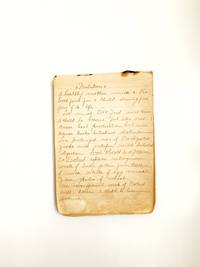
19380002136LAYTON UTAH UT. Good. 1938. On offer is a super original 1938 - 1942 manuscript diary handwritten by Maxine Hadlock Layton later Johansen of Layton Utah. The diary commences at an important juncture for any young woman; almost 16 years old at the beginning from the Depression Era to the beginning of World War II the author already a practical teenage girl-next-door to a College age woman finding her place in the world. Entries range from the simple: "June 29th 1938. Dad gave us 20¢ to go up town with Naomi C. to buy some candy." To a New Years entry that includes pop corn and lemon aid. Religion test in school much different than what everyone expected etc. Interestingly we note that she and many others go to the Joseph Smith Building to hear President Roosevelt speech the day after the heinous surprise attack by the Japanese on December 7th 1941. Her online obituary: Bountiful: Maxine Hadlock Layton Johansen 80 passed away August 22 2002. She was born January 25 1922 in Layton Utah to Lionel and Bessie Hadlock Layton. Maxine graduated from Davis High School and BYU and worked as a secretary in Ogden for the railroad. Having married a career army officer she traveled extensively living in many states Germany and Hawaii before it was a state. She especially loved her stay in Hawaii where she learned to hula and loved the Hawaiian people. An active member of The Church of Jesus Christ of Latter-day Saints she was Primary president in Massachusetts and in the Relief Society presidency. Maxine served as a Temple Ordinance Worker in the Salt Lake and Bountiful Temples and served a mission with her husband in the Atlanta Georgia Temple in 1992-93 where she learned the ordinances in Spanish. Maxine had a gentle and loving nature and enjoyed helping the missionaries and college students in her ward. She is survived by four children: Myrth Ann Michael Mills Kingsport TN; John Jackie Johansen West Jordan; Jill Robben Hixson Sandy; Leilani Eric Shepherd Lee's Summit MO; 16 grandchildren 12 great grandchildren one brother James J. Layton Layton; her twin sister Kathleen Wintle Honeyville; and another sister Lucile Giddings Stanwood WA. She was preceded in death by her husband Willard W. Johansen her parents a sister Ione Layton and a brother Lionel Bud Layton. Overall G.; Manuscript; 24mo - over 5" - 5¾" tall; KEYWORDS: HISTORY OF MAXINE HADLOCK LAYTON JOHANSEN LAYTON UTAH DEPRESSION ERA PRE WORLD WAR II WWII WW2 GENDER STUDIES WOMEN'S STUDIES BOUNTIFUL MORMON MORMONISM MISSIONARIES AMERICANA HANDWRITTEN MANUSCRIPT AUTOGRAPHED AUTHORS DOCUMENT LETTER AUTOGRAPH KEEPSAKE WRITER HAND WRITTEN DOCUMENTS SIGNED LETTERS MANUSCRIPTS HISTORICAL HOLOGRAPH WRITERS AUTOGRAPHS PERSONAL MEMOIR MEMORIAL PERSONAL HISTORY ARCHIVE DIARY DIARIES JOURNAL LOG PRIMARY SOURCE FIRST HAND ACCOUNT SOCIAL HISTORY PERSONAL STORIES LIVING HISTORY ANTIQUITÉ CONTRAT VÉLIN DOCUMENT MANUSCRIT PAPIER ANTIKE BRIEF PERGAMENT DOKUMENT MANUSKRIPT PAPIER OGGETTO D'ANTIQUARIATO ATTO VELINA DOCUMENTO MANOSCRITTO CARTA ANTIGÜEDAD HECHO VITELA DOCUMENTO MANUSCRITO PAPELBIOGRAPHY BIOGRAPHICAL AUTOBIOGRAPHICAL AUTOBIOGRAPHY PERSONAL NARRATIVES . unknown
19260001604STEWARTSVILLE WYOMING WY. Good. 1926. On offer is an interesting 1926 manuscript relic of railroad history being a handwritten diary dated from July 6 1926 to November 14 1926 authored by a young man who is a fireman for the railroad who tells about his days working on the railroad and riding on the trains watching engines girls he meets accidents ballgames etc. The young Wyoming man Mr. Woods he identifies his father as Chas. Woods in the financials does a super job detailing his life and times. Here are some snippets: July 6 left Stewartsville for St. Joe to Cheyenne on St. Joe Grand Island Railway. Fare St. Joe to Cheyenne $22.97; July 8. Passed physical examination for fireman rec'd a pass to Laramie Wyo.; July 20. Given a job at watching engines. Keeping them full of water steam and . My shift 4pm to 12 midnight .41 cents per hr.; Aug 10. Went to circus and wild animal show in evening; Aug. 26. withdrew $10 from Albany National Bank. Dinner at Grand Caft. Super at kuster walked about town. Talked to some good looking girls but couldn't quite persuade them to go to show with us . Guy came along in a car and they went car riding without us. Too bad guess we'll get a car.; Aug 27. Bought blue corduroy blazer $5.00. Saw out girls friends again but they dodged us and got away. Lots of work for nothing try again we'll show them.; Aug 29. Helms supply man went to sleep under coal chute. Woke him up with water hose. Good business today 16 road engines and 4 switch engines bus.; Sept 4. Mac Mclaughlin hostler on middle shift killed instantly about 3:15pm caught between two cars on coal track about 10 feet north of coal chutes. Talked with him about 5 minutes before the accident. Impossible to realise that it happened.; Sept 16. Left on engine 9010. Of 81 cars had trouble with elvin stoker coal to coarse for crusher had to stop on the hill; Sept 26. Had trouble with fire tell we got to rock river left rowlin i had to call in the flag 5 or 6 times made about 50 to 55 miles per hour down the hill from lookout to Wyoming.; Oct 3. On engine 5055. Of 64 cars 2964 ton. Almost stalled out of ridge. I took the throttle for about 4 min. While Harris worked on sander pipes.; Oct 6. Left Laramie at 1 pm on engine 5077 with a Las Angeles train of 45 cars went to the western and heard negro orchestra.; Oct 10. Saw the world series game between N.Y. Yanks & St. Louis Cardinals on the Republican Bermeraing's Playograph. St. Louis wins 3-2.; Oct 19. Saw 15 to 20 antelope southeast of track between Speer and Carr. There are 10 pages of receipts and expenses. The 6¾ x 8¼ inch diary is in a composition book which has 56 pages of entries sometimes just few lines but a lot of half page or more written daily. A chunk has been taken out of the top edgeaffexting the entire book but no loss of text. Overall G.; 8vo - over 7¾" - 9¾" tall; KEYWORDS: HISTORY OF RAILROAD RAILWAYS FIREMAN ENGINEER WYOMING STEWARTSVILLE STOKER AMERICANA HANDWRITTEN MANUSCRIPT DOCUMENT LETTER AUTOGRAPH DIARY JOURNAL LOG KEEPSAKE WRITER HAND WRITTEN DOCUMENTS SIGNED LETTERS MANUSCRIPTS HISTORICAL HOLOGRAPH WRITERS DIARIES JOURNALS LOGS AUTOGRAPHS PERSONAL MEMOIR MEMORIAL PERSONAL HISTORYantiquité contrat vélin document manuscrit papier Antike Brief Pergament Dokument Manuskript Papier oggetto d'antiquariato atto velina documento manoscritto carta antigüedad hecho vitela documento manuscrito papel. . unknown
19140009013CAMP MEADE WADSWORTH GORDON AMERICA HOMEFRONT. Good. 1914. On offer is the absolutely fascinating and deeply detailed wartime homeland diary of Paul James McGahan. McGahan starts as a simple orderly and works his way up to private 1st class and then through hard work and tremendous diligence shows himself to be an exemplary soldier and gets commissioned and ends up as a 1st Lieutenant shortly before WW1 ends. This diary is remarkably detailed with almost every day written as a fully detailed entry. Most impressive are the months of hard training that McGahan does with each training schedule written out in its entirety so the reader gets a full scope of just how difficult and intense the military training is. The diary is signed Paul James McGahan. 1325 Mt. Vernon St. Philadelphia PA. The same page also has a detailed breakdown of all the ranks that McGahan has during the course of 1918 where he earned them and from what time period he held the rank. In the beginning of the diary McGahan is in New York on leave from the military and enjoying the sights and sounds of the Big Apple: going to museums visiting friends wining and dining all over the city. January 3 1918. Spent afternoon with Dr. Cohen who pronounced me wonderfully fit and said the systolic murmur of the heart was very faint. Declared I showed great improvement over previous years exams. Dined at Harlem. Visited Margaret and Edward for Got back to Pen & Penal club and as hotels were all filled had to sleep on chairs by log fire. By January 10th McGahan is back in active duty. Came off guard at 4:30 and was told I would be head orderly starting in the morning. After January 15th there are not many entries for the next two months. A notable exception is on February 22 when McGahan writes Was made a private 1st class by Lieutenant E W Madeira commanding Headquarters Troop. There are no entries for the entire month of March and only a few for the end of April. He mentions at the end of April returning home from Annapolis to Philadelphia so it is assumed that McGahan was at Annapolis training as a private. At the very end of April McGahan goes to Camp Meade in Middletown Pennsylvania. His training seems to take an immediate toll on him as he develops two huge boils on each of his legs. Could hardly sit on train!!!!! he writes. Two days later he is in the Base Hospital. The next week have only one sentence under each entry. In hospital. He is released on May 8. On May 17th he writes Long delays at troop but Glenn and I as the 2 successful candidates departed to the school. He took artillery. I took the infantry course. Very busy evening getting belongings together to stand inspection in A.M. Was assigned to third Platoon Third Company and became instead of Private 1st Class. In Camp Meade McGahan is recommended an advanced infantry course. He spends the next month writing very detailed and specific diary entries of his days learning and training. It is obvious the army way of thinking is getting to him as the days are divided into specific increments of time and tasks. May 24 1918. Very busy day. School of soldier 7.30 to 8.30. Conference on care of equipment 8.30/9.30. Platoon drill 9.30 to 10. School of Squad 10 to 11. Was a corporal for about 15 minutes. 11 to 11.30 bayonet drill. Capt. gave me some personal instruction. Running drill as an instructor 1.15 to 2.15. Hike with gun & light pack 2.15 to 3.15. Conference on Instructor Guard Duty to 3.45. School of company to 4.45. Hard work preparing for inspection. No chance to look at books. Most days in May and June are like this. Intense training and schooling. For a bit McGahan is waylaid with a knee problem but it quickly is dressed and resolves itself for him to train some more. These months are incredibly interesting to see the tremendous amount of training that went into becoming a commissioned officer in the army. Near the end of June McGahan has his final exam for the infantry course which he passes. He describes the whole exam in detail. On June 25 he moves down to Camp Gordon in Georgia for more training. The schedule is even heavier at Camp Gordon. July 3 1918. Platoon Drill 7 to 8.15. PHysical 8.15 to 8.45. Bayonet 8.45 to 9.15. To 9.45 Wig Way. 9.45 to 10.30 Conference Musketry Chapter 8. 10.45 to 11.30 Musketry drill review of trigger and rapid fire. 1 to 2 Conference I.D.R. 350 to 424. 2 to 3 I.H.R. 50 to 83. External orders 1st man out in front of platoon at this formation. Nother hot day and I dont feel any too chillier. 7 to 9 given over to study of stuff for tomorrow. So far no regular mail service has been established. We are finding mail in all other company barracks. Ive had just one letter it forwarded from Meade. July and August are the same as the months before. Training studying drills study sleep. Over and over again. There are occasional personal comments on his life and events that occur around him mostly interpersonal relations with other soldiers but the entries are usually full of the day-to-day training schedule. No day is missing in these months. He finishes his training in the end of August. On August 26th he is sworn in as a commissioned officer. August 26 1918. Red Letter day. Were sworn in by Capt. Scott at 8.30. Signed oath of office and got Commissions. Helped McConnell and Pickett closeout company and at 11.30 said goodbye to all. Very amusing as boy dressed out in their officers regalia. Lunched at Hosers House and boarded usual train at 1. Said goodbye to Sgt. Quinn and Capt. Scott. Train did not leave until 2.45. After he is commissioned McGahan has a few weeks off where he returns to Philadelphia sees friends and family goes to Ocean City New Jersey to see his godchild and spends a good deal of time relaxing and being with non-military people. In September he is given orders to go to Camp Wadsworth near Spartanburg South Carolina. September 5 1918. It started raining as we hit Camp Wadsworth. I am assigned to the 58th Pioneer Infantry and for the present am attached to Company M. I have my own little tent. As a commissioned officer McGahan is in charge of a small number of troops with whom he trains in infantry and rifle skills and bonds with. He also participates in a court martial. The circumstances are unclear but McGahan testifies on behalf of the men being court martialed. I feel I made a good case for them he says of his testimony. In Camp Wadsworth McGahan attends automatic rifle school and gas school for understanding how to fight in gas masks. September and October are mostly full of new training and a new understanding of his commissioned roles in the military. In early November less than a week before WW1 officially ends McGahan is commissioned as a 1st Lieutenant Infantry. He is ecstatic about his promotion. On November 11 1918 World War 1 ends. Whistles and bells awakened us all at 2.45 this morning when official announcement was made that Germans had accepted offer of armistice. It is a holiday. People in autos to camp cheering and waving flags. Town was thronged with cheery celebrations. Very busy on military cemetery. The rest of the year is easy for McGahan. Shortly after the end of the war he is appointed a Judge Advocate of the Regimental Special Court Martial. In addition to his regular tasks with his own company he also attends numerous court martials as the Judge Advocate meaning he serves as a legal advisor to the command to which he is assigned. At the very end of the year McGahan gets leave and returns to New York and Philadelphia for Christmas and New Years. The diary continues past December 31 and there are entries up to January 8th 1919 when McGahan comes back from vacation and is stationed again at Camp Meade. McGahan would end up serving in the military almost his entire life and would retire a colonel after World War Two. He died in 1972 and is buried in Arlington National Cemetery in Virginia. He would receive a Army Commendation Medal for his lifelong work in the American Armed Forces.; Manuscript; 4to - over 9¾" - 12" tall; KEYWORDS: HISTORY OF PAUL JAMES MCGAHAN CAMP MEADE CAMP WADSWORTH CAMP GORDON PHILADELPHIA MIDDLETOWN PENNSYLVANIA SPARTANBURG SOUTH CAROLINA TRAINING BASES IN THE FIRST WORLD WAR ANNAPOLIS RANKS OF THE MILITARY BASIC TRAINING IN WORLD WAR ONE AMERICANA HANDWRITTEN MANUSCRIPT DOCUMENT LETTER AUTOGRAPH WRITER HAND WRITTEN DOCUMENTS SIGNED LETTERS MANUSCRIPTS HISTORICAL HOLOGRAPH WRITERS AUTOGRAPHS PERSONAL MEMOIR MEMORIAL AMERICANA ANTIQUITÉ CONTRAT VÉLIN DOCUMENT MANUSCRIT PAPIER ANTIKE BRIEF PERGAMENT DOKUMENT MANUSKRIPT PAPIER OGGETTO D'ANTIQUARIATO ATTO VELINA DOCUMENTO MANOSCRITTO CARTA ANTIGÜEDAD HECHO VITELA DOCUMENTO MANUSCRITO PAPEL . unknown
1927000970Herkimer County New York NY. Good. 1927. On offer is a very large well detailed fully handwritten 1927 manuscript diary of a bright insightful 91 year old woman. The writer while unidentified leaves many many clues that should help a local historian or genealogist determine precisely who the author is. She relates all manner of local historical details and this diary will prove a treasure trove for genealogical and local area collectors of history. Our writer in sometimes shaky hand never misses a day and fills this 9 x 6 inch with hundreds of names of family visitors friends and local news. Activities include: going to the Cooperstown fair; Dorr Van Horn called to say their daughter Jene was dead; Adams store at Hartwick burns; Grange Hall to the movies; dedication ceremonies at the Peace Bridge; Union tea agent called and many many hundreds of other details of local history. VG.; 12mo - over 6¾" - 7¾" tall; WOMEN'S STUDIES FEMINISM FEMINISTS POST SUFFRAGE NEW YORK STATE HERKIMER COOPERSTOWN HANDWRITTEN MANUSCRIPT DOCUMENT LETTER AUTOGRAPH DIARY JOURNAL LOG KEEPSAKE WRITER HAND WRITTEN DOCUMENTS SIGNED LETTERS MANUSCRIPTS HISTORICAL HOLOGRAPH WRITERS DIARIES JOURNALS LOGS AUTOGRAPHS PERSONAL MEMOIR MEMORIAL PERSONAL HISTORY AMERICANA Archive Lot antiquité contrat vélin document manuscrit papier Antike Brief Pergament Dokument Manuskript Papier oggetto d'antiquariato atto velina documento manoscritto carta antigüedad hecho vitela documento manuscrito Papel . unknown
19150001850ALDERSHOT ENGLAND UK. Good. 1915. On offer is a super manuscript relic of World War I soldiering and combat training being a handwritten Bayonet fighting training book dated Dec `15 Aldershot by William J. Budd 2/Lt 2/5 R. War R. Over 46 pages Mr. Budd details thee art of fighting with a bayonet under all conditions and seems very comprehensive indeed. The book proper is bound in a maroon cloth binding with blind stamp MSS front cover. There is some rubbing to edges spine lightly faded but overall the book is G.; Manuscript; 8vo - over 7¾" - 9¾" tall; KEYWORDS: HISTORY OF BAYONET FIGHTING WORLD WAR I WW1 WWI THE WAR TO END ALL WARS COMBAT INFANTRY HAND TO HAND COMBAT ALDERSHOT BRITISH ARMY INSTRUCTIONS SOLDIERING FIGHTING HANDWRITTEN MANUSCRIPT AUTOGRAPHED AUTHORS AMERICANA MANUSCRIPT DOCUMENT LETTER AUTOGRAPH KEEPSAKE WRITER HAND WRITTEN DOCUMENTS SIGNED LETTERS MANUSCRIPTS HISTORICAL HOLOGRAPH WRITERS AUTOGRAPHS PERSONAL MEMOIR MEMORIAL PERSONAL HISTORY ARCHIVE DIARY DIARIES antiquité contrat vélin document manuscrit papier Antike Brief Pergament Dokument Manuskript Papier oggetto d'antiquariato atto velina documento manoscritto carta antigüedad hecho vitela documento manuscrito Papel . hardcover
19220001235Milwaukee Wisconsin WI. Very Good. 1922. On offer are original 1922 and 1928 manuscript diaries handwritten by noted chemist Dr. John Arthur Wilson. Dr. Wilson was one of the most distinguished chemists in America at the time and was so renowned that his scientific articles and papers were translated into many foreign languages and published in scientific journals throughout the world. These diaries detail and document his busy business and social life: he writes of working in his lab writing his book doing research going to Jones Island attending matinees giving lectures at different universities attending many dinners & meetings related to work. He writes of having lunch at Pfister and going to the Athletic Club. He frequently "called on the folks in the evening". A highlight of this diary is when he writes daily about a vacation to California on the Gold State Limited train. The trip lasted from June 3 to June 25 1922. Here are some snippets: January 26 1922: "Had luncheon at the Pfister with Statton Copeland and Steisig. Discussed problems pertaining to the experimental work at Jones Island." February 17 1922: "Attended dinner and meeting of the Chemical Society at the Medford. Prof. Harkins spoke on "How Atoms are Built and the Nature of Isotopes." April 12 1922: "Showed the tannery and laboratories to members of the senior chemistry class of the University of Wisconsin in the afternoon. Called on the folks in the evening." May 12 1922: "Was the guest of the Shriners at luncheon. Addressed them on Water Filtration." June 3 1922: "Mother W. Woogie & I left for California at 2:00 P.M. Harold & Mildred met us at the station. Left Chicago on the Golden State Limited Rock Island at 6:30 P.M. R.R. time. June 4 1922: "The train stopped for nearly an hour at Kansas City. Strolled around the city near the station." June 5 1922: "Our train was delayed for 2-1/2 hours at Corona New Mexico by a freight engine breaking down on our track. Strolled around the station at El Paso during our short stay." June 6 1922: "Our train made up all of its lost time reaching Yuma on time. Our car was switched onto the San Diego and Arizona Railway. Had a delightful ride from Yuma to San Diego across a desert through the Carrisso Gorge and through parts of Mexico. Reached San Diego at 2:45 P.M. Registered at the U.S. Grant Hotel. June 7 1922: "Motored over to TiaJuana in Mexico where we spent an hour and then to Coronado where we had luncheon at the the Hotel del Coronado and then spent most of the afternoon on the beach." June 11 1922: "Visited the Pickford-Fairbanks Studio and witnessed part of the filming of the new Robin Hood picture." June 12 1922: "Left Los Angeles at 9:00 A.M. and arrived at Santa Catalina Island at 12:15 via S.S. Avalon. Registered at Hotel St. Catherine." June 21 1922: "Arrived at Salt Lake City at 1:40 P.M. Registered at Hotel Utah. Visited the Mormon Tabernacle and then went for a drive around the city. Although it was hot in the city snow-capped peaks were plainly visible." June 22 1922: "In the morning motored out to the curious mining town of Bingham to see the great Utah Copper Mine. Spent the afternoon at Saltair and had a delightful swim in Great Salt Lake." Sept 7 1922: "I was elected Chairman of the Leather Division." Sept 9 1922: "Visited Phoenix Leather Tannery Company. Showed process of making leather." Dec. 17 1922: "Completed manuscript of the Monograph The Chemisty Of Leather Manufacture. Duplicate shipped to Professor John Johnston at Yale Univ." Dec 25 1922: Saw Robin Hood at the Alhambra. We had seen part of the filming of this picture on June 11." At the back of the 1922 diary he lists his 1921 income as $8412.40 with "taxes" of $304.29. Some of the 1928 entries: January 9 1928: "Prof. Men's Club at noon. Dr. E.W. Wenstrand and Mr. E.A. Bacon Jr. spoke on "What It Means to Be a Non-Professional Artist." Chemists Circle at the Astor in the evening. I was installed as President for 1928 and spoke on "Recent Developments at the Sewage Disposal Plant." February 17 1928: "Lectured to the pupils of Lincoln High School on "Positions in Industrial Chemistry." Attended a meeting of the Milwaukee Tanners Association." February 29 1928: "Saw "Two Girls Wanted" at the Davidson after which we joined Nola and Bill at the Club and danced." March 27 1928: "Director's meeting of Prof. Men's Club at noon. In the evening presided over the annual meeting of the Security Management Co. 110 attended dinner. Mr. Puslicker was the principal speaker. Was re-eleced a director and president of the company." March 8 1928: "Called on the Borns to hear Freddy's new 5-tube 1500 volt amplifier. Got caught in blizzard on the way." April 11 1928: "Saw Ethel Barrymore in The Constant Wife at the Davidson. April 30 1928: "Prof. Men's Club Frank Vaughn spoke on the "FUTURE OF COMMERCIAL AVIATION".May 23 1928: "Saw "Pirates of Penzance" at the Davidson after which we danced at the Club." June 5 1928: "Reached Syracuse at noon. Spent the afternoon with Mr. Webb visiting the Nettleton shoe factory. Left Syracuse at 5:30 spent a few hours in Albany and then started on for Boston." Aug 20 1928: "Prof. Men's Club at noon - Heller described experiences hunting lions in Africa." September 8 1928: "Reached New York at 5:30 P.M. Registered at the Commodore. Saw Dennis King in "The Three Musketeers" at the Lyric." September 11 1928: "Attended the first session of the Leather Division in the afternoon. Sonia & Frank dined with us at the Ocean House. Received a letter from Reed telling of my election to the presidency of the Am. Leather Chemists Association." Sept 24 1928: "Prof Men's Club Fred Homer spoke on "Why an engineer should be President of the United States." October 6 1928: "Attended football game between Notre Dame and Wisconsin. Received letter from Prof McKee announcing that I had been awarded the CHANDLER METAL." December 7 1928: "Attended a dinner given in my honor by the trustees of Columbia University after which I gave the Chandler lecture and received the Chandler Medal." BIO NOTES: He was Chief Chemist at A.F. Gallun & Son's and "he was awarded the Nichols Medal for the year 1931 at the meeting of the New York Section of the American Chemical Society on March 13 1931 in recognition of his outstanding achievement in colloid chemist applied particularly to leather and sanitation". The American Leather Chemistry Association was founded in 1903. In 1959 Salem Oil & Grease Company established and financed a memorial lecture as a memorial to Dr. Wilson to be given at each annual meeting of the ALCA. It was designated as the "John Arthur Wilson Memorial Lecture" with awards still being given out today. Both of these diaries are in excellent condition for their age with tight clean pages no marks rips tears or loose binding and no musty smells. These were very well cared for and Dr. Wilson's handwriting is very easy to read no blurring of lines or smeared ink. The front of the diary he writes his address as: 203 Juneau Ave Milwaukee Wisconsin. They both measure 3" x 5". VG.; Manuscript; 24mo - over 5" - 5¾" tall; MILWAUKEE WISCONSIN CHEMISTRY SCIENCE SCIENTISTS TRAVEL AMERICANA HANDWRITTEN MANUSCRIPT DOCUMENT LETTER AUTOGRAPH KEEPSAKE WRITER HAND WRITTEN DOCUMENTS SIGNED LETTERS MANUSCRIPTS HISTORICAL HOLOGRAPH WRITERS AUTOGRAPHS PERSONAL MEMOIR MEMORIAL PERSONAL HISTORY ARCHIVE DIARY DIARIES antiquité contrat vélin document manuscrit papier Antike Brief Pergament Dokument Manuskript Papier oggetto d'antiquariato atto velina documento manoscritto carta antigüedad hecho vitela documento manuscrito . hardcover
18990001206WASHINGTON DC LEIPZIG LEIPSIC. Very Good. 1899. On offer is the original 1899 manuscript diary handwritten by Rebecca P. Warner known by one and all as Bess or Bessie who was 26 at the time. Bess the oldest of 9 children offers the reader a unique view of how a prominent wealthy Washington DC family the lived at the end of the 19th century but even more important is the very intimate interesting view of Germany during one of the country's most fascinating eras of historical development pror to World War I. Bess' father was Brainard Warner Sr. who was a lawyer but made his fortune in banking real estate and land development. His company was responsible for the oversight or building of over 1000 buildings and homes in the Washington DC area. Bess's mother was Mary Jacobs Parker Warner who was descended from Edward Doty a Pilgrim and indentured servant who sailed over on the Mayflower signed the Mayflower Compact and helped to settle Plymouth Colony. This diary describes Bess' trip with her sister Anna and brother Brainard Jr. to Leipzig Germany where Brainard Jr. was the US Consul. Bess does a super job of detailing setting up house in Leipzig and also about their daily lives there. They also did a lot of traveling within Germany and she describes that as well. Research notes that the Warner family endured a lot of sadness. They lost three children at birth or very early in life. They lost their mother Mary Jacobs after the birth of Lucy who then died. They lost their son and brother Southard who committed suicide at age 33 by shooting himself while stationed as a consul in China. Then Brainard Warner Sr died two years after the death of Southard. Here are some snippets and observations from a casual reading: They went to the motette at St Thomas Kirche which was very beautiful. The church was crowded. Students belonging to a club were there. They stayed after the service and thought they might see a German wedding. They have them nearly every Saturday after motette. They got caught in the middle of a religious service. They were sitting right in front of the minister and Bess was afraid they'd get called up to do something In the evening Mrs Young telephoned to ask them over. Brainard had an engagement but Bess and Anne went. They left Leipzig for Chemnitz and went directly to the consulate where they had supper. They went with Mr Monaghan to Schellenburg where his family was summering. "This was a queer little town located on the top of a mountain" There is a beautiful castle and some old walls. Aside from that Bess thought it was an uninteresting place to spend a summer. They left on Monday. They went to a parade in honor of the King of Saxony. About 5000 men were received. They expected to see the King on horseback but he was on foot with other officers. They met Professor Gregory who showed them around some parts of the University. In the afternoon Brainard Anne and Bess called on Mrs Monroe. Brainard went out in the evening with friends. "Today is the Emperor's birthday and all the flags are out. We stood for a long time to watch the Lieut General review the officers. It was a fine sight. what little we could see though the crowd But we were nearly frozen it was so cold" Bess practiced and then went for a lesson with Herr Krause only he wasn't in. She went again at 4 pm. "He was very discouraging and said I had no independence of fingers" Bess thought it would take her several lessons to get the right finger position and that there was no royal road to piano playing. "Hard work is the only road to success in anything". She went home. They had letters from Mamma and Pa. Then they went over to hear the St Thomas Kircke choir practice such beautiful voices. They had a number of people who stopped by for visits." We actually had a count call on us Graf Laisher who was very bright and interesting. He is studying medicine at the University" He said he couldn't speak English but he was very fluent. He proceeded to show them some of his feats of exercise and they were petrified because of their rented furniture. But everything was whole when he left. In the evening Bess and Anne went to the home of Mrs Morris. They danced but it was more of a lesson for the young grandson. He fancied Bess as a teacher and so they whirled around in a circle for 2 hours. Bess wrote that dancing on the ship over was "nothing compared to my feelings after dancing in the mad German fashion" Bess Anne and Lucy went to the Catholic Church which the royal family attended. "I must say I was thoroughly disappointed in royalty as exhibited here. The king queen and two other members of the family sat in boxes on a level with the gallery of the church and just to the left of the altar. Princess Matilda is one of the coarsest people I have ever seen. She spent most of her time yawning. She must weigh at least 200 lbs. We only stayed while the King and Queen were there." The diary has approximately 141 pages of entries from January 1 1899 to August 2 1899 with some gaps in this 4" x 6 ½" diary. Overall G.; English; 12mo - over 6¾" - 7¾" tall; MAYFLOWER GENDER STUDIES TRAVEL PRE WORLD WAR I BRAINARD WARNER DOTY WOMEN'S STUDIES GERMAN ROYALTY DEUTSCHLAND ANTI SEMITISM GERMANY AUTOGRAPH HANDWRITTEN MANUSCRIPT Gründerzeit Emperor William II antiquité contrat vélin document manuscrit papier Antike Brief Pergament Dokument Manuskript Papier oggetto d'antiquariato atto velina documento manoscritto carta antigüedad hecho vitela documento Manuscrito HANDWRITTEN MANUSCRIPT DOCUMENT LETTER AUTOGRAPH DIARY JOURNAL LOG KEEPSAKE WRITER HAND WRITTEN DOCUMENTS SIGNED LETTERS MANUSCRIPTS HISTORICAL HOLOGRAPH WRITERS DIARIES JOURNALS LOGS AUTOGRAPHS PERSONAL MEMOIR MEMORIAL PERSONAL HISTORY . unknown
18430001723HANOVER NEW HAMPSHIRE NH ST. LOUIS MISSOURI MO. Fair. 1843. On offer is an original manuscript diary dated 1843 and 1849 handwritten by an unidentified man attending Dartmouth College in the 1843 part which covers 26 pages wherein we find he is married appears to be a Divinity student describes his lessons and waxes philosophical regarding the plight of man and how he longs for letters from home. He also notes attending Church in the home of Reverend Cutter. Later in 1849 he writes 13 pages of entries from St. Louis Missouri where he is apparently teaching at a boys' school. On Oct. 15th he writes: "Today is a great day for St. Louis. The National Railroad Convention met here today to deliberate on the momentous subject on constructing a railroad to the Pacific Ocean." The beautiful old book with leather spine and marbled boards some scuffing on corners and edges and there is some brittleness with the initial text block pulled away from the spine. He writes in a graceful script. Overall Fair.; Manuscript; 12mo - over 6¾" - 7¾" tall; KEYWORDS: HISTORY OF DARTMOUTH COLLEGE DIVINITY STUDENT ST. LOUIS MISSOURI RELIGION RELIGIOUS STUDIES HANOVER NEW HAMPSHIRE EDUCATION TEACHING HANDWRITTEN HANDWRITTEN MANUSCRIPT DOCUMENT LETTER AUTOGRAPH DIARY JOURNAL LOG KEEPSAKE WRITER HAND WRITTEN DOCUMENTS SIGNED LETTERS MANUSCRIPTS HISTORICAL HOLOGRAPH WRITERS DIARIES JOURNALS LOGS AUTOGRAPHS PERSONAL MEMOIR MEMORIAL PERSONAL HISTORY AMERICANA ANTIQUITÉ CONTRAT VÉLIN DOCUMENT MANUSCRIT PAPIER ANTIKE BRIEF PERGAMENT DOKUMENT MANUSKRIPT PAPIER OGGETTO D'ANTIQUARIATO ATTO VELINA DOCUMENTO MANOSCRITTO CARTA ANTIGÜEDAD HECHO VITELA DOCUMENTO MANUSCRITO PAPEL . hardcover