13 728 résultats
19300012262Tacoma Washington Usa. Good with no dust jacket. 1930. Softcover. On offer is a delightful collection containing a school aged girls pocket diary and a collection of her handmade artwork. The diary and artwork were created by Betty Jean legal birth name: Andrina Elizabeth Willison b.1920 of Tacoma Washington. Betty Jean was the third of five children born to Andrew and Olive Derrickson Willison. She was in elementary school at the time she kept this diary but would go on to graduate from Stadium High School and George Washington University. In 1942 Betty Jean would marry Lloyd Garrison 1917-2007 in Palm Beach Florida where Lloyd was stationed with the US Navy. They divorced in California in 1971. Unfortunately we were unable to trace the rest of Willisons life. Betty Jean kept her diary in 1930 and from March 10 through May 1st. While brief her entries paint a quite lovely picture of the life of this 10-year-old girl with her family friends and at school Some excerpts: Last night I went up to Virginias house. I made the cutest garage for a little car and she made a little Gas Station March 12. Saturday we played baseball and every time I was up they caught my fly. So it made it very bad for me Mar 15. Last night I went to the Symphony concert. My cousin played in it. Her name was Virginia Willison Mar 20. Last night I played Jacks. I was in my 60s when my sister was only in her 30s April 19. Yesterday we played house. I was the maid Jessie was the father and my cousin was the mother and my little sister was the child April 27. Along with her sweet diary are several pieces of Betty Jeans artwork some of which are signed by her most being forms of paper applique. Altogether it is a charming diary and collection of a childs artwork highlighting the daily life of a happy and secure school age child at the outset of the Great Depression. The diary consists of a small top-bound notebook measuring 5 inches by 3 inches. It contains only 24 pages all with diary entries with evidence that a number of pages had been removed at the back of the notebook. The covers are in good condition as is the binding. The pages are in good condition and the handwriting is legible. ; Manuscripts; 8vo 8" - 9" tall; 24 pages; Signed by Author . paperback
19300002244DELAWARE OHIO CLEVELAND AKRON OH. Good. 1930. On offer is a fascinating original January 1 1930 to November 9 1930 manuscript diary handwritten by Grace Elinore Chapman later Nash a 21 year old woman a concert violinist and teacher who would one day soon find love move to the Philippines and then in 1942 become a prisoner of war under cruel and severe treatment by her Japanese captors. Casual research finds an article regarding her life titled: "An Unbelievable Life: Mother wife teacher POW author - Grace Nash packs a lot of living into 97 years 'Amazing' Grace; Mother Wife Teacher POW Author: Grace Nash Packs a Lot of Living into 97 Years." Grace's story is truly unbelievable from how she met her husband to her capture and enduring three years of the most awful treatment and conditions and even giving birth in prison but she did endure and thrived to a goodly age. She is noted for having refused her captors admonition to give up her violin and her refusal and subsequent use of the violin led to her salvation and maintained her sanity. Her love of the violin and teaching violin led her to write 30 or so books on the subject plus she trained and taught teachers throughout the world on how to teach violin. However her first book "That We Might Live" an autobiography of her time in prison shared so that others could learn of the horrors she and her family faced. This 7 x 5 inch page a day diary book usually with full page entries describing her life friends near endless practising performing and working while trying to maintain a social life is about 2/3rd full and was written while she was at Ohio Wesleyan College in Delaware Ohio offers an unusual opportunity for researchers and historians to meet the young woman who would soon have to prove her mettle and survive when so many others did not. Overall G.; Manuscript; 16mo - over 5¾" - 6¾" tall; KEYWORDS: HISTORY OF GRACE ELINORE CHAPMAN NASH VIOLINIST VIOLIN TEACHERS PRISONER-OF-WAR MUSICIAN SYMPHONIC SYMPHONY WWII WORLD WAR II WW2 JAPANESE PRISONS THE BATTLE FOR MANILA PHILIPPINES WOMEN'S STUDIES GENDER STUDIES WOMEN IN WAR WOMEN CAPTIVES OF THE JAPANESE SANBORN LIBRARY CLEVELAND OHIO DELAWARE OHIO OHIO WESLEYAN COLLEGE CHICAGO MUSICAL COLLEGE AMERICANAHANDWRITTEN MANUSCRIPT AUTOGRAPHED AUTHORS DOCUMENT LETTER AUTOGRAPH KEEPSAKE WRITER HAND WRITTEN DOCUMENTS SIGNED LETTERS MANUSCRIPTS HISTORICAL HOLOGRAPH WRITERS AUTOGRAPHS PERSONAL MEMOIR MEMORIAL PERSONAL HISTORY ARCHIVE DIARY DIARIES JOURNAL LOG PRIMARY SOURCE FIRST HAND ACCOUNT SOCIAL HISTORY PERSONAL STORIES LIVING HISTORY ANTIQUITÉ CONTRAT VÉLIN DOCUMENT MANUSCRIT PAPIER ANTIKE BRIEF PERGAMENT DOKUMENT MANUSKRIPT PAPIER OGGETTO D'ANTIQUARIATO ATTO VELINA DOCUMENTO MANOSCRITTO CARTA ANTIGÜEDAD HECHO VITELA DOCUMENTO MANUSCRITO PAPELBIOGRAPHY BIOGRAPHICAL AUTOBIOGRAPHICAL AUTOBIOGRAPHY PERSONAL NARRATIVES . unknown
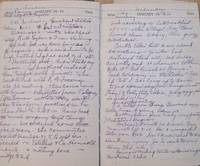
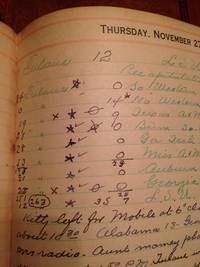
19300002313NEW ORLEANS LOUISIANA LA. Good. 1930. On offer is a super original 1930 manuscript diary handwritten by New Orleans native Marcel Theodore Ducros a 52 year old city employee of the New Orleans Sewerage & Water Board and businessman. Born in New Orleans September 30 1878 Marcel would become a formidable citizen in helping usher New Orleans into the Modern Age as he travelled the area extensively and helped build some of the major canals in the state. A Depression era diary we note that Marcel lived the life; an active Shriner football enthusiast weekends primping his Nash playing with the kids and much dining whether with friends or out enjoying New Orleans. He writes January 01 1930 through December 31 1930 he does a super job writing daily noting the weather conditions his wife Ms. Kitty Catherine whether it was the new green dress she bought for $6.00 or the $2.00 she lost at the race track playing cards or listening to Amos and Andy on the radio. He talks about local elections LSU vs Tulane dinner at Arnauds Carnival Season and eating crawfish oysters and crabs. He traveled the streets of downtown New Orleans Bucktown Algiers Westwego and Hammond where he oversaw many canal projects. The largish 8 x 7 inch book has seen better days; the spine cap and back cover is missing the front cover is detaching though the pages are still bound with the exception of the last few pages entitled "Cash Accounts". Some foxing on the first pages and occasional spots and stains. He writes in a lovely hand but some entries were done in light green ink that has faded but is legible with good lighting. Overall Fair.; Manuscript; 8vo - over 7¾" - 9¾" tall; KEYWORDS: HISTORY OF MARCEL THEODORE DUCROS CATHERINE KITTY DUCROS NEW ORLEANS LOUISIANA DEEP SOUTH CIVIL ENGINEER NEW ORLEANS SEWERAGE AND WATER BOARD DEPRESSION ERA TULANE FOOTBALL BUCKTOWN ALGIERS WESTWEGO HAMMOND CANALS AQUEDUCTS SOUTHERN AMERICANA AMERICANA HANDWRITTEN MANUSCRIPT AUTOGRAPHED AUTHORS DOCUMENT LETTER AUTOGRAPH KEEPSAKE WRITER HAND WRITTEN DOCUMENTS SIGNED LETTERS MANUSCRIPTS HISTORICAL HOLOGRAPH WRITERS AUTOGRAPHS PERSONAL MEMOIR MEMORIAL PERSONAL HISTORY ARCHIVE DIARY DIARIES JOURNAL LOG PRIMARY SOURCE FIRST HAND ACCOUNT SOCIAL HISTORY PERSONAL STORIES LIVING HISTORY ANTIQUITÉ CONTRAT VÉLIN DOCUMENT MANUSCRIT PAPIER ANTIKE BRIEF PERGAMENT DOKUMENT MANUSKRIPT PAPIER OGGETTO D'ANTIQUARIATO ATTO VELINA DOCUMENTO MANOSCRITTO CARTA ANTIGÜEDAD HECHO VITELA DOCUMENTO MANUSCRITO PAPELBIOGRAPHY BIOGRAPHICAL AUTOBIOGRAPHICAL AUTOBIOGRAPHY PERSONAL NARRATIVES . unknown
19300009067ABOARD THE S.S. RELIANCE SCANDANAVIA USSR. Good. 1930. On offer is the 1930 Log Book of the S.S. Reliance of a Cruise to Northern Wonderlands and Russia on the Hamburg-American Line. This is a fantastic book of particular interest to those interested in the history of cruise travel the Hamburg-American line or snapshots of Northern Europe in the Interwar period. The cruise journey lasted 36 days and travelled from New York to Iceland numerous cities in Norway Sweden Estonia Leningrad in the U.S.S.R. Finland Denmark France and finally Germany. The first entry of the book is for July 5th and begins our first stop was Iceland. The ___ ride to the island wasnt more than a minute ride. The hilly climb thru the town of Reykjavik was of interest because of the people the ladies with small black skull caps fitted close to their heads with long blond braids hanging down their backs. In Reykjavik the author visits the Einar Jónsson Museum comments on the uniqueness of the people the automobiles and the island geography. A well he goes to the Hot Springs where women from the neighborhood come to wash. We passed many fields where ladies were garbed in yellow and white were packing and salting smelly fish. The next day the boat goes to the North Cape in Norway the most northerly point of Europe and the author climbs up to the plateau. At the top the Midnight Sun was an unforgettable night. We looked down on the glistening wall of gold. And were breathless at the wonder and beauty of it all. The next day the author visits the town of Hammerfest but writes there is practically nothing to write about Hammerfest because we didnt get to see the Meridian Line. We were hot and tired from the night before. From there the ship travels to Lyngseidet and notes the appearance of the natives and their dirty looking woolen clothes. The boat continues down the Norwegian coast to Trondhjem then to Åndalsnes Molde Hellesylt Merok Balholm Gudvangen Bergen then Oslo. The towns are written about in often short descriptions and the glaciers and fjords are noted often for their beauty and as a treat to anyone enjoying scenery.The gorgeous miles of glaciers on all sides was almost too good to be true. Bergen the author writes gave us a particular thrill tho it was not caused by the fish smell; but by the fact that it was the first really civilized place we visited. A stop in Stockholm brings a drive through the city visiting the Town Hall Royal Palace Riddarholm Church and the Skansen Museum. What a beautiful city Stockholm turned out to be; and it appeared quite progressive with its new buildings being erected very clean; and with traffic giving in all directions - mainly in yours! Tallinn Estonia is next and the author writes of their guide who takes them through the city: She was from a ___ impoverished family supporting her children by being a guide and interpreter. She was full of ___fire and enthusiasm - and a horror of Russia - said she had lived in Moscow and escaped in time. The trip goes on to Leningrad Russia. So much romance beauty and historical significance has been attracted to Leningrad and Moscow that seeing them now in such a deplorable state seems pathetic. The author comments on seeing the Hermitage museum as well as a number of statues and paintings including a life-like Voltaire a most adorable Cupid and a painting by Caravaggio probably misheard by the author as the name is spelled Garraraggio. At this point the author has run out of room to write in the book and entries for the last few stops Helsingfors Copenhagen Boulogne and finally Hamburg are not recorded. The book in which all this is written is one that seems to have been bought by some passengers. The cover page shows that this book is number 127 out of an edition of 144. It was bought for $17 quite a sum in the Great Depression Era. The log book is specific for this trip stating a detailed itinerary of each city including optional shore excursions as well as a map of the cruises route through North Europe. As well there are a number of pages of more general knowledge including entries for Bell Time on Shipboard an explanation of Miles and Knots Common Nautical Terms Latitude and Longitude Ocean Depths Foreign Money conversion and more. Each main stop on the cruise has an entry in the book explaining a bit of the history of the country in general and specific city of call. Under these entries is where most of the journal is written. There are a number of free pages that as well that just say At Sea that are more filled with writing. The second page contains a photograph of the captain of the ship Capt. C. Luck. The final two pages include an autograph page of Fellow Passengers Met On Board with a number of signatures and addresses as well as a number of newspaper clippings one clipping of photographs of Snapshots of a Peasant Wedding at Os. Near Solstrand Hotel one explaining the significance of Elsinore Denmark as a setting for Shakespeares Hamlet and finally a clipping of a short history of Bergen Norway. Included in the back pocket of the book is a 25 page pamphlet that includes a comprehensive List of Passengers the Cruise Itinerary advertisements for other Hamburg-America line cruises and a number of pages of Information for Passengers that cover things such as entertainment on board the ship laundry baggage gymnasium use wireless telegrams and a number of other subjects. A loose photograph of a man in a casual sailor garb is included in this pamphlet. The back reads With happy wishes and pleasures in Germany. The name is difficult to make out but it looks like Resso Prien. This name is not found in the list of passengers or crew so it is unclear if this photograph is of the owner of the log book or not. The log book is 48 pages in length in which there are about 25 pages or so with writing in them. It has a green cover showing very minimal wear. The spine does have two small tears. The pages are all in good shape though some show evidence of age and use. The authors writing is easily legible in black ink. A few passages are slightly faded but can still be read easily. This is a super document well preserved and very interesting to many different collectors.; Manuscript; 12mo - over 6¾" - 7¾" tall; KEYWORDS: HISTORY OF S. S. RELIANCE HAMBURG-AMERICAN LINE CRUISE TO NORTHERN WONDERLANDS AND RUSSIA CRUISE SHIP MEMENTO REYKJAVIK ICELAND NORTH CAPE HAMMERFEST NORWAY SWEDEN SCANDINAVIA ESTONIA LENINGRAD U.S.S.R. SOVIET ERA RUSSIA INTERWAR PERIOD TRAVEL GREAT DEPRESSION ERA TRIPLE SCREW STEAMER LUXURY 20TH CENTURY TRAVEL NORTHERN EUROPE IN THE INTERWAR PERIOD SIGHTSEEING IN EUROPE CAPTAIN C. LUCK PASSENGERS LIST LUXURY CRUISE VACATION AMERICANA HANDWRITTEN MANUSCRIPT DOCUMENT LETTER AUTOGRAPH WRITER HAND WRITTEN DOCUMENTS SIGNED LETTERS MANUSCRIPTS HISTORICAL HOLOGRAPH WRITERS AUTOGRAPHS PERSONAL MEMOIR MEMORIAL ANTIQUITÉ CONTRAT VÉLIN DOCUMENT MANUSCRIT PAPIER ANTIKE BRIEF PERGAMENT DOKUMENT MANUSKRIPT PAPIER OGGETTO DANTIQUARIATO ATTO VELINA DOCUMENTO MANUSCRITTO CARTA ANTIGÜEDAD HECHO VITELA DOCUMENTO MANUSCRITO PAPEL . hardcover
19300002600LINCOLN NEBRASKA CHEYENNE WYOMING. Good. 1930. On offer is an original historically significant 1930 manuscript diary handwritten by noted Nebraskan William Eugene Guthrie sometimes Guthrey Civil War historian; Nebraska cattleman and ardent activist involved in a government dispute concerning water rights and the Platte River. Guthrie had hunted buffalo; broken in horses to be used by soldiers in the Civil War; was an ardent genealogist making copious notes from the family Bible and recorded herein; was an historian of the battles in the Civil War just to name a few of his credits. William E. Guthrie was also known for having shaken every President's hand since Lincoln up to and including President Hoover in 1930. On the 26th day of September in 1930 he was on his way to Washington D.C. to fight yet another battle. William Eugene Guthrie was a noble man of high character family values and fascinating personal first person history to be told. This historic journal commences as Guthrie is in Washington D.C. to see Willis Van Devanter an Associate Justice of the Supreme Court of the United States to hear Guthrie's case pertaining to water rights along the Platte River in the state of Nebraska; the date is September 1930. The Platte River is a major river in the state of Nebraska and is about 310 mi long. Measured to its farthest source via its tributary the North Platte River it flows for over 1050 miles. The government and Guthrie and his associates had an ongoing disagreement pertaining to their water rights along the Bridgeport irrigation district; Belmont Canal and Empire Canal water rights on Guthrie's property along the Platte. He is going to Washington DC to urge the importance of securing a hearing to get a final decision on this case. His handwritten entries include: "My first reaction upon being asked this mission was appalling. To approach a Justice of the United States Supreme Court and to talk to him about land in which I was personally invested seemed to me most fool hardy. Assured by both R. O. Canaday and Judge Wright of Omaha attorney for the district that such an attempt would be entirely ethical I finally agreed to undertake the mission and as a result landed in Washington D.C. on the 28th day of September and registered at the Hotel Raleigh." "I learned that Justice Van Devanter had not returned from his summer vacation and as it would be a few days before his return my thought was why not see Gettysburg. I had many times wished I would have an opportunity of going to that famous battlefield. I have been something of a student of the life of Pres. Lincoln and of the Civil War. Many of the municipal battles of that war have been an interesting study to me and none more interesting then the battle of Gettysburg and the battle of Vicksburg. In 1881 I made a trip from Cincinnati to New Orleans in one of the famous steamers. The steamer stopped at Vicksburg half a day and gave the passengers an opportunity to visit the city and the battleground. Vicks and Gettysburg were the deciding battles of the Civil War. Having seen Vicksburg i had hoped I would some day see Gettysburg and I did in 1930! He goes on to say that the battle of Gettysburg in his opinion was not only the decisive battle of the war but a decisive battle of the world." He was able to be on the tour bus alone and the tour guide gave him an answer to all his questions. Then Guthrie stood where Lincoln delivered his Gettysburg address and was overcome with the historical importance of this sacred place. Returning to Washington and calling Van Devanter office he was able to secure a private talk with him on Oct. 3 at 8:30 A.M. They talked about the famous "lease" as to the property and the water rights. Van Devanter's final remark to Guthrie was "This lease will probably come before me and I will sift it through from top to bottom." I said thank you very much and this ends my mission. Before I left having been acquainted with Van Devanter 40 years ago Justice Van Devanter then said to me; before you go you must go with me to my rooms and meet with Mrs. Van Devanter; he then called on Mrs. Van Devanter and Mrs. and I had a very pleasant visit. A very pleasant ending to a rather trying ordeal - and thats that." The following day Guthrie decided he would like to go and talk to President Hoover. He knew Mr. McKenna who had been at the Whitehouse for years and would be the go-between he would need to get through to have a private visit with Hoover and thus he went to speak to McKenna and reminded him that he had shaken every Presidents hand since he shook the hand of Lincoln. McKenna was moved by this and secured a private visit in the Whitehouse. "Jan. 23 Needless to say I was at the Whitehouse the following day at 1:30 and on that Friday of Oct. 3 1930 I was admitted to the President's office and was cordially received. President Hoover seemed much interested in the fact that I had seen President Lincoln and he asked me many questions. One question was "do you remember how President Lincoln looked" I certainly do Mr. President. I shared my very clear impression as to the rough course of his jaw and the sadness apparent in every feature and especially I do remember his eyes. Hoover remarked to me "Mr. Guthrie you are indeed fortunate." The President then shook hands with me cordially and I remarked "Mr. President I hope to have the opportunity to vote for you in 1932 and he replied you are good for another 10 years at least." Guthrie was 81 years old at this time and had arrived in Washington D.C. by train and bus. Before going back home to Nebraska he then and there decided to go and visit as many living relatives as he could and as many of the Civil War battlefields as he had the energy to do and thus begins his fascinating odyssey as he writes in captivating detail of all that he saw and did. Midway through this diary after all his visiting traveling and sight seeing in Marion Ohio Shenandoah Woodstock Harpers Ferry Manassas Indianapolis St. Louis MO St. Joseph MO &c. he decides to write his memoirs. He commences to remember when he was 12 years old in 1861 and with his older brother Silas's transporting horses to Washington D.C. to be sold to the United States Government for their use in the Civil War and when he first saw Lincoln. This part of the journal goes on for several pages and is spell binding as to how this whole horse transporting selling and trading procedure was carried out by the government. It was there that he not only saw Lincoln but was able to shake his hand. His handwritten entry: "The incident which stands out most clearly in my mind during my stay in Washington was the day I saw President Lincoln. Returning to our hotel one day we found the street for blocks filled with crowds of people waiting for the President to pass by. Presently there appeared a Landau drawn by two big black horses driven by a big Negro in uniform and high hat. In the carriages there were 4 men two facing the horses and two facing backwards; all wore high hats. On the right side facing front was as I then thought the tallest man in the world and this was Lincoln. The impression left on my mind that day is confident as to that appearance of Lincoln and still clear to this day. I too remember soldiers everywhere. The country surrounding the city was literally covered with lamps and tents. I recall that one Ohio regiment was camped near the city and a company that was recruited near Marion Ohio. Captain Schofield of this company was an old friend of ours and Uncle John visited the Captain in his tent taking me with him. After several weeks in Wasington D.C. returning home and taking up farm work was quite a let down after so much "high life" and how I longed to get into the army and have a uniform like the "boys." He goes on to write about his exploits while buffalo hunting; His mother's visit to "her boys" in 1882; The Pioneers; Then and Now; &c. He ends this memoir by signing his name "William E. Guthrie Bridgeport Nebraska March 31st 1931." He then adds his handwritten "The Sequel" to include Grandmother's Bible and Old Time Religion; Pioneer Mothers; Religion Then and Now &c. The last few pages of this incredible and engrossing handwritten book are genealogy records copied from "the old Bible belonging to Isaac & Rachel Guthrey; Marriages Births Deaths and a final foot note; "From Maggie he was the first to go." Maggie was his daughter and she was recording that he died before her. This historically important diary may have history in here that one could not find in a history book as it is a first person account of life as it was lived by William Eugene Guthrie born July 26 1849; married Margaret Snow Hewitt 12-3-1885 and known by his friends as Billy Guthrie died at the age of 85 on Nov. 15 1935. Affixed to a page is a cut-out from the Wyoming Stock Growers' Association of the "Guthrie & Oskamp Cattle Company W.E. Guthrie General Manager Cheyenne Wyoming 1885 PO address Cheyenne Wyo. Range La Bonte Wagon Hound and La Prele Creeks." BIO NOTES: Guthrie in the History of Western Nebraska: William E. Guthrie whose extensive business activities and public efforts had made him prominent for years in Wyoming and Nebraska was a resident of Bridgeport since 1904 and was then the secretary of the board of irrigation in this district. Mr. Guthrie was born at Rue in Marion County Ohio July 26 1849 the son of Isaac F. and Rachel Fredrick Guthrie. The father was born in Ohio a son of Joseph Guthrie and a grandson of Colonel John Guthrie an officer in the Revolutionary War. Mr. Guthrie's parents were married in Ohio and he was the second born of their twelve children the other survivors being as follows: S. A. in the sheep business in Wyoming; a sister the wife of County Clerk Clelland of Converse county Wyoming; P. E. in the cattle business in Broken Bow Nebraska; and another sister the wife of J. B. Russell a capitalist of Savannah Missouri. The father of this family was very prominent in Marion county Ohio for many years. He was a successful farmer there and owned his Ohio farm until the time of his death although in 1885 he came to Merrick County Nebraska bought land near Clarks and died on that place. In politics he was a Democrat. For twelve years he was county commissioner of Marion county and for fifteen years was a justice of the peace. He belonged to the Masonic fraternity and lived up to every rule of the order. The mother of Mr. Guthrie was a member of the Methodist Episcopal church and the father was a liberal contributor. Guthrie enjoyed educational advantages in the district schools in boyhood and later in the Wesleyan University at Delaware Ohio. From college he returned home to give his father assistance and remained until 1878 when he went to Wyoming and there for twenty-five years prospered in the cattle business. In 1895 he located in Omaha and shortly afterward bought a farm and feedyard at Clarks in Merrick County where he continued to handle cattle for the next twenty years. In the meanwhile he had become active in the political field and in 1890 was elected to the Wyoming state legislature on the Republican ticket and took part in bringing about some very important legislation. In 1904 when Mr. Guthrie came first to Morrill county he became deeply interested in the irrigation projects and bought land along the Belmont Irrigation Canal where he continued his active interest and as mentioned above is secretary of the board that is expending $75000 in putting in drains and headgate in the Morrill county irrigation district. Mr. Guthrie owned four irrigated farms and spent much of his time to their development. In 1885 Mr. Guthrie was united in marriage to Miss Margaret Hewitt who was born at Zanesville Ohio but was reared in Des Moines Iowa. They had one daughter Margaret the wife of I. P. Hewitt who was connected with the Puget Sound Navy Yard at Everett Washington. They had two children: William Guthrie Hewitt and Helen Hewitt. Mr. Guthrie was a York Rite Mason and a Shriner and belonged also to the Knights of Pythias and the Elks.Condition: Hardbound in red covers with "National Diary 1930" in gilt lettering front cover and date on spine this absorbing handwritten book is in good to very good condition internally fresh and tight and is a very worthy acquisition indeed. Using a page a day book though not using it in order of the dates it is very well filled with every page having handwritten entries. Journal measures approx. 4 1/2 x 7 inches and has one small tear in the red cloth cover at the bottom as seen in images. ; Manuscript; 12mo - over 6¾" - 7¾" tall; KEYWORDS: HISTORY OF; WILLIAM EUGENE GUTHRIE GUTHREY WATER RIGHTS AND THE PLATTE RIVER; BUFFALO HUNTER NEBRASKA MARGARET HEWITT LINCOLN GUTHRIE & OSKAMP CATTLE COMPANY W.E. GUTHRIE GENERAL MANAGER CHEYENNE WYOMING CHEYENNE WYO. RANGE LA BONTE WAGON HOUND LA PRELE CREEKS CATTLEMAN CATTLE RANCHERS CATTLE DRIVES AMERICANA HANDWRITTEN MANUSCRIPT DOCUMENT LETTER AUTOGRAPH WRITER HAND WRITTEN DOCUMENTS SIGNED LETTERS MANUSCRIPTS DIARY DIARIES JOURNALS PERSONAL HISTORY SOCIAL HISTORY HISTORICAL HOLOGRAPH WRITERS AUTOGRAPHS PERSONAL MEMOIR MEMORIAL ANTIQUITÉ CONTRAT VÉLIN DOCUMENT MANUSCRIT PAPIER ANTIKE BRIEF PERGAMENT DOKUMENT MANUSKRIPT PAPIER OGGETTO D'ANTIQUARIATO ATTO VELINA DOCUMENTO MANOSCRITTO CARTA ANTIGÜEDAD HECHO VITELA DOCUMENTO MANUSCRITO PAPEL . hardcover
19300011013Omaha Nebraska: Omaha Nebraska Ford Motor Company Labor Relations Greatest Generation. Good. 1930-1945. Hardcover. On offer is a rare 14-volume archive of diaries that chart the course of an American boy's life through the Great Depression and World War II a classic member of 'the Greatest Generation'. This is an outstanding archive of diaries that document the life of a man throughout his boyhood in Midwestern America throughout the Great Depression and into WWII. The author of this archive is Richard Allen Metzler. He was born in 1920 in Omaha Nebraska where his father Clyde was a dentist. He married Doris Cuthbert in 1946. He worked his entire career with Ford Motor Company. His wife taught with distinction in the Dearborn Public Schools system. He passed away in 2000 at the age of 80. His diaries begin at age 10 and continue until he is 25. This is a terrific collection. It traces this boy's growth as a young child teenager college student and young man through some of the most momentous years of the 20th century. As would be expected his writing matures over the years as he begins to add reflection and nuance to his daily entries. Taken as a whole they offer a superb picture of growing up in the America in the pre-war years. The following excerpts will give a sense of the flavour of these diaries: "This afternoon Paul Richard's brother went downtown with Bob Muchow and went to a show. Tonight Eddie came over and we played down in the basement" Mar 28 1930; "Tonight Paul went to the drawing lesson all alone and staid up to Story's and ate supper. Today altogether I won sixteen snurts one glassy and three mossies nicknames for types of marbles May 1 1930"; "This morning Paul went caddying but didn't earn anything. This afternoon Lary me and Paul went swimming. We got a new car and went riding" June 11 1930. Two years later he has a paper route that he manages for the next several years and takes very seriously : "We had a short little moving picture on how to brush your teeth today at school. It snowed all day today. Story carried newspapers with me. Paul went to scout meeting. I made fudge did homework and played with Tag after supper" Feb 16 1932; "In homeroom assembly I had to get up and talk on "the industry of carrying papers". When I went to school this morning I locked myself out of the house so I ate up at 27th with Story . I had to come home from Scout Meeting and go over to P. T. A. At North and demonstrate how to do beadwork in front of a pile of people. "Was I mortified! " May 8 1932; "1 of us kids went on a hike to Stone Park this morning. The other 3 walked but I rode the bike and carried all the stuff. When I was going down a hill I was in a deep rut and didn't have any brakes and there was a log slap bang in front of me ." Nov 30 1934; "Paul Huntley and Bill slept out in Stone Park last night so I carried Paul's route. Snyder helped me carry my route and then dad took us out. Threw axes and knives at trees all day. Ate dinner out there. . Found out that Huntley smokes. . Typed some more chain letters" May 5 1935; ". Eddie Meents is in my Chem class. He flunked Chem 2 last sem. & is going to flunk again. Bob Bierworth is back from reform school. He looks like the sea hag's dad " Sept 23 1936; ". Went to A. Y. McDonald and applied for a job. Fred Hagly even phoned up here for me. He said to start tomorrow. So ----- . Paul left for Beresford to work for three weeks " Aug 14 1938. His entries focus almost exclusively on his immediate world. He does make a passing reference to troubles afar: ". Got a cottage on Lake Carlos with electricity so now we can hear the war nes - it started Thurs. I guess but we didn't know about it" Sept 2 1939; ". I haven't said a thing about the European War. Well there is one and a real one. In fact France is licked and Britain looks pretty sick. Looks like Hitler is on the way. Hadn't better come over here bless his hide." June 18 1940; ". Just started on a letter to Marj when I was called to the phone by Mrs S. I just sensed what it was before she called up the stairs - Paul was phoning that he had gotten a telegram from Dad that mother had passed away at 5: 30 this morning. At 5: 30 A. M. July 18 1941 my mom ceased to suffer and is now with the Lord and waiting for me and Paul and dad." July 18 1941. Clipped in to a back page is a newspaper clipping of the announcement of her death. He notes the Japanese attack on Pearl Harbor and the fact that America will be at war. His Dec 9th entry begins with the laconic: "Well they didn't bomb Detroit - yet "Dec 9 1941. He writes detailed entries about his life at college especially his life as a fraternity member. 1942 however finds him in Detroit working for Ford Motor Company - a place he would work for the rest of his life: ". Johnson and I walked over to the glass plant but got kicked out because its been completely converted into government tool & die ." Dec 5 1942And lest people thought that the war effort made other labour concerns fade away he records this: ". We struggled to keep ourselves occupied - the whole foundry was on strike. Don't like the swing shift. The stinkers should be slapped into the Army " May3 1943; ". Foremen on strike at the Rouge. A negro-white race riot started on Belle Isle bridge last night. Several dead lot wounded "June 21 1943. His last entry is rather poignant: ".Got a card from Dorothy Head. . She asked me why I broke it up & I told her - that I was getting way too much involved & I was too yellow to get married. She told me she loved me at the time & would have married me that I nearly broke her heart. I told her I had walked out on at least 3 other gals just the same way since. So we had quite a talk" Apr 2 1945. Within the next 15 months he would meet and marry Dorothy Cuthbert and they would be married for 50 years. For a historian this is a simply outstanding archive. Its rare to find a large group of diaries started by a young boy and maintained through to adulthood. The diaries chart the not only physical growth of this boy but the development of values and character. It is an excellent longitudinal study of life growing up in Midwestern America - a classic example of a member of what Tom Brokaw described as The Greatest Generation. For genealogists these diaries are a treasure trove. In many of them he keeps detailed lists of people he knows with in some cases phone numbers and addresses as well as class lists. This is a rare and certainly valuable collection of diaries. This collection includes 14 diaries from 1930-1945. Only 1931 is missing. The diaries vary in size most are hardcover all are 100% complete and in good condition. Please contact seller for chart with a breakdown of the size and number of pages in each diary. ; Manuscripts; 8vo 8" - 9" tall; Keywords: handwritten manuscript document letter autograph writer hand written documents signed letters manuscripts historical holograph writers autographs personal memoir memorial antiquité contrat vélin document manuscrit papier antike brief pergament dokument manuskript papier oggetto d'antiquariato atto velina documento manoscritto carta antigüedad hecho vitela documento manuscrito papel Richard Allen Metzler; Omaha Nebraska; Ford Motor Company; America in World War II; Labour Relations in World War II America; Tom Brokaw; The Greatest Generation The Great Depression strike laborers striking corporate America pre-war America intra-war years post-war America boyhood manhood; Signed by Author . Omaha, Nebraska, Ford Motor Company, Labor Relations, Greatest Generation hardcover
19310001735JOHANNESBURG SOUTH AFRICA SA TEL AVIV ISRAEL. Good. 1931. On offer is a fascinating significant original archive of three 3 manuscript books; being two 2 diaries covering 1930s through 1990s and one 1 book of personal thoughts writings and copies of his favourite essays poems and observations handwritten by Yehuda Lieb Frank a fascinating individual originally from South Africa then Israel and back to South Africa and Israel again biographical notes follow the listing. Lieb Frank does not write a traditional diary but moreso a log book of happenings to remember and a ledger of events. Some months he will write 5 or 6 entries as simple as a grandchild's visit or their first step. A doctor's appointment the results of blood tests or in the 1930s how well he danced ballet or if he bought new dance shoes. Some days he writes 3 4 or 5 lines noting a small number of the day's details but overall it is between the 2 diary books and the anthology book a remarkably clear picture of this man who would bloom as an activist Zionist and heroic leader of South African Jews. Book 1: 1931 - 1953 Headings include: books read; theatres cinemas concerts; visitors visits meetings; miscellaneous and then diary entries. Book 2: 1954 - April 21st 1998. Book 3: My Random Anthology "There is a melody and an indescribable exquisiteness about beautiful ideas expressed in beautiful words. Beautiful language like sweet music is the language of the angels - a delight for the heart and head " Headings include: War Hate Woman and Love the East My People - Ami and more. The books are approximately 15cm x 10cm with about 120 pages the first two books in Good shape with some age spotting and general ageing but the shape of the third book is worse as the text block loose some loose pages but all present. BIO NOTES: Jerusalem Post: May 22 2012 Tuesday 1 Sivan 5772 12:50 IST SOUTH AFRICAN and Zimbabwean Rhodesian expatriates who missed out on paying their last respects to Leib Frank who passed away a month ago at 91 will have the opportunity to do so at the consecration of his tombstone on Friday at the Kfar Shmaryahu cemetery. Frank served from 1962-1979 as the director of the South African Zionist Federation now known as Telfed. One of his four children the late David Frank was for several years a member of the editorial staff of The Jerusalem Post. While still in South Africa Leib Frank was one of the founding members of Hashomer Hadati which was the forerunner of Bnei Akiva. In 1940 together with many other Jewish youths he volunteered for the South African army to fight the Nazis. He was severely wounded and lost a leg. After returning to Johannesburg he married Rachel Luffy Josephson. In 1949 Frank was appointed director of the Rhodesian Zionist Federation in which capacity he hosted Moshe Dayan and Moshe Sharett. In 1961 he finally realized a long-cherished dream and settled here. A year later he became the director of what was to become Telfed and was instrumental in making the absorption process of many immigrants from South Africa and Rhodesia much easier. His interest in South African immigrants remained steadfast even after his retirement and he found ways of helping them through the various boards on which he served. Frank's two surviving children are Lironne Bar-Sadeh a diplomat currently serving in Italy and Gillam Keinan director of Foreign Investments at the Ministry of Industry Trade and Labor. He is also survived by eight grandchildren. One online source provides: Obit: It is with great sadness that we report the passing of Leib Frank at the age of 91. Leib served for many years 1962-1979 as the Director of the South African Zionist Federation now known as TelFed. Born in Bloemfontein and raised in Johannesburg he became a dedicated Zionist in his teens. He was among the founding members of the Hashomer Hadati the forerunner of Bnei Akiva in South Africa. The funeral will take place at the Kfar Shmaryahu Cemetery on Sunday 10th January at 15.00. Shiva will be held at Beth Protea today Sunday and Monday. Tuesday and thereafter at Gillam's house at 42/9 Hermon St. Mivaserret Tzion - Keinan Family. In 1940 he volunteered for the South African army together with many other Jewish youth "in order to go and fight the Nazis" as he put it. Leib fought with the 1st. Rand Light Infantry regiment in North Africa. He was severely wounded in action and consequently lost his right leg. He never complained about his disability and it certainly didn't affect his future dreams. Indeed only his closest family was aware of it. He walked with his prosthesis -his artificial leg undetected by most. On his return to Johannesburg he met Rachel Luffy Josephson. They married and had four children. In 1949 Leib was appointed Director of the Rhodesian Zionist Federation. In 1961 he realized his boyhood dream and made Aliyah. In 1962 he replaced Sam Levin as Director of TelFed in Tel-Aviv. After his retirement he continued to serve the South African community in Israel sitting on numerous boards. Thousands of South Africans who made Aliyah in the 1960's and 70's benefited from his professionalism and caring manner. ; 32mo - over 4" - 5" tall; KEYWORDS: HISTORY OF JOHANNESBURG JEWISH JUDAICA ISRAEL SOUTH AFRICA ZIONISM ZIONIST ACTIVIST YEHUDA LIEB FRANK SOUTH AFRICAN ZIONIST FEDERATION HASHOMER HADATI RHODESIAN ZIONIST FEDERATION 1ST. RAND LIGHT INFANTRY SOUTH AFRICAN SOUTHERN AFRICA AFRIKAANS AFRIKANER HANDWRITTEN MANUSCRIPT DOCUMENT LETTER AUTOGRAPH DIARY JOURNAL LOG KEEPSAKE WRITER HAND WRITTEN DOCUMENTS SIGNED LETTERS MANUSCRIPTS PHOTO ALBUM PHOTOGRAPHIC ALBUM HISTORICAL HOLOGRAPH WRITERS HANDSCHRIFT HANDGESCHRIEBEN MANUSKRIPT DIARIES JOURNALS LOGS AUTOGRAPHS PERSONAL MEMOIR MEMORIAL PERSONAL HISTORY antiquité contrat vélin document manuscrit papier Antike Brief Pergament Dokument Manuskript Papier oggetto d'antiquariato atto velina documento manoscritto carta antigüedad hecho vitela documento manuscrito Papel . hardcover
19350009004Yangtze River Shanghai Hankow China. Good. 1935. Unbound. On offer is a fascinating and significant handwritten diary that was found with other military items from a US 4th Marine Veteran George Mower who served in China WW II and Korea. The very unique diary was written by five Marines their rank and last names listed on the first page while on duty in China from Dec. 28 1934 through Feb 1 1935. The very first words of the journal are as such: "This diary of facts concerning a trip made up the Yangtzie River into the interior of China that mysterious and forbidding land of the Green and Yellow Dragon - by five marines detailed as armed guards for the Yangtzie Rapid Steamship Co. - an American owned and operated Co. - was conceived and written by Oscar Nelson and George Mowers with the help of the remainder of the detail. The trip and what is said about the country is described by Mowers. Nelson was the he located the different points of interest learned their names and their distances apart. All members of the group added the human interest which is committed to the pages. This diary was not kept for material gain but only as a souvenir. It is written in the simple words of those who made the trip so that as they ramble through its pages so they may live over again in the memory those days spent on the Yangtzie River." The men on detail are referred to as Lt. Hussa Sgt. Stevens Cpl. Nelson Pvt Mowers and Pvt. Sours. On December 28 they gather their supplies and embark "at 5:15 PM aboard Yangtze River Steamship Co. Ship I'Fung". During the detail there are many details on their trip often in the military way of breaking down the events by the time they happened "At 1700 it begins to darken - a cold rain makes visibility poor. The bleak and dreary banks of the river is now relieved by several hills crowned by pagodas and tall trees." On another day the diary states "The weather is cold and the wind still too high to allow us to venture out on deck to observe much of the country along the banks of the river. What I can see of the short from my cabin window looks to be cold beak bare and desolate. Occasionally I can pick out a small grass shack from which drifts a small lazy column of smoke. Then at other times I can see a Chinese farmer scurrying along the banks of the river or perhaps he's a fisherman. What a perfect setting for one who likes nature in the raw. I'll take mine after it has been refined." There are plenty of details about life on the ship and the dreary and rainy conditions which seem to be ever present. As well the authors of the diary seem to be slightly interested in Chinese history as there are some small passages on the history of China: "At the close of the Sung dynasty it was founded by refugees who fled from other parts of the country to escape the conquering Mongols." There is also writings about the little time off in Shanghai and Hankow. "Arrived at Hankow and anchored at 1600. Clean well built city from the river. Went ashore after dinner and walked up the - clean and well policed. Rickshawed and walked thru the city. A big prosperous city - modeled after Shanghai - but did not see much of interest. Their famed "Cabaret Row" was a flop. Was sober and the girls looked old and their teeth were dirty. The liquor was bad." There are also run ins with bandits and pirates "Now when you get on the land opposite your ship you run into some of the famous Yangtzie River Pirates in the guise of men. They demand 40 cents big money to bring you a hundred yards to your boat. And they get it or you swim." One of the trips ashore is described as "By chance we were witness to a very interesting sight this afternoon. We saw a number of Chinese soldiers forcing a number of Chinese civilians into service in the army. They must have had about a thousand of these recruits and they marched them down the streets four abreast. Some of the recruits were greasy and dirty looking as though they had been taken from shops or factories while others were a little seedy looking and indicating that they were farmers or fishermen. What a strange site they formed as they marched along.In age and size they ranged from mere boys to full grown men. Each one of them carried on his back a blanket or rag in which was roped all of his worldly possessions as a whole they resembled a herd of wild sheep being herded to the slaughter house. Such is life in China some Chinaman with a little money who has had the privilege of gaining a little knowledge and an education declares himself a general recruits himself an army - either willing or otherwise - and procedes to make himself master of all he surveys." The diary is full of these fascinating little observations of life and nature in China along the banks of the Yangtze River. There are also details on the military strife happening in China in the mid-1930s. "National Chinese soldiers are being sent up the river to Wanhsien and other towns in the Szechuan province for very obvious reasons. Szechuan theoretically is supposed to be a part of the Republic of China but in practice it is not. It is controlled by General Lu an influential and powerful General. Szechuan is the richest province in China is isolated from the rest of China due to the fact that it lies in the remote western part of the country and is surrounded by mountain boundaries which are almost inaccessible except by way of the Yangtzie river through the gorges . It is to this isolation and natural defence formed by the mountains General Lu in the past with aid of his powerful and well equipped army has been able to maintain control over Szechuan and levy and collect the taxes. The armored detail eventually switches from their original boat to the I'Ping and then to the I'Chang. The diary ends on Feb. 2nd with no mention of any transfer or change in duty only that they were close to Shanghai. It is unclear whether this diary is complete or not. Each page is numbered at the top so they are very easy to keep in order as the pages are loose and unbound. It ends with "We anchored for the night at 2200. Lt. Shaw said that the Captain told him we would be in Shanghai about 1000 tomorrow. Nelson is becoming more and more restless. He is longing for the dear old Shanghai nights." All pages of the diary are easily readable in a very accessible script. There are spelling mistakes consistently throughout the diary but they are not a barrier to understanding the words. Each page is in excellent condition.; Manuscript; 9" x 12"; KEYWORDS: HISTORY OF STORIES OF UNITED STATES MARINES EXTRA-MILITARY DUTY CHINA PRE WORLD WAR TWO PRE CHINESE COMMUNIST REVOLUTION YANGTZE RIVER HANKOW SHANGHAI BANKS OF THE YANGTZE RIVER GREEN AND YELLOW DRAGON YANGTZE RIVER STEAMSHIP COMPANY YANGTZIE THE SAND PEBBLES LIEUTENANT HUSSA SERGEANT STEVENS CORPORAL NELSON PRIVATE MOWERS PRIVATE SOURS USMC I'PING I'CHANG AMERICANA HANDWRITTEN MANUSCRIPT DOCUMENT LETTER AUTOGRAPH WRITER HAND WRITTEN DOCUMENTS SIGNED LETTERS MANUSCRIPTS HISTORICAL HOLOGRAPH WRITERS AUTOGRAPHS PERSONAL MEMOIR MEMORIAL AMERICANA ANTIQUITÉ CONTRAT VÉLIN DOCUMENT MANUSCRIT PAPIER ANTIKE BRIEF PERGAMENT DOKUMENT MANUSKRIPT PAPIER OGGETTO D'ANTIQUARIATO ATTO VELINA DOCUMENTO MANOSCRITTO CARTA ANTIGÜEDAD HECHO VITELA DOCUMENTO MANUSCRITO PAPEL . unknown
19300011008New York City Interwar NY: Interwar Years Great Depression New York City Teen. Good. 1930s. Hardcover. On offer is a well-kept Jewish middle class teenage girl's five-year diary from the 1930's in New York City. The author of the diary is Florence Heller. She lives in New York City and context suggests that she is 16 years of age when she begins it. Our informal research has not found any other additional biographical information about her. The diary covers the years 1933 and 1934 with several more entries scattered of the following 3 years. Her family is Jewish and as owners of a shop occupy a middle class position in the community. There are no references to the widespread economic woes of the Great Depression and her life seems insulated from its ravages. As you would expect it is chock full of the events and names of individuals that made up her busy adolescent life. "My birthday - terrible time - went shopping for a party - bought nothing. Sam Gottlieb called - had a good laugh" Jan 2 1933; "Got a call from Benny - he's bringing a friend along for Yetta - hope its someone nice . Yetta slept over. Benny brought Hal much to my disappointment - Benny is just about crazy over me - Saw Irving while walking with Benny - was a bad girl because I kissed too much" Feb 24 1933; "I wonder if I should go with Perry. I'll ask Lillie what to do"June 24 1933; "Yetta told me she met a nice fellow in nite school - I ought to go too - maybe I'll meet a nice fellow ." Oct 23 1933; "Closed store - Bob came in - said he didn't write because he was ill - I don't particularly care for Bob - We're going out tomorrow with Charlie and a girl" Jan 13 1934. The simple reference to the family having a 'colored girl' to do housekeeping hints at the racial and economic divisions in their society: "Francis the colored girl didn't come so I had to clean put on curtains & change bedding. After shower we had seder" Mar 30 1934. For a researcher into Women's Studies or a social historian this is an excellent window into the world of teenage girls during the inter-war years. The attitudes hinted at in this diary point to the type of traditional roles for women that would be steadily altered over her lifetime. The diary measures 5.5 inches by 4.0 inches and contains 365 pages. It is approximately 40% complete. The book is in good condition. The cover is a soft leather with an embossed design and shows little sign of wear. The handwriting is legible.; Manuscripts; 24mo 5" - 6" tall; 365 pages; Keywords: handwritten manuscript document letter autograph writer hand written documents signed letters manuscripts historical holograph writers autographs personal memoir memorial antiquité contrat vélin document manuscrit papier antike brief pergament dokument manuskript papier oggetto d'antiquariato atto velina documento manoscritto carta antigüedad hecho vitela documento manuscrito papel Classism racism Great Depression Lived Experiences Girls experiences women's studies growing up in New York NYC New York in the 1930s interwar years middle class Jewish women Jewish teenager store owner Jewish store owners Jewish middle class NYC Americana US History ; Signed by Author . Interwar Years, Great Depression, New York City Teen hardcover
19350008225LOS ANGELES DOWNEY BELLFLOWER CALIFORNIA. Good. 1935. On offer is the fascinating original manuscript childhood diary of a young 12 year old boy who would one day become a successful professional and noted Rotarian growing up in Depression era pre-WWII California and his slightly older boy crazy sister! Diary measures 6 inches by 4.5 inches and contains 365 pages plus an extensive address section. This is a 5-year perpetual diary begun in January 1935. Considering its 5-year span the diary is approximately 25% complete. The cover is padded green leather and is in very good condition. The binding and pages are also in good condition. The handwriting is legible. The diary was written by Earle Hoggard begun when he was 12 years old. Hoggard was born in Spring TX in 1922. However his family moved to Downey CA where he grew up and spent much of his adult life. After finishing high school he served in the U.S. army during WWII. He was commended for decoding Japanese communications. Following the war he enrolled in the L.A. College of Optometry. Following graduation he established his own practice in the neighbouring community of Bellflower. While building his practice he became active in local politics and served on the Bellflower municipal council. At the same time he became active in Rotary International the international service organization. As a Rotarian he established a successful international student exchange program with students from Los Mochis Mexico. He also was a gifted amateur musician. Hoggard passed away in 2003 at the age of 80. This diary spans three years - the first 3 months of 1935 several of 1938 and most of 1939. The entries reflect the age and life experiences of the writers - because there was more than one! They revolve around school and his family/social life: "Rained hard today. I had to come home for lunch and got all wet. Went to Scout meeting. Also went to basketball game" Jan 9 1935; "Played football with Bill Jack and Eugene and got in fight with Sis again." Feb 20 1935. The diary continues written by his sister Julienne. There is no explanation for the transition - but the entries still revolve around school and social activities. Julienne began making entries beginning June 12 1938! "Got out of school today. Just got home from graduation. I am a 10th grader now. I think Sister Wilfred is going away. Darn it I love her! ." June 12 1938; "Got all my stuff unpacked and am living with Mother now. Dear Jesus please let me marry either Ronald or Billy or Bobby."June 13 1938. She is obviously infatuated with some twin brothers as her entries reflect repeated desires to see them and she spares no prayers in her quest: "I wanted to go home so much today but couldn't Oh Lord Jesus please give me my wish and let me meet the twins this summer. I love Bill and Bob so." July 6 1938; "Went to school and showed kids my autograph of Dale Carnegie ." Mar 13 1939. For a social historian this diary offers a look into the life of a teenage boy just before the outbreak of WWII. It is prime material for a women's studies program as it certainly portrays an attitude about gender roles in the society at that time.; Manuscript; 16mo - over 5¾" - 6¾" tall; KEYWORDS: HISTORY OF; UNITED STATES; CALIFORNIA; EARLE G HOGGARD; ROTARY INTERNATIONAL; DALE CARNEGIE; JULIENNE MORTON; 20TH CENTURY; 1930s; GROWING UP IN PRE-WW2 AMERICA; PRE-WAR CALIFORNIA; GREAT DEPRESSION; SCHOOLBOYS IN 1930S CALIFORNIA; DOWNEY CA; LOS ANGELES COUNTY; GATEWAY CITIES; SOUTHERN CALIFORNIA; BELLFLOWER RESIDENTS; YOUTH SOCIAL LIFE IN 1930S CALIFORNIA; WOMEN STUDIES; TEENAGE GIRLS IN PRE-WW2 CALIFORNIA; AMERICANA HANDWRITTEN MANUSCRIPT DOCUMENT LETTER AUTOGRAPH WRITER HAND WRITTEN DOCUMENTS SIGNED LETTERS MANUSCRIPTS DIARY DIARIES JOURNALS PERSONAL HISTORY SOCIAL HISTORY HISTORICAL HOLOGRAPH WRITERS AUTOGRAPHS PERSONAL MEMOIR MEMORIAL ANTIQUITÉ CONTRAT VÉLIN DOCUMENT MANUSCRIT PAPIER ANTIKE BRIEF PERGAMENT DOKUMENT MANUSKRIPT PAPIER OGGETTO D'ANTIQUARIATO ATTO VELINA DOCUMENTO MANOSCRITTO CARTA ANTIGÜEDAD HECHO VITELA DOCUMENTO MANUSCRITO PAPEL . hardcover
19310008080LITTLE ROCK ARKANSAS. Good. 1931. On offer are 2 diaries of a southern businessman with clear links to his state government. Dating from the 1930's these small volumes measure 4 1/2 inches by 3 inches and 4 inches by 2 1/2 inches respectively. They each contain 52 pages plus memoranda and are 100% complete. The handwriting is small but legible. Wilbur A Smith was a businessman in Little Rock AR in the 1930's. He notes that he was born in 1866 and a Wilbur A. Smith born that year is recorded as having died in 1940. He mentions his wife Lucy and a daughter Lucille. Based on this information it can be said with surety that the author is Wilbur Andrew Smith 1866-1940 grandson of William Andrew "Uncle Billy" Smith who was a pioneer of eastern oil and helped Edwin Drake to drill the first oil well starting the oil boom. Wilbur himelf was a noted businessman prominent in Arkansas transportation business. According to "Arkansas Democrat" he was born in Titusville PA at the age of 26 he was assistant superintendant at the John Hancock Fire Insurance Company for Buffalo in 1900 he became a manager of small picture theater "Lyric" in Little Rock and by 1918 became an owner of one of the largest auto liveries in the South and of a mammoth Smith Auto Livery Garage since 1920s he owned the Smith-Arkansas Traveler Bus Lines then the largest motor coach operation in the state of Arkansas. He was married to Lucy M. King from Franklin they had a daughter Lucille and a son Harry W. Smith who served in Arkansas National Guard participated in Mexican war and WW1 and is mentioned in relation to the last lynching in Little Rock in 1927 when he was one of the officers leading Arkansas guardsmen that dispersed a rioting mob. Since January 1937 Wilbur was a superintendent of the Arkansas State Capitol. He keeps a meticulous if brief daily record of happenings in his life. He notes that he is in his office most days of the week - Saturday and Sundays included. Here he meets quite a number of people although the nature of their business is not recorded: "Office 9 to 12 noon. Lake Side Directors Mtg 12:15 to 2 P.M. Office Bal of Day Mitchell in Army Navy Club" Jan 13 1931 "At Joes office and Wilson's office. Settled claim . " Jan 21 1931. He spends a great deal of time at the State Capitol building visiting frequently: "Office 6:40 A. M. Will B and R. Kirby called . " Apr 5 1931. In October of 1931 he makes several references to canvassing for an electoral candidate. His activities at the State Capitol continued in 1934. For months he makes repeated references to a "State Cap job" where he attended from about 7:30 until 4:00 PM. Part of his role is apparently to reduce the workforce which certainly reflects the impact of the Depression: "On State Cap job to help lay off." Jan 20 1934 "Went to Cap job to stop men going to work . " Jan 26 1934. "At State Cap job 7:30 til 3:30. Let 10 painters go" Feb 14 1934/ "On job St Cap 7 AM til 5:30. 22 men laid off" Feb 22 1934 His affairs take him out of town and trips include to Brinkley Texarkana and St. Louis. On one trip to Marion he comments: "Went to Marion 10 AM till noon. Kirby and I met a bunch of hill billies ." Jan 7 1934 "In late 1934 he notes transfer of prisoners and meeting at US Marshall's office and at Governor's office. As well on at least 2 occasions he is involved in the transfer of prisoners. All-in-all these are 2 fascinating diaries that paint a picture of a man very much involved in his community. An urban or social historian would find it a valuable resource illustrating business life in the American South during the Depression. His connection to the State government would be very interesting to explore as it seems that he has a lot of influence and/or power. This would be an intriguing aspect of the state government history during the Depression to investigate as well.; Manuscript; 32mo - over 4" - 5" tall; KEYWORDS: HISTORY OF 20TH CENTURY 1930s GREAT DEPRESSION UNITED STATES PULASKI COUNTY WILBUR A. SMITH; WILBUR ANDREW SMITH LITTLE ROCK AR; ARKANSAS IN THE GREAT DEPRESSION; LITTLE ROCK BUSINESSES ARKANSAS STATE CAPITOL STATE CAPITOL SUPERINTENDENT SMITH GARAGE LITTLE ROCK AR SMITH AUTO LIVERY LITTLE ROCK AR SMITH-ARKANSAS MOTOR COACH COMPANY SMITH-ARKANSAS TRAVELER COMPANY TRANSPORTATION IN ARKANSAS LITTLE ROCK BUSINESSMEN ARKANSAS STATE GOVERNMENT ARKANSAS BUS COMPANIES AMERICANA HANDWRITTEN MANUSCRIPT DOCUMENT LETTER AUTOGRAPH WRITER HAND WRITTEN DOCUMENTS SIGNED LETTERS MANUSCRIPTS DIARY DIARIES JOURNALS PERSONAL HISTORY SOCIAL HISTORY HISTORICAL HOLOGRAPH WRITERS AUTOGRAPHS PERSONAL MEMOIR MEMORIAL ANTIQUITÉ CONTRAT VÉLIN DOCUMENT MANUSCRIT PAPIER ANTIKE BRIEF PERGAMENT DOKUMENT MANUSKRIPT PAPIER OGGETTO D'ANTIQUARIATO ATTO VELINA DOCUMENTO MANOSCRITTO CARTA ANTIGÜEDAD HECHO VITELA DOCUMENTO MANUSCRITO PAPEL . unknown
1931000834Boston Massachusetts MA Nova Scotia NS. Very Good. 1931. Leather. On offer is a charming piece of Depression Era Americana being a handwritten manuscript 5-year diary authored by Jean Coleman a young girl of 13 in 8th grade and following her into womanhood and her first semester of college. There are a number of interesting parts to this young girl's life and while this is a Depression Era diary the depression has no effect on her family when it comes to comings and goings. She has diligently filled the diary with a near obsessive quality only missing a few days in 1935. The diary bears out that she's an unusual charming girl from a loving and supporting extended family. Jean lived in the Boston Massachusetts and with relatives in Canada and the many long family visits there makes for a fair bit of Canadiana in this journal. An active good student she records what she studied that day. She was also very active belonging to girl scouts attending Red Cross training taking art and music classes playing tennis skiing skating swimming hiking going to numerous movies and plays spending time in libraries and museums acting in school productions attending dances and the like. She also aspired to be a writer something she refers to at age 13 and at age 18. Here are snippets: 1931: 5/25--Went to school. Came home at 11:30 because 600 aeroplanes came. 7/4--Horrible parade! Mock Marriage. Side shows. Circus. Big show in evening. Watched rockets! 9/1--I wrote my first short novel. 9/16--Went to school. Came home. Studied. What else is there to do 1932: 3/10--It is too bad that it should be Aunty Edna & Laura & Uncle Sandy got in today. Went to hospital. Grandma died at about two o'clock. It is awful. 3/11--Oh it is awful. Went in town with Aunty Edna and Aunty Ida. Went to Grandma's. Walked home. Went to see Grandma. She is beautiful. All the Aunties left for St. John with her the family is from St. John New Brunswick. 3/13--My Birthday. I wish it wasn't. Grandma buried today. 5/8--I cut my finger. 5/9--Stayed home from school because of finger but went to leather class. Made pocketbook. 5/10--Went to school. Did not miss much I must say. 6/13 feeling some adolescent angst--Went to school per usual. Came home per usual. Didn't see anyone per usual. 7/12--Fainted at lunch so could not go to Aunt Edna's. Went to Orangemen's picnic and saw parachute jump in evening. 8/31--Saw eclipse. Real exciting. 9/24--Went to baseball game Friday afternoon. Babe Ruth. 10/18--Went to school. Came home. Did nothing as usual except the us 1933: 1/7--Went to Fortune Tellers. 1/10--My the snow is grand! Walked to store in snow. Rolled back. 2/2--The mid exam was long but easy. I studied all evening. Hearing the usual stroke of twelve and making mother sleep with me. 4/2--Took snaps snapshots in the afternoon. Had photos taken in evening. 4/8--Went with 6 scouts to Westin to Miss Dixon's Cabin to pass Pioneer test. Did we work or did we work 5/7--Studied like nobody's business. 5/12--Went to school. Came home to find that Grace was coming up. My four leaf clover worked. O Baby! 6/5--Went to school. Came home. Practiced. Wrote diary. Heat heat terrible heat. Wrote diary. 8/11--Saw star shower. My it was exciting. 8/24--Went to town. Babe and I had fortunes told. 9/11--Went to school for first time. All the hullabaloo & baloney over. Studied late. 1934: 3/13 Jean's 17th birthday--Went to school. Came home. Gee I'm old. 7/22--Started out for walk in the morning. Went to Eastern Lake. Skirted beaver pond. Crossed Dead Creek. Saw skeleton of a moose. 10/4--Went to school. Came home. Always plenty to do in study line. 10/23--Tried to do some of Thursday's homework. Too excited about tomorrow. 10/24--Did not go to school. Went to Statler Hotel with bunch. Met Mrs. Roosevelt and Mrs. Hoover dinner was in honor of Hoover. 11/27--Went to school. Came home. Mailed letters. Studied. Wrote story. 1935: 1/24--16 inches of snow. I never saw so much. No school. Sid & dad could not get car out. 2/2--Went to play rehearsal. Fell down library stairs. Stiff neck. 3/6--Went to school and then to scouts. Those kids are nuts. 3/20--Went to school and then to scouts. Came home. Those kids are the limit. 4/6--Dad went looking for cars. I went to museum. Came home. Dad bought car. Cute blue Plymouth Coupe rumble seat cream wheels. 4/6--Dad brought car. She's sweet. We dusted her off. Too bad she had to stand in rain. 5/18--Left for Albany at 10:30. Saw bus of midgets. Beautiful drive. Up 2200 feet. 7/21--Cleaned car in morning. More hindrance than help to Daddy. 9/8--Walked over point. Took pictures. Got chased by cow. Let cow loose. 9/11--Went to college to register. 9/14--Had lecture and intelligence test. 9/15--Discovered that someone tried to steal our car. Broke locks. 10/16--Went to school. Had interview with Mrs. Mallock. She thinks if I develop I may be a find in writing something. Boy! 10/20--Wrote story. 11/9--Left at 10:30 a.m. for Canada. Drove steadily. Saw many deer on cars of hunters. In the memorandum section at the back of the diary Jean wrote four longer passages one each commemorating her grandmother and grandfather she died in 1932 he in 1935 and two passages about what the fortune teller told her on two different occasions. Diary measures 4.75" x 5.75". Cover scuffed and corners worn but diary is intact and all the writing is very legible. VG; Manuscript; 24mo - over 5" - 5¾" tall; DIARY DIARIES HANDWRITTEN MANUSCRIPT DOCUMENT LETTER AUTOGRAPH KEEPSAKE WRITER HAND WRITTEN DOCUMENTS SIGNED LETTERS MANUSCRIPTS HISTORICAL HOLOGRAPH WRITERS AUTOGRAPHS PERSONAL MEMOIR MEMORIAL PERSONAL HISTORY AMERICANA ARCHIVE DIARY DIARIES antiquité contrat vélin document manuscrit papier Antike Brief Pergament Dokument Manuskript Papier oggetto d'antiquariato atto velina documento manoscritto carta antigüedad hecho vitela documento manuscrito Papel Depression Genealogical Canadiana Nova Scotia SOCIAL STUDIES WOMEN'S STUDIES FEMINISM POST SUFFRAGE . hardcover
19310008147EVANSTON IL. Good. 1931. On offer is an original fascinating and rather chatty diary of the granddaughter of the most prominent architect in the United States at the beginning of the 20th Century. Measuring 5.5 inches by 3.75 inches this 5-year diary contains 365 pages. It is essentially 100% complete. The leatherette cover is in good condition with a slight water stain on the back cover. All pages are intact. The handwriting is legible. Margaret Burnham was born in 1914 and grew up in Evanston IL. Her diary covers the years 1932 through 1936. Her father Hubert Burnham was the oldest son of Daniel H. Burnham the most prominent architect in the United States during his professional career 1872-1912. The impact that Daniel Burnham had on cityscapes across America and overseas cannot by overstated. Burnham essentially created the profession of Urban Planner and brought architecture from a drafting job to a fully-recognized profession. He was a member of the "Chicago School" of architecture. Together with his partner John Root they built the largest architectural firm in the world. His buildings include the first skyscraper - the Montauk Block in Chicago. Other famous buildings followed including such as the Masonic Temple the Rookery Building and the Field Museum Chicago Ellicott Square Buffalo Union Station Washington DC Selfridges London and the famous triangular-shaped Flatiron Building in New York City. He was appointed Director of Works for the World's Columbian Exposition of 1893. Chicago World's Fair Burnham had responsibility for overseeing and completing construction for some 150 buildings on more than 600 acres 240 hectares of land. In little more than two years Burnham created America's most spectacular world's fair of the 19th century. He led a workforce numbering as many as 10000 reviewed guidelines for the many state buildings and supervised the fair's infrastructure including transportation sewage and clean water delivery systems. Nicknamed the "White City" the fair's grand Neoclassical buildings were planned as a cohesive whole in a landscaped setting; they made a lasting impression on millions of visitors. Often noted as the inspiration for the City Beautiful movement the fair was a turning point both for Burnham and for the development of the modern American city. Margaret's father Hubert studied at the U.S. Naval Academy earning a degree in Science. He served in WWI and was in charge of construction of naval bases in France. Prior to the war he worked alongside his brother Daniel Jr. in their fathers firm as architects. After their father's death they left and set up their own architectural firm - Burnham Brothers. This was the creative and dynamic family that Margaret grew up in and where she enjoyed a life of affluence. She attended boarding schools in Switzerland and Paris and made her debut in Chicago in the late 1920s. She then moved to New York City where she became a model She later married Neil Williams had two sons and moved to Palm Springs California. She was divorced and later married Peter Legrow. Margaret Burnham passed away in 2009 at the age of 95. This diary covers her life from age 18-22. Her diary begins in 1932 with her enjoying activities with her family and friends: "Church A.M. and again to a mystery play at St. Lukes. Enjoyed New York Symphony concert - Horowitz playing Rachmaninoff symphony." Jan 3 1932. "School reopened. Errand in town - to mama's for dinner - to mass meeting at Stadium on tax situation" Jan 4 1932. "Downtown A.M on errands. Home rest of day listening to music etc. Gordon John Suite" Mar 26 1932. "Went to board room with Miss Haff for our checks. With Matie this evening." June 25 1932. In the summer of 1933 she and a group of friends took a trip 6 week from Evanston IL down into the deep South. She makes a number of observations in her daily entries: "Left La Grange GA early. Negro women with baskets of laundry on heads walking roads. West Point GA for breakfast. Through Alabama plantations - negros & watermelons - unpainted cabins and crepe Visited Montgomery home of Jeff Davis Jefferson Davis was the first and only President of the Confederacy. Sat afternoon negro market - rickety" July 22 1933. The entries continue in this vein over the entire 5 years. She has a busy social life as a result of her family's business success. In addition to her active social life she records her interests as well as various family doings. A social historian would see this as an excellent window into the world of the affluent professional/business class in America during the grinding years of the Great Depression. There are many specific references to cultural activities such as concerts plays literature and social events which give an insight into how people who had the money could add to the quality of their lives. There are many names mentioned which can assist in making links across the social web in Chicago during this time.; Manuscript; 24mo - over 5" - 5¾" tall; KEYWORDS: HISTORY OF; UNITED STATES; MID-20TH CENTURY; 1930s; GREAT DEPRESSION; MARGARET MARDI BURNHAM; DANIEL H. BURNHAM; HUBERT BURNHAM; BURNHAM AND ROOT; DH BURNHAM AND COMPANY; WORLD'S COLUMBIAN EXPOSITION FLATIRON BUILDING MARSHALL FIELD AND COMPANY; SELFRIDGES; PLAN OF CHICAGO; CITY BEAUTIFUL MOVEMENT; EVANSTON; IL; ILLINOIS; COOK COUNTY; CHICAGO IN THE EARLY AND MID-1930s; CULTURAL LIFE IN CHICAGO IN THE 1930s; FINANCIAL CRISIS OF THE EARLY 1932; AMERICAN SOUTH IN THE EARLY 1930S; AMERICAN ECONOMY IN THE EARLY 1930s; LIFE DURING THE GREAT DEPRESSION; MASS MEETING OF THE CHICAGO TEACHER'S FEDERATION IN 1932; POLITICAL ACTIVITY OF WOMEN IN ILLINOIS AFRICAN AMERICANS AND THE GREAT DEPRESSION; AMERICAN WOMEN IN 1930s; YOUNG WOMEN AND LEISURE IN 1930s; SOCIAL LIFE OF WOMEN IN 1930s; AMERICANA HANDWRITTEN MANUSCRIPT DOCUMENT LETTER AUTOGRAPH WRITER HAND WRITTEN DOCUMENTS SIGNED LETTERS MANUSCRIPTS DIARY DIARIES JOURNALS PERSONAL HISTORY SOCIAL HISTORY HISTORICAL HOLOGRAPH WRITERS AUTOGRAPHS PERSONAL MEMOIR MEMORIAL ANTIQUITÉ CONTRAT VÉLIN DOCUMENT MANUSCRIT PAPIER ANTIKE BRIEF PERGAMENT DOKUMENT MANUSKRIPT PAPIER OGGETTO D'ANTIQUARIATO ATTO VELINA DOCUMENTO MANOSCRITTO CARTA ANTIGÜEDAD HECHO VITELA DOCUMENTO MANUSCRITO PAPEL . hardcover
19310008036CHICAGO ILLINOIS IL UK BRITAIN. Good. 1931. On offer is a superb group including 2 five-year diaries and a collection of papers that provide and incredible window into life in America in the decade immediately preceding WWII. The 2 diaries measure 5 inches by 4 inches and 5 1/2 inches by 4 1/2 inches respectively. They each contain 365 pages and are 100% complete. The first diary has damage to the cover - specifically it has come detached and partially torn. The second diary's leather cover is worn. All pages though are intact and attached. Included with the diaries are dozens of loose papers notes photographs and memorabilia. These round out the picture painted in the diaries. Ruth Gilbert McClain lived in Chicago IL. Born in 1914 she is 17 when she begins her 10 years of diary entries. She was a journalist who worked for several newspapers in both the United States and the United Kingdom. She was married to Patrick Dolan an American who worked in broadcast media WBBM Radio see Oct 6 1939. Casual research does not turn up any biographical data but there are many context clues within the diaries and accompanying papers. The diaries span the years 1931 through 1940 in 2 five-year volumes. In the first volume she is still a journalism student at the University of Illinois. The diary is filled with references to school assignments and her busy social life. "My paper went to the printers intact - but oh did I get 'squelched' by Miss Russell. She pains me." Jan 8 1931. She details many many dates and social events that she attends: "Went to Worlds Fair. Tried to get a job at Libbys through W.F. personnel office - no luck . " June 6 1934. She finished her studies in June 1935 and notes her graduation: "GRADUATION very impressive and now I have my BSc with honors ." June10 1935. The diary ends with several interesting events - on Dec 9th 1935 she meets President Roosevelt. She also meets another journalist: "Met a cute man - PAT DOLAN born in Ireland and educated in Ireland."Nov 20 1935. Notwithstanding her comments about other romantic interests she will end up marrying Pat Dolan. Her second diary is much more work-focused. On Oct 5th 1936 she notes President Roosevelt dedicating a bridge. Other world events are noted as well: "Hindenburg exploded 36 dead ." May 6 1937 "First day of NAZI TIMES story ." Sept 9 1937 "Assigned to the Ada Szceythsiski murder trial- Glad but worries me . "Jan 24 1938. She travels extensively and in 1937 finds herself in England. Her papers contain a separate loose-leaf account of her trip on the passenger liner MV Georgic. She doesn't waste any time upon arrival: "LONDON Arrived at dawn! . Chamberlain's address WAR saw Buckingham Palace & Whitehall" Sept 27 1938 "Got a job 9 guineas $47.25 at the Daily Mirror and Sunday Pictorial ."Oct 5 1938 She notes the build-up to war being declared in 1939 culminating with: "GB declared war at 5 am Chicago time - F rance at 11 am CT - fighting only along French border and in Poland Bremen captured by British Chamberlain King Daladier FDR spoke" Sept 3 1939. She has travelled extensively in Europe including the UK Ireland the Netherlands Paris etc. In addition to the diaries there is a collection of papers that include telegrams from her husband cards and notes from friends loose-leaf journals photographs newspaper clippings ticket stubs and much more. This collection is truly a time capsule. It is written by a well-educated woman with a good eye for detail and an excellent manner of communicating. For a historian this is a treasure trove especially the time she spent in Europe on the eve of WWII. Whether places of interest major events or commentary on life as she sees and experiences it these diaries and papers are an outstanding resource. They would be valuable in a Women's Studies program as they show a clear contrast with the more traditional roles that women assumed in the early 20th century.; Manuscript; 24mo - over 5" - 5¾" tall; KEYWORDS: HISTORY OF 20TH CENTURY 1930S U.S. BRITAIN RUTH GILBERT MCCLAIN; PATRICK DOLAN; CHICAGO ILLINOIS AMERICAN; CHICAGO HERALD; DAILY MIRROR; WBBM RADIO; WORLD WAR II; CHICAGO WORLD FAIR; HINDENBURG UNIVERSITY OF ILLINOIS AT URBANA-CHAMPAIGN JOURNALISM FEMALE JOURNALISTS WOMEN STUDIES AMERICANA HANDWRITTEN MANUSCRIPT DOCUMENT LETTER AUTOGRAPH WRITER HAND WRITTEN DOCUMENTS SIGNED LETTERS MANUSCRIPTS DIARY DIARIES JOURNALS PERSONAL HISTORY SOCIAL HISTORY HISTORICAL HOLOGRAPH WRITERS AUTOGRAPHS PERSONAL MEMOIR MEMORIAL ANTIQUITÉ CONTRAT VÉLIN DOCUMENT MANUSCRIT PAPIER ANTIKE BRIEF PERGAMENT DOKUMENT MANUSKRIPT PAPIER OGGETTO D'ANTIQUARIATO ATTO VELINA DOCUMENTO MANOSCRITTO CARTA ANTIGÜEDAD HECHO VITELA DOCUMENTO MANUSCRITO PAPEL . hardcover
19310002175ICELAND NORWAY SPITSBERGEN ARCTIC CIRCLE. Good. 1931. On offer is a super original 1931 diary photo journal and manuscript relic of a trip to the Arctic Circle via Iceland and Spitzbergen handwritten in French by l'abbe and Professor P. Roure. Father P. Roure was a priest in Igney in Lorrainne and a professor at the private Catholic college 'Institut Saint Joseph' in Épinal France. Wonderfully executed in French the Professor details his trip over 156 hand numbered pages with 30 black and white photos mounted with corners. Beginning July 14th through to August 25th the author and his party leave Hamburg to Paris to Cherbourg dallying around the coast of Great Britain they then travel by way of the Hamburg-American Line's 'Resolute' commanded by the celebrated and renowned Captain Fritz Kruse going north passing the Faroe Islands to Iceland for five days and over two dozen pages including a super description of Reykjavík then a small city of 24000 the intrepid party leaves Iceland. Keenly observant we learn of a sighting of a whale pod the Vatna Glacier the Vestmannaeyjar the volcanic region of Thingvellir the Almannagjá gorge spectacular and famous geysers including the 30 foot Gryla at Gufudalur Steam Valley and the geothermal Efri-Reykir field. A seasoned observer Roure does a superb job annotating and referencing the photos to the narrative and he leaves few details out of his voyage: the intricacies of reading a compass by compensating for polar magnetic declination; the distant mountain peaks and jagged ice of enormous proportion evocative of voyages of discovery: Adams Glacier Wagon Way and Gully Gullybreen Glaciers in Magdalenefjorden are compared and photographed. Announcing their arrival 'Cercle Polaire 66º 33' the Polar Circle 66º 33'' he notes a sudden drop in temperature increase in fog cover and the very late daylight through the cabin window. The expedition held a soiree that evening. At a calmer time in glacial waters an inspection of the luxury steamship becomes opportune with a super passage on the equipment. On July 30th they arrive at Magdalena Bay Spitsbergen. The day ends with the spectacle of the Midnight Sun: "31 Juillet. 5h. Nous sommes à la frontière du monde polaire; la mer libre est coupée nettement par une immense barrière de glace." 31 July. 5 o'clock. We are at the frontier of the polar world; the sea cut clean with an immense ice barrier. They travel to a northernmost point of 529 miles from the North Pole along a near endless ice wall The Professor is overcome by Kings Bay Kongsfjorden Cross Bay Haakon promontory Moller Bay the Mont du Prince Olav and scattered imposing icebergs. Returning to Kongsfjorden they visit the coal-mining village Ny-Ålesund located on its southern shore one of only four permanent settlements on Spitsbergen to this day. Roure finds himself reminiscing about Roald Amundsen who flew on the airship Norge from Ny-Ålesund to Alaska in 1926 with Umberto Nobile and also having departed from there on his fatal flight only 3 years prior to the writer's arrival. They pass Bear Island in the Barents Sea which was at the time owned by a federal Norwegian mining company and festivities begin onboard. In total more than two dozen pages are devoted to their time in Spitsbergen. The approximately 8¾ x 6¾ inch red cloth over paper boards inscribed and labelled on the front cloth splitting at bottom of spine overall G.; French Manuscript; 8vo - over 7¾" - 9¾" tall; KEYWORDS: HISTORY OF PROFESSOR P. ROURE ARCTIC SPITSBERGEN ICELAND CAPTAIN FRITZ KRUSE NORWAY NORSE NORWEGIAN TRAVEL EXPEDITION EXPLORATION ARCTIC CIRCLE HAMBURG-AMERICAN LINE RESOLUTE VATNAJÖKULL VATNA GLACIER VESTMANNAEYJAR WESTMAN ISLANDS THINGVELLIR ALMANNAGJÁ GRYLA GUFUDALUR STEAM VALLEY EFRI-REYKIR IGNEY INSTITUT SAINT JOSEPH ÉPINAL SPITZBERGEN FRANCE SPITZBERGEN SCANDINAVIA POLAR TRAVEL TO THE ARCTIC KINGS BAY KONGSFJORDEN CROSS BAY HAAKON PROMONTORY MOLLER BAY THE MONT DU PRINCE OLAV ICEBERGS NY-ÅLESUND ROALD AMUNDSEN NORGE UMBERTO NOBILE HANDWRITTEN MANUSCRIPT AUTOGRAPHED AUTHORS DOCUMENT LETTER AUTOGRAPH KEEPSAKE WRITER HAND WRITTEN DOCUMENTS SIGNED LETTERS MANUSCRIPTS HISTORICAL HOLOGRAPH WRITERS AUTOGRAPHS PERSONAL MEMOIR MEMORIAL PERSONAL HISTORY ARCHIVE DIARY DIARIES JOURNAL LOG PRIMARY SOURCE FIRST HAND ACCOUNT SOCIAL HISTORY PERSONAL STORIES LIVING HISTORY ANTIQUITÉ CONTRAT VÉLIN DOCUMENT MANUSCRIT PAPIER ANTIKE BRIEF PERGAMENT DOKUMENT MANUSKRIPT PAPIER OGGETTO D'ANTIQUARIATO ATTO VELINA DOCUMENTO MANOSCRITTO CARTA ANTIGÜEDAD HECHO VITELA DOCUMENTO MANUSCRITO PAPELBIOGRAPHY BIOGRAPHICAL AUTOBIOGRAPHICAL AUTOBIOGRAPHY PERSONAL NARRATIVES . hardcover
19310008197INDIANA PENNSYLVANIA. Fair. 1931. On offer is an original handwritten diary authored by a young girl from Indiana Pennsylvania in 1931. The diary measures 6.8' x 4.5' has 126 numbered pages with 3 daily entries on each page and about 75% complete. The front cover of the diary is completely detached the back cover is loose but otherwise it is in good condition. The author's name is not identified but from the context it is clear that she lives in the Indiana County in Pennsylvania studies at senior classes of the Indiana High School is a member of a school literary club her father is a dentist and she has an elder brother Norman. The diary provides an excellent picture of what life for a girl from a well-off family was like in a small Pennsylvania town in 1930s. She writes about her dreams and aspirations - she wants to teach children in poor district or teach ethics abroad and documents her everyday life. Her diary is full of details characteristic to those days including popular radio programs places; films and books people leisure activities that were extremely popular but almost forgotten now like Tom Thumb Golf and many more. She lists what she and her family did every day including what she ate and where they went. Her first entry is made on January 1 1931: "Amid magic music and humanity my New Year was ushered in at Camp Rest with Archie! I slept till 10:30 am had a huge half of a grapefruit for breakfast; brussel sprouts for lunch. Grind drill fill! Papa filled my three cavities. We drove out in the C.C. and saw some gay sled riders. Grandpa and Grandma were here for dinner; Grandpa told about New Year Eve at Richmond Va. during the Civil War. Papa and Mama went to see Streams and Rays; Norman had a date and I went to see the gala performance "Just imagine - 1980". C'est tout." "Just Imagine" was an American pre-code science fiction film by David Butler. Naturally school takes a large part of her records: "School wasn't so bad as we had no assignments. I gave a talk in Health class on "Physical Illiteracy". . after supper we listened to Amos and Andy and Thomas Lowell" Jan. 5. "Amos and Andy" was a favourite early evening radio show in 1930s America by Thomas Lowell preeminent journalist traveller and broadcaster. She seems intelligent and idealistic: "We got to talking about what I am going to do after I finish I.H.S. Indiana High School. I would like to teach forth grade or around there in a district of poor some Jews Greeks Italians Irish etc. children. I think I'd love that. But if I go to High Pallantin College this time for preparation for that would be unduly delayed" Jan.6. She is a member of Pandorean Literary Society - a club of High School girls well read and seems to be a rather good student: "Mrs. Mechler said my P.G.Plane Geometry problems were good. I prepared in Biology Study Hall a report on Woman of Rome. We pronounced in French and almost went mad. We discussed Emerson's essay on friendship in English. Some kids gave their reports on Cicero. I started to read The Kentucky Cardinal . It's by James Lane Allen and it's wonderful. Dr. Alexander here for prayer week stated that life is not goblet to be drained but rather a measure to be filled. Oh how the human heart can ache!" Jan. 9; "I read two short stories one called "Mixed Doubles" which inspired me to really become a decent tennis player this summer - square and calm. The other was "Sylvia . Winter Vacation" which inspired me to be liked for my real self and not for name riches or personal advantages."Jan. 14. And so it continues - she writes about her classes books she reads trips with the family dreams and her plans for future. The diary contains wealth of names of local residents teachers and students making it an excellent source of information for genealogists and local historians. There are many entries about school subjects lessons and assignments including how she felt about them which makes an interesting reading for historians of American education.; Manuscript; 16mo - over 5¾" - 6¾" tall; KEYWORDS: HISTORY OF UNITED STATES; PENNSYLVANIA; INDIANA. PA.; 20TH CENTURY; 1930s; GREAT DEPRESSION; SCHOOL EDUCATION FOR GIRLS IN 1930s; PENNSYLVANIA SCHOOL TEACHERS IN THE EARLY 1930s; ENTERTAINMENT IN 1930s; 1930s FILMS; LEISURE IN THE EARLY 1930s; READING PATTERNS OF 1930s TEENAGE GIRLS; "SMOKY CITY"; PITTSBURGH; IHS INDIANA HIGH SCHOOL; INDIANA HIGH SCHOOL IN PENNSYLVANIA; PANDOREAN LITERARY SOCIETY; INDIANA HIGH SCHOOL ALUMNAE; SCHOOL PROGRAMS IN 1930s; TEACHER TRAINING IN 1930s PENNSYLVANIA; INDIANA COUNTY GENEALOGY; WOMEN'S STUDIES; LITERARY CLUBS; YOUNG WOMEN IN 1930s; AMERICANA HANDWRITTEN MANUSCRIPT DOCUMENT LETTER AUTOGRAPH WRITER HAND WRITTEN DOCUMENTS SIGNED LETTERS MANUSCRIPTS DIARY DIARIES JOURNALS PERSONAL HISTORY SOCIAL HISTORY HISTORICAL HOLOGRAPH WRITERS AUTOGRAPHS PERSONAL MEMOIR MEMORIAL ANTIQUITÉ CONTRAT VÉLIN DOCUMENT MANUSCRIT PAPIER ANTIKE BRIEF PERGAMENT DOKUMENT MANUSKRIPT PAPIER OGGETTO D'ANTIQUARIATO ATTO VELINA DOCUMENTO MANOSCRITTO CARTA ANTIGÜEDAD HECHO VITELA DOCUMENTO MANUSCRITO PAPEL . unknown
19310008035Rochester New York. Good. 1931. On offer is an interesting diary detailing the last year in the life of a 1931 Rochester NY police officer. What makes this especially interesting is that mid-way through the year as his health fails his wife takes over keeping the daily journal. The diary is a hardbound book 6 1/2 inches by 4 3/4 inches with about 210 pages. There are 180 pages of diary entries and they are 100% complete. The binding is loose but otherwise the book is in good shape. The handwriting is quite legible. The author of the diary is 'Will' a police officer in Rochester NY. His wife is always referred to as 'H' but there is an entry where she is identified as 'Harriet'. The diary chronicles the last year of Will's life. That he is ill is made clear from almost the first page. Each daily entry has a note about the weather and a reference to how he is feeling. Over the months the reader can see a slow but steady decline. Included in the entries are many references to friends. There are also references to local events in the city. There are frequent tidbits of domestic life. These entries can give a sense of the diary: "Cold and getting warmer. I did not feel as well all day but H cured her Glick and Goldman gave us a call After supper harry and Celia were up left at 10:30 PM Quiet Cold 12 above Had a bad night" Jan 24 "Cloudy 36 above No change in temp. I don't feel any to good. Renaud and Wilson were up brought Bananas and loco nuts had a poor night. Feel weak. Sick spells" Feb 21 ". H Dink and H Sander called 11 to 12:45 am After dinner Dink came back with a new Patent 5 Gal can of Beer. The Harry Goldman came instead of Glic. We had a little party. Had a bad night. My water bothering me. Hay 9:30 PM" Mar 14. There are many margin notes recording doctor visits. On April 2nd he comments about his friend: Glick had another stroke. His entry for May 1 ends with the simple statement I retired at 9:30 PM . There are references to the wider community: "Thousands of men out of work and nothing in sight" Feb 12 " . Lots of sickness about" Feb 13 "Eastman Kodak Explosion . 5 killed" Sept 11. On Feb 17 he celebrated his 34th anniversary on the Police Force: ". Renaud and Wilson called. They brought a boquet of flowers ordered by Harriet for me on my 34 th anniversary of the Police Dept & Deputy Chief H T Copenhagen sent me a beautiful basket of flowers". In June the entries change as Harriet begins to take over writing them. It is clear that his health is failing. Most daily entries have a comment about how he is feeling and they range normally from fair to poor. "Will very sick. Cecilia came at 9 PM Elmer called for her at 9:30. Called for priest in morning" Oct 23. As the days slowly spin into November he is getting weaker by the day. In one margin note she comments that 124 times Doc called in 1931. Finally this entry: My Dear sweetheart died at 10:50 PM Nov 13 He was 9 days shy of his 61st birthday. Harriet was 50. Beginning Nov 14th each day from then on was numbered - counting now the days since he had passed away. Only on Christmas Day does she refer to children: ". Thank God for the kiddies . 6 weeks Billy is dead" Dec 25. The diary ends with this poignant note: "This was an aweful year for me - losing my best pal" Dec 31. This diary is a very good look into the life of an ordinary working man as he deals with his declining health. I also gives a very good look at the web of friendships and how they sustain and support him and his wife. It is an excellent reference work for a social historian or a researcher into early 20th century Rochester NY or the Rochester Police Dept.; Manuscript; 16mo - over 5¾" - 6¾" tall; KEYWORDS: HISTORY OF 20TH CENTURY 1930S GREAT DEPRESSION POLICING UPSTATE NEW YORK DECORATED OFFICERS PATROLMEN BICYCLE COPS BEAT COPS STREET COPS PEACE OFFICERS ROCHESTER NY ROCHESTER POLICE DEPARTMENT POLICEMEN URBAN HISTORY SOCIAL HISTORY EARLY 20TH CENTURY ROCHESTER DIARY WILLIAM L. SANDER HARRIET REISIG SANDER DIARY AMERICANA HANDWRITTEN MANUSCRIPT DOCUMENT LETTER AUTOGRAPH WRITER HAND WRITTEN DOCUMENTS SIGNED LETTERS MANUSCRIPTS DIARY DIARIES JOURNALS PERSONAL HISTORY SOCIAL HISTORY HISTORICAL HOLOGRAPH WRITERS AUTOGRAPHS PERSONAL MEMOIR MEMORIAL ANTIQUITÉ CONTRAT VÉLIN DOCUMENT MANUSCRIT PAPIER ANTIKE BRIEF PERGAMENT DOKUMENT MANUSKRIPT PAPIER OGGETTO D'ANTIQUARIATO ATTO VELINA DOCUMENTO MANOSCRITTO CARTA ANTIGÜEDAD HECHO VITELA DOCUMENTO MANUSCRITO PAPEL . hardcover
19310008202NEW YORK. Fair. 1931. On offer is an interesting diary of a graduate student in the years of the Great Depression. The diary measures 8 inches by 6.25 inches. There are 365 pages and it is 100% complete. Although fully intact the cover shows obvious signs of wear and damage. The pages are intact and the handwriting is legible. This 1931 diary was authored by William C. Beller a Ph.D from Columbia University in Electrical Engineering. He studied under the well-known Dr. Michael Pupin. At some point Beller married Esther Hoffman. They lived in New York City and in 1965 gifted their historic family home the Valentine-Varian house to Bronx Historical Society. It is the second oldest house in the Bronx. William C. Beller was an accomplished microscopist and pioneering researcher in the electronics industry. Beller held key patents in electronics research development. He was a very well-educated man and his interests ranged well outside his academic field. He was proficient in Sanskrit Greek Latin French and German language and literature and wrote a poetic drama called "Theomachia" "War of the Gods". He was active from a young age in the Theosophical Society and published some articles that were of primarily philosophical nature. From context it appears that this diary was written when he was a graduate student at Columbia likely working on his doctorate. Although he never mentions classes he attends regularly and carries out mostly work in a laboratory. "Did some reading and cleaning in the morning. Also experimented with synchronous converters with a view to overcoming radio interference due to it. . Made inquiries about filter for converter and purchased one. In the evening I went with Mother to Proctor's Cinema Theatre and saw "Blue Angel" and "Royal Bed" ." Mar 5; "I spent most of the morning reading. In the afternoon went to Fulton and Courtlandt St. And bought a condenser and transformer for television experiments. ." Mar 20; "I went to university in the morning and started making cathode for another x-ray tube. Went to university in the afternoon and helped Hull pump tube which finally I sealed off. ." June 19. In addition to his work in electrical engineering Beller enjoys literature and the performing arts often taking in plays with either his mother or father. At that time after years of experimentation in a number of countries television had been invented. Philo Farnsworth is considered to have developed the first electronic television in 1927. Only 4 years later Beller was carrying out experiments to create a television as well: "I spent most of the morning setting up television apparatus " Dec 30; "I demonstrated television ." Dec 31. This is an excellent record of the work done by a distinguished American engineer at the beginning of both an eminent career and a new age of communications. A student of the history of the early development of electrical engineering would appreciate the many details involved as he goes about his daily work in carrying out his experiments and his studies. As he lives at home with his parents a social historian would appreciate this look inside the home of a middle-class American family as they lived through the Great Depression.; Manuscript; 8vo - over 7¾" - 9¾" tall; KEYWORDS: HISTORY OF; 20TH CENTURY; 1930s; GREAT DEPRESSION; UNITED STATES; WILLIAM C BELLER; COLUMBIA UNIVERSITY; DR. MICHAEL PUPIN; VALENTINE-VARIAN HOUSE; BRONX HISTORICAL SOCIETY; THEOSOPHICAL SOCIETY; PHILO FARNSWORTH; AMERICAN STUDENTS IN 1930s; ELECTRICAL ENGINEERING IN 1930s; LIFESTYLE OF AMERICAN MIDDLE CLASS IN 1930s; DOCTORATE STUDIES IN ELECTRICAL ENGINEERING; COLUMBIA UNIVERSITY STUDENTS; POSTGRADUATE STUDIES IN 1930s; AMERICANA HANDWRITTEN MANUSCRIPT DOCUMENT LETTER AUTOGRAPH WRITER HAND WRITTEN DOCUMENTS SIGNED LETTERS MANUSCRIPTS DIARY DIARIES JOURNALS PERSONAL HISTORY SOCIAL HISTORY HISTORICAL HOLOGRAPH WRITERS AUTOGRAPHS PERSONAL MEMOIR MEMORIAL ANTIQUITÉ CONTRAT VÉLIN DOCUMENT MANUSCRIT PAPIER ANTIKE BRIEF PERGAMENT DOKUMENT MANUSKRIPT PAPIER OGGETTO D'ANTIQUARIATO ATTO VELINA DOCUMENTO MANOSCRITTO CARTA ANTIGÜEDAD HECHO VITELA DOCUMENTO MANUSCRITO PAPEL . unknown
0011065Halifax Nova Scotia Canada. Fair with no dust jacket. Hardcover. On offer is an interesting diary of a Halifax-area woman who seamlessly comments on global political events the movements of the stock market and the events of her fascinating daily life over the course of three years. The author of this diary is unknown. From context she lives in or near Halifax Nova Scotia Canada. We think she was married to a man named Percy and had a daughter named Adelaide. We know she has an extremely close contact named Belle with whom she socialized almost constantly and seems to have worked for at times but it is unclear whether Belle is a friend or family member. She is obviously educated and is acutely aware of the political world around her as well as the challenges of the stock market and references both global and local events frequently. She is a musician who plays in a philharmonic attends church and missionary meetings and seems to have an active family and social life. Our unknown author begins her diary on Feb 27 1931 and continues until November 1934 with random gaps throughout particularly in 1931 and 1932. Some excerpts give a sense of her style: .Terrible loss on waterfront. Peace with India about settled. Belle had tea and went to Mrs. Murrays in fur. P took us. Got fringe March 5 1931. Hot. Went to town for a bit. Had nap and then took A. L. To see Daddy Long Legs. Came home early. Hot in house Hoovers plan came out. Market soared June 20 1931. .Bad in afternoon. Rehearsal for concert in new gym. Nice place March 3 1932. Nice in morning. Storm in afternoon. Was at dentist nerve dying. Market bad. Did not go to Philharmonic Feb 8 1932. Lovely day. Downtown in am. Bad for a while Listened to radio. Helped A. L. And then came home. Market better Feb 16 1932. "Fine. Did some sewing and got dinner. Bad in afternoon. Went to Musical Club in p. M. With B Mary K and Mrs. Mercer" Mar 17 1932. Nice snow fall. A. L. Had a great time. Stock market closed in New York. Had bridge with Percy and Bad at night March 4 1933. Cleared a bit. Wintry. All banks closed in US. Worrisome days. Helped at Belles. Nap and then washed. Went to Phil. Very good practise March 6 1933. Hot. Went to golf. Tried Percys clubs. Made a light tea & Belle A. L. & I went out in canoe. Lovely evening July 6 1934. Beautiful day. Played golf in AM. Helped Belle in afternoon for party. Went to Missionary Picnic at Park. Lovely time and lunch Aug 7 1934. Lovely in a. M. Went to Riverport with Lois and Hector. Had dinner at Lunenburg with Barbara and Sarah. Rain in afternoon.Splendid Oct 25 1934. For a social historian especially of Depression-era Canada this diary provides an intimate look at daily life for one woman during a bleak economic time in one of Canadas poorer provinces. For a Gender Studies program this diary clearly shows the role played in society by more well-off yet globally aware women in that early period of Canadas history. This small 5-year diary measures 5.3x3.75 inches and contains 365 pages. The cover is a brown padded leather with inlaid designs and is closed with a clasp broken. The cover is in good condition with some wear marks on the corners. The binding is in good condition although 3 pages in the centre of the book have detached but are still present in the diary. The pages are in good condition. The diary is about 65% complete. The handwriting is legible. Overall Fair. ; Manuscripts; 24mo 5" - 6" tall; 365 pages . hardcover
19320001809FREDERICK MARYLAND MAUCH CHUNK PENNSYLVANIA. Good. 1932. On offer is an interesting original 1932 - 1936 five year manuscript diary handwritten by Elmina Smith a young woman originally from Mauch Chunk Pennsylvania written while she attended Hood College in Frederick Maryland. Identified by the ephemera tucked in Elmina is an inconsistent writer writing sporadically through the years but we note approximately 450 entries over the 5 years. 1933 and 1934 appears to be the most written years. Miss Smith b. May 14th 1913 with the help of a number of ephemeral pieces tucked in provides an intimate look at a young student's life at college: personal and printed invitations programs notes ticket stubs etc. The 4½ x 5¾ x 1½ inch book is overall G. ; Manuscript; 16mo - over 5¾" - 6¾" tall; KEYWORDS: HISTORY OF HOOD COLLEGE FREDERICK MARYLAND ELMINA SMITH MAUCH CHUNK PENNSYLVANIA GENDER STUDIES WOMEN'S STUDIES DEPRESSION ERA SORORITY AMERICANA NEGRO GENDER STUDIES EARLY 20TH CENTURY LIFE AMERICANA HANDWRITTEN MANUSCRIPT DOCUMENT LETTER AUTOGRAPH DIARY JOURNAL LOG KEEPSAKE WRITER HAND WRITTEN DOCUMENTS SIGNED LETTERS MANUSCRIPTS HISTORICAL HOLOGRAPH WRITERS DIARIES JOURNALS LOGS AUTOGRAPHS PERSONAL MEMOIR MEMORIAL PERSONAL HISTORY ANTIQUITÉ CONTRAT VÉLIN DOCUMENT MANUSCRIT PAPIER ANTIKE BRIEF PERGAMENT DOKUMENT MANUSKRIPT PAPIER OGGETTO D'ANTIQUARIATO ATTO VELINA DOCUMENTO MANOSCRITTO CARTA ANTIGÜEDAD HECHO VITELA DOCUMENTO MANUSCRITO PAPEL . unknown
19320002424SAN DIEGO LONG BEACH CALIFORNIA. Good. 1932. On offer is a super original 1932 through 1936 manuscript diary handwritten by an unidentified Southern California young newlywed Navy wife traveling for the most part up and down the West Coast of America following her husband Glen who is stationed mostly in San Diego and Long Beach but does go to Bremerton Washington and some trips to the East Coast. Written right in the heart of the Great Depression the diary begins with the couple married a year and this is the year he is stationed in Bremerton. They take a road trip in April to Arizona New Mexico Texas Kansas Nebraska Illinois Wisconsin Iowa Wyoming Idaho and Oregon finally ending in Bremerton six weeks later. Not too long after it's back to southern California. We note many local references to events: in 1933 Long Beach experienced an earthquake which she mentions because the day before she drove from San Diego to Long Beach to attend the fights with Glen and sure enough the next night while at the fights the earthquake hit. She also writes of the California Pacific International Exposition that was held in San Diego starting in 1935 and also 1936. It was held at Balboa Park. Here are some snippets: 1932 "January 3rd Glen and I drove to Hollywood and went to matinee at Grauman's Chinese. Saw Hell Divers. Dinner on Seventh St. at French place. Nice day .January 23rd Having a Santa Ana today. Cold too. Glen and I packed part of the things this afternoon. At night we went to Palace and saw "Frankenstein". Terrible .February 28th Thelma Beal and Hazel Cox came by to see me this A.M. In the afternoon I took car and we all went to waterfront and flying field. Saw Auto gyro there .April 4th Glen and I left San Diego Cal. this A.M. Had lunch at Mexicali. Dinner and night at Gila Bend Arizona. Sure hot today. Went past farm .April 6th Breakfast at Lordsburg N. M. Lunch at Juarez Mex. Dinner and night at Roswell N. M. All afternoon and night in wind and sandstorm. Drove 379 miles .April 16th Got car at noon and drove to Junction City. There we met paving and storm. Wind cloudburst etc. Spent night at Kansas Hotel Topeka .May 10th Stopped at Anamosa. We had breakfast with the folks in Benton and left about 7 A.M. Lunch in Marshalltown Ia. Dinner and night in Omaha Nebraska at Rome Hotel. Saw show at night .May 15th Breakfast in Rock Springs Wyoming. Lunch at Soda Springs. Dinner and night at Twin Falls Idaho. Went to Spokane Falls and high bridge over Snake River .May 17th Breakfast in La Grande Oregon. Lunch at The Dalles. Beautiful scenery. We followed the Columbia River most all day. Spent the night in Chehalis Washington June 20th Glen had to go back to ship last night. Colorado came in today. He was home at one. At night we went to Tower and saw "No Greater Love." Rain .July 5th I went to town after groceries. Almost got kidnapped. At night Glen and I went to Beal's. I beat them all playing rummy .July 20th and 21st Breakfast Eugene Oregon. Lunch at Grants Pass Oregon. Dinner and night at Redding California. Had car oil changed and gas at night. Sure hot and tired .Breakfast at Redding Cal. Caught the 12:30 ferry from Vallejo to San Francisco. Ate lunch on there. Dinner in apt. at 344 Fulton Joe Joan and I August 14th We went to L. A. Drove down by Olympic Stadium. Went to Grauman's Chinese Theatre. Saw "Strange Interlude." Glen had to go back to ship at ten tonight " 1933 "January 11th A terrible "Santa Ana" came up last night. Everything covered with dust today. Glen could not get back to ship. Was home all day .January 19th Storm at sea. Glen could not get back to the ship. He tried morning and noon but no luck. It rained all day. Mr. and Mrs. Weeks called afternoon .January 22nd Glen and I went down to see the U. S. S. Constitution "Old Ironsides." Glen had to leave tonight. Sure hated to see him go. It rained all day and night . February 10th I was home day and night. Dad went to see Dr. mother went to beauty parlor. Tonight they both went to Depression Party. Wayne and I had dinner alone .March 10th Went to fights with Glen then to see Dr. Clark. Blanch Lyons Johnny and Donny came. Then alas the earthquake! The town in destruction. Terrible .March 11th Glen and I sat in car last night near Newport. I took him back to ship. He was home by nine and we left for San Diego. Went to Corona Elsinore Escondido .March 19th Three quakes last night so I got up and took Glen down and drove to S. D. We checked out at Nakonnis Home in time to go with mother Wayne and Goldies for dinner .May 9th Glen came home at one after Admirals inspection. We went down town. Tonight we went to North Park Theatre saw "Private Jones" June 25th Afternoon we crossed on ferry to Coronado. Drove by the "Love Nest" then we had dinner at the Foreigner Club .August 5th Glen and I drove to L. A. today. Had dinner at Lucca's. At night we went to Grauman's Chinese saw Gold Dinner of 1933. Stayed at hotel .August 13th We went by after the folks all went back to Indian Reservation to where the rodeo was to be. Sure hot and dusty ." 1934 "January 19th Left San Diego at one. Long Beach at 5 on the S. S. Yale. Met Leona Stout. We danced at night and had a big time. Was quite late when we retired .January 20th Glen met me at ferry. Ted met Leona. We walked all over town looking for place to live. We located at 448 Wilson. Leona and I were about dead .January 21st No gas or lights on yet. We spent day unpacking. Used candles for light at night and cooked breakfast with wood .February 3rd Glen and I went to Frisco on 3:20 ferry. Joe got off work at 8 o'clock. We went to see Barbary Coast. Went to Purcell's Spider Kelly's then to the Cane .February 10th U. S. S. San Francisco put into commission today at Mere Island. Leona and I went over. Dinty met us and Ted took us over new ship. Glen washed afternoon .February 17th I left 448 Wilson and caught 12:30 ferry from Vallejo. Went downtown in Frisco. Left there at 5 P.M. Met Mr. Hammer and Miller Mrs. Calley. We watched them dance . February 18th I met Mrs. Mills and Dona before we got to L. A. harbor at 11. Left there at 3 P.M. The folks met me at ship in San Diego at 8. Had message from Glen .March 13th Nellie and I went to Aqua Caliente to the horse races. She had pass to the Club House. Glen went to attend to tax exemption this afternoon .April 1st Glen and I went for a drive afternoon. We picked up a couple of cadets off the German warship Karlsruhe. All went to Caliente .April 8th My sweetheart left this A.M. I took him down to the docks said goodbye among tears. Afternoon wrote to Glen and drove the folks down to water front .June 15th Air male from Glen telling me I could come east. Went down to see about S. S. ticket. Looked for clothes. Wrote Glen tonight .June 21st Breakfast at Seligman Arizona time up 1 hour. Lunch at Winslow. First felt heat then dinner at Albuquerque. Only a couple of hours of heat today. Cooler tonight .June 23rd Breakfast on diner with Hulda Suter. We arrived Chicago 7:50. I left there on G. I. Lehigh Valley. Lovely air conditioned cars. Went thru Canada Niagara Falls about 12 A.M .June 24th Breakfast in diner. Arrived N. Y. thru tunnel under E. River. Checked bags and took subway up town. Went sight seeing. Went to ship about 2. Left at 5:30 .July 13th Big Navy parade afternoon and dance at night. Glen has the duty! I had dinner out. I washed blouse and hose A.M September 3rd Glen home all day. Labor Day. We packed and he took trunk down and checked it. We had lunch and dinner at Broadway. I left Newport on boat 10 P.M. Raining ." 1935 "February 27th Nice day. Glen got transferred to the Koka today after so long a time. Tonight we went to Coronado to see the Beal's. Both ways via ferry .March 3rd Glen had his first duty on the Koka. I went with McBride's to look for friends. Didn't find them. They left for Long Beach about four .May 22nd Glen took us all up to get our pictures taken for our Expo ticket. Sure a crowd there. Pictures are funny looking .June 1st I came home this A.M. Glen got home from Chauffer duty about two. We went to park late afternoon. Went thru Federal Building tonight Expo .August 15th Glen called. They are going to San Maguel Islands this afternoon. Mother dad and I went to Expo. Saw Fanchon and Marco Show ." 1936 "February 9th Glen came home early A.M. Afternoon we went with Blanch and Leroy to Naval Training station but they could not see the boy. We all went to T. J. Tijuana tonight and danced .April 19th Honeymoon not over. Glen came home this A.M. So did I. We went to Expo afternoon. Took in the Medical Building. Home tonight .May 29th Glen had to go early. Ship went to Island. I went to Dr. afternoon. I had dinner with father. Came home later. Glen home at 11 P.M .June 19th The ship went to San Clemente Island. So Glen is gone again today. I went to see Dr. Got my watch and wedding ring with new stone added ." The book proper has a lovely though worn gold cover. The lock was cut off and absent. The pages are secure together with the binding but the cover is slightly pulling away. It measures about 4" x 5". Overall G. ; Manuscript; 16mo - over 5¾" - 6¾" tall; KEYWORDS: HISTORY OF SAN DIEGO LONG BEACH CALIFORNIA SOUTHERN CALIFORNIA NAVY WIFE GREAT DEPRESSION ERA BREMERTON WASHINGTON EARTHQUAKE CALIFORNIA PACIFIC INTERNATIONAL EXPOSITION WEST COAST TRAVEL BALBOA PARK NAVAL USN UNITED STATES NAVY MARINE DEPRESSION ERA THE GREAT DEPRESSION AMERICANA HANDWRITTEN HANDWRITTEN MANUSCRIPT AUTOGRAPHED AUTHORS DOCUMENT LETTER AUTOGRAPH KEEPSAKE WRITER HAND WRITTEN DOCUMENTS SIGNED LETTERS MANUSCRIPTS HISTORICAL HOLOGRAPH WRITERS AUTOGRAPHS PERSONAL MEMOIR MEMORIAL PERSONAL HISTORY ARCHIVE DIARY DIARIES JOURNAL LOG PRIMARY SOURCE FIRST HAND ACCOUNT SOCIAL HISTORY PERSONAL STORIES LIVING HISTORY ANTIQUITÉ CONTRAT VÉLIN DOCUMENT MANUSCRIT PAPIER ANTIKE BRIEF PERGAMENT DOKUMENT MANUSKRIPT PAPIER OGGETTO D'ANTIQUARIATO ATTO VELINA DOCUMENTO MANOSCRITTO CARTA ANTIGÜEDAD HECHO VITELA DOCUMENTO MANUSCRITO PAPELBIOGRAPHY BIOGRAPHICAL AUTOBIOGRAPHICAL AUTOBIOGRAPHY PERSONAL NARRATIVES . hardcover
19320008054SAN DIEGO CALIFORNIA. Good. 1932. On offer are 3 diaries spanning 12 years in the life of a teacher at a private military boarding school in California. The diaries cover the years 1932 1939 and 1944. The first two measure 7 inches by 4 inches while the third one measures 8 inches by 5 1/2 inches. The first two each contain 365 pages with the third having 182 pages. All three are 100% complete. They are in good condition with some wear evident on the cover of the third volume. The handwriting is legible. James Allaben is a teacher on staff at the Army Navy Academy in San Diego CA. The school follows the rank structure of the United States Army. However it is a completely civilian organization. Allaben carries the title/rank of Major. However that is a school position title and not a substantive rank in the armed forces. There is a card inserted in the 1932 diary wherein using his full name and rank he expresses gratitude to the faculty of the Army and Navy Academy for their expression of sympathy on the death of his mother. Allaben was born about 1879 making him 52 in the first diary 59 in the second and 64 in the third. Casual research did not turn up any other biographical information. He is married to Mildred a year older than him but there are no references to children. His diaries are a study in early 20th century middle class life. He makes frequent reference to going to school to teach but is generally silent on his students. School activities such as parades are noted. His weekdays are inevitably similar: "In school all day. Walked both ways for exercise. Has early session on account of dress parade. . Worked on papers in the evening .Played cards. Listened to the radio Went to bed at 10 o'clock". Feb 25 1932. There is a passing reference to the ravages of the Depression: "The Seymores moved away having lost their home and all Pacific beach property" Mar 30 1932. He also notes at one point having to take stock in the school business in lieu of his paycheck. He refers to the Lindbergh kidnapping: "Lindberg baby kidnapped between 7:30 and 10 P.M." Mar 1 1932. He comments on the progress of the kidnapping investigation every day until the sad news reported on May 12th: "The Lindberg's baby was reported dead and left at the Estate at Hopewell. What a horrible crime!" May 12 1932. Seven years later his daily routine is little altered - up early shave do an exercise routine and go to the ocean for a swim. This is followed by going to school returning home and completing various domestic tasks: "We got up at 6:15 shaved and I went to the ocean for a swim and morning exercises. Millie and Brynda their dog walked to school where I stayed until 3 PM. I came home in the rain changed clothes did some shopping and went to town for a hair cut errands and what not ." Feb 3 1939. After dinner they usually listened to the radio and retired between 9 and 10 o'clock. They do meet friends either at their home or visiting them: ". down to Ogden's for supper. All were well and happy there We had a nice supper and good visit." May 17 1939. His references to the school are brief. He talks about some class assignments examinations and parades. ". I had no study hall spending the morning with Blatt. In the afternoon I played ping pong with Lt. Hadley Chaplin Green and Cadet Burns ." May 13 1939. In late summer he notes the deteriorating state of affairs in Europe: ".The war situation in Europe is getting serious ." Aug 31 1939; "Germany under Hitler is fighting in Poland. England and France not in the war yet . " Sept 1 1939; "War of Germany on Poland is all over ." Sept 2 1939; "War is declared by France and Britain today against Germany. The U.S. is working out neutrality which is an embargo in arms and munitions what are they. We have been listening to the radio reports on the war situation . at six we listened to President Roosevelt's speech. ." Sept 3 1939. He notes the completion of the Parker Dam on the Colorado River: "The Colorado River has been harnessed at the Parker Dam . the water will come to a reservoir in two weeks supplying 13 golden cities ." Oct 14 1939. 1944 was a very significant year for Allaben. The year began with his wife Millie obviously unwell. As the months passed she seemed to decline steadily and finally: ". 2:30 AM Millie passed away . and she gave me a sweet last kiss with her arms around my neck. It is such a sad time Poor dear suffered much" Sept 17 1944. Much of the entries up until this time concern her health and treatment. He does note on June 6th: "Invasion of Europe by the Allies started at dawn today." June 6 1944. Allaben mentions many places in the southern California region and his diaries are full of references to neighbours and friends. Although Allaben is very much a creature of routine a social historian would easily see the world in which he lives. Mildred Allaben's life would be an excellent illustration of a woman's life in that time and place for a Women's Studies program.; Manuscript; 12mo - over 6¾" - 7¾" tall; HISTORY OF 20TH CENTURY 1930S 1940S WW2 SECOND WORLD WAR CALIFORNIA JAMES ALLABEN MILDRED ALLABEN ARMY NAVY ACADEMY SAN DIEGO CA; CALIFORNIA IN THE GREAT DEPRESSION; WORLD WAR II; PRIVATE MILITARY ACADEMIES; BOARDING SCHOOLS MILITARY ACADEMY TEACHERS LINDBERGH KIDNAPPING WOMEN'S STUDIES AMERICANA HANDWRITTEN MANUSCRIPT DOCUMENT LETTER AUTOGRAPH WRITER HAND WRITTEN DOCUMENTS SIGNED LETTERS MANUSCRIPTS DIARY DIARIES JOURNALS PERSONAL HISTORY SOCIAL HISTORY HISTORICAL HOLOGRAPH WRITERS AUTOGRAPHS PERSONAL MEMOIR MEMORIAL ANTIQUITÉ CONTRAT VÉLIN DOCUMENT MANUSCRIT PAPIER ANTIKE BRIEF PERGAMENT DOKUMENT MANUSKRIPT PAPIER OGGETTO D'ANTIQUARIATO ATTO VELINA DOCUMENTO MANOSCRITTO CARTA ANTIGÜEDAD HECHO VITELA DOCUMENTO MANUSCRITO PAPEL . hardcover
19320001600NEW BRITAIN CONNECTICUT CT. Very Good. 1932. On offer is a super archive of ten 10 small manuscript diaries for the years 1932-1933-1934-1936-1938-1939-1940-1941-1943 and 1945 handwritten by Lewis Morrison of New Britain Connecticut a Scottish immigrant arrived in the U.S. in 1913 born November 25 1890. At first glance it is easy to assume Mr. Morrison is a labourer with little to say in his diaries as the entries are somewhat terse and sometimes sporadic but perseverance finds a labourer and intellectual a man who plays the violin teaches reads prodigiously attends concerts and other entertainments and is somewhat of a renaissance man. The ten diaries provide a unique picture of the Depression from a singularly hard working yet very cerebral man. He appears to work for Russell and Erwin a hardware factory plus teaches music students and plays the violin in an orchestra. His entries are generally factual such as what he did how many hours he worked who his students are car maintenance books he reads movies he sees. There's an undercurrent of humor and intelligence in many of the entries and frustration at the economic climate. Some quotes are: Factory goes on 5 hours a day - 25 hours a week. Car greased in Bristol 27745 mileage. Door Check dept. closed for 4th week. Broke E string in middle of Haydn symphony. Aneita's 6th birthday - picnic at Rockwell Park. David visits us in new Buick 8 - we ride around block. They seem to struggle financially due to the Depression. One entry says "Visited Welfare Department City Hall at landlord request to try for help towards rent payment. $58 behind to date." I have not read much in the other nine diaries but they appear to have similar content. Each is about 2/3 to 3/4 full if not more. He briefly notes newsworthy events such as Bruno Hauptmann's execution for the kidnapping of the Lindbergh baby hearing Lloyd George on the radio traveling to Nova Scotia he notes his 20th Anniversary in America heard Yehudi Manhuin sic voting socialist at Trade School the "New Deal" the end of Prohibition bombing of Pearl Harbor death of President Roosevelt the atom bomb the end of the war etc. Genealogical information indicates he was married to Nettie Morrison from Canada was 5' 5" with hazel eyes a slight build and ruddy complexion had a daughter named Anita he always spells it Aneita and died in June 1971. Most of the diaries measure 2 3/4" by 5 3/8" one is smaller. Overall VG.; 12mo - over 6¾" - 7¾" tall; KEYWORDS: HISTORY OF NEW BRITAIN LEWIS MORRISON CONNECTICUT SCOTTISH IMMIGRANT SYMPHONY MUSICIAN VIOLINIST RENAISSANCE MAN DEPRESSION DEPRESSION ERA PRE WORLD WAR II WWII WW2 AMERICANA HANDWRITTEN MANUSCRIPT DOCUMENT LETTER AUTOGRAPH DIARY JOURNAL LOG KEEPSAKE WRITER HAND WRITTEN DOCUMENTS SIGNED LETTERS MANUSCRIPTS HISTORICAL HOLOGRAPH WRITERS DIARIES JOURNALS LOGS AUTOGRAPHS PERSONAL MEMOIR MEMORIAL PERSONAL HISTORYantiquité contrat vélin document manuscrit papier Antike Brief Pergament Dokument Manuskript Papier oggetto d'antiquariato atto velina documento manoscritto carta antigüedad hecho vitela documento manuscrito papel. . unknown
19320001553PHILADELPHIA PENNSYLVANIA PA. Very Good. 1932. On offer is an amazing archive of three 3 original manuscript diaries 1932 1934 and 1935 handwritten by Sidney Irving Brody future medical doctor Naval Captain flight surgeon and the first commanding officer at the Naval Hospital at Quonset Point. Sidney was born in Philadelphia Pennsylvania. Extensive biographic notes follow the description. The first diary was written during his senior year at Northeast High School where he was an excellent student. The other two diaries were written while he was attending the University of Pennsylvania with the latter written during the author's senior year at U of P and he wrote of taking an aptitude test for a medical career and making application to medical school. He eventually graduated from the Hahnemann Medical College in Philadelphia. This diary is a stand out for a number of reasons. On the one hand this is a truly unique study in the beginnings of a young man's adulthood with a considerable future ahead of him that will require him to perform great physical and emotional feats. The author reveals himself intimately expressing his feeling and even base desires. Researchers and historians of men's studies or gender studies of this era will be appreciative of the opportunity to see his psyche revealed even before he ever began his studies of medicine we do note however that Sidney studied anatomy and chemistry in relation to the opposite sex with gusto and successfully so it seems. It really is quite unique to read a young man so expressive in a diary. The 1932 book is quite full and there is an entry for every day. He wrote about his daily activities both school and social. He was an avid tennis player and included in this lot is a framed Tennis Team award. His father bought him a car in his senior year of high school and while attending college the author lived at home. In the summer he was a camp counselor and also traveled to NYC and Atlantic City where his family vacationed each year. Dr. Brody was very interested in all sports and wrote about meeting some baseball greats: April 13."Babe" Ruth and his wife came to school today. We gave him a cup April 19."Mickey" Cochrane came up to school today. Interviewed him. He gave a nice talk Jun 19.Got up early and went to school. The St Louis Cards were there. Met them." He had many girlfriends throughout these years and seemed to put them in two categories - those he took on formal dates and treated with the utmost respect and those that he either picked up in his car or those that would "neck": Jan 24 1932 Got up late and lounged around. Went down to the library about 4:00. After supper went over to Stan's. Took Rochelle to Beth Sholom dance. Was pretty nice. She seemed to take more interest in the other guys. I guess I'll take someone else out next time I go out. Feb 1 Arose late as usual - lounged around in the afternoon. Today was Rochelle's 17 th birthday and I had the extreme honor of taking her out. Bought her an expensive box of candy and we went out with Milt and Eleanor. Went to the State and the Golden Gate. Spent a lot of money tonight. Had a nice time. Sep 21 Drove Stan to the doctor. Then we went to Ethel Horvanti's where I saw Adelle. I then painted the fenders and lights on my car. At night I went over Cooper's where the gang was. Walked Rochelle home. Sat and talked to her. She said that she thought she was in love with me !!! Believe it or not !!!!! Dec 31 Went over to Rochelle's in the afternoon. Had it out with her. Then went to Ruth Koppenheim's. Wright took Rochelle to Harry Grossman's affair at the Ben Franklin. Kissed Rochelle for the first time in over a year. Got in at 9:30 Had a swell time. July 30 Got up at a reasonable hour. Then went to Dittenfast and played tennis with Mort. Had a nice match. After supper at Mort's we went around trying to pick up some broads. Cruised around the whole city including Woodside. Finally got two near home. Took them for a ride and got a good feel. Aug 5 Arose late and sent over to Rochelle's for about an hour with Lena. Left and drove her to get her bathing suit. After supper took family for a ride. Then got Mort and we took the Germantown girls for a ride. Got a good feel and was stopped for driving one handed. May get a summons." A couple of times the author described his sexual experience in clinical terms once adding he didn't have a very good time. He also wrote of problems with girls: "Aug 24 Up early. Was Bernice's birthday. Went over Ruth Koppenheims with Stan Rochelle and Audrey. Audrey fainted on account of Stan not loving her. At night called for Rochelle and Audrey at the Colby theater. Went up to Rochelle's apartment. Audrey tried to take iodine and commit suicide the dope because Stan didn't love her. He had to do some tall convincing to get her to believe him. Took them for a ride. Dec 25 Lounged around in the afternoon. Had the family and friends over for dinner. At night took Mimi to RI . Rochelle was was there and I had my hands full." Although the author wrote much about his experiences with girls social activities parties etc. he approached adulthood with a sense of purpose in both his education and his path towards becoming a doctor. He often wrote about someone named Martin in the diaries. Martin must have been a physician as the author occasionally wrote of going to Philadelphia General with Martin. He once observed an autopsy and wrote of assisting in a couple of very minor surgeries. Martin seemed to have an influence on the author's decision to become a doctor: "Apr 6 Nothing much doing in school. After school went with Harry Green to Convention Hall. Saw General Motors exhibit. Went in Phila General Hospital and saw Martin. Went all around Psychopathic department. Ate supper with him in the hospital. He then gave me material for talk. Came home and did lessons. Aug 11 Got up slightly late. Rochelle called up so I went over there. Stayed there all afternoon. At night got Mort and went over to Rochelle's. Went for a ride and stopped at Kemmer's. Came home and Uncle Steve and Martin and all the girls were here. Took them home. Martin showed me his place at the Hospital. It's swell. Mar 17 Arose pretty early and went to the Philadelphia General Hospital. Saw an autopsy. Apr 20 After school went over to Martin's. We then went to the Phila Gen Hospital and I made the rounds with him. Attended a conference led by Dr. Robinson." Sidney Irving Brody went on to graduate from the Hahnemann Medical College in 1941 He was affiliated with the Frankford Hospital in Philadelphia. The three diaries are all hardcover one is a Wanamaker the other two are slightly larger at 8 1/2" x 5 1/2" and both cover are attached but have detached from the spine on the front hinge. All three diaries have an entry for everyday of the year. Overall VG. BIO NOTES: Obituary: Sidney Brody 1st commanding officer of Quonset Naval Hospital dies at 96. Capt. Sidney I. Brody the first commanding officer of the Naval Hospital at Quonset Point and the first physician to pilot a Navy jet and land on an aircraft carrier died Saturday at his home in Brookline Mass. at the age of 96. A native of Philadelphia and the husband of the former Muriel Myers to whom he was married 69 years Brody was a pioneer in the field of aerospace medicine. When the Navy developed its F-9 jet he was the first to take it to an altitude of 60000 feet. Commissioned a Navy lieutenant junior grade in the Navy Medical Corps in 1942 Brody worked as a Navy flight surgeon in several venues including China and the Philippines when he developed his interest in flying according to his wife. By 1947 he had undergone training as a naval aviator and became the medical officer for Carrier Air Group 4 serving aboard the aircraft carrier Franklin D. Roosevelt. After becoming a physician and test pilot he served as a liaison to the Naval Bureau of Aeronautics and the Bureau of Medicine and Surgery and in the early 1950s was part of team that developed the first pressurized flight suit for pilots for high-altitude flights. Brody eventually became the first senior medical officer aboard the Saratoga. Then influenced by President John F. Kennedy's physician Janet Travell he developed innovative treatments for myofascial pain discovering that sore throat pain often originates in the neck muscles. In 1966 he became the first commanding officer at the Naval Hospital at Quonset Point continuing there until his retirement as a Navy captain in 1970. It was then that he moved to Cumberland where he continued to practice internal medicine for 28 years focusing on chronic pain and immune disorders. He also taught for a short time at Brown Medical School and made rounds at Rhode Island Hospital. Burial with military honors in B'nai Israel cemetery. ; 8vo - over 7¾" - 9¾" tall; KEYWORDS: HISTORY OF USN UNITED STATES NAVY PHYSICIAN FLIGHT SURGEON SIDNEY IRVING BRODY PHILADELPHIA PENNSYLVANIA UNIVERSITY OF PENNSYLVANIA HAHNEMANN MEDICAL COLLEGE QUONSET POINT NAVAL BUREAU OF AERONAUTICS BUREAU OF MEDICINE AND SURGERY MYOFASCIAL PAIN BROWN MEDICAL SCHOOL DEPRESSION ERA JEWISH JUDAICA JEWISH DOCTORS JEWISH SERVICEMEN JEWISH AMERICAN SERVICEMEN DOCTORS MEDICINE TEST PILOTS PRE WORLD WAR II HANDWRITTEN MANUSCRIPT AMERICANA DOCUMENT LETTER AUTOGRAPH DIARY JOURNAL LOG KEEPSAKE WRITER HAND WRITTEN DOCUMENTS SIGNED LETTERS MANUSCRIPTS HISTORICAL HOLOGRAPH WRITERS DIARIES JOURNALS LOGS AUTOGRAPHS PERSONAL MEMOIR MEMORIAL PERSONAL HISTORY antiquité contrat vélin document manuscrit papier Antike Brief Pergament Dokument Manuskript Papier oggetto d'antiquariato atto velina documento manoscritto carta antigüedad hecho vitela documento manuscrito . hardcover
19320009031WALTHAM MASSACHUSETTS MA LOS ANGELES CALIFORNIA CA. Good. 1932. On offer is the 1932 travel journal kept by Anna P. Hastings a young woman travelling by Greyhound bus across the United States to tourist spots and friends homes along the way. Beginning in her home town of Waltham Massachusetts Hastings travels to California and then all the way back.This very scarce first person account of an early Greyhound cross country trip covers a mostly pleasant ride in the era before the Eisenhower Interstate System however there are times where Hastings is obviously unhappy and disappointed with the trip though they are few and far between. Along the route she stops at National Parks museums Indian Reservations roadside stops and stands but most often at the homes of friends. It may be that Hastings had once lived in Southern California as she seems to have many friends and acquaintances that she meets and stay with in Los Angeles San Francisco Berkeley and Davis California. The journal begins on June 3rd 1932. She writes Left Waltham at 11:30. Went thru beautiful country Springfield to Leonx and Dalton and Pittsfield. The streams seemed very low but the gardens and laurels were beautiful and green. Think I drove all night when I wasnt watching the stars come out. We are in Albany at one oclock then had with in Syracuse and dint stop till we got to Buffalo.; June 6 Mon. Saw acres and acres of corn and wheat growing. Coming into St. Louis we crossed the Mississippi on a very long bridge. Had a very nice diner in Ellington Ill. Had supper in station at St. Louis. Arrived at 5.15and had to wait for bus to take us on our way to Kansas City. The natives say summer has just arrived here and it is hot.; June 7 Tues. Saw miles of wide open spaces. had breakfast at the Pickwick dinner in Junction City and super in Ellis. Never felt more dirty in my life. Nothing much to see but cattle and horses and mile & mile of grain fields with once in while a village with good looking school house and churches. On the way to California Hastings comments often on the scenery and the things she sees out the window. She especially likes the landscape and scenery of the Southwest. The bus even stops at the Grand Canyon which she describes as so vast and so wonderful it seems to get you more and more as you look at it and realize it has taken millions of years to create. On June 10th a week after leaving Waltham Hastings arrives in Hollywood California and stays with her friend Miriam for a month and a half. At Miriams she sees a number of movies goes shopping with Myra Hastings bus companion and Miriam and visits the Forest Lawn Memorial Park where she sees the finest collection of statuary in the country and a stained glass window of The Last Supper I think I shall never forget. It was the most beautiful thing of its kind I ever saw. For the time at Miriams Hastings spends her time in leisure waking late enjoying the beautiful weather and visits various touristy spots including Laurel Canyon and the Huntington Memorial Library. A typical day in L.A. reads like this: July 14 Thurs. It seemed as if the sky was never more clear and blue. We left about ten oclock and drove to the San Juan Capistrano Mission arriving at noon. A guide took us there and told us how it was built in 1774 and the church was destroyed in an earthquake in 1812. The chapel was rebuilt and services have been held for 154 years. We drove home by the shore road about 190 miles in all. On July 30 the 1932 Summer Olympics Games of the X Olympiad begin in Los Angeles with a very impressive ceremony. We read about it in the papers. In early August Hastings travels up to her friend Alinas house in San Francisco. This is just for a few days and after less than a week in San Francisco she returns to Miriams. A week at Miriams and then she goes to Berkeley to stay with her friend Sadie. Aug. 2 Sn. We slept later than we intended to and got thru breakfast a little after ten. June took Sadie Alina Margaret me to Antioch where we looked up Caddies oldest sons Henry & his wife. He was very glad to see us & told us his son Harry was on a trip around the world on the S. S. President Pierce and would be in port in Boston in Nov. His next port of call for mail will be Alexandria Egypt. From Berkeley Hastings goes to a friends Edmund home in Davis then she begins a trip back home. August 30 Tues. Arrived in Chicago after riding all night and were advised to spend the night. We decided to go on to Indianapolis. After supper we left for Indianapolis arriving at 2.30. Changed busses left at 3 AM for Columbus. We were late leaving missed the bus at 11.58. Had dinner then got the bus out after 5. It was a lovely ride over hill and dale past fine farming country full of fruit and grain. The trip home is a bit longer as she stays with a friend Edith in Wheeling Illinois spending much of the time talking and resting. After a week with Edith Hastings finally leaves to go back home for good. On September 9th more than three months after leaving she arrives back in Waltham. Left N.Y. at ten oclock and after many delays that seemed terrible long we arrived in Waltham and at about eight-thirty. Everybody seemed very glad to see us. Margarete phoned to Allan and he came right up and took us home. Talked awhile then took a bath and went to bed. 11 PM seemed too good to get into my own bed once more. Came home by way of Springfield Worcester Marlboro Dudley and Wayland to Waltham. Finally there are 4 pages of Cash Accounts where Hastings has written down the item purchased the date of its purchase and the cost. Her ticket across the country and back cost her $108.3. In total she spent more than $200 on her trip over the course of 3 months a very significant amount in the midst of the Great Depression. There are also 15 pages of names and addresses of friends and family mostly from Massachusetts. The diary is filled with approx 100 double sided pages full of material and each entry is fully filled out in Hastings easily read script. The writing is in pencil and is once or twice smudged but the overwhelming majority of the book is very legible. The cover shows some wear but is still in very good shape and has the word TRAVELS embossed in gold. Structurally the book is in excellent shape. It also contains a little holder with a pencil in it possibly the one Hastings used though that cannot be confirmed.; Manuscript; 8vo - over 7¾" - 9¾" tall; KEYWORDS:HISTORY OF ANNA P. HASTINGS GREYHOUND BUS TRAVEL ACROSS THE UNITED STATES PRE EISENHOWER INTERSTATE SYSTEM WALTHAM MASSACHUSETTS LOS ANGELES SAN FRANCISCO BERKELEY DAVIS ANTIOCH CALIFORNIA YOUNG WOMAN TRAVELING FEMINISM WOMEN'S INDEPENDENCE 1932 LOS ANGELES OLYMPICS X OLYMPIAD WOMEN DURING THE GREAT DEPRESSION INTERWAR PERIOD IN AMERICA HISTORY OF TRAVEL WOMENS LEISURE AMERICANA HANDWRITTEN MANUSCRIPT DOCUMENT LETTER AUTOGRAPH WRITER HAND WRITTEN DOCUMENTS SIGNED LETTERS MANUSCRIPTS HISTORICAL HOLOGRAPH WRITERS AUTOGRAPHS PERSONAL MEMOIR MEMORIAL ANTIQUITÉ CONTRAT VÉLIN DOCUMENT MANUSCRIT PAPIER ANTIKE BRIEF PERGAMENT DOKUMENT MANUSKRIPT PAPIER OGGETTO DANTIQUARIATO ATTO VELINA DOCUMENTO MANOSCRITTO CARTA ANTIGÜEDAD HECHO VITELA DOCUMENTO MANUSCRITO PAPEL . unknown