MARMIER XavierLivre Rare Book
1 271 résultats
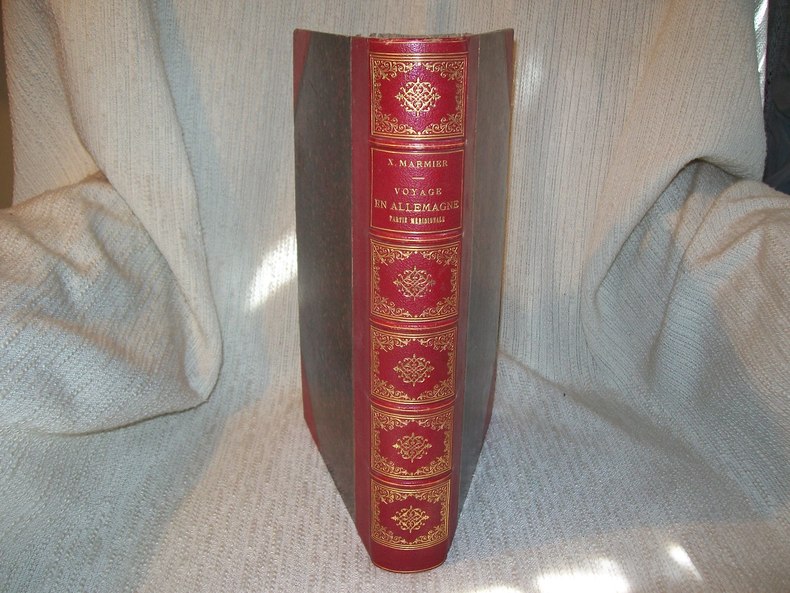
1857GITG406Paris Morizot sans date (1857). Grand in-8 504pp. Demi chagrin rouge, dos à nerfs rehaussés d'un filet, compartiments finement dorés, tête dorée, non rogné, reliure de l'époque. Orné de 24 gravures de Rouargue Frères dont 4 en couleurs. Quelques rousseurs éparses. Bel exemplaire bien complet de son texte et des gravures dans une reliure solide et décorative.
1920. In 8°pp.25n. cop.muta.
Mm 135x215 Collana "Tascabili Bompiani". Brossura editoriale di XVI-288 pagine. Opera in buone condizioni. Spedizione in 24 ore dalla conferma dell'ordine.
1904RXzz0579Prag, Vlg. d. archaeolog. Commission 1904. gr.-8°. 188 S., 2 Bl., 219 Textabb., okart., Rücken m. kleinen Einrissen (= Topographie der historischen und Kunst-Denkmale im Königreiche Böhmen; 10)
1890j2p3c18xbvkParis, 'B. K. Edit.', not dated (early 1890ies). White stereo-photograph frames with blue text 'LE MOULIN ROUGE' in ornaments at both sides and a small red windmill at the top, the coloured rear (unveiling its effects only against a light) is originally protected (within the frames) by thin halftransparent paper; 9 x 18 cm overall.
1769elala199Vienna: Johann Thomas Edlen von Trattnern 1769. 1769. folio. pp. 8 p.l. 282 lvi. 27 engravings in the text & 3 folding engraved plates incl. in pagination. woodcut ornaments & initials. full contemporary dark brown morocco lettered in gilt on upper cover: Constitutio Criminalis Theresiana Spectans Ad Antiquam Civitatem Voitsbergensem 1773 Antonius Josephus Schilcher P.T. Judex Civitatis Voitsberga bit rubbed some browning & foxing marginal dampstain to last section containing engravings folding plates dampstained & repaired -1 with some loss of text. Inscribed on front blank: "Mathias SchuemackerSuperioris Austriae Jo. J. Syndrins Voitsberga 1773". First Edition of the famous criminal code of Maria Theresa which redefined torture as "a subsidiary means of eliciting truth". Torture could be applied to obtain confessions only in cases where condemnation would have involved capital or severe corporal punishment. A remarkable publication including graphic illustrations of instruments and methods of torture thumb-screws stocks racks burning candles leg vices winches the Viennese shoe with detailed and precise instructions on their use. According to the Encyclopaedia Britannica 11th Edn. this illustrated edition was suppressed by Prince Kaunitz chancellor of state and advisor to the Empress a few days after its appearance. Torture was formally abolished in the empire in 1776. Signed by Authors. 1st Edition. Vienna: Johann Thomas Edlen von Trattnern, 1769. hardcover
1744GRIttMAR35The Hague: Antoine De Groot 1744. 1744. 4to. pp. 15. disbound lightly soiled some leaves closely cropped with loss of catchwords. Soft cover. Very Good. The Hague: Antoine De Groot, 1744. Paperback
176957355Wien: Johann Thomas Edlen von Trattnern 1769. First Edition. Folio pp. xvi 282 lvi Illustrated with 27 engravings in the text & 3 folding engraved plates included in the pagination. Some foxed and toned lacks the front flyleaf. Bound in very rubbed contemporary calf still a very good tight copy. Woodcut and typographic ornaments and initials. Text in German black letter with glosses in Latin. Bound in contemporary calf spine gilt little rubbed and recently rebacked red edges. Woodblock printed end papers. Some toning to the text The binding is a little rubbed but still a very good crisp and clean copy. Maria Theresa was the eldest daughter of emperor Charles I and of Elizabeth Christina of Brunswick. At the death of her father in 1740 she became the sole heiress of his dominions of the house of Austria. Upon her accesion to the throne the neighboring countries tried to capture parts of the empire which led to the Wars of Austrian Succession which finally concuded with the treaty of Aix-la-Chapelle in 1748. This is the famous criminal code of Maria Theresa which used torture as a means of "eliciting truth." Her insticts were absolutist and she would allow nothing that limited state power even as she reformed the education system and worked to better the lives of her citizens. And she did not forbid torture. Torture was only to be used only is capital and very serious criminal cases. Included in this volume are very graphic illustrattions of instruments of torture thumb-screws stocks racks burning candles leg vices winches the Viennese shoe! with detailed and precise instruction of their use. According to the Britannica this edition was suppressed by Prince Kaunitz chancellor of the state and an advisor to the Empress. Torture was formally abolished in the empire in 1776. Maria Theresa Walburga Amalia Christina was the only female ruler of the Habsburg dominions and the last of the House of Habsburg. Maria Theresa and her husband Francis I Holy Roman Emperor had sixteen children including Queen Marie Antoinette of France. Maria Theresa was the absolute sovereign . She promulgated financial and educational reforms promoted commerce and the development of agriculture and reorganised Austria's ramshackle military all of which strengthened Austria's international standing. Johann Thomas Edlen von Trattnern unknown books
176952694Wien: Johann Thomas Edlen von Trattnern 1769. First Edition. Folio pp. xvi 282 lvi Illustrated with 27 engravings in the text & 3 folding engraved plates included in the pagination. One of the plates was misfolded and is consequently slightly frayed at the lower edge with an old paper repair at the foredge not affecting the print area. Woodcut and typographic ornaments and initials. Text in German black letter with glosses in Latin. Bound in contemporary calf spine gilt little rubbed and recently rebacked red edges. Woodblock printed end papers. Some toning to the text The binding is a little rubbed but still a very good crisp and clean copy. Laid in: MARIA THERESA; EMPRESS. Autograph Note Signed "Maria Theresia" on black rimmed mouring paper to paymaster Mayer in German concerning her son's pension requesting 500 ducats or sovereigns and in a postscript written at lower edge and vertically at upper edge adding that the letters would follow in the evening. 1 page 12mo mourning stationery; some staining affecting signature but still legible folds. Vienna circa 1776. Maria Theresa was the eldest daughter of emperor Charles I and of Elizabeth Christina of Brunswick. At the death of her father in 1740 she became the sole heiress of his dominions of the house of Austria. Upon her accesion to the throne the neighboring countries tried to capture parts of the empire which led to the Wars of Austrian Succession which finally concuded with the treaty of Aix-la-Chapelle in 1748. This is the famous criminal code of Maria Theresa which used torture as a means of "eliciting truth." Her insticts were absolutist and she would allow nothing that limited state power even as she reformed the education system and worked to better the lives of her citizens. And she did not forbid torture. Torture was only to be used in capital and very serious criminal cases. Included in this volume are very graphic illustrattions of instruments of torture thumb-screws stocks racks burning candles leg vices winches the Viennese shoe! with detailed and precise instruction of their use. According to the Britannica this edition was suppressed by Prince Kaunitz chancellor of the state and an advisor to the Empress. Torture was formally abolished in the empire in 1776. Maria Theresa Walburga Amalia Christina was the only female ruler of the Habsburg dominions and the last of the House of Habsburg. Maria Theresa and her husband Francis I Holy Roman Emperor had sixteen children including Queen Marie Antoinette of France. Maria Theresa was the absolute sovereign . She promulgated financial and educational reforms promoted commerce and the development of agriculture and reorganised Austria's ramshackle military all of which strengthened Austria's international standing. Johann Thomas Edlen von Trattnern unknown books
1937RXzz0580Troppau / Lpz., Heinz [1937]. 440 S., OLn. Erste u. einzige deutschsprachige Ausgabe.
1933RXzz1330Troppau, Leipzig, Heinz [1933]. 591 S., OLn., im Bund gelockert, Schnitt etw. fleckig. Erste dt. Ausgabe.
Mm 220x275 Volume in tela editoriale con titolo in oro impresso al dorso e al piatto, sovraccoperta editoriale policroma, 123 pagine, ricca iconografia perlopiù a colori. Ottimo stato. Spedizione entro 24 ore dalla conferma dell'ordine.
Carta geografica, antica ed originale con coloritura coeva ai confini. Milano, dall’Imperiale Regia Stamperia 1833. Autore: Marieni Giovanni trad. & A. Campana dir.. Luogo: Boemia. Anno: 1833. Tecnica: incisione in rame. Dimensioni: 288x390 mm.
Milano, Regia Stamperia 1830 circa. Incisione in rame all'acquaforte, cm 31,5 x 42 (alla lastra) più margini, confini in colore d'epoca. Una traccia di foxing all'angolo superiore sinistro, leggere ondulazioni della carta, disegno di ruggine all’angolo superiore sinistro, peraltro ottimo esemplare in margini. .
In-8 (cm. 24), brossura editoriale illustrata, sovracoperta, pp. 90, (6), alcune tavole a colori fuori testo. In buono stato di conservazione (good copy).
1910RXzz0589Wien u. Lpz., Kirsch 1910. X, 137 (3) S., obrosch., unaufgeschnitten.
1902RXzz0596Wien, Konegen 1902. 46 S., 1 Bl., obrosch. Erste deutschspr. Ausgabe der Vortragssammlung zu Themen aus Philosophie und Humanität.
1907RXzz1331Frankfurt a.M., Neuer Frankfurter Verlag 1906 (Einbd.: 1907). 128 S., OBrosch. Erste dt. Ausgabe. Enthält: I. Die Masarykprozesse. II. Wissenschaft und Religion, Religion und Schule. III. Der Katechetenspiegel.
1973143261973. Blattgröße: 61 x 43 cm. Bildgröße: 44,5 x 30 cm.
No marks or inscriptions. A very clean very tight copy with bright unmarked boards, slight foxing to top of page edges and no bumping to corners. Slightly dusty dust jacket not price clipped or marked with small tear to upper front corner, a few tiny nicks to edges and slightly rubbed. 88 Plates plus 33pp. Romanesque art began to develop in the Bohemain countries in the 11th century and disappeared in the 13th century. This study covers this period with examples mainly in black & white plus a few in colour. Text in both English and French.
1955RXzz0603Prag, Artia (1955). gr. 4°. 104 (4) S., 279 tlw. farbige Taf., 2 Bl. OLn. Mit Oumschlag in Schuber.
1934RXzz0604Praha, Nákl. Ceské Akademie Ved a Umení 1934. gr.-4°. 37 S. Text u. 28 Abb. in Lichtdruck auf 4 Taf., einige Textabb., obrosch., unaufgeschnitten, wie neu (= Anthropologica). - Mit Literaturverz. u. Zusammenfassung in franz. Sprache.
1933RXzz0605Praha, Nákl. Ceské Akademie Ved a Umení 1933. gr.-4°. 59 S., 6 Taf. mit 15 Abb. in Lichtdruck sowie einige Abb. im Text, obrosch., unaufgeschnitten, wie neu (= Anthropologica). - Mit Literaturverz. u. Zusammenfassung in franz. Sprache.
1964RXzz0606(Praha, Artia 1964). 4°. 55 S., 75 nn. Bll., zahlr. Abb. im Text u. etwa 60 mpontierte Farbtafeln, OLn. mit OUmschlag
5472in 8 cartonné rouge d'éditeur titre et décor dorés sur le premier plat et au dos,dorure disparue par endroit.Faux-titre,titre illustré,46 pages,illustrations hors-texte de L.SAINT Paris Librairie d’éducation Nationale,onzième série sans date (1906) Très bon état.Fort rare Premier livre de Max Jacob,illustré de 6 hors-texte de Louis Saint.L'artiste semble avoir également composé la page de titre.Max Jacob rentra dans le monde des lettres en 1898,en devenant critique d'art au Moniteur sous le pseudonyme de Léon David.Trois ans plus tard,il rencontre Picasso avec qui il partagera une chambre Boulevard Voltaire,avant de fréquenter André Salmon et Guillaume Apollinaire.Vivant alors d'expédients,il sera successivement clerc d'avoué,magasinier à l'Entrepôt Voltaire, précepteur,il écrit fin 1903 deux contes, L'histoire du Roi Kaboul 1er et Le géant du Soleil."Je réfléchis que j'aimais conter des histoires aux enfants. J'écrivis donc dans ma petite chambre boulevard Barbès 33 (au coin de la rue Poulet),sans feu,sans tabac,sans pétrole et nourri par le crédit d'une boulangère charitable, le roi Kaboul et le marmiton Gauwain... ".Le second texte ne fut pas édité,mais le premier parut en mars 1904 comme livre de prix pour les écoles.Monsieur Alain Segal de l'Association des amis de Max Jacob dans son étude sur les différentes éditions du ROI KABOUL en révèle la genèse:c'est sur les conseils de son ami Gaston Courtillier qui travaillait chez Picard et Kahn que Max Jacob proposa son manuscrit.Les éditeurs qui cherchaient un conte pour enfant l'acceptèrent,moyennant quelques minimes retouches dont le changement des mots paroisses,églises ou calvaires qui devinrent pour l'école laïque Hôtel de ville,mairie ou commune.Ce premier livre lui rapportera une petite fortune:"J'ai touché 30 francs pour le Roi Kaboul.J'en ai profité pour aller dans un restaurant.Tous les plats étaient à 0fr.25.J'en ai eu pour 2fr.50.Tu imagines tout ce que j'ai mangé pour arriver à cette somme!" confiera-t-il des années plus tard à Marcel Béalu.


