2 381 résultats
60558Reprint from Proceedings of the Linnean Society of London Session 122. 1910. pp. ii 9-50. Original wrappers disbound from a collection of offprints ex-libris SIR JAMES GRAY FRS 1891-1975 with his signature on the front wrapper and his marginal notes a very good copy. Reprint from Proceedings of the Linnean Society of London, Session 122. 1910. unknown
3385316901.Gpaperback. Good. Access codes and supplements are not guaranteed with used items. May be an ex-library book. paperback
2008Q-0553384341Bantam Discovery 2008-10-28. Paperback. New. In shrink wrap. Looks like an interesting title! Bantam Discovery paperback
2008Q-0553591517Bantam Discovery 2008-10-28. Mass Market Paperback. New. In shrink wrap. Looks like an interesting title! Bantam Discovery paperback
2007Q-0553589695Bantam 2007-08-28. Paperback. New. In shrink wrap. Looks like an interesting title! Bantam paperback
143320777X.Gmp3_cd. Good. Access codes and supplements are not guaranteed with used items. May be an ex-library book. unknown
63199OFFPRINTS from The Journal of Anatomy and Physiology Vols. XXXII to XL. 1898-1906. 13 parts in 9. . TOGETHER WITH : GASKELL W. H. STARLING E. H. GADOW H. and others. Discussion on the Origin of Vertebrates. Reprint from Proceedings of the Linnean Society of London Session 122. 1910. pp. ii 9-50. All in original printed paper wrappers excellent condition apart from the slight damage to the foot of the backstrip in one part signature of SIR Arthur. Smith. WOODWARD on one wrapper neat stamp of University College London on each front cover of the main series and either the final plate or text leaf in all other ways a very good set. Exceptionally rare in this form and precedes GARRISON-MORTON #243 The Origin of Vertebrates 1908 - 'Gaskell was probably the most brilliant of Michael Foster's pupils. His history of the origin of vertebrates from invertebrate ancestors is not universally accepted.' In his review of the Linnean Society discussion in NATURE 1910 J. GRAHAM KERR stated - 'The remarks made by Dr. Gaskell and his supporters make it apparent that there exist wide differences between what they accept as the correct principles of morphological research and those which are accepted by other working morphologists. The forgoing paragraphs are not meant as a criticism of Dr. Gaskell's hypothesis. They are merely meant to direct attention to an extraordinary want of agreement as to methods or principles of morphological research.' In part XIII Gaskell sums up his thesis - 'In a series of papers published in this Journal I have developed my theory of the origin of vertebrates and have compared step by step every organ in the arthropod with the corresponding organ in the vertebrate and shown how one after another each has fitted into its right place on the assumption that the arthropod has given rise to the vertebrate without any reversal of surfaces an assumption which necessitates the formation of a new alimentary canal for the vertebrate.' GASKELL 1847-1914 had hoped to complete his study but never did so; in part XIII he stated - 'I am aware that in the course of these papers I have promised at some time to consider separately the vascular and lymphatic systems and the external covering and I still hope to be able some day to publish something on these subjects. At present however I am engaged in putting the whole story into book form and until that is accomplished I am not likely to add to this series.' SIR ARTHUR SMITH WOODWARD FRS 23 May 1864 2 September 1944 English palaeontologist known as a world expert in fossil fish. He also described the Piltdown Man fossils which were later determined to be fraudulent. He is not related to Henry Woodward whom he replaced as curator of the Geology Department of the British Museum of Natural History. OFFPRINTS from The Journal of Anatomy and Physiology, Vols. XXXII to XL. 1898-1906. 13 parts in 9. unknown
1880499941880. J. Physiol.Lond. 3. 18808° 2 26 pp. 3 mehrfach gefalt. Kurventafeln orig. unbedruckte Broschur. Rare Offprint! unknown
2003Q-0553382241Bantam 2003-09-30. Paperback. New. In shrink wrap. Looks like an interesting title! Bantam paperback
2005Q-0553383132Bantam 2005-09-27. Paperback. New. In shrink wrap. Looks like an interesting title! Bantam paperback
2013Q-055338628XBantam 2013-04-23. Paperback. New. In shrink wrap. Looks like an interesting title! Bantam paperback
2006Q-0553383140Bantam 2006-10-31. Paperback. New. New. In shrink wrap. Looks like an interesting title! Bantam paperback
1883440201883. Phil. Trans. B. 173/3 1882. - London Harrison & and Sons 1883 4° pp.993-1033 Figs. 5 Tafeln feiner Pappband. Frist Edition! Walter Holbrook Gaskell 1847-1914 classical memoir on the muscle and nerves of the heart included a description of "Gaskell's nerves" the accelerator nerves of the heart. He showed that the motor impulses from the nerve ganglia in the sinus venosus influence the heart rhythm but do not originate cardiac movements which are due to the rhythmic contraction of the heart muscle. This led to the artificial production of "heart-block" the name of which Gaskell based on a expression of Georges John Romanes." Garrison & Morton No. 829 unknown
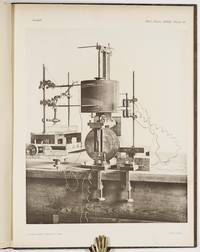
188351495London Harrison and Sons 1883. 4to. No wrappers as extracted from "Philosophical Transactions" Year 1882 Volume 173 - 1883. - Pp. 993-1033 and 5 plates 1 heliogravure instrument 4 folded recordings. <br/><br/><em>First edition of Gaskell's classic in neuroscience on the musculature and innervation of the heart."In the Croonian lecture for 1881 dealing with the frog heart Gaskell presented an important new method for studying heart action later named the "suspension method" and insisted that cardiac inhibition depended less on nerve or ganglionic mechanisms than on the inherent properties of the cardiac musculature. The role of the vagus nerve in inhibition was reduced to that of being the “trophic†anabolic nerve of the cardiac muscle. Yet in the same lecture Gaskell produced impressive evidence against Foster’s myogenic theory of rhythmicity and advocated instead the neurogenic view that discontinuous ganglionic discharges are responsible for the rhythmicity of the normal heartbeat. The background to this defection was exceedingly complex but it derived from an initial assumption which Foster himself accepted that ganglionic impulses - whatever their role in rhythmicity - are somehow involved in coordinating the normal sequence of the vertebrate heartbeat."DSB.Garrison & Morton 829. </em> unknown
1024034720.Ghardcover. Good. Access codes and supplements are not guaranteed with used items. May be an ex-library book. hardcover
50491749like new. unknown
1164258400.Ghardcover. Good. Access codes and supplements are not guaranteed with used items. May be an ex-library book. hardcover
1355831628.Ghardcover. Good. Access codes and supplements are not guaranteed with used items. May be an ex-library book. hardcover
2019x-818094235XMJP Publishers 2019. Paperback. New. 514 pages. 9.20x6.70x1.29 inches. MJP Publishers paperback
44205608like new. unknown
44205608-nnew. unknown
3752392878.Ghardcover. Good. Access codes and supplements are not guaranteed with used items. May be an ex-library book. hardcover
1340401150.Ghardcover. Good. Access codes and supplements are not guaranteed with used items. May be an ex-library book. hardcover
3752338539.Gpaperback. Good. Access codes and supplements are not guaranteed with used items. May be an ex-library book. paperback
1146513038.Gpaperback. Good. Access codes and supplements are not guaranteed with used items. May be an ex-library book. paperback