HOFFMANN, GOTTFRIEDBiblio.com
93 résultats
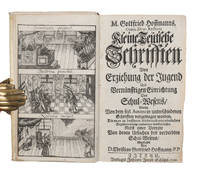
172061982Zittau J. J. Schops 1720. 8vo. In contemporary full vellum with title in contemporary hand. Light wear to extremities. Frontispiece and title-page detached otherwise a nice and clean copy. 12 318 2 239 440 26 pp. frontispiece. <br/><br/><em>Rare first collected edition with a preface on "Ursachen des verderbeten Schul-Wesens" by Hoffmann’s son Christian Gottfried Hoffmann ofthis pedagogical work that focuses on the education of youth and the organization of the school system. Hoffmann was a schoolmaster pedagogue and secretary to Christian Weise in Zittau while also working as a private tutor. In 1685 he became vice-principal Konrektor in Lauban later becoming principal in 1695 and in 1708 he succeeded Christian Weise as head of the school in Zittau. He was the author of numerous pedagogical works. </em> hardcover
1742RO20010040Briasson. 1742. In-12. Relié plein cuir. Etat passable, Couv. défraîchie, Coiffe en pied abîmée, Intérieur bon état. En l'état : 182p illustré de gravure en frontispice de Hoffmann, tranche rouge, dos à nerfs, dos décoré de caissons orné, titre et tomaison sur pièce; plats avec épidermures; manque sur le 2ème plat, mors fendu.la page de garde est détachée.bandeau en tête de chapitre.. . . . Classification Dewey : 610-Sciences médicales. Médecine
1751R240162988Chez Briasson. 1751. In-12. Relié plein cuir. Etat d'usage, Coins frottés, Dos satisfaisant, Quelques rousseurs. CCLIX + 276 pages. Tranches roses. Contreplats jaspés. Petite annotation à l'encre en page de titre. Dos à 5 nerfs, motifs dorés. Pièce de titre manquante.. . . . Classification Dewey : 610-Sciences médicales. Médecine
17267644GB1726. Tle. 5 und 6 von 12 in 1 Bd. Halle Renger 1726-28. 12 Bl. 375 S. - 6 Bl. 360 S. 34 Bl. Pergamentband der Zeit mit handschriftlichem Rückentitel Deckel stark verzogen. Umlaufend roter Sprenkelschnitt. Beide Deckelinnenseiten mit Exlibris des Joh. Paul Egidius Nitsch. Fliegendes Blatt von alter Hand beschrieben. Stellenweise geringfügig fleckig oder mit schwachem Wasserrand entlang des Kopfschnitts. In Teil 5 große Teilen mit gebräuntem Textblock. Sonst in schöner Erhaltung. Blake 217; Hirsch/H. III 258. - Wegen des langen Erscheinungszeitraums 1721-39 heute meist nur noch in Einzelbänden vorkommendes Sammelwerk mit einer Fülle interessanter Krankengeschichten und deren Behandlung. - Friedrich Hoffmann 1660-1742 einer der große deutschen Ärzte im 18. Jahrhundert wurde 1693 erster Prof. der Medizin an der neugegründeten Universität Halle und las dort über Physik Chemie Anatomie Chirurgie und prakt. Medizin. Zu seinen großen und bleibenden Verdiensten gehören seine Verbesserungen und Bereicherungen der Pharmakologie. unknown
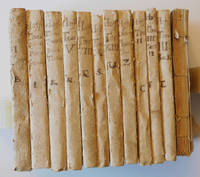
1721705751721-1739. Halle im Magdeburgischen : Zu finden in der Rengerischen Buchhandlung 1721-1739 4° mit gestochenem Portraitfrontispiz 4583 pp.; 1.-10.Theil in 2 Pergamenteinbände d. Zt. und 11.-12. Theil in Pappband im Stil. d.Zt.; feines Expl. DER MEDIZINISCHE RATGEBER DES 18. JAHRHUNDERTS Titel: "Friderici Hoffmanni Diversorum Principum S.R.I. Consiliarii Medici & Professoris Medicinae in Academia Fridericiana Primarii Medicina Consultatoria : Worinnen Unterschiedliche über einige schwehre Casus ausgearbeitete Consilia auch Responsa Facultatis Medicae enthalten Und in Fünf Decurien eingetheilet Dem Publico zum besten herausgegeben". 1.Th.: 24 295 1; 2.: 8 272; 3.: 24 264; 4.: 16 344 40; 5.: 24 375; 6.: 12 360 28; 7.: 8 334 i.e. 344 36; 8.: 12 384; 9.: 16 408; 10.: 16 365 55; 11.: 12 408; 12.: 6 408 34 pp. Friedrich Hoffmanns Königl. Preuß. Medici und Professoris wie auch der Käyßerlichen Königl. Groß-Britannischen und Preußischen Societaeten der Wissenschafften Mitglieds Gründlicher Bericht Gründlicher Bericht von dem Selter-Brunnen: Dessen Gehalt Würckung und Krafft auch Wie derselbe sowohl allein als mit Milch vermischt Bey verschiedenen Kranckheiten mit Nutzen zu gebrauchen Halle: Gedruckt bey Joh. Christ. Hilligern Universitäts Buchdruckern 1727 4° 35 pp. Erste Ausgabe. Wegen des langen Erscheinungszeitraums selten vollständig vorkommendes Sammelwerk ". eine reichhaltige Sammlung von Krankheitsgeschichten darstellend und dadurch sehr werthvoll . hrsg. von einem der Heroen der dt. Medizin im 18. Jhdt" Hirsch-Hübotter. Krankheitsfälle mit Ursache und Verlauf sowie mit den entsprechenden Berichten der Patienten selbst über Erfolg oder Misserfolg. Texte meist in Deutsch einige ganz wenige in Latein. Friedrich Hoffmann 1660-1742 Arzt und Chemiker Professor der Medizin in Halle war Leibarzt des preußischen Königs Friedrich I. "Boerhaave in Leiden Hoffmann und Stahl in Halle wurden die drei großen "Systematiker" der Medizin des beginnenden 18. Jahrhunderts. H.s simplifizierendes System der "mechanischen Arzneigelahrtheit" führte ihm zahlreiche Anhänger zu provozierte aber auch heftige Angriffe der Stahlschen Schule des "Animismus". H. sah den Organismus als eine Art hydraulischer Maschine an. Der Spannungszustand Tonus der Fasern und damit alle das Leben charakterisierenden Bewegungsvorgänge werden gesteuert von einem "Nervenfluidum" das aus dem überall im Kosmos vorhandenen "Äther" hergeleitet und vom Gehirn über die Nerven verteilt wird. Diese Vorstellung knüpft an die alten "Spiritus" ebenso an wie an die solidarpathologischen Lehren der antiken Methodiker. "Spasmus" einerseits "Atonie" andererseits bewirken Krankheit und müssen vom Arzt mit Gegenmitteln behoben werden. Die "Seele" der Stahl eine physiologische Funktion zuweist bleibt streng vom Körper getrennt in der Zuständigkeit der Theologen. In seiner Praxis war H. jedoch kein Doktrinär; er hatte großen Erfolg war ein gesuchter Consiliarius und wurde wegen seiner Liebenswürdigkeit und weltmännischen Sicherheit allgemein bewundert." "Seine chemischen Kenntnisse nutzte H. zu grundlegenden Arbeiten über Mineralquellen unter anderem Karlsbad Lauchstädt. Aber auch präparativ hat er gearbeitet: Die schmerzstillenden "Hoffmannstropfen" bis heute ein beliebtes Hausmittel haben seinen Namen auch im Publikum allgemein bekannt bleiben lassen." Hans-Heinz Eulner NDB 9 1972 pp. 416-418 VD18 11081708. Hirsch-Hübotter III 256. Blake 216 -7; Wellcome III 284 unknown
1733705791733. Halle im Magdeburgischen : Zu finden in der Rengerischen Buchhandlung 1733 4° 16 365 55 pp. Pappband im Stil d.Zt. Erste Ausgabe! Wegen des langen Erscheinungszeitraums selten vollständig vorkommendes Sammelwerk ". eine reichhaltige Sammlung von Krankheitsgeschichten darstellend und dadurch sehr werthvoll . hrsg. von einem der Heroen der dt. Medizin im 18. Jhdt" Hirsch-Hübotter. Krankheitsfälle mit Ursache und Verlauf sowie mit den entsprechenden Berichten der Patienten selbst über Erfolg oder Misserfolg. Texte meist in Deutsch einige ganz wenige in Latein. Friedrich Hoffmann 1660-1742 Arzt und Chemiker Professor der Medizin in Halle war Leibarzt des preußischen Königs Friedrich I. "Boerhaave in Leiden Hoffmann und Stahl in Halle wurden die drei großen "Systematiker" der Medizin des beginnenden 18. Jahrhunderts. H.s simplifizierendes System der "mechanischen Arzneigelahrtheit" führte ihm zahlreiche Anhänger zu provozierte aber auch heftige Angriffe der Stahlschen Schule des "Animismus". H. sah den Organismus als eine Art hydraulischer Maschine an. Der Spannungszustand Tonus der Fasern und damit alle das Leben charakterisierenden Bewegungsvorgänge werden gesteuert von einem "Nervenfluidum" das aus dem überall im Kosmos vorhandenen "Äther" hergeleitet und vom Gehirn über die Nerven verteilt wird. Diese Vorstellung knüpft an die alten "Spiritus" ebenso an wie an die solidarpathologischen Lehren der antiken Methodiker. "Spasmus" einerseits "Atonie" andererseits bewirken Krankheit und müssen vom Arzt mit Gegenmitteln behoben werden. Die "Seele" der Stahl eine physiologische Funktion zuweist bleibt streng vom Körper getrennt in der Zuständigkeit der Theologen. In seiner Praxis war H. jedoch kein Doktrinär; er hatte großen Erfolg war ein gesuchter Consiliarius und wurde wegen seiner Liebenswürdigkeit und weltmännischen Sicherheit allgemein bewundert." "Seine chemischen Kenntnisse nutzte H. zu grundlegenden Arbeiten über Mineralquellen unter anderem Karlsbad Lauchstädt. Aber auch präparativ hat er gearbeitet: Die schmerzstillenden "Hoffmannstropfen" bis heute ein beliebtes Hausmittel haben seinen Namen auch im Publikum allgemein bekannt bleiben lassen." Hans-Heinz Eulner NDB 9 1972 pp. 416-418 unknown
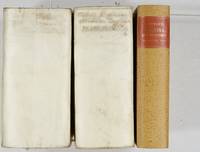
1732D7280Halle 1732-38. Hardcover. Very Good. Contemporary vellum over boards; 12 parts in 6 volumes 4to 166 x 206 mm. Frontispiece portrait in Volume 1. Bookplate of Herbert McLean Evans. Spines chipped and torn; boards lightly rubbed and dust-soiled; text blocks age-toned but otherwise clean. A nice set worthy of repair. <br/><br/>A collection of early editions of Friedrich Hoffmann possibly the most important of the latrochemists. Friedrich Hoffmann was one of the most distinguished physicians and chemists of his time court physician to the King of Prussia and primatus professor of medicine at the University of Halle. He was the first to perceive pathology as an aspect of physiology. hardcover
1732D7280Halle 1732-38. Hardcover. Very Good. Contemporary vellum over boards; 12 parts in 6 volumes 4to 166 x 206 mm. Frontispiece portrait in Volume 1. Bookplate of Herbert McLean Evans. Spines chipped and torn; boards lightly rubbed and dust-soiled; text blocks age-toned but otherwise clean. A nice set worthy of repair. <br/><br/>A collection of early editions of Friedrich Hoffmann possibly the most important of the latrochemists. Friedrich Hoffmann was one of the most distinguished physicians and chemists of his time court physician to the King of Prussia and primatus professor of medicine at the University of Halle. He was the first to perceive pathology as an aspect of physiology. hardcover books
1753006549Neapoli: Benedicti Gessari 1753. Book. Very Good. Soft cover. First Thus. 4to - over 9¾" - 12" tall. The RARE First Italian edition published in Naples 1753-1763 this being a 12 volume partial set of Hoffman's major works containing the following: "Medicinae Rationalis Systematique" Tomus Secundus Tomus Tertius Section I and II all published 1753 and Tomus Quarti Pars Secunda and Pars Tertius 1754 ; "Observationum Physico-Chymicarum Selectiorum" Libri III 1755; "Operum Omnium Physico-Medicorum Supplementum" by itself a 13 volume set books 1 1754 5 1757 8 1760 10 1762 and 13 1763 ; and "Opuscula Medica Varii Argumenti Seu Dissertationes" 1756. Two of the volumes have handwritten " ex Libris Josephi de Bertolois Medici Physici Avia" an 18th century M.D. who appears to be the original owner. The "Opuscula Medici" and Book 1 of the "Operum Omnium" are Good only the "Opuscula Medici" lacking its binding but complete in its contents and Book 1 of the "Operum Omnium" the boards heavily soiled and loose in its binding. The rest of the 10 volumes Very Good soiling to boards some worm holes corner creasing. A remarkable collection of Hoffmann's works. Benedicti Gessari Paperback
1753006549Neapoli : Benedicti Gessari 1753. The RARE First Italian edition published in Naples 1753-1763 this being a 12 volume partial set of Hoffman's major works containing the following: "Medicinae Rationalis Systematique" Tomus Secundus Tomus Tertius Section I and II all published 1753 and Tomus Quarti Pars Secunda and Pars Tertius 1754 ; "Observationum Physico-Chymicarum Selectiorum" Libri III 1755; "Operum Omnium Physico-Medicorum Supplementum" by itself a 13 volume set books 1 1754 5 1757 8 1760 10 1762 and 13 1763 ; and "Opuscula Medica Varii Argumenti Seu Dissertationes" 1756. Two of the volumes have handwritten " ex Libris Josephi de Bertolois Medici Physici Avia" an 18th century M.D. who appears to be the original owner. The "Opuscula Medici" and Book 1 of the "Operum Omnium" are Good only the "Opuscula Medici" lacking its binding but complete in its contents and Book 1 of the "Operum Omnium" the boards heavily soiled and loose in its binding. The rest of the 10 volumes Very Good soiling to boards some worm holes corner creasing. A remarkable collection of Hoffmann's works. First Thus. Handmade Paper Covered Boards . Very Good/No Jacket As Issued. 4to - over 9¾" - 12" tall. Benedicti Gessari Hardcover books
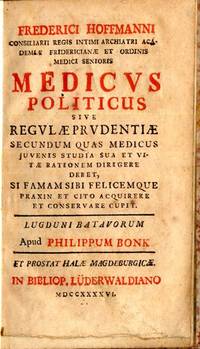
1746271991746. Leiden Ph.Bonk Halle Lüderswald 1746 Kl.8° 4 168 20 pp. Titel in Rot und Schwarz Pappband der Zeit; gutes wohlerhaltenes Exemplar. Friedrich Hoffmann 1660-1742 war einer der Heroen der deutschen Medizin des 18.Jahrhunderts. Sein 'Medicus politicus' ist eine Art medizinischer Methodologie. Er erwähnt darinnen daß durch den Besuch medizin. Vorlesungen allein niemand zum Arzt werde sondern dazu gehöre die klinische Untersuchung. Dem Arzt rät er sich mit dem Chirurgen gut zu stellen namentlich in chirurgischen Dingen. Darinnen hätten sie die größere Erfahrung. The 'Medicus politicus' often discussed as a treatise on medicial ethics is also a discourse on the principles of rational medicine. The physician must know geometry mechanics and hydraulics in order to discover the laws of motion which govern the materials of the body. Cf. Hirsch-H. III p.256-59; Haeser II p.509 unknown
1788ALDR0629Brünn, gedruckt bei Joseph Georg Traßler und im Verlage der Kompagnie (ab Bd 5: und im Verlage R. A. Schrämbls) 1786-1788. 5 Bde. 8°. 324 S., S. 333-421 (Ss. 325-332 fehlen), mit XXI gest., kol. Tafeln, 3 nn. Bll.; 324 S., mit XXII-LX (= 39) gest., kol. Taf., 4 nn. Bll.; 356 S., mit LXI-LXXVII (= 17) gest., kol. Taf., 4 nn. Bll.; Titelbl., 427 S, mit CII-CXL (= 38 v. 39) gest., kol. Tafeln (Taf. CCXVIII fehlt); 482 S., mit CCIII-CCXLIX (= 48) gest., kol. Taf., 5 nn. Bll., mit einigen Zierleisten. Marmorierte Lederbände der Zeit, Rückenschildchen und Rückenverzierung in Goldprägung, einige Bände mit großt. abgeriebenen kleinen Papierschildchen mit handschriftlicher Zählung, Einbanddeckel mit Streicheisenlinien gerahmt, Vorsätze rot marmoriert, Buchschnitte rot gefärbt, bestoßen und berieben, teilw. mit Kratzspuren u. etwas fleckig, an den Kapitalen meist schadhaft, Rückenleder rissig, Leder entlang der Gelenke eingerissen, Bindungen locker. Seiten insgesamt schwach gebräunt bzw. braunfleckig, selten stärker gebräunt, kaum fleckig, mit Randausriss ohne Textverlust im Titelblatt des zweiten Bandes, im siebenten Band fehlt die untere Hälfte des Titelblattes. Mit Bleistiftanmerkungen und -anstreichungen im Text, jeweils einer Zahl in alter Tintenschrift am vorderen Schmutzumschlagblatt oder fliegenden Vorsatzblatt verso. - Aus dem Nachlass des Architekten Johannes Spalt, der es aus der Bibliothek des Architekten Josef Hoffmann erhalten hatte. Mit Spalts Namenszug und dem handschriftlichen Zusatz 'Aus Josef Hoffmanns Bibliothek' mit Bleistift am vorderen Schmutzumschlagblatt avers. VD18 90176952. Vgl. Graesse 1,568 - altösterreichischer Nachdruck der ersten drei, des fünften und siebenten Bandes der umfassenden 'Naturgeschichte der Vögel' des bedeutenden französischen Naturforschers Buffon (1707-1788). Die französische Originalausgabe 'Histoire naturelle des oiseaux' in zehn Bänden erschien erstmals 1770-1786, die deutsche Ausgabe ab 1772. Übersetzer der vorliegenden ersten drei Bände war Friedrich Heinrich Wilhelm Martini (1729-1778), den fünften und siebenten Band übersetzte Bernhard Christian Otto (1745-1835). Ansehnliche Exemplare mit allen - nur Tafel CCXVIII fehlt - sorgfältig altkolorierten Tafeln. Das schadhafte Titelblatt und die fehlenden Seiten aus dem ersten Band liegen in Kopie bei. [3 Warenabbildungen]
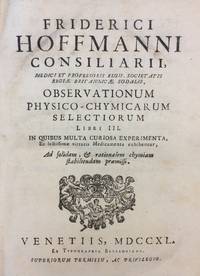
1740116144Venetiis : ex Typographia Balleoniana. 1740. In-8 p. mm. 229x170 2 opere dello stesso A. in 1 tomo p. pergamena coeva titolo manoscritto al dorso testo su due colonne. La prima In quibus multa curiosa experimenta et lectissimae virtutis Medicamenta exhibentur ad solidam & rationalem chymiam stabiliendam praemissi di pp. 16292 segue Frederici Hoffmanni Dissertationum physico-chemicarum trias' di pp. 52. Cfr. Blake p. 217 - Wellcome p. 284 per un'edizione di Napoli 1755.La seconda "Opuscula medica varii argumenti seu Dissertationes selectiores antea diversis temportibus editae nunc revisae et auctiores 1741 di pp. 8311. Vi figurano 20 Dissertazioni fra cuii De Cinnabari Antimonii ejusque eximiis viribus usu tam secretiori quam vulgari tam morbis hucusque cognitis quam incognitis e Fundamenta Medicinae ex principiis naturae Mechanicis in usum Philiatrorum succincte propopsita. Cfr. Wellcome p. 285 per un'edizione di Venezia di S. Coletus 1741 - Blake. p. 217 - Castiglioni p. 597-8: "Federico Hoffmann 1660-1742 prof. di medicina a Halle medico a Berlino alla corte di Federico I. Per le sue concezioni meccaniciste cercò di spiegare tutte le funzioni dell'organismo da un punto di vista matematico. Fu soprattutto un chimico e altresi' l'introduttore delle acque minerali nella terapia razionale".Con qualche fioritura ma buon esemplare. ex Typographia Balleoniana. unknown
1755EBS100395Napoli: Benedicti Gessari 1755. 1st Edition. Hardcover. Very Good/No Jacket. Hoffmann 1660-1742 German chemist personal physician of Frederick I in Berlin was professor of medicine in Halle author of treatises on the analysis of mineral waters on magnesia alba and founder of chemical analysis. Hoffmann advocates a rational and systematic medicine with which he takes an intermediate position between Stahl's animistic vitalism and Boerhaave's mechanism. This is the third edition first in 1722. Friedrich Hoffmann s Observationum Physico-Chymicorum Selectorum is highly valued 18th-century work that reflects the intersection of chemistry medicine and natural philosophy during the early Enlightenment period. Hoffmann was instrumental in the development of iatrochemistry the application of chemistry to medicine and was a major advocate of mechanistic physiology. BOOK DETAILS AND CONDITION: Large 4to in possibly contemporary buff heavy cardboard bound with leather cords cont. writing on spine: 1 blank 6 leaves pp 1-288 i.e. 188 since pp 177-188 the index misnumbered as pp 278-288. Curiously this is reminiscent of very similar misnumbering in two different Venice editions of 1740 see Neville I pp 646-647. Overall VG. Napoli: Benedicti Gessari hardcover
1722EBS100318Halle: Cum Privilegio S.R.M. Polon. Et Elect. Sax 1722. 1st Edition. Hardcover. Very Good/No Jacket. KEY BREAKTHROUGH IN HISTORY OF PHOTOGRAPHY. 4to cont. leather raised bands on spine leather label: 14 leaves 378 pp 11 leaves. Title page in black and red with engraved vignette. Friedrich Hoffmann was one of the most distinguished physicians and iatro-chemists of his time court physician to the King of Prussia and primatus professor of medicine at the University of Halle. This book is rare with no sales recorded at auction in the last century RBH. See Neville I p 646: The darkening of silver salts p. 350 by light is described which makes this book important in the history of photography. int some foxing VG. Ferguson I. Halle: Cum Privilegio S.R.M. Polon. Et Elect. Sax hardcover
173655712Halae: Renger. Good. 1736. Second Edition. Hardcover. Recent sewn leather binding with gilt title; new eps. No original blanks; begins with title page printed in red and black with vignette. Old PO names foxing/dampstaining/toning throughout. ; Large 8vo 9" - 10" tall; 2834222 pages . Renger hardcover
174123733Venedig, ex Typographia Balleoniana, 1741. 4°. Mit Holzschn.-Titelvignette. 620 S., Ldr. d. Zt. a. 5 Bünden m. reicher Rückenverg., goldgepr. Rückenschild u. dreiseitigem Rotschnitt.
1754M13008Genevae:: Apud fratres de Tournes 1754. 1754. Two parts in one. Folio. 24 x 35 cm. viii 871 1 pp. Collation: 4 A6-4D6. Half title title printed in red & black engraved title vignette Latin text printed predominantly in two columns engraved initials engraved head and tail pieces small woodcut fig. p.52; occasional minor stains some folds ownership signature Hermann . . . trimmed on title top edge. Original half calf over boards all edges red; heavily worn with chipped portions spine is mostly missing front joint reinforced with Kozo. Binding "as is" good internally. Bookplate of John G. Curtis Library of Columbia University. Rare. Second edition. "Hoffmann based his treatment on the use of sedatives tonics alternatives and evacuants according to the condition responsible for causing the disease. Apart from this system he was one of the premier practitioners of his day and one of the first to give good descriptions of appendicitis chlorosis rubella and convulsive asthma with dropsy." – Heirs of Hippocrates referring to the entire Opera. More description available on request. REFERENCES: The Dictionary of Eighteenth Century German Philosophers 3 vols. edited by Manfred Kuehn and Heiner Klemme London/New York: Continuum 2010; DSB VI pp. 458-461; Blake NLM lists editions from Geneva in 1740 1748 and 1761; Wellcome Library III p.285 2 vols. in 1. See: Garrison & Morton 72 for the complete 9 volumes published 1740-53; Justin E. H. Smith The Problem of Animal Generation in Early Modern Philosophy 2006; Willius & Dry A History of the Heart and the Circulation pp. 77-78. Apud fratres de Tournes, 1754. hardcover
1754M13008Genevae:: Apud fratres de Tournes 1754. 1754. Two parts in one. Folio. 24 x 35 cm. viii 871 1 pp. Collation: 4 A6-4D6. Half title title printed in red & black engraved title vignette Latin text printed predominantly in two columns engraved initials engraved head and tail pieces small woodcut fig. p.52; occasional minor stains some folds ownership signature Hermann . . . trimmed on title top edge. Original half calf over boards all edges red; heavily worn with chipped portions spine is mostly missing front joint reinforced with Kozo. Binding "as is" good internally. Bookplate of John G. Curtis Library of Columbia University. Rare. Second edition. "Hoffmann based his treatment on the use of sedatives tonics alternatives and evacuants according to the condition responsible for causing the disease. Apart from this system he was one of the premier practitioners of his day and one of the first to give good descriptions of appendicitis chlorosis rubella and convulsive asthma with dropsy." – Heirs of Hippocrates referring to the entire Opera. More description available on request. REFERENCES: The Dictionary of Eighteenth Century German Philosophers 3 vols. edited by Manfred Kuehn and Heiner Klemme London/New York: Continuum 2010; DSB VI pp. 458-461; Blake NLM lists editions from Geneva in 1740 1748 and 1761; Wellcome Library III p.285 2 vols. in 1. See: Garrison & Morton 72 for the complete 9 volumes published 1740-53; Justin E. H. Smith The Problem of Animal Generation in Early Modern Philosophy 2006; Willius & Dry A History of the Heart and the Circulation pp. 77-78. Apud fratres de Tournes, 1754. hardcover books
1738M13787Venice:: Apud Sebastianum Coleti 1738. 1738. Sq. 8vo. viii 311 1 pp. 2 small ink ownership stamps on title unreadable. Nineteenth century marbled boards printed title label on spine; extremities showing. Title verso with ink ownership stamp of Th. Renz. Very good. The work contains two parts of ten papers each for a total of twenty papers. Each studies aspects of medicine from the nature of art and efficacy in healing method application of drugs the power and efficiency of medicines applied the ability of the body to understand the remedies of drinking water and the virtues of milk in medicine the power of milk to heal qualities of mineral waters in promoting health. Continuing in the second part: salts as a healer the uses of China bark as applied to fevers uses of ejecting of venom the causes of death by disease the good of medicine the errors that are common in medical practice. "Friedrich Hoffmann also 'Hofmann' was born on 19 February 1660 in Halle where he also died on 12 November 1742. Called 'the second Hippocrates' and the 'Aesculapius Hallensis' he was among the most widely read medical authors of the eighteenth century and is best known for his systematic discussion of the iatromechanical model of medicine — similar to what Hermann Boerhaave 1668-1738 was developing at Leiden — that views the human body as a hydraulic machine wholly governed by mechanical laws. "Hoffmann's father Friedrich Hoffmann the Elder was the respected municipal physician of Halle. The younger Hoffmann enrolled at nearby Jena in 1678 the university at Halle would not open for another fifteen years where he studied medicine for two years under the iatrochemist Georg Wolfgang Wedel 1645-1721 also attending Caspar Cramer's lectures on chemistry in Erfurt in 1680. He received his doctorate in medicine from Jena in 1681 January 31 with a dissertation on suicide de autochiria and began lecturing on chemistry a standard course taught in the medical faculty but soon left perhaps pushed out by senior faculty jealous of his teaching success. After practicing medicine in Minden for two years Hoffmann made an academic tour of Belgium Holland and England during which he met Boerhaave Thomas Sydenham and Robert Boyle returned to Minden in 1684 and assumed various medical offices eventually being appointed the regional physician for Halberstadt. He married an apothecary's daughter Anna Dorothea Herstell on 10 December 1689. "In 1693 he was called to the newly-founded university at Halle as an ally of the Priest August Hermann Francke 1663-1727 with the charge of organizing its medical school and to serve as its first professor of medicine. He also became the godfather to Christian Wolff's first-born son Friedrich. Hoffmann recruited his old college friend from Jena Georg Ernst Stahl 1660-1734 for the second chair of medicine and the two taught side by side for twenty years transforming Halle into the preeminent medical school among German-speaking universities. Along with Boerhaave at Leiden Hoffmann and Stahl were the principal forces behind the medical reforms of the early eighteenth century. "Hoffmann was a member of the German Academy of Natural Scientists Leopoldina 1696 the Berlin Academy of Sciences he was included in Leibniz's founding lists and was inducted on 1 April 1701 the Royal Society of London 1720 and the Russian Academy of Sciences in St. Petersburg 1735. "In all Hoffmann authored about 400 publications mostly brief dissertations and essays but also the six-volume systematics discussed above a twelve-volume collection of case studies Medicina consultatoria 1721-39 and a nine-volume work on how to live a long and healthy life Basic Guide 1715-28 wherein Hoffmann emphasized the restorative effects of proper diet exercise clean air and sleep. He also criticized the diversity and overuse of drugs and was successful in reducing the pharmacopoeia of his day to a few basic remedies. -- The Dictionary of Eighteenth Century German Philosophers 3 vols. edited by Manfred Kuehn and Heiner Klemme. CONTENTS: Part I: 1 De naturae & artis efficacia in medendo. 2 De recta et simplicissima natura medendi method. 3 De medicamentorum prudenti application in tempore. 4 De prudenti medicamentorum continuation. 5 De vera medicamentor in morbis virtute et efficacia rite dignoscenda. 6 De cognoscenda corporis humani natura ex effectu remediorum. 7 De medicina simpilicissima & optima motu inedia aquae potu. 8 De mirabili lactis asinini in medendo usu. 9 De saluberrima seri lactis virtute. 10 De connubio aquarum mineralium cum lacte longe saluberrimo. Part II: 1 De salium mediorum excellente in medendo virtute. 2 De sale medicinali Carolinarum. 3 De manna ejusque praestantissimo in medicina usu. 4 De recto corticis chinae usu in febribus intermittenibus. 5 De purgantibus fortioribus ex praxi medica merito ejiciendis. 6 De medicina emetica et purgante post iram veneno. 7 De imprudenti medicatione multorum morborum et mortis causa. 8 De remediorum benignorum abusu et noxa. 9 De vesicantium et fonticulorum circumspecto in medicina usu. 10 De erroribus vulgaribus circa usum topicorum in praxi. / "Although Enlightenment physicians debated the suitability of milk as a treatment for different individuals and situations Friedrich Hoffmann's Treatise of the Extraordinary Virtues and Effects of Asses Milk 1754 exemplifies the basic understanding of its health benefits in the eighteenth century. Hoffmann who served as the physician to the Prussian King Friedrich I was a friend of Boerhaave and a proponent of the neo-Hippocratic school. He argues that since humans were nourished by a milky substance in the womb and raised on breast milk and since all food upon entering the body was transformed into a milky substance called chyle milk was 'manifestly proved to be the principal of all the kinds of aliment; so it may be deservedly reckoned the chief of all remedies.' Although Hoffmann preferred ass's milk for its resemblance to human breast milk he also recommended the milk of cows sheep and goats for the relief of fevers chronic coughs colic and nervous disorders -- the same aliments that afflicted Pompadour. Why was milk so effective" Hoffman argued that is possessed powerful cleansing properties functioning as a nonviolent purgative that penetrated the body's channels allowing fresh air to enter and perspiration to exit. It also removed obstructions in the chest lungs and bowels and returned the body to its proper system of 'flows.' Hoffmann told readers of how a certain 'gentlewoman' in his care who had been sick for years with fevers aches and pains began a course of milk treatment and 'in three days only everything appeared wonderfully amended.'" -- Meredith Martin Dairy Queens: The Politics of Pastoral Architecture from Catherine de' Medici to Marie-Antoinette Harvard Historical Studies Harvard University Pres 2011 pp. 135-6. REFERENCES: Blake NLM 217; Wellcome II 285. Apud Sebastianum Coleti, 1738. hardcover books
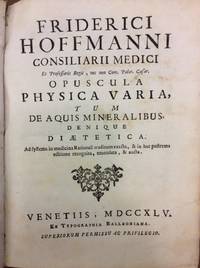
1745116156Venetiis: ex Typographia Balleoniana 1745. In-8 p. mm. 230x170 p. pergamena coeva piccole mancanze ai risg. e antiche scritte titolo manoscritto al dorso restaurato per strappi pp. 4667 testo su due colonne. Vi sono contenuti: XIII Opuscula physica varii argumenti - XIV Opuscula de aquis mineralibus earumque salutari virtute - XVII Opuscula diaetetica in quibus agitur.Cfr. Blake p. 217 che cita solo questa edizione veneziana - Castiglioni p. 597-8: "Federico Hoffmann 1660-1742 prof. di medicina a Halle medico a Berlino alla corte di Federico I. Per le sue concezioni meccaniciste cercò di spiegare tutte le funzioni dell'organismo da un punto di vista matematico. Fu soprattutto un chimico e altresi' l'introduttore delle acque minerali nella terapia razionale".Qualche lieve fioriture ma buon esemplare. ex Typographia Balleoniana, unknown
17386669GB1738. 3 Werke in 1 Band. Venedig Balleoni 1738-1739. XII 412 S. - 4 Bl. 311 S. - 2 Bl. 334 S. Pergamentband der Zeit mit Lederrückenschild und vergoldetem Rückentitel leicht verzogen und fleckig. Umlaufend bunter Sprenkelschnitt Vorderschnitt leicht fleckig. Durchgehend mit unauffälligem Wasserrand im oberen Viertel bis S. 92 sehr kleiner Wurmgang am oberen Bund. Vereinzelt geringfügig fleckig sonst in schöner Erhaltung. unknown
175350529BB2 Titel in 1 Band. Leipzig, bey Friedrich Lankischens Erben (und: Naumburg, bey Christian Friedrich Gessner) 1753 und 1757. Klein-8°. 204 S., 20 n.n. S. Register; 4 n.n. Bl., 154 S., 6 n.n. S. Index. Halblederband der Zeit mit Rückenschild.
175335100DB2 Titel in 1 Band. Leipzig, bey Friedrich Lankischens Erben (und: Naumburg, bey Christian Friedrich Gessner) 1753 und 1757. Klein-8°. 204 S., 20 n.n. S. Register; 4 n.n. Bl., 154 S., 6 n.n. S. Index. Halblederband der Zeit mit Rückenschild.
175335100DB1753. 2 Titel in 1 Band. Leipzig bey Friedrich Lankischens Erben und: Naumburg bey Christian Friedrich Gessner 1753 und 1757. Klein-8°. 204 S. 20 n.n. S. Register; 4 n.n. Bl. 154 S. 6 n.n. S. Index. Halblederband der Zeit mit Rückenschild. Beide Titel nicht bei Blake. - Wellcome 3 285 für Hofmanns lateinische Erstausgabe von 1746. - Sehr seltene Verhaltensregeln für Mediziner in der Praxis und in der Gesellschaft. Die erste deutsche Ausgabe erschien beim gleichen Verleger 1752. - Das "Vade Mecum" von Knör ist eine pharmazeutische Rezeptsammlung mit einem Vorwort und aus dem Nachlass herausgegeben von Christian Theodor Wachter. Knör wurde durch seine "Venus à la mode" berühmt eine 1717 erschienene Sammlung von Mitteln gegen Geschlechtskrankheiten. - Einband an den Aussen- und Innenkanten mit Wurmspuren. Durchgehend etwas gebräunt und stockfleckig. - Selten. unknown