93 résultats
172854922Hamburg Felginers Wittwe 1728. Contemp. full calf. Gilt compartments on spine. repairs to top of spine and upper compartment. Gilt lineborders with gilt cornerpieces on covers. Engraved titlevignette. 14552869 pp. unknown
176626619Hamburg 1766. nach den Gründen der Vernunft und des Glaubens. Einbd.etwas ber. ohne Vorsatzbl.wenige Stockfl. ansonsten guter Zustand Von neuem durchgesehen u.verb. J.C.Bohn 8°. Hpgt. Varia unknown
172854922Hamburg, Felginers Wittwe, 1728. Contemp. full calf. Gilt compartments on spine. repairs to top of spine and upper compartment. Gilt lineborders with gilt cornerpieces on covers. Engraved titlevignette. (14),552,869 pp.
178461403Ohne Ort [Wien], Gedruckt an der schlesischen Gränze [Hartl], 1784. Kl.-8°. 8 Bll., 168 S., Ldr. d. Zt. m. Rückenverg. u. goldgepr. Rückenschild.
175254765BBUlm, bey Daniel Bartholomäi und Sohn. 1752. 8°. 6 n.n. Bl., 746 S., 15 n.n. Bl. Register. Halblederband der Zeit goldgeprägtem Rückenschld und wenig Rückenvergoldung.
17423615998Leipzig, J. C. Langenheim, 1742. 4to. 3 Bl., 40, 200 S., 1 gestochene Schrifttafel. Halbpergamentband der Zeit (ohne das Titelporträt, Titelblatt mit altem Besitzvermerk und Ausschnitt der unteren Ecke).
17861172462Erfurt, G. A. Keyser, 1786. 32, 112 S. Broschur d. Zeit (berieben, Rücken überklebt).
1704352071905-1704. DMW 31/184243. - Leipzig Georg Thieme 1905 4° pp.697-736; 1665-1704; 1705-1744 Broschur. unknown
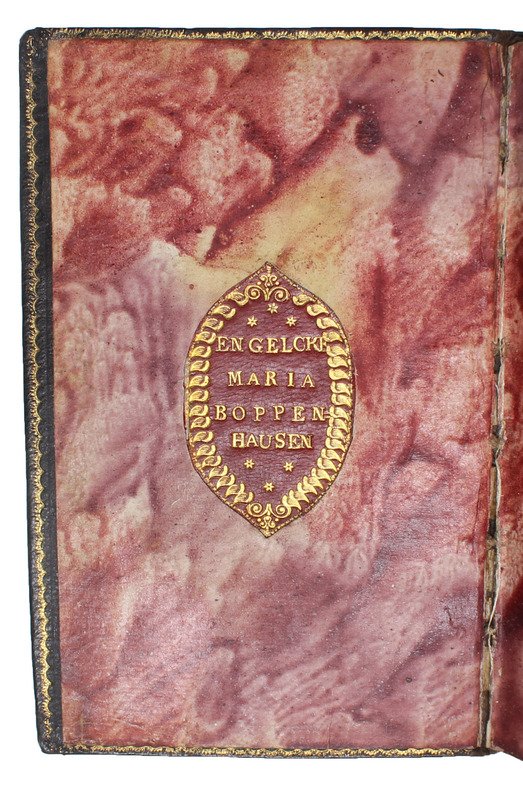
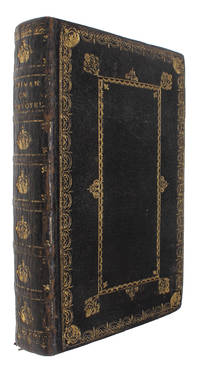
173857402København J.J. Höpfner 1738. 8vo. I et samtidigt særdeles nydeligt mørkeblåt hellæderbind med seks ophøjede bind. Med forgyldt kongeligt våben og titel på ryg. Med ciseleret guldsnit. Med forgyldt spejlornamentik på permer. Indbundet af Engelke Maria Boppenhausen ca. 1717-1778 hvis signatur fremgår i forgyldt skrift på rødt skind på verso af forperm. Bindet er dateret til 1740. unknown
173857402København, J.J. Höpfner, 1738. 8vo. I et samtidigt særdeles nydeligt mørkeblåt hellæderbind med seks ophøjede bind. Med forgyldt kongeligt våben og titel på ryg. Med ciseleret guldsnit. Med forgyldt spejlornamentik på permer. Indbundet af Engelke Maria Boppenhausen (ca. 1717-1778) hvis signatur fremgår i forgyldt skrift på rødt skind på verso af forperm. Bindet er dateret til 1740.
1800198631Not Identified: Not Identified 1800. Paperback. AS IS Wraps are missing; pages are toned and heavily worn/chipped/scuffed/smudged; some pages are loose. Wraps are absent; 24 stapled sheets with color illustration. "Tales in verse about some naughty children and the fates that befall them when they misbehave" -- WorldCat. Contents include: Shock-headed Peter -- The story of cruel Frederick -- The dreadful story about Harriet and the matches -- The story of the inky boys -- The story of the man that went out shooting -- The story of little Suck-a-thumb -- The story of Augustus who would not have any soup -- The story of fidgety Philip -- The story of Johnny Head-in-the-air -- The story of flying Robert. Not Identified paperback
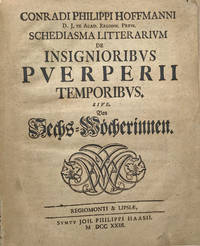
1723M13631Konigsberg & Leipzig:: Johann. Philipp Haas 1723. 1723. 199 x 163 mm. Small 4to. 96 pp. Title-page vignette headpiece; browned. Modern quarter white paper paper corners decorative boards modern end-leaves. Very good. FIRST EDITION. Hoffmann's compilation of literary scraps ancient and modern on the signs of childbirth. It is divided into three parts: pre- during and post-partum. CONTENTS: Chapter I.: De Temporibus ante Puerperium The time before childbirth. Chapter II: De Temporibus ipsius Puerperii The time during the childbirth. Chapter III: De Temporibus post Puerperium The time after childbirth. See: Blake NLM p. 216; Wellcome III p. 283. OCLC: 4 copies. Johann. Philipp Haas, 1723. hardcover books
17437882Regiomonti et Lipsiae: Impensis Francisci Bortoletti 1743. 4to. 96 pp. <br><br>Diss. Koenigsberg. First printed in 1721. Removed from a nonce volume. In very good condition. Impensis Francisci Bortoletti unknown books
1723M13631Konigsberg & Leipzig:: Johann. Philipp Haas 1723. 1723. 199 x 163 mm. Small 4to. 96 pp. Title-page vignette headpiece; browned. Modern quarter white paper paper corners decorative boards modern end-leaves. Very good. FIRST EDITION. Hoffmann's compilation of literary scraps ancient and modern on the signs of childbirth. It is divided into three parts: pre- during and post-partum. CONTENTS: Chapter I.: De Temporibus ante Puerperium The time before childbirth. Chapter II: De Temporibus ipsius Puerperii The time during the childbirth. Chapter III: De Temporibus post Puerperium The time after childbirth. See: Blake NLM p. 216; Wellcome III p. 283. OCLC: 4 copies. Johann. Philipp Haas, 1723. hardcover
1701419721701. Halae Litteris Orphanotrophii 1701 Kl.4° 8 pp. orig. Broschur. unknown
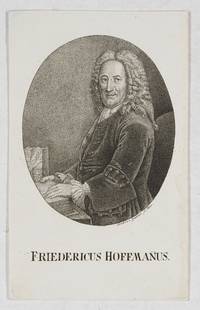
1750709281750. um 1800. Punktierstich. Blattgröße: 175 x 110 mm.; A. Gabler sc. nach A. Pesne. Dieser seltene Punktierstich geht auf ein Gemälde Antoine Pesnes zurück und wurde von A. Gabler gestochen; ähnliche Blätter kursierten in medizinischen Porträtsammlungen und illustrierten biographische oder panegyrische Texte zu Hoffmann. Als gelehrtenbildnerisches Repräsentationsblatt bzw. als Beigabe zu biographischen oder medizinhistorischen Drucken geschaffen; präsentiert Hoffmann als akademischen Autor dessen Schriften auf dem Tisch angedeutet sind. Die Darstellung zeigt Hoffmann in barockem Gelehrtenhabit mit reich gelockter Perücke die Hände auf einem aufgeschlagenen Buch wodurch seine Rolle als schreibender und lehrender Arzt hervorgehoben wird. Der fein getönte Punktiergrund im Oval hebt Figur und Kostüm plastisch hervor und entspricht der im späten 18. Jahrhundert beliebten Reproduktionsgraphik nach Gemälden Pesnes. Friedrich Hoffmann 19.02.1660 Halle/Saale - 12.11.1742 Halle/Saale war ein deutscher Arzt und Chemiker der Frühaufklärung. Er studierte Medizin u. a. in Jena und Erfurt und wurde 1693 erster Professor der Medizin an der neu gegründeten Universität Halle; später wirkte er als Leibarzt Friedrichs I. und Friedrich Wilhelms I. von Preußen. Hoffmann veröffentlichte zahlreiche Lehrbücher und entwickelte ein mechanistisches Medizinsystem das Körperfunktionen als Bewegungen der Körpersäfte deutete. Berühmt wurde er durch den "Liquor anodynus" bzw. die Hoffmannstropfen ein Beruhigungs- und Kreislaufmittel das seit 1706 weite Verbreitung fand. Hoffmann zählt zu den prägenden Ärzten der deutschen Frühaufklärung; seine Lehre beeinflusste die akademische Medizin im deutschsprachigen Raum und darüber hinaus. Das Porträt trug zur ikonographischen Fixierung seines Bildes als höfisch geehrter zugleich praktisch-klinisch tätiger Arzt bei und wurde in späteren medizinhistorischen Sammlungen häufig reproduziert. R. Burgess Portraits of doctors & scientists in the Wellcome Institute London 1973 no. 1418.10 unknown
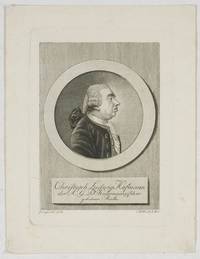
1788554041788. Frontispiz zu: Goeckingk L.F.G. v.: Journalvon und für Deutschland 1799 10 stück. Plattengröße: 170 x 125 mm. Blattgröße: 214 × 165 mm. - Johann de Giorgi del. 1783 Christoph Wilhelm Bock sc. Johann de Giorgi 1788 del. Zeichner vermutlich im deutschsprachigen Raum tätig; Christoph Wilhelm Bock ca. 1755-1830 deutscher Kupferstecher in Leipzig und Umgebung spezialisiert auf Porträt und Buchillustrationsstiche. Als selbständige gelehrtenbildnerische Porträtgraphik geschaffen vermutlich für den regional medizinhistorischen Kontext in Westfalen; diente der repräsentativen Darstellung Hoffmanns als hochfürstlicher Medizinalbeamter und Gelehrter. Profilbüste im Rundmedaillon vor dicht schraffiertem Fond mit betont nüchterner spätaufklärerischer Kostümierung; die sauber kalligraphierte Kartusche verbindet Bild und Amtsbezeichnung und verankert Hoffmann im administrativen Umfeld der fürstbischöflichen Medizinalverwaltung. Christoph Ludwig Hoffmann 3.12.1721 Rheda - 27.07.1807 Eltville am Rhein Kuhrmainzischer geheimer Rath war deutscher Arzt und Medizinalbeamter. Er promovierte 1746 zum Dr. med. und wirkte zunächst als Landphysikus und Leibarzt in Rheda und Detmold. 1756 wurde er Lehrer der Medizin und Philosophie sowie Bibliothekar am Akademischen Gymnasium Burgsteinfurt später Leibarzt und Medizinalbeamter in Münster. 1773 gründete er das Collegium medicum in Münster und wurde später Direktor des Medizinalkollegiums in Kassel; seine Schriften zur Medizinalgesetzgebung und Volksgesundheit fanden überregionale Beachtung. Lit.: Flaskamp Franz: Der kurfürstlich-kölnische Leibarzt Christoph Ludwig Hoffmann 1721-1807. Münster: Aschendorff 1937. Terhalle Hermann: Hoffmann Christoph Ludwig. In: Westfälische Lebensbilder 14. Münster: Aschendorff 1987: pp.129-146. Lippe Landesarchiv Hg.: Hoffmann Christoph Ludwig 1721-1807. In: Lippische Biographien online. Wolfenbüttel Herzog August Bibliothek Inventar-Nr. A 9832; Mortzfeld A 9832 Drugulin Ä. 2535; Diepenbroick 11927 Porträtsammlung Diepenbroick 5 833 unknown
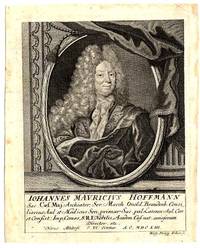
1710342801710. Wolfg. Phillip Kilian Sc. Kupferstich ca. 1710 184 x 14 4 cam auf 205 x 175 cm. Johann Moritz Hofmann 1653-1727 "als Sohn des Anatomen Moritz Hofmann 1622-1698 in Altdorf am 6. October 1653 geboren studirte Philosophie in Hersbruck Mittel-franken Bayern dann Medicin in Altdorf Frankfurt a. 0. und Padua. In letzterer Stadt verweilte er zwei Jahre lang bereiste von hier aus Italien und kehrte 1674 nach seiner Vaterstadt zurück wo er 1675 den Doctortitel annahm und 1677 zum Prof. e. o. der Anatomie ernannt wurde. Später 1681 wurde er ordentlicher Professor dieses Faches und etwa 1686 erhielt er auch den Lehr-stuhl für Chemie und Botanik. 1709 entsagte er der Lehrthätigkeit für Anatomie behielt nur die Professur für Arzneimittellehre die er schliesslich 1713 ebenfalls aufgab um als Leibmedicus in den Dienst des Markgrafen von Ansbach zu treten wo er am 31. October 1727 starb. Hofmann war seit 1684 Mitglied und seit 1727 Präsident der Leopoldinischen Akademie der Naturforscher. Er verfasste eine beträchtliche Zahl von kleineren akademischen Abhandlungen meist Dissertationen die in Altdorf während der Jahre 1680-1703 erschienen so: "De aegro asthmatico" - "De ossium carie" - "De naso faciei promontorio" 1681 - "De dolore" - "De glandulis renalibus" 1682 - "De rnedicamentis martialibus" - "De anorexia" - "Dissertationes anatomico physiologicae ad Joh. van Horne microcosmum annotatae" 1685 - "De odoramentis et suffimentis" 1686 - "De vena portae" 1687 u. A.; ferner eine Sammlung von 20 Dissertationen vereinigt u. d. T.: "Idea machinae humanae anatomico-pysiologica ad observationes recentiores conformata etc." Ebenda 1703; ferner mehrere nicht unbedeutende chemische und botanische Schriften so: "De differentits alimentorum" Ebenda 1677 - "Laboratorium novum chemicum apertum medicinae cultoribus" 1683 - "Acta laboratorii chymici Altorfini" 19 - "Florae Altorfinae deliciae hortenses" 1703 u. A. m" -Pagel Hirsch III p.249 Biogr. méd. V pag. 261. - Dict. hist. III pag. 225. - Poggendorff I pag. 1122." unknown
175335100DB1753. 2 Titel in 1 Band. Leipzig bey Friedrich Lankischens Erben und: Naumburg bey Christian Friedrich Gessner 1753 und 1757. Klein-8°. 204 S. 20 n.n. S. Register; 4 n.n. Bl. 154 S. 6 n.n. S. Index. Halblederband der Zeit mit Rückenschild. Beide Titel nicht bei Blake. - Wellcome 3 285 für Hofmanns lateinische Erstausgabe von 1746. - Sehr seltene Verhaltensregeln für Mediziner in der Praxis und in der Gesellschaft. Die erste deutsche Ausgabe erschien beim gleichen Verleger 1752. - Das "Vade Mecum" von Knör ist eine pharmazeutische Rezeptsammlung mit einem Vorwort und aus dem Nachlass herausgegeben von Christian Theodor Wachter. Knör wurde durch seine "Venus à la mode" berühmt eine 1717 erschienene Sammlung von Mitteln gegen Geschlechtskrankheiten. - Einband an den Aussen- und Innenkanten mit Wurmspuren. Durchgehend etwas gebräunt und stockfleckig. - Selten. unknown
175335100DB2 Titel in 1 Band. Leipzig, bey Friedrich Lankischens Erben (und: Naumburg, bey Christian Friedrich Gessner) 1753 und 1757. Klein-8°. 204 S., 20 n.n. S. Register; 4 n.n. Bl., 154 S., 6 n.n. S. Index. Halblederband der Zeit mit Rückenschild.
175350529BB2 Titel in 1 Band. Leipzig, bey Friedrich Lankischens Erben (und: Naumburg, bey Christian Friedrich Gessner) 1753 und 1757. Klein-8°. 204 S., 20 n.n. S. Register; 4 n.n. Bl., 154 S., 6 n.n. S. Index. Halblederband der Zeit mit Rückenschild.
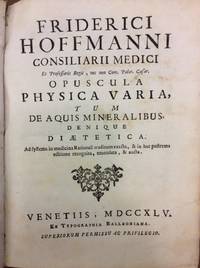
1745116156Venetiis: ex Typographia Balleoniana 1745. In-8 p. mm. 230x170 p. pergamena coeva piccole mancanze ai risg. e antiche scritte titolo manoscritto al dorso restaurato per strappi pp. 4667 testo su due colonne. Vi sono contenuti: XIII Opuscula physica varii argumenti - XIV Opuscula de aquis mineralibus earumque salutari virtute - XVII Opuscula diaetetica in quibus agitur.Cfr. Blake p. 217 che cita solo questa edizione veneziana - Castiglioni p. 597-8: "Federico Hoffmann 1660-1742 prof. di medicina a Halle medico a Berlino alla corte di Federico I. Per le sue concezioni meccaniciste cercò di spiegare tutte le funzioni dell'organismo da un punto di vista matematico. Fu soprattutto un chimico e altresi' l'introduttore delle acque minerali nella terapia razionale".Qualche lieve fioriture ma buon esemplare. ex Typographia Balleoniana, unknown
17386669GB1738. 3 Werke in 1 Band. Venedig Balleoni 1738-1739. XII 412 S. - 4 Bl. 311 S. - 2 Bl. 334 S. Pergamentband der Zeit mit Lederrückenschild und vergoldetem Rückentitel leicht verzogen und fleckig. Umlaufend bunter Sprenkelschnitt Vorderschnitt leicht fleckig. Durchgehend mit unauffälligem Wasserrand im oberen Viertel bis S. 92 sehr kleiner Wurmgang am oberen Bund. Vereinzelt geringfügig fleckig sonst in schöner Erhaltung. unknown
1738M13787Venice:: Apud Sebastianum Coleti 1738. 1738. Sq. 8vo. viii 311 1 pp. 2 small ink ownership stamps on title unreadable. Nineteenth century marbled boards printed title label on spine; extremities showing. Title verso with ink ownership stamp of Th. Renz. Very good. The work contains two parts of ten papers each for a total of twenty papers. Each studies aspects of medicine from the nature of art and efficacy in healing method application of drugs the power and efficiency of medicines applied the ability of the body to understand the remedies of drinking water and the virtues of milk in medicine the power of milk to heal qualities of mineral waters in promoting health. Continuing in the second part: salts as a healer the uses of China bark as applied to fevers uses of ejecting of venom the causes of death by disease the good of medicine the errors that are common in medical practice. "Friedrich Hoffmann also 'Hofmann' was born on 19 February 1660 in Halle where he also died on 12 November 1742. Called 'the second Hippocrates' and the 'Aesculapius Hallensis' he was among the most widely read medical authors of the eighteenth century and is best known for his systematic discussion of the iatromechanical model of medicine — similar to what Hermann Boerhaave 1668-1738 was developing at Leiden — that views the human body as a hydraulic machine wholly governed by mechanical laws. "Hoffmann's father Friedrich Hoffmann the Elder was the respected municipal physician of Halle. The younger Hoffmann enrolled at nearby Jena in 1678 the university at Halle would not open for another fifteen years where he studied medicine for two years under the iatrochemist Georg Wolfgang Wedel 1645-1721 also attending Caspar Cramer's lectures on chemistry in Erfurt in 1680. He received his doctorate in medicine from Jena in 1681 January 31 with a dissertation on suicide de autochiria and began lecturing on chemistry a standard course taught in the medical faculty but soon left perhaps pushed out by senior faculty jealous of his teaching success. After practicing medicine in Minden for two years Hoffmann made an academic tour of Belgium Holland and England during which he met Boerhaave Thomas Sydenham and Robert Boyle returned to Minden in 1684 and assumed various medical offices eventually being appointed the regional physician for Halberstadt. He married an apothecary's daughter Anna Dorothea Herstell on 10 December 1689. "In 1693 he was called to the newly-founded university at Halle as an ally of the Priest August Hermann Francke 1663-1727 with the charge of organizing its medical school and to serve as its first professor of medicine. He also became the godfather to Christian Wolff's first-born son Friedrich. Hoffmann recruited his old college friend from Jena Georg Ernst Stahl 1660-1734 for the second chair of medicine and the two taught side by side for twenty years transforming Halle into the preeminent medical school among German-speaking universities. Along with Boerhaave at Leiden Hoffmann and Stahl were the principal forces behind the medical reforms of the early eighteenth century. "Hoffmann was a member of the German Academy of Natural Scientists Leopoldina 1696 the Berlin Academy of Sciences he was included in Leibniz's founding lists and was inducted on 1 April 1701 the Royal Society of London 1720 and the Russian Academy of Sciences in St. Petersburg 1735. "In all Hoffmann authored about 400 publications mostly brief dissertations and essays but also the six-volume systematics discussed above a twelve-volume collection of case studies Medicina consultatoria 1721-39 and a nine-volume work on how to live a long and healthy life Basic Guide 1715-28 wherein Hoffmann emphasized the restorative effects of proper diet exercise clean air and sleep. He also criticized the diversity and overuse of drugs and was successful in reducing the pharmacopoeia of his day to a few basic remedies. -- The Dictionary of Eighteenth Century German Philosophers 3 vols. edited by Manfred Kuehn and Heiner Klemme. CONTENTS: Part I: 1 De naturae & artis efficacia in medendo. 2 De recta et simplicissima natura medendi method. 3 De medicamentorum prudenti application in tempore. 4 De prudenti medicamentorum continuation. 5 De vera medicamentor in morbis virtute et efficacia rite dignoscenda. 6 De cognoscenda corporis humani natura ex effectu remediorum. 7 De medicina simpilicissima & optima motu inedia aquae potu. 8 De mirabili lactis asinini in medendo usu. 9 De saluberrima seri lactis virtute. 10 De connubio aquarum mineralium cum lacte longe saluberrimo. Part II: 1 De salium mediorum excellente in medendo virtute. 2 De sale medicinali Carolinarum. 3 De manna ejusque praestantissimo in medicina usu. 4 De recto corticis chinae usu in febribus intermittenibus. 5 De purgantibus fortioribus ex praxi medica merito ejiciendis. 6 De medicina emetica et purgante post iram veneno. 7 De imprudenti medicatione multorum morborum et mortis causa. 8 De remediorum benignorum abusu et noxa. 9 De vesicantium et fonticulorum circumspecto in medicina usu. 10 De erroribus vulgaribus circa usum topicorum in praxi. / "Although Enlightenment physicians debated the suitability of milk as a treatment for different individuals and situations Friedrich Hoffmann's Treatise of the Extraordinary Virtues and Effects of Asses Milk 1754 exemplifies the basic understanding of its health benefits in the eighteenth century. Hoffmann who served as the physician to the Prussian King Friedrich I was a friend of Boerhaave and a proponent of the neo-Hippocratic school. He argues that since humans were nourished by a milky substance in the womb and raised on breast milk and since all food upon entering the body was transformed into a milky substance called chyle milk was 'manifestly proved to be the principal of all the kinds of aliment; so it may be deservedly reckoned the chief of all remedies.' Although Hoffmann preferred ass's milk for its resemblance to human breast milk he also recommended the milk of cows sheep and goats for the relief of fevers chronic coughs colic and nervous disorders -- the same aliments that afflicted Pompadour. Why was milk so effective" Hoffman argued that is possessed powerful cleansing properties functioning as a nonviolent purgative that penetrated the body's channels allowing fresh air to enter and perspiration to exit. It also removed obstructions in the chest lungs and bowels and returned the body to its proper system of 'flows.' Hoffmann told readers of how a certain 'gentlewoman' in his care who had been sick for years with fevers aches and pains began a course of milk treatment and 'in three days only everything appeared wonderfully amended.'" -- Meredith Martin Dairy Queens: The Politics of Pastoral Architecture from Catherine de' Medici to Marie-Antoinette Harvard Historical Studies Harvard University Pres 2011 pp. 135-6. REFERENCES: Blake NLM 217; Wellcome II 285. Apud Sebastianum Coleti, 1738. hardcover books
1754M13008Genevae:: Apud fratres de Tournes 1754. 1754. Two parts in one. Folio. 24 x 35 cm. viii 871 1 pp. Collation: 4 A6-4D6. Half title title printed in red & black engraved title vignette Latin text printed predominantly in two columns engraved initials engraved head and tail pieces small woodcut fig. p.52; occasional minor stains some folds ownership signature Hermann . . . trimmed on title top edge. Original half calf over boards all edges red; heavily worn with chipped portions spine is mostly missing front joint reinforced with Kozo. Binding "as is" good internally. Bookplate of John G. Curtis Library of Columbia University. Rare. Second edition. "Hoffmann based his treatment on the use of sedatives tonics alternatives and evacuants according to the condition responsible for causing the disease. Apart from this system he was one of the premier practitioners of his day and one of the first to give good descriptions of appendicitis chlorosis rubella and convulsive asthma with dropsy." – Heirs of Hippocrates referring to the entire Opera. More description available on request. REFERENCES: The Dictionary of Eighteenth Century German Philosophers 3 vols. edited by Manfred Kuehn and Heiner Klemme London/New York: Continuum 2010; DSB VI pp. 458-461; Blake NLM lists editions from Geneva in 1740 1748 and 1761; Wellcome Library III p.285 2 vols. in 1. See: Garrison & Morton 72 for the complete 9 volumes published 1740-53; Justin E. H. Smith The Problem of Animal Generation in Early Modern Philosophy 2006; Willius & Dry A History of the Heart and the Circulation pp. 77-78. Apud fratres de Tournes, 1754. hardcover books