5 186 résultats
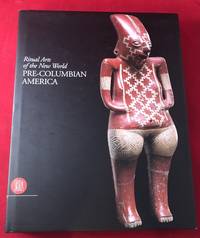
20004371Milano Italy: Skira 2000. First Edition. Hardcover. Near Fine/Near Fine. 9 1/4 X 12 Inches. 407 PP. Stated "First Edition" on the copyright page. Profusely illustrated pictorial history of Mexican art. Hint of scuffing to DJ. Skira hardcover
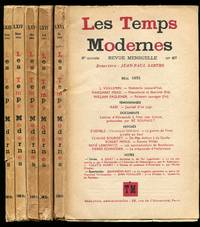
1951511232Paris: Les Temps Modernes 1951. Softcover. Very Good. Nos. 63-67. January 1951 - May 1951. Text in French. Directeur: Jean-Paul Sartre. Printed wrappers. Toned spines with chips and tears pages lightly toned toning on the wraps of three issues overall very good. Five issues each containing a contribution by William Faulkner. Contains "Palmiers Sauvages" the first appearance in French of Faulkner's "Wild Palms" complete in five parts translated into French by M. E. Coindreau; other contributions by Ignazio Silone Margaret Mead Jean Paul Sartre and many more. Les Temps Modernes unknown
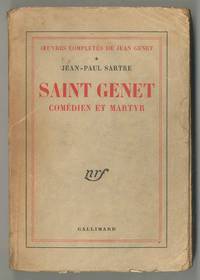
1952501129Paris: Gallimard 1952. Softcover. Good. First edition. Printed wrappers. Text in French. Ownership signature of Chilean pianist Claudio Arrau on front fly "New York 1961" pages toned covers slightly soiled and worn with a bit of loss to corners and edges spine moderately toned about good. Volume one only of the five-volume Collection Blanche complete works of Jean Genet. Gallimard unknown
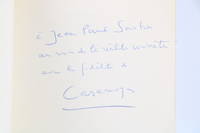
197392020Paris: Gallimard 1973. Fine. Gallimard Paris 1973 14 x 20.5 cm Broché First edition one of the press service copies no deluxe paper copies issued. A dampstain to the lower edge of one textblock edge. Precious signed autograph inscription from Casamayor: ""à Jean Paul Sartre au nom de la réalité concrète avec la fidélité de Casamayor."" Gallimard unknown
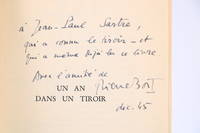
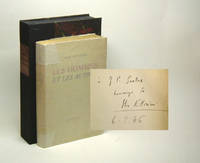
194591190Paris: Gallimard 1945. Fine. Gallimard Paris 1945 11.8 x 18.6 cm Broché First edition one of the publishers review copies.Spine and boards very slightly and marginally sunned.Fine dated and signed autograph inscription by Pierre Bost: ""à Jean-Paul Sartre qui a connu le tiroir - et qui a même déjà lu ce livre. Avec l'amitié de Pierre Bost dec.45."" Gallimard hardcover
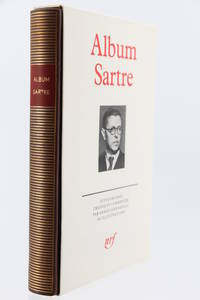
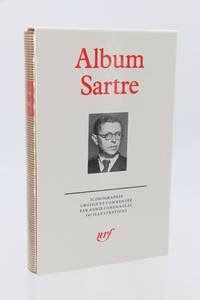
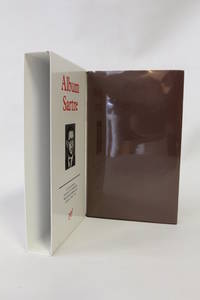
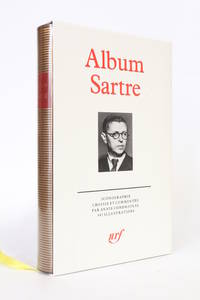
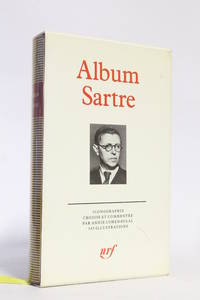
199179985Paris: Gallimard Bibliothèque de La Pléiade 1991. Fine. Gallimard Bibliothèque de La Pléiade Paris 1991 10.50 x 17.50 cm reliure de l'éditeur sous étui First edition. Publisher's binding in full brown grained sheep orange top edge smooth spine decorated with gilt fillets. Rich iconography. Fine copy complete with its protective jacket and slipcase. Gallimard, Bibliothèque de La Pléiade unknown
199183325Paris: Gallimard Bibliothèque de La Pléiade 1991. Fine. Gallimard Bibliothèque de La Pléiade Paris 1991 10.50 x 17.50 cm reliure de l'éditeur sous étui souple et cartonné First edition. Publisher's full brown grained sheep binding orange top edge smooth spine decorated with gilt fillets. Rich iconography. Handsome copy complete with its glassine wrapper and slipcase. Gallimard, Bibliothèque de La Pléiade unknown
199167809Paris: Gallimard Bibliothèque de La Pléiade 1991. Fine. Gallimard Bibliothèque de La Pléiade Paris 1991 10.50 x 17.50 cm reliure de l'éditeur sous étui First edition. Publisher's full brown grained sheepskin orange top edge smooth spine decorated with gilt fillets. Richly illustrated. Handsome copy complete with its cellophane wrapper and slipcase. Gallimard, Bibliothèque de La Pléiade unknown
199170263Paris: Gallimard Bibliothèque de La Pléiade 1991. Fine. Gallimard Bibliothèque de La Pléiade Paris 1991 10.50 x 17.50 cm reliure de l'éditeur sous étui First edition. Publisher's full brown grained sheepskin binding orange top edge smooth spine decorated with gilt fillets. Richly illustrated. Handsome copy complete with its glassine wrapper and slipcase. Gallimard, Bibliothèque de La Pléiade unknown
199154074Paris: Gallimard Bibliothèque de La Pléiade 1991. Fine. Gallimard Bibliothèque de La Pléiade Paris 1991 10.50 x 17.50 cm reliure de l'éditeur sous étui First edition. Publisher's binding in full brown grained sheep orange top edge smooth spine decorated with gilt fillets. Rich iconography. Fine copy complete with its glassine wrapper and slipcase. Gallimard, Bibliothèque de La Pléiade unknown
199157178Paris: Gallimard Bibliothèque de La Pléiade 1991. Fine. Gallimard Bibliothèque de La Pléiade Paris 1991 10.50 x 17.50 cm reliure de l'éditeur sous étui First edition. Publisher's binding in full brown grained sheep orange top edge smooth spine decorated with gilt fillets. Rich iconography. Fine copy complete with its cellophane wrapper as well as its slipcase. Gallimard, Bibliothèque de La Pléiade unknown
199136040Paris: Gallimard Bibliothèque de La Pléiade 1991. Fine. Gallimard Bibliothèque de La Pléiade Paris 1991 10.50 x 17.50 cm reliure de l'éditeur First edition. Richly illustrated. A very good copy complete with plastic wrappers. Gallimard, Bibliothèque de La Pléiade unknown
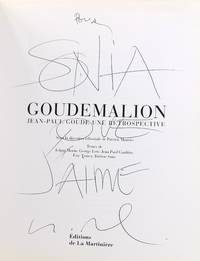
201191753Paris: Editions de la Martinière 2011. Fine. Editions de la Martinière Paris 2011 20 x 25.5 cm Broché First French edition. Profusely illustrated. Text by Edgar Morin Georges Lois Jean-Paul Gaultier Eric Troncy Jérôme Sans. Valuable signed autograph inscription from Jean-Paul Goude to Sonia Rykiel in capital letters: ""POUR SONIA QUE J'AIME."" Editions de la Martinière unknown
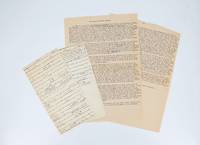
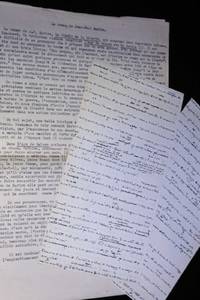
194582300s. l. Paris: S. n. Paysage dimanche 1945. Fine. S. n. Paysage dimanche s. l. • Paris s. d. 1945 11.50 x 22 cm 3 pages 1/2 in-4 Autograph manuscript by the author 3½ pages octavo published in the October 21 1945 issue no. 19 of Paysage dimanche. Complete recto-verso manuscript in very dense handwriting with numerous deletions corrections and additions. Literary chronicle published on the occasion of the publication of the first two volumes of Jean-Paul Sartre's trilogy Les chemins de la liberté: ""L'Age de raison"" and ""Le Sursis"". Together with the complete typescript with one deletion and one autograph correction by the author. When this chronicle appeared in autumn 1945 Maurice Blanchot and Jean-Paul Sartre had already demonstrated their mutual interest in each other's respective work in articles that were sometimes critical sometimes laudatory always attentive. Similarly if Les chemins de la liberté aroused Blanchot's admiration it was essentially through the philosopher's skillful use of the influence of two monuments of Anglo-Saxon literature Virginia Woolf and John Dos Passos: « Ce qui nous paraît frappant c'est le caractère d'œuvre d'art qu'en reçoit le livre œuvre extrêmement composée calculée avec un souci infiniment sûr des effets où la confusion reste claire où le désordre est perfection et telle qu'on y reconnaît sans cesse la présence de l'écrivain le plus lucide capable de tout obtenir du langage dont il est maître. » ""What strikes us as remarkable is the character of a work of art that the book receives an extremely composed work calculated with infinitely sure concern for effects where confusion remains clear where disorder is perfection and such that one constantly recognizes the presence of the most lucid writer capable of obtaining everything from the language he masters."" But this ""Roman de Sartre"" was above all an opportunity for Blanchot to raise the question of the links between literature and politics on which the two men would have great difficulty agreeing in the following decades. Thus Blanchot summarized Sartre's vision evoking the problem of commitment: « Il est indéniable que l'art de Sartre atteint son plus grand pouvoir lorsqu'il décrit l'engloutissement des consciences par les choses qui les hantent et les débordent et de laquelle elles coulent comme une pâte pleine d'odeurs. Le monde qu'il sent est celui d'une métamorphose mais cette métamorphose n'est pas changement de forme elle n'est pas la transformation d'un être en un autre être fût-ce d'un homme en une vermine ; elle va plus loin elle est irrémédiable car c'est la conscience même qui devient un matériel c'est la pensée qui se fige en une substance gluante visqueuse sans contour sans apparence un dedans triste et vague que nous ne pouvons saisir et qui pourtant comme tel continue désespérément à penser. Tel est l'univers dans lequel nous sommes jetés tant que nous n'essayons pas de le reprendre par une action qui nous engage. » ""It is undeniable that Sartre's art reaches its greatest power when he describes the engulfing of consciousness by the things that haunt and overwhelm them and from which they flow like a paste full of odors. The world he perceives is one of metamorphosis but this metamorphosis is not a change of form it is not the transformation of one being into another being even of a man into vermin; it goes further it is irreparable for it is consciousness itself that becomes material it is thought that freezes into a sticky viscous substance without contour without appearance a sad and vague interior that we cannot grasp and which nevertheless as such continues desperately to think. Such is the universe into which we are thrown as long as we do not try to reclaim it through an action that commits us."" The third volume of Les Chemins de la liberté not yet published left little doubt in Blanchot's eyes as to its content; and he summarized somewhat sarcastically: « Ce qui suivra est facile à S. n.[ Paysage dimanche] unknown
194544941s. l. Paris: S. n. Paysage dimanche 1945. Fine. S. n. Paysage dimanche s. l. Paris s. d. 1945 11.50 x 22 cm 3 pages 1/2 in-4 Autograph manuscript by the author of 3½ pages octavo published in the October 21 1945 issue no. 19 of Paysage dimanche. Complete recto-verso manuscript very densely written with numerous deletions corrections and additions. Literary chronicle published on the occasion of the publication of the first two volumes of Jean-Paul Sartre's trilogy Les chemins de la liberté: ""L'Age de raison"" and ""Le Sursis"". The complete typescript is included with one deletion and one autograph correction by the author. When this chronicle appeared in autumn 1945 Maurice Blanchot and Jean-Paul Sartre had already demonstrated mutual interest in their respective works in articles sometimes critical sometimes laudatory always attentive. Similarly if Les chemins de la liberté aroused Blanchot's admiration it was essentially through the use the philosopher had made of the influence of two monuments of Anglo-Saxon literature Virginia Woolf and John Dos Passos: « Ce qui nous paraît frappant c'est le caractère d'uvre d'art qu'en reçoit le livre uvre extrêmement composée calculée avec un souci infiniment sûr des effets où la confusion reste claire où le désordre est perfection et telle qu'on y reconnaît sans cesse la présence de l'écrivain le plus lucide capable de tout obtenir du langage dont il est maître. » ""What strikes us is the character of a work of art that the book receives an extremely composed work calculated with infinitely sure concern for effects where confusion remains clear where disorder is perfection and such that one constantly recognizes the presence of the most lucid writer capable of obtaining everything from the language he masters."" But this ""Novel by Sartre"" is above all an opportunity for Blanchot to raise the question of the links between literature and politics on which the two men would have great difficulty agreeing in the following decades. Thus Blanchot summarizes Sartre's vision evoking the problem of engagement: « Il est indéniable que l'art de Sartre atteint son plus grand pouvoir lorsqu'il décrit l'engloutissement des consciences par les choses qui les hantent et les débordent et de laquelle elles coulent comme une pâte pleine d'odeurs. Le monde qu'il sent est celui d'une métamorphose mais cette métamorphose n'est pas changement de forme elle n'est pas la transformation d'un être en un autre être fût-ce d'un homme en une vermine ; elle va plus loin elle est irrémédiable car c'est la conscience même qui devient un matériel c'est la pensée qui se fige en une substance gluante visqueuse sans contour sans apparence un dedans triste et vague que nous ne pouvons saisir et qui pourtant comme tel continue désespérément à penser. Tel est l'univers dans lequel nous sommes jetés tant que nous n'essayons pas de le reprendre par une action qui nous engage. » ""It is undeniable that Sartre's art reaches its greatest power when he describes the engulfment of consciousness by things that haunt and overwhelm it and from which it flows like a paste full of odors. The world he feels is one of metamorphosis but this metamorphosis is not a change of form it is not the transformation of one being into another being even of a man into vermin; it goes further it is irreparable because it is consciousness itself that becomes material it is thought that hardens into a sticky viscous substance without contour without appearance a sad and vague interior that we cannot grasp and which nevertheless as such continues desperately to think. Such is the universe into which we are thrown as long as we do not try to reclaim it through action that engages us."" The third volume of Les Chemins de la liberté not yet published leaves in Blanchot's eyes little doubt as to its content; and he summarizes somewhat sarcastically: « Ce qui suivra est facile à imaginer : nous aurons la guerre l'occupation S. n.[ Paysage dimanche] unknown
1958463145New York: Ben Adler Advertising Service Inc 1958. Softcover. Near Fine. First edition. Slim quarto. 31 1 pp. Heavily illustrated in black and white from film stills photographs and drawings. Stapled self-wrappers. Small ownership signature of a noted American psychologist in the corner of one page very slight mustiness staples lightly oxidized near fine.<br /> <br /> An advertising piece for both natural childbirth and French director Jean-Paul le Chanois's film The Case of Dr. Laurent reportedly the first movie to feature natural childbirth. Profusely illustrated with captioned film stills black and white photographs and drawings of preparatory exercises for the mother-to-be and drawings illustrating positions the baby may take in the womb. The final two pages features a 1956 speech by Pope Pius XII on natural childbirth. <br /> <br /> An interesting and we surmise somewhat avant-garde promotional piece for both natural birth and French cinema. Ben Adler Advertising Service, Inc unknown
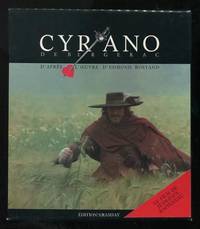
199029218Edition1/Ramsay. Fine in Fine dj. 1990. First Edition. Hardcover. two volumes -- one hardcover w/dust jacket the other an oversize softcover -- contained within a slipcase all components in as-new condition but for extremely minor wear at several corners of the slipcase. color photographs Essentially an elaborate presentation package for the 1990 French film CYRANO DE BERGERAC starring Gerard Depardieu and directed by Jean-Paul Rappeneau. The softcover volume contains the entire script of the film in French; the hardcover volume is a condensed telling of the film's story illustrated with color photos of scenes from the film. A statement in the back of the hardcover volumes states that "One hundred copies of this work were printed numbered from 1 to 100" but there is no sign of numbering or any other limitation-marking present. NOTE that additional postage charges will be assessed for international shipping of this heavy two-volume item; if this concerns you please contact us for a shipping quote before placing your order. As always at ReadInk domestic Media Mail shipping is free. . Edition1/Ramsay hardcover
198099077Paris 1980-1981. 268x210mm. 320Êpages photos couleurs et n/b broch. Bel exemplaire. 2398 unknown
194526708Geneva: Editions du Continent 1945. First Edition. Soft cover. First Edition. Soft cover. Signed by Author. First French Edition of 'Uomini e No' Men and not Men a novel of resistance against the German occupation of Italy Inscribed and Signed by the author to Jean-Paul Sartre on the front endpaper. With Cesare Pavese Vittorini an acclaimed translator novelist his Conversations In Sicily was published in the United States with an introduction by Ernest Hemingway editor and anti - fascist was a pioneer in translating English French and American authors into Italian. A bright fresh copy in the original wrappers. Housed in an elegant custom clamshell case black cloth over marbled paper red morocco spine label with gilt titles. A significant Association. Editions du Continent unknown
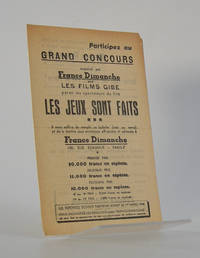
1948206196Paris: France Dimanche 1948. Evenly toned; a few incidental wrinkles and a small bit of shallow wear to two corners. Single leaf approx. 5-1/4 X 8-1/4 in. printed on both sides. Broadsheet entry blank for a contest sponsored by the tabloid journal "France Dimanche" asking for audience response to the film by Jean Delannoy based on a screenplay by Jean-Paul Sartre. The film which premiered at the Cannes Festival in 1947 tells the story of a man and a woman who though unknown to each are destined to be together as life partners. They themselves only meet after both have died but are given a second chance at life if they can return and realize their love in the real world. Once back in life however they find themselves absorbed in unresolved matters from their previous lives and fail in their mission. The contest asks readers of "France Dimanche" two questions: 1. would you have done as Eve and Pierre why or why not and 2. should Jean-Paul Sartre be condemned or offered a chair at the Academie An intriguing ephemeron from a moment of intellectual ferment in post-war Paris. France Dimanche unknown
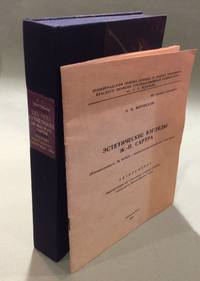
196926706Lenningrad: Leningrad 1969. First Edition. Soft cover. First Edition. Soft cover. Signed by Author. First Edition of this Russian thesis examining the esthetic views of Jean-Paul Sartre. Inscribed by the author to Sartre on the title-page and Inscribed and Signed by Jean-Paul Sartre to close friend Michelle Vian Boris Vian's wife. A fresh bright copy in the original printed wrappers. 16 pp. Housed in an elegant custom clamshell case black cloth over marbled paper red morocco spine label with gilt titles. An uncommon Sartre title. An Important Association Copies as Sartre began a life-long affair with writer & maverick creative force Boris Vian's first wife Michele L'Eglise in the late 40's which lasted until Sartre's death in 1980. L'Eglise & Vian divorced in 1951. Sartre & de Beauvoir loved Boris & promoted him often. Sartre nominated Vian for a celebrated literary prize for the novel L'Ecume. Vian's extraordinary work mirrored his fascinating life. A jazz trumpeter film actor cabaret singer translator record company executive jazz writer inventor of the elastic wheel Vian moved in both the world of Miles Davis & Dizzie Gillespie as well as that of Sartre & de Beauvoir. Leningrad unknown
196748Kibbutz Lehavot HaBashan 1967. 15 vintage black and with photos approximately 180 × 130 mm. Mounted on black album card leaves. With 3 pages of typed text in French about the history of the kibbutz. In blue leatherette album with gilt floral ornament to panel. In fine condition. 15 vintage black and with photos approximately 180 × 130 mm. Mounted on black album card leaves. With 3 pages of typed text in French about the history of the kibbutz. In blue leatherette album with gilt floral ornament to panel. With a dedication in French: “A Jean Paul Sartre en souvenir d’une journee a Lahavot Habachan. 17/3/1967â€. <p>The photos are showing the view the facilities and the daily life of the kibbutz. <p><p><br /> This unique photo album was a gift to Jean-Paul Sartre 1905–1980 the French existentialist philosopher Nobel Prize winner and political activist who visited kibbutz Lehavot HaBashan on March 17 1967. <p><p><br /> Sartre and his wife Simone de Beauvoir arrived to Israel on March 14 1967 after their voyage to Egypt as a month-long visit to the Middle East. The travel was intended to clarify the possibilities of a dialogue between the Arab and Israeli left. A special edition of “Les Temps Modernes†edited by Sartre and published in June 1967 planned to coincide with this voyage wherein Arabs and Israelis could put their views alongside each other. This highly significant dialogue of the time was interrupted by the Six-Day War.<p>. unknown
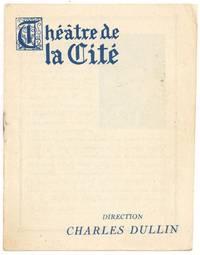
1943597082Paris: Théatre de la Cité 1943. Softcover. Very Good. Theater program. Slim 24mo. Measuring approximately 4" x 5". Two thin leaves folded and stapled to make eight pages. Illustrated with a portrait of Dullin and an ad for Secours National Entr'aide D'Hiver du Maréchal. Moderate wear very good. Prints a page of text by Dullin an analysis of the play a cast list and material regarding the theater. An interesting piece of theater ephemera from the first production of Sartre's The Flies staged in Nazi-occupied Paris. Théatre de la Cité unknown
194527736Paris: Les Editions de Minuit 1945. Fine. Les Editions de Minuit Paris 1945 12 x 16.50 cm broché First edition of this selection of texts with a preface by Lucien Scheler. Precious autograph inscription from him to Francis Ponge. With a frontispiece portrait of J.P. Marat after a linocut by L. Scheler. Spine slightly sunned a tiny corner loss to the heads of the first pages. Les Editions de Minuit unknown
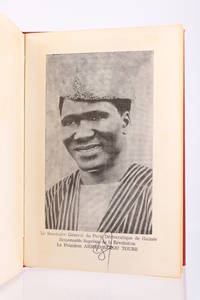
196989981No Location: Sans nom d'éditeur 1969. Fine. Sans nom d'éditeur No Location s. d. 1969 15.6 x 23 cm Relié First edition of this collection of political speeches.Full red percaline binding smooth spine without lettering showing slight rubbing gilt inscription stamped to the upper cover: ""République de Guinée R.D.A. à S.E. Jean Paul Sartre. N°30""; endpapers partly toned a contemporary presentation binding offered to Jean-Paul Sartre.Frontispiece photographic portrait bearing the autograph signature of President Ahmed Sékou Touré: Secretary General of the Parti Démocratique de Guinée Supreme Leader of the Revolution. Sans nom d'éditeur unknown