SARTRE (Jean-Paul)Biblio.com

5 186 résultats
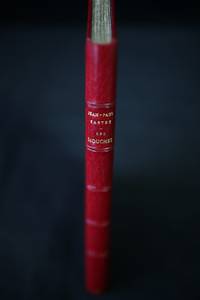
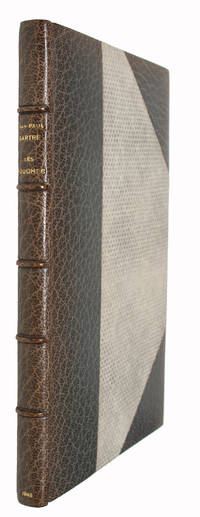
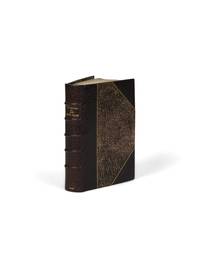
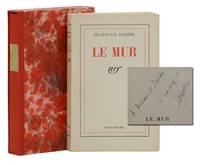
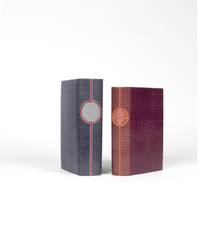
29322Paris Gallimard 30 décembre 1963. 1 vol. 120 x 185 mm de 224 p. Maroquin brun décor mosaïqué de sept pièces de maroquin havane en relief réhaussé d'arabesques de box rouge et vert titre doré date en pied tranches dorées sur témoins doublures et gardes gardes de daim vert chemise et étui bordés reliure signée de Paul Bonet 1964. . Édition originale. Un des 15 premiers exemplaires sur japon impérial n° 15. L’exemplaire contient par ailleurs le nuancier original de Paul Bonet qui lui a servi à la composition de cette reliure – la seule qu’il réalisa sur le papier de tête des Mots. . Écrire fut longtemps pour Sartre donner sens « arracher ma vie comme il disait au hasard ». Il dresse ici un bilan définitif de ses illusions passées. Elles sont d'abord publiées en deux livraisons des Temps modernes octobre et novembre 1963 avant de paraître chez Gallimard en avril 1964. « Malgré l'image polémique dont est alors victime Sartre dans l'opinion publique française les hommages de la presse sont unanimes et les titres souvent très inspirés des nombreux articles qui recensent le livre rendent compte de la surprise et de l'émotion générales . L'auteur nous fait pénétrer dans l'intimité de sa famille maternelle les Schweitzer de ses grands-parents ‘Karl et Mamie' qui accueillirent la mère et l'enfant dans leur maison de Meudon puis dans leur appartement entre le Panthéon et le jardin du Luxembourg . Mon grand-père écrit-il ‘me jeta dans la littérature par le soin qu'il mit à m'en détourner : au point qu'il m'arrive aujourd'hui encore de me demander . si je n'ai pas couvert tant de feuillets de mon encre jeté sur le marché tant de livres qui n'étaient souhaités par personne dans l'unique et fol espoir de plaire à mon grand-père'. Sartre bataillera pour dénouer ce règlement de compte avec l'aïeul jusqu'à son dernier livre son colossal Flaubert. D'ailleurs malgré ses efforts pour se construire fils de personne comme il le fit dans Les Mots Sartre est bien le produit de la bourgeoisie intellectuelle en gloire comme en attestent les documents découverts par les historiens pour construire le contexte de sa généalogie » Anne Cohen-Solal Sartre. Parfait exemplaire en reliure strictement contemporaine de Paul Bonet première des deux reliures qu'il créa pour ce titre et la seule sur ce papier de tête. Il en confia l'exécution au relieur René Desmules qui travailla de juin à décembre 1964. L'exemplaire est répertorié dans les Carnets sous la référence 1479. Sans doute l'un des plus précieux exemplaires de ce jalon de la littérature du XXe siècle qui vaudra à son auteur en octobre 1964 le prix Nobel de littérature - qu'il refusera. Contat & Rybalka Les Écrits de Sartre 63/383 ; Carnets de Paul Bonet 1479. Paris, Gallimard, (30 décembre) 1963. 1 vol. (120 x 185 mm) de 224 p. Maroquin brun, décor mosaïqué de sept pièces de maroq unknown
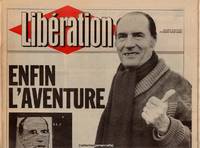
197375634Paris: Libération 1973. Fine. Libération Paris 1973-2004 6200 numéros en feuillets Complete run of the first twenty years of the newspaper Libération founded in 1973 by Jean-Paul Sartre Serge July Philippe Gavi Bernard Lallement and Jean-Claude Vernier. 6200 issues in pristine condition never opened. This unique collection comprises 6200 issues of Libération in impeccable condition never opened and is absolutely complete including all the numéros zéros promotional issues special reports thematic supplements including the entire series of the celebrated Sandwich issues and the commemorative twentieth anniversary album from Monday 5 February 1973 to Monday 3 January 1994. The collection is offered with its custom-made display unit 2.60 m high 4.20 m wide and 50 cm deep. It consists of 35 stackable compartments each measuring 84 x 36.5 x 50 cm each housing two sliding drawers. Each drawer holds approximately one hundred issues of the newspaper. Provenance: Frédéric Fredj Collection. Libération unknown
194345374Paris: Gallimard 1943. Fine. A superb copy impeccably bound in a triple binding by Duhayon Gallimard Paris 1943 12 x 19 cm relié sous chemise et étui First edition one of 18 numbered copies on pur fil from the deluxe issue. Full red Jansenist morocco binding spine in five compartments date gilt at foot black morocco endpapers and pastedowns covers and spine preserved all edges gilt; matching half red morocco chemise spine in five compartments date gilt at foot black felt lining; slipcase edged in red morocco ochre felt interior a highly elegant ensemble superbly executed by Duhayon. A superb copy impeccably bound in a triple binding by Duhayon. Gallimard unknown
2566Washington DC: Lunn Gallery/Graphics International Ltd 1977. First edition. Orignial publisher's box. Very Good. A COLLECTION OF THE MOST CELEBRATED COLOUR PHOTOGRAPHS OF TWENTIETH-CENTURY ARTISTS. NUMBER 1 OF 6 COPIES RESERVED FOR ARTIST AND PUBLISHERS OUT OF A TOTAL OF 36. The present portfolio of Freund's photographic portraits assembles the most celebrated of her innovative colour images. The portfolio is comprised of Freund's portraits of:<br /> <br /> 1. Colette 1873-1954<br /> 2. Virginia Woolf 1882-1941<br /> 3. André Gide 1869-1951<br /> 4. James Joyce 1882-1941<br /> 5. Andreinne Monnier 1892-1955<br /> 6. Jean Cocteau 1889-1963<br /> 7. Simone de Beauvoir 1908<br /> 8. Jean-Paul Sartre 1905<br /> 9. André Malraux 1901-1976<br /> 10. Victoria Sackville-West 1892-1962<br /> <br /> It is well documented both Woolf's and Joyce's aversions to sitting for photographs and indeed "Freund was twice refused admission to Tavistock Square but eventually Woolf succumbed" being "acutely self-conscious and disliked sitting for pictures never mind 'seeing herself'"Richard Shone "Portraits of Virginia Woolf: here the true face of the modern writer" The Guardian 20 June 2014. Freund's ability to capture her subjects in states of ease-not to mention in colour-has preserved for posterity valuable likenesses of the most talented creative literary minds of the past century. The authorised release of these portraits each signed by Freund and numbered and embossed by the publisher as Au Pays des Visages coincided with Freund's appointment to the presidency of the French Association of Photographers and represent a definitive curation of her pre-eminent portraiture.<br /> <br /> Size: Images = 8x11.5 in; matte = 14.5x18.5 in; portfolio = 17x21 in.<br /> <br /> FREUND GISÈLE. Au Pays des Visages. Washington D.C.: Lunn Gallery/Graphics International Ltd. 1977. First edition number 1 of 6; 'The total edition is of 36 examples of which 30 are for sale and 6 are reserved by the artist and the publishers.' Each print is signed by the artist and stamped blind and numbered "I/VI" by the publisher. Original blue cloth publisher's box each print is mounted as issued. Some wear to box otherwise fine.<br /> <br /> EXTREMELY RARE SIGNED FREUND PORTRAITS ISSUE 1 OF 6. Lunn Gallery/Graphics International Ltd unknown
194344574Paris Gallimard 1943. Bound with the original printed wrappers also the backstrip in a contemporary no later than 1955 beautiful very elegant grey half morocco binding with five raised bands and gilt title to spine Gemet&Plumbelle. A beautiful near mint copy. <br/><br/><em>The seminal first edition presentation-copy for Claude Gallimard one of 15 large paper copies of Sartre's groundbreaking play "The Flies" which constitutes his very first play as well as the only one he himself characterized as a "drama". The first edition appeared in 15 copies on pur fil and 525 regular copies. The 15 copies on pur fil are not numbered presumably because the issue was so small and there were no other copies on fine paper made but the back wrapper states "EXEMPLAIRE SUR PUR FIL/ 60 francs". "Gallimard 1943. 145 pages. 15 exemplaires pur fil et 525 exemplaires reliés Héliona dont l'achevé d'imprimer est de décembre 1942. Volume mis en vente en avril 1943." Contat & Rybalka p. 88.The magnificent presentation-inscription which reads as thus: "A Claude Gallimard/ en hommage amical de/ JPSartre" "Gallimard" is vague as someone presumably Gallimard himself or his family when selling the copy has tried to erase it as is often done with identifiable names when trying to hide the provenance but it is still fully legible is for Sartre's publisher Claude Gallimard 1914-1991 the son of Gaston Gallimard. Claude Gallimard worked in the family publishing company since 1937."The Flies" counts as Sartre's most important play as well as one of his most important works. It is a dramatical exposition of his central philosophical themes and a main exponent for his existentialism. As such it is also one of the most important plays of the 20th century. It is in 1943 with "The Flies" and with "l'Étre et le Néant" same year that Sartre's ideas become fully developed and of the two "The Flies" had by far the greatest impact on contemporary thought philosophy and literature. The work thus constitutes one of the most important and influential works of the period. Following its premiere June 3rd 1943 in the "Théatre de la Cité" in Paris the play was censored by the German military administration. Almost immediately after the war the play was performed again in Germany as well as in France. Contat & Rybalka: 43/35 pp. 88-89. </em> hardcover
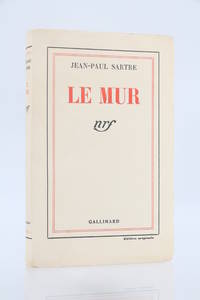
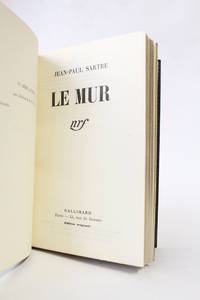
193988165Paris: Gallimard 1939. Fine. Gallimard Paris 1939 12 x 19 cm broché First edition one of 40 numbered copies on pure vellum the deluxe issue. A rare and attractive copy. Gallimard hardcover
193959946Paris: Gallimard 1939. Fine. Gallimard Paris 1939 12 x 19 cm relié sous étui First edition one of 40 numbered copies on vélin pur fil paper the tirage de tête deluxe copies. Full morocco covers and spine preserved slipcase elegant binding signed by Semet & Plumelle. Provenances: mostly from Robert Desprechins' library with his ex-libris drawn by Jean Cocteau and by Louis de Sadeleer with his engraved ex-libris. A very nice copy beautifully bound morocco signed by Semet & Plumelle. Gallimard unknown
194934301Paris Gallimard 1949. Uncut and unopened in the orig. printed wrappers excellent copy original handwritten manuscript-leaf in ink 2pp. 4to for the pages 134-138 in the first edition containing numerous corrections and emendations as well as a burnt hole from one of Sartre's cigarettes. The paper is watermarked "Herakles". Both items are placed in a very beautiful custom-made red full-morocco box internally broadened to fit both items w. single gilt line-borders to boards and back beatifully gilt titles on back. The manuscript-fragment is placed in a red morocco-backed plastic-folder. <br/><br/><em>First edition of this splendid and important novel without doubt the best of the novel-cycle one of three copies out of commerce printed on "vergé antique blanc" numbered "C". The manuscript-fragment greatly varies from the printed leaves and is probably part of Sartre's very first notes to the manuscript which were written several years before the publication of the work. The work was announced already in 1945 under the title "La Dernière Chance" and was supposed to appear in "Les Temps modernes" in November 1947 but because the work grew to great Sartre let it become part three of the novel-cycle "Les chemins de la liberté" instead of setting free the characters in the already printed novels I and II and casting them as main characters in new independent novels. This work represents one of Sartre's best literary works and in it he presents us with the existentialist moral sentiments that were philosophically outlined in his main philosophical work L'être et le néant but this time in literary form."Le volume - qui est sans doute le meilleur de la série - fut écrit en 1947-1948 en même temps notons-le que l'ébauche de la morale de l'existentialisme promise à la fin de L'ÊTRE ET LE NÉANT. Le première partie couvre chronologiquement la période du 1 au 18 juin 1940 et se termine en laissant Mathieu dans une situation particulièrement despérée; la deuxième partie décrit le début de captivité d'un groupe de soldats francais qui comprend le militant communiste Brunet et un certain Schneider que l'on soupconne d'être un indicateur." Contat & Rybalka p. 207.The first edition of the work appeared in 2163 copies out of which 8 were on "vergé antique blanc" numbered I-V and A-C the last three being "hors commerce" 105 were on "vélin pur fil Lafuma Navarre" numbered VI-CV and D-H the last five being "hors commerce" and 2.050 on "alfa Navarre" numbered 1-2050 the last 50 being "hors commerce". Contat & Rybalka 49/179. </em> hardcover
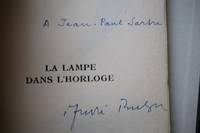
194845375Paris: Robert Marin 1948. Fine. Robert Marin Paris 1948 11 x 17 cm broché sous chemise et étui BRETON André. La Lampe dans l'horloge The Lamp in the Clock Robert Marin Paris 1948 11 x 17 cm original wrappers with custom slipcase First edition one of the numbered copies on alfa mousse paper this one not justified. Wrappers in chemise and case. With an exceptional and important presentation inscription from André Breton to Jean-Paul Sartre. Case with almond-colored paper boards and chemise red morocco title-piece and label with exemplaire de J. P. Sartre J.P. Sartre's copy. This inscription from the Pope of Surrealism to the master of Existentialism of whose rare meetings most notably in New York there remain barely any traces in their biographies is all the more surprising since Sartre had just published a vitriolic article on Breton in Qu'est-ce que la littérature What is literature: The theoretical accord between Surrealism and the Communist Party against the bourgeoisie does not in fact go beyond the formal; it is the formal idea of negativity that unites them Negativity subsists no matter what anyone says outside of history: it is at the same time of the instant and everlasting it is the ultimate end of both literature and art. Somewhere Breton approves of the sacred mission' of the proletariat. But in the end this class imagined as a legion of exterminating angels is in reality nothing more for authors than a religious myth that plays a role for the salving of their consciences analogous to that played by the myth of the People' in 1848 for well-intentioned writers. André Breton did not reply to Sartre's criticisms nor even the ones formulated a year later by Simone de Beauvoir in The Second Sex. This little work as much political as it is poetical is nonetheless a part of the common cause of these two intellectuals within the extremely ephemeral Rassemblement Démocratique Révolutionnaire. Founded in 1947 by Sartre it very quickly floundered despite the active engagement of Breton. 1948 was therefore the only intellectual meeting of these two great Masters of Thought of the second half of the 20th century whose personalities intransigent and exclusionary did not allow for a lasting philosophical union. Robert Marin hardcover
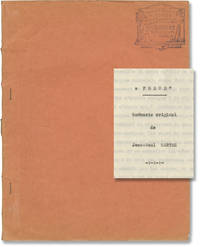
1965158800N.p.: N.p. 1965. Archive of vintage treatments scripts and other ephemera from the 1962 film.<br /> <br /> Archive includes: <br /> <br /> Two carbon typescript treatment scripts by Jean-Paul Sartre one in English and one in French both dated December 15 1958 with annotations in Sartre's hand.<br /> <br /> An early xerographically duplicated draft of Sartre's voluminous three-part script a later reproduction made for internal use with copied annotations throughout. <br /> <br /> A working script used during the film's production with revision pages.<br /> <br /> A film program. <br /> <br /> Three telegrams a telefax and a letter regarding the release of the film the return of Sartre's treatments and script and a deposition reminder all from agent Paul Kohner to director John Huston. <br /> <br /> A copy of the 1984 posthumous publication of Sartre's script The Freud Scenario.<br /> <br /> Huston announced his intention to make a film about a young Sigmund Freud in 1958 and asked Sartre whom he had met on the set of his 1952 film Moulin Rouge to submit a screenplay. The partnership quickly soured however due to Sartre's refusal to shorten his script which had ballooned to the colossal 472-page script on offer. Huston and Sartre would meet in Galway but Sartre continued to reject the director's proposed cuts wryly noting "We can make a film of four hours in the case of Ben Hur but the Texas public couldn't stand four hours of complexes." The film was ultimately finished and released in 1962 and although many elements of Sartre's script remain in the film the philosopher went uncredited. <br /> <br /> Set in Vienna shot on location in Austria and Germany.<br /> <br /> French Treatment:<br /> <br /> Salmon untitled wrappers. Title page present dated 15 Décembre 1958 noted as Scénario original with credits for author Jean-Paul Sartre. 95 leaves with last page of text numbered 95. Carbon typescript copy on onionskin rectos only. Pages Near Fine wrapper Near Fine saddle-stapled with two staples.<br /> <br /> English Treatment:<br /> <br /> Tan untitled wrappers with a titled label noted as Original Outline on the front wrapper with credits for author Jean-Paul Sartre. Title page present dated December 15 1958 noted as 1. Draft with credits for author Jean-Paul Sartre. 61 leaves with last page of text numbered 60. Carbon typescript copy on onionskin rectos only. Pages Near Fine wrapper Near Fine bound with three screw brads.<br /> <br /> Xerographically duplicated Sartre Script:<br /> <br /> White untitled wrappers. 472 leaves with last page of text numbered 181. Xerographic duplication rectos only. Pages Near Fine wrapper Very Good plus with light soiling overall bound internally with three gold brads.<br /> <br /> Working Script:<br /> <br /> Brown untitled wrappers. Title page present. 162 leaves with last page of text numbered 168. Mimeograph duplication rectos only with blue buff and yellow revision pages throughout dated variously between 9/8/61 and 12/19/61. Pages Near Fine wrapper Very Good lacking rear wrapper and much of the spine bound with a prong binding.<br /> <br /> Telegrams telefax and letter: 6.5 x 4.5 to 8.5 x 11 inches. Very Good plus to Near Fine.<br /> <br /> Program: 7 x 8.5 inches bi-fold. Very Good plus.<br /> <br /> Book: Near Fine and unread in a lightly rubbed Very Good plus dust jacket. N.p. unknown
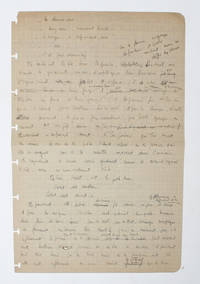
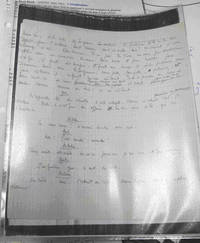
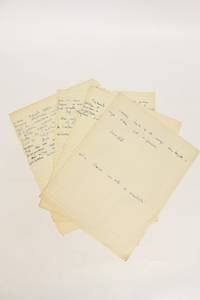
29536n.d. c. 1950-51 n.p. Paris. First Edition. First Edition. Signed by Author. SARTRE Jean-Paul. Autograph Manuscript. N.d. c. 1950-51 n.p. Paris. 1 page - small 4to. On his typical graph paper. One page from his famous play Le Diable et Le Bon Dieu published in 1952 & staged in Paris in 1951. A fragment of the second act Scene IV with part of the dialogue between Hilda & Goetz. A few corrections & certain variants from the published printed version. Rare. n.d. [c. 1950-51], n.p. [Paris] unknown
31419Paris Gallimard 15 juin 1948. 1 vol. 120 x 185 mm de 259 p. et 2 f. Demi-maroquin brun à coins dos à nerfs titre doré date en pied filet doré sur les plats tranches dorées sur témoins couverture et dos conservés reliure signée de Alix. Édition originale. Un des 15 premiers exemplaires sur vélin de hollande n° X. . La première des Mains sales est donnée le 2 avril 1948 avec notamment André Luguet et François Périer au théâtre Antoine dirigé par Simone Berriau. Cette pièce la grande pièce historico-existentialiste de Sartre tient son originalité dans son temps narratif particulier : la pièce se déroule sur deux ans et est organisée en sept tableaux autour d'un retour en arrière : les tableaux I et VII sont situés en mars 1945 et se déroulent au cours de la même soirée de 21 heures à minuit. Les tableaux II à VI retracent eux les événements du mois de mars 1943 deux années plus tôt ; l'ensemble s'articule autour d'un récit de trois heures durée de la pièce. « Dans l'oeuvre dramatique de Sartre bien et mal volonté de résistance et esprit de résignation héroïsme réel ou joué et lâcheté victimes et bourreaux idéalistes et réalistes dialoguent et s'opposent au fil de pièces qui empruntent à tous les genres sans en adopter aucun voire en les détournant tous. » La Pléiade. Pièce de l'engagement politique Les Mains sales pose la question de l'idéalisme. Jusqu'où celui-ci doit-il être poussé Dans une Europe partagée entre les deux grandes puissances assujetties par ses libérateurs par les alliés qu'elle n'avait cessés d'appeler l'espoir communiste s'y effondre sous le joug soviétique et les illusions démocratiques de Hugo et d'Olga s'épuiseront devant le spectacle du stalinisme triomphant. De la bibliothèque de Max Brun ex-libris. Paris, Gallimard, (15 juin) 1948. 1 vol. (120 x 185 mm) de 259 p. et [2] f. Demi-maroquin brun à coins, dos à nerfs, titre dor unknown
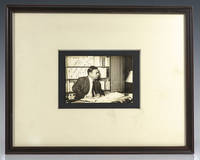
123541Rare silver gelatin print of French philosopher novelist and playwright Jean-Paul Sartre. Inscribed by him in the upper left corner of the image "A M. Satoru Yamano sympatheque hommage Jean-Paul Sartre." In near fine condition. Matted and framed. The entire piece measures 14 inches by 11 inches. French philosopher novelist playwright political activist and literary critic Jean-Paul Sartre was one of the key figures in the philosophy of existentialism and phenomenology and one of the leading figures in 20th-century French philosophy and Marxism. The conflict between oppressive spiritually destructive conformity mauvaise foi literally 'bad faith' and an "authentic" way of "being" became the dominant theme of Sartre's early work a theme embodied in his principal philosophical work Being and Nothingness L'Être et le Néant 1943. Sartre was awarded the 1964 Nobel Prize in Literature despite attempting to refuse it saying that he always declined official honors and that "a writer should not allow himself to be turned into an institution." unknown
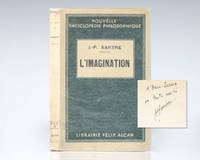
1936139855Paris: Librairie Felix Alcan 1936. First edition of Sartre's first book published as volume 10 of the Nouvelle Encyclopedie Philosophique and commissioned by the editor Henri Delacroix. Octavo original wrappers. Presentation copy inscribed by the author on the half-title page "A Brice Parain en tout amitie! JP Sartre." The recipient Brice Parain was a fellow French philosopher and friend of Sartre's mainly interested in Communism Surrealism and Existentialism the failures of which he anticipated in part in some of his earlier works such as Essai sur la misère humaine 1934 and Retour à la France 1936. Parain was one of the chief collaborators in the beginnings of Éditions Gallimard since 1927 as well as a close friend of the Gallimard brothers particularly Gaston. He was the principal director of the Encyclopédie de la Pléiade collection and translated various Russian classic works published through Gallimard including works by Lev Tolstoy Anton Chekhov and Aleksandr Pushkin. Near fine in the original glassine which is in near fine condition with a small annotation "Envoi" to the crown of the spine. First editions are rare presentation copies exceedingly so. Understanding the imagination was central to Sartre’s attempts to understand what it was to be human and how one should live. In L'Imagination Sartre discusses what the existence of imagination shows about the nature of human consciousness and argues that while some believe imagining to be like an internal perception it is in fact nothing like it. Ultimately Sartre argues that because we can imagine we are ontologically free. A consciousness that could not imagine he points out would be hopelessly mired in the "real" incapable of the perception of unrealized possibilities and thus any real freedom of thought or choice. In order to imagine a consciousness must be able to posit an object as irreal—nonexistent absent somewhere else and it does so always from a particular point of view. Librairie Felix Alcan unknown
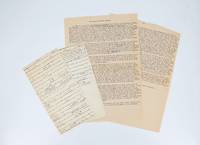
1952698341952. Fine. s. d. 1952 - 12 feuillets Autograph manuscript of 12 pages on squared sheets written in blue ink with numerous passages underlined. A previously unpublished set of reflections by Jean-Paul Sartre on social structure and bourgeois ideology probably written in 1952 as part of a projected screenplay on the revolutionary period. This series of interior dialogues on the nature of individual and collective power constitutes an early draft of the ideas later developed in his 1960 masterpiece Critique of Dialectical Reason. Through the example of the French Revolution and the Terror Sartre questions the role of the citizen and of property drawing on the writings of Kant Marx Rousseau Hobbes Saint Paul and Luther. This group of leaves shows numerous similarities in both content and form with two manuscripts dating from before 1953 now preserved at the University of Austin Texas the manuscript entitled Liberty Equality Harry Ransom Humanities Research Center collection and at the University of Ottawa the manuscript Screenplay / Joseph Le Bon . A reference in our manuscript to a study by Jean Vialatoux on Hobbes reissued in 1952 further supports its dating to that year. Throughout these pages one recognizes Sartres characteristic note-taking style composed of striking assertions and flashes of thought attacking social systems and structures: for the bourgeois can derive the sacred only from himself One is sacred insofar as one is the slave of the sovereign who defends each of his slaves against the other slaves . It is an opportunity for the philosopher to deploy numerous lines of reasoning and syllogisms and for the reader to follow in detail the course of his intellectual process: What then is the sovereign in relation to me 1/ My own will but alienated. It is returned to me as other. That is to say I re-interiorize it in the form of command duty and law. Example: I own and cultivate my land. I give my right to the sovereign. He confirms me in this possession . Through a series of tests applied to ideological assertions Sartre analyses the phenomenon of the devolution of power and the place of individual will thereby dismantling the mystique of the State of which Hobbes was the great theorist. The early 1950s correspond to a period of great productivity for the writer who stages his scandalous play The Devil and the Good Lord and mobilizes for the release of Henri Martin imprisoned for his action against the Indochina War. In 1952 he devotes himself to biographical projects with the publication of his Saint Genet and also begins work on an unfinished screenplay about the life of a little-known revolutionary the Montagnard Joseph Le Bon intended to be a sort of filmed philosophical biography rethinking the data emphasized by the historiography of the Revolution Philippe Gilles Construction du personnage et argumentation philosophique sur un scénario inédit de Jean-Paul Sartre the drafts of which are now preserved at the Universities of Ottawa and Austin. These handwritten notes probably form part of a body of reflections preliminary to the writing of this screenplay with substantial sections devoted to an anthropological and particularly innovative approach to the Terror aiming to understand the emergence of violence in History in the manuscript the germ of Terror : There is terror when pessimism turns into optimism without the original conception of man being changed. Then Evil becomes a parasitic thicket to be cleared away in order to recover the good. Evil is negating. Otherwise if we start from the idea that Man is metaphysically evil as the result of a free act from which one cannot return there is pessimism and not terror. Beyond the revolutionary period addressed in a few pages this manuscript reflects the underlying concerns and internal debate of Sartrean philosophy between individual and collective real and ideal sovereign and masses. unknown
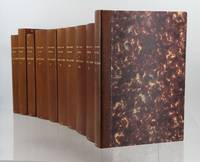
194781881Paris: Gallimard 1947. Fine. Gallimard Paris 1947-1976 12 x 19 cm 10 volumes brochés sous chemises-étuis Each volume in its first edition: one of 30 numbered copies on Pur fil paper for the first one of 14 numbered copies on Hollande for the second and third one of 36 numbered copies on Hollande from the fourth to the ninth one of 35 numbered copies on Hollande for the tenth and last. Each work is presented in a brown half morocco slipcase smooth spine slightly sunned gilt date at the foot of spine marbled paper boards wood-like paper inside. A very nice complete set in 10 volumes and a very rare collection of first editions. There were only 14 copies ever printed on Hollande paper of the second and third volumes meaning that there are possibly only 14 complete sets in existence. Gallimard hardcover
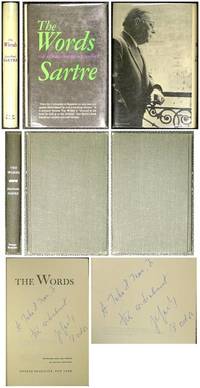
196433005New York: George Braziller 1964. First Edition. First Edition. Signed by Author. First American Edition Inscribed and Signed by Jean-Paul Sartre on the title-page in blue ballpoint: 'A John P. James Jr. trés cordialement signed Sartre 18 Oct. 69'. 8vo. 255 pp. A near fine copy in black cloth white titles to the spine rose topstain John P. James Jr's neat bookplate on the front pastedown in a bright fresh price-clipped dustwrapper. Translated from the French by Bernard Frechtman. A brilliant autobiography that is often compared with Rousseau's Confessions. Housed in an elegant custom clamshell case black cloth over marbled paper red morocco spine label with gilt titles. George Braziller unknown
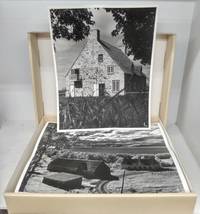
1959143553Montreal ca. 1959-60. Fine. 90 original b&w photographs. 28 x 35 cm. Each numbered with the photographer's monograph in the negative. Original 7 p. mimeographed key identifying the source for each of the images. Housed in a cardboard box. <br/><br/>Thirty of these images show some of the most architecturally significant houses and buildings in Quebec from Ile d'Orleans Quebec City and many other villages. Thirty photos show carved wooden sculptures and bas-reliefs from various old chuches. The final thirty depict various works of art in wood silver iron etc. Sets of this series of photos are held by several major Canadian Archives including Libary and Archives Canada Bibliotheque Nationale du Quebec and the National Gallery of Canada. Now you can own a set too. unknown
1939140943750Paris: Gallimard 1939. First Edition. Near Fine. First edition advance service de press copy. Signed by Jean-Paul Sarte and inscribed to a former owner. Bound in publisher's original printed wraps. Light toning light general wear and light reading creases to the spine faint vertical crease to rear cover. Housed in a custom slipcase with an edge-chipped morroco title label lettered in gilt. Gallimard unknown
25774Paris Gallimard 11 et 16 mars 1983. 2 vol. 145 x 235 mm de 600 p. et 6 f. ; 140 x 215 de 432 p. et 4 f. Bradel plein box d'un semis de petits point obtenus par épidermure pièces de titre mosaïquées sur le dos têtes dorées sur témoin couvertures et dos conservés étui reliure signée de Renaud Vernier 1984. . Édition originale. Un des 38 et 57 premiers exemplaires sur Hollande van Gelder n° 27 et 46. . En 1943 dans la conclusion de L'Être et le Néant Sartre annonçait qu'il consacrerait un prochain ouvrage au problème moral : cet ouvrage ne verra jamais le jour et n'en resteront que des notes élaborées en 1947 et 1948. Elles seront rassemblées mises en forme et publiées en 1983 par Arlette Elkaïm-Sartre sous le titre de Cahiers pour une morale. Les Carnets de la drôle de guerre qui paraissent conjointement viennent compléter ces textes notamment ceux qui décrivent « l'ensemble d'actes par lesquels l'homme décide pour soi et pour autrui dans et par l'Histoire de l'essence de l'homme ». Remarquable diptyque en box par Renaud Vernier lequel a créé un décor aux petits points par une épidermure du cuir dont il a le secret ; les pièces de titre mosaïquées sont cerclées de filets gainés en box de couleurs. De la bibliothèque du Docteur genevois Christos Karagevrekis par ailleurs commanditaire de cette reliure. Paris, Gallimard, (11 et 16 mars) 1983. 2 vol. (145 x 235 mm) de 600 p. et [6] f. ; (140 x 215) de 432 p. et [4] f. Bradel plein unknown
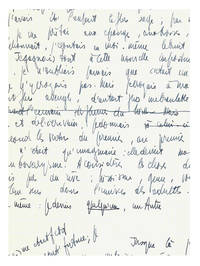
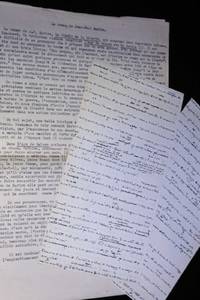
1953Sartre2<p><strong>SARTRE Jean-Paul 1905-1980</strong></p><p>Autograph preparatory manuscript for <em>Les Mots<br /></em>N.p.n.d c. 1953-1955 1 p. in-4°<br />Some words crossed out by Sartre</p><p><strong>Precious unpublished preparatory manuscript for <em>Les Mots</em> one of the densest that can be found of Sartre's autobiographical masterpiece</strong></p><p><em>" Je ne ressentais rien toute mon énergie s'absorbait à produire cette mutation dans cette mue. <strong>Je fus atteint de distraction chronique ; possédé par mon absence nulle part je ne me sentis présent tout à fait</strong>. Par comédie par zèle j'avais été l'enfant le plus sage ; par indifférence je devins plus docile encore je me prêtai aux éponges aux brosses au gant de crin : pendant qu'on me bouchonnait j'écoutais en moi-même le bruit des marteaux qui battaient le fer. Je gagnais tout à cette nouvelle imposture : jusque-là quand je faisais le héros je n'oubliais jamais que c'était un jeu que j'étais un mal-bâti. Bref je n'y croyais pas. <strong>Mais je croyais à ma vocation : cette certitude était d'autant plus aveugle d'autant plus inébranlable qu'elle m'était plus étrangère</strong>. En parant l'écrivant des plumes du héros. Mais quand. Lorsque je fis forgeais l'alliage du héros et de l'écrivain je donnais à celui-ci les vertus de celui-là à celui au second les vertus du premier au premier la réalité du second. <strong>Ma valeur n'était qu'imaginaire : elle devint ma vérité future je passai du jeu au bovarysme. À considérer les choses du dehors il va de soi que je ne sortais pas du rêve : héroïsme génie vocation tous ces mots enfantins perdent leur sens dans l'univers des adultes. Mais au-dedans il n'en était pas de même :<br />Je devins <u>quelqu'un</u> un Autre </strong></em>…<em> "</em></p><p>Sartre began drafting a preparatory manuscript for <em>Les Mots</em> initially titled <em>Les Affections du cœur</em> between 1952 and 1953. Deeply involved at the time in his philosophical work—particularly <em>Critique of Dialectical Reason</em>—he temporarily abandoned his autobiographical project before resuming it in the late 1950s. The book published by Gallimard in 1963 was met with great success.<br />Several preparatory and fragmentary texts are known ranging from one to about ten pages for the longest now housed at the BnF Bibliothèque nationale de France. These fragments are published in the Pléiade edition under the section "Vers <em>Les Mots</em>" "Towards <em>Les Mots</em>".<br />Unknown to Jean-François Louette the present manuscript remains one of the most valuable that can be found from the philosopher so rich is it in thematic density and so revealing of the existential concerns that permeate Sartre's work. It also stands out by having both a 'beginning' and an 'end' unlike other isolated fragments.</p><p><u>"Bovarysm":</u><br />It is worth noting that this term does not appear in the final version of <em>Les Mots</em>. Sartre as is well known had a deep interest in <em>Madame Bovary</em> having read Flaubert's work numerous times. For the young Sartre <em>Madame Bovary</em> embodied a life project—somewhere between a challenge to the adult world and a form of childish play see <em>Sartre et la tentation Bovary</em> – F. Noudelmann.</p><p>Does not appear in <em>"Vers Les Mots"</em> <em>Les Mots</em> Pléiade edition edited by Jean-François Louette 2010.</p>
194582300s. l. Paris: S. n. Paysage dimanche 1945. Fine. S. n. Paysage dimanche s. l. • Paris s. d. 1945 11.50 x 22 cm 3 pages 1/2 in-4 Autograph manuscript by the author 3½ pages octavo published in the October 21 1945 issue no. 19 of Paysage dimanche. Complete recto-verso manuscript in very dense handwriting with numerous deletions corrections and additions. Literary chronicle published on the occasion of the publication of the first two volumes of Jean-Paul Sartre's trilogy Les chemins de la liberté: ""L'Age de raison"" and ""Le Sursis"". Together with the complete typescript with one deletion and one autograph correction by the author. When this chronicle appeared in autumn 1945 Maurice Blanchot and Jean-Paul Sartre had already demonstrated their mutual interest in each other's respective work in articles that were sometimes critical sometimes laudatory always attentive. Similarly if Les chemins de la liberté aroused Blanchot's admiration it was essentially through the philosopher's skillful use of the influence of two monuments of Anglo-Saxon literature Virginia Woolf and John Dos Passos: « Ce qui nous paraît frappant c'est le caractère d'œuvre d'art qu'en reçoit le livre œuvre extrêmement composée calculée avec un souci infiniment sûr des effets où la confusion reste claire où le désordre est perfection et telle qu'on y reconnaît sans cesse la présence de l'écrivain le plus lucide capable de tout obtenir du langage dont il est maître. » ""What strikes us as remarkable is the character of a work of art that the book receives an extremely composed work calculated with infinitely sure concern for effects where confusion remains clear where disorder is perfection and such that one constantly recognizes the presence of the most lucid writer capable of obtaining everything from the language he masters."" But this ""Roman de Sartre"" was above all an opportunity for Blanchot to raise the question of the links between literature and politics on which the two men would have great difficulty agreeing in the following decades. Thus Blanchot summarized Sartre's vision evoking the problem of commitment: « Il est indéniable que l'art de Sartre atteint son plus grand pouvoir lorsqu'il décrit l'engloutissement des consciences par les choses qui les hantent et les débordent et de laquelle elles coulent comme une pâte pleine d'odeurs. Le monde qu'il sent est celui d'une métamorphose mais cette métamorphose n'est pas changement de forme elle n'est pas la transformation d'un être en un autre être fût-ce d'un homme en une vermine ; elle va plus loin elle est irrémédiable car c'est la conscience même qui devient un matériel c'est la pensée qui se fige en une substance gluante visqueuse sans contour sans apparence un dedans triste et vague que nous ne pouvons saisir et qui pourtant comme tel continue désespérément à penser. Tel est l'univers dans lequel nous sommes jetés tant que nous n'essayons pas de le reprendre par une action qui nous engage. » ""It is undeniable that Sartre's art reaches its greatest power when he describes the engulfing of consciousness by the things that haunt and overwhelm them and from which they flow like a paste full of odors. The world he perceives is one of metamorphosis but this metamorphosis is not a change of form it is not the transformation of one being into another being even of a man into vermin; it goes further it is irreparable for it is consciousness itself that becomes material it is thought that freezes into a sticky viscous substance without contour without appearance a sad and vague interior that we cannot grasp and which nevertheless as such continues desperately to think. Such is the universe into which we are thrown as long as we do not try to reclaim it through an action that commits us."" The third volume of Les Chemins de la liberté not yet published left little doubt in Blanchot's eyes as to its content; and he summarized somewhat sarcastically: « Ce qui suivra est facile à S. n.[ Paysage dimanche] unknown
194544941s. l. Paris: S. n. Paysage dimanche 1945. Fine. S. n. Paysage dimanche s. l. Paris s. d. 1945 11.50 x 22 cm 3 pages 1/2 in-4 Autograph manuscript by the author of 3½ pages octavo published in the October 21 1945 issue no. 19 of Paysage dimanche. Complete recto-verso manuscript very densely written with numerous deletions corrections and additions. Literary chronicle published on the occasion of the publication of the first two volumes of Jean-Paul Sartre's trilogy Les chemins de la liberté: ""L'Age de raison"" and ""Le Sursis"". The complete typescript is included with one deletion and one autograph correction by the author. When this chronicle appeared in autumn 1945 Maurice Blanchot and Jean-Paul Sartre had already demonstrated mutual interest in their respective works in articles sometimes critical sometimes laudatory always attentive. Similarly if Les chemins de la liberté aroused Blanchot's admiration it was essentially through the use the philosopher had made of the influence of two monuments of Anglo-Saxon literature Virginia Woolf and John Dos Passos: « Ce qui nous paraît frappant c'est le caractère d'uvre d'art qu'en reçoit le livre uvre extrêmement composée calculée avec un souci infiniment sûr des effets où la confusion reste claire où le désordre est perfection et telle qu'on y reconnaît sans cesse la présence de l'écrivain le plus lucide capable de tout obtenir du langage dont il est maître. » ""What strikes us is the character of a work of art that the book receives an extremely composed work calculated with infinitely sure concern for effects where confusion remains clear where disorder is perfection and such that one constantly recognizes the presence of the most lucid writer capable of obtaining everything from the language he masters."" But this ""Novel by Sartre"" is above all an opportunity for Blanchot to raise the question of the links between literature and politics on which the two men would have great difficulty agreeing in the following decades. Thus Blanchot summarizes Sartre's vision evoking the problem of engagement: « Il est indéniable que l'art de Sartre atteint son plus grand pouvoir lorsqu'il décrit l'engloutissement des consciences par les choses qui les hantent et les débordent et de laquelle elles coulent comme une pâte pleine d'odeurs. Le monde qu'il sent est celui d'une métamorphose mais cette métamorphose n'est pas changement de forme elle n'est pas la transformation d'un être en un autre être fût-ce d'un homme en une vermine ; elle va plus loin elle est irrémédiable car c'est la conscience même qui devient un matériel c'est la pensée qui se fige en une substance gluante visqueuse sans contour sans apparence un dedans triste et vague que nous ne pouvons saisir et qui pourtant comme tel continue désespérément à penser. Tel est l'univers dans lequel nous sommes jetés tant que nous n'essayons pas de le reprendre par une action qui nous engage. » ""It is undeniable that Sartre's art reaches its greatest power when he describes the engulfment of consciousness by things that haunt and overwhelm it and from which it flows like a paste full of odors. The world he feels is one of metamorphosis but this metamorphosis is not a change of form it is not the transformation of one being into another being even of a man into vermin; it goes further it is irreparable because it is consciousness itself that becomes material it is thought that hardens into a sticky viscous substance without contour without appearance a sad and vague interior that we cannot grasp and which nevertheless as such continues desperately to think. Such is the universe into which we are thrown as long as we do not try to reclaim it through action that engages us."" The third volume of Les Chemins de la liberté not yet published leaves in Blanchot's eyes little doubt as to its content; and he summarizes somewhat sarcastically: « Ce qui suivra est facile à imaginer : nous aurons la guerre l'occupation S. n.[ Paysage dimanche] unknown
1945483431945. Fine. 1945 - 19 pages 1/2 in-8 Autograph manuscript of the author of 19 pages and a half in-8 published in the October issue No. 10 of L'Arche Complete two-sided manuscript very dense writing with many erasures corrections and additions. Since the 1930s Maurice Blanchot regularly devotes articles to Jean-Paul Sartre and especially to his novels. The publication of the first two volumes of the trilogy The paths of freedom was to give rise to the almost simultaneous publication of a rather short chronicle in Dimanche paysage No. 19 October 21 1945 and this large study entitled ""The Novels of Sartre "". This one which goes beyond the circumscribed frame of the literary news intends to analyze what makes the specificity of these works namely the use of the ""thesis"": ""One can wonder why the thesis novel has bad reputation"" . Grievances seem as numerous on the side of the thesis as on the side of the novel; the theoretical affirmation complains of the adventure to which it is committed and from which it derives an additional truth. . In a novel of this kind we reproach the characters for being lifeless but it is ""the idea"" that is lifeless: it only looks like itself it has only its own sense . . "" Therefore Blanchot salutes Sartre's meeting of exceptional philosophical as well as literary capacities while underlining that it is also the fruit of his time: ""It is true that fiction works are more and more besieged by theoretical aims and that theoretical works are more and more a call to problems that require a complete expression. Existentialists or not novelists and philosophers pursue similar experiments and research . . "" Moreover he praises Sartre's ability to make his novels both an experience in itself and ""the story of an experience"" an essential concept for Blanchot and which had emerged as one of the central themes of his first critical collection False Pas 1943. And it is this same quality that he lends by the way to Simone de Beauvoir's Guest a ""remarkable work"" . Thus at the end of a reflection which reveals the admiration of Blanchot for the Sartrean novel and particularly for Nausea composed at the same time as his Thomas the Obscure he concludes: ""In short could not it be possible not that the novel was much less the enemy of the thesis than it is said ""The manuscript and multiple deletions and additions then reflects the hesitation of Blanchot in formulating the end of his demonstration yet clear in the finished text"" This only: to respect the status of bad faith that is its morality it to recognize a power of transformation of crystallization by the transparency of discovery through exposure which is its reality and finally having formed of its substance existing only by its duration to triumph by disappearing according to the movement proper to art to recover in affirmation and to fulfill itself in failure - which is its truth. "" The text will be repeated with some corrections in La Part du Feu 1949. unknown
1395222Muizon France: Éditions A L'Ecart 1984. Limited Edition: #49/100. Hardcover. Quarto 60 pages. In Very Good minus condition with a Very Good minus slip case. Bound in black paper boards with gilt lettering to spine. Scuffing along edges of slip case and spine. Features 20 photographs all detached from plates but loose within. Also features poems and letters by the artists. Text in French. <br /> <br> <br /> Shelved in Case 0. Renée Vivien 1877-1909 was a British lesbian poet and writer who resided in Paris and wrote mostly in French. Natalie Barney her most notable partner was an American writer who was known for the literary salons she hosted in Paris. She initially moved to France to live with her partner at the time American actress Eva Palmer. 1395222. Shelved Dupont Bookstore. Éditions A L'Ecart hardcover