VOITURE, Vincent deBiblio.com

10 résultats
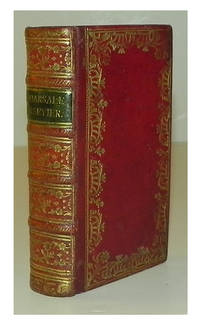
1654000530Paris: Iouxte la copie imprime 1654. Hardcover. See Description. 12mo. pp. 24 608 14. With engraved title page and a portrait of the author verso 12 both by Peter Clouwet. Bound in early full red morocco including gilt paneled boards; neatly re-backed in matching morocco with gilt stamped spine in five compartments. Staining and mild darkening are present on the covers; the extremities contain some rubbing and wear; the corner tips and the edges of the boards are neatly touched up. Interior pages contain mild marginal age toning; a chip in the outer margin of the portrait leaf is neatly patched. An old ink shelf number is written on the upper verso of the title. Vincent de Voiture 1598-1648 was a French poet and letter writer. Voitures letters are known for their wit and fine prose. This edition is possibly an Elzevir imprint published in Holland or Belgium. Brunet V 1347. <br/> <br/> Iouxte la copie imprime hardcover
1630219319Verlag ovn Johann Ambrosius Barth Leipzig. A spese di Giovanni Ambrogio Barth Lipsia 1630. Softcover Die Jahresangaben sind ungefähr. Zustand: mit Kennungen einer Privatbibliothek. Keine Beschädigungen Ecken Kanten gut. Bitte fordern Sie Bilder an. Verlag ovn Johann Ambrosius Barth, Leipzig. A spese di Giovanni Ambrogio Barth, Lipsia, paperback
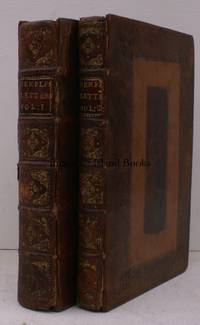
17005946Printed for J. Tonson at Gray's Inn Gate in Gray's Inn Lane; and A. and J. Churchil at the Black Swan in Pater-Noster Row and R. Simpson at the Harp in S. Paul's Church-yard 1700. 2 vols. 8vo. First Edition with portrait frontispiece engraved on wood by Robert White after Lely some moderate foxing throughout; attractively bound in early eighteenth-century panelled tree calf tooled in blind backs gilt extra with five raised bands compartments tooled to a floral design leather labels gilt sprinkled edges joints of first volume worn and cracked but binding entirely sound corners of first volume lightly bruised a very good crisp copy with broad untrimmed margins. With a fine engraved armorial bookplate. The work considered to be Swift's first publication is dedicated to William III. A third volume 'Letters to the King the Prince of Orange' was published in 1703 but the present work is complete in itself. CBEL II p.570; Teerink 469; Wing T641. Printed for J. Tonson, at Gray's Inn Gate in Gray's Inn Lane; and A. and J. Churchil, at the Black Swan in Pater-Noster hardcover
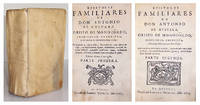
1665000335Anveres: Jacobo Mevrcio 1665. Limp Vellum. See Description. Small 8vo. 2 volumes in 1. Volume I. pp. 400 6. Vol. II. pp. 383 7. With separate title page to each volume. Bound in period vellum. Occasional faint miniscule underlining in an old hand and a couple short marginal notations; some marginal smudging / soiling; front and rear blank leaves are ragged and torn. Volume I: tiny hole in p. 271 mostly between lines but partly obstructing a couple of letters; bottom corner tip clipped on p.399 - not effecting text; pages 400-401 are dusty / soiled. Volume II: upper corner crease on p. 81. The bottom corner tips of the last few gatherings are chipped/worn. Antonio de Guevara 1480-1545 - Spanish writer who grew up in the court of Ferdinand and Isabella. He later joined the Franciscan order and was appointed court preacher and imperial historiographer by Charles V of Spain. In 1527 he became bishop of Guadix and in 1537 bishop of Mondonedo. Guevera's works were quite popular in their time. His "Epistolas Familiares" first published 1539-1545 consist of a series of essay-letters addressed to various eminent persons and written in a highly formal style. <br/> <br/> Jacobo Mevrcio hardcover
16872906711687. Softcover Kupferstich Die Jahresangabe ist ungefähr. Bildunterschrift: Diser rahre Tyger-Schimel mit schwartzen Haren hatte einen licht braunen Kopff mit weisser blasse graue und castanien braune Flecken und gantz schwartze Schenckel das ere der Hochgräffl. Erbachischen Familie zu gehöret weiset die hinder der nach dem Leben gemachten Mahlerey aprevierte Schrifft. Erbach F. H. d. Schomb. H. 1687. Unten rechts: Joh. El. Ridinger delin. sculps. et excudit Aug. Vindel. In Farbe. Das Bild unter Glas mit Rahmen 50x36cm. Zustand: Keine Beschädigungen. paperback
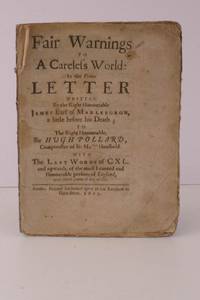
16659438Printed for Samuel Speed at the Rainbow in Fleet-Street 1665. Sm. 4to. First and Sole Edition F2 torn at fore-margin with some loss of text some light age-staining; disbound sewed as issued uncut a fresh crisp copy. With the publisher's advertisement leaf at end. The work is dedicated by Henry Smith to Pollard himself. James Ley 1618-1665 third Earl of Marlborough and naval captain was grandson of his namesake the first Earl and notable barrister. By 1643 he had become a Royalist commander and two years later established a colony at Santa Cruz in the West Indies. He then commanded the East Indies squadron that received Bombay from the Portuguese in 1661 and was nominated Governor of Jamaica in 1664. Ley's 'pious letter' is dated 24 April 1665. It concludes with the phrase 'So prays old James near the coast of Holland' at sea during the Second Anglo-Dutch War. A marginal note in a neat contemporary hand states correctly 'the ship he was in Old James was his own name'. He died soon after 13 June 1665 aboard the same vessel. The Battle of Lowestoft fought on 13 June 1665 between the English fleet under James Duke of York and the United Provinces Dutch fleet under Jacob van Wassenaer remains the worst naval defeat in Dutch history. The author was killed in the 68-gun 'Old James' stationed in the Centre Division of the Duke of York's Red Squadron. Smith's compilation is nothing if not wide ranging. The other 'learned and honourable persons' include of the UK Arundel Bacon Bancroft Charles I Compton Coventry Donne Egerton Hatton Howard Leicester Mason Peito Pembroke Raleigh Selden Thomas Smith Somerset Stafford Usher Walsingham Wolsey Wotton; and others Aristotle Caracciolus Charles V Chrysostom Gondamar Grotius de Haro Heinsius Ignatius Irenaeus Junius Justin Martyr Mazarin Origen Plato Polycarp Richlieu Salmasius Seneca Socrates Solomon Tertullian. Significantly the publisher's advertisement leaf announces 'An excellent Preservative against Plague 2s. 6d. Per Paper sealed' together with 'Medela Pestilentiae an exact Method for curing that Epidemical Distemper' and 'Reflections on the Weekly Bills of Mortality for the Cities of London and Westminster'. EXTREMELY SCARCE. Printed for Samuel Speed at the Rainbow in Fleet-Street, unknown
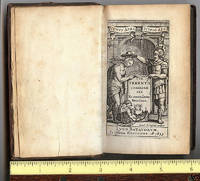
1635biblio41<p>Terentius Afer Publius. Comoediae sex. 48 304 6 pages including engraved title by Cornelius Claude Dusend. 12mo contemporary French citron morocco lavishly gilt-tooled to center-and-corner design of pointille volutes and small ornamental tools around blank center oval on covers vertical ornamental rolls on flat spine joints slightly rubbed. Amsterdam: Officiana Elzeveriana 1635 Second of 5 editions with this imprint date and pagination described under willems 433 Provenance: Howard Granville Hanrott 19th Century initialed catalogue note and armorial bookplate; George G. Tillotson sale Anderson Auction Company 1 February 1910 lot 53 sale marked $11.00. Sold Swan Galleries Sale 2041 lot 175 $360.00. No copies found.</p><p>Publius Terentius Afer 195/185–159 BC better known as Terence was a playwright of the Roman Republic. His comedies were performed for the first time around 170–160 BC and he died young probably in Greece or on his way back to Rome. Terentius Lucanus a Roman senator brought Terence to Rome as a slave educated him and later on impressed by his abilities freed him. All of the six plays Terence wrote have survived. One famous quotation by Terence reads: "Homo sum humani nil a me alienum puto" or "I am a man I consider nothing that is human alien to me." This appeared in his play Heauton. Terence's date of birth is disputed; Aelius Donatus in his incomplete Commentum Terenti considers the year 185 BC to be the year Terentius was born; Fenestella on the other hand states that he was born ten years earlier in 195 BC.</p><p>He may have been born in or near Carthage or in Greek Italy to a woman taken to Carthage as a slave. Terence's ethnonym Afer suggests he lived in the territory of the Libyan tribe called by the Romans Afri near Carthage prior to being brought to Rome as a slave. This inference is based on the fact that the term was used in two different ways during the republican era: during Terence's lifetime it was used to refer to anyone from the land of the Afri Africa meaning Northern Tunisia including Carthage; later after the destruction of Carthage in 146 it was used to refer to non-Carthaginian Berbero-Libyans with the term Punicus reserved for the Carthaginians. It is therefore possible that Terence was of Libyan descent considered ancestors to the modern-day Berber peoples. In any case he was sold to Terentius Lucanus a Roman senator who educated him and later on impressed by Terence's abilities freed him. Terence then took the nomen Terentius which is the origin of the present form. When he was 25 Terence left Rome and he never returned after having exhibited the six comedies which are still in existence. Some ancient writers tend to say that he died at sea. Like Plautus Terence adapted Greek plays from the late phases of Attic comedy. He was more than a translator as modern discoveries of ancient Greek plays have confirmed. However Terence's plays use a convincingly 'Greek' setting rather than Romanizing the characters and situations. Terence worked hard to write natural conversational Latin and most students who persevere long enough to be able to read him in the vernacular find his style particularly pleasant and direct. Aelius Donatus Jerome's teacher is the earliest surviving commentator on Terence's work. Terence's popularity throughout the Middle Ages and the Renaissance is attested to by the numerous manuscripts containing part or all of his plays; the scholar Claudia Villa has estimated that 650 manuscripts containing Terence's work date from after 800 AD. The mediaeval playwright Hroswitha of Gandersheim claims to have written her plays so that learned men had a Christian alternative to reading the pagan plays of Terence while the reformer Martin Luther not only quoted Terence frequently to tap into his insights into all things human but also recommended his comedies for the instruction of children in school.</p><p>Terence's six plays are:</p><p> Adelphoe The Brothers</p><p> Andria The Girl from Andros</p><p> Eunuchus; Restoration poet and playwright Sir Charles Sedley modelled his comedy Bellamira: or The Mistress 1687 partly on this play.</p><p> Heauton Timorumenos The Self-Tormentor</p><p> Hecyra The Mother-in-Law</p><p> Phormio</p><p>The first printed edition of Terence appeared in Strasbourg in 1470 while the first certain post-antiquity performance of one of Terence's plays Andria took place in Florence in 1476. There is evidence however that Terence was performed much earlier. The short dialogue Terentius et delusor was probably written to be performed as an introduction to a Terentian performance in the ninth century possibly earlier. A phrase by his musical collaborator Flaccus for Terence's comedy Hecyra is all that remains of the entire body of ancient Roman music. This has recently been shown to be unauthentic.</p> Elzeveriana hardcover
1658001066Leiden: Jean Elsevier Elzevir 1658. Hardcover. See Description. Small 12mo. pp. 417 1. With extra engraved title page. Bound in period full red morocco. Spine is gilt in compartments; boards are richly gilt with floral borders. The binding is well preserved with only minor spots of wear. All edges of the book block are gilt. The extra engraved title is tightly trimmed with no outer margin. Interior pages contain occasional mild marginal spotting but are otherwise generally clean. Lucans epic poem "Pharsalia" written during the reign of Nero concerns the Roman Civil War between Julius Caesar and Pompey. In 48 b.c.e the conflict came to a conclusion with Pompeys defeat on the Thessalian plains of Pharsalus. The poem then extends down to the capture of Egyptian Alexandria. Lucans epic is also noted for containing many elements of the supernatural including turgid scenes of magic and witchcraft. Translated from the Latin into French verse by the French poet and translator Georges de Brébeuf. The first de Brébeuf edition was published by De Sommaville in Paris 1655. Willems 827; Rahir 826; Berghman 907 - "Édition belle et des plus appréciées" <br/> <br/> Jean Elsevier [ Elzevir ] hardcover
16931263801693 sumptibus ac typis J. J. de Rubaeis (Romae) - 1693 - In-folio à l'italienne (48x38,5cm environ), reliure plein veau marbré d'époque, dos à 5 nerfs portant pièce de titre en doré sur fond rouge et caissons ornés de fleurons en doré, toutes tranches jaspées rouge, roulette dorée sur les chasses, contregardes marbrés seules - 84 pages dont 82 gravures
1692OCE200M1692, Claude Barbin, Paris. In-12, relié, pleine basane fauve de l’époque, dos à 5 nerfs orné, chasses ornées, 341pp. Imprimé chez Laurent Rondet. Intérieur parfaitement bon voire frais. Tampon ex-libris sur page de titre. Reliure d’époque restaurée dans le respect de la patine. Tranches bonnes. Intérieur très propre. Exemplaire sain et robuste.