ASSEMANI, SimoneBiblio.com
7 850 résultats
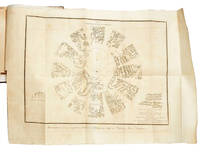
1790J1IBOS4BUCS1Padua 1790. Small folio 21.5 x 29.5 cm. Seminary printing office Contemporary green half calf gold-tooled spine marbled sides. With 3 large folding engraved plates. 16 CCXIX 9 pp. First and only edition of a rare study describing and illustrating with all elements needed to construction a 3D facsimile one of the most splendid Islamic globes ever made a celestial globe with Cufic lettering in the Borgia Museum at Velletri now at the Museo Nazionale di Capodimonte in Naples. The Syrian mathematician Qaysar ibn Abu al-Qasim 1178/79-1251 made the bronze globe with inlaid silver and copper 22 cm diameter in 622 AH 1225/26 CE for the fourth Ayyubid Sultan of Egypt al-Malik al-Kamil Muhammad ca. 1177-1238. The three folding plates show measured drawings apparently original size though without a scale of the components of the celestial globe with 1025 stars and 48 constellations designed so that they could be cut out and assembled around a globe body: the first shows the meridian and horizon rings with 2 gnomon scales for the base and a small view of the assembled globe the second shows the northern hemisphere and the third the southern hemisphere. Mediaeval Arabic astronomers used celestial globes to help solve various problems in astronomy far in advance of their European contemporaries. The seminary printing office in Padova established 1684 had its own typefoundry and had non-Latin types including Arabic cut for its first books published in 1685.Old library shelfmark label on the inside of the front board. The hinges and the head and foot of the spine somewhat worn. Otherwise in fine condition.l Brunet VI 8185; DG 7.9265; M. H. Fikri Treasures from the Arab Scientific Legacy in Europe no. 13 with full-page illustration; for Ahmed al-Farghani: DSB IV pp. 541-545. ABE CAT Astronomy & Cosmography unknown
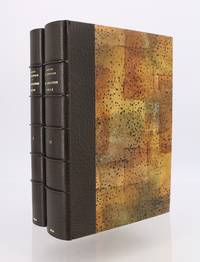
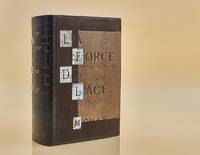
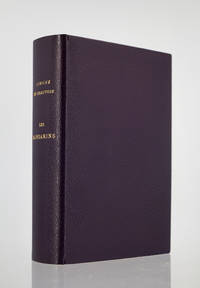
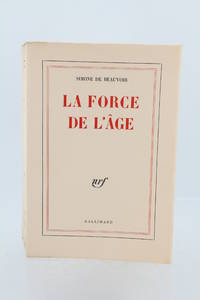
29809Paris Gallimard septembre 1958 octobre 1960 octobre 1963 et août 1972. 1 vol. 135 x 205 mm de 359 p. et 3 f. Veau brique à encadrement plats en daim marine avec décor à la lettre repris sur le dos tête dorée doublure et garde de papier bleu couverture et dos chemise et étui P.-L. Martin 1961 ; 1 vol. 140 x 205 mm de 622 p. et 1 f. Maroquin ébène à encadrement plats de daim marron avec décor à la lettre réhaussé d'une pièce de papier granité décor repris sur le dos tête dorée doublure de papier bordeaux et garde de papier bleu couverture et dos chemise et étui P.-L. Martin 1961 ; 1 vol. 155 x 210 mm de 686 p. et 1 f. Maroquin bleu nuit à encadrement plats en daim marine avec décor à la lettre réhaussé d'une pièce de box titre et tête dorés date en pied doublures et gardes papier couvertures et dos conservés chemise et étui bordé P.-L. Martin 1964 ; 1 vol. 155 x 220 mm de 512 p. et 2 f. Maroquin vert à encadrement plats en daim vert avec décor à la lettre réhaussé d'une pièce de box titre doré date en pied doublure et garde papier vert tête dorée couvertures et dos conservés chemise et étui P.-L. Martin 1975. . Édition originale pour tous les volumes. Un des 25 premiers exemplaires sur vélin de Hollande n° 13. Un des 30 premiers exemplaires sur vélin de Hollande n° 25. Un des 35 premiers exemplaires sur vélin de Hollande n° 10. Un des 40 premiers exemplaires sur vergé blanc de Hollande n° 21. . La somme autobiographique de Simone de Beauvoir : son oeuvre majeure jalon de la littérature féministe du XXe siècle. Magnifiques reliures de Pierre-Lucien Martin : trois d'entre elles ont été exécutées pour lui-même ; seule la première n'a pas de provenance identifiée mais elle est l'exacte copie de celle qu'il avait faite pour lui-même l'année précédente vente Pierre-Lucien Martin n° 36 exemplaire D. On connaît par ailleurs deux autres reliures de Martin pour Mémoires d'une jeune fille rangée en 1964 pour Pierre Consten et en 1966 pour Jean-Pierre Guillaume soit quatre au total. Ce décor princeps de 1960 marque une étape importante dans un type de décor que Martin déclinera beaucoup par la suite. Pierre-Lucien Martin aura au total réalisé quatre jeux complets sous ces reliures - toutes avec des variantes plus ou moins importantes. Seize exemplaires en tout et pour tout. Plusieurs volumes ont été dispersés ici et là et notre ensemble est le seul complet connu à l'heure actuelle. Dans ce premier volet autobiographique Simone de Beauvoir décrit les vingt premières années de sa vie de 1908 à 1928 jusqu'à sa rencontre avec Jean-Paul Sartre. « En 1929 Simone de Beauvoir a vingt ans. Elle vient d'être reçue brillante seconde derrière Sartre redoublant à l'agrégation de philosophie. Farouchement cartésienne elle tire des plans sur la comète : elle entend vivre pour écrire et aller son chemin sans entrave. ‘Libre comme l'air' elle conclut une alliance sacrée avec Sartre : ‘Jamais nous ne deviendrions étrangers l'un à l'autre jamais l'un ne ferait en vain appel à l'autre et rien ne prévaudrait contre cette alliance.' Alliance qui se doublait du serment : ‘Nous nous dirons tout.' . La vie de Simone de Beauvoir telle que nous l'avons découverte dans ses quatre livres autobiographiques et ses deux romans a constitué une véritable pédagogie de la liberté féminine pour plusieurs générations de femmes. Même si aucune vie ne peut s'ériger en modèle reste qu'en tournant le dos aux normes patriarcales millénaires en refusant le destin obligé des femmes d'épouse et de mère en devenant l'une des philosophes les plus célèbres de son temps elle a montré à ses lectrices qu'elles pouvaient elles aussi tenter d'ouvrir la cage des préjugés qui les tenaient enfermées. Nos enfants ne liront peut-être plus ni La Nausée ni Le Deuxième Sexe ni aucune oeuvre d'elle ou de lui mais leurs noms sont inscrits à présent dans l'histoire des mentalités et dans celle de la mythologie amoureuse. Ce n'était peut-être pas le projet initial de Sartre. Mais c'est grâce au Castor qui a construit vaille que vaille ce couple mythique avec lui que Sartre restera à la postérité. Douce revanche de Beauvoir : c'est avec elle qu'il gagnera l'éternité. » Elisabeth Badinter Simone de Beauvoir ou les chemins de la liberté Bnf Conférences 2002. Merveilleux ensemble unique. Ex-libris non identifié timbre rouge au contreplat du tome 1 ; Des bibliothèques Pierre-Lucien Martin ex-libris et vente 20 mai 1987 n° 36 puis François Ragazzoni ex-libris pour le tome 2 ; Des bibliothèques Pierre-Lucien Martin vente 20 mai 1987 n° 37 ; Jean-Pierre Guillaume vente 17 et 18 mai 1995 n° 50 pour le tome 3 ; Des bibliothèques Pierre-Lucien Martin ex-libris et vente 20 mai 1987 n° 38 et François Ragazzoni ex-libris pour le dernier. Paris, Gallimard, (septembre) 1958, (octobre) 1960, (octobre) 1963 et (août) 1972. 1 vol. (135 x 205 mm) de 359 p. et [3] f. Ve unknown
194984229Paris: Gallimard 1949. Fine. The most important feminist essay in a limited first edition deluxe issue Gallimard Paris 1949 15 x 21 cm 2 volumes brochés en coffret First edition one of 55 numbered copies on pur fil paper most limited deluxe issue. Endleaves and half-title slightly and partially shaded. Exceedingly rare and handsome copy of this seminal text of modern feminism. Our copy is housed in a custom gray clamshell box square spine titled in red author's name and subtitles in black first panel hollowed revealing a black and white photograph of Simone de Beauvoir as a young woman under a plexiglass title in red author's name first volume number and subtitle in black second panel hollowed revealing a color photograph of the author in her prime under plexiglass titled in red author's name second volume number and subtitle in black box lined with burgundy paper superb work by artist Julie Nadot. Gallimard unknown
1961140945681New York: Alfred A. Knopf 1961. First Edition. Very Good. First edition stated first printing. A presentation copy with a very important association signed by Julia Child and inscribed to close friends Hadley Richardson and Paul Mowrer on the half-title page "For Paul and Hadley who were in at the very beginning of this oeuvre - with all my love - Julia / Chocorua - September 1962." With Paul's ownership signature to the front free endpaper. <p>Hadley was the first wife of author Ernest Hemingway and her second husband Paul Scott Mowrer was an American newspaper correspondent and winner of the first Pulitzer Prize for Correspondence. Hadley had first become acquainted with Julia's husband artist Paul Child when she and her then-husband Hemingway were in Paris in the 1920s. After World War II and back in Paris Hadley now with her second husband Paul Mowrer became very close friends with Paul and Julia Child. <p>This was during the formative years of Julia's culinary journey while she was learning and exploring French cooking a journey which culminated in the publication of this iconic book. Hadley is mentioned in Julia Child's memoir My Life in France and Julia was matron-of-honor at Hadley and Ernest's son Jack Hemingway's wedding. <p>Bound in publisher's white fleur-de-list patterned cloth lacking a dust jacket. Very Good with fading to cloth heaviest at spine light soiling and and a few scattered stains to cloth and pages throughout. Pages tanned several leaves nicked at the bottom edge. Inscribed one year after publication in Chocoreur New Hampshire where Hadley and Paul lived. A fantastic association copy of Child's magnum opus inscribed by Child to close friends who were there as she states "at the very beginning of this oeuvre Alfred A. Knopf unknown
195884321Paris: Gallimard 1958. Fine. Gallimard Paris 1958-1972 14.50 x 21.50 cm 4 volumes brochés sous coffrets Mémoires d'une jeune fille rangée Memoirs of a Dutiful Daughter - La force de l'âge The Prime of Life - La force des choses Force of Circumstance - Tout compte fait All Said and Done Gallimard Paris 1958-1972 145x215cm 4 bound volumes. First edition one of 25 30 35 and 40 numbered copies on vergé de hollande most limited deluxe issue for each of the 4 volumes. A very rare and handsome set of this autobiographical and feminist tetralogy. Each volume is presented in a custom box signed by Julie Nadot reproducing the cover plates and the spine of the work. Gallimard unknown
93093Editions Des Musees Nationaux. As New. N.D. Paperback. FREE UPGRADE to Courier/Priority Shipping Upon Request - IN STOCK AND IMMEDIATELY AVAILABLE FOR SHIPMENT - AS NEW THE TEXT BLOCK IS PRISTINE CLEAN UNMARKED AND IN EXCELLENT CONDITION - - Text in French. Opus published between 1954 and 1992 inclusive comprised of 11 volumes organized into 4 parts: 1 Epoques Prehellenique Geometrique Archaique Et Classique; 2 Myrina; 3 Epoques Hellenistique Et Romaine Grece Et Asie Mineure; and 4 Epoques Hellenistique Et Romaine Italie Meridionale AND Epoques Hellenistique Et Romaine Cyrenaique Egypte Ptolemaique Et Romaine Afrique Du Nord Et Proche-Orient. Catalogue Raisonne Catalog Raisonné Complete Works La Vie et L'uvre Oeuvre Raisonnee Editions Des Musees Nationaux paperback
194988321Paris: Gallimard 1949. Fine. The most important feminist essay in a deluxe issue Gallimard Paris 1949 14 x 20.50 cm 2 volume reliés First edition one of 55 numbered copies on pure wove paper the only deluxe paper issue. Bound in half brown morocco spines with five raised bands gilt dates at foot boards covered with abstract patterned paper endleaves and doublures of brown paper original wrappers and backstrips preserved gilt edges bindings signed by Thomas Boichot. A precious copy of this foundational text of modern feminism. Gallimard hardcover
C93093Editions Des Musees Nationaux. As New. N.D. Paperback. FREE UPGRADE to Courier/Priority Shipping Upon Request - IN STOCK AND IMMEDIATELY AVAILABLE FOR SHIPMENT - AS NEW THE TEXT BLOCK IS PRISTINE CLEAN UNMARKED AND IN EXCELLENT CONDITION - - Text in French. Opus published between 1954 and 1992 inclusive comprised of 11 volumes organized into 4 parts: 1 Epoques Prehellenique Geometrique Archaique Et Classique; 2 Myrina; 3 Epoques Hellenistique Et Romaine Grece Et Asie Mineure; and 4 Epoques Hellenistique Et Romaine Italie Meridionale AND Epoques Hellenistique Et Romaine Cyrenaique Egypte Ptolemaique Et Romaine Afrique Du Nord Et Proche-Orient. Catalogue Raisonne Catalog Raisonné Complete Works La Vie et L'uvre Oeuvre Raisonnee -- with a bonus offer-- - May be EITHER: out of print OOP and extremely rare in this pristine condition; signed by author or contributor; or a first or special edition; inquire for details . Editions Des Musees Nationaux paperback
196084581Paris: Gallimard 1960. Fine. Gallimard Paris 1960 15 x 21 cm relié First edition one of 30 numbered copies on Holland paper the deluxe issue.Bound in full ebony morocco smooth spine decorated with small inlays of garnet morocco and pearl-grey box calf the latter framing the authors initials and the title; the first numeral of the date given in Roman numerals appears within a square of pearl-grey box calf. Morocco boards framed with wide panels of chocolate suede the upper cover with a large granulated paper panel lettered with the title and date of the edition set in garnet morocco the initials framed by a rectangle of paper taken from a map of Haute-Savoie; bluish paper endpapers and pastedowns original wrappers and spine preserved top edge gilt; housed in a chemise with a rhodoid-backed spine and slipcase trimmed with ebony morocco. Binding signed by Pierre-Lucien Martin and dated 1964. These memoirs-autobiography by Simone de Beauvoir trace her life from her success at the agrégation prepared with Jean-Paul Sartre to the Liberation of Paris in August 1944. A superb and celebrated binding produced in a few copies each differing slightly by Pierre-Lucien Martin one of the masters of twentieth-century French bookbinding. Gallimard hardcover
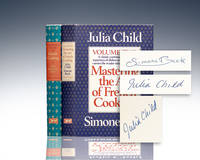
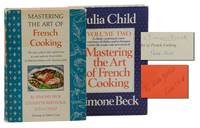
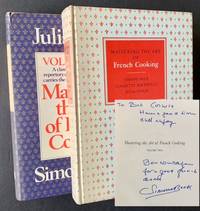
140944292New York: Alfred A. Knopf 1970. First Edition. Near Fine/Near Fine. Two volumes both are first editions stated first printings. Volume I is Signed by Julia Child and Simone Beck on the half-title page; Volume II is signed by Julia Child and her husband and inscribed to a former owner on the half-title page. <p>Bound in publisher's original white cloth with red and blue Fleur-de-Les pattern. Near Fine. Volume I with bumped corners hinge at half-title page exposed with owner details written on half-title page as well. Dust jacket is price-clipped and with light edge wear and light toning worn at the corners and spine ends with short tears. Volume II has a water-droplet to the blue topstain and light softening to spine ends in a price-clipped dust jacket with a tiny hold to the front panel short tear to the top edge and a small stain to the rear. A lovely set both first printings and both signed directly. Alfred A. Knopf unknown
1961146310New York: Alfred A. Knopf 1961-70. First editions of both volumes of this classic cook book. Quarto 2 volumes original illustrated boards. Volume one is boldly signed by Julia Child and Simone Beck on the title page. Volume two is signed by Julia Child on the title page. Drawings by Sidonie Coryn. Drawings by Paul Child. Typography binding and jacket design by Warren Chappell. Housed in a custom half morocco clamshell box made by the Harcourt Bindery. An exceptional set rare signed in both volumes and in this condition. Julia Childs Mastering the Art of French Cooking is arguably the most influential work on French food ever published in the United States. A "self-confessed ham she became a darling of audiences almost from the moment she made her debut in 1963 at the age of 50" New York Times. Alfred A. Knopf hardcover
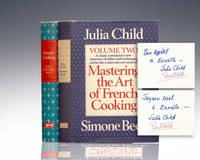
1961147888New York: Alfred A. Knopf 1961-70. First editions of both volumes of this classic cook book. Quarto 2 volumes original illustrated boards. Volume one is boldly signed and inscribed by the author on the half-title page "Bon Appetit to Ernesta- Julia Child" and additionally signed by Paul Child. Volume two is signed and inscribed by Julia Child on the half-title page "Joyeaux Noel to Ernesta- Julia Child" and additionally signed by Paul Child. Drawings by Sidonie Coryn. Drawings by Paul Child. Typography binding and jacket design by Warren Chappell. Each are near fine in near fine dust jackets with first volume price-clipped dust jacket. An exceptional set rare signed in both volumes and in this condition. Julia Childs Mastering the Art of French Cooking is arguably the most influential work on French food ever published in the United States. A "self-confessed ham she became a darling of audiences almost from the moment she made her debut in 1963 at the age of 50" New York Times. Alfred A. Knopf hardcover
195478090Paris: Gallimard 1954. Fine. Gallimard Paris 1954 14 x 21 cm relié sous chemise et étui Gallimard Paris 1954 14 x 21 cm bound in morocco with custom chemise and slipcase First edition one of 25 numbered copies on Holland the tirage de tête deluxe copy. Binding in full purple morocco endpapers lined with mauve velvet all edges gilt covers and spine preserved chemise and slipcase lined in purple morocco wood-style paper boards interior of the chemise in grey felt perfect binding signed Jean-Paul Miguet. Spine of the chemise faded. Superb copy perfectly set in a triple binding by Jean-Paul Miguet. Gallimard hardcover
140944722New York: Alfred A. Knopf 1970. First Edition. Very Good/Very Good. Two volumes both are first editions stated first printings. Volume I is Signed by Julia Child and Simone Beck on the half-title page; Volume II is signed by Julia Child on the front free endpaper and inscribed to a former owner. <p>Bound in publisher's original white cloth with red and blue Fleur-de-Les pattern. Volume I is Very Good with staining to the textblock edge and light water warping to the top page corners with some loss to the topstain there as well; former owner inscription to the front free endpaper. In a Very Good unclipped dust jacket with some tanning and edge tears. Volume II is Near Fine with some loss to the blue topstain in a Near Fine unclipped dust jacket with light soiling light tanning to the spine. Alfred A. Knopf unknown
195321090New York: Alfred A. Knopf 1953. First edition in English of the author's masterpiece. Octavo original half cloth. Signed by Simone de Beauvoir on the title page. Fine in a very good dust jacket with light rubbing and wear to the extremities. Housed in a custom half morocco clamshell box. Signed first editions of this classic work are rare and none have appeared at auction in the last sixty years. In 1946 Simone de Beauvoir began to outline what she thought would be an autobiographical essay explaining why when she had tried to define herself the first sentence that came to mind was “I am a woman.†That October my maiden aunt Beauvoir’s contemporary came to visit me in the hospital nursery. I was a day old and she found a little tag on my bassinet that announced “It’s a Girl!†In the next bassinet was another newborn “a lot punier†she recalled whose little tag announced “I’m a Boy!†There we lay innocent of a distinction— between a female object and a male subject— that would shape our destinies. It would also shape Beauvoir’s great treatise on the subject. The Second Sex deals with the treatment of women throughout history and is regarded as a major work of feminist philosophy and the starting point of second-wave feminism. Literary scholar Camille Paglia praised The Second Sex calling it "brilliant" and "the supreme work of modern feminism." Named by Modern Library as one of top 100 books of non- fiction of the twentieth century. Also named by The Times Literary Supplement as one of the most hundred influential books since World War II. Alfred A. Knopf hardcover
196122038New York: Alfred A. Knopf 1961. Decorative Cloth. Near Fine/Very Good . Paul Child. The 1961 AND the 1970 stated 1st editions. WARMLY INSCRIBED BY AUTHOR SIMONE BECK along the half-title of Vol. II. Both volumes clean tight and Near Fine in bright price-intact $10.00 and $12.50 respectively very sharp examples of the 1st issue dustjackets with mild fading along the spine of Vol. II. Thick uniform quartos nicely illustrated throughout by Sidonie Coryn "based on photographs by Paul Child". A very impressive example of this landmark set in its original incarnation accompanied by the appreciably less common signature/inscription of co-author Simone Beck. Alfred A. Knopf unknown
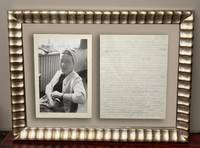
195833875Paris 1958. First Edition. First Edition. Signed Simone De Beauvoir and Gisèle Freund. 1. Rare Two page original handwritten Manuscript edited drafts. The writing seems to refer to her award winning book The Mandarins Les Mandarins in French since one notes DUBREUILH" mentioned throughout and reference to "SRL" of which "Dubreuilh" was the founder in this story.<br /> It is one of Beauvoir's most celebrated works earning her the prestigious Prix Goncourt. given to the author for the best and most imaginative prose work of the year.Considered to be a "Roman à clef" a novel with a key a work of fiction based on real life events and people. This novel is often regarded as a semi-autobiographical depiction of the post-World War II intellectual and political climate in France focusing on the lives of left-wing intellectuals.<br /> <br /> The novel follows two central characters: ANNE DUBREUILH a psychiatrist who is deeply introspective and whose internal struggles mirror those of Beauvoir and ROBERT DUBREUILH her partner who is involved in politics and reflects the intellectual life of Jean-Paul Sartre Beauvoir's real-life partner. <br /> The characters wrestle with moral dilemmas personal relationships and political commitment in a rapidly changing post-war society.<br /> The title "Mandarins" refers to a class of intellectual elites who grapple with their role in shaping political and social futures. The novel explores themes of existentialism political engagement love freedom and betrayal set against the backdrop of the Cold War and France's post-war reconstruction.<br /> <br /> 2. This iconic photograph shows Simone de Beauvoir sitting in her office. It was part of a series of photos taken by Freund at her desk. This silver gelatine print is signed by the artist on the bottom left front and studio-stamped on the back. Stamped in ink verso center: PLEASE CREDIT / Gisèle FREUND / 12 RUE LALANDE / PARIS-XIVe / SEG: 77-49 <br /> Some of the other subjects photographed by Freund were Virginia Woolf Colette André Gide James Joyce Adrienne Monnier Jean Cocteau Jean-Paul Sartre André Malraux & Vita Sackville-West. <br /> <br /> Frame size: 22" x 16"<br /> Photo size: 6 x 9.25"<br /> Manuscript page size: 8.25" x 10.5"<br /> Back to back images. unknown
207205New York: Knopf 1979. First Edition; Early Printing. Hardcover. Both volumes Near Fine in Very Good price clipped dust jackets. Volume 1 31st printing Volume 2 14th printing.; Both volumes signed by Julia Child on half title page.; Signed by Author. Knopf hardcover
195483810Paris: Gallimard 1954. Fine. Gallimard Paris 1954 14 x 21 cm broché First edition one of 25 numbered copies on Holland paper ours one of 5 hors commerce copies deluxe issue. Fine copy. Gallimard unknown
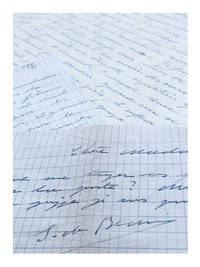
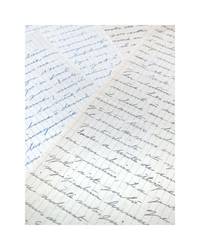
1956SDB2<p><strong>BEAUVOIR de Simone 1908-1986</strong></p><p>Autograph manuscript fragments with an autograph letter signed addressed to her typist for <em>La Longue Marche – Essai sur la Chine<br /></em>Paris 1956 15 p. in-4° on graph paper<br />Two autograph envelopes stamped with postmarks<br />Usual fold marks numerous corrections and words crossed out by Simone de Beauvoir</p><p><strong>A few of the last surviving pages from <em>La Longue Marche – Essai sur la Chine</em> the account of the official trip Simone de Beauvoir took to China with Jean-Paul Sartre at the end of 1955</strong></p><p><u>The present corpus unfolds in three distinct movements:</u></p><p>The first section is headed "2 to 5 September 1955" and paginated 25 to 30 including one leaf numbered "bis". It corresponds to the "Preliminaries" and opens with the travelers' observations in the waiting room at Orly Airport. Simone de Beauvoir draws a striking contrast between on the one hand those bound for Boston dressed impeccably—almost to the point of caricature—and on the other those modestly clothed preparing to depart for Moscow on an "official expedition." The philosopher takes notes on the Soviets Hungarians and Czechs at the Moscow airfield as well as on a South African also an official guest of the Chinese government with whom the couple converses. This travel account is enriched with glimpses of the landscape and reflections on the Western presence in Mongolia since the 17th century particularly that of scholars and monks.</p><p><em>" <strong>Comme Paris est loin ! Derrière moi le temps et l'espace se sont si bien embrouillés le système de nos besoins – faim soif sommeil – et de toute ma vie a été si radicalement lissé qu'il me semble non avoir fait un voyage mais terminé un rite de passage</strong> long fatigant et qui m'a jetée insensiblement ailleurs. J'écoute l'aimable discours qu'on nous adresse en chinois et qu'un interprète traduit. <strong>Les porteurs de hautes fleurs écarlates la moiteur de l'air la forte odeur végétale qui monte de la terre me suffoque</strong>. </em>… <strong><em>Jusqu'ici quand je pensais à la Chine je pensais à une histoire une civilisation un régime </em></strong>… <strong><em>mais la Chine n'est pas une entité politique ; je devine avec joie qu'elle a un ciel ses couleurs ses arbres une chair</em></strong><em> "</em></p><p>On 16 December 1956 she sent a second fragment paginated 476 and 486 bis. It corresponds to Chapter V "Culture."<br /><em>" <strong>Sous les Mandchous la décadence du monde féodal se réflète dans la littérature</strong> ; elle commença à s'évader des règles formelles ; des genres nouveaux se développèrent. Le roman devint autre chose qu'un divertissement</em> … <em>Le Rêve de la chambre rouge entre autres est caractéristique de cette période "</em></p><p>On December 18 1956 she sent a final fragment paginated 757 781 and 782. It corresponds to Chapter VIII "Cities of China."<br /><em>" Elle fut la capitale des Song dont le règne coïncida avec le plus beau moment de la civilisation chinoise et on la considère comme l'Athènes de la Chine.</em> … <em>Les maisons ne ressemblent pas à celles de Pékin. Au lieu de se cacher derrière des murs elles exhibent des façades de deux à trois étages garnies de fenêtres "</em></p><p>An official guest of the Chinese government alongside numerous other European intellectuals Simone de Beauvoir traveled to China with Jean-Paul Sartre from September 6 to October 6 1955. The following year in April 1957 the philosopher published her essay praising a country that had just completed its revolution. Speaking of her work she wrote:<br /><em>"This book is not a reportage: a reporter explores a stable present whose more or less contingent elements serve as keys to one another. In China today nothing is contingent; everything draws its meaning from the future they all share. The present is defined by the past it surpasses and the novelties it announces: it would be a distortion to regard it as static. </em><em>It is only one stage of this 'long march' that is peacefully leading China from democratic revolution to socialist revolution. It is therefore not enough to describe it: it must be explained. That is what I have tried to do."<br /></em>The manuscript itself has been lost; these fifteen leaves are the last surviving fragments of the work. The envelopes confirm unsurprisingly that she was working on it in 1956. Sylvie Le Bon de Beauvoir notes that the material belongs to an earlier version of the final text. Simone de Beauvoir removed almost all of the pages numbered 25 to 30 substantially reworking her "Preliminaries."</p><p><u>Provenance:</u><br />Estate of Berthe Mandinaud</p>
196084237Paris: Gallimard 1960. Fine. Gallimard Paris 1960 14.50 x 21 cm broché First edition one of 30 numbered copies on Holland paper deluxe copy. A handsome copy. Gallimard unknown
196384236Paris: Gallimard 1963. Fine. Gallimard Paris 1963 14.50 x 21 cm broché First edition one of 35 numbered copies on Holland paper deluxe copy. Two tiny tears of no consequence at head and foot of spine. A handsome copy. Gallimard unknown
196378202Paris: Gallimard 1963. Fine. Gallimard Paris 1963 14.50 x 21 cm broché First edition one of 35 numbered copies on Holland the tirage de tête. A beautiful copy despite tiny foxing on the spine and another at the foot of the first board. Gallimard unknown
1951Beauv1<p><strong>BEAUVOIR Simone de 1908-1986</strong></p><p>Autograph manuscript for her essay <em>Must we burn Sade </em> N.p.n.d 1951 7 pages in-4 on grid paper Some corrections one crossed off paragraph from her hand clipper mark on first sheet</p><p><strong>Remarkable autograph manuscript for her famous essay <em>Must we burn Sade </em></strong></p><p>This manuscript contains slight variations with the published one.</p><p>" <strong><em>En quoi mérite-t-il de nous intéresser Ses admirateurs mêmes reconnaissent volontiers que son œuvre est dans sa plus grande partie illisible ; philosophiquement elle n'échappe à la banalité que pour sombrer dans l'incohérence</em></strong><em>. Quant à ses rêves ils n'étonnent pas par leur originalité ; dans ce domaine <strong>Sade n'a rien inventé</strong> et on rencontre à foison dans des traités de psychiatrie des cas pour le moins aussi étranges que le sien. En vérité ce n'est ni comme auteur ni comme perverti sexuel que Sade s'impose à notre attention : c'est par la relation qu'il a créée entre ces deux aspects de lui-même. Les anomalies de Sade prennent leur valeur du moment où au lieu de les subir comme une nature donnée il élabore un immense système afin de les revendiquer</em> …. <em>Sade a tenté de convertir son destin psycho-physiologique en un choix éthique ; de cet acte par lequel il assumait sa séparation il a prétendu faire un exemple et un appel : c'est par là que son aventure revêt une large signification humaine</em> "</p><p><em>" <strong>Il y avait à cette époque bien des libertins qui se livraient à de pires orgies impunément ; mais je suppose que dans le cas de Sade le scandale était fatal</strong> ; il est certains "pervertis sexuels" auxquels s'appliquent exactement le mythe de M. Hyde et du Docteur Jekyll ; ils espère pouvoir d'abord satisfaire leurs "vices" sans compromettre leur personnage officiel ; mais ils sont assez imaginatifs pour se pense peu à peu par un vertige où se mêlent honte et orgueil ils se découvrent : ainsi Charlus malgré ses ruses et par ses ruses mêmes "</em> …</p><p><em>" Chez le héros sadique l'agressivité mâle n'est pas atténuée par l'ordinaire métamorphose du corps en chair ; pas un instant il ne se perd dans son animalité : il demeure si lucide si cérébral qu'au lieu de le gêner dans ses élans les discours philosophiques sont pour lui un aphrodisiaque.</em> …<strong> <em>Grâce à cette démesure l'acte sexuel créé cette illusion de jouissance souveraine qui en fait aux yeux de Sade le prix incomparable</em></strong> … "</p><p><em>" À partir du scandale de 1763 <strong>l'érotisme de Sade n'est plus seulement une attitude individuelle ; c'est aussi un défi de la société</strong>. Dans une lettre à sa femme Sade explique comment de ses goûts il a fait des principes : "Ces principes et ces goûts sont portés par moi jusqu'au fanatisme" écrit-il "et le fanatisme est l'ouvrage des persécutions de mes tyrans". L'intention suprême qui anime toute activité sexuelle c'est qu'elle se veut criminelle : cruauté ou souillure il s'agit de réaliser le mal "</em></p><p>… <em>" Et puis sur le papier <strong>l'auteur prolongeant indéfiniment l'agonie de la victime peut éterniser l'instant privilégié où un esprit lucide habite un corps qui se dégrade en matière</strong> ; il insuffle encore un passé vivant dans la dépouille inconsciente : mais en vérité que ferait un tyran de cet "<u>objet inerte</u>" : un cadavre " <br /></em></p><p>These pages were replaced to be typed for insertion in this essay on Sade which will be published in December 1951 in the n° 74 of Les Temps modernes taken up with two others in Privilèges Gallimard 1955 and since then collected with the same under the title Must we burn Sade The text of the manuscript contains slight variations with the published one.</p><p>In <em>Must we burn Sade </em>Simone de Beauvoir tries to show how the divine marquis after having provoked the scandal sought to reconcile his individual pleasures and his social existence; how through his works he wanted to assume his sexual practice by transforming it into ethics. It raises the question of the criminalization of sexuality how society codifies it and the norm.</p><p>We attach the carbon copies by Berthe Mandinaud of these pages.</p>
1956140941173Cleveland and New York: The World Publishing Company 1956. Signed Limited Edition. Near Fine. First edition limited issue. One of a limited 500 unnumbered copies signed by Simone de Beauvoir. Bound in publisher's Red cloth-covered boards over dark blue spine cloth stamped in gilt. Near Fine with slight fading to spine in toned acetate wrapper in publisher's slipcase which is unevenly sunned and lightly rubbed. A beautiful copy. The World Publishing Company unknown