CASTIGLIONE Baldassarre -Biblio.com
502 résultats
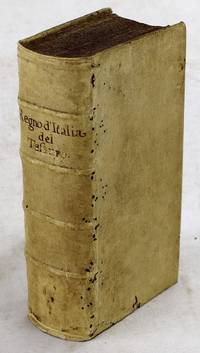
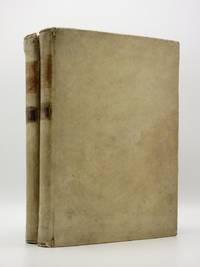
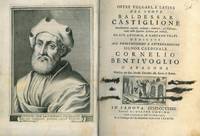
2-74108Padova per Giuseppe Comino 1733 4to cm. 24 x 19 legatura coeva in piena pergamena con titolo manoscritto al dorso sbiadito tagli spruzzati pp. 32-XXXII-436 con bella antiporta calcografica Ritratto del Castiglione di Giovanni Battista Cromer e Francesco Maria Francia grande marca tipografica incisa in rame riquadrata al frontespizio marca xilografica blasone nobiliare a p. 428 con data 1732 testatine capolettere finalini xilografici. Due piccole riparazioni ben eseguite al dorso in corrispondenza della cerniera posteriore; qualche antica cancellatura ad inchiostro al frontespizio che ha forato il margine bianco senza perdite di testo. Un bell'esemplare solido marginoso ancora fresco e croccante all'interno di questa ottima edizione delle opere del Castiglione. Brunet I p. 270: “Bonne édition peu communeâ€; Gamba 296: “Bella ed accurata ristampaâ€. unknown
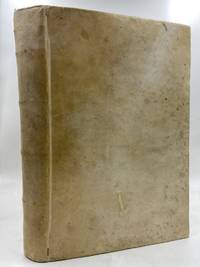
1680000806Venetia Venice: Giacomo Hertz 1680. Hardcover. Very Good. 12mo. 24 732 pp 72 unpaginated index. 58 engraved plates 3 folding maps. Libreria Vinciana Autori Italiani del 1600 499. History of Italian monarchs during darkest of the Dark Ages or the period following the fall of the Roman Empire til around 1000 A.D. a period obscure to even most ardent history buffs and scholars. Consulted by Manzoni in his research of Longobardi or the Lombards. Each of the plates of ancient kings decorated with emblems and baroque ornamentation. Contemporary vellum attractive. Binding tight. Light soilage at most to leaves -- mostly just age toning. Discreet very old writing below half title plate and backside of same leaf. A small wormhole in upper left affecting pages in the 200s but only a few pages where actual letters are lost and even these pages reading loss is insignificant. Overall a very good copy. Giacomo Hertz hardcover
16802010140055Venetia : Gio. Giacomo Hertz 1680. Hardcover. Very Good. History of Italy under Barbarian rule Early Venetian imprint in a contemporary binding vellum binding. Some worming to vellum but doesn't effect text. Pages are general sound and clean. 24 732 72 p. Engraved frontispiece; engraved vignette on title; 64 of 66 plates; 3 folding maps. Brunet V 730 Graesse VI 2 72 for the 1667 edition. Venetia : Gio. Giacomo Hertz hardcover
STLX0021Padua Giuseppe Comino 1733 in fine 1732. 4°. Tit. 14 Bll. Widm. XXXII 436 S. Mit 1 gest. Front.Portr. d. Verf. I.B. Cromer del. u. M. Francia sc. 1 Tit.vign. 1 Kopfleiste u. 1 Init. in Kupferst. sowie 2 Druckermarken u. einigen Zierrat in Holzschnitt. Pergamentbd. d. Zt. m. goldgepr. Rü.tit. auf mont. Rüschi. Einbd. etw. angeschmutzt fl. u. stellenw. m. unscheinbaren Kratzspuren ersten Bll. finger- u. braunfl. BBKL XXIX 267-282; Brunet I 1628. Schöne dem italienischen Kardinal Guido Bentivoglio d'Aragona 1668-1732 gewidmete Ausgabe der Werke des bedeutenden Schriftstellers Diplomaten und Höflings Baldassare Castiglione 1478-1529. Neu herausgegeben durch die Brüder Volpi in der 'Edizione Cominiana'. In der 'Edizione Cominiana' veranstaltete Ausgaben erschienen in dem von dem Drucker und Buchhändler Giuseppe Comino zusammen mit Gianantonio und Gaetano Volpi 1717 in Padua gegründeten Verlag der sich der Herstellung im Text möglichst verlässlicher und kommentierter Ausgaben klassischer Autoren verschrieb. Die 'Edizione Cominiane' erschienen bis 1782 sie sind mit Viten versehen enthalten Zeugnisse zu den Autoren und zuweilen Bibliographien. - Mit einer für die Editionsgeschichte von Castigliones Werken nützlichen Übersicht Catalogo di molte delle principali edizioni del Cortegiano S.417-422. ""Bonne édition peu commune"" Brunet. Padua, Giuseppe Comino 1733 (in fine 1732). unknown
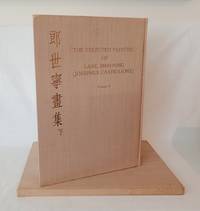
1971F7176Hong Kong: The Arts and Literature Press. 1971. First Edition. Hardcover. Very Good. Cloth lightly foxed occasional mild blemish small nick to spine hinge on volume two. One gathering slightly protruding in vol. 2. Internally excellent.; Complete with 77 plates; 4to 11" - 13" tall; "One of the key figures in establishing the new aesthetic at the Qing court was the Italian Jesuit Giuseppe Castiglione 1688-1766 whose illusionist approach to painting revolutionized Qing court art. Castiglione served at the Qing court for fifty years working under the Chinese name Lang Shining. A master of vividly naturalistic draftsmanship and large-scale compositions in Italy and Portugal he had worked as a muralist Castiglione successfully combined Western realism with traditional Chinese conventions of brushwork in a manner that suited the imperial taste. Descriptively complex technically finished and monumental in scale Castiglione's vividly realistic painting style perfectly served the emperor's documentary purposes as well as his predilection for self-promotion on a grandiose scale". Asia for Educators Columbia University . The Arts and Literature Press hardcover
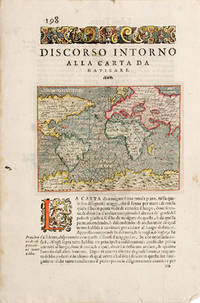
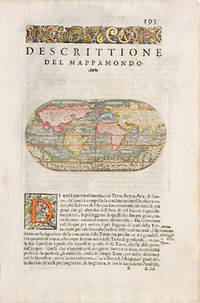
2939World Celestial & Curiosities: Venice Gorgio Angeliera a instantia de gli Herede di Simone Galignani de Karera 1590. Copper engraved maritime map of the World by Girolamo Porro from Porcacchi's " L'Isole piu Famose del Mondo" Set in a page of descriptive Italian text page 198 with decorative woodcut headpiece and historiated initial. Single page. folio text to verso. The decorative miniature sea chart is criss-crossed with rhumb lines; South America somewhat distorted; Alaska named as India Superior joined to Asia perhaps; large land mass Terra Incognita to the South. Dark Impression; light soiling to edges. Tomasso Porcacchi da Castiglione first published his Isolario in 1572 in Venice The maps were engraved by Girolamo Porro. whilst Porcacchi provided the descriptions. The "Isolario" follows the tradition started by Sonetti and Bordone of "Island "books Shirley World 128. Sabin 64151;Adams P-1906; Alden and Landis 590/54; BMC Italian p.534; World Celestial & Curiosities World Carta Maretime Carta da Navigare Venice Gorgio Angeliera a instantia de gli Herede di Simone Galignani de Karera 1590 unknown
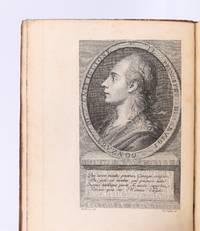
177791097n. l.: s. n. 1777. Fine. s. n. n. l. Lu à la Royal Society de Londres 1777 18.1 x 22.9 cm Relié An intriguing first edition complete with its engraved frontispiece of the author by Giovanni Volpato after Domenico Corvi and its introductory poem by the Abbé Luigi Godard. A copy unrecorded in non-European libraries according to WorldCat. Contemporary binding of fawn mottled calf smooth spine divided into five gilt compartments by gilt rolls brown morocco lettering-piece triple gilt fillet framing the boards double gilt fillet on the board edges blue speckled edges and shell-pattern marbled pastedowns and endpapers. The lower cap lacking some surface wear to the spine and corners the upper joint slightly split for several centimetres a few discreet wormholes and small areas of loss to the leather on the boards light rubbing to the edges; the interior in very good condition. A marginal tear to p. 51 very slightly affecting the text and a marginal stain to p. 47. The spirit of the Enlightenment is vividly reflected in this essay on the achievements of the human mind by an enlightened princethe last descendant of the cadet branch of the Gonzaga dynastywho sold his lands in exchange for an annual life annuity; an eloquent writer and admirer of English and French philosophers notably Montesquieu whom he cites repeatedly in this volume; and very much a libertine of his age the lover of the poet Maria Maddalena Morelli. s. n. hardcover
159053262Venice: L'Isole Piu Famoso del Mondo. Simon Galignani. 1590. Attractive world map a mariner's map with rhumb lines emanating from 16 points. The maps for this atlas were engraved by Girolamo Porro from Padua and are set within a page of text with engraved headpiece and decorated initial. There were many editions of this popular atlas between 1576 and 1713. Size:197 x 297 mm. Copper engraving. Hand coloured. Closed tear on lower margin of leaf not affecting map. Very good condition. Moreland and Bannister p.68 unknown
17691231I006Padova Padua: Presso Giuseppe Comino 1769-1771. 1st Edition . Hardback. Printed pages: 4to. xiv 222 2; xii 384. Very Good. 7 x 9.5 inches 18 x 24 cm. Complete two volume set. Contemporary full vellum bindings. Volume I has wear to head of spine and top edge of front board. Red mottled page edges. Foxing to endpapers browning to some pages. A few pencilled notes to margins text is otherwise clean throughout. Scribbled out contemporary ownership inscription to the blank facing title page in both volumes. Vignette to both title pages. Several woodcut initials headpieces and tailpieces within the text. Italian language. Provenance: From the library of John Lambton 1st Earl of Durham with Durham's bookplate to front pastedown endpaper in both volumes. Volume I also has a label for the library at Lambton Castle the ancestral seat of the Earls of Durham. Pencilled notes of front pastedown endpaper in Volume I states that this set was sold at the Lambton Castle book auction 19-22 April 1932 lot 634. Also states that the notes within the books are by E.R.Vincent 1894-1978 Chair of Italian at Cambridge University. Overall condition is Very Good. Size: 7 x 9.5 inches 18 x 24 cm. Presso Giuseppe Comino hardcover
1771C0584<br />4 books in 2 volumes: 8xvi255 pages with frontispiece; 205 pages with index and errata. Octavo 8" x 5 3/4 bound in stiff wrappers with labels to spines and deckle edges. This edition not in <i>Bibliotheca Van der Linde-Niemeijeriana</i>; however there are a number of listings for this title in the bibliography 4315 through 4330 listing 16 editions of various dates and publishers. First published in 1528.<br /><br />Baldassare Castiglione count of Novilara was an Italian courtier diplomat soldier and a prominent Renaissance author. He was born into an illustrious Lombard family at Casatico near Mantua. In 1494 at the age of sixteen Castiglione began his humanist studies in Milan which would eventually form his future writings. However in 1499 after the death of his father Castiglione left his studies and Milan to succeed his father as the head of their noble family. Soon his duties seem to have included representative offices for the Gonzaga court. For the Gonzaga he traveled quite often; during one of his missions to Rome he met Guidobaldo da Montefeltro duke of Urbino. Urbino was at that time the most refined and elegant among Italian courts a meeting point of culture ably directed and managed by duchess Elisabetta Gonzaga and her sister-in-law Maria Emilia Pia. The most constant guests included: Pietro Bembo Giuliano de' Medici Cardinal Bibbiena Ottaviano and Federigo Fregoso and Cesare Gonzaga a cousin of both Castiglione and the duke. The hosts and guests organized intellectual competitions which resulted in an interesting stimulating cultural life producing brilliant literary activity. Castiglione wrote about his works and of those of other guests in letters to other princes maintaining an activity very near to diplomacy though in a literary form. In 1516 Castiglione was back in Mantua where he married Ippolita Torelli descendant of another ancient noble family; two passionate letters he wrote to her expressing deep sentiment have survived but she unfortunately died only four years later. At that time Castiglione was in Rome again as an ambassador this time for the Duke of Mantua. In 1521 Pope Leo X conceded to him the tonsura first sacerdotal ceremony and thereupon began Castiglione's second ecclesiastical career.<br /><br />In 1528 the year before his death the book by which he is most famous <i>The Book of the Courtier Il Libro del Cortegiano</i> was published in Venice by the Aldine Press run by Andrea d'Asolo father-in-law of Aldus Manutius. The book is based on a nostalgic recreation of Castiglione's experience at the court of Duke Guidobaldo da Montefeltro of Urbino at the turn of the sixteenth century. It describes the ideal court and courtier going into great detail about the philosophical and cultured and lively conversations that occurred at Urbino presided over by Elisabetta Gonzaga. Castiglione himself does not contribute to the discussion the book is his tribute to his friendship with the participants of the discussion all of whom went on to have important positions. <i>The Book of the Courtier</i> caught the "spirit of the times" and was soon translated into Spanish German French and English. One hundred and eight editions were published between 1528 and 1616 alone. Pietro Aretino's La cortigiana is a parody of this famous work. Castiglione's depiction of how the ideal gentleman should be educated and behave remained for better or for worse the touchstone for all the upper classes of Europe for next five centuries. <b>The work on chess is in the second volume of this work</b>.<br /><br /><b>Condition:</b><br /><br />Old stamps to title of volume two and first un-numbered page of volume one Spine ends chipped with loss to heal corners bumped wrappers rubbed else a good copy of scarce title. Vendramini Mosca hardcover
2009Adhya-9780387751146SPRINGER 2009. Hardcover. New. SPRINGER hardcover
2009Adhya-9780387751146SPRINGER 2009. Hardcover. New. SPRINGER hardcover
a78943Bergamo 1759 1st Appresso Pietro Lancellotti. In Italian. Hardcover. Sm.4to. xii 220pp. vignette on title page impressive and fine full page copperplate portrait of St. Charles Borromeo as frontis errata page lovely hand stamped red and green floral paper covered boards with 3/4 vellum. Owner signed on top corner of title page and two lines of old ink notation on rear end paper no other ownership marks. VG ink spine label mostly faded away faint rippling throughout text. . hardcover
1901539159New York: Charles Scribner's Sons 1901. Softcover. Near Fine. First edition thus. Translated from the Italian and annotated by Leonard Eckstein Opdycke. With seventy one portraits and fifteen autographs reproduced by Edward Bierstadt. Large quarto. Japon vellum gilt. Boards a trifle soiled from handling very near fine. Copy number 454 of 500 numbered copies. Charles Scribner's Sons unknown
159053261Venice: L'Isole Piu Famoso del Mondo. Simon Galignani. 1590. Oval map of the world. The maps for this atlas were engraved by Girolamo Porro from Padua and are set within a page of text with engraved headpiece and decorated initial. There were many editions of this popular atlas between 1576 and 1713. Size:197 x 297 mm. Copper engraving. Hand coloured. A fine crisp impression. Fine condition. Moreland and Bannister p.68 unknown
166814426Milano: Giovanni Battista Ferrari 1668. Esemplare privo dell’antiporta allegorica ma ben completo di tutte le carte inclusa quella bianca all’inizio della seconda opera e l’ultima col registro. Piccolo lavoro di tarlo va a ledere qualche parola sulle ultime carte del De Spiritibus dedica moderna sulla prima carta bianca. Legatura d’epoca in pergamena rigida in quarto cm 30 x 20.5 pp 24 438 2 8 102 ma 94 per errore tipografico la numerazione delle pagine salta da 80 a 89 2. Esemplare privo dell’antiporta allegorica ma ben completo di tutte le carte inclusa quella bianca all’inizio della seconda opera e l’ultima col registro. Piccolo lavoro di tarlo va a ledere qualche parola sulle ultime carte del De Spiritibus dedica moderna sulla prima carta bianca. Prima edizione della celebre farmacopea milanese stampata per generazioni dalla famiglia Branda Castiglioni che ne mantenne il privilegio fino agli anni ’30 del secolo XVIII; Giovanni Onorato Castiglione iscritto al Collegio dei Medici di Padova nel 1633 fu Regio Protomedico di Milano. Dedica titolo e alcune parti del testo sono in latino ma il ricettario vero è proprio è in italiano. L’antidotario illustra diverse preparazioni farmaceutiche vini medicali pillole cerotti ecc; la seconda opera con proprio frontespizio il saggio sugli spiriti e i semplici tratta fra la l’altro di preparazioni cosmetiche profumi e saponi delle spezie dell’imbalsamazione e varie altre curiosità. Krivatsky n. 2597; Vinciana 1872: «Edizione originale di quest’unica opera dell’Autore il quale ebbe per essa molto onore». Giovanni Battista Ferrari unknown
1766BB1797Padova Padua: Appresso Giusseppe Comino 1766. Early Reprint. Full Calf. Fine. An important reprint of Aldine's first edition of 1528 discarding the extensive alterations to the text that corrupted editions of this classic treatise on etiquette for more than a century. 4to 23 x 16 cm xxiv 352pp with portrait frontispiece of Castiglione after Raphael illuminated initials and head and tail pieces throughput. Modern vellum and marbled boards spine titled in gilt. Included is the "best and fullest biography of Castiglione which was written by Abate Pietro Serassi who had access to the family papers brought to Rome by Cardinal Valenti Gonzaga secretary to Pope Benedict XIV." Cartwright A very scarce wide-margined survival tightly bound contents clean with only light occasional foxing. PMM 59. Razzollini p. 99. Gamba 296 for Comino's complete edition of Castiglione's works from 1733 upon which this edition is based. Cartwright v. 2 pp. 445-447. First printed in Venice by Aldine Press in 1528 then reprinted innumerable times since in every major European language. The Courtier is the most celebrated instruction manual on the courtly manners of the Italian High Renaissance "a veritable compendium of Renaissance culture." Literary Encyclopedia In 1590 Pope Sixtus V placed it on the Church's List of Prohibited Books but exempted the expurgated edition prepared by Antonio Ciccarelli which was the only edition that remained in circulation for more than 100 years. Finally in 1733 Volpi issued an edition of Castiglione's collected works that disregarded Ciccarelli's corruptions and reverted to the original Aldine edition. Our edition is a reprint here of Volpi's text of The Courtier and it exists in two states unmutilated and mutilated. According to Razzollini more than a thousand copies originally were printed but only one hundred were issued and only after the text primarily Book IV was extensively revised to incorporate Ciccarelli's changes and elisions reducing the original text to 303 pages vs. 352 pages in unmutilated copies. Our is one of the rare unmutilated copies beautifully preserved. N. B. With few exceptions always identified we only stock books in exceptional condition. All orders are packaged with care and posted promptly. Satisfaction guaranteed. Fine Editions Ltd is a member of the Independent Online Booksellers Association and we subscribe to its codes of ethics. Appresso Giusseppe Comino unknown
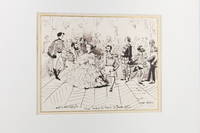
185677880Paris 1856. Fine. Paris 1856 30 x 24 cm une feuille sous marie-louise Original ink drawing signed and dated by Charles Robert titled ""Madame la Comtesse de Castiglione et Napoléon III ou Le bal aux Tuileries le mardi 29 janvier 1856"". This drawing immortalizes the historic meeting of the 19-year-old Countess de Castiglione with Emperor Napoleon III at a ball given by his cousin Princess Mathilde. Invested by Cavour with a delicate diplomatic mission the Countess came to Paris with the aim of seducing the Emperor and making him sympathetic to the Piedmontese cause and thus convert him to the idea of a unified Italy. She had a famed affair with the Emperor which strengthened ties between France and Italy before coming to an end as Italian carbonari made an attempt on the Emperor's life the following year. Aesthetic representation of the early days of this Italian Mata Hari as ambassador and spy to the French imperial court. unknown
155475<p>4to 214x152 mm. 8 135 1 leaves. Collation: 4 †4 a-z4 A-L4. With the large woodcut portrait of the author on the title page and the printer's device on last leaf verso. Contemporary limp vellum inked title on the spine and lower edge remnants of ties new endpapers small stains. On title page manuscript ownership's inscription Ballybay Library. Inner margin of the title page reinforced small holes to the gutter of the first two leaves with no loss of text small ink stain on the upper blank margin at the end of the volume otherwise a very good genuine copy.</p><p>FIRST COMPLETE EDITION. First published in Bologna in 1546 containing only seventy-two chapters the <em>Ricordi</em> appeared in an enlarged edition in 1549 124 chapters also in Bologna. The present definitive edition containing 133 'ricordi' was edited by Zaccaria Bellenghi Fra Sabba's chaplain in Faenza shortly after the latter's death. The work became very popular and between 1546 and 1613 twenty-five editions were published.</p><p>In the present edition is also found for the first time the title woodcut showing Fra Sabba in his study. Ugo Rozzo <em>Lo studiolo nella silografia italiana 1479-1558</em> Udine 1998 pp. 90 114 deems this frontispiece to be remarkable for the mid-sixteenth century both for its Hospitaller imagery and its display of books within the study. The woodcut is emblematic of Sabba's monastic life conducted within the Order's parameters of social utility. He presents an iconographic image of the devout humanist knight who prefers the tranquility of his Commenda to the bustle of the city see also D. Thornton <em>The Scholar in his Study: Ownership and Experience in Renaissance Italy</em> New Haven CT 1997 pp. 106-114.</p><p>The work consists of two series of "avvertimenti" advices each closely related to Castiglione's initial idea of providing to his grandnephew Bartolomeo Righi useful hints on how to become a perfect knight Hospitaller but its numerous printings in the sixteenth century and its breadth of scope suggest a wider target audience. The other 'ricordi' were developed into true small treatises or essays that Castiglione expanded and augmented in every new edition. Despite not having a wide-ranging extent nevertheless they present a considerable interest especially when compared to the works of contemporaries on the same topics i.e. the life of a courtier the government of a city the prince and the tyrant men of arms and religion marriage how to decorate a house clothes food and drink physical exercise travel etc. But included were also his life in Faenza his political aspirations linguistic experiments ideas on religious reform. Geopolitical issues of the day are vigorously engaged and farcical passages replete with colloquial phrasing appear alongside passionate theological discourse expressing a strident anti-Lutheran viewpoint cf. C. Scarpati <em>Per il testo dei 'Ricordi'</em> in: "Studi sul Cinquecento italiano" Milano 1982 pp. 68-82; see also D.F. Allen <em>The Hospitaller Castiglione's Catholic Synthesis of Warfare Learning and Lay Piety on the Eve of the Council of Trent</em> in: "The Hospitallers the Mediterranean and Europe: Festschrift for Anthony Luttrell" K. Borchardt & al. eds. London 2016 pp. 286-298.</p><p>The <em>Ricordi</em> is also very interesting from the point of view of art history and criticism showing Fra Sabba's antiquarian efforts for Isabella d'Este his admiration for Dürer's prints and the artists he had known at Rome e.g. Gian Cristoforo Romano Bramante Raphael Cristoforo Foppa 'Il Caradosso' the San Gallo family just to mention a few cf. M. Collareta <em>Il mondi dell'arte dei 'Ricordi' di Fra Sabba</em> in: "Sabba da Castiglione 1480-1554. Dalle corti rinascimentali alls Commenda di Faenza. Atti del Covegno Faenza 19-20 maggio 2000" A.R. Gentilini ed. Florence 2004 pp. 297-312.</p><p>At the end of the volume is reprinted another work by Fra Sabba the <em>Consolatoria</em> written during his stay at Rhodes November 25 1517. This consolatory epistle addressed to the Milanese poet Camilla Scarampi for the death of her husband Ambrogio Guidoboni. This letter was published at Bologna in 1529. From the dedication dated March 15 1527 to Giacomo Guicciardini vice-president of Romagna we learn that Fra Sabba had submitted the work in the last ten years to Niccolò Machiavelli and Panfilo Sassi asking them if they considered it worthy of being published M.C. Tarsi <em>Una poetessa nella Milano di primo Cinquecento Samilla Scarampi</em> in: "Giornale storico della letteratura italiana" 192/639 2015 pp. 414-451.</p><p>Sabba da Castiglione was an instance of the self-fashioned courtier-knight of the later Renaissance who combines an unusual set of roles: Hospitaller commander canon regular art collector courtier poet and preceptor of knightly rules. He was born in Milan around 1480 where he also became his first. education. He pursued post-secondary studies at the University of Padua studying jurisprudence from about 1500 to late spring 1505 but did not finish his legal education. After a brief stay in Mantua in 1505 at the age of 25 he decided to join the Order of the Knights of Jerusalem later called Knights of Malta of which he soon became Deputy Attorney General. He lived in Rhodes until 1508 then moved to Rome where he sojourned seven years as legal aide-de-camp to the admiral of the Order of the Knights Hospitaller and later Grand Master Fabrizio del Carretto cultivating his interest in the arts and literature. In Rome he also met his cousin Baldassare Castiglione author of Il <em>Cortegiano</em>. Fra Sabba was a passionate forerunner of archaeology and during his stay on the Aegean Sea he was able to procure several ancient marble pieces to Isabella d'Este in Mantua. In 1515 at the age of thirty-five Fra Sabba became a Hospitaller commander accepting a post previously held by his friend Giulio de' Medici the future Pope Clement VII. He took up residence at the Order's Commenda or commandery a district headquarters similar to a feudal estate in Faenza Romagna part of the Papal States. He accepted this post to better dedicate himself to the studies he loved so much away from mundane affairs the intrigues of courts and military life. His residence in Faenza was the Church of Commenda Saint Mary Magdalene also called 'Magione' dating back to the XII century. It was not in good conditions when Fra Sabba came. This was due to the fact that previous commanders had not chosen the complex of the Commenda as their own living place employing their revenues for other purposes. In 1533 Fra Sabba entrusted Girolamo da Treviso with the task to embellish the church with a fresco portraying the 'Enthroned Madonna between Saint Mary Magdalene and Saint Catherine of Alexandria'. Another work of art of great importance accomplished in the year of his death is the one painted by Francesco Menzocchi from Forlì: a monochrome fresco depicting him as an old man presented by Saint Joseph to the Virgin. Underneath this image lies Fra Sabba's sepulchre with a Latin epigraph composed by himself. His interests as a man of study and collector gave birth to a library unfortunately lost and to a collection of pieces of art whose surviving items are to be seen in the Pinacoteca Comunale of Faenza F. Petrucci <em>Sabba da Castiglione</em> in: "Dizionario biografico degli italiani" 22 1978 pp. 100-106.</p><p>Edit 16 CNCE 10159; Universal STC 819593; Index Aureliensis 133.665; R.M. Bell <em>How To Do It. Guides to Good Living for Renaissance Italians</em> Chicago IL 1999 p. 337; C. Scarpati <em>op. cit.</em> p. 89.</p> Paolo Gherardo
1990102595Sagep Editrice S. P. A. New. 1990. Hardcover. FREE UPGRADE to Courier/Priority Shipping Upon Request - IN STOCK AND IMMEDIATELY AVAILABLE FOR SHIPMENT - Flawless copy brand new pristine never opened -- Text in Italian. 270 pp. With 235 ills. 64 col. . 28 x 21 cm. -- with a bonus offer-- . Sagep Editrice S. P. A. hardcover
1983102620Yale Univ Pr. New. 1983. Hardcover. 0300026498 . FREE UPGRADE to Courier/Priority Shipping Upon Request - IN STOCK AND IMMEDIATELY AVAILABLE FOR SHIPMENT - Flawless copy brand new pristine never opened -- 215 pages; illustrated in black and white. -- with a bonus offer-- . Yale Univ Pr hardcover
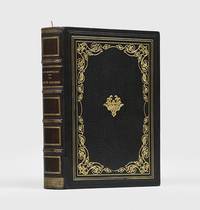
1913172668Paris: Goupil & Cie 1913. The most famous woman in Paris First edition of the Parisian aesthete's sumptuously illustrated biography. Castiglione 1837-1899 was a self-fashioned icon of high society whose extensive portfolio as a photographic model made her a major figure in the medium's early history. "La Castiglione was one of the first celebrated women to realize the iconic potential of the camera in this first period of photography. She was aware of the necessity for control a concern to use the camera rather than let the camera use her. Her chosen studio Mayer and Pierson made over seven hundred images of her an enterprise that in photography's earliest years represented a considerable investment in time and effort" Badger p. 51. She performed a wide variety of identities in her highly staged portraits including mythical historical seductive and grotesque. The fame resulting from her enigmatic images earned her significant political influence: her affair with Napoleon III likely contributed to Italian unification and Otto von Bismarck met with her to discuss the strategic importance of Paris following the Franco-Prussian war. Although he never met Castiglione Montesquiou 1855-1921 was enraptured by her reputation and collected hundreds of her photographs the majority of which are now held at the Metropolitan Museum of Art. A fellow photography enthusiast - he aspired to be the most photographed person in the world - he was also a Symbolist poet painter and dandy. Quarto 273 x 195 mm. Colour photogravure frontispiece 25 plates 5 colour captioned tissue guards floriated initials borders and head- and tailpieces by Louis Popineau chapter titles printed in red. Bound with original wrappers. Contemporary dark green morocco by Durvand of Paris spine lettered and ruled in gilt 4 raised bands covers framed in blind and gilt gilt crown centrepiece surrounded by scrollwork border gilt fillets on board edges and turn-ins purple moiré endpapers top edge gilt the rest uncut orange red and green silk bookmarker loosely inserted. Spine gently toned ends a little rubbed plates bright and clean: a fine copy. Gerry Badger The Pleasures of Good Photographs: Essays 2010. hardcover
154532371Venetia Venice: nelle case de figlioli di Aldo I Manuzio 1545. Fourth Aldine printing. Small folio. 122 ff. Eighteenth century full pigskin gilt lettering to the spine all edges green a single leaf in book three lacking but the text supplied in consummate manuscript predating or contemporary with the binding. Faint dampstain cutting across the upper corner of the last 16 leaves at the gutter also evident on both pastedowns a few marks to the boards an attractive copy. Baldessare Castiglione 1478-1529 was very much a man of his day educated in a Humanist school in Milan in the 1490s where he also served at the court of Duke Ludovico Sforza. He returned to his native Mantua on the death of his father at the age of 21 whereupon he entered the service of the local marquis Francesco Gonzaga for the next five years. During this time he became acquainted with Guidobaldo da Montefeltro Duke of Urbino whose court he entered in 1504. Castiglione acted in various capacities for Guidobaldo and his successor principally diplomatic though he also played an active role in the flourishing cultural life of the court. His talents took him to Rome in ambassadorial roles for Urbino and subsequently Mantua leading to his involvement with the Vatican and his later ecclesiastical career towards the end of his life he was made Bishop of Avila. He is now best remembered for this work first published in 1528 by the Aldine Press. Written in the form of a dialogue between several protagonists Castiglione sought to define the courtly ideal. Going beyond a mere book of etiquette he described the essential characteristics and traits that a courtier should exhibit. These include refinement in the arts athletic prowess most obviously in bearing arms great oratory skills very much in the Ciceronian tradition and something which Castiglione termed "sprezzatura". Translated and defined by the Oxford English Dictionary as "studied carelessness" Castiglione suggested that a man about court should eschew flamboyance and grandiosity in favour of a genteel modest and nonchalant manner and temperament - essentially that all his efforts and undertakings should be worn lightly and completed with as little perceptible exertion as possible. Its contemporary importance is demonstrated by the fact that the Aldine Press had printed it another four times by 1547 the first four editions in folio as here the final as an 8vo. By 1616 over 100 further editions in Italian and in translation had been published. Unsurprisingly its cultural influence in the succeeding centuries became manifest across Europe with traces of the work found in the writings of Cervantes Corneille and amongst others in the English language Shakespeare Spenser and Shelley. Printing and the Mind of Man 59. "It is an epitome of the highest moral and social ideas of the Italian Renaissance. Venetia [Venice]: nelle case de figlioli di Aldo [I Manuzio] unknown
154719132Vinegia: Figlioli di Aldo Aldus 1547. Early Printing by Aldus. Elaborate Aldine device Impressed on the titlepage and at the end on the verso of the colophon leaf. Dedication to Michel de Selva vescovo di Viseo. 8vo bound in 17th century stiff vellum red morocco lettering label gilt. ff. 5 195 8. A fine example with the title label with a bit of chipping and with some light loss. RARE ALDINE EDITION OF THE CLASSIC LANDMARK IL CORTEGIANO. Castiglione’s great work is one of the most famous books of the Italian Renaissance and represents the highest level of commitment to the prince and the new political and social order. The Courtier is the prototype of the courtesy book written as conversation between members of the court. At the time of its composition Castiglione was at the court of Guidobaldo de Montefeltre and Elizabetta Gonzaga at Urbino together with Bembo Giuliano de' Medici Federico Fregoso and other Renaissance luminaries; members of that court feature as speakers in the conversation. <br> Castiglione after serving the Sforzas at Milan and the Gonzagas at Mantua came to the Court of Urbino in 1504 where de Montefeltre and his consort Elizabetta Gonzaga were the center of the most brilliant court in Italy which counted among its members Bembo Bibbiena G. de’Medici and many other eminent men. This brilliant book is based on Castiglione’s experience of life among these dazzling figures.<br> ‘The Courtier’ depicts the ideal aristocrat and it has remained the perfect definition of a gentleman ever since. It is an epitome of the highest moral and social ideas of the Italian Renaissance and is written in the form of a discussion between members of the court. The fundamental idea that a man should perfect himself by developing all his faculties goes back to Aristotle’s ETHICS and many of the Aristotelian virtues reappear---honesty magnanimity and good manners. The ideal man should also be proficient in arms and games be a scholar and connoisseur of art; he should develop graceful speech and cherish a sense of honour. Relations between the prince and the courtier forms of government and rules for the conduct of a lady are also discussed and the book ends with the celebrated pronouncement on platonic love by Bembo.<br> This Renaissance ideal of the free development of individual faculties and its rules of civilized behaviour formed a new conception of personal rights and obligations in Europe. The book was translated into most European languages and between 1528 and 1616 no less than one hundred and eight editions were published. It had great influence in Spain where traces of it can be found in DON QUIXOTE and in France in Corneille’s writings. But its most potent influence was probably in England. Its influence can be seen in Shakespeare Spenser Ben Jonson Sir Philip Sidney Robert Burton and Shelley. It had a great impact on the development of English drama and comedy.<br> The beautiful and highly important printings of the house of Aldus are exceptional and revered in their own right. This one of the most exceptional of Italian Renaissance works published by the great Renaissance printer of Italy. Figlioli di Aldo (Aldus) hardcover