PORCACCHI DA CASTIGLIONE, THOMASOBiblio.com
502 résultats
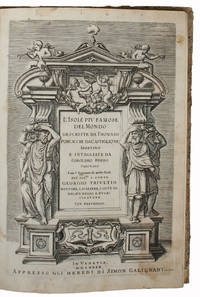
159047728Venetia Venice apresso gli heredi di S. Gagliani 1590. Colophon: In Vintia appresso Giorgio Angelieri a instantia de gli heredi di Simon Gagliani de Karera 1590. Small folio. 18th century ab. 1780-90 half vellum with gilt leather title label to spine. Corners a bit bumped and title label a bit worn otherwise nice and tight. A very nice copy on thick crisp paper. A few quires browned and brownspotted and some occasional lighter browning. Four leaves with a marginal worm-tract far from affecting text. Beautiful engraved title-page consisting of a wide architectural border illustrated with large figures putti globes and various symbols. Beautiful large woodcut initials and head- and tail-pieces. 47 half-page engraved maps in the text by Porro of islands and continents excellent crisp impressions. Large woodcut device to colophon. 12 ff. 201 1 pp. <br/><br/><em>Third much enlarged edition with 47 maps as opposed to the mere 30 of the first edition of Porcacchi's great book of islands arguably the most famous of all "isolario"s with the 47 finely engraved maps by the famous map-maker Girolamo Porro which also include maps of non-insular places e.g North America and Mexico City the famous city plan of Venice and that of Constantinople. Porcachhi's great "isolario" represents the culmination of the "book of islands"-genre both in regards to artistic quality and the information provided. It furthermore constitutes a main work in the history of the published knowledge of farther parts of the world and an important link in the development from what we call the "book of islands" to the modern atlas. As such it is of great value in several respects both historically culturally and cartographically. "The "book of islands" or isolario a novel form of cartographic book combining maps and narrative-historical chorography was invented and initially developed in Italy during the fifteenth and sixteenth centuries. According to R.A. Skelton "like the portolano or pilot-book to which it was related it had its origins in the Mediterranean as an illustrated guide for travelers in the Aegean Archipelago and the Levant.". The first "book of islands" was authored by a Florentine ecclesiastic around 1420 named Cristoforo Buondelmonti .The "book of islands" was eventually superseded as a cartographic genre as was the "Geographia" of Ptolemy by the modern atlas; it persists even after Abraham Ortelius's 1570 "Theatrum orbis terrarium" but at the margins rather than at the center of the history of cartography. While the "isolario" Ptolemy's "Geographia" and the "modern" atlas coexist for some time the gradual eclipse of the "book of islands" at one level reflected a progressive decentering of the Mediterranean that occurred within the broader context of early modern history following the Atlantic discoveries. But well before that happened in conjunction with the culminating moment of the discoveries and exploration period and at the height of the high Renaissance the second printed "book of islands" appeared in 1528 in Venice published by Zoppino: the "Libro di Benedetto Bordone nel qual si ragiona de tutte l'isole del mondo" Book of Benedetto Bordone in which are discussed all the islands of the world. As the title suggests this "isolario" provided even broader coverage than the Martellus recensions of Buondelmonti and gave special prominence to the islands of the New World .Da li Sonetti's translation of Buondelmonti's "book of islands" into a cycle of sonnets in Venice represented in its way an expression of the same desire to reconcile contemporary geographical knowledge to Italian vernacular traditions of geographical poetry that Berlinghieri's poetic Ptolemy expressed. But while the tradition of Tuscan geographical poetry would not survive the Quattrocento the prose book of islands did thanks especially to the Venetian print culture that was responsible for da li Sonetti and that produced Bordone's High Renaissance print "isolario". As mentioned the print genre "book of islands" would endure in fact albeit at the margins of modern cartography and literature in multiple editions of Bordone which were followed by the no less successful Tommaso Porcacchi's "L'isole più famose del mondo" 1572; with copper-plate engravings a line that continued through the seventeenth century . But just as with other major literary fields of endeavor including the political Machiavelli the pastoral Sannazzaro the courtly-bureaucratic Castiglione and the epic-novellistic Ariosto the "isolario" produced its masterpieces in the discoveries and travel writing fieldalongside Columbus Vespucci and Verrazzano during the High Renaissance." Cachey "From the Mediterranean to the World: A Note on the Italian "Book of Islands" "isolario"" pp. 1-10. Shirley T.POR-1d; Phillips: 50. </em> hardcover
154525180Vinegia: Figlioli di Aldo Aldus 1545. A very early and rare printing of Castiglione by Aldus in the original folio format mirroring the 1528 printing. Elaborate Aldine device impressed on the title and at the end on the verso of the colophon leaf. Dedication to Michel de Selva vescovo di Viseo. Folio handsomely bound in fine Italian vellum. 122 ff. pp. A beautifully preserved copy handsome and clean. RARE ALDINE EDITION OF THE CLASSIC LANDMARK IL CORTEGIANO. Castiglione’s great work is one of the most famous books of the Italian Renaissance and represents the highest level of committment to the prince and the new political and social order. The Courtier is the prototype of the courtesy book written as conversation between members of the court. At the time of its composition Castiglione was at the court of Guidobaldo de Montefeltre and Elizabetta Gonzaga at Urbino together with Bembo Giuliano de' Medici Federico Fregoso and other Renaissance luminaries; members of that court feature as speakers in the conversation. <br> Castiglione after serving the Sforzas at Milan and the Gonzagas at Mantua came to the Court of Urbino in 1504 where de Montefeltre and his consort Elizabetta Gonzaga were the center of the most brilliant court in Italy which counted among its members Bembo Bibbiena G. de’Medici and many other eminent men. This brilliant book is based on Castiglione’s experience of life among these dazzling figures.<br> ‘The Courtier’ depicts the ideal aristocrat and it has remained the perfect definition of a gentleman ever since. It is an epitome of the highest moral and social ideas of the Italian Renaissance and is written in the form of a discussion between members of the court. The fundamental idea that a man should perfect himself by developing all his faculties goes back to Aristotle’s ETHICS and many of the Aristotelian virtues reappear---honesty magnanimity and good manners. The ideal man should also be proficient in arms and games be a scholar and connoisseur of art; he should develop graceful speech and cherish a sense of honour. Relations between the prince and the courtier forms of government and rules for the conduct of a lady are also discussed and the book ends with the celebrated pronouncement on platonic love by Bembo.<br> This Renaissance ideal of the free development of individual faculties and its rules of civilized behaviour formed a new conception of personal rights and obligations in Europe. The book was translated into most European languages and between 1528 and 1616 no less than one hundred and eight editions were published. It had great influence in Spain where traces of it can be found in DON QUIXOTE and in France in Corneille’s writings. But its most potent influence was probably in England. Its influence can be seen in Shakepeare Spenser Ben Jonson Sir Philip Sidney Robert Burton and Shelley. It had a great impact on the development of English drama and comedy.<br> The beautiful and highly important printings of the house of Aldus are exceptional and revered in their own right. This one of the most exceptional of Italian Renaissance works published by the great Renaissance printer of Italy. Figlioli di Aldo (Aldus) hardcover
