9 résultats
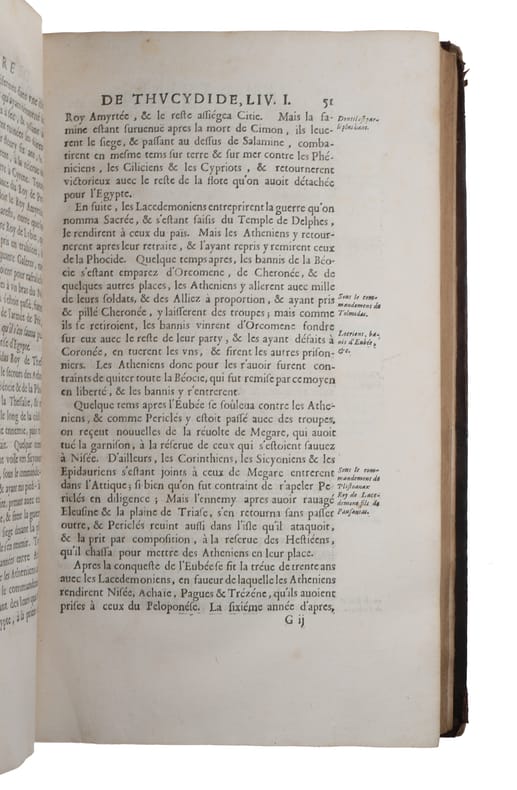
1662102735Amsterdam chez Louys et Daniel Elzevier 1662 1 vol. relié in-12, plein veau moucheté havane, dos à nerfs orné de fleurons et motifs dorés, plats encadrés d'un filet doré, (48) + 430 pp. (reliure frottée, coiffes et coins émoussés). Tome 1 seul, comprenant les quatre premiers livres. Précédé d'une préface et d'un extrait du Traité de Lucien "Comment il faut écrire l'histoire".
161885561618 rel. époque, dos à n., (très maniées - Ier plat détaché au Ier volume), en l'état… 2 vol. in-folio, (20ff., 778ff. (13ff.) et 676ff., tables, P. Claude Morel 1616-1619,
166260247Paris Augustin Courbe 1662. Folio 359 x 220 mm. In contemporary full calf over wooden boards with six raised bands and gilt ornamentation and lettering to spine. Extremities with wear. Boards with stains and scratches. Lower part of back hinge and upper part of front hinge split. Dampstain to lower outer corner affecting from p. 497 till end. Otherwise internally fine and clean. 26 599 1 29 30 pp. <br/><br/><em>First edition of d'Ablancourt famous translation of Thucydides’ History of the Peloponnesian War. The present translation went through four editions and constitute third overall French translation of Thucydides’ work. </em> hardcover

166260247Paris, Augustin Courbe, 1662. Folio (359 x 220 mm). In contemporary full calf over wooden boards with six raised bands and gilt ornamentation and lettering to spine. Extremities with wear. Boards with stains and scratches. Lower part of back hinge and upper part of front hinge split. Dampstain to lower outer corner affecting from p. 497 till end. Otherwise internally fine and clean. (26), 599, (1), 29, (30) pp.
161431123Argentorati Strassburg: Sumptibus Lazari Zetzneri Bibliop. Lazarus Zetzner 1614. Very Good. Argentorati Strassburg: Sumptibus Lazari Zetzneri Bibliop. 1614. First Zetzner Edition. Octavo 17cm.; 19th-century roan over papier-peint boards marbled endpapers; 3266448pp. collated complete; folding map plate woodcut printer's device to title page initials throughout. Leather chipped and dried with smallish loss at spine crown and biopredation along rear joint and upper cover fore-edge very faint evidence of gilt spine titling only else a Very Good internally clean and sound example. Sumptibus Lazari Zetzneri Bibliop. [Lazarus Zetzner] unknown
1676Thucydides<p><strong>Thucydides. <em>The History of the Grecian War.</em></strong><br />Translated from the original Greek by <strong>Thomas Hobbes of Malmesbury</strong>.<br /><strong>Second edition corrected and amended.</strong><br />London: Printed by <strong>Abel Swall</strong> for <strong>Charles Harper</strong> at the Flower-de-luce over against St. Dunstan's Church in Fleetstreet <strong>MDCLXXVI 1676</strong>.</p><p><strong>Folio large</strong><br /><strong>Binding:</strong> Contemporary or near-contemporary full calf ruled in panels spine in compartments.<br /><strong>Condition:</strong> Exterior worn and rubbed with heavy surface wear/abrasion to boards and joints; nonetheless still a solid attractive folio. Internally clean as in the examples shown; complete including maps.</p> Abel Swall, for Charles Harper hardcover
1676922London: Andrew Clark 1676. Second Edition. Folio 13" Tall Fine Leather Binding Bound by A.B. Buck. Near Fine. The History of the Grecian War: In Eight Books<br /> Written by Thucydides. Faithfully Translated from the Original by Thomas Hobbes of Malmsbury. Second Edition 1676. Printed in London by Andrew Clark for Charles Harper.<br /> A handsome beautifully bound 1676 second edition of Thomas Hobbes’s landmark translation of Thucydides’s History of the Peloponnesian War. Originally published in 1629 Hobbes’s translation was his first published work and remains one of the most celebrated and muscular English translations of the great Greek historian. Complete with striking fold-out maps and detailed engravings this volume represents a brilliant intersection of classical history and 17th-century English political philosophy.<br /> The Hobbes Translation: Highly sought after by collectors of both classical history and political philosophy. Hobbes translated Thucydides to warn his fellow Englishmen against the dangers of democracy making this text a precursor to his later masterpiece Leviathan.<br /> Superb Cartography & Engravings: Features the magnificent "Mapp of Antient Greece" expressly designed by Thomas Hobbes himself alongside intricate fold-out plates depicting city fortifications regional maps and boasts a beautifully engraved architectural title page.<br /> <br /> <br /> Imprint: London: Printed by Andrew Clark for Charles Harper and are to be sold by him at the Flower-de-luce over against St. Dunstan's Church in Fleet-street MDCLXXVI 1676. Second Edition much Corrected and Amended.<br /> Large folio 13"x9" bound by A.B. Buck in full dark brown Morocco with six compartments and five raised bands to spine with bright gilt rule to bands. Binding and hinges are excellent new end papers and paste downs elaborate engraved frontispiece/title page depicting Thucydides and scenes from the Peloponnesian War. The text block is crisp with generous margins. Includes the dedication to Sir William Cavendish. The volume contains all fold-out maps and plans including the notable map of Ancient Greece by Hobbes himself and detailed engravings of fortified cities. Early neat ink marginalia/manuscript notes on the endpapers add a lovely touch of historical provenance. Pages are bright and clean with minimal age toning/foxing/soiling.<br /> Thomas Hobbes undertook this translation during a period of rising political tension in England. He chose Thucydides because in Hobbes's own view the Greek historian demonstrated the failures of democracy and the necessity of strong centralized authority. Because of this this translation is not just a classical history—it is a foundational text in the development of modern political thought.<br /> <br /> <br /> Key Conflicts & Campaigns within the Text<br /> The Archidamian War Books 1–5: This is the first decade of the conflict characterized by repeated Spartan invasions of Attica and Athenian naval raids on the Peloponnesian coast. It includes the famous account of the devastating Plague of Athens which killed the great Athenian leader Pericles.<br /> The Siege of Plataea Books 2–3:<br /> One of the most famous and harrowing sieges in ancient history. Thucydides provides incredible tactical details of the Spartan siege engines the Plataean counter-defenses and the ultimate desperate breakout attempt by the defenders in the dead of winter.<br /> The Mytilenean Revolt Book 3:<br /> A critical moment where the city of Mytilene attempts to break away from the Athenian Empire. This section contains the famous "Mytilenean Debate" a chilling discussion on the ethics of empire justice and whether to execute an entire rebel population.<br /> The Battle of Pylos and Sphacteria Book 4:<br /> A shocking Athenian victory where they managed to trap and capture elite Spartan hoplites on a small island. This completely upended the myth of Spartan invincibility as Spartans were expected to fight to the death rather than surrender.<br /> The Sicilian Expedition Books 6–7:<br /> Often considered the climax of Thucydides's narrative this covers Athens' disastrous hubristic attempt to conquer Syracuse in Sicily. It is a massive self-contained tragedy within the broader war ending in the total annihilation of the Athenian fleet and army. For collectors Books 6 and 7 are often considered the greatest pieces of military writing in antiquity.<br /> The Ionian War / The Oligarchic Coup Book 8:<br /> The final book covers the beginning of the end for Athens detailing naval warfare in the Aegean the intervention of the Persian Empire and the political collapse of the Athenian democracy into a short-lived oligarchy. Thucydides's manuscript abruptly cuts off in the year 411 BC.<br /> <br /> <br /> . Andrew Clark unknown
16762710London: : Charles Harper 1676. SECOND EDITION. . Folio:. 31 x 20.5 cm. . Ï€2 engraved and printed titles A4 a-d4 e2 B-Z4; Aa-Zz4; Aaa4. With five added maps and plates. Illustrated with the famous engraved title page showing Archidamos Perikles and the author with vignette views of Sparta Athens and a small map of Greece; and five engraved maps and views by Thomas Cecill entitled: "The Mappe of Ancient Greece" "Plataea" "Sphoicteria" "Antient Sicele According to the Description of Philip Chiuerius" and "Syracvse Beseeged by the Athenians". Bound in contemporary sprinkled calf ruled in compartments with decorative tools at each corner of the central panel. The hinges are starting the corners bumped but the binding is in overall good condition. The contents are in excellent condition: the leaves are bright and crisp the maps and plates are intact and present. Hobbes published his translation of Thucydides’ masterpiece in 1629 when he was in his early forties. Yet he tells us in the introduction that the translation once completed “lay long by†him indicating that it had been completed much earlier. “Hobbes was interested in Thucydides less for his style than his subject matter. Nor did he take up the study and translation of the Greek historian simply with a scholar’s antiquarian interest but with the humanist desire to learn and pass on the lessons of history to his contemporaries. He is not shy of speaking of the utility of history. He talks of Thucydides’ writings ‘as having in them profitable instruction for Noblemen and such as may come to have the managing of great and weighty actions.’ It is in the history of Thucydides that the purposes of history are most finely embodied: ‘For the principall and proper worke of History being to instruct and enable men by the knowledge of Actions past to beare themselves prudently in the present and providently towards the Future there is not extant any other merely humane that doth more fully and naturally performe it then this of my Author.’… “Hobbes had very definite ideas about the conclusions to be drawn from Thucydides. In the long introductory essay ‘Of the Life and History of Thucydides’ he derives from the history an account of the political opinions of its author: ‘For his opinion touching the government of the State it is manifest that he least of all liked the Democracy. And upon divers occasions hee noteth the emulation and contention of the Demagogues for reputation and glory of wit; with their crossing of each others counsels to the damage of the Publique; the inconstancy of Resolutions caused by the diversity of ends and power of Rhetorique in the Orators; and the desperated actions undertaken upon the flattering advice of such as desired to attaine or to hold what they had attained of authority and sway amongst the common people. Nor doth it appeare that he magnifieth anywhere the authority of the Few; amongst whom he saith every one desireth to be chiefe; and they that are undervalued beare it with lesse patience than in a Democracy; whereupon sedition followeth and dissultion of the government. Hee prayseth the government of Athens when it was mixed of the Few and the Many; but more he commendeth it both when Pisistratus raigned saving that it was an usurped power and when in the beginning of this Warre it was Democraticall in name but in effect Monarchicall under Pericles.’ “Thucydides here is represented as a closet royalist. The passage to which Hobbes is directly referring which must have been written after the final defeat of Athens in 404 is Thucydides summary account of the causes of her downfall in Book II. This is a long but crucial passage in Hobbes’ translation a shortcut to the lessons to be learnt from the larger narrative. While there are many factors that contributed to the political philosophy later developed by Hobbes not least his experience of civil disorder in Britain it might be argued that the political analysis here of the weakness of the Athenian democracy was influential in defining a problem to which the doctrine of Leviathan was the solution.â€Robin Sowerby “Thomas Hobbes’ Translation of Thucydides†"The historical methods of Thucydides who lived in the fifth century B.C. have never been bettered. His severe standard of historical truth coupled with his passionate belief in the general significance of particular events have given his history of the tragic war between Athens and Sparta a universal value to statesmen and historians alike." Printing and the Mind of Man 219 Wing 1134 Charles Harper, unknown books