ThucydidesBiblio.com

1 191 résultats
1550111546London: William Tylle 1550. First edition of one one of the greatest of classic historical works. Folio bound in 19th century full vellum morocco spine label marbled endpapers title-page with elaboarate historiated woodcut border. In very good condition with light toning to the text. Rare and desirable in this condition. “The standards and methods of Thucydides as a contemporary historian have never been bettered. He began work at the very start of the events he records and the penetration and concentration which he devoted to his account of the ‘Peloponnesian War’ the war between Athens and Sparta from 431 to 404 B.C. were based on the conviction that it would prove the most important event in Greek history… He saw his history as a source of profit to ‘those who desire an exact knowledge of the past as a key to the future which in all probability will resemble the past.’ It was in this sense… that he called it… ‘a possession forever.’ This is exactly what it has become†PMM 102. William Tylle hardcover
193048579Chelsea.: The Ashendene Press. 1930. Original publisher's full white pigskin by W. H. Smith & Son Ltd. with their signature gilt to rear turn-in banded spine with gilt title in six compartments. Folio. 408 x 282 mm. Printed title and 'Book I' to 'Book X' of Thucydides' text in English in red and black in Ptolemy type chapter summaries in Blado marginal chapter summaries and opening lines by Graily Hewitt in red the red initials from the alphabet designed by Eric Gill for the Ashendene Utopia final leaf with colophon and woodcut Ashendene device verso. The Ashendene Thucydides the final folio from the press.From the edition limited to 280 copies with this one of 260 on Batchelor 'knight in armour' Ashendene paper; 20 copies on vellum were also issued.The Greek text was translated by Benjamin Jowett Regius Professor of Greek at Oxford. The book is printed in Ptolemy with Blado marginal chapter summaries - the first time St John Hornby had used a different type for side-notes.This copy includes the original purchaser's invoice a single leaf 216 x 150 mm headed 'THE ASHENDENE PRESS / SHELLEY HOUSE CHELSEA' and made out to Mr. Jacques Steinitz / Warren Ohio'. Signed by St. John Hornby with two pence stamp and dated May 27th 1931 the cost is detailed as 15 Guineas.Ashendene XXXVII. The Ashendene Press. unknown
15408317Basileae Basel ex Officina Hervagiana 1557-1540. 2 works bound in one volume folio. pp. xx 310 ii blank; xxiv 178 iv blank with woodcut printer's device to verso of both final leaves. Greek text numerous early marginal notes and alternative readings in the first work occasional annotations in an early hand in the second. Near contemporary quarter pigskin over pasteboard rubbed. Johannes Herwagen was a protestant printer from Strasbourg. He became a citizen of Basel in 1528 and married Johann Froben's widow. Froben had made Basel a centre for the priting of Greek and Latin texts modelling his business on the example of scholar-printer Aldus Mantutius. Herwagen continued the tradition collaborating at first with his stepson Hieronymus Froben and his brother Nicholas Episcopius and printing under his own name from 1531. He was fined and expelled from the city in 1542 after having an affair with his stepson's wife but Landgrave Philip of Hesse Duke Christoph von Württemberg and the University of Basel campaigned for him so that he was pardoned in 1545 and a period of house arrest and a tavern ban were both lifted in 1547 by the City Council. He published the first edition in Greek of Euclid's Elements 1533 and other works such as Heliodorus' Aithiopika 1534. These are the third printings of the 'father of history' and of Thucydides in the original Greek. Book unknown
1676922London: Andrew Clark 1676. Second Edition. Folio 13" Tall Fine Leather Binding Bound by A.B. Buck. Near Fine. The History of the Grecian War: In Eight Books<br /> Written by Thucydides. Faithfully Translated from the Original by Thomas Hobbes of Malmsbury. Second Edition 1676. Printed in London by Andrew Clark for Charles Harper.<br /> A handsome beautifully bound 1676 second edition of Thomas Hobbes’s landmark translation of Thucydides’s History of the Peloponnesian War. Originally published in 1629 Hobbes’s translation was his first published work and remains one of the most celebrated and muscular English translations of the great Greek historian. Complete with striking fold-out maps and detailed engravings this volume represents a brilliant intersection of classical history and 17th-century English political philosophy.<br /> The Hobbes Translation: Highly sought after by collectors of both classical history and political philosophy. Hobbes translated Thucydides to warn his fellow Englishmen against the dangers of democracy making this text a precursor to his later masterpiece Leviathan.<br /> Superb Cartography & Engravings: Features the magnificent "Mapp of Antient Greece" expressly designed by Thomas Hobbes himself alongside intricate fold-out plates depicting city fortifications regional maps and boasts a beautifully engraved architectural title page.<br /> <br /> <br /> Imprint: London: Printed by Andrew Clark for Charles Harper and are to be sold by him at the Flower-de-luce over against St. Dunstan's Church in Fleet-street MDCLXXVI 1676. Second Edition much Corrected and Amended.<br /> Large folio 13"x9" bound by A.B. Buck in full dark brown Morocco with six compartments and five raised bands to spine with bright gilt rule to bands. Binding and hinges are excellent new end papers and paste downs elaborate engraved frontispiece/title page depicting Thucydides and scenes from the Peloponnesian War. The text block is crisp with generous margins. Includes the dedication to Sir William Cavendish. The volume contains all fold-out maps and plans including the notable map of Ancient Greece by Hobbes himself and detailed engravings of fortified cities. Early neat ink marginalia/manuscript notes on the endpapers add a lovely touch of historical provenance. Pages are bright and clean with minimal age toning/foxing/soiling.<br /> Thomas Hobbes undertook this translation during a period of rising political tension in England. He chose Thucydides because in Hobbes's own view the Greek historian demonstrated the failures of democracy and the necessity of strong centralized authority. Because of this this translation is not just a classical history—it is a foundational text in the development of modern political thought.<br /> <br /> <br /> Key Conflicts & Campaigns within the Text<br /> The Archidamian War Books 1–5: This is the first decade of the conflict characterized by repeated Spartan invasions of Attica and Athenian naval raids on the Peloponnesian coast. It includes the famous account of the devastating Plague of Athens which killed the great Athenian leader Pericles.<br /> The Siege of Plataea Books 2–3:<br /> One of the most famous and harrowing sieges in ancient history. Thucydides provides incredible tactical details of the Spartan siege engines the Plataean counter-defenses and the ultimate desperate breakout attempt by the defenders in the dead of winter.<br /> The Mytilenean Revolt Book 3:<br /> A critical moment where the city of Mytilene attempts to break away from the Athenian Empire. This section contains the famous "Mytilenean Debate" a chilling discussion on the ethics of empire justice and whether to execute an entire rebel population.<br /> The Battle of Pylos and Sphacteria Book 4:<br /> A shocking Athenian victory where they managed to trap and capture elite Spartan hoplites on a small island. This completely upended the myth of Spartan invincibility as Spartans were expected to fight to the death rather than surrender.<br /> The Sicilian Expedition Books 6–7:<br /> Often considered the climax of Thucydides's narrative this covers Athens' disastrous hubristic attempt to conquer Syracuse in Sicily. It is a massive self-contained tragedy within the broader war ending in the total annihilation of the Athenian fleet and army. For collectors Books 6 and 7 are often considered the greatest pieces of military writing in antiquity.<br /> The Ionian War / The Oligarchic Coup Book 8:<br /> The final book covers the beginning of the end for Athens detailing naval warfare in the Aegean the intervention of the Persian Empire and the political collapse of the Athenian democracy into a short-lived oligarchy. Thucydides's manuscript abruptly cuts off in the year 411 BC.<br /> <br /> <br /> . Andrew Clark unknown
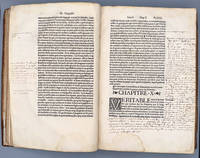
1527winter5<p> <strong>IMPORTANT THUCYDIDES ANNOTATED IN THE 1620s BY A REPRESENTATIVE OF THE "REPUBLIC OF LETTERS" CONTEMPORARY OF GABRIEL NAUDÉ & THE DUPUY BROTHERS CAPABLE OF INVOKING MACHIAVELLI AS WELL AS MAGELLAN</strong> </p><p>THUCYDIDES<br /><em>L'Histoire de la guerre qui fut entre les Peloponnesiens</em> Paris Josse Bade 1527.</p><p>Folio 15 ff. CCLXXXI ff. 17th-century sheep with corners and spine raised bands renewed caramel title-label. Title-leaf lacking small cut at foot of final leaf dampstain in the lower margin throughout more pronounced in the last quarter of the volume.<br />Dimensions: 32.7 × 22.3 cm.</p><p>References: Moreau-Renouard III 1343. USTC no. 22806.<br />Languages of annotation: French; quotations in Latin and Italian; a few words in Greek.</p><p>Bibliography<br />C. Grell "Thucydide en France de la Renaissance à la Révolution" in <em>Ombres de Thucydide. La réception de l'historien depuis l'Antiquité jusqu'au début du XXe siècle</em> Ausonius 2010 pp. 587–600.</p><p>An edition published at the instigation of François I</p><p>First edition of the translation by Claude de Seyssel based on Lorenzo Valla's Latin translation published at the instigation of François I by Jacques Colin his almoner and ordinary reader. The printing was made thanks to the manuscript kept in the king's library and the colophon explains the meaning of this gesture: "… et finablement a esté publié et mis en lumière par le commandement du tres chrestien Roy Françoys premier de ce nom au prouffit et edification de la noblesse et subjectz de son Royaulme."</p><p>Born in Savoy around 1450 Claude de Seyssel pursued a diplomatic career before becoming an influential prelate he died archbishop of Turin in 1520. He translated several historical works including Diodorus of Sicily offering his presentation manuscripts to Louis XII. The contract linking Josse Bade and François I is still preserved.</p><p>Important copy annotated by a reader belonging to the "Republic of Letters"</p><p>Our volume was very extensively annotated with great regularity by a humanist scholar from the late 1620s to the early 1630s. Indeed at f. CLXXVIIv an event of the year 1629 is mentioned designated as "this year": "de nostre temps ès villes huguenottes qu'on desmolit cest an 1629." The year 1632 also appears in a reference to Nicolas Faret's <em>Honneste-Homme</em> preface f. a 7v.</p><p>Our reader — who wrote about 1000 notes often substantial throughout the work — proves emblematic of the Republic of Letters: he makes the Ancients Thucydides Aristotle and the Moderns Machiavelli Bodin Giovio converse in the margins. He summons geography Ortelius as well as technical treatises; and relies on examples from navigators such as Magellan.</p><p>His humanistic cursive handwriting accompanies a precise method: to state maxims support them with examples then give precise references. The echoes to recent publications or to the current affairs of the reign of Louis XIII finally reveal an attentive eye on contemporary events faithful to the critical ideal of European men of letters. A profile emerges that places our annotator in the lineage or the milieu of Naudé the Dupuy brothers or Peiresc.</p><p>Numerous philosophical historical references & resonances with the history of his time</p><p>Our annotator makes numerous references to ancient Greek and Latin historical works Appian of Alexandria at f. XLVIII v° Aristotle's <em>Politics</em> at f. LVII v° Livy at f. XLIX v° Tacitus and Zonaras at f. XXV r° but it is above all the political and philosophical works of the Renaissance that he more readily invokes particularly Machiavelli <em>Florentine Histories</em> and the <em>Discourses</em> the history of Paolo Giovio and Jean Bodin.</p><p>His method often consists in formulating in the margin a general maxim which he illustrates with solid historical references confirming the usefulness — stressed by Seyssel — of the numerous speeches "contions" included in Thucydides' work. He possesses enough Italian to quote Machiavelli in the text on several occasions.</p><p>At f. XXIIIr concerning the Spartans who hear the complaints of the Athenians and send them out so they may deliberate among themselves he notes that "les intéressés doivent sortir des assemblées ou leurs affaires se deliberent Tite Live dec. 3 L. 6 fol. 140 fol. 141. dec 4. L. 5 fol. 135."</p><p>Likewise at f. CXXVI v° where he draws on Paolo Giovio's <em>History of His Time</em> which contains long developments on the Sack of Rome in 1527: "quiconque n'obtient à ce qu'il desire se persuade qu'on luy fat rot vide Jovio l. 31 fol. 231 du pape Clem 7 piqué contre l'empereur Charles 5."</p><p>Or again at the beginning of chapter 7 of book III where he cites Jean Bodin in support: "Toute ceste harangue tend à persuader qu'il faut pardonner. Bod. li. 4 <em>De la rép</em> ch. 6 p. 91" f. XCI r°.</p><p>From time to time our reader makes fascinating parallels with his own era: this is the case at f. CLXXVIIv where he connects a passage of book V chap. 10 of Thucydides on the effectiveness of the mobilisation of the entire Athenian people to strengthen the walls with the contemporary effort to destroy Huguenot strongholds in the France of Louis XIII: "de nostre temps ès villes huguenottes qu'on desmolit cest an 1629."</p><p>A reader fond of geography & seafaring who mentions Magellan & relies on the maps of Ortelius</p><p>Our annotator also pays attention to geographic and historical accuracy and makes use of comparative cartography of his time to picture the situation of a battle: from Athens to Mytilene he compares the map of Hondius who counts 240 miles while Ortelius counts only 200 f. XCIIIv°.</p><p>He often relies on the testimony of sailors mathematicians or geographers for greater accuracy: for example concerning the size of the kingdom of the Odrysians he refers to the <em>Dialogue de la longitude est-ouest</em> by Toussaint de Bessard Norman mathematician and hydrographer published in 1574. One sees how attached he is to the testimonial history of Thucydides as opposed to the more anthropological and sometimes unreliable history of Herodotus.</p><p>At f. 80 verso appears a reference to Magellan: after stating that "un capitaine de marine doit sur toutes choses prudence garder à soy" our annotator then mentions "Almeida près du cap de bonne espérance l'an 1510" & "Magellan à Zébu Cebu l'an 1521" references he finds "chez Osorius en l'Histoire de Portugal livre 6 no 16."</p><p>A few textual remarks and corrections are also to be noted: in chapter 4 of book II he notes that there is an improbability in the length of the wall and does not know to whom he should attribute the error: "ce passage estoit corrompu en l'original latin que Seyssel a traduit ou il a mal conceu l'intention de Thucicide …" f. XLVIII v°.</p><p><strong>Precious volume annotated by a humanist scholar of the 1620s manifestly close to the networks of the Republic of Letters</strong></p> Josse Bade
1759140946021Glasguae Glasgow: Robertus et Andreas Foulis 1759. Near Fine. Foulis Press edition. Each volume has the Greek text followed by the Latin translation which was taken from Duker's 1731 edition by Valla rev. Estienne Portus & Duker. Bound in contemporary speckled calf with double gilt ruling; six compartment spines tooled in gilt with five raised bands and the original morocco spine labels. All edges stained red 6.25" x 4" 18mo. Near Fine with chip to spine label on volume one minor rubbing to joints. Minor dust soiling to top edges; slight offset to title pages in each volume else bright. <p>A handsome set of Thucydides' primary historical account The Peloponnesian War printed by famed scholars and publishers Robert and Andrew Foulis. A pioneering work of history. Robertus et Andreas Foulis unknown
156428293(Genova), Excudebat Henricus Stephanus, illustris viri Huldrichi Fuggeri typographus, 1564. Folio. Later red full calf, rebacked, soft boards. Inner hinges reinforced. T-p. w. repaired loss to lower right corner, not affecting text. Upper part of first about 100 leaves w. decreasing waterstaining w. very minor affect to text. Cont. owner's name to t-p. (""Ex libris Rabillone""). T-p. in red and black, woodcut printer's device to t-p., woodcut initials and vignettes, first part w. beautiful Greek script. Overall good condition. (16), 297, (2), 216, (8) pp.
156428293Genova Excudebat Henricus Stephanus illustris viri Huldrichi Fuggeri typographus 1564. Folio. Later red full calf rebacked soft boards. Inner hinges reinforced. T-p. w. repaired loss to lower right corner not affecting text. Upper part of first about 100 leaves w. decreasing waterstaining w. very minor affect to text. Cont. owner's name to t-p. "Ex libris Rabillone". T-p. in red and black woodcut printer's device to t-p. woodcut initials and vignettes first part w. beautiful Greek script. Overall good condition. 16 297 2 216 8 pp. <br/><br/><em>First edition thus. First part in Greek second part in Latin. "The Latin version is Valla's which Stephan published separately in 1564 but which usually accompanies the Greek text." Dibdin II:506. "The text was first printed by Aldus in 1502. The edition of Henri Estienne a member of the famous French family of printers who corresponded with scholars as an equal first came out in 1564. The edition cited the second edition 1588 was improved by the addition of a translation into Latin by Lorenzo Valla." PMM 102. This edition also contains Valla's excellent and famous translation being the second part of the work separately paginated pp. 1 - 216; in the second edition the translation is not printed separately but in parallel columns on the same pages as the Greek text. "Édition plus belle" Brunet V:844. Stephanus Estienne worked in Paris and Dibdin mentions the work as being printed in Paris whereas PMM states that it is printed in Genova. Brunet V:844 PMM 201 Dibdin II:506. Greasse 7:149. </em> hardcover
15631310180028Appresso G. Giolito de' Ferrari 1563-01-01. Hardcover. Good. Bound in contemporary vellum with gilt flourish. Some soiling to cover. Good binding. 463 p. ; 20 cm. Clean unmarked pages. History of the Peloponnesian War. Printer's devices engravings. Appresso G. Giolito de' Ferrari hardcover
1676Thucydides<p><strong>Thucydides. <em>The History of the Grecian War.</em></strong><br />Translated from the original Greek by <strong>Thomas Hobbes of Malmesbury</strong>.<br /><strong>Second edition corrected and amended.</strong><br />London: Printed by <strong>Abel Swall</strong> for <strong>Charles Harper</strong> at the Flower-de-luce over against St. Dunstan's Church in Fleetstreet <strong>MDCLXXVI 1676</strong>.</p><p><strong>Folio large</strong><br /><strong>Binding:</strong> Contemporary or near-contemporary full calf ruled in panels spine in compartments.<br /><strong>Condition:</strong> Exterior worn and rubbed with heavy surface wear/abrasion to boards and joints; nonetheless still a solid attractive folio. Internally clean as in the examples shown; complete including maps.</p> Abel Swall, for Charles Harper hardcover
17314069<p>A handsome copy in the original full vellum. Folding maps of ancient Greece & Sicily. ; Folio 27 x 41.5 cm; 343472848123 pages. All shipments through USPS insured Priority Mail.</p> R. & J. Wetstein & Gul. Smith hardcover
154500009254Venetia = Venice: Vincenzo Vaugris = Vincenzo Valgrisi 1545. First Italian edition. Hardcover. Near Fine. Small 8vo. 24 440 1 pp. Every other text page paginated. Recent early 20th century tan paper-covered boards. Title page with publisher's device woodcut initials final page of text with publisher's device on the reverse. Translated from the Italian on the title page: "With annotations and explanations of the historical places and most detailed alphabetized tables of all the wars the peace agreements the alliances formed the naval battles the daily events the cities taken the portents predicted and the leveled burned destroyed places that are recorded in history." Translated from the Greek into the Tuscan language by Francesco di Soldo Strozzi Fiorentino. A Manual of Classical Bibliography Joseph Moss 700. The Oxford Classical Dictionary 1134; 1516-1521. The first edition in Italian. Moss records this imprint as the first edition in Italian and writes that it has been reprinted several times both with and without dates. Adams records an undated Venetian imprint from Baldassar de Constantini Adams T-684 but not the Venetian Valgrisi imprint the Constantini imprint recorded by Adams shares the same collation as the Valgrisi imprint. Thucydides' Peloponnesian War is one of the first written histories dependent on eyewitness accounts and primary sources to be produced in the Western world. The work is divided into several parts: an introductory book a section on The Ten Years War focused on the conflict between Athens and Corinth the peace that followed this war The Peace of Nicias the Sicilian War the Plague that struck Athens with the last book Book 8 a portion of Thucydides history on the Decelean War. Thucydides intended his histories to describe the events that directly follow the ones recorded by Herodotus. He began writing the books soon after the Peloponnesian War started and recorded several of the events soon after they happened. From his 20s to his 50s Thucydides worked on his histories and the work reflects his changing perspective over time. His scientific exacting approach to describing the causes of the war and the fall of Athens along with his brief and concise prose all help his work to stand apart from the other historical writings of Classical Antiquity. Binding is Near Fine with two tiny splits to the paper over the joints leaves rarely show foxing with one or two corners missing not affecting the text marginal annotations or the catch words. Overall a nice clean copy. Vincenzo Vaugris [= Vincenzo Valgrisi] hardcover
200324278Focus Publishing/R. Pullins Co Incus. New. 2003. Paperback. 1585100781 . FREE UPGRADE to Courier/Priority Shipping Upon Request - IN STOCK AND IMMEDIATELY AVAILABLE FOR SHIPMENT - FLAWLESS COPY PRISTINE NEVER OPENED -- 90 pages; clean and crisp tight and bright pages with no writing or markings to the text. -- DESCRIPTION: This volume collects all of the surviving state funeral orations from Athens including Thucydides Gorgias Lysias Plato Menexenus Demosthenes and Hyperides. To stimulate student discussion and comparison For reference Lincoln's address at Gettysburg is included in an appendix. Translations are in English including introduction and notes as well as literary and historical commentary. -- AUTHOR: Jud Herrman is Assistant Professor of Classical Studies at Allegheny College. -- FROM THE INTRODUCTION: "Throughout the fifth and fourth centuries BC at the close of each campaign season the Athenian state honored its war-dead in a public burial ceremony choosing a prominent orator to give the keynote address. This volume collects all of the surviving state funeral orations from classical Athens. Like tragedy these speeches present an image of an idealized Athens. The narratives of past Athenian glories found in these speeches feature many of the same mythical tales that were also presented on stage. Like many of the plays the funeral orations emphasize important themes such as Athenian unity their aid to suppliants and their willingness to drive away foreign invaders to protect the other Greeks. The selective version of more recent history found in the funeral orations also highlights these same qualities by focusing on the role of Athens during the Persian Wars 490-479 when the city helped save the other Greeks from invading foreigners and by passing over other events such as the Peloponnesian War 431404 in which Athens opposed fellow Greeks. Although nearly all of the surviving Greek tragedies are set in the distant mythical past the significant exception is Aeschylus Persians the audience in the theater would recognize aspects of contemporary Athens in the depiction of ancient Athenian heroes such as Theseus. The funeral orations draw similar connections more explicitly by presenting a continuous narrative tying the present generation with the great heroes of long ago." -- with a bonus offer-- . Focus Publishing/R. Pullins Co Inc,us paperback
14881New York: Modern Library. As New. Paperback. FREE UPGRADE to Courier/Priority Shipping Upon Request - IN STOCK AND IMMEDIATELY AVAILABLE FOR SHIPMENT - ND; copyright 1951 -- with a bonus offer-- . Modern Library paperback
17596265Glasguae Glasgow: In aedibus Academicis excudebant Robertus et Andreas Foulis 1759. FIRST FOULIS EDITION 8 vols. 8vo pp. vi 184 184; ii 150 150; ii 151 3 blank 151 1; ii 178 178 2 blank; ii 134 134 2 blank; ii 151 3 blank 151 1; 138 138; 154 154. Contemporary calf spines divided by raised bands between double gilt rules. One blank leaf of 8 discarded some light spotting one or two minor edge tears. Rather rubbed and marked some wear to spine ends several joints cracking and one one front of vol. 1 loosening labels lost. Gilt crest to head of each vol. of army officer politician and aide-de-camp to George III James St Clair Erskine 2nd Earl of Rosslyn 1762-1837. The scarce first Foulis edition of Thucydides a highly regarded printing: ‘It is beautifully printed and called by Harwood “one of the most correct of all the Greek classics published at Glasgow.” Copies of it are now scarce and in fine condition bear a considerable price’ Dibdin. The text is Duker’s the translation the same as had appeared in Duker’s 1731 folio which is ultimately Valla’s but as revised by Estienne Portus and Duker. This is the variant issue with the Latin text following the Greek text instead of on alternating leaves. Gaskell 375; ESTC T99792; Dibdin II 509. In aedibus Academicis, excudebant Robertus et Andreas Foulis hardcover
90809Norwalk Connecticut: Easton Press 2000. Full Leather. Fine. Complete 12 volume set uniformly bound in full black leather with gilt design lettering and AEG. Moire endpapers silk ribbon. 24 x 16.5 cm. "A note about" laid-in for each volume. Color frontispiece in each. A few small scratches to gilt edges of "Peloponnesian War" & Aristotle's Ethics larger scratch to top gilt edge of "The Odyssey<br /> <br /> <br /> Great condition overall of this set of classic Greek philosophy plays and history. Large set substantial extra charges will be required for international orders. List of titles:<br /> <br /> Aeschylus: The Oresteia 335pp. Translated by Robert Fagles.<br /> <br /> Aesop: The Complete Fables 262pp. Translated by Olivia and Robert Temple. <br /> <br /> Aristophanes: Four Comedies 393pp. Translated by Dudley Fitts. <br /> <br /> Aristotle: The Nicomachean Ethics 383pp. <br /> Translated by J. A. K. Thomson.<br /> <br /> Euripides: The Bacchae and Medea 451pp. Translated by Philip Vellacott. <br /> <br /> Herodotus: The Histories 622pp. Translated by Aubrey de Selincourt. <br /> <br /> Homer: The Iliad 683pp. Translated by Robert Fagles. <br /> <br /> Homer: The Odyssey 541pp. Translated by Robert Fagles.<br /> <br /> Menander: Plays and Fragments 265pp. Translated by Norma Miller.<br /> <br /> Plato: The Last Days of Socrates Translated by Hugh Tredennick and Harold Tarrant 237pp.<br /> <br /> Sophocles: The Three Theban Plays Antigone Oedipus the King Oedipus at Colonus 430pp. Translated by Robert Fagles. <br /> <br /> Thucydides: History of the Peloponnesian War 648pp. translated by Rex Warner. Easton Press unknown
Vol. 1: fine Vol. 2: light bumping to upper corners. Vol 3: very light soiling to spine. Light wear to one corner; vol. 4: light chip to top of spine else fine. Vol. 5: small chip to base of spine. Else fine. Set appears unread. Volumes range from VG+ to Fine. ; Publishing years 2008-2009. Isbns: 9025612359, 9025612369, 9025612423, 9025612474, & 9789025612528 ; 5 Volume Set COMPLETE. Supplementi Di Lexis; 2439 pages
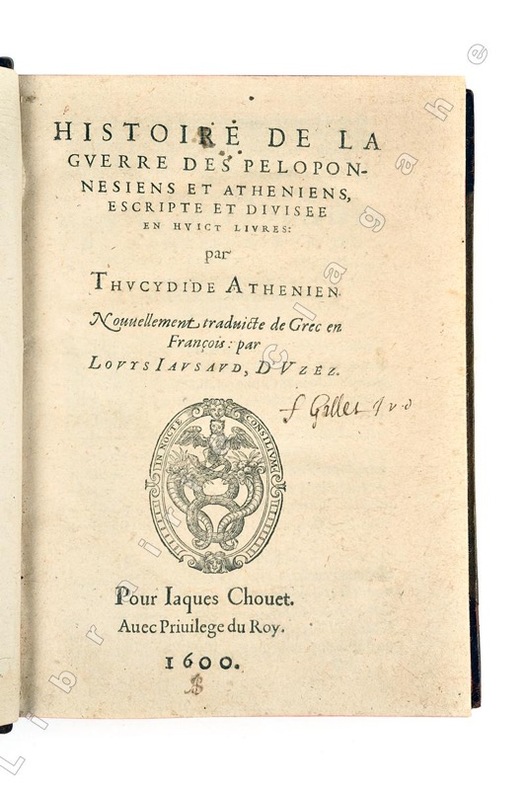
160020037[Genève], Iaques Chouet, 1600; marque de l’imprimeur au titre avec la devise “In nocte consilium” ; in-4, demi veau fauve à coins, dos lisse, pièce de titre grenat décoré, tranches rouges (reliure ancienne) ; [12], XIV, [1] f. blanc, 551, [1] bl., [23-1 bl.] ff. ; Col. 4, 2, -, A-Z, AA_ZZ, AAA-ZZZ, a-c4.
130396Venice Venetiis Apud Juntas 1603. 4to. XLIV600 p. Overlapping vellum 23 cm Ref: Hoffmann 3563; Schweiger 1331; Ebert 22957 Details: Two thongs laced through the joints. Gilt red morocco letterpiece on the back. Printer's mark of the Giunta family on the title: a fleur-de-lys. Woodcut initials good paper fine printing Condition: old and small inscription on front pastedown; a bigger one on the front flyleaf. Name and a faint small inkstain on the title. Some very small wormholes near the lower edge keeping far away from any text; holes have occasionally been mended with a layer of thin paper Note: This volume contains the exhaustive and learned lecture notes of Fabio Paolino da Udine or Fabius Paulinus Utinensis on the description of the plague epidemy by the Greek historian Thucydides Thuc. Hist. 2.47-58. This epidemy reached the war-stricken city of Athens in 430 B.C. at the beginning of the Peloponnesian war which lasted from 431 till 404 B.C. Thucydides is the first to describe the social upheaval of a pandemy and its consequences. The identification of what was the cause of this pandemy is until this day a matter of controversy. Fabius Paulinus Utinensis born at Udine ca. 1535 was the very man for a commentary on this subject. 'His first training in Greek and Latin was at Venice with Bernardino Partenio. Later he went to Padua where he graduated in philosophy and medicine but studied rhetoric and Arabic as well. He practiced medicin for a time before he became public professor at Venice where he taught Greek in the School of San Marco and Latin in the Collegio de'Notai. Both chairs he obtained in 1588 as the successor of Bernardino Partenio'. 'Medieval and Renaissance Latin translations and commentaries vol. 8' Washington 2003 p. 180. Paulinus held his lectures in the library of the San Marco Gymnasium. The work starts with a list of 232 questions concerning the possible causes of the pest. Each chapter is preceded by the relevant Greek text and a Latin translation. § On the flyleaf a former owner has written a quotation from Gibbon's 'Decline and Fall of the Roman Empire' chapter XLIII note 90: 'I was indebted to Dr. Hunter for an elaborate commentary on this part of Thucydides the plague of Athens a quarto of 600 pages Ven. 1603 apud Juntas which was pronounced in St. Marks Library by Fabius Paullinus sic Utinensis a physician and philosopher'. These passages of Thucydides helped Gibbon to understand the impact of the pest epidemy which ravaged Konstantinople in 542 under the emperor Iustinian Provenance: Name on the title of 'Joannis Molini'. This must be a relative of one of the 3 senators of the Gymnasium to whom Paulinus dedicates his work. The book is dedicated to 'M. Anto. Memmo' and the noblemen 'Francisco Molino' & 'Antonio Priolo' Collation: a-d4 e6; A-4F4 Photographs on request hardcover
130396Venice (Venetiis), Apud Juntas, 1603.
161431123Argentorati Strassburg: Sumptibus Lazari Zetzneri Bibliop. Lazarus Zetzner 1614. Very Good. Argentorati Strassburg: Sumptibus Lazari Zetzneri Bibliop. 1614. First Zetzner Edition. Octavo 17cm.; 19th-century roan over papier-peint boards marbled endpapers; 3266448pp. collated complete; folding map plate woodcut printer's device to title page initials throughout. Leather chipped and dried with smallish loss at spine crown and biopredation along rear joint and upper cover fore-edge very faint evidence of gilt spine titling only else a Very Good internally clean and sound example. Sumptibus Lazari Zetzneri Bibliop. [Lazarus Zetzner] unknown
Volumes 1 has light bumping. DJ has some tears to spine ends and some spotting to DJ spine. Vol. 1: small tear to front panel of DJ (1 cm). Vol 2: minor chipping and browning to DJ. Vol 3: DJ has some spotting to DJ spine. A few small tears. Vol 5: old price to inner cover in pen. DJ spine a bit sunned. Very slight edgewear. Books range from VG to NF. Djs from VG- to VG+; V. 1: (1966) 480 pgs. ISBN: 0198141262; V. 2: 1962 edition 436 pgs ISBN: 0198140037; V. 3: 1966 edition pages 437-748. V. 4: 1970 edition 502 pgs ISBN: 0198141785; V. 5: 1981 edition 502 pgs. ISBN: 019814198X. ; 5 Volume Set COMPLETE; Vol. 1/5/2022
Volumes 1 has former owner's name to ffep in pen. Vol. 1: tears to ends of DJ and lower front corner. DJ has a bit of spotting. Vol 2: a few tiny tears to DJ. DJ is price-clipped. Vol 3: minor creasing to foreedge of ffep. DJ has a couple of tears to head of spine. DJ is price-clipped. DJ has chipping to lower corners. Vol 4: a bit of bumping along upper edge of front board and corner. Foxing/dustsoiling to top of textblock. Pages tanned. DJ is price-clipped. Vol 5: bumping to corners. Spotting to textblock. Foxing/dustsoiling to top of textblock. DJ spine is a bit sunned. Very slight edgewear. Books range from VG to NF. Djs from VG- to VG+; V. 1: (1971) 480 pgs. ISBN: 0198141262; V. 2: 1969 edition 436 pgs ISBN: 0198140037; V. 3: 1969 edition pages 437-748. V. 4: 1978 edition 502 pgs ISBN: 0198141785; V. 5: 1981 edition 502 pgs. ISBN: 019814198X. ; 5 Volume Set COMPLETE; Vol. 1/5/2022
33877Verona: 1735 Vol 1 1736 Vol 2. 1st Edition. 1st Edition. First edition in Italian two volumes vol. 1 380 pp vol. 2 280 pp vellum 4to 12 x 8.5" 30 x 21.5cm. <br /> Easily one of the oldest books in our library still in good condition especially given its almost three centuries of age. A wonderful example of Italian printing and binding during the Enlightenment period. These 2 volumes on the Peloponnesian War between Athens and Sparta in 5th century BCE by Thucydides are considered to be some of the first true Historical studies in the modern sense and this Italian translation helped disseminate ideas about War - it's dynamics and consequences Democracy and Governance Politics and Human Nature throughout Italy and Europe just when these topics were being widely debated. Translated from the Greek by Francesco Di Soldo Strozzi Fiorentino these volumes also include a life of the author by Tomaso Porcacchi a chronological table by Tomaso Gale in the appendix and a foldout map of Sicily. Edited by Dionigi Ramanzini and dedicated to Piero Gradenigo. A wonderful piece of History this copy of the Istorico Greco shows wear consistent with its age some stains wavy vellum and general scuffing. A very good copy nonetheless with an indecipherable very old previous owner signature reading " Guiseppe di." in quill and ink. A fine addition for the Antiquarian book collector. 1735 (Vol 1), 1736 (Vol 2) unknown
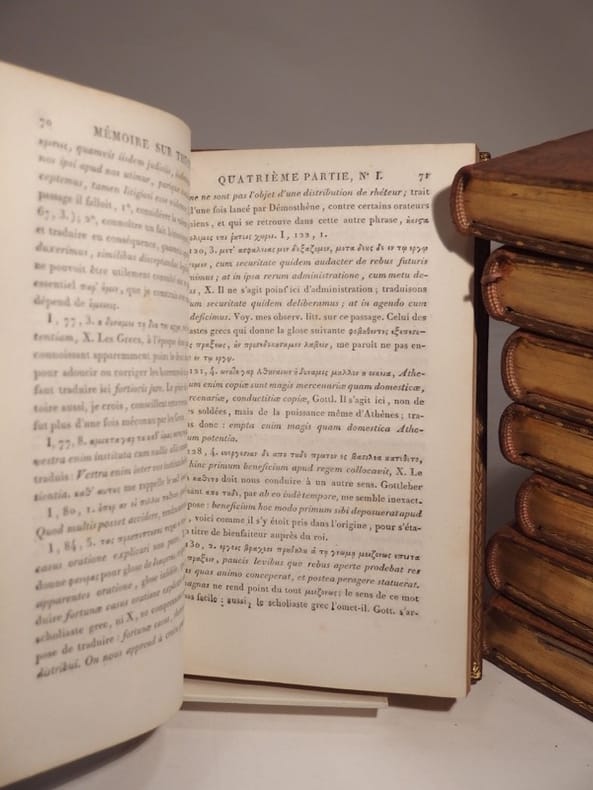
12652Paris, Gail Neveu (XIXe-XXVIe volume de la Collection in-8°), 1807(-1808). 8 volumes in-8, (4)-II-72-210-(2), (4)-263-(1)-203-(1), (4)-201-(1)-237-(1), (4)-181-(1)-297-(1), (4)-177-(1)-199-(1), (4)-IV-312, (4)-205-(1)-199-(1) et (4)-168-163-(1) pp., reliure de l'époque plein veau raciné (Bradel), dos ornés, Aigle impérial doré sur chaque plat ("Université impériale, Concours des Lycées de Paris"), toutes tranches dorées (dos un peu frottés, légères rousseurs). Texte en grec, latin et français. Etiquette de libraire au tome 1 : Brunot-Labbé, Libraire de l'Université Impériale.