69 résultats
185018991Dijon Frantin, Imprimeur De L'académie 1850 In-8 235 ( 4 planches) + 112 + 4 + 184 + 15 et 1 planche dépliante, couvertures conservées
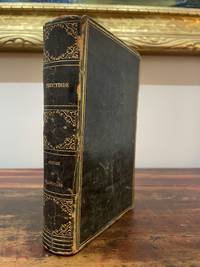
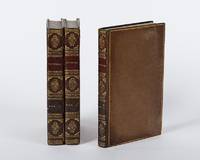
181132394AB1811. Bilingual Edition Greek-Latin. Three Volumes complete set. Oxford J.Parker 1811. Octavo. Pagination: Volume I:XXIV 440 pages / Volume II: 418 pages / Volume III: 266 pages plus 60 unnumbered pages of Index Rerum and Index Verborum. Hardcover / Original full leather with gilt lettering and ornament on spine and boards. Occasional annotations and textmarkings. Bindings rubbed and a little dusty but very firm and overall in very good condition with only minor signs of wear.Hinges all attached with only the front boards of Volume I and II slightly starting. Besides a few dogears a nd minor signs of only occasional foxing in very good condition. From the library of Daniel Conner Connerville / Manch House with his Exlibris / Bookplate to pastedown. This is a rare version of this text ! Thucydides c. 460 c. 400 BC was an Athenian historian and general. His History of the Peloponnesian War recounts the fifth-century BC war between Sparta and Athens until the year 411 BC. Thucydides has been dubbed the father of "scientific history" by those who accept his claims to have applied strict standards of impartiality and evidence-gathering and analysis of cause and effect without reference to intervention by the gods as outlined in his introduction to his work. Thucydides has been called the father of the school of political realism which views the political behaviour of individuals and the subsequent outcomes of relations between states as ultimately mediated by and constructed upon fear and self-interest. His text is still studied at universities and military colleges worldwide. The Melian dialogue is regarded as a seminal text of international relations theory while his version of Pericles's Funeral Oration is widely studied by political theorists historians and students of the classics. More generally Thucydides developed an understanding of human nature to explain behaviour in such crises as plagues massacres and wars. Thucydides believed that the Peloponnesian War represented an event of unmatched importance. As such he began to write the History at the onset of the war in 431 BC. He declared his intention was to write an account which would serve as "a possession for all time". The History breaks off near the end of the twenty-first year of the war 411 BC in the wake of the Athenian defeat at Syracuse and so does not elaborate on the final seven years of the conflict. The History of the Peloponnesian War continued to be modified well beyond the end of the war in 404 BC as exemplified by a reference at Book I.1.13 to the conclusion of the war. After his death Thucydides's History was subdivided into eight books: its modern title is the History of the Peloponnesian War. This subdivision was most likely made by librarians and archivists themselves being historians and scholars most likely working in the Library of Alexandria. Thucydides is generally regarded as one of the first true historians. Like his predecessor Herodotus known as "the father of history" Thucydides places a high value on eyewitness testimony and writes about events in which he probably took part. He also assiduously consulted written documents and interviewed participants about the events that he recorded. Unlike Herodotus whose stories often teach that a hubris invites the wrath of the deities Thucydides does not acknowledge divine intervention in human affairs. Thucydides exerted wide historiographical influence on subsequent Hellenistic and Roman historians although the exact description of his style in relation to many successive historians remains unclear. Readers in antiquity often placed the continuation of the stylistic legacy of the History in the writings of Thucydides's putative intellectual successor Xenophon. Such readings often described Xenophon's treatises as attempts to "finish" Thucydides's History. Many of these interpretations however have garnered significant scepticism among modern scholars such as Dillery who spurn the view of interpreting Xenophon qua Thucydides arguing that the latter's "modern" history defined as constructed based on literary and historical themes is antithetical to the former's account in the Hellenica which diverges from the Hellenic historiographical tradition in its absence of a preface or introduction to the text and the associated lack of an "overarching concept" unifying the history. A noteworthy difference between Thucydides's method of writing history and that of modern historians is Thucydides's inclusion of lengthy formal speeches that as he states were literary reconstructions rather than quotations of what was saidor perhaps what he believed ought to have been said. Arguably had he not done this the gist of what was said would not otherwise be known at allwhereas today there is a plethora of documentationwritten records archives and recording technology for historians to consult. Therefore Thucydides's method served to rescue his mostly oral sources from oblivion. We do not know how these historical figures spoke. Thucydides's recreation uses a heroic stylistic register. A celebrated example is Pericles' funeral oration which heaps honour on the dead and includes a defence of democracy: " The whole earth is the sepulchre of famous men; they are honoured not only by columns and inscriptions in their own land but in foreign nations on memorials graven not on stone but in the hearts and minds of men." Stylistically the placement of this passage also serves to heighten the contrast with the description of the plague in Athens immediately following it which graphically emphasises the horror of human mortality thereby conveying a powerful sense of verisimilitude: "Though many lay unburied birds and beasts would not touch them or died after tasting them . The bodies of dying men lay one upon another and half-dead creatures reeled about the streets and gathered round all the fountains in their longing for water. The sacred places also in which they had quartered themselves were full of corpses of persons who had died there just as they were; for as the disaster passed all bounds men not knowing what was to become of them became equally contemptuous of the property of and the dues to the deities. All the burial rites before in use were entirely upset and they buried the bodies as best they could. Many from want of the proper appliances through so many of their friends having died already had recourse to the most shameless sepultures: sometimes getting the start of those who had raised a pile they threw their own dead body upon the stranger's pyre and ignited it; sometimes they tossed the corpse which they were carrying on the top of another that was burning and so went off." Thucydides omits discussion of the arts literature or the social milieu in which the events in his book take place and in which he grew up. He saw himself as recording an event not a period and went to considerable lengths to exclude what he deemed frivolous or extraneous. Wikipedia hardcover
1889606CBBartenstein, Gebrüder Kraemer (= Programm Nummer 2), 1889. gr.8°, 21 S., original Heft mit Papierrückenstreifen, Erstausgabe schöner alter Stempel der Lehrerbibliothek eines alteingesessenen Frankfurter Gymnasium auf Titelseite, sonst sehr schöne kaum altersspurige Broschur (Li1, Ordner28)
1863RO20136295HACHETTE. 1863. In-12. Broché. Etat passable, Livré sans Couverture, Dos abîmé, Intérieur acceptable. 594 pages. Manque du 2e plat. Manque de la fin de la table des matières. Manque du dos initial. 1e plat abimé et taché.. . . . Classification Dewey : 880-Littératures helléniques. Littérature grecque
188714369United Kingdom: MacMillan & Co 1887. Hardcover. Very Good/NO Dustwrapper. 16mo - over 5¾" - 6¾" tall. being Books VI and VII of Thucydides with Notes. Text is in Greek with notes and introduction in English. MacMillan & Co. London 1887. map xviii 322 24pp publisher's catalogue hb No Dust-wrapper gilt red boards with school books embossed stamp on front cover covers scuffed & marked pages browned previous owner's details overall vg <br/> <br/> MacMillan & Co hardcover
1888K113119Lausanne, Imp. Corbaz & Régamey 1888 93pp., 23cm., br.orig., Thèse de licence présentée à la Faculté des Lettres de Lausanne, cachet au verso de la p.d.t., texte frais et en bon état, K113119
1880276339Verlag von Wilhelm Violet Leipzig 1880. Hardcover mit Leinenrücken und -ecken Kopffarbschnitt ohne Schutzumschlag 6 Bände Präparationen Homer: Die Ilias I-V Lysias: Reden gegen EratosthenosAgoratos Thucydides: 1. Buch Xenoph: Cyrop. I-III 1 Band Herodot: Histor. Lib. I. Demosthenes: philipp. Reden I-VIII Tacitus: Annalen Lib. I-II 2. Bd. Sophokles: Antigone XI Elektra I-VIII Aias II König Oedipus 3. Bd. Cicero: Catilin. I-IV Tusc. Disput. Lib. I-III Homer: Odyssee 1.2. Bd. Gesang I-XIIXIII-XXIV 5. Bd. Die Jahresangabe ist ungefähr. Zustand: Keine Beschädigungen keine Eintragungen. Rücken Ecken Kanten gut. Nachgebunden. Aus einer Klosterbibliothek mit Kennungen Stempel Rückenschild. Verlag von Wilhelm Violet, Leipzig, hardcover
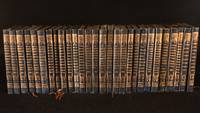
1897984N23London: J.M Dent and Sons 1897-1939. Cloth. Very Good. 6" by 4". Various. A grand collection of The Temple Classics thirty-three books of twelve selected works that are praised for their significance and longevity. A grand collection of The Temple Classics an array of popular classical literature selected for their significance and longevity. All published by J.M Dent and Sons between 1897-1939. Edited by Israel Gollancz a professor of English Language and Literature at King's College London. Scarce as such a large set.<br /><br />In the publisher's original blue cloth with a charming frontispiece at the beginning of every volume. Collated complete.<br /><br />The Life of Samuel Johnson by James Boswell. Volumes 1-6. Published in 1897.<br />The Essayes of Michael Lord of Montaigne translated by John Florio. Volumes 1-6. Published in 1897.<br />The Journal of a Tour to the Hebrides with Samuel Johnson. Published in 1898. Contains a folding map as the frontispiece. <br />The Golden Legend or Live of the Saints as Englished by William Caxton. Volumes 1-7. Published in 1900.<br />The Rule and Exercises of Holy Living by Jeremy Taylor. Volume 2 published in 1900. A complete edition published in 1901. Includes advertisements from Dent and Sons to end papers.<br />A Journal of the Plague Year by Daniel Defoe. Published in 1900.<br />The Natural History of Selborne by Gilbert White. Published in 1901.<br />Thucydides' Peloponnesian War translated by Richard Crawley: Volume 2. Published in 1903.<br />The Hellenics and Gebir of Walter Savage Landor. Published in 1908.<br />The Little Flowers of Saint Francis of Assisi newly translated out of the Italian by T.W. Arnold. Published in 1926.<br />The Gul's Hornbook and The Belman of London in Two Parts by Thomas Dekker. Published in 1928.<br /><br />Another The Golden Legend or Live of the Saints as Englished by William Caxton. Volumes 1-3 and 5-7. Volumes 5 is a 1900 original while volumes 1-3 and 6 are 1930's reprints. In the publisher's original blue cloth. Externally very smart with the odd mark to boards. Small signs of shelf wear to head and tail of spines. Slight bruising to board extremities of Selborne Montaigne volumes 6 and 4 and Life of Johnson volume 2. Offsetting to end papers and the occasional spot. Browning to original advertisements in both Taylors. Internally firmly bound. Pages are bright and clean. Very Good J.M Dent and Sons hardcover
1890448CBLiegnitz, Oskar Heinze (= Programm-Nr. 189), 1890. gr.8°, 32 S., original Heft mit Papierrückenstreifen, Erstausgabe schöner alter Stempel der Lehrerbibliothek eines alteingesessenen Frankfurter Gymnasiums auf Titelseite, sonst schöne kaum altersspurige Broschur (Li1, Ordner25)
1844M3215MSPhiladelphia PA: Thomas Wardle 1844. 344 pp. Original brown cloth covers stamped in blind w/ gilt title on spine. Binding moderately soiled and rubbed. Corners and spine ends bumped and worn. Previous owner's name to top corner of front blank endpaper. Light to moderate foxing throughout. Illust. w/ a frontispiece of Thucydides. Hard Cover. Good to Very Good/No Dust Jacket. 8vo - over 7¾" - 9¾" tall. Thomas Wardle Hardcover
1864ROD0007607Jules DELALAIN. 1864. In-12. Cartonnage d'éditeurs. Etat d'usage, Tâchée, Dos frotté, Intérieur frais. 152 pp., tranches écrites, manque de papier sur le 2è plat - 1 PHOTO DISPONIBLE.. . . . Classification Dewey : 480-Langues helléniques. Grec
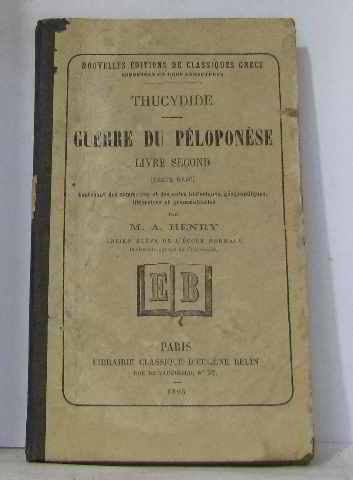
1867137983Eugène belin 1867 97 pages in12. 1867. Cartonné. 97 pages. Bilingue grec-français
185362666Ensemble de 4 tomes avec couverture verte souple et imprimée. Dos ridés avec manques plus ou moins importants. Usure avancée des couvertures avec manques plus ou moins importants selon les exemplaires. Pages non-coupées. Papier bruni. Auréoles et piqures sur les pages.
18635405Paris: L. Hachette ET Cie 1863. First Edition. Very Good. Traduction Nouvelle avec une Introduction et des Notes par E.-A. Bétant Derecteur du Gymnase de Genève. First edition of this popular French translation of Thucydides' 'History of the Peloponnesian War.' Bound in contemporary green stained leather over boards with gilded double rule border on front and rear. With gilding on the spine. General wear rubbing to edges chipping at head of spine and creasing; square and solidly bound. Marbled end papers 2 aged ink notes on first blank. Infrequent marginal section indicators in aged ink and minor and light infrequent spotting. Overall very good condition and complete with blanks at front and rear. <br /> <br /> Pages: 6 8 595 Dimensions: 71/8 x 4¾ x 13/8. L. Hachette ET C(ie) unknown
1869160912Paris Librairie de Louis Hachette & cie. 1869 595p 1 volume IN8. Reliure d'époque en demi basane noire à coins. Dos à nerfs titré (coiffe arrachée). Traduction nouvelle avec une introduction et des notes par E.A Bétant. Deuxième édition.
1852RES42L1Paris Charpentier 1852 In12 Tome 1 - Belle demi basane - dos lisse avec titres et filets dorés - 463 pages - rousseurs - bon etat
1869696081869 Paris, Librairie de L. Hachette et cie, 1869, In-douze, 11,5*18,7, 595 pp, Reliure en demi-veau blond, tête rouge,dos à cinq nerfs orné de caissons, bon état,
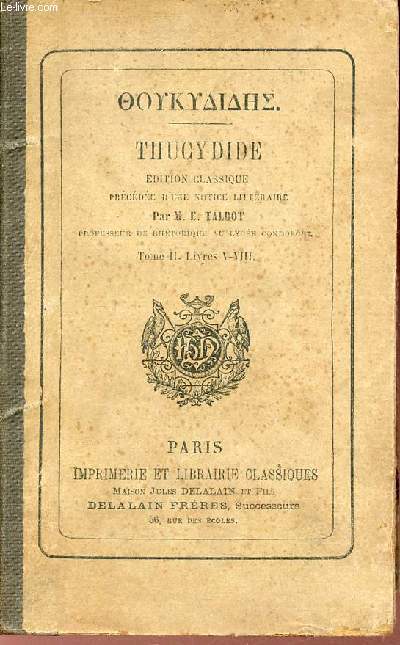
1887R320139490Delalain Frères. 1887. In-12. Cartonné. Etat d'usage, Couv. légèrement passée, Dos satisfaisant, Quelques rousseurs. 335 pages - quelques rousseurs à l'intérieur de l'ouvrage sans conséquence sur la lecture - ouvrage en grec - petite annotation sur le 1er plat - rousseurs sur les plats - coins frottés.. . . . Classification Dewey : 880-Littératures helléniques. Littérature grecque
19005vHb0055Paris France: Librairie Hachette 1900. Book. Good. Decorative Hardcover. Copyright 1900. 16mo or 16° Sextodecimo: 5¾" x 6¾" tall. 288 pp. Solidly bound copy with moderate external wear. Moderate foxing on page edges. No dj. Text in Greek and French. Slightly bumped cover board corners. Librairie Hachette Hardcover
1893R320015562CHARPENTIER / FASQUELLE. 1893. In-12. Relié demi-cuir. Etat d'usage, Coins frottés, Coiffe en tête abîmée, Intérieur acceptable. XIX + 461 pages et 407 pages - Plats intérieurs et extérieurs et tranches marbrés - Dos a 5 nerfs - Auteur, titre, tomaisons, fleurons et filets dorés (fané) - Tome I : coiffe en tête et pied arrachées.. . . . Classification Dewey : 930-Histoire générale du monde ancien jusqu'à 499 apr. J.-C.
183688296A. Desrez, Libraire-éditeur 1836 In-4. Reliure de l’époque, demi-basane fauve, dos lisse orné de roulettes dorées, de filets et de petits fers dorés, XVI-818 pp., cac-similé et carte repliés hors texte. Reliure frottée, coiffe de tête arrachée, rousseurs marginales, intérieur correct.
188665761886 Paris: Hachette, 1886. 1 vol.: in-8, XXVIII-468 p. Précédé des Vies de Thucydide par Marcellinus et par l'anonyme, et de la notice de Suidas. Reliure en demi-chagrin caramel. Dos à quatre nerfs avec pièce de titre en basane glacée verte et orné de fleurons dorés. Plats et gardes recouverts de papier marbré. Tranche sup. rouge. Dos légèrement décoloré. Bel exemplaire.
1886RO40259323Librairie Hachette et Cie, Paris. 1886. In-8. Relié. Etat passable, Plats abîmés, Mors fendus, Quelques rousseurs. 467 pages. Texte en grec ancien, Introduction et Notes (sur 2 colonnes) en français. Titre, roulettes et filets dorés sur le dos. Etiquette de code sur la couverture. Quelques tampons de bibliothèque. Fortes épidermures sur le dos, avec également un manque important. Plats très frottés et tachés, avec de nombreux manques. Annotations en page de faux-titre (ex-libris). Nombreuses annotations dans le texte (ouvrage de travail).. . . . Classification Dewey : 480-Langues helléniques. Grec
1833RO40242384Typographie de Firmin Didot Frères, Paris. 1833. In-8. Broché. Etat d'usage, 2ème plat abîmé, Dos abîmé, Quelques rousseurs. 480 + 54 pages. Texte en grec ancien et en français en regard. Illustré de quelques cartes dépliables en noir et blanc. Etiquette de code sur la couverture. Quelques tampons de bibliothèque. Dos fendu.. . . . Classification Dewey : 480-Langues helléniques. Grec