Steinbeck, JohnBiblio.com
4 050 résultats
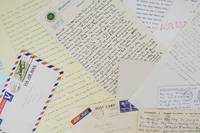
1966140946326Various places: No Publisher 1966. A vast archive of correspondence featuring approximately 395 letters postcards and correspondences from the iconic American author John Steinbeck sent to family members over the course of twenty-nine years. The scope is incredible spanning from the publication of his masterpiece Of Mice and Men to two years before his death. Provenance: from the estate of John’s sister Mary Dekker Steinbeck. <p>The bulk of John’s correspondence over 300 letters is written to his younger and much-adored sister Mary. These letters span a sweeping twenty-eight year period beginning in 1937 and continue until right before Mary’s death in 1965. <p>The remainder of John’s letters are written to other family members primarily his sisters Beth and Esther Mary’s daughter Joan and her husband David Heyler. These letters continue up until 1966. <p>The majority of the letters and postcards are autograph though roughly 93 are typed or typed and signed; including roughly 14 typed and sent in triplicate by John to his three sisters. The vast majority of John’s letters are accompanied by their original transmittal envelopes—over the years postmarks come from various locations such as New York City Sag Harbor California Mexico the Virgin Islands Europe and more detailing John’s life by location. <br /> The condition varies but most range from Near Fine to Very Good. A spreadsheet of the contents can be provided upon request. A partial transcription is available as well serious inquiries only. <p>The archive additionally includes 165 pieces of communication from other family members mostly sent within the family and a small assortment of ephemera. The majority of these peripheral letters were sent by John’s second wife Gwyn Conger Steinbeck m. 1943-1948 and third Elaine Steinbeck m. 1950-1968 to Mary. These correspondences begin in 1940 when William Bill Dekker a World War I pilot sends his wife Mary a letter home. Bill would disappear in action over Italy in July 1943 and John would detail attempts he made overseas with his military correspondent connections to locate Bill in letters he sent Mary. The family letters stretch onward until 1997 nearly 30 years after John died with letters from Elaine written to Joan and David. <p>Included in the assorted ephemera is a note from Mary to John’s editor and friend Pat Covici on the necessity of the title East of Eden notes two typescripts seven snapshot photographs depicting John and several others on a boat and one depicting John in a yard being greeted by a dog. Several telegrams are present; including the one John sent to Mary relaying the news of the birth of his second son John IV June 12 1946: “A BOY BOTH FINE 5 POUNDS 4 OUNCES. LOVE= JOHNâ€. <p>These letters portray a sweeping and intimate look at Steinbeck’s life as told in his own words and the words of those closest to him through deeply personal letters covering his private and professional life during his most artistically productive years. He ranges over countless topics from the mundane minutia of daily life such as stockpiling meat in his new deep freeze to save a few pennies per pound should meat prices raise to the profound—childhood memories the births of his sons the collapse of his marriage to Gwyn his grappling with depression mortality and much more. Despite John’s worldwide acclaim and success winning both the Pulitzer and Nobel Prizes his nostalgic thoughts often drift back to a green cliff overlooking the Carmel River of his youth. <br /> He writes at length of his professional life his work and milestones from being a war correspondent to novelist and playwright. He expounds on the ups and downs of his writing process—from research to starting new work becoming frustrated and throwing work out finishing work and starting again. <p>Collections of this magnitude and breadth regarding such a major American author are virtually unobtainable in the marketplace with most material already held by institutions. Because this correspondence comes from family members it offers a much more intimate and private look into the life of John Steinbeck than otherwise available. Despite his prolificacy he never wrote an autobiography and these intimate letters offer insights available no other way. [No Publisher] unknown
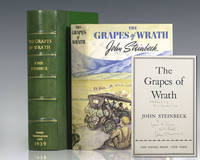
193916902JNew York: Viking Press 1939. First Edition First Issue. With a remarkable poignant inscription written by John Steinbeck in blue ink on the half title: “’My man is in jail fo’ striken’: / It ain’t against the law! / My boy is in jail fo’ strikin’ / It ain’t against the Law! / We say - ‘Plead Not Guilty / And rot they damned jail down’. From a speech by a woman cotton picker Cotton Strike Shafter Calif. 1938 / John Steinbeck.†Near fine in a near fine first issue dust jacket. Enclosed in custom clamshell box. An American literary landmark winner of the Pulitzer Prize and the basis of the acclaimed motion picture starring Henry Fonda directed by John Ford. Viking Press unknown
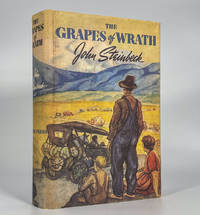
1939ST18154New York: The Viking Press 1939. FIRST EDITION First Printing with the words "First Published in April 1939" printed on the copyright page. 210 x 135 mm. 8 1/4 x 5 3/8". 3 p.l. 619 pp. <br/> Publisher's pictorial linen endpapers printed with the sheet music for "Battle Hymn of the Republic." In the original unclipped dust jacket displaying the $2.75 price and "First Edition." In a fine modern blue calf clamshell box. Goldstone-Payne A12.a. A PRISTINE COPY.<br/> <br/> Published when America was still deep in the Great Depression "The Grapes of Wrath" is a novel detailing the heartbreak of rural dispossession and a work that in the words of ANB "captured the decade's angst as well as the nation's legacy of fierce individualism visionary prosperity and determined westward movement." In citing it as one of the "Books that Shaped America" the Library of Congress noted "Few novels can claim that their message led to actual legislation but 'The Grapes of Wrath' did just that. Its story of the travails of Oklahoma migrants . . . ignited a movement in Congress to pass laws benefiting farmworkers. When Steinbeck won the Nobel Prize in 1962 the committee specifically cited this novel as one of the main reasons for the award." The novel won the Pulitzer Prize in 1940 and was printed in a large press run making it readily available at the time and ever since. But the present unsurpassably fine copy of Steinbeck's greatest work is almost literally from a time capsule: it is one of a dozen or so copies discovered in a warehouse in the 1980s still in their unopened boxes from Viking Press. While the copies at the bottom of the box had suffered some water damage those in the upper layers like the present one look unchanged from the day they were packed by the publisher. While there are numerous copies of this book currently on the market the condition here sets it far above the competition. It is certainly the finest copy of any important modern first edition we have ever offered for sale. The Viking Press unknown
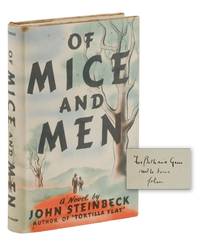
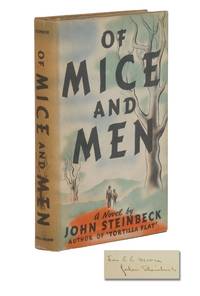
1937140948912New York: Covici Friede 1937. First Edition. Near Fine/Near Fine. A family presentation copy inscribed by John Steinbeck on the front free endpaper to his sister Beth and her husband Eugene Ainsworth; Beth's bookplate to front pastedown. First edition first printing first issue with "pendula" on page 9 and a bullet between the two 8's of the page number on page 88. <p>186 pp. Bound in publisher's tan cloth stamped in orange and black blue topstain. Near Fine with foxing to cloth textblock edges endpapers and intermittently throughout. In a Near Fine unclipped dust jacket with soft creasing to front and rear panels with a short closed tear at the bottom edge of the front light wear foxing and toning. Goldstone & Payne A7.a.<p>One of just 2500 copies printed in the first issue given by the author to his beloved older sister whom he held up as a model of integrity in the dedication to Winter of Our Discontent: "To Beth my sister whose light burns clear." Steinbeck was satisfied with his novella about the struggles of two itinerant farm workers but he didn't expect the book to make any money. It ended up selling 117000 copies in less than a month. The story was originally intended for children and The Times called it a "fairy tale" in its review. The novella is now assigned to grade school students across the country as their first introduction to Steinbeck. Covici Friede unknown
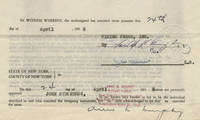
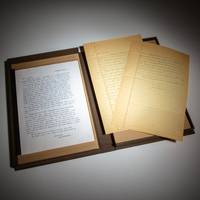
19391665624/04/1939. <blockquote><p>“The undersigned Viking Press Inc. and John Steinbeck hereby sells grants conveys and assigns to the Twentieth Century Fox Film Corporation…talking motion picture rights…that he may have in and to the original composition entitled “The Grapes of Wrathâ€â€¦â€ A unique and compelling piece of American cinematic history</p><p> </p><p><iframe src=""https://player.vimeo.com/video/258864368"" width=""640"" height=""360"" frameborder=""0"" allowfullscreen=""allowfullscreen""></iframe></p></blockquote><p>“The Grapes of Wrath†won the Pulitzer Prize and National Book Award for fiction in 1940 and helped John Steinbeck earn the Nobel Prize awarded him in 1962 which turned on the “keen social perception†in this book. At the time of the Dust Bowl when hundreds of thousands of Americans migrated to the West Coast mainly California in search of a better life Steinbeck was writing a series of seven articles about migrant worker communities for the San Francisco Chronicle. He spent a lot of time getting to know families who lived in various migrant worker camps in towns like Bakersfield and Visalia and was angered and disgusted by the amount of heartbreak and suffering that he witnessed. He channeled those emotions as he wrote his classic - “The Grapes of Wrathâ€.</p><p>Published in 1939 by Viking Press “The Grapes of Wrath†vividly portrays life during the Great Depression and the Dust Bowl in America as it follows a family of Oklahoma tenant farmers driven from their home by drought economic hardship agricultural industry changes and bank foreclosures forcing tenant farmers out of work. The family traveled westward to California seeking jobs land dignity and a future. It explores the strength and goodness of the human spirit in the face of gruesome truly dismal circumstances.</p><p>This novel had a profound impact in America. Many people applauded Steinbeck for capturing so honestly the lives of migrant farm workers during the Depression and starkly pointing out conditions they faced. There were calls for social action in response. Eleanor Roosevelt took interest and as a result she called for congressional hearings on migrant worker camp conditions. Labor laws were changed. Others accused Steinbeck of being a socialist and of championing leftist beliefs.</p><p>Confident that the book would be a smash hit Hollywood rushed to make a film on the book even as it first hit the book shops. The film they made “The Grapes of Wrath†is widely considered one of the greatest films of all time. It was produced by Darryl F. Zanuck for Twentieth Century Fox directed by John Ford and starred Henry Fonda and Jane Darwell. It was nominated for seven Academy Awards including for Best Picture Actor Fonda Film Editing Sound and Writing. Ford won the Best Director Oscar and actress Darwell won Best Actress for her portrayal of Ma Joad. In 1989 “The Grapes of Wrath†was one of the first 25 films to be selected for preservation by the Library of Congress for its U.S. National Film Registry as being ""culturally historically or aesthetically significant.â€</p><p>This is the original contract in which Twentieth Century Fox obtained the rights from John Steinbeck and Viking Press to make the film “The Grapes of Wrathâ€. It is one of the most important if not the most important piece of American film history to ever reach the market.</p><p><strong>Document signed</strong> on Twentieth Century Fox’s own stationery one sheet with text on both sides New York April 24 1939 just days after the novel's initial release. It provides<em>: “…the undersigned Viking Press Inc. and John Steinbeck hereby sells grants conveys and assigns to the Twentieth Century Fox Film Corporation…the right title and interest of the undersigned throughout the world in and to the silent sound and dialogue and talking motion picture rights…that he may have in and to the original composition entitled “The Grapes of Wrathâ€â€¦â€</em> It identifies the author as John Steinbeck the publisher as Viking Press and gives the copyright date as April 16 1939. Steinbeck and the president of Viking Press Harold Guinzberg have signed at the conclusion on the verso and the contract has been notarized there the notary stating that Steinbeck had personally appeared before her.</p> unknown
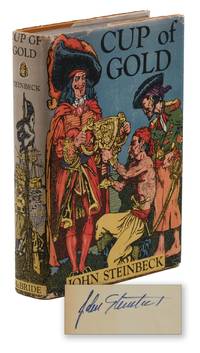
1929140947494New York: Robert M. McBride & Company 1929. First Edition. Near Fine/Near Fine. First edition first printing first issue. Association copy signed by John Steinbeck on the front free endpaper. From the collection of the author's sister Olive Esther Steinbeck Rodgers with Steinbeck Family bookplate to front pastedown. vi 269 pp. Bound in publisher's yellow cloth lettered in black blue topstain. Near Fine with slight lean to spine and light edgewear light toning to contents. Offsetting to front free endpaper from contemporary newspaper clipping advertising novel laid in. Additional gift inscription and owner bookplate to front endpapers. In a Near Fine unclipped dust jacket with with light edgewear and rubbing fading to spine panel and several surface scratches to rear panel. <p>An association copy of Steinbeck's scarce first novel. The book was published in a print run of just 2476 copies of which 939 were remaindered and reissued in 1936; this copy came from the collection of Steinbeck's older sister. Goldstone-Payne A1.a. Robert M. McBride & Company unknown
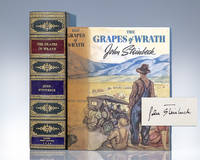
1939140947496New York: The Viking Press 1939. First Edition. Near Fine/Very Good. First edition first printing. Signed by John Steinbeck on the front free endpaper and inscribed "affectionately" to Edna Goss. Goldstone-Payne A12. vi 619 pp. Bound in publisher's oatmeal cloth with pictorial brown stamping yellow topstain. "Battle Hymn of the Republic" printed endpapers. Near Fine with light rubbing to cloth very light soiling to textblock edges bookseller ticket to back pastedown. In a Very Good dust jacket price-clipped but with "First Edition" statement on front flap; with light rubbing and edgewear 2 tears along flap folds and light staining. Housed in a custom leather clamshell case printed with the dust jacket painting by Elmer Hader signed by Papuchian H&H Bindery. <p>A scarce signed first printing of Steinbeck's Pulitzer Prize-winning novel of the Great Depression. The Viking Press unknown
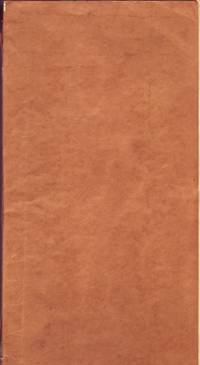
JD29396first edition. n.p. NY n.p. The Viking Press n.d. 1944 first edition wrappers. Softcover. <br/><br/> Advance copy an uncorrected galley proof bound in plain unprinted tannish wrappers printed on rectos only a very scarce advanced state of this minor or not so minor Steinbeck masterpiece whose themes of death and loneliness are masked by its surface layer of humor all the more rare in that this is an Author Presentation Copy Inscribed by Steinbeck to the best man at his second marriage Howard O. Hunter who was the Works Progress Administration WPA commissioner in the early 1940s under the FDR administration Steinbeck and his second wife Gwen Conger were married March 29 1943 just 11 days after receiving his final divorce decree from his first wife Carol Steinbeck has Inscribed the first preliminary as follows "For Howard/who really/belongs in/Cannery Row/John Steinbeck/last night in New York 1944" this galley lacks all the preliminaries found in the 1945 published version such as half titles title page copyright page dedication page etc. although not specifically cited in Goldstone & Payne there is a notation under G&P A22a that "a copy of the unrevised galley proofs is in the Humanities Research Center at the University of Texas" see Morrow 172 that copy with a yellow label on front giving publication date and price that is not on this copy--the Morrow copy was not signed or inscribed now housed in a beautiful custom clamshell case with leather spine laid in loosely is a letter of provenance from Ellen Leonard who was given this proof by Hunter's wife Edna. This was bound for in-house use by Viking and not for sale thus it was never meant to be in great condition even when new spine ends are chipped there is offsetting from printed pages onto the previous verso some pages are becoming dis-bound. hardcover books
195218857New York: New York Times Magazine 1952. Handwritten Manuscript. Paper. Near fine. Handwritten by John Steinbeck parts two and three of his three-part article for The New York Times Magazine titled "Autobiography: Making of a New Yorker." Together with three autograph letters signed by Steinbeck to NYTM editor Seymour Peck and o. In total this collection includes 12 legal page leaves written in pencil by Steinbeck on rectos only and one typed letter from his editor. All in near fine condition with faint toning to edges and small paperclip indentations. Goldstone & Payne C90 article With an 11-page typed transcription of the drafts and letters bound in chronological order of appearance. Housed in a custom brown cloth clamshell case title printed on paper label affixed to spine. Provenance: Christie's 1986; Christie's 1999<br /> <br /> John Steinbeck's article "Autobiography: Making of a New Yorker" begins in Part One not included here with his first unhappy and short-lived experience in New York City in 1925 at the age of 23.<br /> Part Two handwritten here details his second "assault on New York" in the fall of 1935 in which he begrudgingly transforms from a "Country Boy" into a true "New Yorker." At first Steinbeck writes: "It is so strange to look back. I was going to live in New York but I was going to avoid it." Near the end of the installment his anecdotes change. He writes: "Everything fell into place. I saw every face I passed. It was beautiful - but most important - I was part of it I was no longer a stranger."<br /> In the final section handwritten here Steinbeck describes the broad dichotomy of the city and romanticizes city life. He writes: "New York is an ugly city a dirty city. Its climate is a scandal its politics are used to frighten children its traffic is madness its competition is murderous. But. once you have lived in New York and it has become your home - no place else is good enough. All of everything is concentrated here population theatre art painting publishing importing business murder mugging luxury poverty. It is all of everything."<br /> The correspondence between Steinbeck and NYTM editor Seymour Peck primarily discusses deadlines for the article drafts. In the first letter Steinbeck tells Peck of his plans for the three-part article. Peck responds on November 26 1952 asking for all writing to be completed by December 24 1952. The second letter is inserted at the end of Part Two informing Peck that Part Three will be along shortly. The third letter dated December 17 1952 accompanies Part Three in which Steinbeck says the article "isn't very good but it is heart-felt."<br /> <br /> A truly exceptional collection of autobiographical writings from a classic American author. Despite his reputation as a Californian John Steinbeck spent nearly half his life living in New York City. In 1925 he left Stanford University without a degree and moved to the city for roughly one year. He returned to New York with his then-girlfriend Gwen living for a while in Sneden's Landing. They stayed in New York until the birth of his first son Thom and the publication of Cannery Row 1945. He later returned to the East Coast with his third wife Elaine and bought a home in Sag Harbor in 1955. Steinbeck remained in New York City until his death in 1968. [New York Times Magazine] unknown
193979419New York:: The Viking Press 1939. First edition. publisher's illustrated cloth in the correct dust jacket with "First Edition" at the bottom of the front flap. Preserved in a custom quarter leather folding clamshell box. A very fine copy in a very fine jacket. 8vo. This is one of perhaps twelve to fifteen copies that were uncovered in a warehouse in the early to mid-1970s or 80s. They were in two cartons from The Viking Press which had never been opened. The Viking Press, hardcover
19392302028New York: Viking 1939. First. hardcover. Fine/Fine. A fine first edition in a fine first issue dust jacket. A virtually flawless copy very rare in this pristine condition. Housed in a custom-made collectors foldout case. Viking unknown
19391287161939. First Edition. STEINBECK John. The Grapes of Wrath. New York: Viking 1939. Octavo original pictorial beige cloth illustrated endpapers original dust jacket. Housed in a custom clamshell box. $28500.First edition first issue of Steinbeck's most important novel his searing masterpiece of moral outrage and ""intense humanity"" winner of the 1940 Pulitzer Prize.""It is a long novel the longest that Steinbeck has written and yet it reads as if it had been composed in a flash ripped off the typewriter and delivered to the public as an ultimatum Steinbeck has written a novel from the depths of his heart with a sincerity seldom equaled"" Peter Monro Jack. ""The Grapes of Wrath is the kind of art that's poured out of a crucible in which are mingled pity and indignation Its power and importance do not lie in its political insight but in its intense humanity It is the American novel of the season probably the year possibly the decade"" Clifton Fadiman. First issue with ""First Published in April 1939"" on copyright page and first edition notice on front flap of dust jacket. Goldstone & Payne A12a. Salinas Public Library 29. Bruccoli & Clark I:354. Slight discoloration to cloth along spine joints much less than typical; jacket bright and beautiful with only faintest toning along top margin. A stunning copy most rare in this condition. hardcover
JD29396n.p. NY n.p. The Viking Press n.d. 1944 first edition wrappers. Softcover. Advance copy an uncorrected galley proof bound in plain unprinted tannish wrappers printed on rectos only a very scarce advanced state of this minor or not so minor Steinbeck masterpiece whose themes of death and loneliness are masked by its surface layer of humor all the more rare in that this is an Author Presentation Copy Inscribed by Steinbeck to the best man at his second marriage Howard O. Hunter who was the Works Progress Administration WPA commissioner in the early 1940s under the FDR administration Steinbeck and his second wife Gwen Conger were married March 29 1943 just 11 days after receiving his final divorce decree from his first wife Carol Steinbeck has Inscribed the first preliminary as follows "For Howard/who really/belongs in/Cannery Row/John Steinbeck/last night in New York 1944" this galley lacks all the preliminaries found in the 1945 published version such as half titles title page copyright page dedication page etc. although not specifically cited in Goldstone & Payne there is a notation under G&P A22a that "a copy of the unrevised galley proofs is in the Humanities Research Center at the University of Texas" see Morrow 172 that copy with a yellow label on front giving publication date and price that is not on this copy--the Morrow copy was not signed or inscribed now housed in a beautiful custom clamshell case with leather spine laid in loosely is a letter of provenance from Ellen Leonard who was given this proof by Hunter's wife Edna. This was bound for in-house use by Viking and not for sale thus it was never meant to be in great condition even when new spine ends are chipped there is offsetting from printed pages onto the previous verso some pages are becoming dis-bound. n.p. (NY), n.p. (The Viking Press), n.d. (1944), first edition, wrappers. Softcover. paperback
69902in the original frames; about 17 x 12 inches to 18 x 16 inches overall. Some nicks and use to the frames; one coin-sized tidemark and some extremely light foxing to the portrait of Ma Joad; portraits otherwise fine. Various sizes. From the estate of Elizabeth Ainsworth the author's sister. These portraits were issued separately in collection with the 1940 release of the Limited Edition Club's edition of the novel illustrated by Benton. They were presented to Steinbeck by the artist at that time and remained in Steinbeck's possession for the rest of his life. unknown
1929319434New York: Robert M. McBride 1929. First edition first issue of the author's first book. vi 269 3 pp. 1 vols. 8vo. Original yellow cloth titled in black on front cover and spine top edge stained blue; pictorial dust jacket designed by Mahlon Blaine with $2.50 price present; tan cloth slipcase. The cloth in unusually bright condition; the jacket spine panel lightly faded and with wear at ends affective the lettering of the title a few abrasions to front and back panels. Despite these flaws a bright and entirely original copy of a book infrequently found in collector's condition. First edition first issue of the author's first book. vi 269 3 pp. 1 vols. 8vo. FIRST EDITION of the future Nobel laureate's elusive first book published when he was 27 years old. One of 1537 copies the publisher printed 2476 copies 939 of which were remaindered as unbound sheets. This was Steinbeck's fourth attempt at a novel and was rewritten six times from an unpublished story titled "A Lady in Infra-Red" which he composed while at Stanford. "Aside from a few reviews the only early recognition . was Berton Braley's 'thanks and acknowledgements' for Steinbeck's permission to use some of the incidents in a doggerel epic 'Morgan Sails the Caribbean' 1934" Peter Lisca 'The Wide World of John Steinbeck' Rutgers UP 1958. Goldstone & Payne A1a Robert M. McBride unknown books
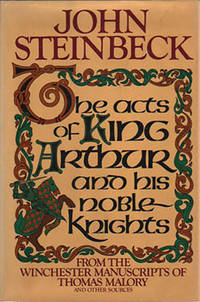
JD30866first edition. <br/><br/> This is a group of three carbon typescripts all with holographic corrections by Steinbeck and one carbon manuscript that comprise three chapters of what Farrar Straus & Giroux published as The Acts of King Arthur and His Nobel Knights in 1976 eight years after the death of Steinbeck and 17 years after the 1959 date these chapters were written the chapters are The Knight With The Two SwordsGawain Ewain and Marhalt and The Noble Tale of Sir Lancelot of the Lake this typescript and manuscript material totals 348 leafs on typing paper and sheets of lined legal-sized yellow notepaper housed within a green marbled custom folding box with leather spine with author's name and title in gilt are the carbon manuscript of The Noble Tale of Sir Lancelot of the Lake 81 leafs numbered 19-100 followed by 168 leafs of carbon typescript for this chapter with notes in Steinbeck's hand together with a blue marbled custom folding box with leather spine with author and title in gilt that houses the carbon typescript for The Knight With The Two Swords dated May 16 1959 being 22 leafs with many penciled corrections deletions and revisions by Steinbeck followed by Gawain Ewain and Marhalt noted in pencil as Section 5 and dated July 1959 being 72 leafs also with many ink corrections deletions and revisions in Steinbeck's hand Steinbeck's fascination with King Arthur began when his Aunt Mollie gave him a copy of The Boy's King Arthur when he was eight years old that book began a life-long affair with the written word and to his continued study of King Arthur he eventually tried to "translate" Arthur into modern English which Farrar Straus & Giroux eventually published after his death in his own introduction for that book Steinbeck wrote "I remember that words -- written or printed -- were devils and books because they gave me pain were my enemies.And then one day an aunt gave me a book and fatuously ignored my resentment. I stared at the black print with hatred and then gradually the pages opened and let me in. The magic happened.I think my sense of right and wrong my feelings of noblesse oblige and any thought I may have against the oppressor and for the oppressed came from this secret book". Expected wear. hardcover books
1939119562New York: The Viking Press 1939. First edition with "First Published in April 1939" on copyright page and first edition notice on the front flap of the dust jacket. Octavo original beige cloth. Association copy playfully inscribed by the author on the title page "Continuing the tradition. To John H. Lyon go to hell! John Steinbeck." The recipient was John Henry Hobart Lyon an English professor at Columbia University and a friend of Steinbeck's. "Great names usually come in clusters for one creative scholar attracts others to work with him. The unforgettable Professor John Henry Hobart Lyon stirs his students by his lectures on Shakespeare romantic literature and the world's masterpieces" Coon p. 33. Lyon also taught a popular course called "Literature of Today" for which he invited well-known contemporary authors to lecture. Among those who appeared were Thomas Mann Kenneth Roberts Orson Welles Stephen Benet Erskine Caldwell Somerset Maugham Moss Hart and Eleanor Roosevelt. Near fine in a near fine dust jacket with a touch of shelfwear. Jacket design by Elmer Hader. Housed in a custom half morocco clamshell box. An exceptional example with noted provenance. "The Grapes of Wrath is the kind of art thats poured out of a crucible in which are mingled pity and indignation Its power and importance do not lie in its political insight but in its intense humanity It is the American novel of the season probably the year possibly the decade" Clifton Fadiman. It is the basis for the 1940 John Ford directed film bearing the same name starring Henry Fonda. It is widely considered as one of the greatest American films of all time. In 1989 this film was one of the first 25 films to be selected for preservation in the United States National Film Registry by the Library of Congress as being "culturally historically or aesthetically significant." Listed by Modern Library as one of the 100 best novels of the twentieth century. The Viking Press hardcover books
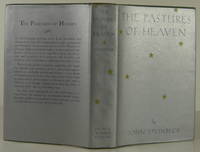
19321114023Brewer Warren and Putnam 1932. 1st Edition. Hardcover. Fine/Near Fine. NY Brewer Warren & Putnam 1932 1932. NY Brewer Warren & Putnam 1932 first edition dust jacket. Hardcover. His second book Goldstone & Payne A2a Morrow 14 this first edition is one of only 1650 copies actually bound from a print-run of 2500 sets of sheets only 650 copies were actually sold. According to Harry Thornton Moore in his first critical study of Steinbeck's works The Pastures of Heaven "is the most popular of Steinbeck's three early books. It points the way to most of his subsequent writing. Near fine in a near fine dust jacket. Jacket 2 mm shorter than the book. Housed in a custom-made collectors slipcase. Brewer, Warren and Putnam hardcover books
1929319434New York: Robert M. McBride 1929. First edition first issue of the author's first book. vi 269 3 pp. 1 vols. 8vo. Original yellow cloth titled in black on front cover and spine top edge stained blue; pictorial dust jacket designed by Mahlon Blaine with $2.50 price present; tan cloth slipcase. The cloth in unusually bright condition; the jacket spine panel lightly faded and with wear at ends touching the top of titling a few abrasions to front and back panels. Despite these flaws a bright and entirely original copy of a book infrequently found in collector's condition. First edition first issue of the author's first book. vi 269 3 pp. 1 vols. 8vo. FIRST EDITION of the future Nobel laureate's elusive first book published when he was 27 years old. One of 1537 copies the publisher printed 2476 copies 939 of which were remaindered as unbound sheets. This was Steinbeck's fourth attempt at a novel and was rewritten six times from an unpublished story titled "A Lady in Infra-Red" which he composed while at Stanford. <br /> "Aside from a few reviews the only early recognition . was Berton Braley's 'thanks and acknowledgements' for Steinbeck's permission to use some of the incidents in a doggerel epic 'Morgan Sails the Caribbean' 1934" Peter Lisca 'The Wide World of John Steinbeck' Rutgers UP 1958. Goldstone & Payne A1a Robert M. McBride unknown
1939148747New York: The Viking Press 1939. First edition of this pivotal Pulitzer prize-winning novel with "First Published in April 1939" on the copyright page and first edition notice on the front flap of the dust jacket. Octavo original pictorial beige cloth pictorial endpapers. Boldly signed by the author on the half-title page. Near fine in a near fine unclipped dust jacket with some toning to the spine. Jacket design by Elmer Hader. Housed in a custom folding chemise and half morocco slipcase in fine condition. A very nice example rare and desirable signed. 'The Grapes of Wrath' is the kind of art that is poured out of a crucible where pity and indignation merge. Its power and importance do not lie in its political insight but in its intense humanity. "It is the American novel of the season probably the year possibly the decade" Clifton Fadiman. The basis for the 1940 John Ford directed film bearing the same name starring Henry Fonda 'The Grapes of Wrath' is widely considered as one of the greatest American films of all time. In 1989 this film was one of the first 25 films to be selected for preservation in the United States National Film Registry by the Library of Congress as being 'culturally historically or aesthetically significant;' Listed by Modern Library as one of the 100 best novels of the twentieth century. The Viking Press hardcover
19321114023Brewer Warren and Putnam 1932. 1st Edition. Hardcover. Fine/Near Fine. NY Brewer Warren & Putnam 1932 1932. NY Brewer Warren & Putnam 1932 first edition dust jacket. Hardcover. His second book Goldstone & Payne A2a Morrow 14 this first edition is one of only 1650 copies actually bound from a print-run of 2500 sets of sheets only 650 copies were actually sold. According to Harry Thornton Moore in his first critical study of Steinbeck's works The Pastures of Heaven "is the most popular of Steinbeck's three early books. It points the way to most of his subsequent writing. Near fine in a near fine dust jacket. Jacket 2 mm shorter than the book. The third issue dust jacket is reportedly 1/8th of an inch shorter than the first issue dust jacket so this could be the third issue jacket. Housed in a custom-made collectors slipcase. Brewer, Warren and Putnam hardcover
JD27333first edition. NY Viking 1939 first edition first printing dust jacket. Hardcover. <br/><br/> His masterpiece and winner of the Pulitzer Prize in the correct first issue dust jacket as illustrated by Elmer Hader this is an Author Presentation/Association Copy being inscribed to Vincent Sheean "For Vincent Sheean/John Steinbeck" Sheean was a published author as well as a newspaper reporter who was a favorite drinking buddy of Ernest Hemingway and who had a knack of being in the right place at the right time for news events he is mentioned in a Hemingway-related story in Jack Benson's biography of Steinbeck The True Adventures of John Steinbeck Writer below Steinbeck's inscription Sheean has written "Although it is signed to me Mr. Steinbeck/intended this book to go for/the Spanish intellectuals/in exile--/Vincent Sheean" signed presentation copies of The Grapes of Wrath are scarce Goldstone & Payne A12a see Morrow 106. Very good indeed now housed in a custom clamshell case. hardcover books
1937140946360New York: Covici Friede 1937. First Edition. Near Fine/Near Fine. First edition first printing first issue with "pendula" on page 9 and a bullet between the two 8's of the page number on page 88. Signed by John Steinbeck on the front free endpaper and inscribed to a former owner. 186 pp. Bound in publisher's cloth stamped in orange and black. Near Fine with slight lean to binding contents lightly tanned. In a Near Fine unclipped dust jacket with light toning to spine minor edge wear with several short closed tears. Small strip of offsetting to verso at spine from a previous dust jacket protector. <p>A scarce signed edition of John Steinbeck's Western novella about the struggles of two itinerant farm workers George and Lennie in California during the Great Depression. One of only 2500 copies printed in the first issue. Covici Friede unknown
JD29949NY Viking 1939 first edition first printing dust jacket. Hardcover. No book is more identified with John Steinbeck than this masterpiece which won the Pulitzer Prize for fiction and which was the source for the film version directed by John Ford that starred Henry Fonda as Tom Joad and which won Jane Darwell an Academy Award for her portrayal of Ma Joad the book was also the source for the Tony Award-winning Broadway play one of the true high spots of 20th Century literature jacket designed by Elmer Hader this is an incredibly scarce Review Copy with review slip from Viking this is the only review copy seen by this bookseller in more than 60 years of being involved in all things Steinbeck see Goldstone & Payne A12a see Morrow 107. Fine in a jacket with a couple of small tape ghosts from where the review slip was previously affixed jacket is otherwise clean bright and fine. NY, Viking, 1939, first edition, first printing, dust jacket. Hardcover. hardcover
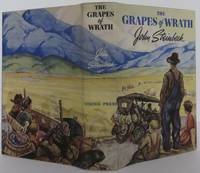
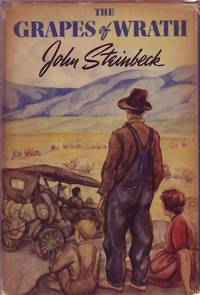
193921205711939. New York: Viking. 1939. 8vo. Original tan pictorial cloth with dust wrapper displaying ""$2.75"" and ""First edition"" endpapers with reproduction of the Battle Hymn of the Republic; pp. 619; dust jacket with minimal wear to the corners a little toning to edges a couple of spots of browning generally very good indeed.First edition. Steinbeck's masterpiece and literature's lasting testament to the Great Depression it won the National Book Award and Pulitzer Prize and was singled-out as a ""great work.an epic chronicle"" in his citation for the Nobel Prize in 1962. This book is one of the great American novels the travails of Tom Joad and his family struggling through the Depression in the Dust Bowl having become legendary. The book has inspired films plays operas and popular music but nothing compares to the stripped back beauty of Steinbeck's prose; ""To the red country and part of the gray country of Oklahoma the last rains came gently and they did not cut the scarred earth"". Copies in this condition are extremely hard to find.The iconic jacket design is by the children's illustrator Elmer Hader. His collaboration was specifically requested by Steinbeck who loved his work in the 1936 book Billy Butter and Hader went on to design later books such as East of Eden. Goldstone & Payne A12a. hardcover