4 050 résultats
193773772New York:: Covici Friede 1937. First edition first state. publisher's cloth in dust jacket. Bookplate on pastedown; same owner's 1937 ink ownership notation on front free endpaper. A fine copy in a beautiful example of the dust jacket with almost none of the usual tanning to the spine. . 8vo. Covici Friede, hardcover
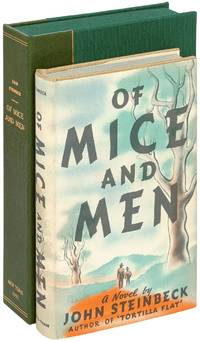
1937541008New York: Covici Friede 1937. Hardcover. Fine/Fine. First edition first issue. Fine in fine and bright dustwrapper. A beautiful copy of this poignant classic novella of two Depression-era drifters whose dreams of a better life are not supported by fate. By way of illustration of this volume's scarcity 2500 copies of the first issue were printed vs. 50000 for The Grapes of Wrath and 78000 for Cannery Row. Basis for the 1939 Lewis Milestone film with Burgess Meredith and Lon Chaney Jr. in the lead and which lost out to Gone With the Wind for the Best Picture Oscar in possibly Hollywood's greatest year other "losers" that year included The Grapes of Wrath Dark Victory Goodbye Mr. Chips The Wizard of Oz Ninotchka Stagecoach Mr. Smith Goes to Washington and Wuthering Heights. Probably the nicest copy we've seen. Covici Friede hardcover
19397093New York: Viking Press 1939. First edition. Near Fine/Near Fine. A Near Fine copy in like dust jacket. A few spots to the topstain otherwise a bright fresh copy. First issue dust jacket retains the original price and "First Edition" slug on the front flap. Slight toning to the spine and a little rubbing at the spine ends. Housed in a blue clamshell case.<br /> <br /> Steinbeck's classic account of the Dust Bowl and Depression era struggle of the Joad family The Grapes of Wrath is a quintessential American classic. It would win both the National Book Award and Pulitzer Prize; and the Nobel Prize committee would refer to it as Steinbeck's "epic chronicle" upon giving him the award in 1962. The book was the best-selling novel of 1939 and became instantly controversial upon its release for its depiction of farmers and worker rights. Of course The Grapes of Wrath was also adapted into the classic 1940 film directed by John Ford and starring Henry Fonda which was one of the first films selected by The Library of Congress for preservation in the United States National Film Registry. "It is a very long novel the longest that Steinbeck has written and yet it reads as if it had been composed in a flash ripped off the typewriter and delivered to the public as an ultimatum" Contemporary New York Times Review. Near Fine in Near Fine dust jacket. Viking Press unknown
1935140946122New York: Covici Friede 1935. First Edition. Fine. First edition wrappered issue of the author's first successful novel. A fantastic survival of this format. Provenance: Actor Jean Hersholt with his label to interior of chemise; and later from the collection of John Steinbeck's nephew David Heyler. <p>Publisher's original sewn binding in wraps original glassine wrap; approximately one of 500 copies that were bound as such. Though Goldstone and Payne mention there is no evidence this preceded the trade cloth issue it is often assumed that this was issued in advance of publication. Fine with a faint bump to foot of spine and endsheets faintly offset. A stunning copy with wonderful provenance housed in a custom folding slipcase. Goldstone and Payne A4a. Covici Friede unknown
193221379NY: Brewer Warren & Putnam. 1932. First Edition. Hardcover. Very Good in Very Good dust jacket. Green cloth titled in gilt. First edition of the author's second book. Cloth faded at spine and extremities and gilt rubbed at front panel rubbed off at spine. Cloth is rubbed through at bottom points though only slightly. Points are essentially sharp. Unmarked sound binding. The DJ in mylar has extensive inner reparations at spine and folds and is mildly edgeworn with a few short closed edge tears.; 8vo 8" - 9" tall . Brewer, Warren & Putnam hardcover
1939STEINBEC001517Viking New York. 1939. First edition. Octavo. pp.vi 619. Fine in near-fine dustwrapper with a few signs of minor restoration only visible and barely so on the reverse. Preserved in a fine custom-made cloth drop-back box with leather title-labels on spine and upper panel. Viking, New York. hardcover
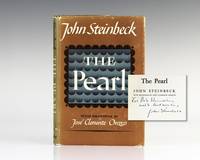
194721019New York: The Viking Press 1947. First edition of this classic story of simplicity based on a Mexican folk tale. Octavo original cloth. Presentation copy inscribed by the author on the title page "For Bob Kriendler with best wishes John Steinbeck." The recipient was the owner of the legendary New York City landmark restaurant and speakeasy ''21''. Steinbeck was a frequent visitor to 21 and was friends with Kriendler. It has hosted every President since Franklin Delano Roosevelt except for George W. Bush has dined at 21 although Bush's wife and daughters have. Light rubbing to the bottom cloth and small bookplate near fine in a near fine first issue dust jacket with Steinbeck looking to the left on the rear panel. Drawings by Jose Clemente Orozco. Housed in a custom half morocco clamshell box. A nice association. A story of classic simplicity based on a Mexican folk tale The Pearl explores the secrets of man's nature the darkest depths of evil and the luminous possibilities of love. Steinbeck began writing the story as a movie script in 1944 and first published it as a short story called "The Pearl of the World" in Woman's Home Companion in December 1945. He expanded it to novella length and published it under the name The Pearl by Viking Press in 1947. As he was writing the novella version he was frequently travelling to Mexico where the film version co-written with Jack Wagner was being filmed. The film was also released by RKO in 1947 as a co-promotion with the book. The Viking Press hardcover books
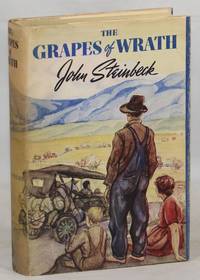
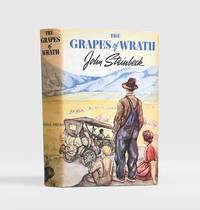
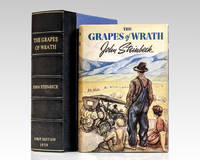
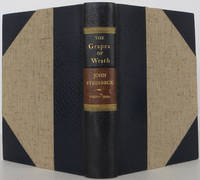
1939000013566New York: The Viking Press 1939 1939. First edition. Hardcover. Near Fine/Near Fine. 8vo. 8 3-619 3 pp. Publisher's buckram with decorations in brown on the boards and spine brown lettering on the spine; yellow topstain. Decorative endpapers and pastedowns printed with a section of "The Battle Hymn of the Republic". Price of $2.75 on the front flap of the dust jacket. Jacket illustration by Elmer Hader. The "First Edition" slug on the jacket's front flap's bottom corner. Ahearn APG 014d. Goldstone & Payne A12. The 1940 recipient of the Pulitzer Prize. Steinbeck's tour de force which deeply moved readers across the United States including the First Lady Eleanor Roosevelt. This novel played a major role in reshaping American labor laws. It stands as a warning against completely unchecked unfettered capitalism one of the reasons why it became a target of book bans. Throughout the novel greed and apathy each take their turn in ruining the lives and prospects of the Joads and other migrant families like them. Widely considered to be one of the finest American novels of the twentieth century Steinbeck's masterpiece still remains relevant today with parallels between the current climate crisis and the Dust Bowl and the suffering of migrant farmhands in his day versus the plight of low-wage workers in today's agricultural industry. Our copy of this celebrated novel presents beautifully. A very scant trace of foxing to the top textblock; three small spots of paper restoration on the jacket's spine panel subtly done. The Viking Press (1939) hardcover
194721019New York: The Viking Press 1947. First edition of this classic story of simplicity based on a Mexican folk tale. Octavo original cloth. Presentation copy inscribed by the author on the title page "For Bob Kriendler with best wishes John Steinbeck." The recipient was the owner of the legendary New York City landmark restaurant and speakeasy ''21''. Steinbeck was a frequent visitor to 21 and was friends with Kriendler. It has hosted every President since Franklin Delano Roosevelt except for George W. Bush has dined at 21 although Bush's wife and daughters have. Light rubbing to the bottom cloth and small bookplate near fine in a near fine first issue dust jacket with Steinbeck looking to the left on the rear panel. Drawings by Jose Clemente Orozco. Housed in a custom half morocco clamshell box. A nice association. A story of classic simplicity based on a Mexican folk tale The Pearl explores the secrets of man's nature the darkest depths of evil and the luminous possibilities of love. Steinbeck began writing the story as a movie script in 1944 and first published it as a short story called "The Pearl of the World" in Woman's Home Companion in December 1945. He expanded it to novella length and published it under the name The Pearl by Viking Press in 1947. As he was writing the novella version he was frequently travelling to Mexico where the film version co-written with Jack Wagner was being filmed. The film was also released by RKO in 1947 as a co-promotion with the book. The Viking Press hardcover
193919471New York: Viking Press 1939. FIRST EDITION FIRST ISSUE. Original brown publisher’s pictorial cloth with illustrated endpapers. Dust jacket unclipped with “First Edition†on lower corner of front flap. Copyright page states “First Published in April 1939.†Includes like new folded advertisement booklet entitled “What America thinks of The grapes of wrath by John Steinbeck†by Newbegin’s Book Shop San Francisco. Dust jacket a bit ragged on top edges with minor rubbing on joints but otherwise very good; book in fine condition. First edition first issue; a fine copy of Steinbeck’s most iconic novel. One of the most important pieces of twentieth-century American literature Steinbeck’s colorful dialogue and haunting prose brought global attention to the plight of the farmers and migrant workers of the Dust Bowl. Almost one hundred years later the novel’s central themes of economic disparity labor rights climate change and religious conflict will still resonate with modern readers.<br /> <br /> This is an extremely crisp near pristine first edition copy. <br /> <br /> As a young man Steinbeck 1902-1968 worked with migrant laborers on the farms of his native central California coast an experience which became a rich source of inspiration for several of his novels and short stories. <br /> <br /> Goldstone A12. Viking Press unknown
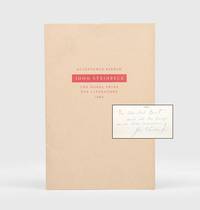
1962179537New York: The Viking Press 1962. A writer who does not passionately believe in the perfectibility of man has no dedication nor any membership in literature First edition presentation copy inscribed by the author to the editor-in-chief of the Viking Press on the title page "For Marshal Best with all the things we are both remembering John Steinbeck". Best was a "giant of publishing" and "led Viking to a position of great prestige in the industry" Patrakis. Steinbeck's long association with the Viking Press began in 1938 when Pascal Covici who had published Steinbeck's novels over the previous three years joined Viking as a senior editor bringing the author with him. Save for a handful of private press productions Steinbeck published all his books with Viking from The Long Valley 1938 until his death in 1968. Steinbeck was awarded the Nobel Prize in Literature in 1962 for "his realistic and imaginative writings combining as they do sympathetic humour and keen social perception". The selection was criticized by both Swedish and American literary critics and by the author himself. When asked on the day of its announcement if he deserved the award he coolly replied "Frankly no". Octavo pp. 12. Photographic portrait frontispiece by Paul Farber. Text printed in black and red. Original light brown wrappers lettered in red. Housed in a custom white cloth slipcase and chemise. Book label of William A. Strutz 1934-2024 to inside of chemise. A fine copy. Goldstone & Payne A40. Harry Mark Petrakis Song of My Life: A Memoir 2014. hardcover
1939190786New York: The Viking Press 1939. The fields were fruitful and starving men moved on the roads First edition of the author's masterpiece widely regarded as the supreme literary achievement of the Depression era. The film adaptation by Darryl F. Zanuck produced the following year is similarly one of the greatest 20th-century American films. "Lauded by critics nationwide for its scope and intensity the book attracted an equally vociferous minority opinion" with some debating Steinback's use of supposedly crass language and his unwavering sympathy for the disenfranchised ANB. It was consequently banned in several counties until well into the Second World War. The jacket design is by the children's writer and illustrator Elmer Hader 1889-1973 the joint recipient alongside his wife Berta of the 1948 Caldecott medal. Steinbeck was so taken with the illustrations in their book Billy Butter 1936 that he specially requested Elmer design the jacket for The Grapes of Wrath. Elmer later designed the jackets of East of Eden 1952 and The Winter of Our Discontent 1961. Octavo. Original buff cloth spine lettered in brown pictorial design in brown wrapped around spine and covers endpapers printed with sheet music for "Battle Hymn of the Republic" top edge yellow. With dust jacket. Housed in custom green cloth slipcase and chemise. Tiny spots to bottom edge; jacket unclipped spine toned and creased at head minor rubbing to extremities: a fine copy in very good jacket. Goldstone & Payne A12a. hardcover
1939108158Viking Press 1939. 2nd Edition. Hardcover. Near Fine/Near Fine. Inscribed by John Steinbeck on the title page. A second printing before publication. Very good in a very good dust jacket. Book has slightly tanned spine and a small less than an inch tear in the spine cloth near the front panel. Jacket has reviews on the front flap and is from a later printing. Bottom corner of the front flap is clipped where it would have said what printing it is. We will provide a certificate of authenticity. Housed in a custom-made collector's slipcase. Viking Press hardcover books
19401607218Heritage Press 1940. Illustrated Edition. Hardcover. Fine. Inscribed illustrated edition. Inscribed by John Steinbeck on the title page to Mr. and Mrs. O'Quinn. Thomas Hart Benton illustrator. 559 pgs 7 7/8" wide x 10 1/4" tall. Illustrated endpapers. Dark tan cloth with silver lettering . All external page edges have been tinted a light yellow by the publisher. The book spine is slightly sunned. Comes in publisher's slipcase edges worn and top edge on one side split. The book itself is internally unmarked clean tightly bound and in fine condition. All housed in a custom-made slipcase. The story of The O'Quinns: In 1955 John Steinbeck came to Austin Texas to visit his nephew Jon Atkinson. Jon was highschool friends with Kerry O'Quinn. During Steinbeck's visit Kerry went to Jon's house and took his parent's Heritage Club copy of The Grapes of Wrath which Steinbeck signed with the wonderful inscription: "For Mr. & Mrs. Quinn from John Steinbeck who isn't angry at anybody". FYI: When Jon and Kerry graduated highschool in 1956 their parents gave them a two week trip to New York City. John and Elaine Steinbeck were away at Sag Harbor for the summer but offered them the use of his 5-story townhouse on East 72nd Street complete with housekeeper and cook. Elaine helped them to get orchestra seats for all the big Broadway musicals including My Fair Lady which was sold out. Heritage Press hardcover books
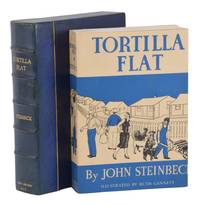
JD27332first edition. NY Covici Friede 1935 first edition first printing dust jacket. Hardcover. <br/><br/> His breakthrough novel that follows the antics of Monterey's paisanos this surface story is an allegory based on the Knights of the Round Table this is an unrecorded Review Copy with the Covici Friede review slip tipped to the front free endpaper which prints the publication date as May 28 1935 and shows the published price as $2.50 very scarce thus the trade edition was comprised of 4000 copies illustrated by Ruth Gannett see Goldstone & Payne A4b see Morrow 29 although not specifically indicated this was M. B. Goldstone's copy he was the brother and rival collector of Adrian Goldstone upon whose collection the Steinbeck bibliography is based. Very good. hardcover books
195369082n.p. 1953. n.p.: 1953.<br> <br> Full Description:<br> <br> STEINBECK John. Manuscript draft for essay entitled "My Short Novels". n.p.n.d ca: 1953.<br> <br> Manuscript draft in Steinbeck's hand for the essay entitled "My Short Novels which served as a preface to the Literary Guild's 1953 edition of "The Short Novels of John Steinbeck." A near word for word representation of the essay which was originally published by The Literary Guild Review and found in their magazine "Wings" in October 1953 Pages 4-8. This manuscript is exciting because it is an close representation but still a draft of what was finally printed. In comparing the two documents you can see that the published piece was trimmed down a bit from what Steinbeck wrote in this manuscript draft. Many of the edits are eliminations of a few words here and there but there are a few places where whole sentences and ideas have been cut. Most of these are some what self-deprecating which is interesting to watch him ultimately play down. Apart from punctuation changes the parts of this manuscript that are not found in the final publication have been indicated by us below by being housed within brackets.<br> <br> Four foolscap legal-sized pages 12 1/2 x 8 inches; 318 x 202 mm. Written in pencil on recto only of each page. With a few notes and corrections. Each page is approximately 28 lines long. Lacking a final leaf which would go on to discuss the final two stories. Some minor toning and a small bump to bottom left corner of all leaves. Still a near fine example of a wonderful Steinbeck manuscript. Housed in a blue quarter morocco clamshell. Another manuscript draft version of this essay was sold at auction in 2023 for 32500 Euros and was also incomplete.<br> <br> Together with A copy of the The Literary Guild Review Magazine "Wings" which includes the entire essay.<br> <br> In the four present pages he discusses the origins of the stories The Red Pony Tortilla Flat Of Mice and Men and The Moon is Down. The final page which is lacking goes on to discuss Cannery Row and The Pearl.<br> <br> The Manuscript reads:<br> <br> "I have never written a preface nor a comment to one of my books before believing that the work should stand on its own feet even if it's legs ankles were slightly wobbly. When I was asked to comment on the five short novels of this volume my first impulse was to refuse. And then thinking over the things that have happened to these stories since they were written I was taken with the idea that the things that happen to a book are very like those that happen to a man. These stories cover a long period of my life. As each one was finished that part of my life it represented was finished. It is true that while he is doing it the writer and his book are one. When the book is finished it is a kind of death a matter of pain and sorrow to the writer. And then he starts a new book and a new life and if he is growing and changing a new life starts. And the writer like a fickle lover forgets his old love. It is no longer his own- the intimacy and the surprise are gone. So much I knew but I had not thought of the poor little stories thrust out into an unfriendly world to make their way. They have experiences too they grow and change or wane and die just as everyone does. They make friends or enemies and sometimes they waste away from neglect. Remembering the careers of these short novels has been interesting to me. All of the have been experiments. That is why no two of them are remotely alike. And experiments are rarely accepted all at once.<br> <br> My stories have been slow starters almost like shy young men who do not make friends quickly. Indeed most of my books have succeeded without trying in making quick and fierce enemies at first. It is pleasing to me that they do in time make lasting and loyal friends.<br> <br> The Red Pony was written a long time ago when there was desolation in my family. The first death had occurred- and the family which every child believes immortal was shattered. Perhaps this is the first adulthood of any man or woman- the first tortured question why and then acceptance and your child was a man. The Red Pony then was an attempt an experiment if you must to set down loss and acceptance death a the transfiguration the adult mind must create for itself.<br> <br> At that time I had had three books published and all of them had failed to come any where near selling their first editions. The Red Pony could not find a publisher. It came back over and over again until at last a foolishly brave editor bought it for The North American Review and paid 90 dollars for it. This was more money than I thought the world contained. What a great party we had in celebration. The Magazine went broke almost immediately and my story disappeared for a good number of years. That it ever came back is the remarkable thing. But it not only did but it seems to gather friends as it goes.<br> <br> It takes only the tiniest pinch of encouragement to keep a writer going and if he gets none he sometimes learns to feed even on the acid of failure.<br> <br> Tortilla Flat grew out of a reading of the sources of The Arthurian cycle- from Mabinogion Through Geoffrey and through the to Tennyson. I wanted to take the stories of my town of Monterey and cast them into a kind of folklore. The result was Tortilla Flat. It followed the pattern. Publisher after publisher rejected it until Pascal Covici finally published it. But it did have one distinction the others had not. It was not ignored. Indeed the Chamber of Commerce of Monterey fearing for its tourist business issued a statement that the book was a lie and that certainly no such disreputable people lived in that neighborhood. But perhaps the chamber did me a good service for this book sold two editions I think and this was almost more encouragement than I could stand. I was afraid I might get used to such profligacy on the part of the public and I knew it couldn't last. A moving picture company bought it and paid 4000 dollars for it- 3600 came to me. It was a fortune. When a few years later the company fired its editor one of the reasons was that he had bought Tortilla Flat. He bought it for the from the company for the original 4000 and several years later sold it to MGM for 90000 dollars a triumph for me albeit shallow a kind of justification for me and a fortune for the editor.<br> <br> Of Mice and Men was another experiment- an attempt to write a novel in three acts to be played from the lines. I had nearly finished it when my setter pup ate it one night- literally made confetti of it. I had to start fresh. I don't know how close the first and second versions would prove to be.<br> <br> This book had some success but as usual it found its enemies. It was called brutal its characters sub humans its story sadistic and one group found homosexuality in it which puzzled me quite a bit. With rewriting however it did become a play and had some success.<br> <br> There were long books written between these little novel. I think the little ones were exercises for the longer ones. The war came on and I wrote The Moon is Down as a kind of celebration of the durability of democracy. I couldn't have conceived that it would be denounced as almost treason. I had written of Germans as men not super men and this was considered a very weak attitude to take. I couldn't make much sense out of this and it seems."<br> <br> HBS 69082.<br> <br> $10000. n.p. unknown
1939151252New York: The Viking Press 1939. First edition of this pivotal Pulitzer prize-winning novel with "First Published in April 1939" on the copyright page and first edition notice on the front flap of the dust jacket. Octavo original pictorial beige cloth pictorial endpapers. Near fine in a near fine dust jacket. Jacket design by Elmer Hader. Housed in a custom half morocco clamshell box. An exceptional example. 'The Grapes of Wrath' is the kind of art that is poured out of a crucible where pity and indignation merge. Its power and importance do not lie in its political insight but in its intense humanity. "It is the American novel of the season probably the year possibly the decade" Clifton Fadiman. The basis for the 1940 John Ford directed film bearing the same name starring Henry Fonda 'The Grapes of Wrath' is widely considered as one of the greatest American films of all time. In 1989 this film was one of the first 25 films to be selected for preservation in the United States National Film Registry by the Library of Congress as being 'culturally historically or aesthetically significant;' Listed by Modern Library as one of the 100 best novels of the twentieth century. The Viking Press hardcover
19401607218Heritage Press 1940. Illustrated Edition. Hardcover. Fine. Inscribed illustrated edition. Inscribed by John Steinbeck on the title page to Mr. and Mrs. O'Quinn. Thomas Hart Benton illustrator. 559 pgs 7 7/8" wide x 10 1/4" tall. Illustrated endpapers. Dark tan cloth with silver lettering . All external page edges have been tinted a light yellow by the publisher. The book spine is slightly sunned. Comes in publisher's slipcase edges worn and top edge on one side split. The book itself is internally unmarked clean tightly bound and in fine condition. All housed in a custom-made slipcase. The story of The O'Quinns: In 1955 John Steinbeck came to Austin Texas to visit his nephew Jon Atkinson. Jon was highschool friends with Kerry O'Quinn. During Steinbeck's visit Kerry went to Jon's house and took his parent's Heritage Club copy of The Grapes of Wrath which Steinbeck signed with the wonderful inscription: "For Mr. & Mrs. Quinn from John Steinbeck who isn't angry at anybody". FYI: When Jon and Kerry graduated highschool in 1956 their parents gave them a two week trip to New York City. John and Elaine Steinbeck were away at Sag Harbor for the summer but offered them the use of his 5-story townhouse on East 72nd Street complete with housekeeper and cook. Elaine helped them to get orchestra seats for all the big Broadway musicals including My Fair Lady which was sold out. Heritage Press hardcover
1939108158Viking Press 1939. 2nd Edition. Hardcover. Near Fine/Near Fine. Inscribed by John Steinbeck on the title page. A second printing before publication. Very good in a very good dust jacket. Book has slightly tanned spine and a small less than an inch tear in the spine cloth near the front panel. Jacket has reviews on the front flap and is from a later printing. Bottom corner of the front flap is clipped where it would have said what printing it is. We will provide a certificate of authenticity. Housed in a custom-made collector's slipcase. Viking Press hardcover
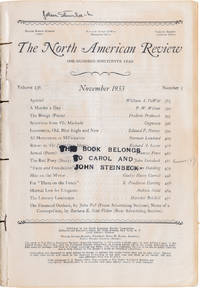
19341015New York: The North American Review Corporation 1934. First Edition. 3 volumes individual issues November 1933 December 1933 and April 1934 of the magazine each containing the first appearance of Steinbeck stories. Original printed wrappers bound in plain brown paper covered boards the front cover of the November '33 issue and the rear cover of the April '34 issue are used as a paste downs. Signed 'J.E. Steinbeck' in pencil on the top of the front cover of each issue the impression can be read on the back of the November cover that has been pasted down signed 'John Steinbeck' in pen on the title page of the November '33 issue along with a stamp reading "This book belongs to Carol and John Steinbeck" on the same title page. Front board has a watercolor of a woman reading likely by Carol Steinbeck. Rubbing chips to the spine soiling hinges split but holding else internally very good. Ex- Steinbeck nephew in-law David Heyler. A trio of stories that exhibit Steinbeck's ability to explore complex human experience at different stages in life. "The Red Pony" is a nuanced exploration about the delicate emotional journey of childhood. "The Murder" uses violence as a transformative act to initiate a shift in a stagnant marriage. "The Great Mountains" considers the themes of aging the allure of adventure and the mysterious nature of life and death. <br /> <br /> Steinbeck's early career during which these stories were published represents a crucial developmental period in his literary evolution. Writing during the depths of the Great Depression Steinbeck was beginning to forge connections between individual experiences and broader socioeconomic structures. In these three stories we can identify his emerging materialist analysis that would later flourish in works like "The Grapes of Wrath." Although not yet explicitly political these narratives contain the seeds of his later class consciousness. The intergenerational tensions in "The Great Mountains" the complex power dynamics of "The Murder" and the disillusionment narrative in "The Red Pony" all reveal Steinbeck's early interest in how social and economic forces shape human relationships and personal development. His writing methodology during this period involved immersive research into the lives of California's working people creating an authenticity that distinguishes his work from contemporaries who approached similar themes from more privileged perspectives. The North American Review Corporation unknown
1962207376New York: Viking 1962. First Edition; First Printing. Hardcover. Very Good in a Very Good dust jacket.; Personalized by author on title page. Viking hardcover
JD30040first edition. NY Marguerite and Louis Henry Cohn 1947 first edition wrappers. Softcover. <br/><br/> First and only edition No. 7 of only 60 copies printed by Ward Ritchie with its original white paper envelope which is also No. 7 the first 10 copies went to Steinbeck with the remainder going to the Cohns House of Books for Christmas gift presentation this elusive "A" item is a letter from Steinbeck to Arnold Gingrich editor of "Esquire" thanking him for sending a watch as a gift the letter is full of Steinbeck's typical humor noting that he had expected a watch when he graduated from high school but none was forthcoming and since he didn't actually graduate from Stanford University he likewise hadn't received a watch as a gift Goldstone & Payne A26a Morrow 199 and 200. Fine. paperback books
19392101037Viking Press 1939. fifth. hardcover. near fine. Fifth edition published one month after the first edition as stated on copyright page May 1939. One of ten leatherbound presentation copies signed by Steinbeck on a laid-in slip inscribed to Elyse. Book near fine. Housed in a custom-made fold-out case. Viking Press unknown books
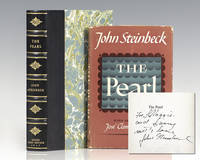
1947103774New York: The Viking Press 1947. First edition of this classic story of simplicity based on a Mexican folk tale. Octavo original cloth. Presentation copy inscribed by the author on the half-title page "For Maggie and Larry with love John Steinbeck." Near fine in a near fine first-issue dust jacket with Steinbeck looking to the left on the rear panel. Drawings by Jose Clemente Orozco. Housed in a custom half morocco clamshell box. A story of classic simplicity based on a Mexican folk tale The Pearl explores the secrets of man's nature the darkest depths of evil and the luminous possibilities of love. Steinbeck began writing the story as a movie script in 1944 and first published it as a short story called "The Pearl of the World" in Woman's Home Companion in December 1945. He expanded it to novella length and published it under the name The Pearl by Viking Press in 1947. As he was writing the novella version he was frequently travelling to Mexico where the film version co-written with Jack Wagner was being filmed. The film was also released by RKO in 1947 as a co-promotion with the book. The Viking Press hardcover books
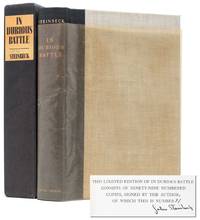
19366736New York: Covici Friedi 1936. First edition. Fine/Near Fine. Number 31 of 99 copies of the signed limited edition. This copy Fine and unread in the original glassine jacket and publisher's slipcase. Glassine also Nearly Fine condition with a small tear at the lower rear corner publisher's slipcase Near Fine with a small nick to the lower corner and slight rubbing. <br /> <br /> Historically overshadowed by Steinbeck's towering works East of Eden and The Grapes of Wrath his later novel In Dubious Battle has seen a resurgence of scholarly interest for its depictions of race and class. In developing the novel's central structure "Steinbeck utilized episodes from the Tagus Ranch peach strike of 1933 and a cotton strike throughout the San Joaquin Valley that October"; while he "deviated from the particulars of these labor disputes to clarify the central themes of the novel.In Dubious Battle indicates that the primary responsibility for human suffering rests on the growers since they preside over an economic framework that limits the opportunities available to the working class" predominantly composed of people of color Dawson. Steinbeck's emphasis on laborers unionizing to fight back against their abusers - predominantly powerful white men - are concerns that still resonate today. In Dubious Battle made its appearance on the big screen in 2017 as a film directed by James Franco.<br /> <br /> Goldstone & Payne A5a. Fine in Near Fine dust jacket. Covici Friedi unknown