Panzer, G.WAntiquariat.de

5 467 résultats
1803199032Nürnberg, (M.J. Schmid für) J.E. Zeh, 1793-1803. 4°. M. 11 (wiederh.) gest. Tit.-Vign. Ldrbde. d. Zt. m Rücken- u.- Deckelverg. Rverg. verbl. Einbde. berieben u. bestoßen. Rücken/Kapitale meist etwas eingerissen. Deckel teils m. kl. Wurmspuren. Bd. 1 u. 2 m. mont. Exlibris u. Zueignungsvermerk. St. a. Tit. u. hint. Vorsatz. Gebräunt u. braunfl.
65815Geneva, Typography Genevoise, 1964 Veau des Indes avec dorure et bo te en parchemin, avec 45 gravures plein page, papier pur chiffon vergeures XIIIe si cle, 43 x 30 cm.(104/250)
98444aaf1) A Paris, Chez François Montalant, / 2) A Paris, Julien-Michel Gandouin et Pierre-François Giffart, 1715 / 1735, in-4°, XV (+ 1 table) + 181 p. (+ 1 privilège) + 11 planches gravées dépl. / 2) CIV (=104 p.) + 162 p. + 1 f. (fautes à corriger) + 4 planches gravées dépl., petite tache d’eau marginale au début de l’ouvrage (sans gravité), reliure en plein veau d’époque, dos à 5 nerfs richement orné en or, tranches rouges, gardes en papier dominoté originales, bel exemplaire en parfait état.
First edition, 7 vols., complete, small 4to (263 x 165 mm). (I): [6], ix, [3], lii, 383, [1]pp., with half-title, 11 engraved plates on 12 leaves as called for, without the rarely found india paper print which was to be pasted into the text of p. 79, frontis., offset, occasional spotting and offsetting. (II): [6], 503, [1]pp., with half-title and fly-title, one engraved plate as called for; (III): [4], 509, [1], [6]pp., with half-title and fly-title, no plates called for; (IV): vii, [3], 587, [1], lxxvii, [3]pp., with half-title and fly-title, 10 engraved plates as called for, occasional spotting and offsetting; (V): viii, [4], lxii, 279, [1]pp., 32 engraved plates, half-title, frontis., offset, without the plate of the Marchioness Camden which Jackson describes as an 'added plate' present in some copies, offsetting from plates; (VI): [6], 322, [2]pp., half-title, engraved portrait frontispiece (offset); (VII): x, 295, [1]pp., without half-title, no plates called for; numerous illustrations, engraved portraits, plans and views, facsimiles of woodcuts and devices, mostly mounted India proofs, extensively printed in red and black, some spotting and offsetting, uniform contemporary calf, panels blind-tooled, hinges cracked and a couple holding by cords, spines and labels chipped (see image). Guild, p.24. "This superb collection of books contains upwards of 45,000 volumes; among them are sixty-four editions from the press of Wm. Caxton... The abundance and beauty of the facsimiles and other embellishments, as well as the fineness of the paper and printing, render this catalogue one of the most splendid bibliographical works ever published in any country. It describes books printed from wooden blocks about the middle of the fifteenth century, early printed Bibles, Liturgical works, works of the Fathers, Greek and Latin Classics & Miscellaneous Literature". Windle & Pippin, A25, A26, A27 & E4 a; Jackson 36,37 & 38; De Ricci 72-77pp.
4to (290 x 225mm), xv, [1], 46pp., 92 collotype plates, with the bookplate of the Printer's Library (Oxford University Press) and small stamp to verso of title-page, title printed in red and black, orig. quarter blue Roxburghe morocco, spine lettered in gilt, slightly faded, uncut, t.e.g. Barker, 224.
First edition, 3 vols., bound in 4, 4to (279 x 185 mm), ONE OF 100 COPIES PRINTED ON THICK AND LARGE PAPER WITH EXTRA PLATES, [4], xxv, [7], 462,lxxix, [1]; [2], 555, [1]; [2], 298; [2], 299-622, lxiipp., with the author's wood-engraved device on each title-page, a wood engraving of the elaborately-quartered coat of arms of the Roxburghe Club on the dedication page, 85 engraved plates ((including the private plate of 'Diana de Poictiers' in vol. 2, which was apparently destroyed after only 50 copies had been printed, and a proof of the 'Prater' plate in vol. 3), 62 illustrations printed on fine and thin "India" paper and mounted on the text leaves, 55 other illustrations in the text, with the additional sixty engraved plates on 52 leaves from Lewis' Series of Groups bound in at the appropriate places as designated by Lewis in his 'Directions to the binder', contemporary notes in pencil to several endpapers and a few within the text, text and plates have staining of varying degrees, pale stain to many lower margins, a little damage to endpapers where bookplates have been removed, full red hard grain red morocco,,covers waterstained, spines lettered in gilt, all edges gilt. Unfortunately this handsome large paper copy has suffered from water damage sometime in the past, additional photographs are available upon request. This set with the additional set of etchings on india paper by George Lewis, of a classic work of the utmost importance for its wealth of eye-witness information and anecdotes about printed books, manuscripts, buildings, other artefacts and people, both from past centuries and from the author's own day, for the extraordinary collection of illustrations, mostly drawn during the tour itself, and finally as a sumptuous piece of book production. As soon as the book appeared, leading scholars derided Dibdin for his lack of scholarship, especially concerning early manuscripts and printed books. But one must distinguish between the extensive and extremely useful information about things and people Dibdin saw during his 1818 tour, and his own interpretations and conclusions, which now serve only as a window to the attitudes of the time. Dibdin's enthusiasm, readable style and entertaining anecdotes, moreover, caught the mood of his age, making the book extremely popular and influential. Lewis' A Series of Groups... was intended to accompany Dibdin's Tour but was rejected by Dibdin as unworthy of his book. Lewis, most perturbed, issued them at his own expense and presented his case in the eight-page Advertisement which was separately printed. Jackson 48; 56; 56n: Windle & Pippin A38a; A44; D13.
8vo (185 x 125 mm), 4pp., folded, with short tears to fold. The extremely rare catalogues of works published by Prince Bonaparte, listing 142 titles, apart from 'Ouvrages Sous Presse', each entry gives the number of copies printed, usually 250, and the number printed on special paper.
Crown 8vo (246 x 150 mm), ff. 63, tipped-in is a small folio sheet (280 x 213 mm) printed of one side only "Prices of Type and Materials Manufactured and Sold by Stephen Sutton & Co. at the Caxton Letter Foundry...", later quarter red morocco, green boards. A very rare specimen of printing types from this little known foundry. The specimen begins with 34 samples of different size font from "the most modern faces, cut by artists of first-rate skill and acknowledged talent." Then follows 27 priced specimens of "a beautiful and extensive assortment of Stereotype Ornaments." The tipped-in price list is printed in double-column and gives prices for type, wood type, leads' and metal furniture, galleys, brass rule, cases, frames, and furniture. At the foot is a list of "Agents for the Country": Mr. Joseph Graham, 2 Jewry Street, Aldgate; Mr Simmons, Artillery Lane, Bishopsgate Street; Messrs. Renshaw and Kirkman, Budge Row; Messrs. Shepherd and Sutton, Foster Lane. Provenance: From the typographical library of John Lewis (his bookplate) and John Brinkley (his signature). The only other copy recorded is that of The British Library.
1876667P16Paris: Goupil & Cie 1876. Leather. Fair. 20" by 14". Not Stated. A very scarce and beautiful look at the ceiling paintings at the Paris Opera the Palais Garnier written by the painter of the ceiling Paul Baudry. Illustrated throughout. Last seen at auction in 1993. In the original French. A very scarce work last seen at auction in 1993. A beautiful look at the impressive ceiling paintings found in the Grand Foyer of the Palais Garnier the Paris Opera a foyer that stretches over five-hundred feet. The Palais Garnier is well known today due to it being the setting of the novel 'The Phantom of the Opera' by Gaston Leroux. The ceiling was painted by Paul-Jacques-Aimé Baudry who painted representations of various moments in the history of music. These include the allegorical figures of Eurydice Psyche Diana and Aurora.The foyer was designed resembling a classical chateau with gold accented by mirrors and windows. This work was published only one year after the Opera first opened. Illustrated with a frontispiece six folding plates and thirty-three plates. Written by Paul Baudry who painted the ceiling. The Palais Garnier is his best known work. His style is full of elegance and grace He also painted in the Court of Cassation Chateau of Chantilly Hotel Fould and Hotel Paivabut. In the original publisher's half morocco binding with cloth to the boards. Externally sound the boards are detached from the textblock. Some loss to the extremities. Top third of the spine is lifting. Rubbing and marking to the boards and spine. Two institutional labels to the front pastedown. Label to the recto to the front endpaper. Front free endpaper and half-title detached but present. Internally firmly bound. Pages are bright and with some spotting and marking not affecting the images. Mark to plate IX. Institutional stamps to the half-title title page and to the reverse of the plates. Fair Goupil & Cie hardcover
[4], 284pp., running title at head of final two leaves slightly shaved, 9013 items. 2 works bound in one, 8vo (205 x 125 mm), cont. half calf, rebacked, corners rubbed, spine gilt. Thomas Jennet (1769-1846) bookseller and printer, a native of Kirkdale, Yorkshire, was apprenticed to, and later partnership with, Robert Christopher, trading as 'Chrisopher & Jennet'. After Christopher's death in 1819 Jennet traded alone. He was the most important printer in Stockton, a magistrate and three times Mayor. After his death the business was continued as 'Jennet & Co'. A search of both Copac and OCLC fails to find any catalogues issued by Jennet. Emerson Charnley I (1782-1845) bookseller and politician, son of William and Elizabeth, 'the veteran emperor of Northumbrian booksellers' according to Dibdin who stayed with him in 1834. He published many important catalogues of antiquarian books until he gave up that side of his business to concentrate on new books in 1843. He supplied 'Literary societies, mechanics societies, book clubs, village libraries, schools... on the most liberal terms' according to an advertisement of 1839. He was active in Newcastle politics, his shop being the headquarters of the Whigs on the town council. Succeeded by his son, Emerson II. Not listed on Copac; OCLC finds a single copy at Huntington Library. Provenance: Woodcut bookplate of Wm. and Elizabeth Anderson, Newcastle-upon-Tyne, to front paste-down; Presented to the Auctioneers' & Estate Agents' Institute by Wm. Anderson, with their bookplate to rear paste-down (with a couple of unobtrusive stamps). Hunt, The Book Trade in Northumberland and Durham to 1860. p. 53 & 21.
9 volumes in 10 delen, gebonden. ISBN 9061940125. Catalogus van de pamfletten-verzameling berustende in de Koninklijke Bibliotheek / door W.P.C. Knuttel ; herdruk, met handgeschreven verbeteringen, aanvullingen en varianten ; met-een inleidend essay en een handleiding voor de gebruiker door H. van de Hoeven ; with a summary in English. * 1-I. 1486-1620 * 1-II. 1621-1648 * 2-I. 1649-1667 * 2-II. 1668-1688 * 3. 1689-1713 * 4. 1714-1775 * 5. 1776-1795 * 6.1796-1830 * 7. 1831-1853 * 8. Supplement * 9. Alfabetisch register van onderwerpen 1486-1795. De grondslag voor deze verzameling vormde de zogenoemde Bibliotheca Duncaniana, die met de overige collecties van stadhouder Willem V in 1795 aan de staat waren gekomen. In 1889 verscheen het eerste deel van de Catalogus van de pamflettenverzameling berustende in de Koninklijke Bibliotheek, in 1916 kon het zevende, laatste deel verschijnen, alsmede een supplementdeel, terwijl in 1920 een registerdeel de catalogus voltooide. In 1979 verscheen nog een fotomechanische herdruk met bijgeschreven aanvullingen en correcties. Hoewel Knuttel in Tiele, Van der Wulp en Petit enkele eminente voorgangers had, is zijn catalogus, waarin een 32.000 pamfletten zijn beschreven, toch een werk dat bewondering afdwingt en dat tot op heden zijn waarde als naslagwerk ten volle behouden heeft. Nieuw.
Folio, x,507,[1]pp., facsimiles throughout (some coloured), orig. cloth. The present volume is compiled by Lotte Hellinga with contributions by Paul Needham, Margaret Nickson and John Goldfinch. It includes descriptions of 323 copies of books, representing 221 editions of items printed in England, out of a total of 395 known to date, extensive introductions and 52 full-size plates accompanying the descriptions of printing types. Since the appearance in 1908 of the first volume of BMC the work has been relied on as one of the main authorities on the earliest printing in Europe. Its coverage of early printing from the European countries in which the new technique was successively introduced provides not only extensive bibliographical descriptions, but introduces the material with an analysis of the development of printing in the relevant areas. The guiding theme throughout the earlier volumes is the spread of printing in the fifteenth century as reflected in the British Museum Library's outstanding collection. England is the last volume to appear in this momentous series.
42 volumes, orig. uniform cloth. "The aim of this series is to provide access to contemporary sources for the history of English publishing and bookselling, including controversy over copyright legislation and freedom of the press, from the Restoration through the early nineteenth century. To this end, we have gathered from libraries in Great Britain and the United States a comprehensive working collection of pamphlets, broadsides and memoirs, amounting to 156 individual titles, reprinted in forty-two volumes".?Introduction.
22381Paris, Hachette et Cie, 1889. 1 vol. grand in-4°, maroquin tête-de-nègre, dos à nerfs avec titre doré et date en pied, double filet doré sur les coupes, bordure intérieure finement décorée de filets, roulettes, dents de rat et fleurons dorés, doublures en broderie de velours et soie d'après une maquette spécialement exécutée par A. Giraldon, doubles gardes, tranches dorées. Reliure de Champs. Dos insolé. Couv. et dos cons. Portrait h.-t. en frontispice d'E. About d'après Paul Baudry, 10 fig. h.-t. de F. de Myrrbach gravées sur bois, ornements typographiques de A. Girladon gravés sur bois en deux couleurs par Robert de Lueders, (2) ff., VIII-224 pp.
Sammelband mit 11 Schriften des streitbaren, aber unglücklichen Juristen und Rhetors Johann Ernst Phillipi (1701-1758), wovon zwei in Erstausgabe. – Inhalt, Autor: Philippi hatte 1731 die Nachfolge Gottscheds als Professor für »Beredsamkeit« in Halle angetreten, sich mit Polemiken u.a. gegen diesen, gleichzeitig mit akademisch zweifelhaften Arbeiten wie der hier vorliegenden Analyse der Rede Ciceros gegen Naevius, aber bald den Unmut der Hallenser Kollegenschaft zugezogen. Diese veranlasste den Satiriker Christian Ludwig Liscow contra personam Philippi zu schreiben (u.a. »Briontes der Jünger«, 1732), was letzterem – nunmehr als Prototyp eines „elenden Scribenten“ (Liscow) stigmatisiert – nicht nur Hohn und Spott der Hallenser Studierenden einbrachte, sondern auch zu einem anhaltenden, für Philippi letztlich ruinösen Schriftenstreit mit Liscow führte. Aus Halle entlassen wurde Philippi 1740 erstmals „als geistesgestört in Gewahrsam genommen“ (Killy), und sollte er danach nicht wieder im Leben Fuß fassen. – Illustration: Das Frontispiz zeigt eine satirische Darstellung des „Privilegirten Plasebalg Händelers“ Philippi, der „Wind-Beutel“ wie Cicero (und wohl auch Liscow und Gottsched) wegbläst. Der Haupttitel und der Anhang „Von dem Rechte der verdeckten Schreib-Art“ in Erstausgabe, die anderen 9 Pamphlete waren laut Meusel bereits in den Jahren 1733 und 1734 erschienen. – Erhaltung: Fehlpaginierung: 227/8 und 491/2 doppelt vergeben, Paginierung springt von 507 auf 518 und von 528 auf 531. Einband and den Gelenken, Ecken und Kanten berieben, vorderer fliegender Vorsatz mit Inhaltsverz. u. Anmerkungen mittels Bleistift; Buchblock stellenweise zur Einpassung in die Bindung beschnitten, jedoch immer ohne Textverlust. – Seltenheit: Obschon in deutschen institutionellen Beständen gut vertreten sind Philippis Schriften im Handel aktuell und historisch von ausnehmender Seltenheit. Laut JAP/APO und RBH kamen seit nur 3 derartige Sammelbände jemals zur Auktion (2006, 1970, 1918). – Literatur: Meusel X, 413-419 (EA v. Nrn. 1 und 11, S. 416 und 418); Killy, DBE, Bd. 7 (1998) zit. WBIS/DBA.
Folio (380 x 245mm), 35pp., followed by 75 fine collotype plates, including 3 in gold and colours, with the bookplate of the Printer's Library, Oxford University, title printed in red and black, orig. half Roxburghe morocco, lightly rubbed, corners bumped, spine lettered in gilt, uncut, t.e.g. This illuminated manuscript is held in Corpus Christi College, Cambridge (MS. 53). Barker, 178.
First edition, 8vo (205 x 125 mm), iv, 446pp., 1 plate showing typographical marks (foxed and offset onto title), text moderately browned in places, 32 page author text followed by 326 pages of specimens of type in different sizes, from the foundry of Mr Thorne in Fan Street, Aldersgate Street, with footnotes by the author, pp. 359-446 contain tables with the regular charges for printing works of the same size type length and width as the foregoing specimen pages, cont. half calf, rebacked with original spine laid-down, marbled boards, corners rubbed through. A compendium of information on the early nineteenth-century printing trade: payment for compositors, master printers' rates, typographical marks, casting off copy, type specimens, etc. This book is far scarcer than Stower's earlier work The Printer's Grammar of 1808.
20053084Berlin: Juergen Holstein Privately Printed 2005. First edition in 400 copies. cloth. New in new dustjacket. Large Quarto 25cm x 28cm= 10" x 11". Over 550 pages with 1000 color illustrations of Berlin-published books of the Weimar era in the collection of Juergen Holstein. Index. in German. With 18 essays by well known scholars and critics. A magnum opus! Compiled and edited by legendary German bookdealer/collector Juergen Holstein. A visual feast for historians and book gatherers of all persuasions celebrating one of the most interesting if not turbulent cultural periods in twentieth century history. The book was wonderfully reviewed in Der Spiegel ending with the following: "Blickfang" ein kiloschwerer Bildband mit 1000 Abbildungen wuerdigt die nahezu ausgestorbene Kunst echter Umschlaggestaltung - und wird dank enormen Themenvielfalt zur Zeitreise in die wohl kreativste Epoche des 20. Jahrhunderts." The book is currently out of print and we may have the only copies available. Because of limited availability and very high shipping costs to the US market price is net to all with s/h extra. Juergen Holstein (Privately Printed) hardcover
92 pages. Lovely A.J. Casson painting of a bustling winter street on front cover Features: Great vintage photo ad for the New International "Special Delivery" Truck; Cream of Wheat ad claims it keeps pupils more alert; When Men Kill for Whisky - Millionaire Carling Breweries Executive Sam Low of Walkerville, Ontario was kidnapped by Gangsters for a $35k ransom - great photo-illustrated article about rum-running between Windsor, Ontario and Detroit; Brummagen Love, by Thelma Rudge; What I Learned from Europe, by Ontario Premier G. Howard Ferguson; Ottawa-Vancouver in 32 Hours - The Stirring Story of Canada's First Transcontinental Air Mail Flight - with photos; The Mystery of Number Nine, by Leslie McFarlane - Part 1; Louis Letourneau, Leo Dandurand and Joe Cattarinich - a colorful description of the adventures and achievements of The Three Musketeers of Modern Sport; Canada's Pictorial War Records - Adequate Housing Required, by W.W. Murray; Lights in the Windows, by Lillian Beynon Thomas; Full-colour colour reproduction of painting "Canada's Answer" by Norman Wilkinson, R.I.; The Work Cure - Vetcraft has brought health, happiness and economic being to hundreds of veterans; By Especial Corespondent, by Geoffrey Hewelcke; The Devil Guards His Own, by Victor Lauriston; Amazing photo of Malahat Drive on Vancouver Island - not much more than a couple of ruts through the forest; Nice ad for the De Soto Six, by Chrysler; "New York Now Huge Negro City - Black Invasion of Harlem"; Art Deco-style ad for the New Frigidaire refrigerator; Science Teaching Weather Control - Man has made enormous progress in combat with nature; Fantastic colour full-page ad for Packard cars; Great colour full-page ad for Wahl-Eversharp Pens, Pencils, Desk Sets; Wonderful full-page ad for Erector Set toys; Color ad for Chipso Laundry Soap; *Magnificent* Colour Centerfold ad for Parker Duofold Pens, Pencils and Duettes; Great full-page colour ad for Westclox Clocks; Ad for Mueller Faucets of Sarnia, Ontario; "Let the Laundry Do It" - a two-colour ad encouraging readers to let laundries clean their clothes; Nice Hupmobile Ad for their Century Six and Eight; Colour photo ad for Kodak cameras; Lovely colour full-page ad for Moirs Chocolates; Article about collector Walter McRaye; Buses Hurt British Railways - with photo of their first auto Pullman which allows passengers to sleep on the bus; The Road to Perth - short history article by Donald McNicol; Ad for the T-N Toilet which promises to 'banish embarrassment' because it is quiet; Colour ad for Swift's Premium Hams and Bacon; Two-Colour full-page Christmas-themed ad for Eveready flashlights and batteries; Home-Made Christmas Gifts; Short write-up and photo of Elizabeth Styring Nutt; Rug Magic, by Mary Agnes Pease; Stewart Warner radio ad; Business Article - "Adventuring in Speculation is Highly Specialized Business"; Colour ad fo Sun-Maid Puffed seeded Muscat Raisins inside back cover. Average wear to textblock. Crossword completed on page 83 otherwise unmarked. Chips and openings along cover fold. Covers loose as one but present. Back cover in rough shape. Particularly wonderful content to go with the excellent front cover artwork. Book
8vo (225 x 140 mm), xxiii, [1], [3]-343, [1]pp.,, 8 lithographed plates (5 folding), later calf brown morocco, uncut, t.e.g. a nice copy. Scarce sale catalogue of the large celebrated collection of incunabula (mainly from German presses) and manuscripts gathered together by Professor Kloss, a physician from Frankfurt, built on the collections of Johannes von Dalberg, Bishop of Worms, Adelmann von Adelmannsted and the Church Library at Essligen. 4,682 lots. Provenance: From the reference library of E. P. Goldschmidt with initials stamped in gilt at base of spine. De Ricci, p.117.
189174961Paris: Hachette & Cie 1891. Fine. Hachette & Cie Paris 1891 20.50 x 29.50 cm relié sous étui First edition illustrated with text illustrations and plates by Hermann Vogel and ornaments by Adolphe Giraldon one of 60 numbered copies on China paper the only deluxe copies after 20 on Japan. Full blue morocco binding spine very slightly faded with five raised bands date and place gilt at foot gilt borders on the headcaps gilt fillet border on the pastedowns in full purple morocco purple watered silk endpapers following endpapers of combed paper covers preserved all edges gilt double gilt fillets on the edges slipcase edged with blue morocco marbled paper boards superb full morocco binding with doublure signed Blanchetière Bretault. Each plate appears in triple state in our copy. Very handsome copy free from foxing established in a magnificent full morocco binding with doublure by Blanchetière Bretault. Hachette & Cie hardcover
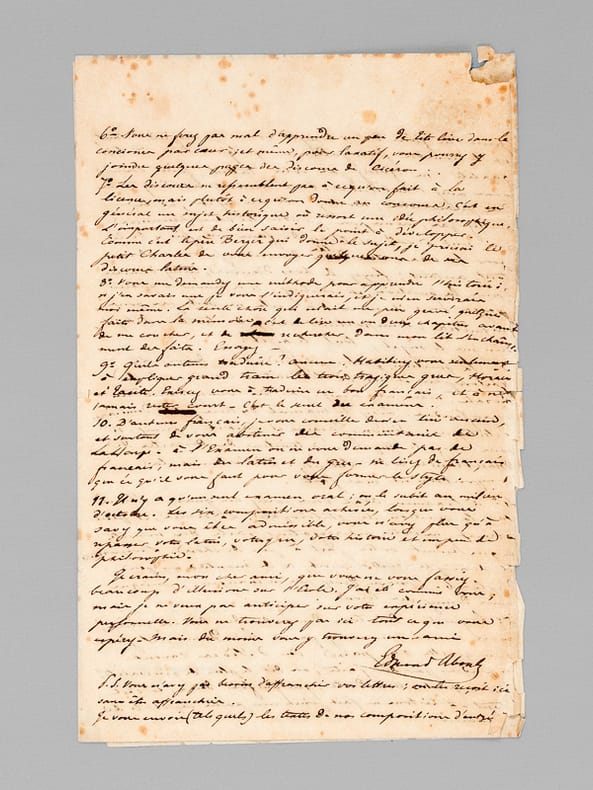
1849639831 L.A.S. de 4 pages sous enveloppe jointe affranchie le 4 mars 1849, adressée à M. "Deulin, Etudiant, à Condé sur l'Escaut" : Edmond About s'excuse de ne pas avoir répondu plus tôt "mais heureusement vous êtes en état de me comprendre et de m'excuser quand je vous dirai que je vous aurai répondu depuis longtemps si je n'étais moi-même amoureux, et sérieusement, c'est à dire follement et de manière à ne pouvoir rien faire de sérieux, pas même une lettre à un ami. Il y a peut-être cette différence entre votre infirmité et la mienne que vous êtes probablement heureux, ou que vous pourrez l'être ; tandis que moi sauf le bonheur d'aimer, je n'en attends, je n'en espère et je ne voudrais même pas en désirer d'autre. [... ] Celui qui vous écrit est dans une impasse d'où l'on ne sort que par un mariage ou par une infamie ; or ni l'un ni l'autre ne sont de mon goût. Je désire de tout mon coeur, mon coeur ami, que vous soyez plus heureux que moi" [ About se réjouit de la vie douce de son ami à Condé-sur-l'Escaut : ] "Je vous félicite donc sincèrement de n'être pas venu à Paris, et d'avoir compté vainement sur M. de Falloux. Si je l'avais connu la dernière fois que je vous ai écrit, j'aurai pu vous éclairer sur la nature de sa parole. Il est venu nous voir à l'Ecole et nous a noyés de compliments délayés et très fades : au reste, il nous déteste et ne songe qu'à nous traiter comme l'école d'administration" [ Il l'invite à se préparer lui-même au concours de l'Ecole : ] "Dans le cas où vous ne seriez pas reçu (ce dont les Dieux nous gardent !) vous vous seriez fait connaître de ces messieurs, et ils vous obtiendraient une place de professeur en province ; en attendant, ils l'ont fait pour un de nos camarades qui ne vous valait pas, et qui avait été refusé pour impertinence à l'examen oral" [ Il répond ensuite en 11 points à toutes ces questions sur l'examen ; durée, longueur, compositions en vers, examens oraux, et notamment pour la dissertation philosophique : ] "Lisez le manuel des trois demi-ânes éclectiques Simon, Jacquin et Saisset ; prenez, si vous avez le temps, une teinture de Descartes, de Malebranche et de Leibnitz. Généralement, la composition est mal faite" [Pour la question d'histoire :] " Peu d'élèves savent répondre par des faits ; on dit le plus de généralités qu'on peut. Une date, quelquefois deux, et c'est tout" [Avec la même verve, il continue plus loin : ] "D'auteurs français, je vous conseille de n'en lire aucun, et surtout de vous abstenir du commentaire de Laharpe. A l'examen, on ne vous demande pas de français, mais du latin et du grec. Ne lisez de français que ce qu'il vous faut pour vous former le style [etc... ] "Je crains, mon cher ami, que vous ne vous fassiez beaucoup d'illusions sur l'Ecole. J'ai été comme vous, mais je ne veux pas anticiper sur votre expérience personnelle. Vous ne trouverez pas ici tout ce que vous espérez. Mais du moins vous y trouverez un ami" [... ]
64 pages. Features: Cover illustration by Franklin Arbuckle presents the rail line to Ungava's Iron; Editorial argues that Canadians need to read more of their authors; Elegant one-page colour 1953 Chrysler ad features red two-door New Yorker; The Crisis in Education - the Canadian education system is creaking toward chaos, Part 1 - The Teachers; Jerry (Gerald) Bull - Boy Rocket Scientist - photo-illustrated article on 24-year-old Dr. Gerald V. Bull, guided missile expert; The Dumbest Cluck on the Farm - fun article about raising chickens; When the Redskins took over Twiggeville (short story); Montreal - A City With a Heart - Karsh photos capture the spirit of the city; The Neighbours Who Sing for Canada - The Don Wright Chorus of London, Ontario - article with many photos; How the Boom Hit Seven Islands, Quebec courtesy of Mining Magnate Jules Timmins - article with many photos; Interesting one-page Massey-Harris ad examines the economic impact of farmers; Handsome one-page colour ad for the 1953 De Soto Firedome V-8 (maroon); Sensational 1953 Studebaker centrefold colour-photo ad features a canary yellow Starliner coupe; One-page two-colour Royal Canadian Air Force (R.C.A.F.) ad features photo of airman with puppy in his helmet; One-page colour ad for the 1953 Meteor car features a black on yellow car; One-page Morris Minor car ad; Nice colour one-page ad for Leonard fridges; What to do until the guests leave; Lovely colour Dofasco ad shows housewife picking peaches through her window in the middle of winter; Nice colour La-Z-Boy ad shows officeman relaxing; General Motors one-page photo ad explains how their many activities spend $350 million annually; Champion spark plugs ad features small photo of Chuck Stevenson, 1952 AAA National Racing Champion; Nice colour one-page Oldsmobile ad features green 1953 Super '88' holiday coupe; Half-page RCMP recruiting ad; Colour ad for the 1953 Ford Monarch (grey) inside back cover; Weston's ad on back cover links with the Coronation of Queen Elizabeth II; and more. Moderate wear. Unmarked. A sound copy of this nice vintage issue. Book
56 pages. Features: Cover photo of Japanese Renaissance Man Yukio Mishima who took his life three months later; Dear Prince - a letter to Norodom (Prince) Sihanouk on the situation in his native Cambodia since he moved to Peking (Beijing) and US troops came and went; Photo-illustrated feature article on Yukio Mishima; How to Lose the Bermuda (Yacht) Race (from Newport, RI to the Onion Patch); Beautiful color fashion ads; Portrait of a Decade - what the census shows about the turbulent 60's; Fashion photos entitled 'Cop-out Clothes; Photos of Robert T. Snyders' home in Brooklyn; Bridge article; No-Cal Cola ad on back cover says "We Ain't Got No Sugar." Above-average external wear. Crossword completed in pencil. A worthy vintage copy of this rare Mishima memento. Book
202 pages. Boldly signed in blue marker by Raquel Welch upon her cover photo. Contents: Feature Article - The New Raquel - with many photos, most in color; Summer Fashion - Best Bets; The Sweater You Can't Get Along With This Summer; Fashion with Sol; Summer is...; Vogue Patterns; S. Hurok Presents!; New York's Museum of Modern Art; Museum Maker - Alfred H. Barr; Hubert de Givenchy and Diana Vreeland Talk about Balenciaga; Your Blood Pressure; Edward Steichen 1879-1973; and much more. Tiny bit of faint writing near top of front cover. Moderate wear. Binding sound. Crease to upper corner of back cover. Pages gently yellowing with age at periphery. A magnificent Raquel Welch collectible. Book