5 467 résultats
Dahl, RoaldIn Pristine Condition. unknown
19881247401Frankfurt/Main, V. Klostermann, (1988). Gr.-8vo. 10, 340 S. (Zeitschrift für Bibliothekswesen u. Bibliographie, Sonderheft 46). OKart.
First etymological dictionary of Ukrainian, here vol. 1 (of 2 published) in the original part-issues with publisher's wrappers. – Contents: The »Etymological Dictionary of the Ukrainian Language« was a lifelong effort by prominent Ukrainian linguist and slavic scholar Jaroslav Rudnyckyj (1910-95) and is nowadays considered an indispensable resource for Ukrainian studies and Slavic studies in general. It was also the first Slavic etymological dictionary yet to appear in English language. The dictionary was published over a timespan of 20 years and consists of 2 volumes with 11 fascicles each, a total of 22 part issues. Present vol. 1 appeared between 1962 and 1972 in 10 part issues covering the first 5 letters of the Ukrainian alphabet, A to ?, as well as 1 introductory fascicle (numbered 0). Vol. 2 followed between 1973 and 1982 and comprised another 11 fascicles for the letters starting fromto ?. – Condition: Wrappers of introductory part and part 1 with little wear, otherwise mint, mainly uncut set. – Rarity: Scare in trade even in single part issues. – Reference: Senkus, R. (1993) Rudnyckyj, Jaroslav. In: Kubijowytsch, W: Encyclopedia of Ukraine, vol. 4: Ph-Sr.
First edition, 8vo (205 x 130 mm), [4], vi, 158pp., portrait frontispiece, some light water-staining to a few margins, recent marbled boards, morocco title label to spine. "A sketch of the life of Gutenberg, with a eulogium of his invention."?Bigmore & Wyman. Bigmore & Wyman II, p. 70.
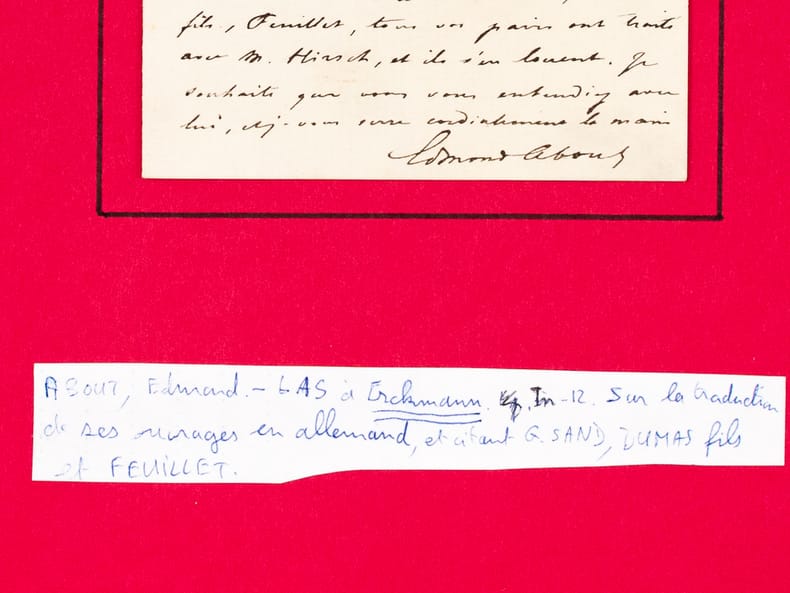
639631 L.A.S. d'une page sur 2 ff. au chiffre d'Edmond About, lettre contrecollée en tête sur carton rouge (collection Claude Seignolle), non datée : "Mon cher Erckmann, Je viens de faire un traité avec M. Arnold Hirsch pour la traduction allemande de mes ouvrages. Peut-être ne vous serait-il pas désagréable de tirer cette deuxième monture de votre sac. Madame Sand, Dumas fils, Feuillet, tous vos pairs ont traité avec M. Hirsch, et ils s'en louent. Je souhaite que vous vous entendiez avec lui, et je vous serre cordialement la main".
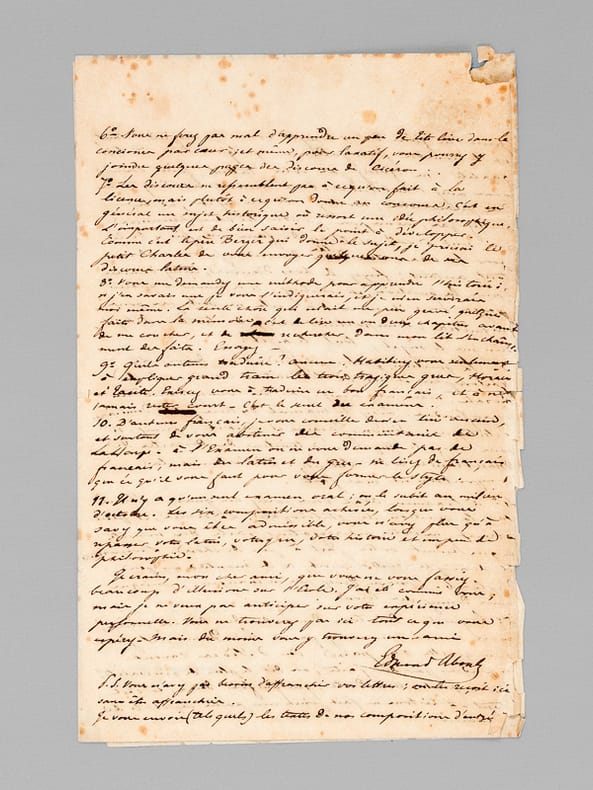
1849639831 L.A.S. de 4 pages sous enveloppe jointe affranchie le 4 mars 1849, adressée à M. "Deulin, Etudiant, à Condé sur l'Escaut" : Edmond About s'excuse de ne pas avoir répondu plus tôt "mais heureusement vous êtes en état de me comprendre et de m'excuser quand je vous dirai que je vous aurai répondu depuis longtemps si je n'étais moi-même amoureux, et sérieusement, c'est à dire follement et de manière à ne pouvoir rien faire de sérieux, pas même une lettre à un ami. Il y a peut-être cette différence entre votre infirmité et la mienne que vous êtes probablement heureux, ou que vous pourrez l'être ; tandis que moi sauf le bonheur d'aimer, je n'en attends, je n'en espère et je ne voudrais même pas en désirer d'autre. [... ] Celui qui vous écrit est dans une impasse d'où l'on ne sort que par un mariage ou par une infamie ; or ni l'un ni l'autre ne sont de mon goût. Je désire de tout mon coeur, mon coeur ami, que vous soyez plus heureux que moi" [ About se réjouit de la vie douce de son ami à Condé-sur-l'Escaut : ] "Je vous félicite donc sincèrement de n'être pas venu à Paris, et d'avoir compté vainement sur M. de Falloux. Si je l'avais connu la dernière fois que je vous ai écrit, j'aurai pu vous éclairer sur la nature de sa parole. Il est venu nous voir à l'Ecole et nous a noyés de compliments délayés et très fades : au reste, il nous déteste et ne songe qu'à nous traiter comme l'école d'administration" [ Il l'invite à se préparer lui-même au concours de l'Ecole : ] "Dans le cas où vous ne seriez pas reçu (ce dont les Dieux nous gardent !) vous vous seriez fait connaître de ces messieurs, et ils vous obtiendraient une place de professeur en province ; en attendant, ils l'ont fait pour un de nos camarades qui ne vous valait pas, et qui avait été refusé pour impertinence à l'examen oral" [ Il répond ensuite en 11 points à toutes ces questions sur l'examen ; durée, longueur, compositions en vers, examens oraux, et notamment pour la dissertation philosophique : ] "Lisez le manuel des trois demi-ânes éclectiques Simon, Jacquin et Saisset ; prenez, si vous avez le temps, une teinture de Descartes, de Malebranche et de Leibnitz. Généralement, la composition est mal faite" [Pour la question d'histoire :] " Peu d'élèves savent répondre par des faits ; on dit le plus de généralités qu'on peut. Une date, quelquefois deux, et c'est tout" [Avec la même verve, il continue plus loin : ] "D'auteurs français, je vous conseille de n'en lire aucun, et surtout de vous abstenir du commentaire de Laharpe. A l'examen, on ne vous demande pas de français, mais du latin et du grec. Ne lisez de français que ce qu'il vous faut pour vous former le style [etc... ] "Je crains, mon cher ami, que vous ne vous fassiez beaucoup d'illusions sur l'Ecole. J'ai été comme vous, mais je ne veux pas anticiper sur votre expérience personnelle. Vous ne trouverez pas ici tout ce que vous espérez. Mais du moins vous y trouverez un ami" [... ]
8vo, [2, index], 396pp., lacks title-page, bound in green cloth-backed boards.
Very Good Turkish, Ottoman (1500-1928) Fine red leather reward binding with art-nouveau decorations and Sultan Mehmed Resad tughra. 'Mükâfât' [i.e. Reward] written on board in very calligraphic Turkish with Arabic letters. Title gilt on spine. Light chipped on extremities of binding. Marbled endpapers. Blindstamped colophon. A finely printed book, a special paper. Cr. 8vo. (20 x 14 cm). In Ottoman script. (Old Turkish with Arabic letters). 181, [3] p., 1 errata, richly illustrated. The reverse side of the first pages including the portrait of Gustav V has a letter by Selim Sirri Tarcan bilingual in Swedish and Ottoman Turkish sent to Gustaf V, The King of Sweden, written in Pangalti, Constantinople. The book has a brilliant travel account to Sweden from a Turkish perspective. Only three institutional copies in Turkey (2) and Netherlands (1, Leiden) libraries in OCLC: 949541692.; Özege 2474. First and Only Edition. Swedish gymnastics gained institutional structure by the courtesy of Ling in the early 19th century and forced the dominance areas of German, French, and British systems, which were used in school physical education in Europe from the middle of the century, due to their fully defined and justified pedagogical, psychological, military and medical functions, and increased its impact in a short time. Civil or military personnel sent by European governments received education in Stockholm's Royal Central Institute of Gymnastics, which provided Swedish gymnastics education from 1813, and proved to be the most important, leading, and exemplary institution of its genre. On their return to their homelands, they pioneered and tried to introduce Swedish gymnastics in/into their own countries. Military and political conditions in his country would turn a soldier-engineer into a physical educator and pave the way for Selim Sirri Tarcan's travel to Sweden in 1909. German Gymnastics (Turnen) based French Amoros Gymnastics is one of the physical education movements which Turkey met after political reforms of 1839 (Tanzimat) and it was incorporated into first military school then civil school curricula as from mid-19th century. Selim Sirri Tarcan encountered this apparatus gymnastics course at Mekteb-i Sultani (today Galatasaray High School), whose curriculum was created according to the French system and came to the forefront with his skills. After his graduation from Military Engineering School, he put effort into teaching and promotion via media of this gymnastics, rather than dealing with his military duties. However, the posture caused by his muscular body he developed by strength exercises and liked to show on every occasion, and his general health problems would make him question the gymnastics system he was governed by. The problem was also in Europe's agenda, and physical education entered the area of interest of public health policies, and the opinion that it is the most convenient and economical means to improve individual and public health became widespread, which popularized Swedish gymnastics appealing to this field. As of the late-19th century, Swedish-style gymnastics began to be promoted by medical-gymnastics institutes founded in the Ottoman capital as well as by published articles on this system by physicians and intellectuals knowledgeable on a sport-health relationship. Selim Sirri Bey, who was also attracted by Swedish gymnastics, turned his penalty of being sent abroad due to his active participation as a soldier in the constitutional movement of 1908 to opportunity and asked authorities to send him to Stockholm's Royal Central Institute of Gymnastics. During his higher education on gymnastics, he was also impressed by Sweden's healthy social structure into which physical education was integrated, heard of Zander, whose therapeutic gymnastics exercises were being applied in clinics opened on his behalf in European cities, and took medical gymnastics and massage classes at Zander's clinic in Stockholm. Selim Sirri Bey recognized pedagogical and scie
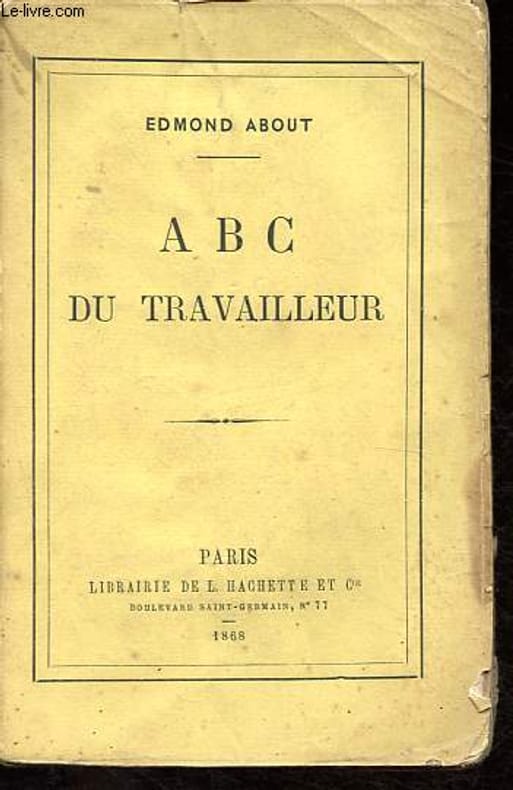
1868R200129715Hachette. 1868. In-12. Broché. Etat d'usage, Couv. légèrement pliée, Coiffe en pied abîmée, Rousseurs. 315 pages - papier jauni, coins frottés, dos plié, rousseurs sur les plats, coins des plats légèrement rognés, annotation sur la page de titre.. . . . Classification Dewey : 840.08-XIX ème siècle
198328449Ottawa Indians and Northern Affairs Canada 1983
1160275963.Gpaperback. Good. Access codes and supplements are not guaranteed with used items. May be an ex-library book. paperback
1167622480.Gpaperback. Good. Access codes and supplements are not guaranteed with used items. May be an ex-library book. paperback
0282953914.Gpaperback. Good. Access codes and supplements are not guaranteed with used items. May be an ex-library book. paperback
0428530184.Ghardcover. Good. Access codes and supplements are not guaranteed with used items. May be an ex-library book. hardcover
B9781167622489New. unknown
First edition, 5 vols., large 8vo, 464; 400; 369; 459; 445pp., ex-library with the usual markings, frontispiece portrait in vols. 1 and 4 (both offset onto title-page), cont. red half calf, worn, remains of labels, some light staining, joints starting, uncut. The very scarce catalogue of this outstanding collection of English topography. Lists over 6,500 works with detailed collations, arranged primarily by county.
First Edition, 2 vols., [viii],747; [viii],[749]-1536pp., plates and facsimiles, orig. cloth. Some of the subjects covered include Manx language and literature, poetry and drama, prose fiction, periodicals and journalism etc.
Second Edition, 3 vols., frontispiece in each volume (offset), 9 plates, illustrs., in the text, orig. cloth, hinges torn, one spine lacking. Windle & Pippin A38b; Jackson 49.
First edition, 3 vols., bound in 4, 4to (279 x 185 mm), ONE OF 100 COPIES PRINTED ON THICK AND LARGE PAPER WITH EXTRA PLATES, [4], xxv, [7], 462,lxxix, [1]; [2], 555, [1]; [2], 298; [2], 299-622, lxiipp., with the author's wood-engraved device on each title-page, a wood engraving of the elaborately-quartered coat of arms of the Roxburghe Club on the dedication page, 85 engraved plates ((including the private plate of 'Diana de Poictiers' in vol. 2, which was apparently destroyed after only 50 copies had been printed, and a proof of the 'Prater' plate in vol. 3), 62 illustrations printed on fine and thin "India" paper and mounted on the text leaves, 55 other illustrations in the text, with the additional sixty engraved plates on 52 leaves from Lewis' Series of Groups bound in at the appropriate places as designated by Lewis in his 'Directions to the binder', contemporary notes in pencil to several endpapers and a few within the text, text and plates have staining of varying degrees, pale stain to many lower margins, a little damage to endpapers where bookplates have been removed, full red hard grain red morocco,,covers waterstained, spines lettered in gilt, all edges gilt. Unfortunately this handsome large paper copy has suffered from water damage sometime in the past, additional photographs are available upon request. This set with the additional set of etchings on india paper by George Lewis, of a classic work of the utmost importance for its wealth of eye-witness information and anecdotes about printed books, manuscripts, buildings, other artefacts and people, both from past centuries and from the author's own day, for the extraordinary collection of illustrations, mostly drawn during the tour itself, and finally as a sumptuous piece of book production. As soon as the book appeared, leading scholars derided Dibdin for his lack of scholarship, especially concerning early manuscripts and printed books. But one must distinguish between the extensive and extremely useful information about things and people Dibdin saw during his 1818 tour, and his own interpretations and conclusions, which now serve only as a window to the attitudes of the time. Dibdin's enthusiasm, readable style and entertaining anecdotes, moreover, caught the mood of his age, making the book extremely popular and influential. Lewis' A Series of Groups... was intended to accompany Dibdin's Tour but was rejected by Dibdin as unworthy of his book. Lewis, most perturbed, issued them at his own expense and presented his case in the eight-page Advertisement which was separately printed. Jackson 48; 56; 56n: Windle & Pippin A38a; A44; D13.
First Edition, large 8vo, front inner hinge shaken, orig. buckram, slightly stained and worn.
First edition, 4to, lxvi, 516pp., orig. cloth. Full descriptions of over 1,000 books.
187p. Hardcover Fine condition
19291320917London, The Dancing Times Ltd. 1929. 11, (1), 228 S. OLwd (Rücken verblichen, innen gebräunt u. teils braunfleckig).
274 p. Hardcover Very good condition good
202pp., frontis., 4 plates, orig. cloth, d.w.