361 résultats
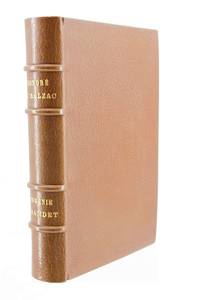
1850128963Paris possibly other locations: B. G. Barba and others not identified 1850. Hardcover. VG- corners and hinges show wear small tear to paper edge of back cover. Text block and some pages show foxing. All pages crisp. Marbled paper boards with leather spine with narrow raised bands and corners; gilt lines on cover spine lettering text block; 287 pp illustrated with charming engravings. In French. An assemblage of several popular illustrated novels of the mid- to late 1800s with no title page or publishing information for the book as a whole. Each novel has delightful engraved illustrations and typeface size varies. Several were published by Barba with a common masthead on the first page with the title "Romans Populaires Illustres." Others have no identifying publishing information. Included novels: "Les sept peches capitaux L'Avarice" by Eugene Sue 45 pp - "Seraphita" by Balzac 32 pp - "Le careme de ma tante" by Auguste Ricard 32 pp - "Le carnaval de mon pere" by Auguste Ricard 18 pp - "Le bal de sceaux" by Balzac 16 pp - "Honorine" by Balzac 48 pp - "L'Ecumeur de mer" by Fenimore Cooper - "Pierre Simple" by Le Capitaine Marryat 64 pp. B. G. Barba, and others not identified hardcover
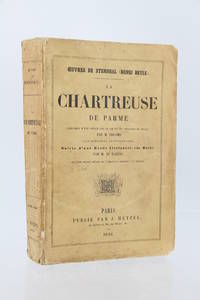
184685577Paris: Jules Hetzel 1846. Fine. Jules Hetzel Paris 1846 12 x 18.50 cm broché First duodecimo edition. Work preceded by a notice on the life and works of Beyle by his literary executor Romain Colomb followed by a literary study on Beyle by Honoré de Balzac. Spine restored small losses and marginal tears to boards foxing. Rare copy in original wrappers as issued. Jules Hetzel hardcover
180932842Paris: Imprimerie Impériale 1809. Fine. Imprimerie Impériale Paris 1809-1829 53.50 x 71 cm une feuille Original unshaved full-page etching from the Imperial edition of the Description de l'Égypte or Recueil des observations et recherches faites en Égypte pendant l'expédition française publié par les ordres de Sa Majesté l'Empereur Napoléon le Grand A Collection of the observations and research carried out in Egypt during the French expedition published on the orders of his Majesty the Emperor Napoleon the Great'.Produced between February 1802 and 1830 on the orders of Naopleon Bonaparte and published between 1809 and 1828 1000 copies were printed and distributed to institutions on vergé paper with an 'Égypte ancienne et moderne' watermark visible when held up to the light. Light marginal spotting not touching image otherwise in very fresh fine condition. An engraving from the Description de l'Egypte one of the masterpieces of French printing and the birth of a new field: Egyptology. A gigantic survey of Egypt at the time of Bonaparte's conquests in 1798 and 1799 the work is divided into 13 volumes of engravings making up 892 plates of which 72 colored as well as presenting the splendors of the Egypt of the Pharaohs in 9 volumes. The other volumes discuss natural history and present a fascinating portrait of Coptic and Islamic Egypt as it was seen by Bonaparte's Eastern Armies. The Egyptian campaign' militarily a disaster demonstrates through the engravings of the Description d'Egypte the scientific success it nonetheless became thanks to the 167 expert members of the Commission of the Sciences and Arts of the Institut d'Egypte Egyptian Institute who followed Napoleon's army. The Institut gathered together in Egypt the mathematician Monge the chemist Berthollet the naturalist Geoffroy Saint-Hilaire as well as numerous artists engineers architects and doctors. They were tasked with re-discovering modern and ancient Egypt and displaying its natural treasures as well as the know-how of its inhabitants.This edition the so-called Imperial edition of the plates for the Description de l'Egypte was printed in four large formats two of which were specially created for it and christened Moyen-Egypte and Grand-Egypte. A special press was built to print it the process extending over 20 years from 1809 to 1829. The Imperial edition proved so popular that a second edition this time in black and white and without the Egypte ancienne et moderne watermark known as the Royal Edition was published during the Restoration by the printing house of C.-L.-F. Panckoucke Paris.The engravings of the Description d'Egypte owe a great deal to Baron Dominique-Vivant Denon illustrator diplomat collector and later Director of the Musée Napoléon the Louvre. His exploration of the South of Egypt gave Bonaparte the idea of sending the experts of the Institut there thus creating a faithful and complete portrait of the area. This was the research gathered together from 1802 in the mammoth Description de L'Egypte.Denon embarked on this story of archeological exploration at the age of 51 reaching first Alexandria and then Cairo before exploring Upper Egypt. Along with the members of the Institut d'Egypte the Natural History Museum's painter H.J. Redouté brother of Pierre-Joseph Redouté author of Roses the mineralogist Dolomiue and the draughtsman Joly Denon then explored the Nile Delta and Lower Egypt. When however he joined the 21st Light Infantry Regiment as it marched across Upper Egypt in pursuit of the retreating Mameluks in November 1798 he found himself the only civilian. In the very midst of the battle itself he reeled off sketches of the works of art that peppered his path right up to the threshold of the Sudan. He said that he had crossed a country that is apart from its name entirely unknown to Europeans and therefore everything was worth describing Voyages dans la Basse et la Haute Egypte pendant les campagnes Imprimerie Impériale unknown
180926081Paris: Imprimerie Impériale 1809. Fine. Imprimerie Impériale Paris 1809-1829 53.50 x 71 cm une feuille Original unshaved full-page etching from the Imperial edition of the Description de l'Égypte or Recueil des observations et recherches faites en Égypte pendant l'expédition française publié par les ordres de Sa Majesté l'Empereur Napoléon le Grand A Collection of the observations and research carried out in Egypt during the French expedition published on the orders of his Majesty the Emperor Napoleon the Great'.Produced between February 1802 and 1830 on the orders of Naopleon Bonaparte and published between 1809 and 1828 1000 copies were printed and distributed to institutions on vergé paper with an 'Égypte ancienne et moderne' watermark visible when held up to the light. Light marginal spotting not touching image otherwise in very fresh fine condition. An engraving from the Description de l'Egypte one of the masterpieces of French printing and the birth of a new field: Egyptology. A gigantic survey of Egypt at the time of Bonaparte's conquests in 1798 and 1799 the work is divided into 13 volumes of engravings making up 892 plates of which 72 colored as well as presenting the splendors of the Egypt of the Pharaohs in 9 volumes. The other volumes discuss natural history and present a fascinating portrait of Coptic and Islamic Egypt as it was seen by Bonaparte's Eastern Armies. The Egyptian campaign' militarily a disaster demonstrates through the engravings of the Description d'Egypte the scientific success it nonetheless became thanks to the 167 expert members of the Commission of the Sciences and Arts of the Institut d'Egypte Egyptian Institute who followed Napoleon's army. The Institut gathered together in Egypt the mathematician Monge the chemist Berthollet the naturalist Geoffroy Saint-Hilaire as well as numerous artists engineers architects and doctors. They were tasked with re-discovering modern and ancient Egypt and displaying its natural treasures as well as the know-how of its inhabitants.This edition the so-called Imperial edition of the plates for the Description de l'Egypte was printed in four large formats two of which were specially created for it and christened Moyen-Egypte and Grand-Egypte. A special press was built to print it the process extending over 20 years from 1809 to 1829. The Imperial edition proved so popular that a second edition this time in black and white and without the Egypte ancienne et moderne watermark known as the Royal Edition was published during the Restoration by the printing house of C.-L.-F. Panckoucke Paris.The engravings of the Description d'Egypte owe a great deal to Baron Dominique-Vivant Denon illustrator diplomat collector and later Director of the Musée Napoléon the Louvre. His exploration of the South of Egypt gave Bonaparte the idea of sending the experts of the Institut there thus creating a faithful and complete portrait of the area. This was the research gathered together from 1802 in the mammoth Description de L'Egypte.Denon embarked on this story of archeological exploration at the age of 51 reaching first Alexandria and then Cairo before exploring Upper Egypt. Along with the members of the Institut d'Egypte the Natural History Museum's painter H.J. Redouté brother of Pierre-Joseph Redouté author of Roses the mineralogist Dolomiue and the draughtsman Joly Denon then explored the Nile Delta and Lower Egypt. When however he joined the 21st Light Infantry Regiment as it marched across Upper Egypt in pursuit of the retreating Mameluks in November 1798 he found himself the only civilian. In the very midst of the battle itself he reeled off sketches of the works of art that peppered his path right up to the threshold of the Sudan. He said that he had crossed a country that is apart from its name entirely unknown to Europeans and therefore everything was worth describing Voyages dans la Basse et la Haute Egypte pendant les campagnes Imprimerie Impériale unknown
188674980Paris: Motteroz 1886. Fine. Motteroz Paris 1886 16 x 25 cm relié sous étui Illustrated edition with 8 original full-page engravings after Pascal Dagnan-Bouveret by Le Rat. 120 numbered copies on vélin satiné our copy one of 100 nominative. Beige morocco by Marius Michel mint green morocco doublures framed with a gilt floral frieze decorated with inlaid morocco pieces and fillets on the boards moiré silk endpapers original wrappers preserved double gilt fillets on the edges all edges gilt case lined with morocco moiré paper boards superb binding signed Marius Michel. Bookseller's ticket label glued on a guard. Our copy includes a suite of 8 full-page etchings. A very nice copy superbly set by Marius Michel in doubled morocco. Motteroz hardcover
1841143283Paris: Aubert & Lavigne 1841. 1st edition. Nice copy. 16mo. cloth boards 124 128pp. illusts. First work has 58 wood-engravings by Gavarni. Humorous essays concerning the young French schoolboy; the village school the schoolroom Christian indoctrination college professors etc. Second work has 53 wood-engravings by Trimolet. Humorous essays concerning workers in various occupations; clerks cashiers cooks civil servants etc. A lovely little gem. FRENCH TEXT Aubert & Lavigne hardcover
1826OB1011<p>Paris Urbain Canel Delongchamps. M DCCC XXVI 1826. Hard Cover. 2 leaves iv 553 p. 1 leaf illus.; 25 cm. "Vie de Molière" by Honoré de Balzac iv p. This is an early publication of Balzac a year before he began the Comédie humaine. Each play is headed by an engraved vignette. Pforzheimer Molière 514. Slight foxing on first and last leaves; handsomely bound by Hollis Bedell in marbled boards with faux-leather spine; Very Good. Stock#OB1011.</p> Urbain Canel ...Delongchamps... Baudouin Frères hardcover
18942603160081Athenaeum Society New York 1894. Hardcover. Good. 6 volume set. Bound in blue cloth. Paper spine labels. Top edges gilt. Hardcover. Good bindings and covers. Shelf wear. Spines slightly darkened. Minor foxing. This is an oversized or heavy book which requires additional postage for international delivery outside the US. Athenaeum Society, New York hardcover
1843004201Paris: Furne 1843. Hardcover. Very Good. Francais Gavarni Gerard-Seguin Tony Johannot Meissonnier Henri Monnierc.Nanteuil Perlet. 492 frontispiece portrait 6 platespaper covered boards black title label to spine original card covers bound-in dust stained vol. V of the Oeuvres Complètes La Comédie Humaine Cinquième Volume Premiére Partie Études des Moeurs Deuxième Livre. Size: 8vo - over 7¾" - 9¾ <br/> <br/> Furne hardcover
18391770105873IEVCharpentier Libraire-editeur 1839. Hardcover. Acceptable. 1839. No Edition Remarks. 354 pages. Half bound brown leather with marbled paper covered boards. French text. Ex-Libris plate stuck to front pastedown. Pages have light tanning and foxing throughout. Previous owner's inscription to front free endpaper. Severe cracking to hinges causing boards to be loose. Front board and spine partially detached from text block. Boards have heavy shelf-wear with bumping to corners crushing to spine ends and rub wear all over. Tears to spine and edges. Charpentier, Libraire-editeur hardcover
1820P700Paris 1820. Very good some brownings. Notes: Published in the important and comprehensive work on Egypt commissioned by Napoleon: "Description de l’Egypte ou recueil des observations et des recherches qui ont ete faites en Egypte pendant l’expedition de l’armee Francaise." Image Size : 775x445 mm 30.5x17.5 Inches Platemark Size : Paper Size : 1055x665 mm 41.5x26.125 Inches Coloring: Original Hand Coloring Medium: Copper Engraving Categories: Views Africa Egypt unknown
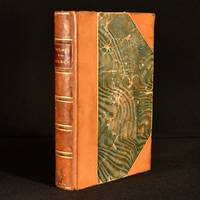
18402116London: Wm S Orr and Co 1840. Hardcover. Very Good. Threequarter green calf binding with marbled boards. Raised bands to spine with red title labels and gilt printing. Edges are schuffed and the leather is worn. Spine is beginning to crack. Marbled endpapers and page edges. Internally tight. Pages are age tanned with scattered foxing. Slight staining to front inner blank page. Pencilled notes on inner page. 230 charming engravings throughout the book. This is a fascinating account of French characters seen through the eyes of Balzac Janin and others Very Good 1840 Wm S Orr and Co hardcover
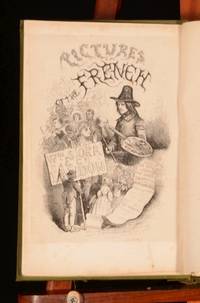
1840912P18London: Wm. S. Orr and Co 1840. First edition. Leather. Very Good. 9.5" by 6.5". Various. The first edition of this illustrated look at the different people of France a comical work with contributions by various authors. The first edition.A charming work being a series of short pieces looking at various characters found in France such as the Parisian Lady grocer horticulturist leader of fashion Duchess law student literary adventurer charwoman pensioner and more.Illustrated with a frontispiece forty-five plates and in-text engravings.Collated complete. With contributions by Jules Janin Honore de Balzac Madame de Bawr Eugene Nyon Viscount d'Arlincourt Raoul Perrin and more.Two bookplates to the front paste downs of E. G. Graham Little and John Fuller. In a rebacked half calf binding with marbled paper to the boards.Externally smart. Spine is a little rubbed. Minor rubbing to the boards. Light bumping to the extremities. Two bookplates to the front paste downs. Internally firmly bound. Pages are bright and generally clean with scattered spots. Neat repair to the margin of leaf iii/iv. Very Good Wm. S. Orr and Co hardcover
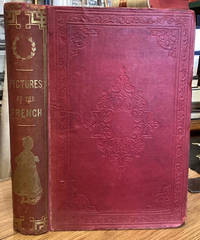
1840GEN28-H-3London : Wm. S. Orr and Co. 1840. Cloth. Good. 9.5" by 7". Gavarni H. Monnier et al. Pictures of the French: A Series of Literary and Graphic Delineations of French Character by Jules Janin Balzac Cormenin and other Celebrated French Authors. Illustrated with upwards of two hundred and thirty engravings drawn on the wood by Gavarni H. Monnier and Meissonier and engraved by Lavieille Etc. With an introduction to front by Jules Janin and sections on people such as The Parisian Lady The Grisette The Speculator The Artist's Friends and The Peer of France. In a cloth binding. Externally sound but with slight bumping and wear to extremities marks and marginal fading to boards. Front hinge strained. Internally generally firmly bound although slightly strained in places. Bright but with the odd spot and handling marks and foxing to plates. Good Wm. S. Orr and Co. hardcover
1840GEN24-G-6London : Wm. S. Orr and Co. 1840. Cloth. Very Good. 9.5" by 7". Gavarni H. Monnier and Meissonier. A charming and detailed observational work looking into the stereotypical characters seen throughout France. Delicately illustrated with upwards of two hundred and thirty engravings drawn on the wood by Gavarni H. Monnier and Meissonier and engraved by Lavieille. With an introduction to front by Jules Janin and sections on people such as The Parisian Lady The Grisette The Speculator The Artist's Friends and The Peer of France. In a green cloth binding with handwritten spine label. Externally generally sound although with slight bumping and rubbing to extremities. As well as gentle sunning to the spine label. Internally generally firmly bound although slightly strained in places. Bright throughout and generally clean although with the odd instances of light foxing to the plates. Very Good Wm. S. Orr and Co. hardcover
1840Alibris.0000752London: Wm. S. Orr 1840. Hard cover. Very good. No dust jacket as issued. Rebound in blue buckram spine sunned binding tight text clean and unmarked. 361 p. Includes illustrations. Wm. S. Orr hardcover
180925825Paris: Imprimerie Impériale 1809. Fine. Imprimerie Impériale Paris 1809-1829 54 x 71 cm une feuille Original unshaved full-page etching from the Imperial edition of the Description de l'Égypte or Recueil des observations et recherches faites en Égypte pendant l'expédition française publié par les ordres de Sa Majesté l'Empereur Napoléon le Grand A Collection of the observations and research carried out in Egypt during the French expedition published on the orders of his Majesty the Emperor Napoleon the Great'.Produced between February 1802 and 1830 on the orders of Naopleon Bonaparte and published between 1809 and 1828 1000 copies were printed and distributed to institutions on vergé paper with an 'Égypte ancienne et moderne' watermark visible when held up to the light. Light marginal spotting not touching image otherwise in very fresh fine condition. An engraving from the Description de l'Egypte one of the masterpieces of French printing and the birth of a new field: Egyptology. A gigantic survey of Egypt at the time of Bonaparte's conquests in 1798 and 1799 the work is divided into 13 volumes of engravings making up 892 plates of which 72 colored as well as presenting the splendors of the Egypt of the Pharaohs in 9 volumes. The other volumes discuss natural history and present a fascinating portrait of Coptic and Islamic Egypt as it was seen by Bonaparte's Eastern Armies. The Egyptian campaign' militarily a disaster demonstrates through the engravings of the Description d'Egypte the scientific success it nonetheless became thanks to the 167 expert members of the Commission of the Sciences and Arts of the Institut d'Egypte Egyptian Institute who followed Napoleon's army. The Institut gathered together in Egypt the mathematician Monge the chemist Berthollet the naturalist Geoffroy Saint-Hilaire as well as numerous artists engineers architects and doctors. They were tasked with re-discovering modern and ancient Egypt and displaying its natural treasures as well as the know-how of its inhabitants.This edition the so-called Imperial edition of the plates for the Description de l'Egypte was printed in four large formats two of which were specially created for it and christened Moyen-Egypte and Grand-Egypte. A special press was built to print it the process extending over 20 years from 1809 to 1829. The Imperial edition proved so popular that a second edition this time in black and white and without the Egypte ancienne et moderne watermark known as the Royal Edition was published during the Restoration by the printing house of C.-L.-F. Panckoucke Paris.The engravings of the Description d'Egypte owe a great deal to Baron Dominique-Vivant Denon illustrator diplomat collector and later Director of the Musée Napoléon the Louvre. His exploration of the South of Egypt gave Bonaparte the idea of sending the experts of the Institut there thus creating a faithful and complete portrait of the area. This was the research gathered together from 1802 in the mammoth Description de L'Egypte.Denon embarked on this story of archeological exploration at the age of 51 reaching first Alexandria and then Cairo before exploring Upper Egypt. Along with the members of the Institut d'Egypte the Natural History Museum's painter H.J. Redouté brother of Pierre-Joseph Redouté author of Roses the mineralogist Dolomiue and the draughtsman Joly Denon then explored the Nile Delta and Lower Egypt. When however he joined the 21st Light Infantry Regiment as it marched across Upper Egypt in pursuit of the retreating Mameluks in November 1798 he found himself the only civilian. In the very midst of the battle itself he reeled off sketches of the works of art that peppered his path right up to the threshold of the Sudan. He said that he had crossed a country that is apart from its name entirely unknown to Europeans and therefore everything was worth describing Voyages dans la Basse et la Haute Egypte pendant les campagnes de Imprimerie Impériale unknown
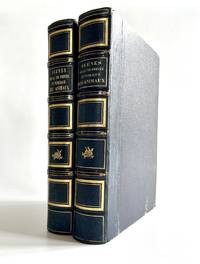
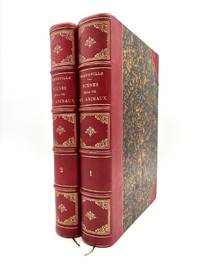
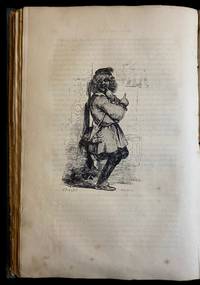
184286562à Paris: Chez Hetzel et Paulin 1842. Fine. Chez Hetzel et Paulin à Paris 1842 18 x 27 cm 2 volumes reliés First edition admirably illustrated with 201 hors-texte figures and 120 vignettes by Grandville. Hetzel's publisher's preface most often absent is here present before the prologue. Most copies begin directly with the prologue. 2 frontispieces. Contemporary half-navy shagreen bindings with corners. Spine with false flat raised bands with 4 compartments composed of thick and thin fillets one with fleuron mirror tooling on the raised bands gilt title. In a way not perceptible at first glance there exist small differences between the 2 volumes which were bound by the same binder but not at the same time: thus the typography of the title is noticeably different the compartment with the fleuron has no thick fillet framing. The volumes bear no volume numbering. We know that the 2 volumes did not appear at the same time and that the first volume appeared separately and that a second part a continuation was added afterwards. The binding seems to have followed the publication process. Traces of rubbing. Some pale foxing on well-white paper however foxing on the half-titles and the last page of the table of contents. Handsome copy. This famous publication needs no introduction a satire of contemporary Parisian society of the Second Empire whose enterprise is due to Hetzel who under the pseudonym of Stahl signed several texts and commissioned texts from the most famous pens of the time: Balzac Musset Sand La Bedollière. The last chapter recounts the imprisonment of the different writers whom one can see in locations at the Jardin des plantes where we see Grandville from behind drawing them. One of Grandville's great works of imagination full of verve and fantasy. Chez Hetzel et Paulin hardcover
184279090à Paris: Chez Hetzel et Paulin 1842. Fine. Chez Hetzel et Paulin à Paris 1842 17.70 x 27 cm 2 volumes reliés First edition admirably illustrated with 201 plates and 120 vignettes by Grandville. This first volume correctly has the first third of the work printed on tinted paper while the rest is on white paper a characteristic of the first printing; most copies are from a second printing as the leaves are also white like the rest of the work. Moreover Hetzel's publisher's preface usually absent is present here before the prologue. Most copies begin directly with the prologue. The frontispiece of volume 1 has been placed facing p. 32 the engraved half-title entitled Scène de moeurs serving as frontispiece; this half-title is often absent from most copies. The frontispiece and engraved title of volume 2 as well as an engraved half-title also entitled 2e partie have been preserved without the title page of the second volume which has not been bound in this copy. These 2 half-titles in the first volume Scène de moeurs in the second volume 2e partie are very often absent from copies. Near-contemporary half red shagreen bindings with corners. Spines with raised bands with 3 decorated compartments gilt title and volume number. Separation fillets on boards. Combed edges echoing the pattern of the endpapers. Signs of rubbing. On the upper board of volume 1 a 2 cm area exposing the cardboard. Superb freshness of the paper completely free from foxing. Handsome copy. This famous publication needs no introduction a satire of contemporary Parisian society under the Second Empire an enterprise due to Hetzel who under the pseudonym Stahl signed several texts and commissioned texts from the most famous writers of the time: Balzac Musset Sand La Bedollière. The last chapter recounts the imprisonment of the various writers who can be seen in enclosures at the Jardin des plantes where we see Grandville from behind drawing them. One of Grandville's great works of imagination full of verve and fantasy. Chez Hetzel et Paulin hardcover
18414237London: Thomas Tegg 1841. First edition. Hardback in original cloth with gilt illustrated title vignette to front and spine. Moiré endpapers. Complete with all 24 b/w plates including frontispiece and many others in text. Pages are darkened at edges and some foxing to a few pages; otherwise good general condition. xii 200 pages. 250 x 165 mm 9¾ x 6½ inches. Thomas Tegg hardcover
184072352London: Wm. S. Orr and Co. 1840. Large 8vo. xx 361 pp. 45 engraved plates including frontis and numerous other in-text illustrations. Recased in red cloth with bind-stamped decoration to boards and gilt-decorated and lettered spine. Wear to extremities and scattered foxing to text. The plates are on India paper. A series of portraits of members of French society. . Good. Blind-stamped Cloth. 1840. Wm. S. Orr and Co. 1840 hardcover
18400011053London: Wm. S. Orr And Co. 1840. First English Language Edition. Hardcover. Good plus. Octavo; xx 361 pages full greeen calf extra-gilt spine edgeworn gilt logo of the Upper Canada College with an student award for First Prize in 1848; rebacked with the leather spine laid down. Very Scarce: WorldCat cites only the Harvard copy. <br/><br/>With upwards of 230 engravings drawn on wood by Garvarni H. Monnier and Meissonier and engraved by Lavielle etc. " This work is a selection from LES FRANCAIS PEINTS PAR EUX-MEMES. " What the ancients neglected to do for us we have done for posterity; they will have our 'pictures' - not 'heads' but full-lengths and as ridiculous as the originals. . nothing has been neglected that could make the work a perfect picture of contemporary manners .". - Introduction. The larger plates have been tipped-in. Wm. S. Orr And Co. hardcover
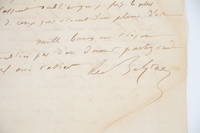
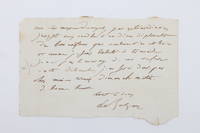
183077791Tours 1830. Fine. Tours 23 juin 1830 13.20 x 19.90 cm une feuille Unpublished autograph letter: As soon as I had arrived in Tours I was thrown on the coasts of Brittany by the best conditioned desire that had ever seized a man to shut off the atmosphere of Paris and its ideas by going to run on the beautiful rocks that border the sea in Brittany Tours 23 June 1830 13.2 x 19.9cm one leaf Unpublished handwritten letter signed by Honoré de Balzac one and a half pages written in black ink on a leaf of white paper. Transversal folds and ink a little faded at the bottom of the first page without making it difficult to read. The man from Tours poetically recounts his wanderings on the Breton coast during a trip he took in the company of Madame de Berny. Together they sailed up the Loire in a boat all the way to Le Croisic: As soon as I had arrived in Tours I was thrown on the coasts of Brittany by the best conditioned desire that had ever seized a man to shut off the atmosphere of Paris and its ideas by going to run on the beautiful rocks that border the sea in Brittany and there once arrived I stayed a fortnight the most delicious in the world running on the bays on the kelp collecting the pucelages that are in large numbers on the sea sand in reverse of the rue Vivienne. The pucelages here are shellfish so named because of their vulvoid shape allowing Balzac an allusion to the prostitution very popular at the time that occupied the Galerie Vivienne. This amusing letter is addressed to one of the editors of La Silhouette magazine as evidenced in particular by the sign off at the end of the letter mentioning the founder of the periodical: A thousand good friendships do not forget to give a large part to our friend Victor Ratier. Balzac also mentions several articles: I am writing to give you a sign of life proof of interest and of friendship but I write to you briefly because I have twenty letters to answer and I promise you a letter for.1st July which will contain the end of the charlatan issue 2 la bella dona and finally the articles that will have passed through my head and with which you will be furnished so as to not ask anything of me for a month or two and so that around August you will be my publisher. We have not found any trace of said letter in the writer's correspondence no more besides than the continuation of the Charlatan the first part of which was published in the second issue of La Silhouette. No article under the title of Bella Dona appears in the following issues either although Balzac emphasizes in his letter the desire to provide other texts given that the charms of the Loire must not make him forget that he is the poorest of those who live on a quill pen. A beautiful and spicy unpublished letter. unknown
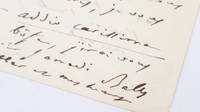
1839803451839. Fine. s. d. ca 1839 13 x 8 cm une feuille Signed handwritten letter to Louis Desnoyers ca 1839 13 x 8 cm one leaf Handwritten letter signed by Honoré de Balzac addressed to Louis Desnoyers written on a white piece of paper in black ink. My dear Mr Desnoyers extraordinarily today I attend a diplomatic dinner of good-natured folk who want to laugh and drink and as I am in a stupor at work I have not had the courage to refuse this debauchery; I will therefore not be at home. Come early Sunday morning. / Yours / de Balzac. Louis Desnoyers plays an important role in the foundation of the Société des gens de lettres which aims to protect literary and artistic property and to create a solidarity fund. Balzac supported the creation of this Society of which Desnoyers was vice-president. Amusing letter testimony of Balzac's love of good food. unknown
184286807Paris 1842. Fine. Balzac's Soon to be Lost Illusion Paris 12 mars 1842 13.50 x 26 cm 4 pages sur un feuillet Autograph letter signed by Honoré de Balzac to Sophie Koslowska. 4 pages in black ink on a bifolium. Usual folds. Very small lacks of paper along the horizontal fold of the first leaf. Published in his Correspondance 1819-1850 II. Paris Calmann-Lévy 1875 pp. 31-33. A long feverish letter by Balzac a few days before the premiere of Les Ressources de Quinola at the Odéon theater. The writer writes to his close friend Sophie Kozlowska daughter of Prince Kozlowski about the chaotic final preparations and urges her to fill the theater with all of Paris's Russian high society. Balzac wrote this important letter just as he was about to take one of the biggest gambles of his career. The writer wanted to convene a real audience for the premiere of Les Ressources de Quinola and have the play performed in front of a full house of paying spectators instead of using the famous claqueurs clappers traditionally seated in the parterre to encourage audience reactions which is described at length in Lost Illusions. His failed attempt was so publicized by all the newspapers that this performance proved the very necessity of claqueurs: The author preferred peril. Such is the reason for this first performance in which so many people were displeased to have been elevated to the dignity of independent judges Editor's notes in Balzac's OEuvres complètes A. Houssiaux 1855. La Mina wrote me that you were ill and it struck me as a blow as if someone had told Napoleon that his aide-de-camp had died: disregarding Kozlowska's fragile health Balzac set about filling the twelve hundred seats of the Théâtre-Français with all the high-ranking and wealthy spectators Paris had to offer. He relied on the relations of his carissima Sofia to pay for the priciest seats an inclination that earned him accusations of speculation. He indeed takes particular care going over prices in the letter: We'll play next Wednesday barring any misfortune. The first seatings with four places are one hundred francs a box and everyone wants to be there. But the fashionable place where the Aguados the Rothschilds the Doudeauvilles the Castries etc. are is the loge des premières fermées because one feels at home. . Lamartine has asked me for a box: I'll put him between the Russians. Princess Troubetskoï is not the same one whose husband I know. See to it that you write to the prince And don't forget your Makanof . So: balconies twenty-five francs; stalls twenty francs; premières découvertes twenty-five francs a seat; secondes découvertes twenty francs; secondes fermées twenty-five francs; baignoires twenty francs a seat. . Ah! if you only knew what wealth of beautiful women! There will be no clappers in the parterre which is priced at five francs . Write a note to Princess Constantine Razumovska. I don't dare do it myself. For you and for your mother you will go to the premières découvertes; I will place you well. These hurried lines reveal Balzac's great expectations. He deeply believed in the merits of his comedy play about a man of industrial genius in 16th century Spain although the play's reception certainly suffered from Balzac's poor choices during its premiere. The writer expected to solve his financial difficulties and travel with his beloved Madame Hanska following the play's success. Having finished writing the final acts in a hurry he describes the terrible days leading up to the premiere: I'm overwhelmed on edge! I have the actors rehearse in the morning the entire cast during the day and the actresses in the evening. There are twenty thousand francs worth of costumes in the play. The sets are brand new. I'm told that the work is a masterpiece and that makes me shudder! It will always be frighteningly solemn. Some lines even border on the paranoid abundantly underlined with unknown