VIELLERGLE (A., dit Auguste Le POITEVIN de SAINT-ALME ou Le POITEVIN de L'EGREVILLE ou PROSPER de SAINT-ALME).Livre Rare Book
1 527 résultats
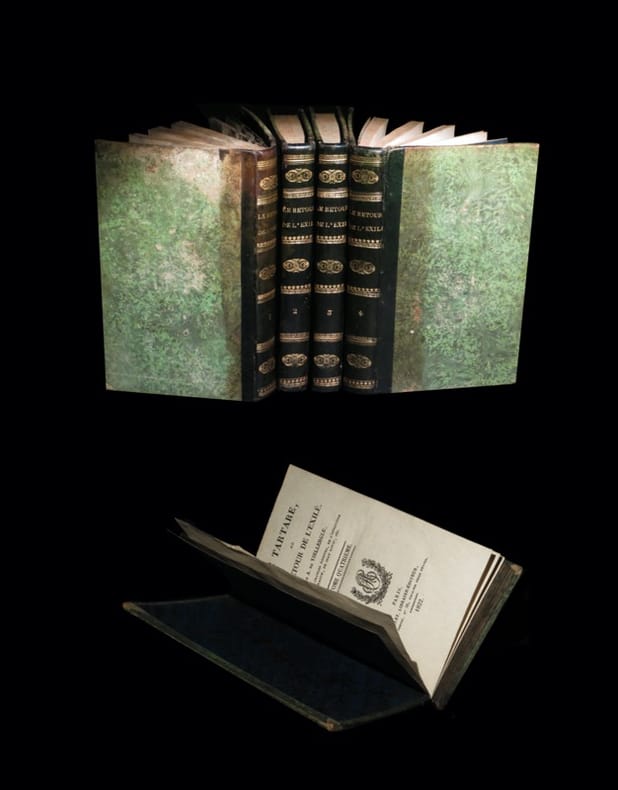
182225114Paris, Pollet, 1822. 4 vol. au format pt in-12 (172 x 106 mm) de xxiv - 186 pp. ; 1 f. bl., 2 ff. n.fol., 210 pp. et 1 f. bl. ; 1 f. bl., 2 ff. n.fol., 204 pp. et 1 f. bl. ; 1 f. bl., 2 ff. n.fol., 245 pp., 1 f. n.fol. de catalogue éditeur in fine et 1 f. bl. Reliures uniformes de l'époque de demi-basane glacée émeraude, dos lisses ornés de roulettes dorées, larges fleurons romantiques dorés, titre doré, tomaison dorée, tranches jaspées.
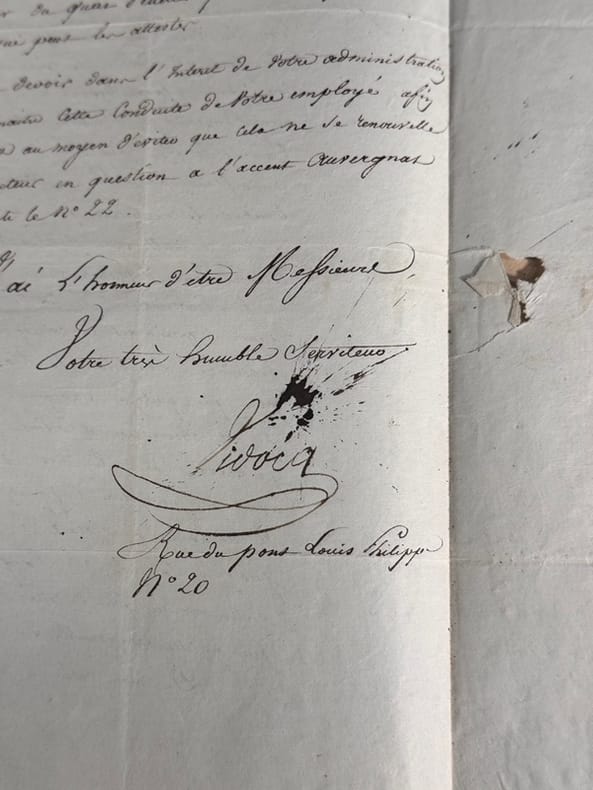
18361887Paris 1836 Portait lithographié et d’une note biographique Lettre autographe signée Vidocq, datée du 21 décembre 1836, in-4, adressée aux messieurs de l'administration des Dames Blanches à la Villette concernant un différent qu'il vient d'avoir avec un cocher de la société de transports de la Dame Blanche. Le cocher, décrit comme grossier et malhonnête, agressif et de mauvaise foi aurait éconduit une pauvre femme en refusant de la faire descendre à l'endroit qu'elle avait désigné. La discussion s'envenimant, ledit cocher n'obtempéra qu'avec peine aux injonctions que l'on imagine tonitruantes de Vidocq.Après avoir porté signalé le fait, à l'inspecteur du quai Pelletier, Vidocq ne sent pourtant pas lavé de cet affront et croit devoir "dans l'intérêt de votre administration (à) vous faire connaître cette conduite de cet endroit afin que vous avisiez le moyen que cela ne se renouvelle. Le conducteur en question a l'accent auvergnat et la voiture est le numéro 22. J'ai l'honneur d'être, messieurs, votre très humble serviteur, Vidocq". Qu'il signe d'une plume rageuse, provoquant une belle tâche sur le papier. Vidocq est l'un des personnages les plus hauts en couleur du XIXe siècle : voleur, forçat, déserteur, roi de l'évasion, faussaire, escroc et assassin, il devient chef de la Sûreté et se retourne contre ses anciens compagnons, revendiquant pour sa très chaotique carrière plus de 16000 arrestations. C'est dans ces circonstances qu'il crée la première officine de détective privé et à cette occasion rencontre Dumas, Balzac et Hugo, qui se nourrirent de la truculence du personnage, s'inspirèrent de sa violence pour créer les personnages de Vautrin chez Balzac et de Jean Valjean ainsi que Javert chez Victor Hugo. Le portrait de Deveria joint à la lettre autographe restitue la force du personnage, à la fois séduisant et roublard dont la postérité a jusque nos jours fait grand cas.
184035501452Bruxelles, Chez l'auteur, 1840 ; in-8 br. XXII pp -172 pp Tiré à 640 ex. n.c., état neuf.
184267947Paris, Au Bureau Central des Publications Nouvelles, 1842-1843, in-4, demi-reliure romantique, dos long, richement orné, plats papier marbré, 412 & 418 pp. Bons exemplaires. Rousseurs éparses, essentiellement en début et fin de volume. Deux premiers cahiers du 1er tome légèrement déboités. Illustrations de Gavarni, Victor Adam, Daumier, d'Aubigny, H. Emy, Traviès, Henri Monnier.
185852061858 in-12, (2ff)., 210pp., br. (mq. de couverture au dos, rousseurs). Paris Librairie nouvelle 1858,
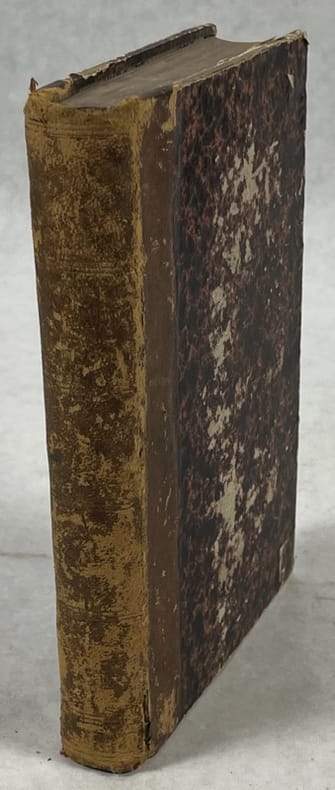
1850128963Paris possibly other locations: B. G. Barba and others not identified 1850. Hardcover. VG- corners and hinges show wear small tear to paper edge of back cover. Text block and some pages show foxing. All pages crisp. Marbled paper boards with leather spine with narrow raised bands and corners; gilt lines on cover spine lettering text block; 287 pp illustrated with charming engravings. In French. An assemblage of several popular illustrated novels of the mid- to late 1800s with no title page or publishing information for the book as a whole. Each novel has delightful engraved illustrations and typeface size varies. Several were published by Barba with a common masthead on the first page with the title "Romans Populaires Illustres." Others have no identifying publishing information. Included novels: "Les sept peches capitaux L'Avarice" by Eugene Sue 45 pp - "Seraphita" by Balzac 32 pp - "Le careme de ma tante" by Auguste Ricard 32 pp - "Le carnaval de mon pere" by Auguste Ricard 18 pp - "Le bal de sceaux" by Balzac 16 pp - "Honorine" by Balzac 48 pp - "L'Ecumeur de mer" by Fenimore Cooper - "Pierre Simple" by Le Capitaine Marryat 64 pp. B. G. Barba, and others not identified hardcover
1850128963Paris possibly other locations: B. G. Barba and others not identified 1850. Hardcover. VG- corners and hinges show wear small tear to paper edge of back cover. Text block and some pages show foxing. All pages crisp. Marbled paper boards with leather spine with narrow raised bands and corners; gilt lines on cover spine lettering text block; 287 pp illustrated with charming engravings. In French. An assemblage of several popular illustrated novels of the mid- to late 1800s with no title page or publishing information for the book as a whole. Each novel has delightful engraved illustrations and typeface size varies. Several were published by Barba with a common masthead on the first page with the title "Romans Populaires Illustres." Others have no identifying publishing information. Included novels: "Les sept peches capitaux L'Avarice" by Eugene Sue 45 pp - "Seraphita" by Balzac 32 pp - "Le careme de ma tante" by Auguste Ricard 32 pp - "Le carnaval de mon pere" by Auguste Ricard 18 pp - "Le bal de sceaux" by Balzac 16 pp - "Honorine" by Balzac 48 pp - "L'Ecumeur de mer" by Fenimore Cooper - "Pierre Simple" by Le Capitaine Marryat 64 pp. B. G. Barba, and others not identified hardcover books
184685577Jules Hetzel | Paris 1846 | 12 x 18.50 cm | broché
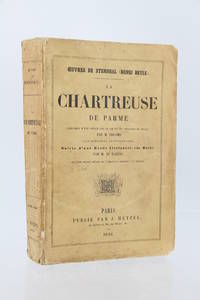
184685577Paris: Jules Hetzel 1846. Fine. Jules Hetzel Paris 1846 12 x 18.50 cm broché First duodecimo edition. Work preceded by a notice on the life and works of Beyle by his literary executor Romain Colomb followed by a literary study on Beyle by Honoré de Balzac. Spine restored small losses and marginal tears to boards foxing. Rare copy in original wrappers as issued. Jules Hetzel hardcover
1854LFA-126743785Un ouvrage de 514 pages, format 125 x 190 mm, relié cartonnage, publié en 1854, Michel Lévy Frères, Libraires-Editeurs (Paris), peu courant
1876028045Paris Calmann-Lévy 1876 un volume grand in-8°, 496 (2) pp. (table), couverture imprimée. (couvertures poussiéreuses et faiblement marquées, petit manque à la couverture inférieure, dos légèrement creusé, rousseurs). Deuxième édition revue, corrigée et augmentée d'un appendice.
189920971Paris Calmann Lévy 1899 In-12 294 pp
189620970Paris Calmann Lévy 1896 In-12 248 pp
1831133460Paris, chez les marchands de nouveautés 1831 In-8 20 x 12 cm. Reliure demi-basane havane, dos lisse, LXVII-319 pp. Reliure sensiblement frottée.
1857RO30361660Michel Lévy frères. 1857. In-12. Cartonné. Etat d'usage, Plats abîmés, Dos abîmé, Papier jauni. 305 pages. Annotations crayon et encre, hors texte. Nombreuses rousseurs. Accrocs, mors fendus, arrachés au dos. Coins frottés.. . . . Classification Dewey : 840.8-Anthologies, recueils
182855021828 reliure plein veau marbré in-octavo, dos long décoré or - pièce de titre sur fond noir -, plats décorés or, tranches peignées, ex-libris sur la page de faux-titre du célèbre Libraire Balzacien Georges Courville de la rue Bonaparte à Paris, illustration : frontispice en couleurs, quelques rares et très légères piqûres, 356 pages, 1828 Paris Chez .D. Belin Libraire,
184071247Paris Hyppolite Souverain 1840 1 In huit reliure usagée , très frottée, dos en partie fendu,coins émoussés 328 pp papier fortement piqué, édition originale ,il manque le tome I et l'année suivante paraitra une édition belge.Cachet de librairie à Bayonne .
182997885Paris Roret 1829 1 vol. relié in-16, relié demi-basane havane, dos lisse orné de fleurons et filets dorés, 316 pp., frontispice gravé par Tony Johannot (dos uniformément passé, mouillure angulaire aux 5 premiers feuillets et au frontispice). Edition originale de l'une des dernières collaborations entre Raisson et Balzac. Rare.
182997885Paris Roret 1829 1 vol. relié in-16, relié demi-basane havane, dos lisse orné de fleurons et filets dorés, 316 pp., frontispice gravé par Tony Johannot (dos uniformément passé, mouillure angulaire aux 5 premiers feuillets et au frontispice). Edition originale de l'une des dernières collaborations entre Raisson et Balzac. Rare.
1819388201819 1 vol in-8 broché - tome VIII - octobre-décembre 1961
182846401304Paris, Brissot-Thivars, , 1828 ; 2 vol. in-16, demi-chevrette violette, dos orné de filets et de fleurons dorés, non rogné (Rel. de l’époque). - 2 ff. n.ch., XLVIII pp. (par Viollet Le Duc), 402 pp., 1 f. table. [Imprimerie de H. Balzac rue des Marais S.G., n° 17]. En réalité il s’agit de l’édition Desœr 1822 (même composition, même papier) qui fut cédée à Brissot-Thivars. Ce dernier s’est contenté de faire refaire les 2 ff. de faux-titre et titre par Balzac. Bel exemplaire avec, sur la garde, un ENVOI AUTOGRAPHE de Viollet-Le Duc « à Monsieur De la Tour, de la part de l’éditeur reconnaissant des soins donnés à son fils 1er janv. 1831 » Ex-libris. L’exemplaire a appartenu à H. Hanoteaux (ex-libris). Note manuscrite de ce dernier sur 4 ff. in 16, au sujet de ce tirage. On joint: REGNIER (Mathurin). Œuvres, avec commentaires, revues, corrigés et augmentés. Précédées de l’Histoire de la Satire en France pour servir de discours préliminaire. Par M. Viollet Le Duc. Edition elzévirienne. Paris, Desœr, 1822 ; in-16, demi-chevrette violette, dos orné de filets et de fleurons dorés, non rogné (Rel. pastiche). Cette édition, identique à celle de 1828, prouve que cette impression balzacienne est hautement contestable. Cet exemplaire porte également l’ex-libris de G. Hanoteaux. Hanoteaux et Vicaire, 141."
180926081Imprimerie Impériale | Paris 1809-1829 | 53.50 x 71 cm | une feuille
180932842Imprimerie Impériale | Paris 1809-1829 | 53.50 x 71 cm | une feuille
180932842Paris: Imprimerie Impériale 1809. Fine. Imprimerie Impériale Paris 1809-1829 53.50 x 71 cm une feuille Original unshaved full-page etching from the Imperial edition of the Description de l'Égypte or Recueil des observations et recherches faites en Égypte pendant l'expédition française publié par les ordres de Sa Majesté l'Empereur Napoléon le Grand A Collection of the observations and research carried out in Egypt during the French expedition published on the orders of his Majesty the Emperor Napoleon the Great'.Produced between February 1802 and 1830 on the orders of Naopleon Bonaparte and published between 1809 and 1828 1000 copies were printed and distributed to institutions on vergé paper with an 'Égypte ancienne et moderne' watermark visible when held up to the light. Light marginal spotting not touching image otherwise in very fresh fine condition. An engraving from the Description de l'Egypte one of the masterpieces of French printing and the birth of a new field: Egyptology. A gigantic survey of Egypt at the time of Bonaparte's conquests in 1798 and 1799 the work is divided into 13 volumes of engravings making up 892 plates of which 72 colored as well as presenting the splendors of the Egypt of the Pharaohs in 9 volumes. The other volumes discuss natural history and present a fascinating portrait of Coptic and Islamic Egypt as it was seen by Bonaparte's Eastern Armies. The Egyptian campaign' militarily a disaster demonstrates through the engravings of the Description d'Egypte the scientific success it nonetheless became thanks to the 167 expert members of the Commission of the Sciences and Arts of the Institut d'Egypte Egyptian Institute who followed Napoleon's army. The Institut gathered together in Egypt the mathematician Monge the chemist Berthollet the naturalist Geoffroy Saint-Hilaire as well as numerous artists engineers architects and doctors. They were tasked with re-discovering modern and ancient Egypt and displaying its natural treasures as well as the know-how of its inhabitants.This edition the so-called Imperial edition of the plates for the Description de l'Egypte was printed in four large formats two of which were specially created for it and christened Moyen-Egypte and Grand-Egypte. A special press was built to print it the process extending over 20 years from 1809 to 1829. The Imperial edition proved so popular that a second edition this time in black and white and without the Egypte ancienne et moderne watermark known as the Royal Edition was published during the Restoration by the printing house of C.-L.-F. Panckoucke Paris.The engravings of the Description d'Egypte owe a great deal to Baron Dominique-Vivant Denon illustrator diplomat collector and later Director of the Musée Napoléon the Louvre. His exploration of the South of Egypt gave Bonaparte the idea of sending the experts of the Institut there thus creating a faithful and complete portrait of the area. This was the research gathered together from 1802 in the mammoth Description de L'Egypte.Denon embarked on this story of archeological exploration at the age of 51 reaching first Alexandria and then Cairo before exploring Upper Egypt. Along with the members of the Institut d'Egypte the Natural History Museum's painter H.J. Redouté brother of Pierre-Joseph Redouté author of Roses the mineralogist Dolomiue and the draughtsman Joly Denon then explored the Nile Delta and Lower Egypt. When however he joined the 21st Light Infantry Regiment as it marched across Upper Egypt in pursuit of the retreating Mameluks in November 1798 he found himself the only civilian. In the very midst of the battle itself he reeled off sketches of the works of art that peppered his path right up to the threshold of the Sudan. He said that he had crossed a country that is apart from its name entirely unknown to Europeans and therefore everything was worth describing Voyages dans la Basse et la Haute Egypte pendant les campagnes Imprimerie Impériale unknown
180926081Paris: Imprimerie Impériale 1809. Fine. Imprimerie Impériale Paris 1809-1829 53.50 x 71 cm une feuille Original unshaved full-page etching from the Imperial edition of the Description de l'Égypte or Recueil des observations et recherches faites en Égypte pendant l'expédition française publié par les ordres de Sa Majesté l'Empereur Napoléon le Grand A Collection of the observations and research carried out in Egypt during the French expedition published on the orders of his Majesty the Emperor Napoleon the Great'.Produced between February 1802 and 1830 on the orders of Naopleon Bonaparte and published between 1809 and 1828 1000 copies were printed and distributed to institutions on vergé paper with an 'Égypte ancienne et moderne' watermark visible when held up to the light. Light marginal spotting not touching image otherwise in very fresh fine condition. An engraving from the Description de l'Egypte one of the masterpieces of French printing and the birth of a new field: Egyptology. A gigantic survey of Egypt at the time of Bonaparte's conquests in 1798 and 1799 the work is divided into 13 volumes of engravings making up 892 plates of which 72 colored as well as presenting the splendors of the Egypt of the Pharaohs in 9 volumes. The other volumes discuss natural history and present a fascinating portrait of Coptic and Islamic Egypt as it was seen by Bonaparte's Eastern Armies. The Egyptian campaign' militarily a disaster demonstrates through the engravings of the Description d'Egypte the scientific success it nonetheless became thanks to the 167 expert members of the Commission of the Sciences and Arts of the Institut d'Egypte Egyptian Institute who followed Napoleon's army. The Institut gathered together in Egypt the mathematician Monge the chemist Berthollet the naturalist Geoffroy Saint-Hilaire as well as numerous artists engineers architects and doctors. They were tasked with re-discovering modern and ancient Egypt and displaying its natural treasures as well as the know-how of its inhabitants.This edition the so-called Imperial edition of the plates for the Description de l'Egypte was printed in four large formats two of which were specially created for it and christened Moyen-Egypte and Grand-Egypte. A special press was built to print it the process extending over 20 years from 1809 to 1829. The Imperial edition proved so popular that a second edition this time in black and white and without the Egypte ancienne et moderne watermark known as the Royal Edition was published during the Restoration by the printing house of C.-L.-F. Panckoucke Paris.The engravings of the Description d'Egypte owe a great deal to Baron Dominique-Vivant Denon illustrator diplomat collector and later Director of the Musée Napoléon the Louvre. His exploration of the South of Egypt gave Bonaparte the idea of sending the experts of the Institut there thus creating a faithful and complete portrait of the area. This was the research gathered together from 1802 in the mammoth Description de L'Egypte.Denon embarked on this story of archeological exploration at the age of 51 reaching first Alexandria and then Cairo before exploring Upper Egypt. Along with the members of the Institut d'Egypte the Natural History Museum's painter H.J. Redouté brother of Pierre-Joseph Redouté author of Roses the mineralogist Dolomiue and the draughtsman Joly Denon then explored the Nile Delta and Lower Egypt. When however he joined the 21st Light Infantry Regiment as it marched across Upper Egypt in pursuit of the retreating Mameluks in November 1798 he found himself the only civilian. In the very midst of the battle itself he reeled off sketches of the works of art that peppered his path right up to the threshold of the Sudan. He said that he had crossed a country that is apart from its name entirely unknown to Europeans and therefore everything was worth describing Voyages dans la Basse et la Haute Egypte pendant les campagnes Imprimerie Impériale unknown