919 résultats
195576969Paris, 1955, in-8, 271pp, broché, Très bel exemplaire de l'édition sur Hollande van Gelder! 271pp
9909P., Marpon et Flammarion, sans date. In 12 demi-bradel, couverture conservée, 290 pp. (traces d’usures, coins émoussés).
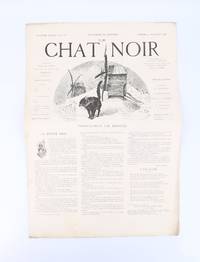
188888810Au cabaret Le Chat noir | Paris 20 octobre 1888 | 31 x 45 cm | en feuillets
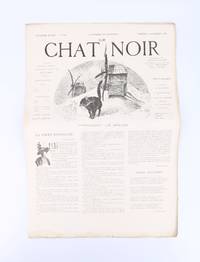
188888811Au cabaret Le Chat noir | Paris 27 octobre 1888 | 31 x 45 cm | en feuillets
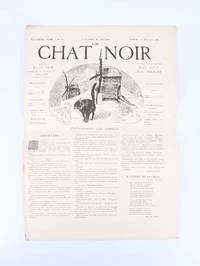
188588582Au cabaret Le Chat noir | Paris 25 juillet 1885 | 31 x 45 cm | en feuillets
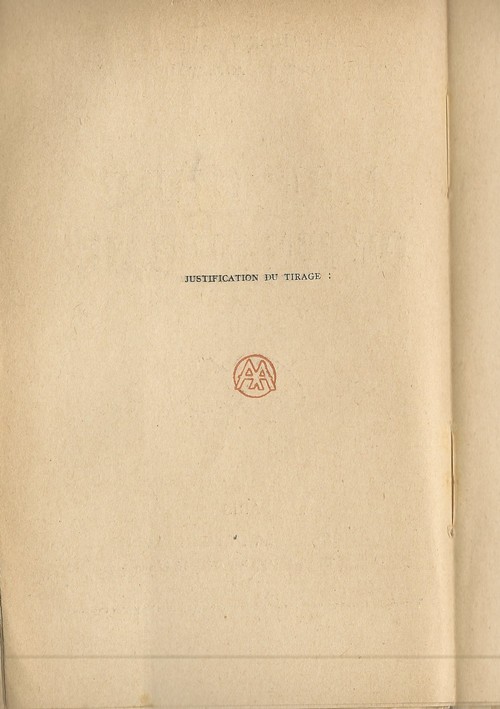
190019192Editions de La Revue Blanche 1900. In-12 broché de 332 pages au format 18,5 x 12 cm. Couverture avec titre imprimé. Dos bien carré, très légèrement insolé. Infimes rousseurs sur les plats. Intérieur frais. Exemplaire justifié au colophon des initiales de l'écrivain, en lettres rouges " A.A ". Superbe état général. Rare édition originale, sans mention, et surtout dans un tel état de fraicheur.
180935406Imprimerie Impériale | Paris 1809-1829 | 71 x 54 cm | une feuille
180926226Imprimerie Impériale | Paris 1809-1829 | 53.50 x 71 cm | une feuille
188588583Au cabaret Le Chat noir | Paris 1er août 1885 | 31 x 45 cm | en feuillets
180925826Imprimerie Impériale | Paris 1809-1829 | 54 x 71 cm | une feuille
188788808Au cabaret Le Chat noir | Paris 9 avril 1887 | 31 x 45 cm | en feuillets
022628655X.Ghardcover. Good. Access codes and supplements are not guaranteed with used items. May be an ex-library book. hardcover
1946107109Paris Editions Fournier. 1946 174p 1 volume petit IN4 broché sous étui et emboitage. Couverture rempliée. Exemplaire sur vélin Robertsau non justifié. Bois originaux de Ch.J.Hello. Préface de Sacha Guitry. Bon exemplaire.
23678Editions de La Revue Blanche 1899. In-12 broché de 302 pages au format 18,5 x 12 cm. Couverture avec titre imprimé. Dos bien carré, très légèrement insolé. Infimes rousseurs sur les plats. Intérieur frais. Exemplaire justifié au colophon des initiales de l'écrivain, en lettres rouges " A.A ". Superbe état général. Mention fictive de deuxième édition. Les livres " Ne nous Frappons pas " et " L'Affaire Blaireau " ne sont pas annoncés dans la liste des oeuvres parues. Rare édition originale, surtout dans un tel état de fraicheur.
A9780198747130Hardback. New. Lucy Allais presents a new account of Kant's transcendental idealism. She argues that Kant is committed to a genuine idealism about things as they appear to us but that this is not a phenomenalist idealism. Instead Kant's idealism depends instead on his notion of intuition and its role in cognition. hardcover
20154819like new. unknown
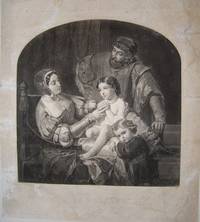
71-6309Paris: Goupil & Co. circa 1844. Engraving and mezzotint. 63.5 x 56 cm sheet. Good sheet mounted to another support sheet light specks of foxing in the margins tears along sheet edges sheet toned water staining. Paris: Goupil & Co., circa 1844. unknown
1071Felix Juven, Paris, 1902.
1842ed. College de Pataphysique 15 Absolu LXXXI (9fevrier 1953) plaquette grand in-8 de 16 pages, amusante et erudite preface d’Anatole JAKOVSKY à cette nouvelle inedite, edition originale, exemplaire numerote sur papier zinzolin d’etoupe (tirage de tête)
180923435Imprimerie Impériale | Paris 1809-1829 | 70 x 51.50 cm | une feuille
188888810Paris: Au cabaret Le Chat noir 1888. Fine. Au cabaret Le Chat noir Paris 20 octobre 1888 31 x 45 cm en feuillets First edition one of the rare copies printed on laid paper. This issue comprises 4 pages and includes a comic strip by Albert Robida: ""Vient de paraître !"" Literary contributions by Alphonse Allais ""La bonne fille"" George Auriol ""La statue de César Dupeauprez"" and Gaston Méry ""Au parc Monceau"" dedicated to Albert Tinchant. A pleasant copy with only a few faint marginal spots. Le Chat noir was a weekly magazine founded by Rodolphe Salis and Emile Goudeau published from 1882 to 1897 intended to promote the famous cabaret of the same name of which it served as a lasting record. It published texts recited during the performances. The magazine stands as a significant literary and artistic document of the late 19th century reflecting the bohemian spirit and the vibrant Parisian atmosphere of the era. Au cabaret Le Chat noir unknown
188588582Paris: Au cabaret Le Chat noir 1885. Fine. Au cabaret Le Chat noir Paris 25 juillet 1885 31 x 45 cm en feuillets First edition one of the rare copies printed on laid paper. This issue comprises 4 pages and features an illustration by Steinlen: ""Le plus vexé des trois"". With literary contributions by Alphonse Allais ""Absinthes"" dedicated to Adolphe Willette Rodolphe Darzens with the poem ""Le conseil de la chair"" Camille de Sainte-Croix ""Paul Margueritte"" Louis Marsolleau ""Villon"" among others. A handsome copy despite a small paper flaw at the head of the first page due to a printing defect. Le Chat noir was a weekly magazine founded by Rodolphe Salis and Emile Goudeau published from 1882 to 1897 intended to promote the famous cabaret of the same name which it sought to document. It featured texts performed during the shows and stands as a major literary and artistic record of late 19th-century bohemian life and Parisian effervescence. Au cabaret Le Chat noir unknown
188888811Paris: Au cabaret Le Chat noir 1888. Fine. Au cabaret Le Chat noir Paris 27 octobre 1888 31 x 45 cm en feuillets First edition one of the rare copies printed on laid paper. This issue comprises 4 pages and features a comic strip by Steinlen ""Du dernier bien avec le général"" as well as drawings by Henry Somm on the facing page. Literary contributions by Alphonse Allais ""La forêt enchantée"" dedicated to George Auriol Raoul Gineste ""Les vieux chats"" and José Rolla ""A l'église"". A well-preserved copy despite a few faint marginal stains. Le Chat noir was a weekly review founded by Rodolphe Salis and Emile Goudeau published from 1882 to 1897 to promote the famous cabaret of the same name of which it served as a record. It featured texts performed during the shows and stands as a major literary and artistic testimony to the late 19th century capturing the bohemian spirit and vibrant Parisian scene of the time. Au cabaret Le Chat noir unknown
180935406Paris: Imprimerie Impériale 1809. Fine. Imprimerie Impériale Paris 1809-1829 71 x 54 cm une feuille Original unshaved full-page etching from the Imperial edition of the Description de l'Égypte or Recueil des observations et recherches faites en Égypte pendant l'expédition française publié par les ordres de Sa Majesté l'Empereur Napoléon le Grand A Collection of the observations and research carried out in Egypt during the French expedition published on the orders of his Majesty the Emperor Napoleon the Great'.Produced between February 1802 and 1830 on the orders of Naopleon Bonaparte and published between 1809 and 1828 1000 copies were printed and distributed to institutions on vergé paper with an 'Égypte ancienne et moderne' watermark visible when held up to the light. Light marginal spotting not touching image otherwise in very fresh fine condition. An engraving from the Description de l'Egypte one of the masterpieces of French printing and the birth of a new field: Egyptology. A gigantic survey of Egypt at the time of Bonaparte's conquests in 1798 and 1799 the work is divided into 13 volumes of engravings making up 892 plates of which 72 colored as well as presenting the splendors of the Egypt of the Pharaohs in 9 volumes. The other volumes discuss natural history and present a fascinating portrait of Coptic and Islamic Egypt as it was seen by Bonaparte's Eastern Armies. The Egyptian campaign' militarily a disaster demonstrates through the engravings of the Description d'Egypte the scientific success it nonetheless became thanks to the 167 expert members of the Commission of the Sciences and Arts of the Institut d'Egypte Egyptian Institute who followed Napoleon's army. The Institut gathered together in Egypt the mathematician Monge the chemist Berthollet the naturalist Geoffroy Saint-Hilaire as well as numerous artists engineers architects and doctors. They were tasked with re-discovering modern and ancient Egypt and displaying its natural treasures as well as the know-how of its inhabitants.This edition the so-called Imperial edition of the plates for the Description de l'Egypte was printed in four large formats two of which were specially created for it and christened Moyen-Egypte and Grand-Egypte. A special press was built to print it the process extending over 20 years from 1809 to 1829. The Imperial edition proved so popular that a second edition this time in black and white and without the Egypte ancienne et moderne watermark known as the Royal Edition was published during the Restoration by the printing house of C.-L.-F. Panckoucke Paris.The engravings of the Description d'Egypte owe a great deal to Baron Dominique-Vivant Denon illustrator diplomat collector and later Director of the Musée Napoléon the Louvre. His exploration of the South of Egypt gave Bonaparte the idea of sending the experts of the Institut there thus creating a faithful and complete portrait of the area. This was the research gathered together from 1802 in the mammoth Description de L'Egypte.Denon embarked on this story of archeological exploration at the age of 51 reaching first Alexandria and then Cairo before exploring Upper Egypt. Along with the members of the Institut d'Egypte the Natural History Museum's painter H.J. Redouté brother of Pierre-Joseph Redouté author of Roses the mineralogist Dolomiue and the draughtsman Joly Denon then explored the Nile Delta and Lower Egypt. When however he joined the 21st Light Infantry Regiment as it marched across Upper Egypt in pursuit of the retreating Mameluks in November 1798 he found himself the only civilian. In the very midst of the battle itself he reeled off sketches of the works of art that peppered his path right up to the threshold of the Sudan. He said that he had crossed a country that is apart from its name entirely unknown to Europeans and therefore everything was worth describing Voyages dans la Basse et la Haute Egypte pendant les campagnes de Imprimerie Impériale unknown
180926226Paris: Imprimerie Impériale 1809. Fine. Imprimerie Impériale Paris 1809-1829 53.50 x 71 cm une feuille Original unshaved full-page etching from the Imperial edition of the Description de l'Égypte or Recueil des observations et recherches faites en Égypte pendant l'expédition française publié par les ordres de Sa Majesté l'Empereur Napoléon le Grand A Collection of the observations and research carried out in Egypt during the French expedition published on the orders of his Majesty the Emperor Napoleon the Great'.Produced between February 1802 and 1830 on the orders of Naopleon Bonaparte and published between 1809 and 1828 1000 copies were printed and distributed to institutions on vergé paper with an 'Égypte ancienne et moderne' watermark visible when held up to the light. Light marginal spotting not touching image otherwise in very fresh fine condition. An engraving from the Description de l'Egypte one of the masterpieces of French printing and the birth of a new field: Egyptology. A gigantic survey of Egypt at the time of Bonaparte's conquests in 1798 and 1799 the work is divided into 13 volumes of engravings making up 892 plates of which 72 colored as well as presenting the splendors of the Egypt of the Pharaohs in 9 volumes. The other volumes discuss natural history and present a fascinating portrait of Coptic and Islamic Egypt as it was seen by Bonaparte's Eastern Armies. The Egyptian campaign' militarily a disaster demonstrates through the engravings of the Description d'Egypte the scientific success it nonetheless became thanks to the 167 expert members of the Commission of the Sciences and Arts of the Institut d'Egypte Egyptian Institute who followed Napoleon's army. The Institut gathered together in Egypt the mathematician Monge the chemist Berthollet the naturalist Geoffroy Saint-Hilaire as well as numerous artists engineers architects and doctors. They were tasked with re-discovering modern and ancient Egypt and displaying its natural treasures as well as the know-how of its inhabitants.This edition the so-called Imperial edition of the plates for the Description de l'Egypte was printed in four large formats two of which were specially created for it and christened Moyen-Egypte and Grand-Egypte. A special press was built to print it the process extending over 20 years from 1809 to 1829. The Imperial edition proved so popular that a second edition this time in black and white and without the Egypte ancienne et moderne watermark known as the Royal Edition was published during the Restoration by the printing house of C.-L.-F. Panckoucke Paris.The engravings of the Description d'Egypte owe a great deal to Baron Dominique-Vivant Denon illustrator diplomat collector and later Director of the Musée Napoléon the Louvre. His exploration of the South of Egypt gave Bonaparte the idea of sending the experts of the Institut there thus creating a faithful and complete portrait of the area. This was the research gathered together from 1802 in the mammoth Description de L'Egypte.Denon embarked on this story of archeological exploration at the age of 51 reaching first Alexandria and then Cairo before exploring Upper Egypt. Along with the members of the Institut d'Egypte the Natural History Museum's painter H.J. Redouté brother of Pierre-Joseph Redouté author of Roses the mineralogist Dolomiue and the draughtsman Joly Denon then explored the Nile Delta and Lower Egypt. When however he joined the 21st Light Infantry Regiment as it marched across Upper Egypt in pursuit of the retreating Mameluks in November 1798 he found himself the only civilian. In the very midst of the battle itself he reeled off sketches of the works of art that peppered his path right up to the threshold of the Sudan. He said that he had crossed a country that is apart from its name entirely unknown to Europeans and therefore everything was worth describing Voyages dans la Basse et la Haute Egypte pendant les campagnes Imprimerie Impériale unknown