Edme-Francois JOMARD - ALLAIS (sculpsit)Biblio.com

239 résultats
180923431Paris: Imprimerie Impériale 1809. Fine. Imprimerie Impériale Paris 1809-1829 70 x 51.50 cm une feuille Original unshaved full-page etching from the Imperial edition of the Description de l'Égypte or Recueil des observations et recherches faites en Égypte pendant l'expédition française publié par les ordres de Sa Majesté l'Empereur Napoléon le Grand A Collection of the observations and research carried out in Egypt during the French expedition published on the orders of his Majesty the Emperor Napoleon the Great'.Produced between February 1802 and 1830 on the orders of Naopleon Bonaparte and published between 1809 and 1828 1000 copies were printed and distributed to institutions on vergé paper with an 'Égypte ancienne et moderne' watermark visible when held up to the light. Light marginal spotting not touching image otherwise in very fresh fine condition. An engraving from the Description de l'Egypte one of the masterpieces of French printing and the birth of a new field: Egyptology. A gigantic survey of Egypt at the time of Bonaparte's conquests in 1798 and 1799 the work is divided into 13 volumes of engravings making up 892 plates of which 72 colored as well as presenting the splendors of the Egypt of the Pharaohs in 9 volumes. The other volumes discuss natural history and present a fascinating portrait of Coptic and Islamic Egypt as it was seen by Bonaparte's Eastern Armies. The Egyptian campaign' militarily a disaster demonstrates through the engravings of the Description d'Egypte the scientific success it nonetheless became thanks to the 167 expert members of the Commission of the Sciences and Arts of the Institut d'Egypte Egyptian Institute who followed Napoleon's army. The Institut gathered together in Egypt the mathematician Monge the chemist Berthollet the naturalist Geoffroy Saint-Hilaire as well as numerous artists engineers architects and doctors. They were tasked with re-discovering modern and ancient Egypt and displaying its natural treasures as well as the know-how of its inhabitants.This edition the so-called Imperial edition of the plates for the Description de l'Egypte was printed in four large formats two of which were specially created for it and christened Moyen-Egypte and Grand-Egypte. A special press was built to print it the process extending over 20 years from 1809 to 1829. The Imperial edition proved so popular that a second edition this time in black and white and without the Egypte ancienne et moderne watermark known as the Royal Edition was published during the Restoration by the printing house of C.-L.-F. Panckoucke Paris.The engravings of the Description d'Egypte owe a great deal to Baron Dominique-Vivant Denon illustrator diplomat collector and later Director of the Musée Napoléon the Louvre. His exploration of the South of Egypt gave Bonaparte the idea of sending the experts of the Institut there thus creating a faithful and complete portrait of the area. This was the research gathered together from 1802 in the mammoth Description de L'Egypte.Denon embarked on this story of archeological exploration at the age of 51 reaching first Alexandria and then Cairo before exploring Upper Egypt. Along with the members of the Institut d'Egypte the Natural History Museum's painter H.J. Redouté brother of Pierre-Joseph Redouté author of Roses the mineralogist Dolomiue and the draughtsman Joly Denon then explored the Nile Delta and Lower Egypt. When however he joined the 21st Light Infantry Regiment as it marched across Upper Egypt in pursuit of the retreating Mameluks in November 1798 he found himself the only civilian. In the very midst of the battle itself he reeled off sketches of the works of art that peppered his path right up to the threshold of the Sudan. He said that he had crossed a country that is apart from its name entirely unknown to Europeans and therefore everything was worth describing Voyages dans la Basse et la Haute Egypte pendant les campagnes Imprimerie Impériale unknown
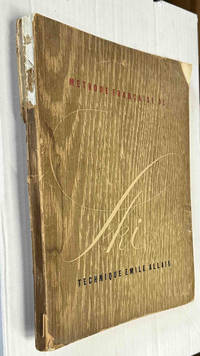
192315Preface by Frison-Roche. Translated from the French by Agustin R. Edwards Vice-President of the Ski Union of the Americas. Paris: Editions Fleche Publishers: 1947 Decorated wrappers that is flexible covers pp. 112 300 x 232 mm Photos and Layout by Pierre Boucher including IX coloured plates additional to the pagination. Near fine copy in good dust-jacket which has a long clean tear. unknown
1947230788<p>Magazine size Trade paperback in stiff wraps with Weak binding missing piece from top of spine. Unmarked text. Acceptable Good reading copy 9 color plates & copius B&W photos. French skiing method Émile Allais technique. Preface by Frison-Roche. Photos Pierre Boucher. 109 pages augmented by numerous black and white illustrations in and out of the text Ski Instructions Technique French Language 050924</p> Editions Fleche paperback
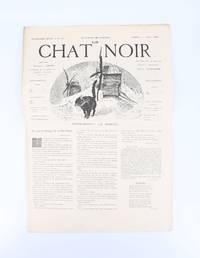
188588583Paris: Au cabaret Le Chat noir 1885. Fine. Au cabaret Le Chat noir Paris 1er août 1885 31 x 45 cm en feuillets First edition one of the rare copies printed on laid paper. This issue comprises 4 pages and features an illustration by Steinlen: ""Coqs et poule"". Literary contributions by Alphonse Allais with ""Le pauvre bougre et le bon génie"" dedicated to Henry Somm François Villon with the poem ""Rondel"" George Auriol with ""Au diable vert"" dedicated to Steinlen Rodolphe Salis. A handsome copy. Le Chat noir was a weekly review founded by Rodolphe Salis and Emile Goudeau published from 1882 to 1897 created to promote the famous cabaret of the same name and to serve as its memory. It published the texts performed during the shows. More broadly it constitutes a major literary and artistic record of the late 19th century centered on bohemian life and the unique creative fervor of Paris at the time. Au cabaret Le Chat noir unknown
1806SAVLD129Paris: Detournelle & J. Charles 1806. Hardcover. Very Good. Elephant folio 500 x 340mm. Collation complete: 120 plates of French Architecture and plans including the Arc de Triomphe Place de la Concorde and other famous Academy projects. With woodcut vignette of cornucopia and muse on title-page table generale listing architectural designs and copper engraved title-page listing academy members. Three-quarter calf-backed over tree-design boards; scattered marginal foxing. Late 19th-century armorial bookplate of Hoffmann Josef Franz Maria Hoffmann on front pastedown. Hoffmann 1870-1956 was an influential Austrian architect who won the Rome Prize in 1895. Known for his contributions to the arts and crafts movement Hoffmann also designed rooms for the Paris Expositions Universelle in 1900. Second series of this magnificent collection of the 1806 Projets dArchitecture 120 fine French Academy competition plates by Allais Detournelle and Vaudoyer which followed a previous publication of Prieur c. 1787-1801 originally issued in 20 cahiers. As these Grands Prix engravings show Academy neoclassicists revived eclectic motifs from antiquity with their prominent use of obelisks pyramids and blank walls in their design. Egpytianizing forms were becoming part of the landscape of Parisian architecture and were used to achieve a solemn appearance; this style was fascinating to young Academics who still wanted to maintain regal tradition. Notably the Grands Prix drawings contain the Chapelle Sepulchrale by la Barre which demonstrated many of these Egyptian design elements including Pantheon-domes pyramids sphinxes and sarcophagi. This fine production of accomplished watercolors was primarily meant for the education of young Academics in this successful architectural style. Many plates include the scale given in French toises or metres. It continued the Collection des Prix 1787-1801 and was continued as the Grands Prix dArchitecture in 1818. <br/><br/>Second series of this magnificent collection of the 1806 Projets dArchitecture 120 fine French Academy competition plates by Allais Detournelle and Vaudoyer which followed a previous publication of Prieur c. 1787-1801 originally issued in 20 cahiers. As these Grands Prix engravings show Academy neoclassicists revived eclectic motifs from antiquity with their prominent use of obelisks pyramids and blank walls in their design. Egpytianizing forms were becoming part of the landscape of Parisian architecture and were used to achieve a solemn appearance; this style was fascinating to young Academics who still wanted to maintain regal tradition. Notably the Grands Prix drawings contain the Chapelle Sepulchrale by la Barre which demonstrated many of these Egyptian design elements including Pantheon-domes pyramids sphinxes and sarcophagi. This fine production of accomplished watercolors was primarily meant for the education of young Academics in this successful architectural style. Many plates include the scale given in French toises or metres. It continued the Collection des Prix 1787-1801 and was continued as the Grands Prix dArchitecture in 1818. Detournelle & J. Charles hardcover
0259179310.Gpaperback. Good. Access codes and supplements are not guaranteed with used items. May be an ex-library book. paperback
0364993561.Ghardcover. Good. Access codes and supplements are not guaranteed with used items. May be an ex-library book. hardcover
0484079794.Ghardcover. Good. Access codes and supplements are not guaranteed with used items. May be an ex-library book. hardcover
0265643716.Ghardcover. Good. Access codes and supplements are not guaranteed with used items. May be an ex-library book. hardcover
0259035211.Gpaperback. Good. Access codes and supplements are not guaranteed with used items. May be an ex-library book. paperback
1332705820.Gpaperback. Good. Access codes and supplements are not guaranteed with used items. May be an ex-library book. paperback
0282961917.Gpaperback. Good. Access codes and supplements are not guaranteed with used items. May be an ex-library book. paperback
0428421822.Ghardcover. Good. Access codes and supplements are not guaranteed with used items. May be an ex-library book. hardcover
0265623812.Ghardcover. Good. Access codes and supplements are not guaranteed with used items. May be an ex-library book. hardcover
180926525Paris: Imprimerie Impériale 1809. Fine. Imprimerie Impériale Paris 1809-1829 54 x 71 cm une feuille Original unshaved full-page etching from the Imperial edition of the Description de l'Égypte or Recueil des observations et recherches faites en Égypte pendant l'expédition française publié par les ordres de Sa Majesté l'Empereur Napoléon le Grand A Collection of the observations and research carried out in Egypt during the French expedition published on the orders of his Majesty the Emperor Napoleon the Great'.Produced between February 1802 and 1830 on the orders of Naopleon Bonaparte and published between 1809 and 1828 1000 copies were printed and distributed to institutions on vergé paper with an 'Égypte ancienne et moderne' watermark visible when held up to the light. Light marginal spotting not touching image otherwise in very fresh fine condition. An engraving from the Description de l'Egypte one of the masterpieces of French printing and the birth of a new field: Egyptology. A gigantic survey of Egypt at the time of Bonaparte's conquests in 1798 and 1799 the work is divided into 13 volumes of engravings making up 892 plates of which 72 colored as well as presenting the splendors of the Egypt of the Pharaohs in 9 volumes. The other volumes discuss natural history and present a fascinating portrait of Coptic and Islamic Egypt as it was seen by Bonaparte's Eastern Armies. The Egyptian campaign' militarily a disaster demonstrates through the engravings of the Description d'Egypte the scientific success it nonetheless became thanks to the 167 expert members of the Commission of the Sciences and Arts of the Institut d'Egypte Egyptian Institute who followed Napoleon's army. The Institut gathered together in Egypt the mathematician Monge the chemist Berthollet the naturalist Geoffroy Saint-Hilaire as well as numerous artists engineers architects and doctors. They were tasked with re-discovering modern and ancient Egypt and displaying its natural treasures as well as the know-how of its inhabitants.This edition the so-called Imperial edition of the plates for the Description de l'Egypte was printed in four large formats two of which were specially created for it and christened Moyen-Egypte and Grand-Egypte. A special press was built to print it the process extending over 20 years from 1809 to 1829. The Imperial edition proved so popular that a second edition this time in black and white and without the Egypte ancienne et moderne watermark known as the Royal Edition was published during the Restoration by the printing house of C.-L.-F. Panckoucke Paris.The engravings of the Description d'Egypte owe a great deal to Baron Dominique-Vivant Denon illustrator diplomat collector and later Director of the Musée Napoléon the Louvre. His exploration of the South of Egypt gave Bonaparte the idea of sending the experts of the Institut there thus creating a faithful and complete portrait of the area. This was the research gathered together from 1802 in the mammoth Description de L'Egypte.Denon embarked on this story of archeological exploration at the age of 51 reaching first Alexandria and then Cairo before exploring Upper Egypt. Along with the members of the Institut d'Egypte the Natural History Museum's painter H.J. Redouté brother of Pierre-Joseph Redouté author of Roses the mineralogist Dolomiue and the draughtsman Joly Denon then explored the Nile Delta and Lower Egypt. When however he joined the 21st Light Infantry Regiment as it marched across Upper Egypt in pursuit of the retreating Mameluks in November 1798 he found himself the only civilian. In the very midst of the battle itself he reeled off sketches of the works of art that peppered his path right up to the threshold of the Sudan. He said that he had crossed a country that is apart from its name entirely unknown to Europeans and therefore everything was worth describing Voyages dans la Basse et la Haute Egypte pendant les campagnes de Imprimerie Impériale unknown
38635069-nnew. unknown
38635069like new. unknown
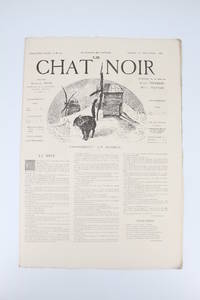
188681927Paris: Au cabaret Le Chat noir 1886. Fine. Au cabaret Le Chat noir Paris 1886 31 x 45 cm en feuillets First edition one of the rare copies printed on laid paper. The issue consists of 4 pages and is illustrated with a comic strip by Louis Blombed: ""Un coup de roulis"". Literary contributions by Alphonse Allais ""La mère"" Rodolphe Salis Victor Meusy Albert Tinchant ""Passe-temps"". Handsome copy. Le Chat noir is a weekly magazine created by Rodolphe Salis and Emile Goudeau published from 1882 to 1897 with the purpose of promoting the famous cabaret of the same name of which it serves as a record. It published the texts recited during the performances. It is moreover an important literary and artistic testimony of the end of the 19th century centered around bohemia and the Parisian effervescence characteristic of that era. Au cabaret Le Chat noir unknown
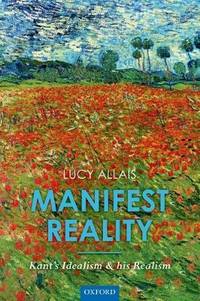
A9780198747130Hardback. New. Lucy Allais presents a new account of Kant's transcendental idealism. She argues that Kant is committed to a genuine idealism about things as they appear to us but that this is not a phenomenalist idealism. Instead Kant's idealism depends instead on his notion of intuition and its role in cognition. hardcover
A9780198801337Paperback / softback. New. Lucy Allais presents a new account of Kant's transcendental idealism. She argues that Kant is committed to a genuine idealism about things as they appear to us but that this is not a phenomenalist idealism. Instead Kant's idealism depends instead on his notion of intuition and its role in cognition. paperback
B9789401043847Paperback / softback. New. THE CONCEPTION OF THIS VOLUME This volume Cardinalism has been initiated by Ole Hagen and is now published due to his perseverance and to Kluwer Academic Publishers. Because of various activities and duties my contribution to the general conception of this volume has only been formal and all the credit for it is due to Ole Hagen. paperback
19799027709602Springer 1979. New/New. <p><strong>Author:</strong> M. Allais G.M. Hagen</p><p><strong>Publisher:</strong> Springer</p><p><strong>ISBN:</strong> 9789027709608</p><p><strong>Release Date:</strong> 1979</p><p><strong>Languages:</strong> English</p><p><strong>Binding:</strong> Hardcover</p><p><strong>Number Of Pages:</strong> 722</p><p><strong>Details:</strong> Utility theory or value theory in general is certainly the cornerstone of decision theory game theory microecon~mics and all social and political theories which deal with public decisions. Recently the American School of utility founded by von N eumann Morgenstern encountered a far-going criticism by the French School of utility represented by its founder Allais. The whole basis of the theory of decisions involving risk has been shaken and put into question. Consequently basic research in the fundamentals of utility and value theory evolved into a crisis. Like any crisis in basic research and this one was not an exception it was very fruitful. One may simply say: Allais versus von Neumann-Morgenstern or the French School of utility versus the American School became one of the battlefields of scientific development which proved to be a most creative source of new advances and new developments in all those sciences which are based on evaluation of utilities.</p> Springer hardcover
ria9780226826202_inpHardback. New. New Book; Fast Shipping from UK; Not signed; Not First Edition; N/A hardcover
A9780226826202Hardback. New. <p><b>The essential work from the Nobel Prize-winning virtuoso of twentieth-century economics translated to English for the first time.</b></p><p> Few scholars advanced the frontier of economic modeling more than French economist Maurice Allais. Allais’s contributions—beyond his famous <i>Allais’s Paradox</i>—earned him the Nobel Prize and drew comparisons to the works of Paul Samuelson and even some modern mathematical behavioral economists. </p><p> Allais’s accomplishments however went largely unread by non-Francophone readers due to the challenge of their translation for publishers. The effects of this gap are immeasurable. As Paul Samuelson wrote “Had Allais's earliest writings been in English a whole generation of economic theory would have taken a different course.†</p><p><i>Economy and Interest</i> is the milestone translation of Allais's most influential work one whose staggering findings predate their accepted formulations by other famed economists decades later. In its sweep and technical virtuosity <i>Economy and Interest</i> is certain to delight and challenge new generations of English-language readers. </p> hardcover
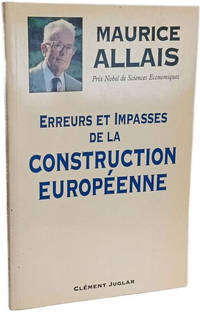
1992100145681Clément Juglar 1992. Très bon état. 381x69x559cm. 1992. Broché. Dans cet essai Maurice Allais prix Nobel d'économie analyse les défauts structurels du projet européen. Il identifie les erreurs et impasses de la construction européenne et propose des pistes de réflexion pour une meilleure intégration notamment en révisant les traités sur les institutions l'union économique et monétaire et la protection du marché Maurice Allais construction européenne critique européenne union économique monnaie unique traités européens intégration européenne défauts structurels Prix Nobel économie institutions européennes Essai économique Critique politique Construction européenne Analyse institutionnelle Politique monétaire Intégration européenne Clément Juglar unknown