110 résultats
188681973Au cabaret Le Chat noir | Paris 1886 | 31 x 45 cm | en feuillets
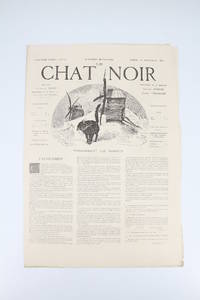
188788808Au cabaret Le Chat noir | Paris 9 avril 1887 | 31 x 45 cm | en feuillets
188788808Paris: Au cabaret Le Chat noir 1887. Fine. Au cabaret Le Chat noir Paris 9 avril 1887 31 x 45 cm en feuillets First edition one of the rare copies printed on laid paper. This four-page issue features a large double-page illustration by Steinlen. Literary contributions by Alphonse Allais Bébert Pimpinelli Pose de lapin dedicated to Albert Tinchant and Narcisse Lebeau Paravent. Some marginal tears and stains. Le Chat noir was a weekly magazine founded by Rodolphe Salis and Emile Goudeau published from 1882 to 1897 intended to promote the famous cabaret of the same name which it sought to commemorate. It published the texts recited during the performances and stands as a major literary and artistic document of late 19th-century bohemian life and the distinctive Parisian vitality of the era. Au cabaret Le Chat noir unknown
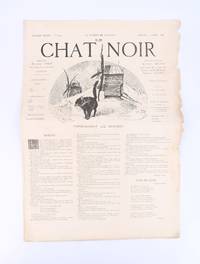
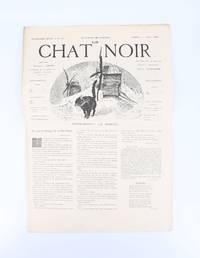
188681973Paris: Au cabaret Le Chat noir 1886. Fine. Au cabaret Le Chat noir Paris 1886 31 x 45 cm en feuillets First edition one of the rare copies printed on laid paper. The issue consists of 4 pages and is illustrated with a comic strip by Théophile Alexandre Steinlen: ""Les mésaventures d'Auguste"". Literary contributions by Alphonse Allais ""L'avancement"" Maurice Mac Nab ""La vue de Naples"" Eugène Godin ""Ronds de cuir"". Fine copy. Le Chat noir is a weekly magazine created by Rodolphe Salis and Emile Goudeau published from 1882 to 1897 with the aim of promoting the famous cabaret of the same name of which it intended to be the record. It published texts declaimed during the performances. It is moreover an important literary and artistic testimony of the late nineteenth century around the bohemia and the Parisian effervescence that was its own. Au cabaret Le Chat noir unknown
1866596571866. Fine. 1866 27.50 x 43.50 cm autre Charcoal black stone and white chalk drawing with wash highlights. Signed lower left in white chalk ""de St Allais 1866"". Thick rigid cardboard of 4 mm. Very fine condition despite a slight lack of 7mm at the upper left corner. Dry stamp lower right corner: Papier Pellée. Slight toning. Finely worked lake and grove landscape. NB: This work is available at the bookstore on request within 48 hours. unknown
1815R150172286CHEZ L AUTEUR.. 1815. In-8. Relié demi-cuir. Etat passable, Coins frottés, Agraffes rouillées, Quelques rousseurs. 416 pages. Gros manque sur le dos. Couverture partiellement décollorée.. . . . Classification Dewey : 940-Histoire générale de l'Europe
1866596571866 | 27.50 x 43.50 cm | autre
180925826Paris: Imprimerie Impériale 1809. Fine. Imprimerie Impériale Paris 1809-1829 54 x 71 cm une feuille Original unshaved full-page etching from the Imperial edition of the Description de l'Égypte or Recueil des observations et recherches faites en Égypte pendant l'expédition française publié par les ordres de Sa Majesté l'Empereur Napoléon le Grand A Collection of the observations and research carried out in Egypt during the French expedition published on the orders of his Majesty the Emperor Napoleon the Great'.Produced between February 1802 and 1830 on the orders of Naopleon Bonaparte and published between 1809 and 1828 1000 copies were printed and distributed to institutions on vergé paper with an 'Égypte ancienne et moderne' watermark visible when held up to the light. Light marginal spotting not touching image otherwise in very fresh fine condition. An engraving from the Description de l'Egypte one of the masterpieces of French printing and the birth of a new field: Egyptology. A gigantic survey of Egypt at the time of Bonaparte's conquests in 1798 and 1799 the work is divided into 13 volumes of engravings making up 892 plates of which 72 colored as well as presenting the splendors of the Egypt of the Pharaohs in 9 volumes. The other volumes discuss natural history and present a fascinating portrait of Coptic and Islamic Egypt as it was seen by Bonaparte's Eastern Armies. The Egyptian campaign' militarily a disaster demonstrates through the engravings of the Description d'Egypte the scientific success it nonetheless became thanks to the 167 expert members of the Commission of the Sciences and Arts of the Institut d'Egypte Egyptian Institute who followed Napoleon's army. The Institut gathered together in Egypt the mathematician Monge the chemist Berthollet the naturalist Geoffroy Saint-Hilaire as well as numerous artists engineers architects and doctors. They were tasked with re-discovering modern and ancient Egypt and displaying its natural treasures as well as the know-how of its inhabitants.This edition the so-called Imperial edition of the plates for the Description de l'Egypte was printed in four large formats two of which were specially created for it and christened Moyen-Egypte and Grand-Egypte. A special press was built to print it the process extending over 20 years from 1809 to 1829. The Imperial edition proved so popular that a second edition this time in black and white and without the Egypte ancienne et moderne watermark known as the Royal Edition was published during the Restoration by the printing house of C.-L.-F. Panckoucke Paris.The engravings of the Description d'Egypte owe a great deal to Baron Dominique-Vivant Denon illustrator diplomat collector and later Director of the Musée Napoléon the Louvre. His exploration of the South of Egypt gave Bonaparte the idea of sending the experts of the Institut there thus creating a faithful and complete portrait of the area. This was the research gathered together from 1802 in the mammoth Description de L'Egypte.Denon embarked on this story of archeological exploration at the age of 51 reaching first Alexandria and then Cairo before exploring Upper Egypt. Along with the members of the Institut d'Egypte the Natural History Museum's painter H.J. Redouté brother of Pierre-Joseph Redouté author of Roses the mineralogist Dolomiue and the draughtsman Joly Denon then explored the Nile Delta and Lower Egypt. When however he joined the 21st Light Infantry Regiment as it marched across Upper Egypt in pursuit of the retreating Mameluks in November 1798 he found himself the only civilian. In the very midst of the battle itself he reeled off sketches of the works of art that peppered his path right up to the threshold of the Sudan. He said that he had crossed a country that is apart from its name entirely unknown to Europeans and therefore everything was worth describing Voyages dans la Basse et la Haute Egypte pendant les campagnes de Imprimerie Impériale unknown
180925826Imprimerie Impériale | Paris 1809-1829 | 54 x 71 cm | une feuille
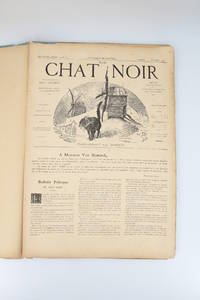
188381900Paris: Au cabaret Le Chat noir 1883. Fine. Au cabaret Le Chat noir Paris 1883 31 x 45 cm broché First edition of this complete 1883 year containing 50 issues in original wrappers under blue temporary covers. Spine split with angular lacks to the covers. Each issue consists of four pages. Texts by Emile Goudeau Alphonse Allais Jean Richepin and Paul Verlaine ""Le Chat noir"" ""Langueur"" ""La Princesse Bérénice"" ""Pantoum négligé"" ""Paysage"" ""Conseil falot"" ""L'Aube à l'envers"" ""Un pouacre"" ""Madrigal"" notably. Drawings by Willette Rodolphe Salis Henri de Sta Tiret-Bognet Henri Pille Caran d'Ache etc. Le Chat noir is a weekly magazine created by Rodolphe Salis and Emile Goudeau published from 1882 to 1897 with the aim of promoting the famous cabaret of the same name serving as its record. It published the texts recited during performances. It is moreover an important literary and artistic testimony of the end of the 19th century centered around bohemian life and the Parisian effervescence characteristic of it. Au cabaret Le Chat noir unknown
188381900Au cabaret Le Chat noir | Paris 1883 | 31 x 45 cm | broché
188687871886 E. AUGE, 1886. ROUEN, In folio broché,de XII-131 p. et 2 ff. Texte par Allais, Ch. De Beaurepaire, Dubosc, Felix, Hedou, H. De Lapommeraye. Orne de quarante heliogravures par Maxime Lalanne representant des vues de l'ancien Rouen.Illustré de 30 dessins de Maxime Lalanne reproduits en héliogravure en hors-texte. Comporte en outre 10 reproductions de dessins dans le texte, généralement en en-tête.
188681927Paris: Au cabaret Le Chat noir 1886. Fine. Au cabaret Le Chat noir Paris 1886 31 x 45 cm en feuillets First edition one of the rare copies printed on laid paper. The issue consists of 4 pages and is illustrated with a comic strip by Louis Blombed: ""Un coup de roulis"". Literary contributions by Alphonse Allais ""La mère"" Rodolphe Salis Victor Meusy Albert Tinchant ""Passe-temps"". Handsome copy. Le Chat noir is a weekly magazine created by Rodolphe Salis and Emile Goudeau published from 1882 to 1897 with the purpose of promoting the famous cabaret of the same name of which it serves as a record. It published the texts recited during the performances. It is moreover an important literary and artistic testimony of the end of the 19th century centered around bohemia and the Parisian effervescence characteristic of that era. Au cabaret Le Chat noir unknown
188681927Au cabaret Le Chat noir | Paris 1886 | 31 x 45 cm | en feuillets
190099951900 Paris, H. E. Martin Editeur, Librairie d'éducation de la jeunesse, sans date (vers 1900); In-folio, pleine percaline de l'éditeur bronze doré, décor en couleurs et argenté au 1er plats et dos, titre en noir et rouge au 1er plat, en noir au dos, tranches dorées; (4)ff., xvi, 134pp. Nombreuses illustrations dans le texte et hors tecte en noir et en couleurs de Suzanne Minier.
180926525Paris: Imprimerie Impériale 1809. Fine. Imprimerie Impériale Paris 1809-1829 54 x 71 cm une feuille Original unshaved full-page etching from the Imperial edition of the Description de l'Égypte or Recueil des observations et recherches faites en Égypte pendant l'expédition française publié par les ordres de Sa Majesté l'Empereur Napoléon le Grand A Collection of the observations and research carried out in Egypt during the French expedition published on the orders of his Majesty the Emperor Napoleon the Great'.Produced between February 1802 and 1830 on the orders of Naopleon Bonaparte and published between 1809 and 1828 1000 copies were printed and distributed to institutions on vergé paper with an 'Égypte ancienne et moderne' watermark visible when held up to the light. Light marginal spotting not touching image otherwise in very fresh fine condition. An engraving from the Description de l'Egypte one of the masterpieces of French printing and the birth of a new field: Egyptology. A gigantic survey of Egypt at the time of Bonaparte's conquests in 1798 and 1799 the work is divided into 13 volumes of engravings making up 892 plates of which 72 colored as well as presenting the splendors of the Egypt of the Pharaohs in 9 volumes. The other volumes discuss natural history and present a fascinating portrait of Coptic and Islamic Egypt as it was seen by Bonaparte's Eastern Armies. The Egyptian campaign' militarily a disaster demonstrates through the engravings of the Description d'Egypte the scientific success it nonetheless became thanks to the 167 expert members of the Commission of the Sciences and Arts of the Institut d'Egypte Egyptian Institute who followed Napoleon's army. The Institut gathered together in Egypt the mathematician Monge the chemist Berthollet the naturalist Geoffroy Saint-Hilaire as well as numerous artists engineers architects and doctors. They were tasked with re-discovering modern and ancient Egypt and displaying its natural treasures as well as the know-how of its inhabitants.This edition the so-called Imperial edition of the plates for the Description de l'Egypte was printed in four large formats two of which were specially created for it and christened Moyen-Egypte and Grand-Egypte. A special press was built to print it the process extending over 20 years from 1809 to 1829. The Imperial edition proved so popular that a second edition this time in black and white and without the Egypte ancienne et moderne watermark known as the Royal Edition was published during the Restoration by the printing house of C.-L.-F. Panckoucke Paris.The engravings of the Description d'Egypte owe a great deal to Baron Dominique-Vivant Denon illustrator diplomat collector and later Director of the Musée Napoléon the Louvre. His exploration of the South of Egypt gave Bonaparte the idea of sending the experts of the Institut there thus creating a faithful and complete portrait of the area. This was the research gathered together from 1802 in the mammoth Description de L'Egypte.Denon embarked on this story of archeological exploration at the age of 51 reaching first Alexandria and then Cairo before exploring Upper Egypt. Along with the members of the Institut d'Egypte the Natural History Museum's painter H.J. Redouté brother of Pierre-Joseph Redouté author of Roses the mineralogist Dolomiue and the draughtsman Joly Denon then explored the Nile Delta and Lower Egypt. When however he joined the 21st Light Infantry Regiment as it marched across Upper Egypt in pursuit of the retreating Mameluks in November 1798 he found himself the only civilian. In the very midst of the battle itself he reeled off sketches of the works of art that peppered his path right up to the threshold of the Sudan. He said that he had crossed a country that is apart from its name entirely unknown to Europeans and therefore everything was worth describing Voyages dans la Basse et la Haute Egypte pendant les campagnes de Imprimerie Impériale unknown
180926525Imprimerie Impériale | Paris 1809-1829 | 54 x 71 cm | une feuille
1806SAVLD129Paris: Detournelle & J. Charles 1806. Hardcover. Very Good. Elephant folio 500 x 340mm. Collation complete: 120 plates of French Architecture and plans including the Arc de Triomphe Place de la Concorde and other famous Academy projects. With woodcut vignette of cornucopia and muse on title-page table generale listing architectural designs and copper engraved title-page listing academy members. Three-quarter calf-backed over tree-design boards; scattered marginal foxing. Late 19th-century armorial bookplate of Hoffmann Josef Franz Maria Hoffmann on front pastedown. Hoffmann 1870-1956 was an influential Austrian architect who won the Rome Prize in 1895. Known for his contributions to the arts and crafts movement Hoffmann also designed rooms for the Paris Expositions Universelle in 1900. Second series of this magnificent collection of the 1806 Projets dArchitecture 120 fine French Academy competition plates by Allais Detournelle and Vaudoyer which followed a previous publication of Prieur c. 1787-1801 originally issued in 20 cahiers. As these Grands Prix engravings show Academy neoclassicists revived eclectic motifs from antiquity with their prominent use of obelisks pyramids and blank walls in their design. Egpytianizing forms were becoming part of the landscape of Parisian architecture and were used to achieve a solemn appearance; this style was fascinating to young Academics who still wanted to maintain regal tradition. Notably the Grands Prix drawings contain the Chapelle Sepulchrale by la Barre which demonstrated many of these Egyptian design elements including Pantheon-domes pyramids sphinxes and sarcophagi. This fine production of accomplished watercolors was primarily meant for the education of young Academics in this successful architectural style. Many plates include the scale given in French toises or metres. It continued the Collection des Prix 1787-1801 and was continued as the Grands Prix dArchitecture in 1818. <br/><br/>Second series of this magnificent collection of the 1806 Projets dArchitecture 120 fine French Academy competition plates by Allais Detournelle and Vaudoyer which followed a previous publication of Prieur c. 1787-1801 originally issued in 20 cahiers. As these Grands Prix engravings show Academy neoclassicists revived eclectic motifs from antiquity with their prominent use of obelisks pyramids and blank walls in their design. Egpytianizing forms were becoming part of the landscape of Parisian architecture and were used to achieve a solemn appearance; this style was fascinating to young Academics who still wanted to maintain regal tradition. Notably the Grands Prix drawings contain the Chapelle Sepulchrale by la Barre which demonstrated many of these Egyptian design elements including Pantheon-domes pyramids sphinxes and sarcophagi. This fine production of accomplished watercolors was primarily meant for the education of young Academics in this successful architectural style. Many plates include the scale given in French toises or metres. It continued the Collection des Prix 1787-1801 and was continued as the Grands Prix dArchitecture in 1818. Detournelle & J. Charles hardcover books
1806SAVLD129Paris: Detournelle & J. Charles 1806. Hardcover. Very Good. Elephant folio 500 x 340mm. Collation complete: 120 plates of French Architecture and plans including the Arc de Triomphe Place de la Concorde and other famous Academy projects. With woodcut vignette of cornucopia and muse on title-page table generale listing architectural designs and copper engraved title-page listing academy members. Three-quarter calf-backed over tree-design boards; scattered marginal foxing. Late 19th-century armorial bookplate of Hoffmann Josef Franz Maria Hoffmann on front pastedown. Hoffmann 1870-1956 was an influential Austrian architect who won the Rome Prize in 1895. Known for his contributions to the arts and crafts movement Hoffmann also designed rooms for the Paris Expositions Universelle in 1900. Second series of this magnificent collection of the 1806 Projets dArchitecture 120 fine French Academy competition plates by Allais Detournelle and Vaudoyer which followed a previous publication of Prieur c. 1787-1801 originally issued in 20 cahiers. As these Grands Prix engravings show Academy neoclassicists revived eclectic motifs from antiquity with their prominent use of obelisks pyramids and blank walls in their design. Egpytianizing forms were becoming part of the landscape of Parisian architecture and were used to achieve a solemn appearance; this style was fascinating to young Academics who still wanted to maintain regal tradition. Notably the Grands Prix drawings contain the Chapelle Sepulchrale by la Barre which demonstrated many of these Egyptian design elements including Pantheon-domes pyramids sphinxes and sarcophagi. This fine production of accomplished watercolors was primarily meant for the education of young Academics in this successful architectural style. Many plates include the scale given in French toises or metres. It continued the Collection des Prix 1787-1801 and was continued as the Grands Prix dArchitecture in 1818. <br/><br/>Second series of this magnificent collection of the 1806 Projets dArchitecture 120 fine French Academy competition plates by Allais Detournelle and Vaudoyer which followed a previous publication of Prieur c. 1787-1801 originally issued in 20 cahiers. As these Grands Prix engravings show Academy neoclassicists revived eclectic motifs from antiquity with their prominent use of obelisks pyramids and blank walls in their design. Egpytianizing forms were becoming part of the landscape of Parisian architecture and were used to achieve a solemn appearance; this style was fascinating to young Academics who still wanted to maintain regal tradition. Notably the Grands Prix drawings contain the Chapelle Sepulchrale by la Barre which demonstrated many of these Egyptian design elements including Pantheon-domes pyramids sphinxes and sarcophagi. This fine production of accomplished watercolors was primarily meant for the education of young Academics in this successful architectural style. Many plates include the scale given in French toises or metres. It continued the Collection des Prix 1787-1801 and was continued as the Grands Prix dArchitecture in 1818. Detournelle & J. Charles hardcover
188588583Paris: Au cabaret Le Chat noir 1885. Fine. Au cabaret Le Chat noir Paris 1er août 1885 31 x 45 cm en feuillets First edition one of the rare copies printed on laid paper. This issue comprises 4 pages and features an illustration by Steinlen: ""Coqs et poule"". Literary contributions by Alphonse Allais with ""Le pauvre bougre et le bon génie"" dedicated to Henry Somm François Villon with the poem ""Rondel"" George Auriol with ""Au diable vert"" dedicated to Steinlen Rodolphe Salis. A handsome copy. Le Chat noir was a weekly review founded by Rodolphe Salis and Emile Goudeau published from 1882 to 1897 created to promote the famous cabaret of the same name and to serve as its memory. It published the texts performed during the shows. More broadly it constitutes a major literary and artistic record of the late 19th century centered on bohemian life and the unique creative fervor of Paris at the time. Au cabaret Le Chat noir unknown
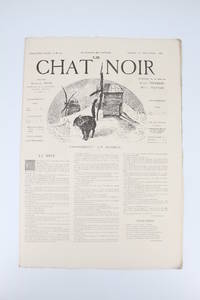
188588583Au cabaret Le Chat noir | Paris 1er août 1885 | 31 x 45 cm | en feuillets
189024031Rouen E. Augé, libraire éditeur 1890
180935406Paris: Imprimerie Impériale 1809. Fine. Imprimerie Impériale Paris 1809-1829 71 x 54 cm une feuille Original unshaved full-page etching from the Imperial edition of the Description de l'Égypte or Recueil des observations et recherches faites en Égypte pendant l'expédition française publié par les ordres de Sa Majesté l'Empereur Napoléon le Grand A Collection of the observations and research carried out in Egypt during the French expedition published on the orders of his Majesty the Emperor Napoleon the Great'.Produced between February 1802 and 1830 on the orders of Naopleon Bonaparte and published between 1809 and 1828 1000 copies were printed and distributed to institutions on vergé paper with an 'Égypte ancienne et moderne' watermark visible when held up to the light. Light marginal spotting not touching image otherwise in very fresh fine condition. An engraving from the Description de l'Egypte one of the masterpieces of French printing and the birth of a new field: Egyptology. A gigantic survey of Egypt at the time of Bonaparte's conquests in 1798 and 1799 the work is divided into 13 volumes of engravings making up 892 plates of which 72 colored as well as presenting the splendors of the Egypt of the Pharaohs in 9 volumes. The other volumes discuss natural history and present a fascinating portrait of Coptic and Islamic Egypt as it was seen by Bonaparte's Eastern Armies. The Egyptian campaign' militarily a disaster demonstrates through the engravings of the Description d'Egypte the scientific success it nonetheless became thanks to the 167 expert members of the Commission of the Sciences and Arts of the Institut d'Egypte Egyptian Institute who followed Napoleon's army. The Institut gathered together in Egypt the mathematician Monge the chemist Berthollet the naturalist Geoffroy Saint-Hilaire as well as numerous artists engineers architects and doctors. They were tasked with re-discovering modern and ancient Egypt and displaying its natural treasures as well as the know-how of its inhabitants.This edition the so-called Imperial edition of the plates for the Description de l'Egypte was printed in four large formats two of which were specially created for it and christened Moyen-Egypte and Grand-Egypte. A special press was built to print it the process extending over 20 years from 1809 to 1829. The Imperial edition proved so popular that a second edition this time in black and white and without the Egypte ancienne et moderne watermark known as the Royal Edition was published during the Restoration by the printing house of C.-L.-F. Panckoucke Paris.The engravings of the Description d'Egypte owe a great deal to Baron Dominique-Vivant Denon illustrator diplomat collector and later Director of the Musée Napoléon the Louvre. His exploration of the South of Egypt gave Bonaparte the idea of sending the experts of the Institut there thus creating a faithful and complete portrait of the area. This was the research gathered together from 1802 in the mammoth Description de L'Egypte.Denon embarked on this story of archeological exploration at the age of 51 reaching first Alexandria and then Cairo before exploring Upper Egypt. Along with the members of the Institut d'Egypte the Natural History Museum's painter H.J. Redouté brother of Pierre-Joseph Redouté author of Roses the mineralogist Dolomiue and the draughtsman Joly Denon then explored the Nile Delta and Lower Egypt. When however he joined the 21st Light Infantry Regiment as it marched across Upper Egypt in pursuit of the retreating Mameluks in November 1798 he found himself the only civilian. In the very midst of the battle itself he reeled off sketches of the works of art that peppered his path right up to the threshold of the Sudan. He said that he had crossed a country that is apart from its name entirely unknown to Europeans and therefore everything was worth describing Voyages dans la Basse et la Haute Egypte pendant les campagnes de Imprimerie Impériale unknown
180926226Paris: Imprimerie Impériale 1809. Fine. Imprimerie Impériale Paris 1809-1829 53.50 x 71 cm une feuille Original unshaved full-page etching from the Imperial edition of the Description de l'Égypte or Recueil des observations et recherches faites en Égypte pendant l'expédition française publié par les ordres de Sa Majesté l'Empereur Napoléon le Grand A Collection of the observations and research carried out in Egypt during the French expedition published on the orders of his Majesty the Emperor Napoleon the Great'.Produced between February 1802 and 1830 on the orders of Naopleon Bonaparte and published between 1809 and 1828 1000 copies were printed and distributed to institutions on vergé paper with an 'Égypte ancienne et moderne' watermark visible when held up to the light. Light marginal spotting not touching image otherwise in very fresh fine condition. An engraving from the Description de l'Egypte one of the masterpieces of French printing and the birth of a new field: Egyptology. A gigantic survey of Egypt at the time of Bonaparte's conquests in 1798 and 1799 the work is divided into 13 volumes of engravings making up 892 plates of which 72 colored as well as presenting the splendors of the Egypt of the Pharaohs in 9 volumes. The other volumes discuss natural history and present a fascinating portrait of Coptic and Islamic Egypt as it was seen by Bonaparte's Eastern Armies. The Egyptian campaign' militarily a disaster demonstrates through the engravings of the Description d'Egypte the scientific success it nonetheless became thanks to the 167 expert members of the Commission of the Sciences and Arts of the Institut d'Egypte Egyptian Institute who followed Napoleon's army. The Institut gathered together in Egypt the mathematician Monge the chemist Berthollet the naturalist Geoffroy Saint-Hilaire as well as numerous artists engineers architects and doctors. They were tasked with re-discovering modern and ancient Egypt and displaying its natural treasures as well as the know-how of its inhabitants.This edition the so-called Imperial edition of the plates for the Description de l'Egypte was printed in four large formats two of which were specially created for it and christened Moyen-Egypte and Grand-Egypte. A special press was built to print it the process extending over 20 years from 1809 to 1829. The Imperial edition proved so popular that a second edition this time in black and white and without the Egypte ancienne et moderne watermark known as the Royal Edition was published during the Restoration by the printing house of C.-L.-F. Panckoucke Paris.The engravings of the Description d'Egypte owe a great deal to Baron Dominique-Vivant Denon illustrator diplomat collector and later Director of the Musée Napoléon the Louvre. His exploration of the South of Egypt gave Bonaparte the idea of sending the experts of the Institut there thus creating a faithful and complete portrait of the area. This was the research gathered together from 1802 in the mammoth Description de L'Egypte.Denon embarked on this story of archeological exploration at the age of 51 reaching first Alexandria and then Cairo before exploring Upper Egypt. Along with the members of the Institut d'Egypte the Natural History Museum's painter H.J. Redouté brother of Pierre-Joseph Redouté author of Roses the mineralogist Dolomiue and the draughtsman Joly Denon then explored the Nile Delta and Lower Egypt. When however he joined the 21st Light Infantry Regiment as it marched across Upper Egypt in pursuit of the retreating Mameluks in November 1798 he found himself the only civilian. In the very midst of the battle itself he reeled off sketches of the works of art that peppered his path right up to the threshold of the Sudan. He said that he had crossed a country that is apart from its name entirely unknown to Europeans and therefore everything was worth describing Voyages dans la Basse et la Haute Egypte pendant les campagnes Imprimerie Impériale unknown
180923435Paris: Imprimerie Impériale 1809. Fine. Imprimerie Impériale Paris 1809-1829 70 x 51.50 cm une feuille Original unshaved full-page etching from the Imperial edition of the Description de l'Égypte or Recueil des observations et recherches faites en Égypte pendant l'expédition française publié par les ordres de Sa Majesté l'Empereur Napoléon le Grand A Collection of the observations and research carried out in Egypt during the French expedition published on the orders of his Majesty the Emperor Napoleon the Great'.Produced between February 1802 and 1830 on the orders of Naopleon Bonaparte and published between 1809 and 1828 1000 copies were printed and distributed to institutions on vergé paper with an 'Égypte ancienne et moderne' watermark visible when held up to the light. Light marginal spotting not touching image otherwise in very fresh fine condition. An engraving from the Description de l'Egypte one of the masterpieces of French printing and the birth of a new field: Egyptology. A gigantic survey of Egypt at the time of Bonaparte's conquests in 1798 and 1799 the work is divided into 13 volumes of engravings making up 892 plates of which 72 colored as well as presenting the splendors of the Egypt of the Pharaohs in 9 volumes. The other volumes discuss natural history and present a fascinating portrait of Coptic and Islamic Egypt as it was seen by Bonaparte's Eastern Armies. The Egyptian campaign' militarily a disaster demonstrates through the engravings of the Description d'Egypte the scientific success it nonetheless became thanks to the 167 expert members of the Commission of the Sciences and Arts of the Institut d'Egypte Egyptian Institute who followed Napoleon's army. The Institut gathered together in Egypt the mathematician Monge the chemist Berthollet the naturalist Geoffroy Saint-Hilaire as well as numerous artists engineers architects and doctors. They were tasked with re-discovering modern and ancient Egypt and displaying its natural treasures as well as the know-how of its inhabitants.This edition the so-called Imperial edition of the plates for the Description de l'Egypte was printed in four large formats two of which were specially created for it and christened Moyen-Egypte and Grand-Egypte. A special press was built to print it the process extending over 20 years from 1809 to 1829. The Imperial edition proved so popular that a second edition this time in black and white and without the Egypte ancienne et moderne watermark known as the Royal Edition was published during the Restoration by the printing house of C.-L.-F. Panckoucke Paris.The engravings of the Description d'Egypte owe a great deal to Baron Dominique-Vivant Denon illustrator diplomat collector and later Director of the Musée Napoléon the Louvre. His exploration of the South of Egypt gave Bonaparte the idea of sending the experts of the Institut there thus creating a faithful and complete portrait of the area. This was the research gathered together from 1802 in the mammoth Description de L'Egypte.Denon embarked on this story of archeological exploration at the age of 51 reaching first Alexandria and then Cairo before exploring Upper Egypt. Along with the members of the Institut d'Egypte the Natural History Museum's painter H.J. Redouté brother of Pierre-Joseph Redouté author of Roses the mineralogist Dolomiue and the draughtsman Joly Denon then explored the Nile Delta and Lower Egypt. When however he joined the 21st Light Infantry Regiment as it marched across Upper Egypt in pursuit of the retreating Mameluks in November 1798 he found himself the only civilian. In the very midst of the battle itself he reeled off sketches of the works of art that peppered his path right up to the threshold of the Sudan. He said that he had crossed a country that is apart from its name entirely unknown to Europeans and therefore everything was worth describing Voyages dans la Basse et la Haute Egypte pendant les campagnes Imprimerie Impériale unknown