ALLAIS Alphonse:Livre Rare Book
110 résultats
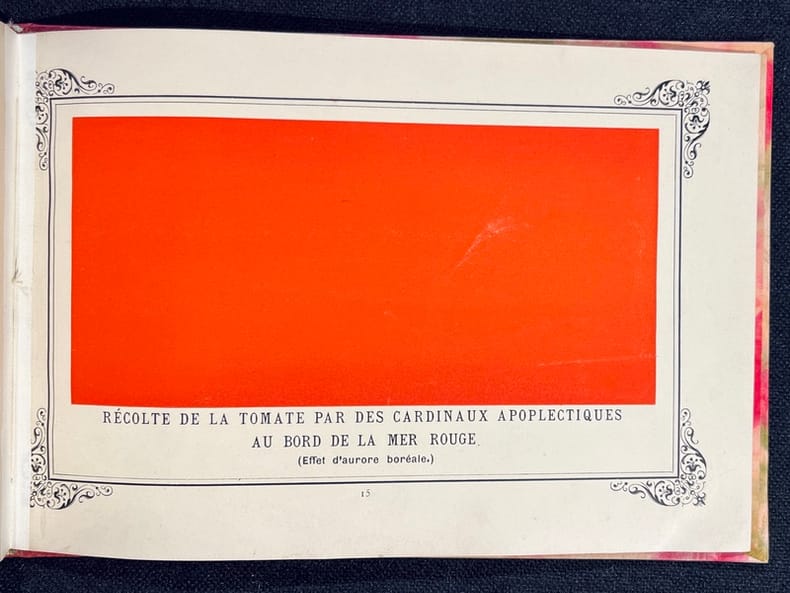
189721797Paris, Paul Ollendorff, sans date [avril 1897]. In-12 oblong de [28] pages incluant les couvertures. Demi-maroquin, dos muet, titre doré au premier plat.
1806SAVLD129Paris: Detournelle & J. Charles 1806. Hardcover. Very Good. Elephant folio 500 x 340mm. Collation complete: 120 plates of French Architecture and plans including the Arc de Triomphe Place de la Concorde and other famous Academy projects. With woodcut vignette of cornucopia and muse on title-page table generale listing architectural designs and copper engraved title-page listing academy members. Three-quarter calf-backed over tree-design boards; scattered marginal foxing. Late 19th-century armorial bookplate of Hoffmann Josef Franz Maria Hoffmann on front pastedown. Hoffmann 1870-1956 was an influential Austrian architect who won the Rome Prize in 1895. Known for his contributions to the arts and crafts movement Hoffmann also designed rooms for the Paris Expositions Universelle in 1900. Second series of this magnificent collection of the 1806 Projets dArchitecture 120 fine French Academy competition plates by Allais Detournelle and Vaudoyer which followed a previous publication of Prieur c. 1787-1801 originally issued in 20 cahiers. As these Grands Prix engravings show Academy neoclassicists revived eclectic motifs from antiquity with their prominent use of obelisks pyramids and blank walls in their design. Egpytianizing forms were becoming part of the landscape of Parisian architecture and were used to achieve a solemn appearance; this style was fascinating to young Academics who still wanted to maintain regal tradition. Notably the Grands Prix drawings contain the Chapelle Sepulchrale by la Barre which demonstrated many of these Egyptian design elements including Pantheon-domes pyramids sphinxes and sarcophagi. This fine production of accomplished watercolors was primarily meant for the education of young Academics in this successful architectural style. Many plates include the scale given in French toises or metres. It continued the Collection des Prix 1787-1801 and was continued as the Grands Prix dArchitecture in 1818. <br/><br/>Second series of this magnificent collection of the 1806 Projets dArchitecture 120 fine French Academy competition plates by Allais Detournelle and Vaudoyer which followed a previous publication of Prieur c. 1787-1801 originally issued in 20 cahiers. As these Grands Prix engravings show Academy neoclassicists revived eclectic motifs from antiquity with their prominent use of obelisks pyramids and blank walls in their design. Egpytianizing forms were becoming part of the landscape of Parisian architecture and were used to achieve a solemn appearance; this style was fascinating to young Academics who still wanted to maintain regal tradition. Notably the Grands Prix drawings contain the Chapelle Sepulchrale by la Barre which demonstrated many of these Egyptian design elements including Pantheon-domes pyramids sphinxes and sarcophagi. This fine production of accomplished watercolors was primarily meant for the education of young Academics in this successful architectural style. Many plates include the scale given in French toises or metres. It continued the Collection des Prix 1787-1801 and was continued as the Grands Prix dArchitecture in 1818. Detournelle & J. Charles hardcover
1806SAVLD129Paris: Detournelle & J. Charles 1806. Hardcover. Very Good. Elephant folio 500 x 340mm. Collation complete: 120 plates of French Architecture and plans including the Arc de Triomphe Place de la Concorde and other famous Academy projects. With woodcut vignette of cornucopia and muse on title-page table generale listing architectural designs and copper engraved title-page listing academy members. Three-quarter calf-backed over tree-design boards; scattered marginal foxing. Late 19th-century armorial bookplate of Hoffmann Josef Franz Maria Hoffmann on front pastedown. Hoffmann 1870-1956 was an influential Austrian architect who won the Rome Prize in 1895. Known for his contributions to the arts and crafts movement Hoffmann also designed rooms for the Paris Expositions Universelle in 1900. Second series of this magnificent collection of the 1806 Projets dArchitecture 120 fine French Academy competition plates by Allais Detournelle and Vaudoyer which followed a previous publication of Prieur c. 1787-1801 originally issued in 20 cahiers. As these Grands Prix engravings show Academy neoclassicists revived eclectic motifs from antiquity with their prominent use of obelisks pyramids and blank walls in their design. Egpytianizing forms were becoming part of the landscape of Parisian architecture and were used to achieve a solemn appearance; this style was fascinating to young Academics who still wanted to maintain regal tradition. Notably the Grands Prix drawings contain the Chapelle Sepulchrale by la Barre which demonstrated many of these Egyptian design elements including Pantheon-domes pyramids sphinxes and sarcophagi. This fine production of accomplished watercolors was primarily meant for the education of young Academics in this successful architectural style. Many plates include the scale given in French toises or metres. It continued the Collection des Prix 1787-1801 and was continued as the Grands Prix dArchitecture in 1818. <br/><br/>Second series of this magnificent collection of the 1806 Projets dArchitecture 120 fine French Academy competition plates by Allais Detournelle and Vaudoyer which followed a previous publication of Prieur c. 1787-1801 originally issued in 20 cahiers. As these Grands Prix engravings show Academy neoclassicists revived eclectic motifs from antiquity with their prominent use of obelisks pyramids and blank walls in their design. Egpytianizing forms were becoming part of the landscape of Parisian architecture and were used to achieve a solemn appearance; this style was fascinating to young Academics who still wanted to maintain regal tradition. Notably the Grands Prix drawings contain the Chapelle Sepulchrale by la Barre which demonstrated many of these Egyptian design elements including Pantheon-domes pyramids sphinxes and sarcophagi. This fine production of accomplished watercolors was primarily meant for the education of young Academics in this successful architectural style. Many plates include the scale given in French toises or metres. It continued the Collection des Prix 1787-1801 and was continued as the Grands Prix dArchitecture in 1818. Detournelle & J. Charles hardcover books
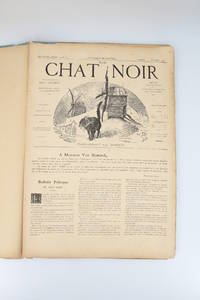
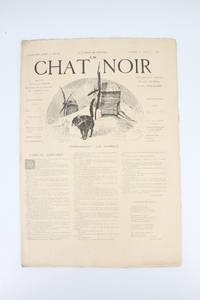
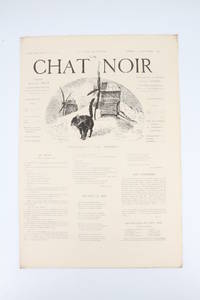
188381900Paris: Au cabaret Le Chat noir 1883. Fine. Au cabaret Le Chat noir Paris 1883 31 x 45 cm broché First edition of this complete 1883 year containing 50 issues in original wrappers under blue temporary covers. Spine split with angular lacks to the covers. Each issue consists of four pages. Texts by Emile Goudeau Alphonse Allais Jean Richepin and Paul Verlaine ""Le Chat noir"" ""Langueur"" ""La Princesse Bérénice"" ""Pantoum négligé"" ""Paysage"" ""Conseil falot"" ""L'Aube à l'envers"" ""Un pouacre"" ""Madrigal"" notably. Drawings by Willette Rodolphe Salis Henri de Sta Tiret-Bognet Henri Pille Caran d'Ache etc. Le Chat noir is a weekly magazine created by Rodolphe Salis and Emile Goudeau published from 1882 to 1897 with the aim of promoting the famous cabaret of the same name serving as its record. It published the texts recited during performances. It is moreover an important literary and artistic testimony of the end of the 19th century centered around bohemian life and the Parisian effervescence characteristic of it. Au cabaret Le Chat noir unknown
188381900Au cabaret Le Chat noir | Paris 1883 | 31 x 45 cm | broché
189342997Paris: Paul Ollendorff 1893. Fine. Paul Ollendorff Paris 1893 12 x 19 cm relié First edition for which there is no mention of large paper copies. Contemporary Bradel binding in half khaki cloth over marbled paper boards the spine with gilt floral motif a double gilt fillet at foot of spine red shagreen title label small marginal scratches one lower corner rubbed. A rare and precious autograph inscription from Alphonse Allais to his publisher Paul Ollendorff : "". le seul éditeur vraiment digne de ce nom hommage d'un auteur qui n'est pas non plus dans une potiche the only publisher really worthy of that name homage from an author who is also not on a sinecure"". Provenance : library of Paul Ollendorff. Paul Ollendorff hardcover
189263748Paris: Marpon & Flammarion 1892. Fine. Marpon & Flammarion Paris s. d. 1892 12 x 19 cm relié First edition for which there is no mention of leading copies. Binding in half saffron percaline with corners smooth back adorned with a gilded floret double gold thread tail piece of brown shagreen that includes scratches marbled paper plates preserved covers Contemporary binding signed by Pierson. Rare and precious autograph signed by Alphonse Allais to Léon Roger-Milès. Marpon & Flammarion unknown
189342997Paul Ollendorff | Paris 1893 | 12 x 19 cm | relié
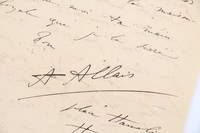
189588099Honfleur: s. n. 1895. Fine. s. n. Honfleur s.d. ca 1895 14 x 22 cm une page recto verso Autograph letter signed addressed to a journalist friend at Figaro illustré 28 lines in black ink. Fold mark inherent to envelope insertion a lack to upper corner of the letter without any damage to the text. Alphonse Allais must do a favor for his friend: ""Un peu de patience mon cher Abel un peu de patience. Sitôt rentré à Paris ma première démarche sera pour ton parapluie que je choisirai en soir gorge-pigeon et manche d'argent."" A little patience my dear Abel a little patience. As soon as I return to Paris my first errand will be for your umbrella which I will choose in pigeon-throat evening silk with a silver handle.; he therefore also allows himself to solicit the kindness of his correspondent: ""Et bien envoie-moi le n° du Figaro illustré d'il y a un mois ou deux où il y avait des choses de Toulouse-Lautrec."" Well then send me the issue of Figaro illustré from a month or two ago where there were things by Toulouse-Lautrec. He concludes his letter with a sententious: ""Donne-moi ta main loyale que je la serre. Ton Alphonse Allais. Bonjour aux amis."" Give me your loyal hand so I may shake it. Your Alphonse Allais. Greetings to friends. s. n. unknown
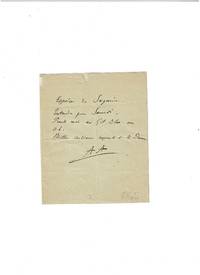
1880756851880. Fine. s. d. circa 1880 11.60 x 14.20 cm un billet Autograph letter signed by Alphonse Allais mounted on fine cardboard. Traces of transverse folds small lacks and marginal tears. ""Espèce de sagouin. / Entendu pour samedi. / Prends moi au Gil Blas vers 6h / Mille cordiaux respects à ta dame. A.A."" ""You rascal. / Agreed for Saturday. / Pick me up at Gil Blas around 6pm / A thousand cordial respects to your lady. A.A."" unknown
188681937Paris: Au cabaret Le Chat noir 1886. Fine. Au cabaret Le Chat noir Paris 1886 31 x 45 cm en feuillets First edition one of the rare copies on laid paper. This issue includes an unpublished poem by Charles Baudelaire ""Chanson du scieur de long"" originally intended for ""L'ivrogne"". The issue is also illustrated with a drawing by Théophile Alexandre Steinlen ""Les deux cochers"". Other contributions include Charles Cros ""Conquérant"" Alphonse Allais ""Comices agricoles"" Rodolphe Salis. A handsome copy. Le Chat noir was a weekly review founded by Rodolphe Salis and Emile Goudeau published from 1882 to 1897 with the aim of promoting the famous cabaret of the same name of which it sought to be the living record. It published the texts declaimed during performances and stands as a major literary and artistic document of the late 19th century reflecting the Parisian bohemian spirit and effervescence that defined it. Au cabaret Le Chat noir unknown
189588099s. n. | Honfleur s.d. (ca 1895) | 14 x 22 cm | une page recto verso
188075685s. d. [circa 1880] | 11.60 x 14.20 cm | un billet
188681937Au cabaret Le Chat noir | Paris 1886 | 31 x 45 cm | en feuillets
1866596571866. Fine. 1866 27.50 x 43.50 cm autre Charcoal black stone and white chalk drawing with wash highlights. Signed lower left in white chalk ""de St Allais 1866"". Thick rigid cardboard of 4 mm. Very fine condition despite a slight lack of 7mm at the upper left corner. Dry stamp lower right corner: Papier Pellée. Slight toning. Finely worked lake and grove landscape. NB: This work is available at the bookstore on request within 48 hours. unknown
1866596571866 | 27.50 x 43.50 cm | autre
180926525Paris: Imprimerie Impériale 1809. Fine. Imprimerie Impériale Paris 1809-1829 54 x 71 cm une feuille Original unshaved full-page etching from the Imperial edition of the Description de l'Égypte or Recueil des observations et recherches faites en Égypte pendant l'expédition française publié par les ordres de Sa Majesté l'Empereur Napoléon le Grand A Collection of the observations and research carried out in Egypt during the French expedition published on the orders of his Majesty the Emperor Napoleon the Great'.Produced between February 1802 and 1830 on the orders of Naopleon Bonaparte and published between 1809 and 1828 1000 copies were printed and distributed to institutions on vergé paper with an 'Égypte ancienne et moderne' watermark visible when held up to the light. Light marginal spotting not touching image otherwise in very fresh fine condition. An engraving from the Description de l'Egypte one of the masterpieces of French printing and the birth of a new field: Egyptology. A gigantic survey of Egypt at the time of Bonaparte's conquests in 1798 and 1799 the work is divided into 13 volumes of engravings making up 892 plates of which 72 colored as well as presenting the splendors of the Egypt of the Pharaohs in 9 volumes. The other volumes discuss natural history and present a fascinating portrait of Coptic and Islamic Egypt as it was seen by Bonaparte's Eastern Armies. The Egyptian campaign' militarily a disaster demonstrates through the engravings of the Description d'Egypte the scientific success it nonetheless became thanks to the 167 expert members of the Commission of the Sciences and Arts of the Institut d'Egypte Egyptian Institute who followed Napoleon's army. The Institut gathered together in Egypt the mathematician Monge the chemist Berthollet the naturalist Geoffroy Saint-Hilaire as well as numerous artists engineers architects and doctors. They were tasked with re-discovering modern and ancient Egypt and displaying its natural treasures as well as the know-how of its inhabitants.This edition the so-called Imperial edition of the plates for the Description de l'Egypte was printed in four large formats two of which were specially created for it and christened Moyen-Egypte and Grand-Egypte. A special press was built to print it the process extending over 20 years from 1809 to 1829. The Imperial edition proved so popular that a second edition this time in black and white and without the Egypte ancienne et moderne watermark known as the Royal Edition was published during the Restoration by the printing house of C.-L.-F. Panckoucke Paris.The engravings of the Description d'Egypte owe a great deal to Baron Dominique-Vivant Denon illustrator diplomat collector and later Director of the Musée Napoléon the Louvre. His exploration of the South of Egypt gave Bonaparte the idea of sending the experts of the Institut there thus creating a faithful and complete portrait of the area. This was the research gathered together from 1802 in the mammoth Description de L'Egypte.Denon embarked on this story of archeological exploration at the age of 51 reaching first Alexandria and then Cairo before exploring Upper Egypt. Along with the members of the Institut d'Egypte the Natural History Museum's painter H.J. Redouté brother of Pierre-Joseph Redouté author of Roses the mineralogist Dolomiue and the draughtsman Joly Denon then explored the Nile Delta and Lower Egypt. When however he joined the 21st Light Infantry Regiment as it marched across Upper Egypt in pursuit of the retreating Mameluks in November 1798 he found himself the only civilian. In the very midst of the battle itself he reeled off sketches of the works of art that peppered his path right up to the threshold of the Sudan. He said that he had crossed a country that is apart from its name entirely unknown to Europeans and therefore everything was worth describing Voyages dans la Basse et la Haute Egypte pendant les campagnes de Imprimerie Impériale unknown
180926525Imprimerie Impériale | Paris 1809-1829 | 54 x 71 cm | une feuille
180923431Paris: Imprimerie Impériale 1809. Fine. Imprimerie Impériale Paris 1809-1829 70 x 51.50 cm une feuille Original unshaved full-page etching from the Imperial edition of the Description de l'Égypte or Recueil des observations et recherches faites en Égypte pendant l'expédition française publié par les ordres de Sa Majesté l'Empereur Napoléon le Grand A Collection of the observations and research carried out in Egypt during the French expedition published on the orders of his Majesty the Emperor Napoleon the Great'.Produced between February 1802 and 1830 on the orders of Naopleon Bonaparte and published between 1809 and 1828 1000 copies were printed and distributed to institutions on vergé paper with an 'Égypte ancienne et moderne' watermark visible when held up to the light. Light marginal spotting not touching image otherwise in very fresh fine condition. An engraving from the Description de l'Egypte one of the masterpieces of French printing and the birth of a new field: Egyptology. A gigantic survey of Egypt at the time of Bonaparte's conquests in 1798 and 1799 the work is divided into 13 volumes of engravings making up 892 plates of which 72 colored as well as presenting the splendors of the Egypt of the Pharaohs in 9 volumes. The other volumes discuss natural history and present a fascinating portrait of Coptic and Islamic Egypt as it was seen by Bonaparte's Eastern Armies. The Egyptian campaign' militarily a disaster demonstrates through the engravings of the Description d'Egypte the scientific success it nonetheless became thanks to the 167 expert members of the Commission of the Sciences and Arts of the Institut d'Egypte Egyptian Institute who followed Napoleon's army. The Institut gathered together in Egypt the mathematician Monge the chemist Berthollet the naturalist Geoffroy Saint-Hilaire as well as numerous artists engineers architects and doctors. They were tasked with re-discovering modern and ancient Egypt and displaying its natural treasures as well as the know-how of its inhabitants.This edition the so-called Imperial edition of the plates for the Description de l'Egypte was printed in four large formats two of which were specially created for it and christened Moyen-Egypte and Grand-Egypte. A special press was built to print it the process extending over 20 years from 1809 to 1829. The Imperial edition proved so popular that a second edition this time in black and white and without the Egypte ancienne et moderne watermark known as the Royal Edition was published during the Restoration by the printing house of C.-L.-F. Panckoucke Paris.The engravings of the Description d'Egypte owe a great deal to Baron Dominique-Vivant Denon illustrator diplomat collector and later Director of the Musée Napoléon the Louvre. His exploration of the South of Egypt gave Bonaparte the idea of sending the experts of the Institut there thus creating a faithful and complete portrait of the area. This was the research gathered together from 1802 in the mammoth Description de L'Egypte.Denon embarked on this story of archeological exploration at the age of 51 reaching first Alexandria and then Cairo before exploring Upper Egypt. Along with the members of the Institut d'Egypte the Natural History Museum's painter H.J. Redouté brother of Pierre-Joseph Redouté author of Roses the mineralogist Dolomiue and the draughtsman Joly Denon then explored the Nile Delta and Lower Egypt. When however he joined the 21st Light Infantry Regiment as it marched across Upper Egypt in pursuit of the retreating Mameluks in November 1798 he found himself the only civilian. In the very midst of the battle itself he reeled off sketches of the works of art that peppered his path right up to the threshold of the Sudan. He said that he had crossed a country that is apart from its name entirely unknown to Europeans and therefore everything was worth describing Voyages dans la Basse et la Haute Egypte pendant les campagnes Imprimerie Impériale unknown
188481938Paris: Au cabaret Le Chat noir 1884. Fine. Au cabaret Le Chat noir Paris 1884 31 x 45 cm en feuillets First edition one of the rare copies on laid paper. The issue is illustrated with a drawing by Adolphe Willette ""Il est né le divin enfant ! "". Other contributions by Alphonse Allais ""Le veau"" Rodolphe Salis Auguste Marin. Handsome copy. Le Chat noir is a weekly magazine created by Rodolphe Salis and Emile Goudeau published from 1882 to 1897 with the aim of promoting the famous cabaret of the same name whose memory it sought to preserve. It published the texts declaimed during the shows. It is moreover an important literary and artistic testimony of the end of the 19th century around the bohemian life and the Parisian effervescence that was its own. Au cabaret Le Chat noir unknown
1897109212Juven 1897 Paris, F. Juven Editeur, 4 volumes, 1897-1899, percalines bleues, environ 170x135mm. Dos légèrement applatis vers le premier plat, reliures salies avec des frottements d'usage, des rousseurs sur les tranches, bon état pour le reste et intérieur propre.
180923431Imprimerie Impériale | Paris 1809-1829 | 70 x 51.50 cm | une feuille
1900134201P., Revue blanche 1900 In-12, cartonnage bradel post., couvertures & dos conservés,335 pp. Papier jauni. Très bon exemplaire. Edition originale.
189749030Paris Juven 1897 2 vol. relié 10 ouvrages reliés en 2 forts vol. in-16, demi-basane cerise, dos à nerfs. Série complète de cette collection de textes drôlatiques (à l'exception du dernier volume paru, "Le Fétiche" de Maurice Montégut), tous en édition originale, avec de nombreuses illustrations in-texte, notamment par Métivet et Vallotton. Détail comme suit :- Tristan Bernard, Contes de Pantruche et d'ailleurs, 1897, 120 pp.- Willy & Andrée Cocotte, L'Argonaute, 127 pp.- Auguste Germain, Petite chatte, 124 pp.- Alphonse Allais, L'Arroseur, 123 pp.- Charles Quinel, J'en ai mal au ventre, 1898, 121 pp.- W. de Pawloswski, On se moque de nous, 124 pp.- J. Dépaquit, Le Secret du cacatoès, 123 pp.- Marc Mario, Culottes rouges, 126 pp.- J. Goudezki, Hercule ou la vertu récompensée, 124 pp.- Rodolphe Bringer, Une idylle à Montmartre, 125 pp.
189749030Paris Juven 1897 2 vol. relié 10 ouvrages reliés en 2 forts vol. in-16, demi-basane cerise, dos à nerfs. Série complète de cette collection de textes drôlatiques (à l'exception du dernier volume paru, "Le Fétiche" de Maurice Montégut), tous en édition originale, avec de nombreuses illustrations in-texte, notamment par Métivet et Vallotton. Détail comme suit :- Tristan Bernard, Contes de Pantruche et d'ailleurs, 1897, 120 pp.- Willy & Andrée Cocotte, L'Argonaute, 127 pp.- Auguste Germain, Petite chatte, 124 pp.- Alphonse Allais, L'Arroseur, 123 pp.- Charles Quinel, J'en ai mal au ventre, 1898, 121 pp.- W. de Pawloswski, On se moque de nous, 124 pp.- J. Dépaquit, Le Secret du cacatoès, 123 pp.- Marc Mario, Culottes rouges, 126 pp.- J. Goudezki, Hercule ou la vertu récompensée, 124 pp.- Rodolphe Bringer, Une idylle à Montmartre, 125 pp.