284 résultats
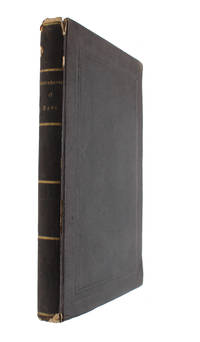
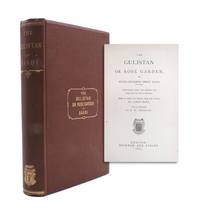
1865333537Boston: Ticknor and Fields 1865. First American edition and first edition thus of this translation with preface by Emerson. 379pp. 8vo. Original brick cloth. Binding has light soiling with rubbing and few tiny tears at tips of spine else a very good bright copy with text fresh and clean. First American edition and first edition thus of this translation with preface by Emerson. 379pp. 8vo. A nice association copy; John Albee was a friend of Ralph Waldo Emerson and he wrote 'Reminiscences of Emerson' 1882; reprinted in 'Concord Lectures in Philosophy'Myerson E202 and 'Remembrances of Emerson' 1901; revised edition 1903. Persian poet Musle-Huddeen Sheik Saadi 1184-1291 was born in Shiraz.<br /> <br /> In Emerson's introduction he explains the reason for the late date of publication "The slowness to import these books into our libraries-mainly owing no doubt to the forbidding difficulty of the original languages- is also due in part to some repulsion in the genius of races. At first sight the Oriental rhetoric does not please our Western taste . " Francis Gladwin translated several of the Oriental writers and wrote a "History of Hindostan." In addition to his numerous translations he also produces several vocabularies and grammatical works including a Persian-Hindustani-English dictionary which was published in 1809. In the 1860's there was a revival of interest in the Persian poems at the time of and following the publication of the "Rubaïyat." Sa'dî was an early 12th century Persian poet described by the "Encyclopedia Britannica" as "the greatest didactic poet and the most popular writer of Persia." Richard Burton and Sir Edwin Arnold both were interested in him and translated his works as did several others. This work is described by Gay Wilson Allen as a "humorous miscellany of ethical subjects in rhymed prose." p. 481 Saadi was Emerson's favorite poet in fact apparently he considered using Saadi in "Representative Men" in place of Shakespeare. Emerson became acquainted and then enamoured of the Persian poets in the late 1830's. Originally he had read Saadi in a German translation. In 1841 he wrote a poem for "The Dial" entitled "Saadi" German thought Oriental influences and Platonic thought were all integral parts of the New England Transcendentalists. Myerson D55 Ticknor and Fields unknown
185360483København C. G. Iversen 1853. 8vo. In the original cloth binding with blindstamped frames to boards. With dedication from the translator: "Til min kiære broder / til erindring om / efteråret 1853 / fra Boisen" i.e. English: "To my dear brother / in memory of / fall 1853 / from Boisen". Wear to hindges and capitals with some loss of the cloth. Ex-libris K. F. Plesner pasted on to pasted down front end-paper. Light brownspotting throughout. VIII 216 pp. <br/><br/><em>Rare first Danish translation - with dedication from the translator - of Saadi's "Gulistan" often translated as "The Rose Garden" a masterpiece of Persian literature written by the 13th-century Persian poet and prose writer Saadi Shirazi – “probably the single most influential work of prose in the Persian tradition" Encyclopædia Iranica. It is a collection of stories anecdotes moral teachings and poetry that are presented in both prose and verse forms. The work is considered one of the most important and enduring pieces of Persian literature. The book is divided into eight chapters each of which focuses on different aspects of life morality ethics and social conduct. These chapters cover topics such as justice humility friendship love and the importance of education. The stories and anecdotes in the "Gulistan" are often used to convey moral lessons and practical advice. They are known for their wit humor and deep insight into human nature. Saadi's writing style is characterized by its eloquence simplicity and use of everyday language making his teachings accessible to a wide audience. The "Gulistan" has been translated into numerous languages and has had a profound influence on literature and thought across the world. Its teachings have been appreciated by scholars philosophers and leaders throughout history. The work has also played a role in shaping Persian cultural identity and ethical values. </em> hardcover
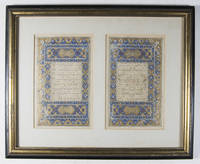
43594Persia ca. late 15th century. Framed. 2 beautifully illuminated manuscript leaves from the Kulliyat collected works of Saadi the famed Persian poet from Shiraz. Remounted and matted. Wood frame painted in black and gold measuring 13x16". Possibly early Safavid Era. Text in Persian. unknown
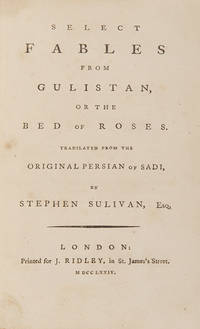
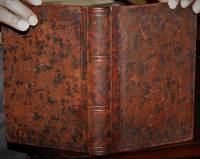
106890London Printed for J. Ridley in St. James's Street 1774. . First edition in English lacking half-title small 8vo; contemporary half calf spine gilt a handsome volume.<br /> An early English translation of the Gulistan Rose Garden by the renowned sufi poet Sa'di of Shiraz often considered one of the singular most important works of prose in the Persian language.<br /> London, Printed for J. Ridley, in St. James's Street, 1774. unknown
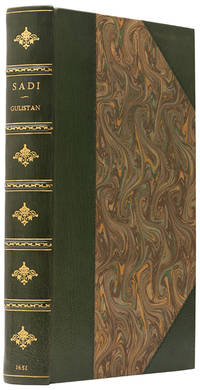
107241Amsterdam Joannis Blaev 1651. . First edition; small folio xx 630pp. completes with the notes of Gentio bound at the end printed in Persian & Latin a clean and attractive copy title and final leaf very slightly browned bound in modern green half morocco over marbled boards spine in compartments with gilt ornaments.<br /> The single most important publication for Western studies in Persian language and history in the seventeenth century. Although the compiler Georgius Gentius 1618-1687 was best-known as a Dutch Hebraists he was also a Persian scholar and this copy of the text includes an appendix of notes relating to the Gulistan by Gentius bound at the end often lacking. <br /><br />The Gulstan or Rose Garden is one of the most important literary works in the Persian language. Sa'adi being one of the most revered of Persian Poets completed this masterpiece in 1258 AD and it has been a literary favourite since. Though a vast quantity of manuscripts of the text precede this publication the delays in printing in the Middle East which weren't established until the nineteenth century make this 1651 publication the earliest printed edition of the text. A partial French translation by du Ryer was published in 1634 and a German version of this French text appeared two years later but this remains the earliest most complete appearance of this monumentally important work in print.<br /> Amsterdam, Joannis Blaev, 1651. hardcover
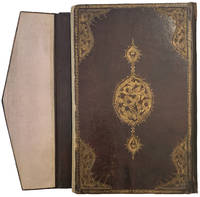
1800MEE1104Persia: undated pre-1800. 1800. 11.25 x 7.5 inches. ca. 228 leaves Written mostly in old Farsi with some Arabic marginal notes. With one leaf f. 66 illuminated on upper quadrant another 2 leaves with a penciled sketch where an illumination was planned but never completed ff. 108 170. There are numerous decorative motifs of flowers throughout the manuscript. Each leaf is variously partitioned perhaps suggestive of a garden! in this case with flowers adorning most leaves. Binding style suggests 18-19th centuries. Bound in Islamic style Ottoman period full Turkey morocco with elaborate gilt rule corner and centre ornamental flourishes with leather flap; some minor repairs to the sides of the binding are evident when examined closely. MANUSCRIPT OF SAADI' GOLESTAN THE GREAT PERSIAN POET: ORIGINAL COMPLETE MANUSCRIPT OF ONE OF THE MOST FAMOUS OF ALL PERSIAN POETS SA'ADI OF SHIRAZI. The calligraphic style and the binding are suggestive of the 16th or 17th century. This piece is embellished with numerous leaves many of which are decorated by hand with small compartments of flowers each realized from the title of Sa'adi's Gulistan Golestan Flower Garden of Sa'adi. Sa'adi is "probably the single most influential work of prose in the Persian tradition completed in 1258 by Mosarref-al-Din Mole known as Shaikh Sa'di of Shiraz." – Encyclopaedia Iranica. / The manuscript is mixed with both poetry and stories or narratives along with a moral as well as some commentaries. / PROVENANCE: Signed Kiffin Yates Rockwell 1892–1916 later label of: Kiffin Ayres Rockwell Beloit Wisconsin June 28 1942. Kiffin Yates Rockwell was a World War I fighter pilot and the first American to shoot down an enemy aircraft in WWI. He shot down a German pilot. Thus the manuscript is clearly in the United States and kept there since before 1942. "Kiffin Yates Rockwell the youngest son of James Chester and Loula Ayres Rockwell." see below. What may clear up some confusion here is that there are at least two persons with this name and there may be three. Kiffin Ayres Rockwell II or III Oct. 8 1917-Jan. 27 1998 who served in the air force in Korea is buried in Black Mountain North Carolina. Sa'adi opens with poems of Sa'eb of Tabriz a Safavid poet of Indian style of poetry added to the text. "Back of the shell kingly gems are orphans." undated [pre-1800]. hardcover
1844B6733Tehran Iran. C.1844. A good example of this text. Some pages browned with marginal spotting. Some bleeding of colour. Some leaves professionally restored with occasional missing text. Binding: Full contemporary mottled calf expertly rebacked in matching style. Upper and lower with blind paneling and motifs in blind. Spine with blind rules. Notes: Extremely rare First or very early edition. With original hand colouring throughout.<br>Saadi Shirazi also known simply as Saadi 1210 – 1291/2 was a prominent Persian poet and writer. Nicknamed “The Master Of Speech†or “The Wordsmith†he is widely recognized as one of the greatest poets of the classic literary tradition. <br><br><br> Size: 8vo. 223x146 mm. Illustration: Titlepage with arabesque-style border and figural headpiece coloured in blue and yellow. Text in 19 lines most often in two columns inside illuminated frame. Main text inside border containing text written in diagonal often with emphasized catchwords and illustrations of plants animals and people. Many pages with additionally decorated and coloured borders in arabesque or floral style or with figural scenes and illustrations. A few of the pictures are dated around 1855. Pages: 314 pages. Category: Book Literature; Book Asia Middle East Iran; unknown
B7092Persia Iran. 17th century. A fine example. Binding worn spine defective some occasional marginal worming to last 25 leaves. Marginalia inked to bottom edges. Interior otherwise generally clean and crisp. Binding: Lacquer boards in coloured floral design. Original spine. Doublures featuring 3 medallions in floral design on gilt background floral border. Notes: Persian Manuscript.<br>Text in Persian. A comprehensive collection of the works of one of Persia’s most eminent celebrated classical prose and poetry writer compromising the full text of Saadi Golestan Rose Garden Bustan Orchard Ghisaid Odes and Ghazaliyat Lyrics. <br><br>Sadi 1210–1291 the prominent Persian poet studied in Baghdad he returned to his native Shiraz in 1256. His Bustan Fruit Garden an ethical-didactic text was composed in Mathnawi rhyming couplets. Even more popular is his Gulistan Rose Garden written in rhyming prose. Sadi is also the author of many Ghasidas long panegyrics in Persian and Arabic of mystic Ghazal love poems and of satiric poetry. <br><br>AbÅ«-Muhammad Muslih al-DÄ«n bin AbdallÄh ShÄ«rÄzÄ« better known by his pen-name Saadi also known as Saadi of Shiraz was a major Persian poet and prose writer of the medieval period. He is recognized for the quality of his writings and for the depth of his social and moral thoughts. Sa’adi is widely recognized as one of the greatest poets of the classical literary tradition earning him the nickname "Master of Speech" or simply "Master" among Persian scholars. He has been quoted in the Western traditions as well. Bustan is considered one of the 100 greatest books of all time according to The Guardian.<br>Sadi's best known works are Bustan The Orchard completed in 1257 and Gulistan The Rose Garden completed in 1258. Bustan is entirely in verse epic metre. It consists of stories aptly illustrating the standard virtues recommended to Muslims justice liberality modesty contentment and reflections on the behavior of dervishes and their ecstatic practices. Gulistan is mainly in prose and contains stories and personal anecdotes. <br><br> Size: 8vo.230 x 140 mm Illustration: Title with illuminated colour headpiece plus others throughout. Fine and handsome Nasta’liq manuscript written in red and black ink in central column of 15 lines to a page with marginal text catchwords often illuminated and coloured gilt borders extensive glosses written diagonally in margins throughout. Pages: 331 leaves. Category: Book Asia Middle East Iran; Book Manuscript; Book Literature; hardcover
B7093Persia Iran. 17th century. Generally good example. Binding worn title headpiece lacking some leaves splitting at column borders mostly at last leaves. Text clean and crisp. Binding: Full black morocco boards with blind borders decorated with three debossed diamond-shaped medallion designs; one larger central medallion and two smaller directly above and below gilt filigree on blue background. Spine with 2 slightly raised bands. <br><br> Notes: Persian manuscript. <br>Text in Persian. Bustan Orchard is one of the works of the Persia’s most eminent celebrated classical prose and poetry writer Saadi of Shiraz.<br><br>Sadi 1210–1291 the prominent Persian poet studied in Baghdad he returned to his native Shiraz in 1256. His Bustan Fruit Garden an ethical-didactic text was composed in Mathnawi rhyming couplets. Even more popular is his Gulistan Rose Garden written in rhyming prose. Sadi is also the author of many Ghasidas long panegyrics in Persian and Arabic of mystic Ghazal love poems and of satiric poetry. <br><br>AbÅ«-Muhammad Muslih al-DÄ«n bin AbdallÄh ShÄ«rÄzÄ« better known by his pen-name Saadi also known as Saadi of Shiraz was a major Persian poet and prose writer of the medieval period. He is recognized for the quality of his writings and for the depth of his social and moral thoughts. Sa’adi is widely recognized as one of the greatest poets of the classical literary tradition earning him the nickname "Master of Speech" or simply "Master" among Persian scholars. He has been quoted in the Western traditions as well. Bustan is considered one of the 100 greatest books of all time according to The Guardian.<br>Sadi's best known works are Bustan The Orchard completed in 1257 and Gulistan The Rose Garden completed in 1258. Bustan is entirely in verse epic metre. It consists of stories aptly illustrating the standard virtues recommended to Muslims justice liberality modesty contentment and reflections on the behavior of dervishes and their ecstatic practices. Gulistan is mainly in prose and contains stories and personal anecdotes. <br><br> Size: 8vo.250 x 160 mm Illustration: Text in Nasta’liq manuscript written 14 lines to a page in gilt columns with blue and green bordering on orange-pink painted leaves beautifully patterned in gilt. Catchwords colour and gilt tailpiece interlinear gilt decoration intercolumnar rules decorated with intertwining floral motifs in gold on blue background. <br><br> Pages: 165 leaves. Category: Book Asia Middle East Iran; Book Literature; Book Manuscript; hardcover