Abdullah Al SaadiBiblio.com
284 résultats
A9786148035678Paperback / softback. New. paperback
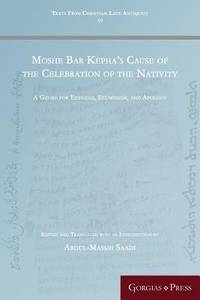
B9781463207335Paperback / softback. New. This book is a part of series of Causes of Celebrations written by Moshe Bar Kepha 813-903. These Causes are unique in that they demonstrate a new genre of the Syriac literature initiated by the East Syriac authors at the beginning of the sixth century. paperback
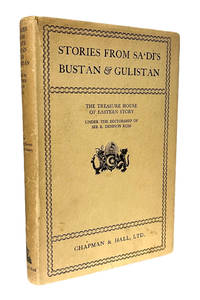
1928202154<p>London: Chapman and Hall 1928. First Edition. Hardcover. Very Good/Very Good. Kent Cynthia. Orange cloth boards with green lettering & decoration under beige dust jacket printed in blue priced at 21s edges uncut. Owner's name to front endpaper. A few stray pencil markings one short verse written in pencil to rear DJ flap. Solid lovely copy of some of the prose works of one of the great Persian authors.</p> Chapman and Hall hardcover
20071575Tacoma WA: Springtide Press 2007. Limited edition. Very Good. No. 37 of 55 copies. Approx. 17-1/2" x 14". Broadside. Delicate sand-colored laid paper printed in brown with mustard ornaments. Center fold line few faint creases. An original poem by Saadi Yousef from "Without an Alphabet Without a Face" printed by Jessica Spring the proprietor of Springtide Press. It is part of the "Mutanabbi Street Starts Here" project which drew on broadside contributions from a variety of printers to commemorate the 2007 bombing of the historic book market in Baghdad.OCLC notes one copy at Indiana University and we find copies in two locations at the University of Washington. Springtide Press unknown
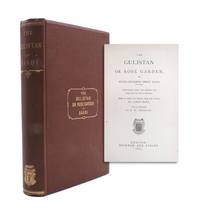
1865333537Boston: Ticknor and Fields 1865. First American edition and first edition thus of this translation with preface by Emerson. 379pp. 8vo. Original brick cloth. Binding has light soiling with rubbing and few tiny tears at tips of spine else a very good bright copy with text fresh and clean. First American edition and first edition thus of this translation with preface by Emerson. 379pp. 8vo. A nice association copy; John Albee was a friend of Ralph Waldo Emerson and he wrote 'Reminiscences of Emerson' 1882; reprinted in 'Concord Lectures in Philosophy'Myerson E202 and 'Remembrances of Emerson' 1901; revised edition 1903. Persian poet Musle-Huddeen Sheik Saadi 1184-1291 was born in Shiraz.<br /> <br /> In Emerson's introduction he explains the reason for the late date of publication "The slowness to import these books into our libraries-mainly owing no doubt to the forbidding difficulty of the original languages- is also due in part to some repulsion in the genius of races. At first sight the Oriental rhetoric does not please our Western taste . " Francis Gladwin translated several of the Oriental writers and wrote a "History of Hindostan." In addition to his numerous translations he also produces several vocabularies and grammatical works including a Persian-Hindustani-English dictionary which was published in 1809. In the 1860's there was a revival of interest in the Persian poems at the time of and following the publication of the "Rubaïyat." Sa'dî was an early 12th century Persian poet described by the "Encyclopedia Britannica" as "the greatest didactic poet and the most popular writer of Persia." Richard Burton and Sir Edwin Arnold both were interested in him and translated his works as did several others. This work is described by Gay Wilson Allen as a "humorous miscellany of ethical subjects in rhymed prose." p. 481 Saadi was Emerson's favorite poet in fact apparently he considered using Saadi in "Representative Men" in place of Shakespeare. Emerson became acquainted and then enamoured of the Persian poets in the late 1830's. Originally he had read Saadi in a German translation. In 1841 he wrote a poem for "The Dial" entitled "Saadi" German thought Oriental influences and Platonic thought were all integral parts of the New England Transcendentalists. Myerson D55 Ticknor and Fields unknown