Orwell, GeorgeBiblio.com
2 052 résultats
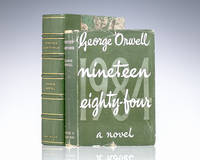
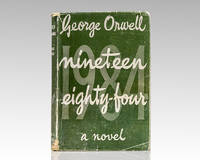
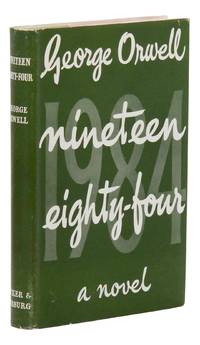
1949140947091London: Secker & Warburg 1949. First Edition. Fine/Fine. An absolutely superlative copy of the first British edition first printing of Orwell's iconic novel. Bound in publisher's pale green cloth with maroon lettering to spine. Trace erased pencil to front free endpaper and rear pastedown still easily Fine with bright cloth and stamping vivid topstain in a Fine unclipped jacket. A towering classic of twentieth century literature that frustrates collectors as copies in jacket nearly always turn up rubbed and faded--this example will not frustrate. A once-in-a-lifetime copy and the nicest we have ever seen by many orders of magnitude. Secker & Warburg unknown
10330Unpublished Typescript. 1932. Typescript comprising two sections: first three pages of carbon copy with Orwell's autograph pencil side-notes recording sound effects the name 'Geoffrey' written twice in red crayon; second twelve roneograph pages with some pencil markings probably in the hand of one of the boy actors Geoffrey Stevens 15 pages folio and 4to spindle holes some slight wear and creasing marginal fraying at outer leaves final leaf torn and reinforced; together with an original photograph of Orwell and his school at this time mounted and labelled. Housed in a purpose made quarter black morocco solander box. Provenance: Geoffrey Stevens; sold Sothebys London Dec. 15th 1988; Private Collection. This short historical play which is written partly in blank verse was composed by the twenty-nine-year-old Eric Blair when he was headmaster at the Hawthorns High School for Boys in Hayes Middlesex a small private school having little more than a dozen pupils as the accompanying photograph shows. It was performed as the school's Christmas play at St Mary's Church Hall in Hayes in 1932. This was in a period when Orwell had finished Down and Out in Paris and London or Days in London and Paris as it was originally titled and was looking for a publisher. He was working on Burmese Days and had only sought the job at Hawthorns because he needed an income. Fed up with his job and his lack of disposable income he then spent the best part of a term writing and rehearsing a school play for the boys to perform. With dramatic speeches noisy altercations involving stocks and pikes unlikely coincidences and some very theatrical dialogue it is little wonder that Geoffrey Stevens one of the boys who performed in the play enjoyed the experience considerably more than Orwell himself who referred to it in a letter to Eleanor Jacques on 19 October as 'a mucky play the boys are to act later'. By 18 November he could record: 'I have had to write & produce a play- am now in the throes of rehearsing it- & what is worst of all have had to make most of the suits of armour etc. for the boys to act it. For the last few weeks I have been suffering untold agonies with glue & brown paper etc.' Collected Essays Journalism and Letters 1968 I 102-105. Geoffrey Stevens whose copy this is remembers the undertaking more fondly: 'The performance lasted only half an hour but we spent hours in preparation finding props constructing the scenery etc. all of which he Orwell supervised closely. It was ambitious. He arranged for plywood doors on either side to have saw cuts made in them so that Cromwell's men could break them open with their pikes. It worked perfectly and made a great crashing noise coming down.' Orwell The Authorised Biography Michael Shelden 1991 p172. Orwell was seldom pleased with his work and destroyed the majority of his manuscripts. King Charles II while it lacks some of the literary gravitas of his published work has pastiche humour and a political message. It remains unpublished and this is the sole known copy. Further details and images for any of the items listed are available on request. Lucius Books welcomes direct contact with our customers. Unpublished Typescript. 1932 unknown
193467096New York: Harper & Brothers 1934. First American edition and true first preceding the British edition by one year of Orwell's first novel. Octavo original cloth. Presentation copy inscribed by the author on the verso of the front free endpaper to Mabel Fierz "With very best wishes from Eric Blair." It was Mabel Fierz who introduced Orwell to Leonard Moore who would later become his literary agent after salvaging the manuscript for Down and Out from the writer's discarded papers. After first meeting Orwell in Southwold Suffolk Mabel and her husband Francis became close friends with the writer and often invited him to stay at their house in Golders Green. On one such occasion Orwell gave Mabel the manuscript which had just been rejected by Faber and telling her to save only the paperclips said she should throw it away. Instead she took it in person to Moore who in turn took it to Gollancz. In gratitude thereafter Orwell presented Mabel with signed copies of all his published works. Mabel Fierz authorial inscription typed letter signed by Mabel's son Adrian Fierz loosely inserted. Near fine in a very good dust jacket. Housed in a custom half morocco clamshell box. Burmese Days was several years in the writing. Orwell was drafting it in Paris during the time he spent there from 1928 to 1929. He was still working on it in 1932 at Southwold while doing up the family home in the summer holidays. By December 1933 he had typed the final version and in 1934 he delivered it to his agent Leonard Moore for publication by Victor Gollancz who had published his previous book. Gollancz smarting from fears of prosecution from another author's work turned it down because he was worried about charges of libel. Heinemann and Cape turned it down for the same reasons. After demanding alterations Harpers were prepared to publish it in the United States where it made its debut in 1934. In the spring of 1935 Gollancz declared that he was prepared to publish Burmese Days provided that Orwell was able to demonstrate it was not based on real people. Extensive checks were made in colonial lists that no British individuals could be confused with the characters. Many of the main European names have since been identified in the Rangoon Gazette and U Po Kyin was the name of a Burmese officer with him at the Police Training School in Mandalay. Gollancz brought out the English version on 24 June 1935. Harpers brought out Burmese Days in the US on 25 October 1934 in an edition of 2000 copies. In February 1935 just four months after publication 976 copies were remaindered. The only American review that Orwell himself saw in the New York Herald Tribune by Margaret Carson Hubbard was unfavourable: "The ghastly vulgarity of the third-rate characters who endure the heat and talk ad nausea of the glorious days of the British Raj when fifteen lashes settled any native insolence is such that they kill all interest in their doings." A positive review however came from an anonymous writer in the Boston Evening Transcript for whom the central figure was "analyzed with rare insight and unprejudiced if inexorable justice" and the book itself praised as full of "realities faithfully and unflinchingly realised." On its publication in Britain Burmese Days earned a review in the New Statesman from Cyril Connolly as follows: "Burmese Days is an admirable novel. It is a crisp fierce and almost boisterous attack on the Anglo-Indian. The author loves Burma he goes to great length to describe the vices of the Burmese and the horror of the climate but he loves it and nothing can palliate for him the presence of a handful of inefficient complacent public school types who make their living there. I liked it and recommend it to anyone who enjoys a spate of efficient indignation graphic description excellent narrative excitement and irony tempered with vitriol." Orwell received a letter from the anthropologist Geoffrey Gorer as follows "Will you allow me to tell you how very much indeed I admire your novel Burmese Days: it seems to me an absolutely admirable statement of fact told as vividly and with as little bitterness as possible." It was as a result of these responses that Orwell renewed his friendship with Connolly which was to give him useful literary connections a positive evaluation in Enemies of Promise and an outlet on Horizon. He also became a close friend of Gorer. In 2013 the Burmese Ministry of Information named the new translation by Maung Myint Kywe of Burmese Days the winner of the 2012 Burma National Literature Award's "informative literature" translation category. The National Literary Awards are the highest literary awards in Burma. Harper & Brothers hardcover books
193467096New York: Harper & Brothers 1934. First American edition preceding the British edition by one year of Orwell's first novel. Octavo original cloth. Presentation copy inscribed by the author with his given name on the verso of the front free endpaper "With very best wishes from Eric Blair." As explained in the accompanying typed letter signed by Adrian Fierz this copy was presented by the author to Mabel Fierz. It was Mabel Fierz who introduced Orwell to Leonard Moore who would later become his literary agent after salvaging the manuscript for Down and Out from the writer's discarded papers. After first meeting Orwell in Southwold Suffolk Mabel and her husband Francis became close friends with the writer and often invited him to stay at their house in Golders Green. On one such occasion Orwell gave Mabel the manuscript which had just been rejected by Faber telling her to save only the paperclips. Instead she brought the manuscript to Moore who in turn took it to the publisher Gollancz. In gratitude Orwell presented Mabel with signed copies of all of his published works. Typed letter signed by Mabel's son Adrian Fierz inserted. Near fine in a very good dust jacket. Housed in a custom half morocco clamshell box. Burmese Days was several years in the writing. Orwell was drafting it in Paris during the time he spent there from 1928 to 1929. He was still working on it in 1932 at Southwold while doing up the family home in the summer holidays. By December 1933 he had typed the final version and in 1934 he delivered it to his agent Leonard Moore for publication by Victor Gollancz who had published his previous book. Gollancz smarting from fears of prosecution from another author's work turned it down because he was worried about charges of libel. Heinemann and Cape turned it down for the same reasons. After demanding alterations Harpers were prepared to publish it in the United States where it made its debut in 1934. In the spring of 1935 Gollancz declared that he was prepared to publish Burmese Days provided that Orwell was able to demonstrate it was not based on real people. Extensive checks were made in colonial lists that no British individuals could be confused with the characters. Many of the main European names have since been identified in the Rangoon Gazette and U Po Kyin was the name of a Burmese officer with him at the Police Training School in Mandalay. Gollancz brought out the English version on 24 June 1935. Harpers brought out Burmese Days in the US on 25 October 1934 in an edition of 2000 copies. In February 1935 just four months after publication 976 copies were remaindered. The only American review that Orwell himself saw in the New York Herald Tribune by Margaret Carson Hubbard was unfavourable: "The ghastly vulgarity of the third-rate characters who endure the heat and talk ad nausea of the glorious days of the British Raj when fifteen lashes settled any native insolence is such that they kill all interest in their doings." A positive review however came from an anonymous writer in the Boston Evening Transcript for whom the central figure was "analyzed with rare insight and unprejudiced if inexorable justice" and the book itself praised as full of "realities faithfully and unflinchingly realised." On its publication in Britain Burmese Days earned a review in the New Statesman from Cyril Connolly as follows: "Burmese Days is an admirable novel. It is a crisp fierce and almost boisterous attack on the Anglo-Indian. The author loves Burma he goes to great length to describe the vices of the Burmese and the horror of the climate but he loves it and nothing can palliate for him the presence of a handful of inefficient complacent public school types who make their living there. I liked it and recommend it to anyone who enjoys a spate of efficient indignation graphic description excellent narrative excitement and irony tempered with vitriol." Orwell received a letter from the anthropologist Geoffrey Gorer as follows "Will you allow me to tell you how very much indeed I admire your novel Burmese Days: it seems to me an absolutely admirable statement of fact told as vividly and with as little bitterness as possible." It was as a result of these responses that Orwell renewed his friendship with Connolly which was to give him useful literary connections a positive evaluation in Enemies of Promise and an outlet on Horizon. He also became a close friend of Gorer. In 2013 the Burmese Ministry of Information named the new translation by Maung Myint Kywe of Burmese Days the winner of the 2012 Burma National Literature Award's "informative literature" translation category. The National Literary Awards are the highest literary awards in Burma. Harper & Brothers hardcover
1934GO016New York: Harper and Brothers 1934 First edition first printing. One of 2000 copies. Publisher's red-orange cloth lettered in black pictorial pale yellow floral endpapers; in the original yellow dust jacket lettered in black and red-orange. Book about fine with only a hint of wear to the extremities else bright and clean; price-clipped dust jacket with some wear and chipping to the extremities minor toning to the spine a hint of light soiling to the otherwise fresh panels. Overall a near fine and very attractive copy of this extremely scarce title very rare in the dust jacket. This first American edition of Burmese Days is the true first printing of Orwell's second work and first novel. Victor Gollancz initially rejected the controversial novel but agreed to publish the first British edition in 1935 after the success of the American edition and making several edits to the text. Notably Orwell would later call the Gollancz edition "garbled" and when Penguin prepared its first edition in 1940 he insisted that the publishers use the American text rather than the English. An extremely scarce title in any condition this copy of Burmese Days is especially rare because of its excellent condition and lack of any repairs or restoration. Based on Orwell's experiences serving in the Indian Imperial Police in Burma from 1922-1927 Burmese Days is set in colonial Burma that the publisher's tout as a "cynical sometimes brutal answer to the Rudyard Kipling 'white man's burden' school of novelists - a caustic portrait of the white man in the East as he really is." Specifically it tells the story of the conflicted timber merchant John Flory who struggles to reconcile his belief in British superior with his appreciation of the Burmese people and culture. Interestingly while English publishers Victor Gollancz Jonathan Cape and William Heinemann all declined to publish Burmese Days for fear of a libel suit from officers in the British colonies American publisher Harper & Brothers flaunted the novel' controversial subject matter. Indeed as the dust jacket boldly proclaims on the front panel "If the prophet is unsung in his own country the truth-teller also is rarely welcome in his home town.". 1st Edition. Hard Cover. Near Fine/Dust Jacket Included. New York: Harper and Brothers hardcover books
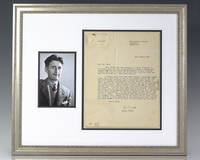
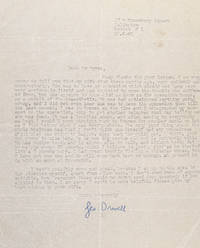
1946133445January 9 1946. Rare typed letter signed by the acclaimed author of Nineteen-Eighty Four George Orwell; part of a long correspondence with scientist Edward R. Ward regarding his views on science. One page typescript the letter reads: '9th January 1946 Dear Mr. Ward Your letter has been passed on to be by "Tribune". I am sorry that in their correspondence columns I should have answered what was really an abridgement of your original letter; but I had not seen the latter and I did not know that what was printed was a shortened version. I cannot enter into what might become a prolonged controversy but I must stick to two of my original points: a that many scientists including some of those you name appear to adopt an extremely unscientific attitude towards problems in which their emotions and loyalties are involved; and b that members of the general public such as myself have a right to form and express their own opinions on the relationship between science and society. I do not know in what way your original letter was mutilated but you did state quite clearly that I as a journalist had no right to express an opinion on matters that were the sole concern of scientists. It was this remark in your letter that led me to reply. The theologians make exactly similar claims - for example that a member of the lay public has no right to air his opinions on such questions as the existence of God - and the one claim seems to me to be about as well founded as the other. Yours truly "Geo. Orwell" George Orwell.' With Orwell's 27B Canonbury Square Islington London return address. From the late 19th century to the turn of the 20th century English scientist Eduard R. Ward was a semi-professional microscopist and well-known figure in the Manchester scientific society. He was one of the founders of the Manchester Microscopical Society and remains best known for his photographic documentation of the construction of the Manchester Ship Canal. Science-Gossip 1901. First published in the Tribune on October 26 1945 Orwell's "What is Science" elaborated on the ideas summarized in his reply to Ward essentially warning of the danger of leaving scientific pursuits to scientists in laboratories and making it inaccessible to the general public. Ward responded to Orwell's "What is Science" in the Tribune in October 1945 but the Tribune printed only an abridged version of his letter. Orwell responded to him in print again in November but had done so without the full text of Ward's original letter. This January 9 1946 letter is his private response to the letter in full. In near fine condition. Double matted and framed with a photograph of Orwell. The entire piece measures 19 inches by 16.25 inches. In his concise article "What is Science" Orwell concludes "A hundred years ago Charles Kingsley described science as ‘making nasty smell in a laboratory’. A year or two ago a young industrial chemist informed me smugly that he ‘could not see what was the use of poetry’. So the pendulum swings to and fro but it does not seem to me that one attitude is any better than the other. At the moment science is on the upgrade and so we hear quite rightly the claim that the masses should be scientifically educated: we do not hear as we ought the counter-claim that the scientists themselves would benefit by a little education. Just before writing this I saw in an American magazine the statement that a number of British and American physicists refused from the start to do research on the atomic bomb well knowing what use would be made of it. Here you have a group of same men in the middle of a world of lunatics. And though no names were published I think it would be a safe guess that all of them were people with some kind of general cultural background some acquaintance with history or literature or the arts — in short people whose interests were not in the current sense of the word purely scientific." unknown
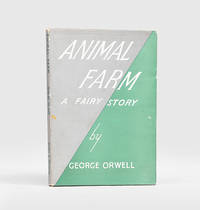
1945190048London: Secker & Warburg 1945. Some animals are more equal than others First edition of Orwell's allegorical warning against totalitarianism under any political regime which quickly brought him international fame. In his 1946 essay "Why I Write" Orwell noted that "Animal Farm was the first book in which I tried with full consciousness of what I was doing to fuse political purpose and artistic purpose into one whole". The imprint of the first impression reads "May 1945" though publication was delayed until August due to wartime paper shortages. Octavo. Original green cloth spine lettered in white. With dust jacket. Touch of sunning to spine ends production flaw to front endpapers; jacket unclipped a little rubbed and faintly marked small nicks to extremities but still bright: a near-fine copy in very good jacket. Connolly 93; Fenwick A.10a. hardcover
1949140949117London: Secker & Warburg 1949. First Edition. Near Fine/Near Fine. First edition first printing. Bound in publisher's pale green cloth with red lettering to spine; purple topstain. Near Fine with light fading to cloth at spine and edges. Bookplate of former owner at front pastedown. In a sharp unclipped dust jacket with fading to spine light rubbing and light edge wear. A beautiful copy of a book difficult to find in this nice of condition. Fenwick A.12.a. Secker & Warburg unknown
1940ORWELLGE000876Victor Gollancz London. 1940. First edition. Octavo. 188 pages. Only 1000 copies were printed. The other essays are "Charles Dickens" and "Boys' Weeklies".Signed by the author ''Geo. Orwell'' on the half-title page.Head and tail of spine a bit scuffed. Covers faintly marked. Very good. No dustwrapper. Victor Gollancz, London. unknown
194014507London: Victor Gollancz Ltd 1940. Cloth. Very Good. SIGNED BY GEORGE ORWELL on the front free endpaper. A solid copy to boot of the 1940 true 1st edition of this uncommon collection of Orwell essays consisting of 3 lengthy pieces --"Charles Dickens" "Boys' Weeklies" and "Inside the Whale". Tight and VG in its dark cloth with rubbing to the spine lettering light spotting --and a bit of minor staining-- at the panels and just a touch of foxing to the endsheets. Orwell's signature of course is legendarily elusive and given his relatively short life 1903-1950 and the major impact his career had in the world of 20th century literature is extremely sought-after. Only a very small handful of 20th century authors command comparable respect in the rare book world. Victor Gollancz Ltd unknown
19371906003Gollancz 1937. 1st Edition. Hardcover. Very Good/Very Good. A very good first edition in a complete and slightly restored original and very rare dust jacket. One of only 2150 copies of the first edition. Housed in a handsome clamshell case with leather spine and corners and gold lettering and decoration. Gollancz hardcover books
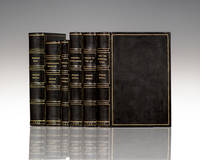
1934147631London: Various Publishers 1934-56. First editions of the novels of George Orwell. Octavo 6 volumes bound in full morocco by the Harcourt Bindery gilt titles and tooling to the spine in six compartments within raised gilt bands gilt ruling to the front and rear panels gilt inner dentelles stamp-signed by the Harcourt Bindery marbled endpapers all edges gilt. An exceptional set rare and desirable. George Orwell is best known for his allegorical novella Animal Farm 1945 and the dystopian novel Nineteen Eighty-Four 1949. Orwell's work remains influential in popular culture and in political culture and the adjective "Orwellian"—describing totalitarian and authoritarian social practices—is part of the English language like many of his neologisms such as "Big Brother" "Thought Police" "Room 101" "Newspeak" "memory hole" "doublethink" and "thoughtcrime". In 2008 The Times named Orwell the second-greatest British writer since 1945. Various Publishers unknown
19371906003Gollancz 1937. 1st Edition. Hardcover. Very Good/Very Good. A very good first edition in a complete and slightly restored original and very rare dust jacket. One of only 2150 copies of the first edition. Housed in a handsome clamshell case with leather spine and corners and gold lettering and decoration. Gollancz hardcover
1945142701June 1945. Rare typed letter signed "Geo. Orwell" to Gerry Byrne announcing that "my wife died three months ago very suddenly and unexpectedly" writing about the aftermath of her death including his relief that their son Richard was too young to to miss her ".He is now 13 1/2 months old and is extremely well. He has twelve teeth and is almost able to walk." apologising that he cannot come to speak at a Labour Party campaign meeting ".I am up to the eyes in the election myself apart from other work. I don't even know of anyone suitable." 1 page 4to 27b Canonbury Square Islington London 28 June 1945 ".She was to have an operation which should not have been very serious in itself and was expected to cure the trouble she suffered from but she appears to have died as soon as the operation began as a result of the anaesthetic." Although Orwell here relates the immediate cause of Eileen's death under anaesthetic for a hysterectomy "the trouble she suffered from" was advanced cancer. Orwell was in France when she died on 29 March 1945 reporting on the final stages of the war in Europe and he here explains to Byrne that he returned as soon as he could after the funeral escaping his grief through work ".I felt better when I was moving about." and leaving his son Richard "with an aunt in Greenwich". He was back in England covering the Election which was just a week away and explains to Byrne that he had just taken on a housekeeper - Susan Watson - which would make it practical for his son to rejoin him in Islington. Orwell's correspondent here is Gerry Byrne the husband of Amy Charlesworth with whom he had corresponded since 1937. The Complete Works of George Orwell: Volume 17 1998 pp. 198-99. unknown
1949198041London: Secker & Warburg 1949. First Edition; First Printing. Hardcover. Very Good in a Good dust jacket. Rubbing along panel edges. Sunned spine. Repairs made to top/bottom of dust jacket by previous owner. Secker & Warburg hardcover
1949140944091London: Secker & Warburg 1949. First Edition. Near Fine/Near Fine. First British edition first printing. Bound in publisher's pale green cloth with red lettering to spine. Near Fine with fading to cloth at spine and edges pages lightly toned and slight evidence of several instances of erased pencil to text. In a Near Fine unclipped dust jacket with fading to the spine light edge wear with shallow chipping at the spine ends several small tape repairs to the verso and a short split to the bottom of the front spine joint repaired with mending tissue from the verso as well. A first edition increasingly difficult to find let alone in nice of condition with no restoration or funny business and quite rare as such. Secker & Warburg unknown
19743406DIANA 1974. 22. softcover. DIANA paperback
1945ORWELLGE015667Secker & Warburg London. 1945. First edition. Octavo. 92 pages. One of the key books of twentieth century English literature and of political satire of any period. Fading to extreme head and tail of spine. Near fine in very good dustwrapper with rubbing to the spine. Seldom seen in such fresh condition. Secker & Warburg, London. unknown
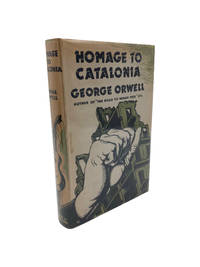
1938001509London: Secker and Warburg 1938. 6 313pp 1. Original cloth in DJ. Reverse of DJ with old paper reinforcing to edges and spine tear to head of spine catching the word 'Homage' now closed with Japanese tissue paper one or two other closed tears small amount of loss to head of lower panel some very minor chips to edges spine browned lower panel lightly browned price-clipped. Some browning to endpapers text lightly browned but clean. Old bookseller's ticket to foot of front pastedown. DJ illustrated by 'K'. Now housed in a morocco backed drop back box by Temple Bookbinders with raised bands and the spine in six panels with the title to second panel the author to fourth and the date to foot. Orwell's experience of the Spanish Civil War where he enlisted in the POUM militia and was shot in the throat. Gollancz declined to publish the work according to Orwell because Gollancz was "part of the communist- racket and as soon as he heard I had been associated with the POUM and Anarchists and had seen the inside of the May riots in Barcelona he said he did not think he would be able to publish my book though not a word of it was written yet" Fenwick page 63. Fenwick A6a. First Edition. Hardback. Good/Good. 8vo. Secker and Warburg Hardcover
194014507London: Victor Gollancz Ltd 1940. Cloth. Very Good. SIGNED BY GEORGE ORWELL on the front free endpaper. A solid copy to boot of the 1940 true 1st edition of this uncommon collection of Orwell essays consisting of 3 lengthy pieces --"Charles Dickens" "Boys' Weeklies" and "Inside the Whale". Tight and VG in its dark cloth with rubbing to the spine lettering light spotting --and a bit of minor staining-- at the panels and just a touch of foxing to the endsheets. Orwell's signature of course is legendarily elusive and given his relatively short life 1903-1950 and the major impact his career had in the world of 20th century literature is extremely sought-after. Only a very small handful of 20th century authors command comparable respect in the rare book world. <br/><br/> Victor Gollancz Ltd hardcover books
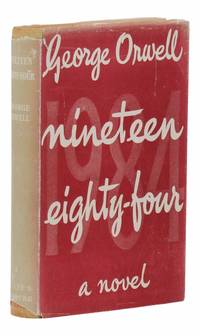
1949143801London: Secker & Warburg 1949. First edition of Orwell's classic dystopian novel. Octavo original cloth. Near fine in a near fine dust jacket with a few small chips and closed tears. Jacket design by Michael Kennard. Housed in a custom half morocco clamshell box made by the Harcourt Bindery. A very nice example. Written while Orwell suffered severely from tuberculosis and published shortly before the disease claimed his life the novel is a work “of hectic devilish claustrophobic intensity… nightmarish in the telling†Clute & Nicholls 896. In 2005 the novel was chosen by Time Magazine as one of the 100 best English-language novels from 1923 to 2005. Named as one of Modern Library 100 Best Novels of the twentieth century. “It is quite simply a novel which has changed the world†Pringle 100 Best Science Fiction Novels 1. Fenwick A12a. Connolly 99. Anatomy of Wonder II:838. 100 Most Influential Books 93. Secker & Warburg hardcover
1949140946931London: Secker & Warburg 1949. First edition. Very Good/Very Good. First edition first printing. 312 pp. Bound in publisher's pale green cloth with spine lettered in red pink topstain. Very Good with slight lean fading to spine and edges with two small stains to top edge bookseller's tickets to front paste down and light toning to contents. In a Very Good price-clipped dust jacket with sunned spine panel chipping at spine ends and top of back panel light foxing to verso. An attractive copy of the British first of Orwell's final novel the dystopian classic. Secker & Warburg unknown
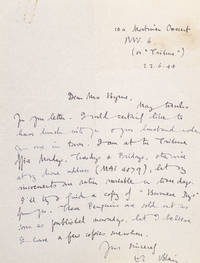
1944142004June 1944. Rare autographed letter signed by George Orwell signed to Amy Charlesworth Byrne detailing his usual weekly routines between his home and the offices of Tribune in order to make lunch arrangements to meet her and her husband also promising her a book ".I'll try & find a copy of 'Burmese Days for you. These Penguins are sold out as soon as published nowadays but I believe I have a few copies somewhere. signed E. Blair" one page 10a Mortimer Crescent London NW6 23 June 1944. Amy Charlesworth with whom Orwell had corresponded in 1937 had now married her second husband Gerry Byrne. In very good condition. The Complete Works of George Orwell: Volume 16 1998 p. 265. unknown
1949152264London: Secker & Warburg 1949. First edition of Orwell’s classic dystopian novel. 312 pages ; 19 cm. Octavo. Original light green cloth spine lettered in red. Fenwick records two variant states of the dust jacket one green and one red with no priority. Bibliographic note: Orwell's last novel published in 1949 a year before his death. Cyril Connolly described it as written with "particular feeling and clarity" observing that "even the political arguments are never dull. In fact they are worked out with passionate logic. 'Double Think' 'Newspeak' 'Big Brother' now form part of the language. It is a warning against totalitarianism under any disguise left or right" Connolly The Modern Movement 99. Condition: Near fine in a very good dust jacket. cf. Connolly The Modern Movement 99; Fenwick A12a. George Orwell's final novel Nineteen Eighty-Four follows Winston Smith a functionary of the Party in a totalitarian superstate that monitors every citizen and continually rewrites the past. Published in 1949 a year before Orwell's death it gave the language Big Brother Newspeak doublethink and the Thought Police. It remains one of the most influential political novels of the twentieth century and a constant reference point in debates over surveillance propaganda and state power. Secker & Warburg hardcover
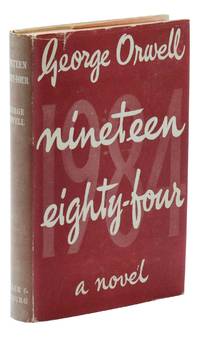
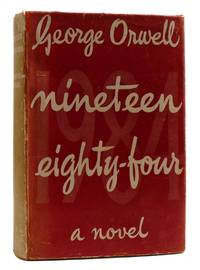
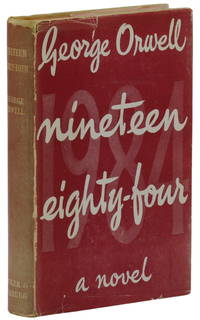
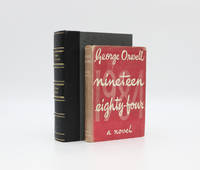
24183London: Secker and Warburg. 1949. First edition first printing. First edition first printing. Publisher's original green cloth with red titles to the spine in the maroon Michael Kennard designed dustwrapper. Top edge purple. An excellent near fine copy the binding square and firm the cloth bright and fresh with a little fading to the extreme edges. The contents are clean throughout and without inscriptions or stamps. The text block edge is a little toned with a few spots of foxing to the top edge the purple however remains vivid and without fading. Complete with the very good rubbed and nicked dustwrapper that has a couple of small chips with associated creasing to the upper tip of the habitually faded spine. The present example in entirely original condition does retain some of its red colour to the spine panel rendering the white titles still legible and is therefore uncommon thus. Not price-clipped 10s net to the lower front flap. Housed in a bespoke grey and black quarter morocco solander case. The first printing of Nineteen Eighty-Four was published on 8th June 1949 in an edition of 25000 copies. The book was issued in two colours of dustwrapper identical in all but the background colour of the upper panel and spine one being green the other maroon. Although no precedence has been established the maroon would appear to be the less common of the two and is considered the more desirable. Fenwick A12a; Connolly 100. Further details and images for any of the items listed are available on request. Lucius Books welcomes direct contact with our customers. London: Secker and Warburg. 1949 hardcover