6 631 résultats
0136487416.Gpaperback. Good. Access codes and supplements are not guaranteed with used items. May be an ex-library book. paperback
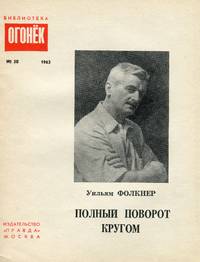
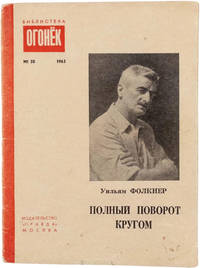
19636393<p><strong>Rare first book edition of these stories in Russian.</strong></p><p>This collection of stories includes '<em>Turnabout'</em> 1932 and '<em>Delta Autumn'</em> 1942. '<em>Turnabout'</em> is considered one of Faulkner's most popular stories and is renowned as the best-known among his World War I fictions. '<em>Delta Autumn'</em> is one of the seven stories from the novel 'Go Down Moses'.<br />It's worth noting that in the foreword Faulkner was referred to as 'a defender of African American rights' due to his exploration of racial discrimination in the Southern United States in his books. The William Faulkner Foundation and scholarship programs for African Americans are also mentioned in this context.<br />The translation was prepared by <strong>Elena Golysheva</strong> 1906-1984 and <strong>Boris Izakov</strong> 1903-1988. Together they translated novels by Graham Greene Arthur Miller and John Priestley and they also completed the first Russian translation of Hemingway's '<em>The Old Man and the Sea'</em>.<br />The illustrations were created by the graphic artist and caricaturist <strong>Vitalii Goryaev</strong> 1910-1982. He received his education at VKhUTEIN and the Moscow Polygraphic Institute under Dmitry Moor and Vladimir Favorsky. Goryaev visited the United States in 1958 and the result of his trip was a series of drawings depicting daily life in America titled '<em>The Americans at Home'</em>.<br />In 1964 <strong>Andrei Tarkovsky</strong> directed a radio drama adaptation of '<em>Turnabout'</em> which marked his first and only adaptation for radio. Due to its perceived pacifism and unique sound '<em>Turnabout'</em> was broadcast only once on Central Asian radio in 1965 in place of the regular nocturnal concert of classical music. The audio drama was subsequently banned and records were stored in the archive with the designation '<em>Strictly limited to use'</em>. The broadcast premiere took place only in 1987.</p><p>Libman # 6325.</p><p>OCLC locates four copies of this edition in USA: in the University of Virginia Library in the Yale University Library in the Harvard College Library and in the University of California.</p> Pravda paperback
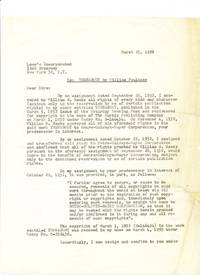
4043Faulkner signed this contract which transferred distribution rights of the film based on Faulkner's story "Turnabout" to the Loew's Corporation. "By an assignment dated September 26 1932 I conveyed to William B. Hawks all rights of every kind. in my story. TURNABOUT published in the March 5 1932 issue of the Saturday Evening Post and registered for copyright. On November 4 1932 William B. Hawks conveyed all. rights. to Metro-Goldwyn-Mayer. your predecessor. In my assignment. it was provided that I. secure. renewals of all copyrights.The copyright of March 1 1932. was renewed in my name on March 4 1959.Accordingly I now assign and confirm to you. the same rights in the work entitled TURNABOUT." Signed in full on the signature line "William Faulkner.". The film referenced in our document is titled "Today We Live" released in 1933 by MGM. According to the Turner Classics Movies web site this film is listed as being distributed by Loew's which was the parent company of MGM from 1924-1959. The story is about an American World War I aviator who befriends a British torpedo boat pilot and comes to see the war from a different perspective. The film considered a romance drama was produced and directed by Howard Hawks and starred Joan Crawford Gary Cooper Robert Young and Franchot Tone. Faulkner provided dialogue for the film. Hawks purchased the option on the story but Irving Thalberg then Vice President of MGM forced Hawks to hire Crawford for the film and forced Faulkner to write a love interest for the men. Crawford was under contract for MGM at the time. <br/><br/>All of this weakened Faulkner's original story and thus the film's plot. In addition the film apparently included inappropriate use of non-period costumes and an unconvincing Crawford. "Today We Live" turned into a failure. According to a movie review in the "New York Times" on April 15 1933 by Mordaunt Hall this "first of William Faulkner's literary efforts to reach the screen. is understood to have been amplified in the studio by the author. is at times vague and cumbersome. It possesses however the spark of sincerity. " Margin tears and stains show on right margins of both pages. unknown books
196312<p>This is a rare first edition of William Faulkner's Turnabout Russian: Полный поворот кругом in Russian published in the USSR in 1963. In Russian.</p><p>M.: Pravda 1963</p><p>Series: Library "Ogonyok". Weekly supplement to the magazine</p><p>ISBN missing</p><p>Cover type: soft</p><p>Format: 70x108/32 130x165 mm</p><p>Pages: 48</p><p>Description: Artist not specified.</p><p>Contents: William Faulkner note pp. 2-2 William Faulkner. Turnabout short story translated by Golisheva pp. 3-17 William Faulkner. Delta Autumn short story translated by Golisheva pp. 34-46</p><p>Note: Signed for publication 23/11/1963</p> Pravda paperback
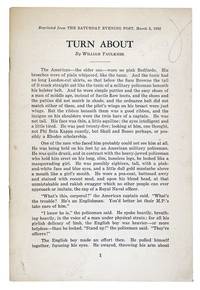
1932035975NY: Saturday Evening Post. 1932. A previously unknown Faulkner "A" item -- an offprint from the March 5 1932 issue of the Saturday Evening Post. In long-accepted Faulkner lore the first and only separate edition of Turn About was the 1939 edition published by W. L. Massiah of Ottawa Canada which has been considered Faulkner's scarcest "A" item with approximately seven known copies. Offered here is a 1932 offprint -- 7 years earlier than the Massiah edition -- with no other known copies. Faulkner's story "Turn About" was first published in The Saturday Evening Post on March 5 1932 with two bibliographically significant markers: the second paragraph includes a description of one character as having "a pink-and-white face and blue eyes and a little dull gold mustache above a mouth like a girl's mouth" and the text is broken up into 10 parts each identified with a Roman numeral from I to X. The earliest book publications of the story -- in O. Henry Memorial Award Prize Stories of 1932 and in Faulkner's collection Doctor Martino and Other Stories published in 1934 -- leave out both the "gold mustache" and the text breaks. The former change seems likely to have been authorial rather than editorial which means that Faulkner changed the text of the story removing the "gold mustache" phrase before the end of 1932 when the O. Henry collection was published. The 1939 Massiah edition includes the phrase which is how it was concluded that it had been printed from the text of the Post story rather than from one of the later book publications. The Massiah publication also retains the 10 text breaks but rather than being identified by Roman numerals the breaks are separated with a filigree design. The 1932 offprint offered here includes the "gold mustache" phrase as well as the 10 text breaks of the original Post publication with Roman numerals delineating the sections -- the only place other than in the original magazine itself where Roman numerals are used in the text. Carl Petersen the renowned Faulkner collector did not have a copy of Massiah's Turn About in his collection when he published his 1975 bibliography. By 1991 when Peter Howard of Serendipity Books published the 643-page catalog of Petersen's Faulkner collection he did have a copy which Serendipity valued at $17500 calling it "by far the rarest of Faulkner's published books." Christie's auction house called the Massiah edition "exceedingly scarce" and noted that "no copies have appeared at auction in at least 50 years" in a 2010 auction listing. As best we have been able to determine this 1932 Saturday Evening Post offprint displaces the 1939 edition of Turn About as Faulkner's scarcest "A" item: it is previously unknown contemporaneous with the initial story publication and possibly at this point one of a kind. 28 stapled pages; one page corner turned; a handful of mostly marginal pencil markings "x's"; near fine in stapled wrappers. Unless otherwise noted our first editions are first printings. First Edition. No Binding. Near Fine. Saturday Evening Post unknown
193982215Ottawa:: W. L. Massiah December 1939. First separate published edition. original purple velour-finish wrappers stamped in gold. Preserved in a custom quarter morocco clamshell box. A very good copy. Peterson A21.2: "By far the rarest of Faulkner's published books.printed in Canada as an inspirational piece to be distributed at the Christmas season 1939 the first winter of World War II." W. L. Massiah, unknown
1997x-0824798295Marcel Dekker Inc 1997. Hardcover. New. 1st edition. 464 pages. 9.50x6.50x1.00 inches. Marcel Dekker Inc hardcover
2003x-0824709802Marcel Dekker Inc 2003. Hardcover. New. 1st edition. 424 pages. 9.25x6.25x1.00 inches. Marcel Dekker Inc hardcover
1993x-082479138XMarcel Dekker Inc 1993. Hardcover. New. 2nd revised expanded edition. 280 pages. 9.50x6.50x1.00 inches. Marcel Dekker Inc hardcover
1849636176.Gmass_market. Good. Access codes and supplements are not guaranteed with used items. May be an ex-library book. unknown
2025__0198898223Oxford Univ Pr 2025. Hardcover. New. 192 pages. 6.30x0.67x9.45 inches. Oxford Univ Pr hardcover
2025x-0198898223Oxford Univ Pr 2025. Hardcover. New. 192 pages. 6.30x0.67x9.45 inches. Oxford Univ Pr hardcover
49538104like new. unknown
49538104-nnew. unknown
0198898223.Ghardcover. Good. Access codes and supplements are not guaranteed with used items. May be an ex-library book. hardcover
2000mon0004048617Oxford University Press 8/27/2025 12:00:01 A. hardcover. Like New. 0.8661 9.5669 6.4961. Oxford University Press hardcover
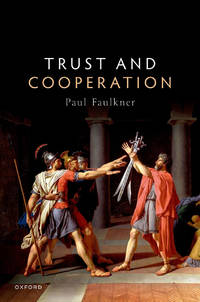
A9780198898221Hardback. New. Society depends on cooperation and cooperation requires trust. This book offers an account of how trust enables cooperation that makes sense of how we understand trust and the role it plays in our reasoning about whether to rely on people in what they say and do. hardcover
2008Q-1561454656Peachtree 2008-09-02. Hardcover. New. In shrink wrap. Looks like an interesting title! Peachtree hardcover
1953608047Kobenhavn: Winthers Forlag 1953. Softcover. Near Fine. First Danish edition of Pylon. Octavo. 231pp. Pictorial wrappers with yapped edges. Modest wear on the wrappers else near fine. Winthers Forlag unknown
15304Paris, Le Club Français du Livre, 1964. In-8°, 369p. Reliure pleine toile imprimée d'éditeur.
16511Paris, Gallimard, collection Blanche, 1949, in-12 broché, 270 pp. Mention fictive de 15e ed. EO sur papier courant après les 120 G.P. Couverture en très bon état, léger défraichissement des marges, sinon intérieur en très bon état.
196474750Paris, Club Français du Livre, 1964, in-8, cartonnage éditeur toilé, 368 pages. Bon état.
1964ROD0017967Club Français du Livre. 1964. In-8. Relié toilé. Bon état, Couv. légèrement passée, Dos fané, Intérieur frais. 367 pages. Des rousseurs sur le dos et la couverture. Portrait n&b de l'auteur in fine avec sa biographie. Traduction de R.N. Raimbault et Ch. P. Vorce avec la collaboration de M.E Coindreau. Préface de R.N. Raimbault. Exemplaire numéroté 3777 sur 7000.. . . . Classification Dewey : 94.41-Editions numérotées (gros tirage)
1964R110107523CLUB FRANCAIS DU LIVRE. 1964. In-8. Relié toilé. Bon état, Couv. convenable, Dos satisfaisant, Intérieur frais. 368 pages. Livre avec rhodoïd.. . . . Classification Dewey : 800-LITTERATURE (BELLES-LETTRES)