388 résultats
1589676841589. Conraf Waldkirch 1589-1599 4° mit 10 sich wiederholenden Portraits und Textholuschnitte im letzten Teil Astrologica. 5 geprägte Schweinsledereinbände d.Zt.; vereinzelt Wurmlöcher ohne Textverlust sehr geines Exemplar. Erster bis Zehender Theil der Bücher und Schrifften. Jetzt auffs new auß den Originalien und Theophrasti eigner Handschrifft an tag geben: durch Joh. Huserum. 10 Teile und die Appendices zu Teilen V und X letzterer in 2 Teilen in 5 Bänden. Mit 12 ganzseitigen wiederholten Porträtholzschnitten des Autors mehrfach wiederholten Wappenholzschnitten Druckermarken und 62 Textholzschnitten im Appendix zu Teil X. Titel in Rot und Schwarz. Reich blindgeprägtes Schweinsleder der Zeit Basel Conrad Waldkirch 1589-1591. Seltene erste deutsche Gesamtausgabe der Werke des Theophrast Bombast von Hohenheim genannt Paracelsus 1493-1541 die sog. "Huser'sche Quartausgabe" in der zahlreiche Schriften zum ersten Mal im Druck erschienen und deren Text für alle späteren Ausgaben maßgeblich wurde. Sie kam mit Unterstützung des Kurfürsten und Kölner Erzbischofs Ernst Prinz von Bayern zustande und wurde von dem Paracelsisten Johann Huser 1545-1600 Arzt aus Waldkirch im Breisgau und kurfürstlich-kölnischem Rat herausgegeben vgl. Hirsch-Hübotter III 350. "Wenn man ohne Voreingenommenheit diese Huser'schen Darlegungen über die bei der Sammelausgabe angewendeten Grundsätze und Massnahmen überblickt so kann man ihm die Anerkennung nicht versagen dass er mit Umsichte und Gründlichkeit an die Lösung seiner Aufgabe gegangen ist" Sudhoff S. 374. Die Ausgabe gliedert sich in medizinische Werke Teile I-VI dann die "Bücher in welchen fürnemlich die Kräfft Tugenden und Eigenschafften Natürlicher dingen auch derselben Bereitdungen betreffend die Artzeney beschriben werden neben eingemischten sachen zur Alchemey dienstlich" Teil VII. Es folgen die philosophischen Schriften Teile VIII-X. Der 5. Teil enthält ein Sudhoff unbekannt gebliebenes Sonderblatt eine "Schedula" zu S. 290 sowie einen 228 Seiten und 21 umfassenden Appendix. Mit der häufig fehlenden Foliotafel im 10. Teil zu S. 68 ferner dem Appendix und einem zweiten Anhang mit dem "Fasciculus Prognosticationum Astrologicarum". Zum Appendix gehören auch die Textfiguren und Holzschnitte davon 30 zur "Auslegung der Magisten Figuren im Carthäuser Kloster zu Nürnberg" und 32 "Figurae Magicae Theophrasti" zur "Prognostication auf XXIIII Jahr zukünfftig". Das vorliegende Exemplar enthält alle erschienenen Teile bis auf den Appendix zu Teil VIII jedoch die Appendices zu Teilen V und vor allem X mit dem genannten "Fasciculus prognosticationum astrologicarum". Kollation: Band I Teil I: 10 Bl. 426 S. 1 Bl.; Teil II: 342 S. 1 w. 28 Bl.; Teil III: 4 Bl. 420 S. 51 Bl.; Teil IV: 417 S. 53 Bl.; Teil V: 4 Bl. 332 S. 48 Bl.; 228 S. 21 Bl.; Teil VI: 4 Bl. 440 S. 12 Bl.; Teil VII: 6 Bl. 439 S. 4 Bl.; Teil VIII: 6 Bl. 363 S. 4 Bl. ohne S. 365-428 Appendix zu VIII; Teil IX: 4 Bl. 459 S. 4 Bl.; Teil X: 4 Bl. 491 S.; 275 S. 4 Bl. letztes weiß 106 S. 1 Bl. VD16 P 365 367 369 371 373 375-379. Mook 154-163. Sudhoff 216-225 220a und 225a. Hirsch-Hübotter IV 499. Garrison-Morton 57 Anm. Durling 3514 unvollständig. - Nicht bei Osler Wellcome Waller. Not in Neville Historical Library; not in Maggs 520 and Ferguson; Durling 3514 imperfect; Heirs of Hippocrates only later complete editions not in Osler Wellcome Waller. unknown
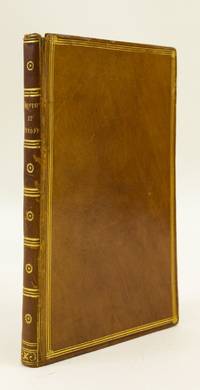
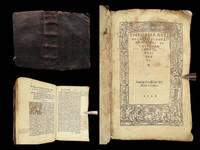
352610<p>Baderbüchlin. Sechs köstliche Tractat armen und reychen nutzlich und notwendig von wasserbädern . Mit fleyß und müe Doctor Adams von Bodenstein zu einem guten neuwen jar publicirt. 4to 202 x 153 mm. 32 ff. A-H4 last blank title in red and black 2 fine woodcuts bathing scenes the larger one repeated printer's device. Modern red morocco 2 gilt fillets and fleurons on boards spine on raised bands decorated with gilt fleurons edges gilt. Small dampstain on the title page. Mülhausen Peter Schmid 1562.</p><p>The eminently rare first edition of one of the earliest works on hydrotherapy. The treatise is about water-baths thermal springs hot baths etc. and their uses — for rich and poor — describing how they are useful and necessary for health. Paracelsus discusses the therapeutic effects of bathing in water for various illnesses and includes treatments for gout gynaecological disorders paralysis leprosy etc. Some of the most famous health resorts and healing springs are described in: Baden in Aargau Pfäffers Leukerbad Bad Gastein Teplitz Plombières Göppingen and others. The work was published by Adam Bodenstein 1528-1577 who Studied medicine in Basel Freiburg im Breisgau Leipzig and Mainz. In 1553 he entered the service of Otto Heinrich Elector Palatine who urged him to study the Paracelsus manuscripts kept in Neuburg an der Donau. He edited more than forty works and to facilitate understanding of Paracelsus' unusual language wrote an Onomasticon.</p><p>Fine copy with ample margins one of the earliest book printed at Mulhouse.</p><p>Provenance: Dr Maurice Villaret 1877-1946 French neurologist known for his work on the localisation of cerebral vascular lesions; with his bookplate "Morte/ Vita engraved on wood.</p><p>References: Fürberth Bäder-Bibliographie Nr. 37. Sudhoff 45 ; Graesse V 127 ; VD16 P-413</p> Mülhausen, Peter Schmid, 1562.
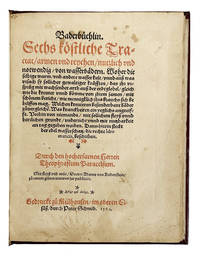
1562676901562. Franckfurt am Mayn bey Weygand Han und Georg Raben 1562. 4º. 3 Teile in 1 Band: Teil: 12 115 Bl.; Teil: 12 129 1 Bl.; Mühlhausen im oberen Elsaß durch Peter Schmid 1562. 4º. 32 Bl. Schweinsledereinband d.Zt. mit Schliessen. Paracelsus Theophrastus Philippus Aureolus Bombastus von Hohenheim. Erster - dritter Theil der grossen Wundartzney deß weitberhümpten bewerten vnd erfahrnen Theophrasti Paracelsi von Hohenheim der Leib vnd Wundartzney Doctoris. & Angebunden: Baderbüchlin. Sechs köstliche Tractat armen und reychen nutzlich und notwendig von wasserbädern . Mit fleyß und müe Doctor Adams von Bodenstein zu einem guten neuwen Jar publicirt. Die "Grosse Wundartzney" gehört zu den einflussreichsten chirurgischen Schriften der frühen Neuzeit und markiert einen Wendepunkt in der praktischen Wundbehandlung in der Ablehnung scholastischer Autoritäten und in der Hinwendung zu einer erfahrungsbasierten am Krankenbett gewonnenen Chirurgie. Der Frankfurter Druck von 1562 bietet in drei Teilen Paracelsus' Lehre von Wunden Schussverletzungen Brandwunden Knochenbrüchen Geschwülsten und anderen chirurgischen Erkrankungen dazu die ausführliche Abhandlung zur "Frantzosischen Kranckheit" Syphilis. Bei der vorliegenden Ausgabe handelt es sich um einen Nachdruck der zweibändigen "Grossen Wundartzney" nach der Augsburger Ausgabe von 1537. Den dritten Teil bildet die Schrift "Von der frantzosischen Kranckheit"; hierfür nutzten Weygand Han und Georg Raben den Nachdruck von 1553 als Vorlage und übernahmen Dessen Druckbogen aus dem Nachlass des Frankfurter Druckers Heinrich Gulfferich für einen Teil der Auflage sogar unverändert. Das angebundene "Baderbüchlin" in der Bearbeitung durch Adam von Bodenstein ist eine eigenständige sehr seltene Publikation über Wasser und Mineralbäder die Paracelsus' balneologische Vorstellungen popularisiert. In sechs "köstlichen Traktaten" richtet sich die Schrift ausdrücklich an "arme und reiche" um den Nutzen der Bäder für Prävention und Therapie verschiedenster Leiden darzulegen. Der Druck bei Peter Schmid in Mühlhausen im oberen Elsass ebenfalls 1562 steht in enger zeitlicher und inhaltlicher Nachbarschaft zur Wundartzney und ergänzt diese ideal um den Bereich der Badetherapie. Die Kombination von vollständiger Frankfurter Wundartzney alle drei Teile und dem zeitgleichen Mühlhauser Baderbüchlin in einem prachtvollen zeitgenössischen Schweinsledereinband mit Schnallen ist äußerst selten. VD16 P 458 Wundartzney; VD16 P 413 Baderbüchlin. Sudhoff Bibliographia Paracelsica Nr. 45 Baderbüchlin und Nr.49-51 Wundtarzney. Ferguson Bibliographia Paracelsica. Schubert Paracelsus Library Drexel Katalog Nr. 25. Fürberth Bäder-Bibliographie Nr. 37. unknown
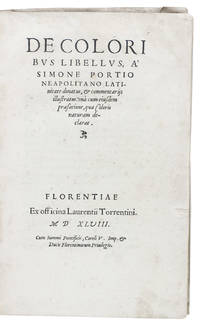
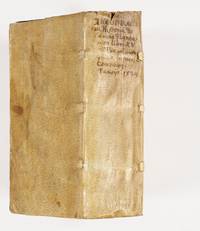
1548642CKI1RIA1QFlorence 1548. 4to. Lorenzo Torrentino Contemporary limp sheepskin parchment straight sewn on 3 wittawed thongs laced through the joints manuscript title down the spine with 4 fragments of a Latin manuscript in an upright humanistic hand on vellum used as spine lining. With 2 large woodcut historiated initials and a vine leaf ornament by Granjon Vervliet 178: 1st recorded in this year. Set in roman types with whole paragraphs in Greek 2 sizes and the dedication and some end matter in italic. 197 3 pp. First edition of one of the earliest printed books about colour translated from the Greek into Latin and with commentary by the Neapolitan physician and philosopher Simone Porzio 1497-1554. Usually attributed to Aristotle it is now thought to be the work of the peripatetic scholar and pupil of Aristotle Theophrastus.''As the author states at the end of the treatise it is intended rather to supply data for a detailed examination into the scientific theory of colour than to expound a complete thesis. He has realized that the development of colour in animals and plants depends to some extent on heat and he seems to suggest that heat and moisture are the controlling factors. It is of more value as a collection of observed facts than for any theory of the origin and development of colour in physical life'' Aristotle Minor Works Cambridge and London Loeb Classical Library 1936 p. 3.With some spotting on the title-page and some marginal tears not approaching the text but otherwise in very good condition and with large margins. Binding with the sewing supports broken a tear in the backstrip and some small stains. An important treatise on colour and one of the earliest.l Adams P1958; Caillet 8881; EDIT16 CNCE 16133; Hoffman I 289 "rare and very important"; Kemp The science of art p. 264; Schwab Bibliographie d'Aristotle 3503; USTC 803281. hardcover
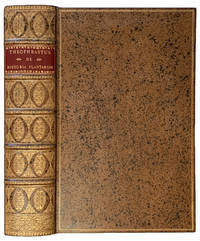
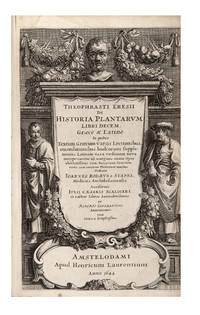
164450986Amsterdam Heinric Laurentius 1644. Folio. Contemporary full vellum with neat later 19th century rebacking. Six raised bands and gilt title to spine. Some wear to extremities. Internally a fresh and clean copy with only a bit of occasional brownspotting. Endpapers with a bit of soiling. 2 bookplates to inside of front board: Gilbert Redgrave London dated 1894 & Gorden M. Jones Virginia. Text in Greek and Latin. Woodcut title-page numerous woodcut intials throughout and more than 600 woodcut illustrations in the text. 20 1187 1 88 - Index pp. <br/><br/><em>First edition thus being the most important and influential edition of Theophrastus' seminal work "Enquiry into Plants" - the first systematization of the botanical world and the most important contribution to botanical science up until the Renaissance. Bodaeus von Stapel's groundbreaking edition constitutes the first illustrated edition of Theophrastus' masterpiece as well as the first with both Greek and Latin text. Furthermore von Stapel has not only collected all relevant commentaries and knowledge he has also added corrections and much foundational information turning the work into one of the most influential botanical works of the 17th century profoundly influencing the likes of Linnaeus and contributing significantly to the development of modern scientific botany. "This edition displays great care and research; the notes are numerous and learned and all botanical information to be gleaned from Aristotle Pliny Dioscorides and other ancient writers seems to be embodied in this work. The Greek text is Heinsius's; the Latin version is that of the editor who has placed Gaza's in the margin with frequent corrections. The conjectures of Scaliger Constantine and Salmasius are also incorporated. it has collected into one body the opinions of the old writers on the subject of the PLANTS. It contains some wood-cuts of the rarer species which are much better uncoloured than coloured." Dibdin II:498. The numerous woodcut plant illustrations were partly copied from other sources and partly made especially for this edition. Thus apart from being "one of the best and most thoughtfully prepared of all the editions of Theophrastos" Hunt our editor has also made original contributions that are of great importance. "It is interesting not only because of the brilliance of the editing but curiously enough to the American botanist as well for involving in the discussion certain species from Virginia other parts of the New World and Asia. The illustrations of these plants have been largely overlooked in botanical history because of their incidental presence in a work which might not be expected to contain anything of the sort. Some were merely borrowed from l'Ecluse or de Lobel but others seem original in this work" H.H. Bartlett: Fifty-five Rare Books - quoted by Hunt.At the height of the Renaissance with the expansion of the known world and the spreading of the book due to the invention of the printing press many new publications on plants appeared. Most of these publications however were primarily concerned with the medicinal qualities of individual plants and only few authors or editors took an interest in the general nature of the plants and how they could systematically be classified. One of the few exceptions was Bodaeus von Stapel. With his seminal 1644 edition of "Historia Plantarum" he focused on the overarching classification system of plants and took Theophrastus' work a step further adding essential commentaries and illustrations - illustrations that were to be copied for centuries after. These illustrations remain the standard illustrations of Theophrastus' foundational work. This edition of Theophrastus' "Historia Plantarum" became the standard edition of that earliest work on systematic botany and the edition that all serious scientific botanists of the 17th and 18th centuries will have studied. "Linnaeus in the practice of his favourite art of systematizing classified not only plants but the writers about them. The writers he distinguishes primarily as Botanists and Plant Lovers recognizing as Botanists only such as treat of plants from some philosophic or scientific point of view. Choosing his illustrations from annals of remote antiquity he names among the earliest of the Greeks who wrote of plants Hippocrates; but because he wrote of plants only in the interests of medicine Linnaeus styles him Father of Medicine. Similarly Aristotle. is down in the Linnaean list of ancient celebrities as Prince of Philosophers. To Theophrastus however he accords the title Father of Botany. From this opinion far from having been newly promulgated in Linnaeus's time there has been no dissenting voice. On the contrary Albert Haller one of the most learned men in Europe in his day and a botanist of such renown that Linnaeus held him in reverence and also in some fear denominates Theophrastus "the first of real botanists in point of time." Kurt Sprengel in the nineteenth century having rehearsed the names of a long line of ancient authors who had written more or less concerning plants says: "But the most illustrious of them all and the true father of botany was Theophrastus Eresius…." Greene Landmarks of Botanical History I:128.It is no wonder that Linnaeus should find in Theophrastus the Father of his own field - The "Historia Plantarum" was not only the earliest work on systematic botany it also contained Theophrastus' description of the formation of the plant seed the earliest account known and the best that was made for 2000 years.Hunt: 240; Pritzel: 9197; BM: V:2091; Dibdin: II:498. </em> hardcover
1644M14453Amstelodami: apud Henricum Laurentium 1644. 1644. Folio in 6s. 20 418 417-694 495-529 730-994 997-1187 1 88 pp. Numerous mispaginations noted. With the magnificent engraved title and 600-700 decorative botanical woodcuts. Text in 2 columns index not paginated parallel texts in Greek and Latin. Bound recently in full antique-style speckled calf richly gilt-tooled in a masterfully elegant binding; some neat paper mends to gutter front & back leaves some leaves variously stained at edges in the rear pages 950-988 browned. New endleaves. The splendid Bodaeus van Stapel edition of Theophrastus' seminal work Enquiry into Plants beautifully illustrated with hundreds of fine woodcuts of all the known plants. This is the first edition by edited by Johannes Bodaeus van Stapel 1602-1636 who died prior to the book being issued. This edition of Bodaeus van Stapel is the most important and influential edition of Theophrastus. The book is the first comprehensive systematization all known plants and as such important in the history of plant science. Plants of the new world America Asia and Africa are included. / The editor Bodaeus van Stapel is known for this particular work the Latin version of Theophrastus' Historia plantarum the text completed before his death in 1636 and published posthumously in Amsterdam in 1644 by his father. / Thomas Frognall Dibdin wrote of this edition: "This edition displays great care and research; the notes are numerous and learned and all botanical information to be gleaned from Aristotle Pliny Dioscorides and other ancient writers seems to be embodied in this work. The conjectures of Scaliger Constantine and Salmasius and also incorporated; and although Haller has censured Bodaeus for occasionally wandering from his subject and introducing a few errors the present this edition of 1644 is nevertheless an edition well deserving of the curious botanist's attention: for it has collected into one body the opinions of the old writers on the subject of plants. It contains some wood-cuts of the rarer species which are much better uncoloured than coloured." - Thomas Frognall Dibdin An Introduction to The Knowledge of Rare and Valuable Editions of the Greek and Latin Classics . . . London 1808 vol. II p. 285. / This edition of Theophrastis is "one of the best and most thoughtfully prepared of all the editions of Theophrastis" - Hunt. / "It is interesting not only because of the brilliance of the editing but curiously enough to the American botanist as well for involving in the discussion certain species from Virginia other parts of the New World and Asia. The illustrations of these plants have been largely overlooked in botanical history because of their incidental presence in a work which might not be expected to contain anything of the sort. Some were merely borrowed from l'Ecluse or de Lobel but others seem original in this work." - Harley Harris Bartlett Fifty-five Rare Books for the botanical library of Mrs. Roy Arthur Hunt. Clements Library 1949. / SEE: Theophrastus. Enquiry into Plants. With an English translation by Arthur Hort. Cambridge: Harvard University Press 1916. / McDiarmid J. B. 'Theophrastus.' In: Dictionary of Scientific Biography edited by Charles Coulston Gillispie. New York 1976. Vol XIII pp. 328-334. / Morton Alan G. History of Botanical Science. London and New York 1981. / Negbi Moshe. 'The scientific cradle of botany - Theophrastus and other pioneers.' In: Israel Journal of Plant Sciences vol 58 pp. 309-18. 2010. / Sharples Robert W. Theophrastus of Eresus. Sources for this Life Writings Thought and Influence. Commentary Vol. 5. Sources on Botany. Leiden: Brill 1995. apud Henricum Laurentium, 1644. unknown
7301Finely engraved title-page a trifle shaved at outer edge & 675 woodcuts in the text. 11 p.l. incl. engr. title 1187 i.e. 1185 87 pp. Folio cont. Dutch vellum over boards upper joint with small split of 7 cm. at foot minor pale dampstaining to first 20 leaves & last third of book panelled in blind central arabesque in blind to each cover ties gone. Amsterdam: H. Laurentius 1644.<br/> <br/> First edition to be edited by Joannes Bodaeus à Stapel; it “is one of the best and most thoughtfully prepared of all the editions of Theophrastos.â€â€“Hunt 240.<br/> <br/> H.H. Bartlett wrote in his Fifty-five Rare Books Ann Arbor: 1949 of this edition: “It is interesting not only because of the brilliance of the editing but curiously enough to the American botanist as well for involving in the discussion certain species from Virginia other parts of the New World and Asia. The illustrations of these plants have been largely overlooked in botanical history because of their incidental presence in a work which might not be expected to contain anything of the sort. Some were merely borrowed from l’Escluse or de Lobel but others seem to be original in this work.â€<br/> <br/> A fine and crisp copy. Bookplate of Piergiorgio Borio M.D.<br/> <br/> â§ D.S.B. XIII pp. 328-34. See Garrison-Morton 1783. unknown
1573622841573. Argentorati = Basel Petrus Perna 1573 2° 12 223 1 28; 2 250 36 pp.; 2 263 5 pp Ledereinband d.Zeit mit Rückenvergoldung; vereinzelt fleckig feines Expl. Erste Ausgabe! PHILIPPI AVREOLI THEOPHRASTI PARACELSI BOMBAST EREMITAE SVMMI INter Germanos Medici & Philosophi. CHIRVRGIA MAGNA in duos tomos digesta. . Nunc recens à IOSQVINO DALHEMIO OSTOFRANCO Medico Latinitate donata. Tomus I : De vulneribus et fracturis libri III. De ulceribus libri III. De tumoribus et aperturis libri III. Tomus II : De Tumoribus Pustulis & Ulceribus / Morbi Gallici Lib. X. De Curatione & Imposturis Morbi / Gallici Lib. Octo. & Aureoli Philippi THEOP. PARACELSI CHYRVRGIA MINOR QVAM ALIAS BERTHEONEAM INTITVLAVIT. CVI ETIAM SEQVENTES TRACTAtus accesserunt eiusdem authoris. De Apostematibus Syronibus & Nodis. De cutis apertionibus. De vulnerum & ulcerum curis. De Vermibus Serpentibus 6c. ac amculis à natiuitrate ortis. Dieser Band enthält die "Chirurgia magna" in zwei Tomi in lateinischer Übersetzung von Josquinus Dalhemius tätig 2. H. 16. Jh. humanistischer Übersetzer paracelsischer Schriften sowie die kürzere "Chirurgia minor" "Bertheonea" in der lateinischen Fassung des flämischen Arztes Alchemisten und Paracelsisten Gerhardus Dorn ca. 1530-ca. 1584. - Gedruckt von dem aus Lucca stammenden seit den 1540er-Jahren in Basel tätigen Humanisten- und Reformationsverleger Petrus Perna ca. 1519-1582. Die Chirurgia magna ist das zentrale chirurgische Werk Paracelsus' und dokumentiert seine praktische Wundarznei ebenso wie seine Reinterpretation traditioneller Krankheitslehren. In ihr treten seine Abkehr von der bloßen Galen Exegese sein empirisches Vorgehen am Krankenbett und sein Einsatz chemischer Präparate deutlich hervor; sie ist für das Verständnis der paracelsischen "Reformation der Medizin" unverzichtbar. Paracelsus betont systematisch die Bedeutung gründlicher Wundreinigung Drainage und Verhinderung von Fäulnis; die "gute Eiterung" der traditionellen Chirurgie wird kritisch relativiert und der Fokus stärker auf rasche "spezifische" Heilung gerichtet. Er beschreibt Trauma Frakturen Ulzera und Tumoren in enger Verbindung mit Umwelt und Stoffeinflüssen; damit wird die spätere Toxikologie vorbereitet Stichwort "Die Dosis macht das Gift" und eine spezifische substanzgebundene Krankheitsauffassung gefördert. Von besonderem Interesse auch für die frühe Geschichte der Neurochirurgie: Paracelsus behandelt in der Chirurgia magna Kopf- und Schädelverletzungen inkl. Indikationen zur Trepanation im Rahmen einer empirisch orientierten Wundchirurgie und verknüpft traumabedingte Lähmungen und Krampfzustände mit lokalen Strukturverletzungen statt ausschließlich mit humoral-systemischen Ursachen. Die Chirurgia minor ist der Teil des paracelsischen chirurgischen Werkes der am ehesten dem späteren Feld der Dermato-chirurgie und der frühen plastisch-rekonstruktiven Bemühungen entspricht - durch ihren Fokus auf Haut Weichteile Wunden Verbrennungen und Narbenführung immer vor dem Hintergrund von Paracelsus' chymischer Pathologie und spezifischer Arzneitherapie. Die Perna-Ausgabe von 1573 ist die erste große lateinische Gesamtausgabe der paracelsischen Chirurgie: Sie überführt die ursprünglich deutschsprachigen Wundarznei-Schriften Große und Kleine Chirurgie in ein gelehrtes europaweit rezipierbares Format und ist damit ein Schlüsselstück der frühen Paracelsus-Rezeption. Chirurgiegeschichtlich markiert der Band den Übergang von handwerklich-zunftgebundener Wundbehandlung zu einer spezifischen substanzgebundenen Therapieauffassung Toxikologie organspezifische Wirkungen Kritik an der "guten Eiterung" und ist für die Geschichte der Chirurgie wie der Pharmakologie gleichermaßen bedeutend. First major Latin edition of Paracelsus' surgical works containing the two tomes of the "Chirurgia magna" and the shorter "Chirurgia minor" in one folio volume. Translated into Latin by Josquinus Dalhemius and Gerard Dorn and printed by the Basel humanist printer Petrus Perna in 1573. Covers wounds fractures ulcers tumours and related conditions combining practical wound surgery with Paracelsus' innovative chymical pathology. Key document in the spread of Paracelsian medicine from German vernacular surgery into the international learned medical world. VD16 P 469; VD16 P 479 Sudhoff "Bibliographia Paracelsica" Nr. 146-148 unknown
15646012<p>8vo. 112 ff pages 2 and 110-112 are blank. Bound in modern paneled calf with gilt-stamped fleurons on front and back covers raised bands. Generally good.<br /></p><p>The first edition of this plague treatise by Paracelsus Theophrastus Bombastus von Hohenheim 1493-1541 the "Luther of Medicine" and one of the key figures in the history of medicine. Written originally in Nördlingen in 1529-1530 it remained unpublished during Paracelsus' lifetime and subsequently taken up and edited for publication by the Paracelsian scholar Adam von Bodenstein 1528-1577. The latter dedicated it to Johann Rudolph Stör von Störenberg Abbot of Murbach and Luders. In addition to the study on pestilence the text includes two short works by Paracelsus: "Vom Preservatiff durch den Schwebel" and "Von der Mummia."</p><p>In the primary tract Paracelsus for the first time presents his complex theory on the origins of the plague which he believed were the result of astrological and corporeal events set in motion by human sins. "This anthropocentric view of an individual disease is in harmony with Paracelsus' whole philosophy and indeed with Renaissance philosophy in general" Pagel p. 179. Paracelsus also postulates the importance of the principle of sulphur the corresponding agent of the planet Mars in pestilence's causation. He believed that sulphur hidden in three minerals—antimony arsenic and marcasite—affected three corresponding organs: the groin the axillae and the ears.</p><p>The chapters on causation are followed by sections on remedies. The doctor must cure the agent causing the disease rather than the symptoms of the disease Paracelsus writes. Humoral pathology and its insistence on diet is of no use. "Paracelsus' plague remedies include sulphur spirit of vitriol sulphur sublimate and metals also—for external treatment of boils—toads and decoctions of beetles designed to remove the evil of magnetic attraction but herbs and drugs as prescribed by Ficino and Agrippa are greatly amplified and still appear in a prominent place" Pagel pp. 180-181 n. 151.</p><p>The editor of this volume Adam von Bodenstein was one of the key figures in the revival of Paracelsian ideas in the German lands in the middle of the sixteenth century. A son of a radical reformer he believed in transmutation of metals into gold and played a key role in the publication of over 80 works by Paracelsus. For his Paracelsianism he was excluded from the faculty and council of Basel University.</p><p>OCLC records US copies at NYAM NLM Wash. U and UMn.</p><p>Karl Sudhoff <i>Bibliographia Paracelsica</i> Berlin 1894 60; Walter Pagel <i>Paracelsus: An Introduction to Philosophical Medicine in the Era of the Renaissance</i> Boston 1982 2nd revised edition; Georgiana D. Hedesan "Alchemy Potency Imagination Paracelsus's Theories of Poison" in John Arrizabalaga Ole Peter Grell Andrew Cunningham eds. <i>It All Depends on the Dose: Poisons and Medicines in European History. The History of Medicine in Context Series</i> New York 2018 pp. 81-102; Peter J. Forshaw "'Paradoxes Absurdities and Madness:' Conflict over Alchemy Magic and Medicine in the Works of Andreas Libavius and Heinrich Khunrath" <i>Early Science and Medicine</i> vol. 13 no. 1 2008 pp. 53-81.</p> Paul Messerschmidt hardcover
155211254Paris: Adrien Turnebe. Very Good with no dust jacket. 1552. First Edition. Vellum. 6 blanks 24; 4 25 3 6 blanks pp. A small quarto 8" x 5". Full vellum with very neatly handwritten title in brown ink on the spine. Covers have normal minor wear. The paper used for theend papers and blanks is a close match to the text paper but with slightly wider chain lines. The first book is in Greek; the second de igne Lib. Eiusdem in Eundem Adnotatiunculae with the date of 1553 and is the Latin translation. Except for a very slight bit of toning and very occasional foxing the paper is clean strong and unmarked. Inside front cover has the bookplate of Thomas Gaisford 1779-1855 Dean of Christ Church curator of the Bodleian and delegate of the Oxford University Press. The first separate edition of Theophrastus's treatise on fire beautifully printed by Turnebe a specialist in Greek textual criticism and Director of the Royal Press. Theophrastus studied under Plato and was Aristotle's successor at the Peripatetic school. He was interested in philosophy especially in how it related to the natural world and his works on botany are famous. Here he looks at fire and tackles the idea of it as a "simple body" or first principle and seems to come to the conclusion -- contra Aristotle -- that fire cannot be an "element" because it relies on other principles for its existence. An important landmark of classical scholarship and printing in the first separate edition -- in both Greek and Latin -- nicely printed and in very good condition with lovely provenance. OCLC 645152760 ; 4to 11" - 13" tall . Adrien Turnebe hardcover
1603197541603. Strassburg Lazarus Zetzner 1603 Folio 12 1127 52; 8 691 32 pp.; Tit. rot/schwarz allegor. Titelbordüre mit Portr. 62 Holzschnitten Pergamenteinband d.Zt.; Papier bedingt gebräunt; sehr gutes Expl. Erste Straßburger Folio-Edition selten wie alle Erstausgaben in deutscher Sprache! Aureoli Philippi Theophrasti Bombasts von Hohenheim Paracelsi . Opera : Bücher und Schrifften/ so viel deren zur Handt gebracht: und vor wenig Jahren/ mit und auß ihren . Originalien collacioniert/ vergliechen/ verbessert / und durch Joannem Huserum Brisgoium in zehen unterschiedliche Theil/ in Truck gegeben jetzund aber von newem in ein Corpus zusammen gebracht gebessert und mit Registern versehen. Argentorati Typis Lazari Zetzneri Anno 1603. Der erster Theil enthält u.a. die grundlegenden medizinisch-theoretischen und naturkundlich-iatrochemischen Schriften: Paramirum Lehre von den fünf Entien der Krankheiten Paragranum Programmschrift zur Reform der Medizin De morbis invisibilibus von den unsichtbaren Krankheitsursachen das Buch von der Gebärung die sogenannten Kärntner Schriften Labyrinthus medicorum errantium Defensiones Chronica Kärnten die Traktate Vom Tartaro / De morbis ex Tartaro die Abhandlung De morbis amentium über Geisteskrankheiten die berühmten Bergkrankheiten drei Bücher De morbis fossorum metallicorum den Kommentar zu den Aphorismen des Hippokrates sowie zentrale iatrochemische Hauptwerke: die Archidoxis erster Teil De natura rerum neun Bücher De praeparationibus und De tinctura physicorum. Der zweite Teil bildet die Fortsetzung und ergänzt den ersten Teil durch die chirurgischen medizinisch-praktischen sowie magisch-astrologischen Schriften. - Enthält u.a. die Große Wundarznei Chirurgia magna und die Kleine Wundarznei Chirurgia minor mit weiteren Chirurgischen Büchern und Schrifften u.a. zu Brüchen Geschwülsten Ulcera Verbrennungen und Harn-/Geschlechtsleiden den Traktat De vita longa über die Lebensverlängerung zusätzliche Pest- und Seuchenschriften De pestilitate sowie die für den Paracelsismus charakteristischen Schriften zur Magia und occulta philosophia zur Geister- Engel- und Dämonenlehre Imagination Besessenheit Exorzismus und zur Astrologia medica Einfluss der Gestirne auf Körper Temperament und Krankheiten daneben mehrere kürzere medizinisch-praktische Traktate als Ergänzung zu den Hauptwerken. "Die Ausgabe beruht vollständig auf der von Johann Huser 1589-1591 in Basel hrsg. Quart - Gesamtausgabe der deutschen Werke des Paracelsus; Zetzner übernimmt deren Textgestalt und Anordnung der Schriften nahezu unverändert im Folioformat." First folio edition in German of the collected works of Paracelsus based on Johann Huser's Basel quarto edition 1589-1591. Paracelsus helped transform medicine by fusing close observation chemistry and theology into a new experience-based healing art. He became one of the most influential and provocative medical thinkers of the sixteenth century. Garrison & Morton No. 3805: "De generatione stultorum" 2: pp.174-182: "Paracelsus was the first to note the coincidence of cretinism and endemic goitre". VD17 12:168467C; VD17 12:168390P; Osler 526; Sudhoff Paracelsus 256 & 257 unknown
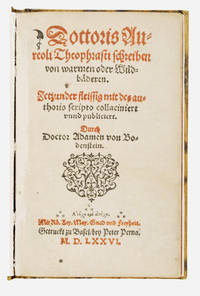
352612<p>Schreiben von warmen oder Wildbäderen. Jetzunder fleissig mit des authoris scripto collacioniert vnnd publiciert Durch Doctor Adamen von Bodenstein. 8° 163x103 mm. 94 pp. title printed in black and red. Modern boards. Slight dampstaining. Basel Peter Perna 1576.</p><p>Rare first edition of a collection of Paracelsus' balneological treatises compiled by the spagyricist and private physician to the Elector Palatine Adam von Bodenstein 1528-1577. It contains the six treatises of the Baderbuchlin of 1562 as well as the famous description of the spa at Pfäfers Von des Bads Pfeffers im Grawen Bundt tugenden; pp. 65-91. The latter was first printed in 1535 by Froschauer in Zurich and then by Christian Muller in Strasbourg in 1571; both editions are very rare and only three copies of the first printing are known to us ZB Zurich BSB Munich and Augsburg City Library. Paracelsus' treatises are among the earliest works on hydrotherapeutics and include treatments for gout women's diseases lameness leprosy etc. The spas described are: Baden in Aargau Pfäfers Leukerbad Bad Gastein Teplitz Plombieres Göppingen etc. - Bodenstein's postface is dated "Bartholomey 1576" i.e. 24 August.</p><p>References: Fürberth Bäder-Bibliographie n° 13.4; cf. Hieronymus Theophrast und Galen - Celsus und Paracelsus I 2005 n° 192; Perini La vita e i tempi di Pietro Perna 2002 278; Sudhoff 172; VD 16 P-418; Durling 3505; STC German 137; Reber 29; Kühlmann/Telle Der Frühparacelsismus 2001 I 534f.and n° 30. - Not in Waller und Wellcome.</p> Basel, Peter Perna, 1576
153429859Colophon: Basel apud Andream Cratandrum 1534. Folio. Nice hcalf from ab. 1750 richly gilt back gilt title-label. Corners a bit bumped. Slightly rubbed. Woodcut printer's device to title and last leaf. 282642 pp. With many smaller and larger woodcut initials. Small stamp at lower corner of the first 2 leaves. Some rather faint dampstainings to first and last leaves otherwise clean and with broad margins. Engraved book-plate inside front board Bibliotheque du comte Le Moyne de Martigny. <br/><br/><em>Very scarce edition of Theophrastus' two main works. It is one of the earliest Latin editions of Gaza's esteemed translation in reality it is the third printing of the first Latin edition first issued 1483 then 1529 in 8vo and now 1534 of the works which together constitute the foundation of scientific botany. By Linnaeus Theophrastus is called "the father of Botany". This edition comprises both botanical works The History of Plants and The Causes of Plants which have survived in their entirety and are the earliest books of this kind in world literature."It is very strange that so much botanic knowledge should have been accumulated by the end of the fourth century and that so little if anything was added to it in ancient times. Theophrastos is not only the first botanic writer but also the greatest until Renaissance of the sixteenth century in Germany.The botany of Theophrastos and the zoölogy of Aristotle represents the climax of natural history in antiquity." Sarton in A History.Vol. I p. 558. "No study of plants of such breadth and quality had previously been conceived: botany now first appears as a distinct science with a comprehensive yet clearly defined field of enquiry." A.G. Morton. - Stillwell No. 702 Note - Hunt No. 26 listing the 1529-edition in 8vo - Pritzel: 9189. - Not in Choulant Handbuch der Bücherkunde für die Ältere Medicin. </em> unknown
1557ST16215jGeneva: Ex Officina Henrici Stephani 1557. 172 x 105 mm. 6 3/4 x 4 1/8". 4 p.l. 17-168 i.e. 152 pp. mispaginated but complete. Edited by Henri Estienne. <br/> Simple but appealing 18th century tan calf covers with triple gilt fillet border smooth spine divided into panels by plain and dotted gilt rules gilt starburst centerpiece gilt titling marbled endpapers. Printer's device on title page. Renouard 116:3; Schreiber 142; Dibdin II 500; Hoffmann I 287-88; Hoffmann III 524; USTC 450450. ◆Joints and extremities lightly rubbed minor offsetting from turn-ins to endpapers and flyleaves leaves with a touch of browning to head edge isolated small marginal spots or minor smudges but still an extremely pleasing copy clean and fresh internally in a well-preserved binding.<br/> <br/> Rarely seen in the marketplace this collection of Greek texts printed in the exquisite Estienne "grecs du roi" type includes four parts: the 23 "Characters" of Theophrastus along with that author's essay on the senses and perception; the pseudo-Aristotle "De Mirabilibus Auscultationibus" "On Marvellous Things Heard"; and an essay on springs rivers and pools by the first century A.D. Greek philosopher Sotion. In "Characters" Theophrastus ca. 371 - ca. 287 B.C. delineates such human foibles as gossiping grumbling and boasting while the text once attributed to Aristotle is a series of anecdotes about inexplicable phenomena in the natural world a genre of classical literature known as paradoxography. The classical texts are followed by the critical notes of Henri Estienne 1528 or 1531-91 who rivaled Aldus Manutius in combining publishing with scholarship. In discussing this work Dibdin says "whatever H. Stephen did is worth consulting." Henri also contributed to the typography used here the smallest size of the "grecs du roi" cut for his father Robert by Claude Garamond--it is based on the Greek script written by the precocious Henri when he was 10 years old. Ex Officina Henrici Stephani unknown
159250012Lyon Franciscus le Preux 1592. Small 8o. Early 19th century half calf with gilt title-label to spine. A bit of wear to hinges and corners but fine and tight. Internally exceptionally nice and clean. P. Rubow's owner's signature to front free end-paper. Woodcut vignettes to title-pages and woodcut initials at beginning of both parts. 8 88; 270 pp 1 blank leaf 16 ff. of indexes and errata at end. <br/><br/><em>Scarce first edition thus being the editio princeps of Casaubon's milestone-edition of the seminal work that is Theophrastus' "Characters" containing apart from the original Greek text and Casaubon's translation of it into Latin also Casaubon's highly important commentary of the text. "This edition which was frequently reprinted 1598-1612-1617-1638 &c. is in every respect worthy of the high reputation of Casaubon. Both the text and the notes have served almost every subsequent editor. The Commentary is a rich mine of Grecian literature. The editor availed himself of the use of four MSS. in the Palatine library". Dibdin.Theophrastus ca. 371- ca. 287 BC Aristotle's successor at the Lyceum and probably the most famous Aristotelian of all times successfully presided over the Peripatetic School for 36 years and here wrote a number of works. The most famous of them is arguably his great moral opus "The Characters" which continues to amaze readers to this day. It introduced the "character sketch" which became the core of the Character as a genre and as such influenced the entire literary tradition of the Western world. The fabulous very witty astute harsh and insightful characteristics of type characters of the human race have been formative for our understanding of moral virtues and vices and for how man expresses them for our understanding of human nature in general. It is no wonder that the work became so popular and widely read during the Renaissance the era of man as the centre of the universe. The French-English classical scholar and philologist Isaac Casaubon 1559 - 1614 was regarded by many of his time as the most learned man in Europe. He is famous for his magnificent commentaries and deep understanding of the texts that he edited translated and commented. His edition of Theophrastus's Characters is considered a work of breakthrough as it constitutes the first example of his peculiar style of illustrative commentary at once apposite and profuse. This work is generally considered to exhibit his most characteristic excellences as a commentator.The present edition came to exercise a profound influence upon the interpretation of Theophrastus' great work. Casaubon's commentary served as the standard commentary for centuries and his translation remains a standard translation of the text. The present work thus remains a primary reference and a primary source when reading the work today.The commentary provided much commentary on Athenian society and the translation popularized the text making it available to modern Renaissance readers. Due to the excellent manner of translation into Latin the first English and French translations of this foundational text were enabled.The work was reprinted numerous times and kept appearing for centuries. "Nouvelle revision du texte sur 4 mss. Palatins accompagnée d'une nouvelle trad. latine et d'un commentaire excellent." Graesse VII:125. Dibdin II:501. </em> unknown
1573622821573. Argentorati = Basel Petrus Perna 1573 Folio 10 223 1 28; 2 250 36 pp. alter Halbledereinband; Titelblatt aufgelegt etwas fleckig; mit alten Marginalien; feines Expl. mit ExLibris von Kenneth Harvey Abbott. Erste Ausgabe! PHILIPPI AVREOLI THEOPHRASTI PARACELSI BOMBAST EREMITAE SVMMI INter Germanos Medici & Philosophi. CHIRVRGIA MAGNA in duos tomos digesta. . Nunc recens à IOSQVINO DALHEMIO OSTOFRANCO Medico Latinitate donata. Tomus I : De vulneribus et fracturis libri III. De ulceribus libri III. De tumoribus et aperturis libri III. Tomus II : De Tumoribus Pustulis & Ulceribus / Morbi Gallici Lib. X. De Curatione & Imposturis Morbi / Gallici Lib. Octo. Dieser Band enthält die "Chirurgia magna" in zwei Tomi in lateinischer Übersetzung von Josquinus Dalhemius tätig 2. H. 16. Jh. humanistischer Übersetzer paracelsischer Schriften. - Gedruckt von dem aus Lucca stammenden seit den 1540er-Jahren in Basel tätigen Humanisten- und Reformationsverleger Petrus Perna ca. 1519-1582. Die Chirurgia magna ist das zentrale chirurgische Werk Paracelsus' und dokumentiert seine praktische Wundarznei ebenso wie seine Reinterpretation traditioneller Krankheitslehren. In ihr treten seine Abkehr von der bloßen Galen Exegese sein empirisches Vorgehen am Krankenbett und sein Einsatz chemischer Präparate deutlich hervor; sie ist für das Verständnis der paracelsischen "Reformation der Medizin" unverzichtbar. Paracelsus betont systematisch die Bedeutung gründlicher Wundreinigung Drainage und Verhinderung von Fäulnis; die "gute Eiterung" der traditionellen Chirurgie wird kritisch relativiert und der Fokus stärker auf rasche "spezifische" Heilung gerichtet. Er beschreibt Trauma Frakturen Ulzera und Tumoren in enger Verbindung mit Umwelt und Stoffeinflüssen; damit wird die spätere Toxikologie vorbereitet Stichwort "Die Dosis macht das Gift" und eine spezifische substanzgebundene Krankheitsauffassung gefördert. Von besonderem Interesse auch für die frühe Geschichte der Neurochirurgie: Paracelsus behandelt in der Chirurgia magna Kopf- und Schädelverletzungen inkl. Indikationen zur Trepanation im Rahmen einer empirisch orientierten Wundchirurgie und verknüpft traumabedingte Lähmungen und Krampfzustände mit lokalen Strukturverletzungen statt ausschließlich mit humoral-systemischen Ursachen. Die Perna-Ausgabe von 1573 ist die erste große lateinische Gesamtausgabe der paracelsischen Chirurgie: Sie überführt die ursprünglich deutschsprachigen Wundarznei-Schriften Große und Kleine Chirurgie in ein gelehrtes europaweit rezipierbares Format und ist damit ein Schlüsselstück der frühen Paracelsus-Rezeption. Chirurgiegeschichtlich markiert der Band den Übergang von handwerklich-zunftgebundener Wundbehandlung zu einer spezifischen substanzgebundenen Therapieauffassung Toxikologie organspezifische Wirkungen Kritik an der "guten Eiterung" und ist für die Geschichte der Chirurgie wie der Pharmakologie gleichermaßen bedeutend. First major Latin edition of Paracelsus' surgical works containing the two tomes of the "Chirurgia magna" in one folio volume. Translated into Latin by Josquinus Dalhemius and printed by the Basel humanist printer Petrus Perna in 1573. Covers wounds fractures ulcers tumours and related conditions combining practical wound surgery with Paracelsus' innovative chymical pathology. Key document in the spread of Paracelsian medicine from German vernacular surgery into the international learned medical world. VD16 P 469 Sudhoff "Bibliographia Paracelsica" Nr. 146-147 unknown
1529613371529. Vænit Parisiis apud Egidium Gourmoncium Wechel 1529 kl.-8° 16 14 2 343 22 3 pp.; 18 354 24 pp. alter Pergamenteinband; teilweise im oberen Rand zarter Wasserrand; trotz der Mängel ein feines Exemplar. Theophrasti de historia et causis plantarum libri quindecim. Theodoro Gaza interprete. Ejusdem Tabulas duas capita librorum complectentes : quarum unam libris de historia alteram de causis plantarum unàcum vocabulis quibusdam græcorum & latinorum nominum præfixas invenies lector. Theodoro Gaza interprete. & Second and last part: "Theophrasti de causis plantarum libri VI. Theodoro Gaza interprete. Luteciæ ex officina Christiani Wechel. 1529" Very Rare second single edition first published in Tarvisii 1483 and together with Aristotel. Hist. anim. Ventia 1504. "Copies of the complete 1529 edition seem to be quite rare as we have found only three others listed above." Hunt catalogue 1:34-35 entry 26. "This is the earliest work of scientific botany a subject not addressed in any of the writings of Aristotle." Theophrastus "system of botanical classification analogous to the zoological system in Aristotle's Historia animalium maintained its authority until the advent of the microscope in the mid 17th century." Garrison & Morton Theophrastus of Eresos c.370-287 bce "one of Aristotle's greatest students built upon Diodes' work and founded the field of biology known as botany. In his works 'On the Natural History of Plants' and 'On the Origins of Plants' Theophrastus identified and classified over 500 species of plants and explained their medicinal properties. He succeeded Aristotle at the Lyceum and taught there for nearly 35 years. He has often been called "the father of botany" and perhaps deserves the title "the father of pharmacognosy" as well. Remarkably Theophrastus pioneered the concept of drug tolerance observing that the power of a drug taken over a long period diminishes in people who become accustomed to taking them." Bob Zebroski A Brief History of Pharmacy: Humanity's Search for Wellness 2016 Uebersetzung des Theodorus Gaza c.1398-c.1475 "kritisch und wichtig" und hier zum ersten Mal "mit brauchbarem Index der griechischen und lateinischen Namen." Choulant pp.58-59 Garrison & Morton No.81.1 1783 1st. Ed.1483 unknown
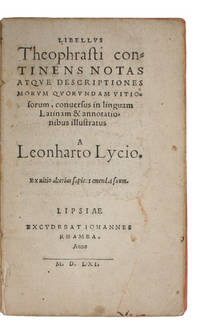
156128328Lipsiae Excudebat Iohannes Rhamba 1561. Small 8vo. Later blue boards ab. 1800. Spine with minor loss and a few cracks. First few leaves with minor soiling but otherwise a nice and clean copy. 19th century owner's inscription to inside of front cover: "Colegii Thomani". Lovely woodcut opening initial. Beautiful Greek script. 48 ff. <br/><br/><em>Extremely scarce first edition thus containing all of Theophrastus' 23 characters in Greek and Latin being the first edition of Auberius' excellent Latin translation and first edition with Lycio's interesting commentaries. "This very rare edition which presents us with the Greek text of H. Stephan Stephanus contains a new Latin version by Claudius Auberius who was scarcely twenty years of age when he composed it. The notes are critical and historical; sometimes bold but always erudite. This version and these notes were republished in Zuinger's edition of Aristotle's "Ethics" at Basil. fol. 1582." Dibdin II:500. This version of Theophrastus' milestone work the first recorded attempt at systematic character writing became hugely influential and is still referred to in modern editions of the text as Auberius' translation is regarded as one of the best and most important interpretations of the text. Claude Aubery or Claudius Auberius ca. 1540-1596 was a noted philosopher and medical doctor professor of Philosophy in Lausanne. He translated several Greek texts into Latin but is best remembered for his excellent version of Theophrastus' "Characters" which was highly influential throughout the Renaissance and which was incorporated into later Renaissance Aristotle-editions as the standard-version of Theophrastus' text. Theophrastus ca. 371- ca. 287 BC Aristotle's successor at the Lyceum and probably the most famous Aristotelian of all times successfully presided over the Peripatetic School for 36 years and here wrote a number of works. The most famous of them is arguably his great moral opus "The Characters" which continues to amaze readers to this day. It introduced the "character sketch" which became the core of the Character as a genre and as such it influenced the entire literay tradition of the Western world. The fabulous very witty astute harsh and insightful characteristics of type characters of the human race have been formative for our understanding of moral virtues and vices and how they come to be expressed in man for our understanding of human nature in general. It is no wonder that the work became so popular and widely read during the Renaissance the era of man as the centre of the universe. "Le texte est le celui de Henri Estienne insére dans l'édition d'Aristote de 1557 mais dans la version il suit pour la plupart ses propres conjectures" Graesse 7: 125. Dibdin II:500 Graesse VII:125. </em> hardcover
178635101Parmae Ex Regio Typographeo 1786. 4to. Orig. blank boards. Spine missing. Bdg. and bookblock tight. Minor occasional soiling; lacking a small part of corners of some leaves far from affecting text. An overall good and solid copy. Engr. frontispiece-portrait engr. title-vignette. Printed on good and thick paper. 10 128 6 pp 1 leaf errata. <br/><br/><em>The rare editio princeps of Theophrastus' 29th and 30th characters. Greek and Latin text.The work is renowned not only for containing the very first printing of Theophrastus' two last "characteres" but also for the beautiful printing of it and Amadutius' excellent and instructive foreword and notes. "A very splendid edition exhibiting only two chapters cap. 29 and 30 of this work from a Vatican MS. of the eleventh century. It is mentioned in order that the student may consult the very learned prolegomena which it contains." Dibdin II:503. Brunet 5:798. </em> hardcover
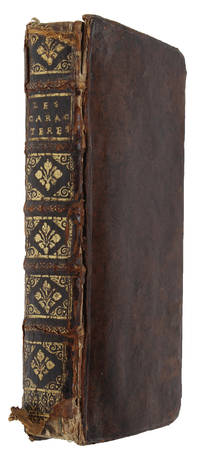
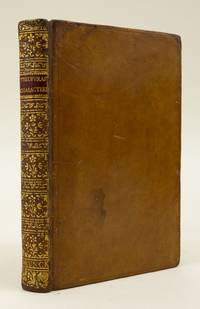
168827999Paris Estienne Michallet 1688. Cont. full calf. 5 raised bands on back back richly gilt all edges of boards gilt. Lacking leather at capitals front-hinge cracked so cords are showing. <br/><br/><em>Second or third printing of the original edition. The title-page states "seconde edition" but it is probably the third printed in the same year as the first and second being a page-by-page re-impression of the second except for the fact that corrections have been made and the errata-leaf is thus not printed in the third. Both the second and third original editions are from the same year and by the same printer as the first. "La seconde édition également impr. en 1688 n'offre que quelques légers changements. et la troisième sous la même date ne qu'une simple réimpression de la seconde." Brunet III:720. This work includes the first French translation of Theophrast's Characters and probably the first translation into any modern language. "Theophraste a eu le grand honneur comme on sait d'être ttraduit au XVIIe siècle par La Bruyère: et c'est pourquoi en France plus que dans tout autre pays en dehors même du cercle des érudits son nom et son opuscule sont populaires." navarre Budé-edition of "Caractères" Paris 1920.Jean de la Bruyère 1639/1644 - 1996 was a very famous French moralist and writer. "C'est au commencement de 1688 que parut la premiere édition des "Caractères de Théophraste traduits du grec ou les Mæurs de ce siècle." L'auteur mettait ses propres observations sur la société moderne sous le patronage d'un ancien." N.B.G. p. 427. The "Characters" gave La Bruyère quite a few enemies and created furor in the learned world. In Denmark Holberg calls him "trivial and simple" Epistle 404. "Mais si en effet la malignité contemporaine applaudissant aux traits satiriques de l'ouvrage a peu contribuer à sa vogue le jugement de la postérité l'a consacré comme un des meilleurs livres de notre langue." N.B.G. p. 427. This work is thus still considered to be one of the greatest French books. Voltaire writes in "Siecle de Louis XIV c. XXXII": "On peut compter parmi les productions d'un genre unique les "Caractères" de La Bruyère. Un style rigide concis nerveaux des expressions pittoresques un usage tout nouveau de la langue mais qui n'en bless pas les règles frappèrent le public". Bruyère's work with the translation really did cause astonishment and had an immense impact on late 17th century Europe and onwards; it created a new literary genre in Europe and the age of Enlightenment was delighted with the short precise characterizations of people and their customs. For an analysis of the contents and the impact on the time of La Bruyère see Nouvelle Biographie Generelle N.B.G. pp. 426-39. Brunet V:798 III:721 Graesse 4:61. </em> hardcover
1599ST16215hLugduni Lyon: Excudebat Guichard Julliéron apud Antoine de Harsy 1599. Editio Altera Second Edition; EDITIO PRINCEPS of books 24-28. 173 x 109 mm. 6 7/8 x 4 1/4". 12 p.l. 349 1 pp. 24 leaves.Edited by Isaac Casaubon. <br/> 18th century French polished calf smooth spine gilt in compartments with central floral sprig surrounded by leaf tools gilt lettering of owner's name Brunck at tail of spine red morocco label marbled endpapers older repairs to joints. Printer's device on title page. Text in Greek and Latin. Title page with ink ownership inscription of Bibliothèque Villelufpen and Richard Brunck; isolated ink marginalia in Hebrew Arabic Greek or Latin. Dibdin II 501; STC French 419; Graesse VII 125; USTC 158510. ◆A couple of short scratches and two small water stains to upper board shallow chip to head of spine leaves somewhat browned due to paper quality a couple of tiny rust spots but a very good copy clean and fresh internally in a sound binding.<br/> <br/> From the library of a notable--and perhaps notorious--classical scholar this is an important edition of the Greek philosopher's "Characters" with Isaac Casaubon's revisions to his translation and commentary of 1592 and the addition of five sections printed here for the first time that Casaubon had recently discovered at the Palatine Library. One of the earliest known works of psychology "Characters" contains pithy descriptions of the various types of human foibles noted by the Oxford Companion for their "remarkable vivacity and keenness of observation." A pupil of Aristotle and the master's successor as head of the school of Peripatetic philosophy Theophrastus ca. 371 - ca. 287 B.C. wrote widely on a number of subjects ranging from ethics to physics to botany he is considered the "father" of the last discipline. He would have considered these descriptions of such characters as "The Flattering Man" "The Stupid Man" and "The Oligarch" a minor work but it is one that has weathered the centuries. The present translation and commentary marked a milestone in the life of the great classical scholar Isaac Casaubon 1559-1614. Sandys says "It is not until we reach his commentary on the 'Characters' of Theophrastus 1592 that we find a work that is marked by his distinctive merit an interpretation of a text of the most varied interest founded on wide reading and consummate learning. It was a work that won the highest praise from Scaliger." Dibdin called the commentary "a rich mine of Grecian literature." Former owner Richard François Philippe Brunck 1729-1803 was a classical scholar of considerable note who devoted his leisure to the critical revision of the Greek poets. According to Britannica "He spent considerable sums of money in publishing editions of the Greek classics." Flaunting the established mode of editing and criticism he did not hesitate to make clarifying changes to difficult or inscrutable passages of text--whether these alterations were supported by manuscript authorities or not. Deprived of his royal pension by the French Revolution Brunck was forced to sell portions of his library in 1790 and again in 1801. Excudebat Guichard Julliéron apud Antoine de Harsy unknown
152924241<p><strong>1529 GREEK Theophrastus BOTANY Philosophy Metaphysics Causes of PLANTS Botanical</strong></p><p><em>"Time is the most valuable thing a man can spend." </em></p><p>― Theophrastus </p><p>Theophrastus was a 4th-century BC Greek philosopher known for his studies in metaphysics and logic of Aristotle and Plato. One of his remaining works was '<em>On the Causes of Plants'</em> an extensive botanical treatise. In fact this work is <strong>considered to be one of the most important works of botany from the middle ages.</strong> Theophrastus describes plant growth instruction on planting and harvesting soils and fertilizers farming tools and the medicinal properties of many plants.</p><p>This 1529 edition of Theophrastus' '<em>Plants'</em> was published in Lutetia or Paris by Christian Wechel.</p><p>Item number: #24241</p><p>Price: $1950</p><p>THEOPHRASTUS</p><p><strong><em>Theophrasti De Cavsis Plantarvm Libri VI. Theodoro Gaza Interprete</em></strong></p><p>Lutetiæ: ex officina Christiani Wechel 1529.</p><p><u>Details</u>: </p><p><!-- if !supportLists-->· <!--endif-->Collation: Complete with all pages</p><p><!-- if !supportLists-->o <!--endif-->19 2-354 24</p><p><!-- if !supportLists-->o <!--endif-->Dozens of illustrated initials throughout</p><p><!-- if !supportLists-->· <!--endif-->Language: Latin </p><p><!-- if !supportLists-->· <!--endif-->Binding: Leather; secure</p><p><!-- if !supportLists-->· <!--endif-->Size: ~6.25in X 4.25in 16cm x 10.5cm</p><p><!-- if !supportLists-->· <!--endif-->Exceedingly rare valuable and desirable with auction records and price comparisons at over $3000</p><p>Our Guarantee:</p><p>Very Fast. Very Safe. Free Shipping Worldwide.</p><p>Customer satisfaction is our priority! Notify us with 7 days of receiving and we will offer a full refund without reservation!</p><p>24241</p><p>Photos available upon request. </p> Christiani Wechel hardcover
168828099Paris Estienne Michallet Se vend à Bruxelles chez Jean Leonard 1688. Later ca. 1800 cardboardbdg. w. marbled peper. Library-labels on back. Hinges capitals and corners w. traces of use. Occationally brownspotted. 56 226 1 pp. <br/><br/><em>This is the reimpression of the original second edition with the words "Se vend à Bruxelles chez Jean Leonard" on title-page from the same year as the first original edition. "Cette réimpression assez belle a 28 ff. prélim. et 226 pp. de texte plus un f. pour le privilége; l'errata n'y est pas reproduit bien que les corrections qu'il indique n'aient pas été faites dans le texte." Brunet III p.720. This work includes the first French translation of Theophrast's Characters and probably the first translation into any modern language. "Theophraste a eu le grand honneur comme on sait d'être ttraduit au XVIIe siècle par La Bruyère: et c'est pourquoi en France plus que dans tout autre pays en dehors même du cercle des érudits son nom et son opuscule sont populaires." navarre Budé-edition of "Caractères" Paris 1920.Jean de la Bruyère 1639/1644 - 1996 was a very famous French moralist and writer. "C'est au commencement de 1688 que parut la premiere édition des "Caractères de Théophraste traduits du grec ou les Mæurs de ce siècle." L'auteur mettait ses propres observations sur la société moderne sous le patronage d'un ancien." N.B.G. p. 427. The "Characters" gave La Bruyère quite a few enemies and created furor in the learned world. In Denmark Holberg calls him "trivial and simple" Epistle 404. "Mais si en effet la malignité contemporaine applaudissant aux traits satiriques de l'ouvrage a peu contribuer à sa vogue le jugement de la postérité l'a consacré comme un des meilleurs livres de notre langue." N.B.G. p. 427. This work is thus still considered to be one of the greatest French books. Voltaire writes in "Siecle de Louis XIV c. XXXII": "On peut compter parmi les productions d'un genre unique les "Caractères" de La Bruyère. Un style rigide concis nerveaux des expressions pittoresques un usage tout nouveau de la langue mais qui n'en bless pas les règles frappèrent le public". Bruyère's work with the translation really did cause astonishment and had an immense impact on late 17th century Europe and onwards; it created a new litterary genre in Europe and the age of Enlightenment was delighted with the short precise characterisations of people and their customs. For an analysis of the contents and the impact on the time of La Bruyère see Nouvelle Biographie Generelle N.B.G. pp. 426-39. Brunet V:798 III:721 Graesse 4:61. </em> unknown
2033Glasguæ: in ædibus academicis excudebat Robertus Foulis Academiae Typographus 1743. Hardcover. Good. Octavo. ii 53 52pp. 1 A4-G4 - G4 blank A4-F4 G2. Greek text followed by the Latin translation. Contemporary red morocco spine gilt. Bound with: 24 page Greek manuscript. This manuscript follows the divisional sections of the Greek text and acts as an explanatory or transilational adjunct to it. This is the first book in which Foulis described himself as University Printer to which office he was elected on 31 March 1743. <br/> <br/> Glasguæ: in ædibus academicis excudebat Robertus Foulis Academiae Typographus, 1743. hardcover
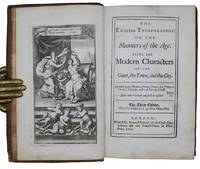
1708AQ28440London: Printed for Bernard Lintott 1708. 14 384pp. With an engraved frontispiece. Contemporary panelled calf calf lettering-piece. Extremities worn upper joint split lower joint starting loss to head-cap. Endpapers browned scattered spotting early inked ownership inscription of George Leslie to REP. Armorial bookplate to FEP of Scottish advocate and philosopher Henry Home Lord Kames 1696-1782. An extended edition of an early eighteenth-century work of moral philosophy sometimes attributed to lexicographer and journalist Abel Boyer 1667-1729. First printed in 1702 the book collects aphorisms and observations on contemporary character types and traits social institutions and behaviour drawn from the writings of La Bruyere La Rochefoucauld and others. ESTC T85463. Third edition. 8vo. Printed for Bernard Lintott unknown