388 résultats
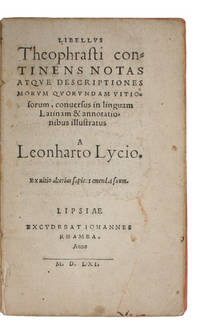
156128328Lipsiae Excudebat Iohannes Rhamba 1561. Small 8vo. Later blue boards ab. 1800. Spine with minor loss and a few cracks. First few leaves with minor soiling but otherwise a nice and clean copy. 19th century owner's inscription to inside of front cover: "Colegii Thomani". Lovely woodcut opening initial. Beautiful Greek script. 48 ff. <br/><br/><em>Extremely scarce first edition thus containing all of Theophrastus' 23 characters in Greek and Latin being the first edition of Auberius' excellent Latin translation and first edition with Lycio's interesting commentaries. "This very rare edition which presents us with the Greek text of H. Stephan Stephanus contains a new Latin version by Claudius Auberius who was scarcely twenty years of age when he composed it. The notes are critical and historical; sometimes bold but always erudite. This version and these notes were republished in Zuinger's edition of Aristotle's "Ethics" at Basil. fol. 1582." Dibdin II:500. This version of Theophrastus' milestone work the first recorded attempt at systematic character writing became hugely influential and is still referred to in modern editions of the text as Auberius' translation is regarded as one of the best and most important interpretations of the text. Claude Aubery or Claudius Auberius ca. 1540-1596 was a noted philosopher and medical doctor professor of Philosophy in Lausanne. He translated several Greek texts into Latin but is best remembered for his excellent version of Theophrastus' "Characters" which was highly influential throughout the Renaissance and which was incorporated into later Renaissance Aristotle-editions as the standard-version of Theophrastus' text. Theophrastus ca. 371- ca. 287 BC Aristotle's successor at the Lyceum and probably the most famous Aristotelian of all times successfully presided over the Peripatetic School for 36 years and here wrote a number of works. The most famous of them is arguably his great moral opus "The Characters" which continues to amaze readers to this day. It introduced the "character sketch" which became the core of the Character as a genre and as such it influenced the entire literay tradition of the Western world. The fabulous very witty astute harsh and insightful characteristics of type characters of the human race have been formative for our understanding of moral virtues and vices and how they come to be expressed in man for our understanding of human nature in general. It is no wonder that the work became so popular and widely read during the Renaissance the era of man as the centre of the universe. "Le texte est le celui de Henri Estienne insére dans l'édition d'Aristote de 1557 mais dans la version il suit pour la plupart ses propres conjectures" Graesse 7: 125. Dibdin II:500 Graesse VII:125. </em> hardcover
159250012Lyon Franciscus le Preux 1592. Small 8o. Early 19th century half calf with gilt title-label to spine. A bit of wear to hinges and corners but fine and tight. Internally exceptionally nice and clean. P. Rubow's owner's signature to front free end-paper. Woodcut vignettes to title-pages and woodcut initials at beginning of both parts. 8 88; 270 pp 1 blank leaf 16 ff. of indexes and errata at end. <br/><br/><em>Scarce first edition thus being the editio princeps of Casaubon's milestone-edition of the seminal work that is Theophrastus' "Characters" containing apart from the original Greek text and Casaubon's translation of it into Latin also Casaubon's highly important commentary of the text. "This edition which was frequently reprinted 1598-1612-1617-1638 &c. is in every respect worthy of the high reputation of Casaubon. Both the text and the notes have served almost every subsequent editor. The Commentary is a rich mine of Grecian literature. The editor availed himself of the use of four MSS. in the Palatine library". Dibdin.Theophrastus ca. 371- ca. 287 BC Aristotle's successor at the Lyceum and probably the most famous Aristotelian of all times successfully presided over the Peripatetic School for 36 years and here wrote a number of works. The most famous of them is arguably his great moral opus "The Characters" which continues to amaze readers to this day. It introduced the "character sketch" which became the core of the Character as a genre and as such influenced the entire literary tradition of the Western world. The fabulous very witty astute harsh and insightful characteristics of type characters of the human race have been formative for our understanding of moral virtues and vices and for how man expresses them for our understanding of human nature in general. It is no wonder that the work became so popular and widely read during the Renaissance the era of man as the centre of the universe. The French-English classical scholar and philologist Isaac Casaubon 1559 - 1614 was regarded by many of his time as the most learned man in Europe. He is famous for his magnificent commentaries and deep understanding of the texts that he edited translated and commented. His edition of Theophrastus's Characters is considered a work of breakthrough as it constitutes the first example of his peculiar style of illustrative commentary at once apposite and profuse. This work is generally considered to exhibit his most characteristic excellences as a commentator.The present edition came to exercise a profound influence upon the interpretation of Theophrastus' great work. Casaubon's commentary served as the standard commentary for centuries and his translation remains a standard translation of the text. The present work thus remains a primary reference and a primary source when reading the work today.The commentary provided much commentary on Athenian society and the translation popularized the text making it available to modern Renaissance readers. Due to the excellent manner of translation into Latin the first English and French translations of this foundational text were enabled.The work was reprinted numerous times and kept appearing for centuries. "Nouvelle revision du texte sur 4 mss. Palatins accompagnée d'une nouvelle trad. latine et d'un commentaire excellent." Graesse VII:125. Dibdin II:501. </em> unknown
0267356420.Gpaperback. Good. Access codes and supplements are not guaranteed with used items. May be an ex-library book. paperback
0267356919.Gpaperback. Good. Access codes and supplements are not guaranteed with used items. May be an ex-library book. paperback
0364199059.Ghardcover. Good. Access codes and supplements are not guaranteed with used items. May be an ex-library book. hardcover
0364503815.Gpaperback. Good. Access codes and supplements are not guaranteed with used items. May be an ex-library book. paperback
036493476X.Ghardcover. Good. Access codes and supplements are not guaranteed with used items. May be an ex-library book. hardcover
0365971502.Gpaperback. Good. Access codes and supplements are not guaranteed with used items. May be an ex-library book. paperback
0366161741.Gpaperback. Good. Access codes and supplements are not guaranteed with used items. May be an ex-library book. paperback
1396674535.Ghardcover. Good. Access codes and supplements are not guaranteed with used items. May be an ex-library book. hardcover
1396646361.Gpaperback. Good. Access codes and supplements are not guaranteed with used items. May be an ex-library book. paperback
1391241754.Ghardcover. Good. Access codes and supplements are not guaranteed with used items. May be an ex-library book. hardcover
1390823954.Gpaperback. Good. Access codes and supplements are not guaranteed with used items. May be an ex-library book. paperback
0526701056.Ghardcover. Good. Access codes and supplements are not guaranteed with used items. May be an ex-library book. hardcover
0674995236.Ghardcover. Good. Access codes and supplements are not guaranteed with used items. May be an ex-library book. hardcover
0674995198.Ghardcover. Good. Access codes and supplements are not guaranteed with used items. May be an ex-library book. hardcover
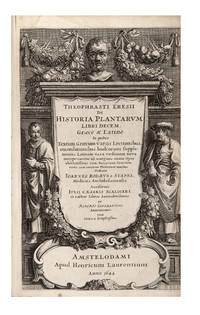
7301Finely engraved title-page a trifle shaved at outer edge & 675 woodcuts in the text. 11 p.l. incl. engr. title 1187 i.e. 1185 87 pp. Folio cont. Dutch vellum over boards upper joint with small split of 7 cm. at foot minor pale dampstaining to first 20 leaves & last third of book panelled in blind central arabesque in blind to each cover ties gone. Amsterdam: H. Laurentius 1644.<br/> <br/> First edition to be edited by Joannes Bodaeus à Stapel; it “is one of the best and most thoughtfully prepared of all the editions of Theophrastos.â€â€“Hunt 240.<br/> <br/> H.H. Bartlett wrote in his Fifty-five Rare Books Ann Arbor: 1949 of this edition: “It is interesting not only because of the brilliance of the editing but curiously enough to the American botanist as well for involving in the discussion certain species from Virginia other parts of the New World and Asia. The illustrations of these plants have been largely overlooked in botanical history because of their incidental presence in a work which might not be expected to contain anything of the sort. Some were merely borrowed from l’Escluse or de Lobel but others seem to be original in this work.â€<br/> <br/> A fine and crisp copy. Bookplate of Piergiorgio Borio M.D.<br/> <br/> ⧠D.S.B. XIII pp. 328-34. See Garrison-Morton 1783. unknown
164450986Amsterdam Heinric Laurentius 1644. Folio. Contemporary full vellum with neat later 19th century rebacking. Six raised bands and gilt title to spine. Some wear to extremities. Internally a fresh and clean copy with only a bit of occasional brownspotting. Endpapers with a bit of soiling. 2 bookplates to inside of front board: Gilbert Redgrave London dated 1894 & Gorden M. Jones Virginia. Text in Greek and Latin. Woodcut title-page numerous woodcut intials throughout and more than 600 woodcut illustrations in the text. 20 1187 1 88 - Index pp. <br/><br/><em>First edition thus being the most important and influential edition of Theophrastus' seminal work "Enquiry into Plants" - the first systematization of the botanical world and the most important contribution to botanical science up until the Renaissance. Bodaeus von Stapel's groundbreaking edition constitutes the first illustrated edition of Theophrastus' masterpiece as well as the first with both Greek and Latin text. Furthermore von Stapel has not only collected all relevant commentaries and knowledge he has also added corrections and much foundational information turning the work into one of the most influential botanical works of the 17th century profoundly influencing the likes of Linnaeus and contributing significantly to the development of modern scientific botany. "This edition displays great care and research; the notes are numerous and learned and all botanical information to be gleaned from Aristotle Pliny Dioscorides and other ancient writers seems to be embodied in this work. The Greek text is Heinsius's; the Latin version is that of the editor who has placed Gaza's in the margin with frequent corrections. The conjectures of Scaliger Constantine and Salmasius are also incorporated. it has collected into one body the opinions of the old writers on the subject of the PLANTS. It contains some wood-cuts of the rarer species which are much better uncoloured than coloured." Dibdin II:498. The numerous woodcut plant illustrations were partly copied from other sources and partly made especially for this edition. Thus apart from being "one of the best and most thoughtfully prepared of all the editions of Theophrastos" Hunt our editor has also made original contributions that are of great importance. "It is interesting not only because of the brilliance of the editing but curiously enough to the American botanist as well for involving in the discussion certain species from Virginia other parts of the New World and Asia. The illustrations of these plants have been largely overlooked in botanical history because of their incidental presence in a work which might not be expected to contain anything of the sort. Some were merely borrowed from l'Ecluse or de Lobel but others seem original in this work" H.H. Bartlett: Fifty-five Rare Books - quoted by Hunt.At the height of the Renaissance with the expansion of the known world and the spreading of the book due to the invention of the printing press many new publications on plants appeared. Most of these publications however were primarily concerned with the medicinal qualities of individual plants and only few authors or editors took an interest in the general nature of the plants and how they could systematically be classified. One of the few exceptions was Bodaeus von Stapel. With his seminal 1644 edition of "Historia Plantarum" he focused on the overarching classification system of plants and took Theophrastus' work a step further adding essential commentaries and illustrations - illustrations that were to be copied for centuries after. These illustrations remain the standard illustrations of Theophrastus' foundational work. This edition of Theophrastus' "Historia Plantarum" became the standard edition of that earliest work on systematic botany and the edition that all serious scientific botanists of the 17th and 18th centuries will have studied. "Linnaeus in the practice of his favourite art of systematizing classified not only plants but the writers about them. The writers he distinguishes primarily as Botanists and Plant Lovers recognizing as Botanists only such as treat of plants from some philosophic or scientific point of view. Choosing his illustrations from annals of remote antiquity he names among the earliest of the Greeks who wrote of plants Hippocrates; but because he wrote of plants only in the interests of medicine Linnaeus styles him Father of Medicine. Similarly Aristotle. is down in the Linnaean list of ancient celebrities as Prince of Philosophers. To Theophrastus however he accords the title Father of Botany. From this opinion far from having been newly promulgated in Linnaeus's time there has been no dissenting voice. On the contrary Albert Haller one of the most learned men in Europe in his day and a botanist of such renown that Linnaeus held him in reverence and also in some fear denominates Theophrastus "the first of real botanists in point of time." Kurt Sprengel in the nineteenth century having rehearsed the names of a long line of ancient authors who had written more or less concerning plants says: "But the most illustrious of them all and the true father of botany was Theophrastus Eresius…." Greene Landmarks of Botanical History I:128.It is no wonder that Linnaeus should find in Theophrastus the Father of his own field - The "Historia Plantarum" was not only the earliest work on systematic botany it also contained Theophrastus' description of the formation of the plant seed the earliest account known and the best that was made for 2000 years.Hunt: 240; Pritzel: 9197; BM: V:2091; Dibdin: II:498. </em> hardcover
153429859Colophon: Basel apud Andream Cratandrum 1534. Folio. Nice hcalf from ab. 1750 richly gilt back gilt title-label. Corners a bit bumped. Slightly rubbed. Woodcut printer's device to title and last leaf. 282642 pp. With many smaller and larger woodcut initials. Small stamp at lower corner of the first 2 leaves. Some rather faint dampstainings to first and last leaves otherwise clean and with broad margins. Engraved book-plate inside front board Bibliotheque du comte Le Moyne de Martigny. <br/><br/><em>Very scarce edition of Theophrastus' two main works. It is one of the earliest Latin editions of Gaza's esteemed translation in reality it is the third printing of the first Latin edition first issued 1483 then 1529 in 8vo and now 1534 of the works which together constitute the foundation of scientific botany. By Linnaeus Theophrastus is called "the father of Botany". This edition comprises both botanical works The History of Plants and The Causes of Plants which have survived in their entirety and are the earliest books of this kind in world literature."It is very strange that so much botanic knowledge should have been accumulated by the end of the fourth century and that so little if anything was added to it in ancient times. Theophrastos is not only the first botanic writer but also the greatest until Renaissance of the sixteenth century in Germany.The botany of Theophrastos and the zoölogy of Aristotle represents the climax of natural history in antiquity." Sarton in A History.Vol. I p. 558. "No study of plants of such breadth and quality had previously been conceived: botany now first appears as a distinct science with a comprehensive yet clearly defined field of enquiry." A.G. Morton. - Stillwell No. 702 Note - Hunt No. 26 listing the 1529-edition in 8vo - Pritzel: 9189. - Not in Choulant Handbuch der Bücherkunde für die Ältere Medicin. </em> unknown
1976180380<p>As new in publishers original shrink wrap. No dust jacket as issued. </p> University Of Notre Dame Press hardcover
0268018294.Ghardcover. Good. Access codes and supplements are not guaranteed with used items. May be an ex-library book. hardcover
1968blb04246Cambridge MA: Harvard University Press 1968. Hardcover. Fine/Near Fine. Condition same for both volumes unless noted: Olive green linen-like cloth on boards with bright as new gilt logo on front and titling and design on spine. Small books are tight square particularly sharp-cornered and totally free of any markings or flaws inside and out. Fine. Bright green Dust Jackets have attractive design - Vol. I has corners of front flap crudely clipped but is otherwise Near Fine with no shelfwear or scuffing showing. Volume II DJ is unclipped. Both now protected in archival quality mylar. Text in English and Greek. With the English translation by Sir Arthur Hort part of the Loeb Classical Library series. Harvard University Press hardcover
1024516059.Gpaperback. Good. Access codes and supplements are not guaranteed with used items. May be an ex-library book. paperback
1024511448.Ghardcover. Good. Access codes and supplements are not guaranteed with used items. May be an ex-library book. hardcover
1968040381United Kingdom: William Heinemann Ltd 1968. Hardcover. Very Good/Very Good. 16mo - over 5¾" - 6¾" tall. Two Volumes. With Minor Works on Odours and Weather Signs. Theophrastus really Tyrtamus of Eresus in Lesbos island born c370 B.C. studied philosophy and later joined Plato's group in Athens and later became a follower of Aristotle and was bequeathed his library and manuscripts. These writings form the most important botanical work surviving from antiquity and the middle ages. Loeb Classical Library series. Translated into English. Reprinted. Harvard University Press Cambridge USA & William Heinemann Ltd London 1968 & 1961. I: xxviii 476 8pp; II: x 500 8pp hb dw clipped & slightly creased pages slightly browned green dw gilt green cloth books near fine <br/> <br/> William Heinemann Ltd hardcover