388 résultats
1407725475.Gpaperback. Good. Access codes and supplements are not guaranteed with used items. May be an ex-library book. paperback
B9781017803143Hardback. New. hardcover

124768993X.Gpaperback. Good. Access codes and supplements are not guaranteed with used items. May be an ex-library book. paperback
6827744Harvard University Press pp. 520 Indices. Hardback. New. Harvard University Press hardcover
1562676901562. Franckfurt am Mayn bey Weygand Han und Georg Raben 1562. 4º. 3 Teile in 1 Band: Teil: 12 115 Bl.; Teil: 12 129 1 Bl.; Mühlhausen im oberen Elsaß durch Peter Schmid 1562. 4º. 32 Bl. Schweinsledereinband d.Zt. mit Schliessen. Paracelsus Theophrastus Philippus Aureolus Bombastus von Hohenheim. Erster - dritter Theil der grossen Wundartzney deß weitberhümpten bewerten vnd erfahrnen Theophrasti Paracelsi von Hohenheim der Leib vnd Wundartzney Doctoris. & Angebunden: Baderbüchlin. Sechs köstliche Tractat armen und reychen nutzlich und notwendig von wasserbädern . Mit fleyß und müe Doctor Adams von Bodenstein zu einem guten neuwen Jar publicirt. Die "Grosse Wundartzney" gehört zu den einflussreichsten chirurgischen Schriften der frühen Neuzeit und markiert einen Wendepunkt in der praktischen Wundbehandlung in der Ablehnung scholastischer Autoritäten und in der Hinwendung zu einer erfahrungsbasierten am Krankenbett gewonnenen Chirurgie. Der Frankfurter Druck von 1562 bietet in drei Teilen Paracelsus' Lehre von Wunden Schussverletzungen Brandwunden Knochenbrüchen Geschwülsten und anderen chirurgischen Erkrankungen dazu die ausführliche Abhandlung zur "Frantzosischen Kranckheit" Syphilis. Bei der vorliegenden Ausgabe handelt es sich um einen Nachdruck der zweibändigen "Grossen Wundartzney" nach der Augsburger Ausgabe von 1537. Den dritten Teil bildet die Schrift "Von der frantzosischen Kranckheit"; hierfür nutzten Weygand Han und Georg Raben den Nachdruck von 1553 als Vorlage und übernahmen Dessen Druckbogen aus dem Nachlass des Frankfurter Druckers Heinrich Gulfferich für einen Teil der Auflage sogar unverändert. Das angebundene "Baderbüchlin" in der Bearbeitung durch Adam von Bodenstein ist eine eigenständige sehr seltene Publikation über Wasser und Mineralbäder die Paracelsus' balneologische Vorstellungen popularisiert. In sechs "köstlichen Traktaten" richtet sich die Schrift ausdrücklich an "arme und reiche" um den Nutzen der Bäder für Prävention und Therapie verschiedenster Leiden darzulegen. Der Druck bei Peter Schmid in Mühlhausen im oberen Elsass ebenfalls 1562 steht in enger zeitlicher und inhaltlicher Nachbarschaft zur Wundartzney und ergänzt diese ideal um den Bereich der Badetherapie. Die Kombination von vollständiger Frankfurter Wundartzney alle drei Teile und dem zeitgleichen Mühlhauser Baderbüchlin in einem prachtvollen zeitgenössischen Schweinsledereinband mit Schnallen ist äußerst selten. VD16 P 458 Wundartzney; VD16 P 413 Baderbüchlin. Sudhoff Bibliographia Paracelsica Nr. 45 Baderbüchlin und Nr.49-51 Wundtarzney. Ferguson Bibliographia Paracelsica. Schubert Paracelsus Library Drexel Katalog Nr. 25. Fürberth Bäder-Bibliographie Nr. 37. unknown
1589676841589. Conraf Waldkirch 1589-1599 4° mit 10 sich wiederholenden Portraits und Textholuschnitte im letzten Teil Astrologica. 5 geprägte Schweinsledereinbände d.Zt.; vereinzelt Wurmlöcher ohne Textverlust sehr geines Exemplar. Erster bis Zehender Theil der Bücher und Schrifften. Jetzt auffs new auß den Originalien und Theophrasti eigner Handschrifft an tag geben: durch Joh. Huserum. 10 Teile und die Appendices zu Teilen V und X letzterer in 2 Teilen in 5 Bänden. Mit 12 ganzseitigen wiederholten Porträtholzschnitten des Autors mehrfach wiederholten Wappenholzschnitten Druckermarken und 62 Textholzschnitten im Appendix zu Teil X. Titel in Rot und Schwarz. Reich blindgeprägtes Schweinsleder der Zeit Basel Conrad Waldkirch 1589-1591. Seltene erste deutsche Gesamtausgabe der Werke des Theophrast Bombast von Hohenheim genannt Paracelsus 1493-1541 die sog. "Huser'sche Quartausgabe" in der zahlreiche Schriften zum ersten Mal im Druck erschienen und deren Text für alle späteren Ausgaben maßgeblich wurde. Sie kam mit Unterstützung des Kurfürsten und Kölner Erzbischofs Ernst Prinz von Bayern zustande und wurde von dem Paracelsisten Johann Huser 1545-1600 Arzt aus Waldkirch im Breisgau und kurfürstlich-kölnischem Rat herausgegeben vgl. Hirsch-Hübotter III 350. "Wenn man ohne Voreingenommenheit diese Huser'schen Darlegungen über die bei der Sammelausgabe angewendeten Grundsätze und Massnahmen überblickt so kann man ihm die Anerkennung nicht versagen dass er mit Umsichte und Gründlichkeit an die Lösung seiner Aufgabe gegangen ist" Sudhoff S. 374. Die Ausgabe gliedert sich in medizinische Werke Teile I-VI dann die "Bücher in welchen fürnemlich die Kräfft Tugenden und Eigenschafften Natürlicher dingen auch derselben Bereitdungen betreffend die Artzeney beschriben werden neben eingemischten sachen zur Alchemey dienstlich" Teil VII. Es folgen die philosophischen Schriften Teile VIII-X. Der 5. Teil enthält ein Sudhoff unbekannt gebliebenes Sonderblatt eine "Schedula" zu S. 290 sowie einen 228 Seiten und 21 umfassenden Appendix. Mit der häufig fehlenden Foliotafel im 10. Teil zu S. 68 ferner dem Appendix und einem zweiten Anhang mit dem "Fasciculus Prognosticationum Astrologicarum". Zum Appendix gehören auch die Textfiguren und Holzschnitte davon 30 zur "Auslegung der Magisten Figuren im Carthäuser Kloster zu Nürnberg" und 32 "Figurae Magicae Theophrasti" zur "Prognostication auf XXIIII Jahr zukünfftig". Das vorliegende Exemplar enthält alle erschienenen Teile bis auf den Appendix zu Teil VIII jedoch die Appendices zu Teilen V und vor allem X mit dem genannten "Fasciculus prognosticationum astrologicarum". Kollation: Band I Teil I: 10 Bl. 426 S. 1 Bl.; Teil II: 342 S. 1 w. 28 Bl.; Teil III: 4 Bl. 420 S. 51 Bl.; Teil IV: 417 S. 53 Bl.; Teil V: 4 Bl. 332 S. 48 Bl.; 228 S. 21 Bl.; Teil VI: 4 Bl. 440 S. 12 Bl.; Teil VII: 6 Bl. 439 S. 4 Bl.; Teil VIII: 6 Bl. 363 S. 4 Bl. ohne S. 365-428 Appendix zu VIII; Teil IX: 4 Bl. 459 S. 4 Bl.; Teil X: 4 Bl. 491 S.; 275 S. 4 Bl. letztes weiß 106 S. 1 Bl. VD16 P 365 367 369 371 373 375-379. Mook 154-163. Sudhoff 216-225 220a und 225a. Hirsch-Hübotter IV 499. Garrison-Morton 57 Anm. Durling 3514 unvollständig. - Nicht bei Osler Wellcome Waller. Not in Neville Historical Library; not in Maggs 520 and Ferguson; Durling 3514 imperfect; Heirs of Hippocrates only later complete editions not in Osler Wellcome Waller. unknown
1019122161.Gpaperback. Good. Access codes and supplements are not guaranteed with used items. May be an ex-library book. paperback
1019117176.Ghardcover. Good. Access codes and supplements are not guaranteed with used items. May be an ex-library book. hardcover
15646012<p>8vo. 112 ff pages 2 and 110-112 are blank. Bound in modern paneled calf with gilt-stamped fleurons on front and back covers raised bands. Generally good.<br /></p><p>The first edition of this plague treatise by Paracelsus Theophrastus Bombastus von Hohenheim 1493-1541 the "Luther of Medicine" and one of the key figures in the history of medicine. Written originally in Nördlingen in 1529-1530 it remained unpublished during Paracelsus' lifetime and subsequently taken up and edited for publication by the Paracelsian scholar Adam von Bodenstein 1528-1577. The latter dedicated it to Johann Rudolph Stör von Störenberg Abbot of Murbach and Luders. In addition to the study on pestilence the text includes two short works by Paracelsus: "Vom Preservatiff durch den Schwebel" and "Von der Mummia."</p><p>In the primary tract Paracelsus for the first time presents his complex theory on the origins of the plague which he believed were the result of astrological and corporeal events set in motion by human sins. "This anthropocentric view of an individual disease is in harmony with Paracelsus' whole philosophy and indeed with Renaissance philosophy in general" Pagel p. 179. Paracelsus also postulates the importance of the principle of sulphur the corresponding agent of the planet Mars in pestilence's causation. He believed that sulphur hidden in three minerals—antimony arsenic and marcasite—affected three corresponding organs: the groin the axillae and the ears.</p><p>The chapters on causation are followed by sections on remedies. The doctor must cure the agent causing the disease rather than the symptoms of the disease Paracelsus writes. Humoral pathology and its insistence on diet is of no use. "Paracelsus' plague remedies include sulphur spirit of vitriol sulphur sublimate and metals also—for external treatment of boils—toads and decoctions of beetles designed to remove the evil of magnetic attraction but herbs and drugs as prescribed by Ficino and Agrippa are greatly amplified and still appear in a prominent place" Pagel pp. 180-181 n. 151.</p><p>The editor of this volume Adam von Bodenstein was one of the key figures in the revival of Paracelsian ideas in the German lands in the middle of the sixteenth century. A son of a radical reformer he believed in transmutation of metals into gold and played a key role in the publication of over 80 works by Paracelsus. For his Paracelsianism he was excluded from the faculty and council of Basel University.</p><p>OCLC records US copies at NYAM NLM Wash. U and UMn.</p><p>Karl Sudhoff <i>Bibliographia Paracelsica</i> Berlin 1894 60; Walter Pagel <i>Paracelsus: An Introduction to Philosophical Medicine in the Era of the Renaissance</i> Boston 1982 2nd revised edition; Georgiana D. Hedesan "Alchemy Potency Imagination Paracelsus's Theories of Poison" in John Arrizabalaga Ole Peter Grell Andrew Cunningham eds. <i>It All Depends on the Dose: Poisons and Medicines in European History. The History of Medicine in Context Series</i> New York 2018 pp. 81-102; Peter J. Forshaw "'Paradoxes Absurdities and Madness:' Conflict over Alchemy Magic and Medicine in the Works of Andreas Libavius and Heinrich Khunrath" <i>Early Science and Medicine</i> vol. 13 no. 1 2008 pp. 53-81.</p> Paul Messerschmidt hardcover
1017684995.Ghardcover. Good. Access codes and supplements are not guaranteed with used items. May be an ex-library book. hardcover
1017690049.Gpaperback. Good. Access codes and supplements are not guaranteed with used items. May be an ex-library book. paperback
45002531like new. unknown
ria9781017684995_inpHardcover. New. New Book; Fast Shipping from UK; Not signed; Not First Edition; This work has been selected by scholars as being culturally important and is part of the knowledge base of civilization as we know it.This work is in the "public domain in the United States of America and possibly other nations. Withi hardcover
8800634like new. unknown
8800634-nnew. unknown
2010__3796526101Schwabe 2010. Paperback. New. 2450 pages. German language. 7.99x5.39x4.80 inches. Schwabe paperback
1585D11004Frankfurt am Main: Apud heredes Andreae Wecheli heirs of Andreas Wechel MDLXXXV 1585. Hardcover. Very Good. 4to 210 x 149mm. 16 blank leaves at front and back 4 318 2 pages including final leaf with Wechel printers device. Title also with Wechels woodcut printers device a pegasus soaring over a caduceus pair of cornucopia and shaking hands AW monogram twice. Edited by Friedrich Sylburg. Dedicated to French scholar Joseph Justus Scaliger 1540-1609. Latin dedication notes and index. Greek text 18th-century calf marbled endpapers and red edges rebacked; light edgewear light marginal foxing title lightly browned. Likely remaining for several generations at the library of Balliol College Taylor Institution Oxford number B.181 deaccessioned sometime in the early 20th century two bookplates on front pastedown. Collection of Francis Howard Forbes 1881-1957 professor of Greek language and literature at Amherst College his round pictorial bookplate of Attic-style scribes on front pastedown. This particular copy was cared for by Oxford institutions for a good part of its history then crossed into a New England personal library of a classical scholar sometime in the early 20th century. <br/><br/>This is the self-contained volume from the 1584-1587 collected edition of the works of Aristotle in Greek and the Metaphysica of Theophrastus. Friedrich Sylburg 1536-1596 was a German classical scholar who made important contributions to several popular Greek texts of the later sixteenth century like Estiennes Greek Thesaurus. In 1583 Sylburg resigned from an educational post he held at Lich and moved to Frankfurt to work as leading active editor for the enterprising Wechel publishers. The humanist printers flourished in three distinct cities; Paris Frankfurt and Hanau. Andreas Wechel settled the firm in Frankfurt and distinguished it mainly by publishing neo-Latin literature classical philology and works by Ramus and his followers. The relationship between Sylburg and the Wechel printers was a seamless match; this 1585 edition of Aristotle was praised for its great critical power and finesse. It is widely regarded as the authoritative edition of its kind. Sound example of a sixteenth century published work on Aristotelian principles born from the inventive relationship between scholar and press.Fabricius-Harles III 444; Hoffmann I 275 and 289. Apud heredes Andreae Wecheli (heirs of Andreas Wechel) hardcover
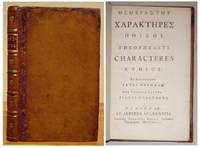
17436108Glasguae Glasgow: In Aedibus Academicis. Excudebat Robertus Foulis Academiae Typographus 1743. 8vo. pp. ii 53 i 52. Greek text followed by Isaac Casaubons Latin translation. Contemporary calf rebacked corners renewed. Foulis was elected University Printer on March 31st 1743 and this is the first book where he styles himself Academiae Typographus. Peter Needhams excellent edition was first published in 1712. 1744 dated ownership signature E Libris Bagnall on the free endpaper with two 20th century inscriptions beneath: R.J. Mockridge St Johns Oxford in 1908; gift to D Hughes from the Rev R. Mockridge then at Harwicke Rectory August 1958. Booksellers ticket R. Saywell to pastedown. Theophrastuss moral character sketches are listed in English in a 19th century hand on the lower pastedown. Gaskell Foulis: 40; ESTC N475398. Book In Aedibus Academicis. Excudebat Robertus Foulis Academiae Typographus unknown
198949463Hannover 1989. Buch I und II in einem Band. Mit einem Nachwort von Udo Benzenhöfer Edition Libri Rari Neuwertig Reprint nach dem Original aus dem Jahre 1556 Schäfer 4°. Pbd. m. Präg. Medizin unknown
1162881364.Gpaperback. Good. Access codes and supplements are not guaranteed with used items. May be an ex-library book. paperback
1169585760.Ghardcover. Good. Access codes and supplements are not guaranteed with used items. May be an ex-library book. hardcover
1162914238.Gpaperback. Good. Access codes and supplements are not guaranteed with used items. May be an ex-library book. paperback
116974768X.Ghardcover. Good. Access codes and supplements are not guaranteed with used items. May be an ex-library book. hardcover
1425350372.Gpaperback. Good. Access codes and supplements are not guaranteed with used items. May be an ex-library book. paperback
19883234829Madrid.: Gredos. 1988. Hardcover. Good. 20 cm. 531 p. Encuadernación en tapa dura de editorial. Introducción traducción y notas José MarÃa DÃaz-Regañón López. Biblioteca clásica Gredos. volumen coleccion 112. BibliografÃa. Ãndice. Botánica. Obras prelinneanas . ISBN: 8424912713 Botánica 58035.3"-03" Gredos. hardcover