THEOPHRASTUS ERESIIBiblio.com

388 résultats
164450986Amsterdam Heinric Laurentius 1644. Folio. Contemporary full vellum with neat later 19th century rebacking. Six raised bands and gilt title to spine. Some wear to extremities. Internally a fresh and clean copy with only a bit of occasional brownspotting. Endpapers with a bit of soiling. 2 bookplates to inside of front board: Gilbert Redgrave London dated 1894 & Gorden M. Jones Virginia. Text in Greek and Latin. Woodcut title-page numerous woodcut intials throughout and more than 600 woodcut illustrations in the text. 20 1187 1 88 - Index pp. <br/><br/><em>First edition thus being the most important and influential edition of Theophrastus' seminal work "Enquiry into Plants" - the first systematization of the botanical world and the most important contribution to botanical science up until the Renaissance. Bodaeus von Stapel's groundbreaking edition constitutes the first illustrated edition of Theophrastus' masterpiece as well as the first with both Greek and Latin text. Furthermore von Stapel has not only collected all relevant commentaries and knowledge he has also added corrections and much foundational information turning the work into one of the most influential botanical works of the 17th century profoundly influencing the likes of Linnaeus and contributing significantly to the development of modern scientific botany. "This edition displays great care and research; the notes are numerous and learned and all botanical information to be gleaned from Aristotle Pliny Dioscorides and other ancient writers seems to be embodied in this work. The Greek text is Heinsius's; the Latin version is that of the editor who has placed Gaza's in the margin with frequent corrections. The conjectures of Scaliger Constantine and Salmasius are also incorporated. it has collected into one body the opinions of the old writers on the subject of the PLANTS. It contains some wood-cuts of the rarer species which are much better uncoloured than coloured." Dibdin II:498. The numerous woodcut plant illustrations were partly copied from other sources and partly made especially for this edition. Thus apart from being "one of the best and most thoughtfully prepared of all the editions of Theophrastos" Hunt our editor has also made original contributions that are of great importance. "It is interesting not only because of the brilliance of the editing but curiously enough to the American botanist as well for involving in the discussion certain species from Virginia other parts of the New World and Asia. The illustrations of these plants have been largely overlooked in botanical history because of their incidental presence in a work which might not be expected to contain anything of the sort. Some were merely borrowed from l'Ecluse or de Lobel but others seem original in this work" H.H. Bartlett: Fifty-five Rare Books - quoted by Hunt.At the height of the Renaissance with the expansion of the known world and the spreading of the book due to the invention of the printing press many new publications on plants appeared. Most of these publications however were primarily concerned with the medicinal qualities of individual plants and only few authors or editors took an interest in the general nature of the plants and how they could systematically be classified. One of the few exceptions was Bodaeus von Stapel. With his seminal 1644 edition of "Historia Plantarum" he focused on the overarching classification system of plants and took Theophrastus' work a step further adding essential commentaries and illustrations - illustrations that were to be copied for centuries after. These illustrations remain the standard illustrations of Theophrastus' foundational work. This edition of Theophrastus' "Historia Plantarum" became the standard edition of that earliest work on systematic botany and the edition that all serious scientific botanists of the 17th and 18th centuries will have studied. "Linnaeus in the practice of his favourite art of systematizing classified not only plants but the writers about them. The writers he distinguishes primarily as Botanists and Plant Lovers recognizing as Botanists only such as treat of plants from some philosophic or scientific point of view. Choosing his illustrations from annals of remote antiquity he names among the earliest of the Greeks who wrote of plants Hippocrates; but because he wrote of plants only in the interests of medicine Linnaeus styles him Father of Medicine. Similarly Aristotle. is down in the Linnaean list of ancient celebrities as Prince of Philosophers. To Theophrastus however he accords the title Father of Botany. From this opinion far from having been newly promulgated in Linnaeus's time there has been no dissenting voice. On the contrary Albert Haller one of the most learned men in Europe in his day and a botanist of such renown that Linnaeus held him in reverence and also in some fear denominates Theophrastus "the first of real botanists in point of time." Kurt Sprengel in the nineteenth century having rehearsed the names of a long line of ancient authors who had written more or less concerning plants says: "But the most illustrious of them all and the true father of botany was Theophrastus Eresius…." Greene Landmarks of Botanical History I:128.It is no wonder that Linnaeus should find in Theophrastus the Father of his own field - The "Historia Plantarum" was not only the earliest work on systematic botany it also contained Theophrastus' description of the formation of the plant seed the earliest account known and the best that was made for 2000 years.Hunt: 240; Pritzel: 9197; BM: V:2091; Dibdin: II:498. </em> hardcover
153429859Colophon: Basel apud Andream Cratandrum 1534. Folio. Nice hcalf from ab. 1750 richly gilt back gilt title-label. Corners a bit bumped. Slightly rubbed. Woodcut printer's device to title and last leaf. 282642 pp. With many smaller and larger woodcut initials. Small stamp at lower corner of the first 2 leaves. Some rather faint dampstainings to first and last leaves otherwise clean and with broad margins. Engraved book-plate inside front board Bibliotheque du comte Le Moyne de Martigny. <br/><br/><em>Very scarce edition of Theophrastus' two main works. It is one of the earliest Latin editions of Gaza's esteemed translation in reality it is the third printing of the first Latin edition first issued 1483 then 1529 in 8vo and now 1534 of the works which together constitute the foundation of scientific botany. By Linnaeus Theophrastus is called "the father of Botany". This edition comprises both botanical works The History of Plants and The Causes of Plants which have survived in their entirety and are the earliest books of this kind in world literature."It is very strange that so much botanic knowledge should have been accumulated by the end of the fourth century and that so little if anything was added to it in ancient times. Theophrastos is not only the first botanic writer but also the greatest until Renaissance of the sixteenth century in Germany.The botany of Theophrastos and the zoölogy of Aristotle represents the climax of natural history in antiquity." Sarton in A History.Vol. I p. 558. "No study of plants of such breadth and quality had previously been conceived: botany now first appears as a distinct science with a comprehensive yet clearly defined field of enquiry." A.G. Morton. - Stillwell No. 702 Note - Hunt No. 26 listing the 1529-edition in 8vo - Pritzel: 9189. - Not in Choulant Handbuch der Bücherkunde für die Ältere Medicin. </em> unknown
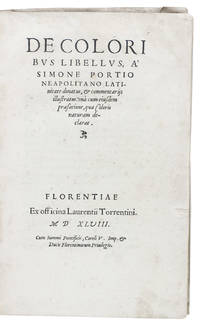
1548642CKI1RIA1QFlorence 1548. 4to. Lorenzo Torrentino Contemporary limp sheepskin parchment straight sewn on 3 wittawed thongs laced through the joints manuscript title down the spine with 4 fragments of a Latin manuscript in an upright humanistic hand on vellum used as spine lining. With 2 large woodcut historiated initials and a vine leaf ornament by Granjon Vervliet 178: 1st recorded in this year. Set in roman types with whole paragraphs in Greek 2 sizes and the dedication and some end matter in italic. 197 3 pp. First edition of one of the earliest printed books about colour translated from the Greek into Latin and with commentary by the Neapolitan physician and philosopher Simone Porzio 1497-1554. Usually attributed to Aristotle it is now thought to be the work of the peripatetic scholar and pupil of Aristotle Theophrastus.''As the author states at the end of the treatise it is intended rather to supply data for a detailed examination into the scientific theory of colour than to expound a complete thesis. He has realized that the development of colour in animals and plants depends to some extent on heat and he seems to suggest that heat and moisture are the controlling factors. It is of more value as a collection of observed facts than for any theory of the origin and development of colour in physical life'' Aristotle Minor Works Cambridge and London Loeb Classical Library 1936 p. 3.With some spotting on the title-page and some marginal tears not approaching the text but otherwise in very good condition and with large margins. Binding with the sewing supports broken a tear in the backstrip and some small stains. An important treatise on colour and one of the earliest.l Adams P1958; Caillet 8881; EDIT16 CNCE 16133; Hoffman I 289 "rare and very important"; Kemp The science of art p. 264; Schwab Bibliographie d'Aristotle 3503; USTC 803281. hardcover
6827412Harvard University Press pp. 368 . Hardback. New. Harvard University Press hardcover
6827415Harvard University Press pp. 480 . Hardback. New. Harvard University Press hardcover
0674995236.Ghardcover. Good. Access codes and supplements are not guaranteed with used items. May be an ex-library book. hardcover
0674995198.Ghardcover. Good. Access codes and supplements are not guaranteed with used items. May be an ex-library book. hardcover
1161547614.Ghardcover. Good. Access codes and supplements are not guaranteed with used items. May be an ex-library book. hardcover
1161563474.Ghardcover. Good. Access codes and supplements are not guaranteed with used items. May be an ex-library book. hardcover
1161567003.Ghardcover. Good. Access codes and supplements are not guaranteed with used items. May be an ex-library book. hardcover
1161591265.Ghardcover. Good. Access codes and supplements are not guaranteed with used items. May be an ex-library book. hardcover
0267356420.Gpaperback. Good. Access codes and supplements are not guaranteed with used items. May be an ex-library book. paperback
0267356919.Gpaperback. Good. Access codes and supplements are not guaranteed with used items. May be an ex-library book. paperback
0364199059.Ghardcover. Good. Access codes and supplements are not guaranteed with used items. May be an ex-library book. hardcover
0364503815.Gpaperback. Good. Access codes and supplements are not guaranteed with used items. May be an ex-library book. paperback
036493476X.Ghardcover. Good. Access codes and supplements are not guaranteed with used items. May be an ex-library book. hardcover
0365971502.Gpaperback. Good. Access codes and supplements are not guaranteed with used items. May be an ex-library book. paperback
0366161741.Gpaperback. Good. Access codes and supplements are not guaranteed with used items. May be an ex-library book. paperback
1396674535.Ghardcover. Good. Access codes and supplements are not guaranteed with used items. May be an ex-library book. hardcover
1396646361.Gpaperback. Good. Access codes and supplements are not guaranteed with used items. May be an ex-library book. paperback
1391241754.Ghardcover. Good. Access codes and supplements are not guaranteed with used items. May be an ex-library book. hardcover
1390823954.Gpaperback. Good. Access codes and supplements are not guaranteed with used items. May be an ex-library book. paperback
0526701056.Ghardcover. Good. Access codes and supplements are not guaranteed with used items. May be an ex-library book. hardcover
1573622841573. Argentorati = Basel Petrus Perna 1573 2° 12 223 1 28; 2 250 36 pp.; 2 263 5 pp Ledereinband d.Zeit mit Rückenvergoldung; vereinzelt fleckig feines Expl. Erste Ausgabe! PHILIPPI AVREOLI THEOPHRASTI PARACELSI BOMBAST EREMITAE SVMMI INter Germanos Medici & Philosophi. CHIRVRGIA MAGNA in duos tomos digesta. . Nunc recens à IOSQVINO DALHEMIO OSTOFRANCO Medico Latinitate donata. Tomus I : De vulneribus et fracturis libri III. De ulceribus libri III. De tumoribus et aperturis libri III. Tomus II : De Tumoribus Pustulis & Ulceribus / Morbi Gallici Lib. X. De Curatione & Imposturis Morbi / Gallici Lib. Octo. & Aureoli Philippi THEOP. PARACELSI CHYRVRGIA MINOR QVAM ALIAS BERTHEONEAM INTITVLAVIT. CVI ETIAM SEQVENTES TRACTAtus accesserunt eiusdem authoris. De Apostematibus Syronibus & Nodis. De cutis apertionibus. De vulnerum & ulcerum curis. De Vermibus Serpentibus 6c. ac amculis à natiuitrate ortis. Dieser Band enthält die "Chirurgia magna" in zwei Tomi in lateinischer Übersetzung von Josquinus Dalhemius tätig 2. H. 16. Jh. humanistischer Übersetzer paracelsischer Schriften sowie die kürzere "Chirurgia minor" "Bertheonea" in der lateinischen Fassung des flämischen Arztes Alchemisten und Paracelsisten Gerhardus Dorn ca. 1530-ca. 1584. - Gedruckt von dem aus Lucca stammenden seit den 1540er-Jahren in Basel tätigen Humanisten- und Reformationsverleger Petrus Perna ca. 1519-1582. Die Chirurgia magna ist das zentrale chirurgische Werk Paracelsus' und dokumentiert seine praktische Wundarznei ebenso wie seine Reinterpretation traditioneller Krankheitslehren. In ihr treten seine Abkehr von der bloßen Galen Exegese sein empirisches Vorgehen am Krankenbett und sein Einsatz chemischer Präparate deutlich hervor; sie ist für das Verständnis der paracelsischen "Reformation der Medizin" unverzichtbar. Paracelsus betont systematisch die Bedeutung gründlicher Wundreinigung Drainage und Verhinderung von Fäulnis; die "gute Eiterung" der traditionellen Chirurgie wird kritisch relativiert und der Fokus stärker auf rasche "spezifische" Heilung gerichtet. Er beschreibt Trauma Frakturen Ulzera und Tumoren in enger Verbindung mit Umwelt und Stoffeinflüssen; damit wird die spätere Toxikologie vorbereitet Stichwort "Die Dosis macht das Gift" und eine spezifische substanzgebundene Krankheitsauffassung gefördert. Von besonderem Interesse auch für die frühe Geschichte der Neurochirurgie: Paracelsus behandelt in der Chirurgia magna Kopf- und Schädelverletzungen inkl. Indikationen zur Trepanation im Rahmen einer empirisch orientierten Wundchirurgie und verknüpft traumabedingte Lähmungen und Krampfzustände mit lokalen Strukturverletzungen statt ausschließlich mit humoral-systemischen Ursachen. Die Chirurgia minor ist der Teil des paracelsischen chirurgischen Werkes der am ehesten dem späteren Feld der Dermato-chirurgie und der frühen plastisch-rekonstruktiven Bemühungen entspricht - durch ihren Fokus auf Haut Weichteile Wunden Verbrennungen und Narbenführung immer vor dem Hintergrund von Paracelsus' chymischer Pathologie und spezifischer Arzneitherapie. Die Perna-Ausgabe von 1573 ist die erste große lateinische Gesamtausgabe der paracelsischen Chirurgie: Sie überführt die ursprünglich deutschsprachigen Wundarznei-Schriften Große und Kleine Chirurgie in ein gelehrtes europaweit rezipierbares Format und ist damit ein Schlüsselstück der frühen Paracelsus-Rezeption. Chirurgiegeschichtlich markiert der Band den Übergang von handwerklich-zunftgebundener Wundbehandlung zu einer spezifischen substanzgebundenen Therapieauffassung Toxikologie organspezifische Wirkungen Kritik an der "guten Eiterung" und ist für die Geschichte der Chirurgie wie der Pharmakologie gleichermaßen bedeutend. First major Latin edition of Paracelsus' surgical works containing the two tomes of the "Chirurgia magna" and the shorter "Chirurgia minor" in one folio volume. Translated into Latin by Josquinus Dalhemius and Gerard Dorn and printed by the Basel humanist printer Petrus Perna in 1573. Covers wounds fractures ulcers tumours and related conditions combining practical wound surgery with Paracelsus' innovative chymical pathology. Key document in the spread of Paracelsian medicine from German vernacular surgery into the international learned medical world. VD16 P 469; VD16 P 479 Sudhoff "Bibliographia Paracelsica" Nr. 146-148 unknown
1573622821573. Argentorati = Basel Petrus Perna 1573 Folio 10 223 1 28; 2 250 36 pp. alter Halbledereinband; Titelblatt aufgelegt etwas fleckig; mit alten Marginalien; feines Expl. mit ExLibris von Kenneth Harvey Abbott. Erste Ausgabe! PHILIPPI AVREOLI THEOPHRASTI PARACELSI BOMBAST EREMITAE SVMMI INter Germanos Medici & Philosophi. CHIRVRGIA MAGNA in duos tomos digesta. . Nunc recens à IOSQVINO DALHEMIO OSTOFRANCO Medico Latinitate donata. Tomus I : De vulneribus et fracturis libri III. De ulceribus libri III. De tumoribus et aperturis libri III. Tomus II : De Tumoribus Pustulis & Ulceribus / Morbi Gallici Lib. X. De Curatione & Imposturis Morbi / Gallici Lib. Octo. Dieser Band enthält die "Chirurgia magna" in zwei Tomi in lateinischer Übersetzung von Josquinus Dalhemius tätig 2. H. 16. Jh. humanistischer Übersetzer paracelsischer Schriften. - Gedruckt von dem aus Lucca stammenden seit den 1540er-Jahren in Basel tätigen Humanisten- und Reformationsverleger Petrus Perna ca. 1519-1582. Die Chirurgia magna ist das zentrale chirurgische Werk Paracelsus' und dokumentiert seine praktische Wundarznei ebenso wie seine Reinterpretation traditioneller Krankheitslehren. In ihr treten seine Abkehr von der bloßen Galen Exegese sein empirisches Vorgehen am Krankenbett und sein Einsatz chemischer Präparate deutlich hervor; sie ist für das Verständnis der paracelsischen "Reformation der Medizin" unverzichtbar. Paracelsus betont systematisch die Bedeutung gründlicher Wundreinigung Drainage und Verhinderung von Fäulnis; die "gute Eiterung" der traditionellen Chirurgie wird kritisch relativiert und der Fokus stärker auf rasche "spezifische" Heilung gerichtet. Er beschreibt Trauma Frakturen Ulzera und Tumoren in enger Verbindung mit Umwelt und Stoffeinflüssen; damit wird die spätere Toxikologie vorbereitet Stichwort "Die Dosis macht das Gift" und eine spezifische substanzgebundene Krankheitsauffassung gefördert. Von besonderem Interesse auch für die frühe Geschichte der Neurochirurgie: Paracelsus behandelt in der Chirurgia magna Kopf- und Schädelverletzungen inkl. Indikationen zur Trepanation im Rahmen einer empirisch orientierten Wundchirurgie und verknüpft traumabedingte Lähmungen und Krampfzustände mit lokalen Strukturverletzungen statt ausschließlich mit humoral-systemischen Ursachen. Die Perna-Ausgabe von 1573 ist die erste große lateinische Gesamtausgabe der paracelsischen Chirurgie: Sie überführt die ursprünglich deutschsprachigen Wundarznei-Schriften Große und Kleine Chirurgie in ein gelehrtes europaweit rezipierbares Format und ist damit ein Schlüsselstück der frühen Paracelsus-Rezeption. Chirurgiegeschichtlich markiert der Band den Übergang von handwerklich-zunftgebundener Wundbehandlung zu einer spezifischen substanzgebundenen Therapieauffassung Toxikologie organspezifische Wirkungen Kritik an der "guten Eiterung" und ist für die Geschichte der Chirurgie wie der Pharmakologie gleichermaßen bedeutend. First major Latin edition of Paracelsus' surgical works containing the two tomes of the "Chirurgia magna" in one folio volume. Translated into Latin by Josquinus Dalhemius and printed by the Basel humanist printer Petrus Perna in 1573. Covers wounds fractures ulcers tumours and related conditions combining practical wound surgery with Paracelsus' innovative chymical pathology. Key document in the spread of Paracelsian medicine from German vernacular surgery into the international learned medical world. VD16 P 469 Sudhoff "Bibliographia Paracelsica" Nr. 146-147 unknown