"THEOPHRASTUS - THEOPHRASTOS - THEOPHRAST.Livre Rare Book

606 résultats
153429859(Colophon: Basel, apud Andream Cratandrum, 1534). Folio. Nice hcalf from ab. 1750, richly gilt back, gilt title-label. Corners a bit bumped. Slightly rubbed. Woodcut printer's device to title and last leaf. (28),264,(2) pp. With many smaller and larger woodcut initials. Small stamp at lower corner of the first 2 leaves. Some, rather faint, dampstainings to first and last leaves, otherwise clean and with broad margins. Engraved book-plate inside front board (Bibliotheque du comte Le Moyne de Martigny).
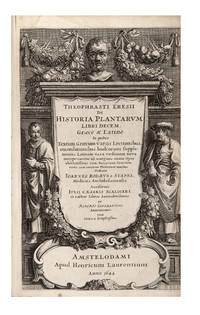
164450986Amsterdam, Heinric Laurentius, 1644. Folio. Contemporary full vellum with neat later (19th century) rebacking. Six raised bands and gilt title to spine. Some wear to extremities. Internally a fresh and clean copy with only a bit of occasional brownspotting. Endpapers with a bit of soiling. 2 bookplates to inside of front board: Gilbert Redgrave, London (dated 1894) & Gorden M. Jones, Virginia. Text in Greek and Latin. Woodcut title-page, numerous woodcut intials throughout, and more than 600 woodcut illustrations in the text. (20), 1187, (1), (88 - Index) pp.
7301Finely engraved title-page a trifle shaved at outer edge & 675 woodcuts in the text. 11 p.l. incl. engr. title 1187 i.e. 1185 87 pp. Folio cont. Dutch vellum over boards upper joint with small split of 7 cm. at foot minor pale dampstaining to first 20 leaves & last third of book panelled in blind central arabesque in blind to each cover ties gone. Amsterdam: H. Laurentius 1644. First edition to be edited by Joannes Bodaeus à Stapel; it "is one of the best and most thoughtfully prepared of all the editions of Theophrastos."-Hunt 240. H.H. Bartlett wrote in his Fifty-five Rare Books Ann Arbor: 1949 of this edition: "It is interesting not only because of the brilliance of the editing but curiously enough to the American botanist as well for involving in the discussion certain species from Virginia other parts of the New World and Asia. The illustrations of these plants have been largely overlooked in botanical history because of their incidental presence in a work which might not be expected to contain anything of the sort. Some were merely borrowed from l'Escluse or de Lobel but others seem to be original in this work." A fine and crisp copy. Bookplate of Piergiorgio Borio M.D. ❧ D.S.B. XIII pp. 328-34. See Garrison-Morton 1783. hardcover books
148316243Treviso: Bartholomaeus Confalonerius 2 Feb 1483. First edition in Latin later issued in Greek with the Aldine Aristotle editions of 1497 and 1498. Folio 153 leaves lacks the front blank and 2 leaves of text supplied in clean facsimile. 28.4'x9.2 cm. Bound in later cloth backed boards some marginal waterstaining contemporary Italian marginalia some trimmed close throughout with a full page of contemporary notes on the verso of the final leaf. HC 15491; BMC VI 894; BM-Ital 668; Klebs 958.1; Garrison 1929 12; Castiglioni 1947 181-182; Stillwell T132; Goff T-155; Pritzel 9184;Osler 263; Stillwell The Awakening . 72; Procter 648; Dibner Heralds of Science 18; Norman 266. Rare this had not been to auction since December of 1967 when it sold for $75000 until it sold for $55200 at the Haskell Norman sale 3/18/1998. Stillwell notes that this is the earliest scientific botany. A study of about 5 plants described according to a rather primitive classification which held however until the mid-sixteenth century. Its ninth section on the medicinal properties of plants"the earliest extant herbal except for fragments of a Greek herbal c. 35 B.C."is believed to have been added somewhat after Theophrastus's time. Known as the founder of scientific botany Theophrastus was born in Lesbos and was Aristotle's most highly regarded student and succeeded Aristotle as head of the Lyceum in Athens. He was a prolific writer yet only these two works survive as major works. His De Historia Plantarum described and classifies several hundred plants while the De Causis Plantarum is a work of etiology: exploring a number of topics including generation seeds and the effects of cultivation on wild species. The Historia divides plants into four main divisions: trees shrubs undershrubs and herbs. The translation is by Theodoros Gaza a Greek who became a leading figure in the Italian Renaissance. This translation was commissioned by Pope Nicholas V 1448-1455 a patron of scholars who wished to set up a library that included Greek texts in Latin. Bartholomaeus Confalonerius 2 Feb unknown books
7301Finely engraved title-page a trifle shaved at outer edge & 675 woodcuts in the text. 11 p.l. incl. engr. title 1187 i.e. 1185 87 pp. Folio cont. Dutch vellum over boards upper joint with small split of 7 cm. at foot minor pale dampstaining to first 20 leaves & last third of book panelled in blind central arabesque in blind to each cover ties gone. Amsterdam: H. Laurentius 1644.<br/> <br/> First edition to be edited by Joannes Bodaeus à Stapel; it “is one of the best and most thoughtfully prepared of all the editions of Theophrastos.â€â€“Hunt 240.<br/> <br/> H.H. Bartlett wrote in his Fifty-five Rare Books Ann Arbor: 1949 of this edition: “It is interesting not only because of the brilliance of the editing but curiously enough to the American botanist as well for involving in the discussion certain species from Virginia other parts of the New World and Asia. The illustrations of these plants have been largely overlooked in botanical history because of their incidental presence in a work which might not be expected to contain anything of the sort. Some were merely borrowed from l’Escluse or de Lobel but others seem to be original in this work.â€<br/> <br/> A fine and crisp copy. Bookplate of Piergiorgio Borio M.D.<br/> <br/> ⧠D.S.B. XIII pp. 328-34. See Garrison-Morton 1783. unknown
164450986Amsterdam Heinric Laurentius 1644. Folio. Contemporary full vellum with neat later 19th century rebacking. Six raised bands and gilt title to spine. Some wear to extremities. Internally a fresh and clean copy with only a bit of occasional brownspotting. Endpapers with a bit of soiling. 2 bookplates to inside of front board: Gilbert Redgrave London dated 1894 & Gorden M. Jones Virginia. Text in Greek and Latin. Woodcut title-page numerous woodcut intials throughout and more than 600 woodcut illustrations in the text. 20 1187 1 88 - Index pp. <br/><br/><em>First edition thus being the most important and influential edition of Theophrastus' seminal work "Enquiry into Plants" - the first systematization of the botanical world and the most important contribution to botanical science up until the Renaissance. Bodaeus von Stapel's groundbreaking edition constitutes the first illustrated edition of Theophrastus' masterpiece as well as the first with both Greek and Latin text. Furthermore von Stapel has not only collected all relevant commentaries and knowledge he has also added corrections and much foundational information turning the work into one of the most influential botanical works of the 17th century profoundly influencing the likes of Linnaeus and contributing significantly to the development of modern scientific botany. "This edition displays great care and research; the notes are numerous and learned and all botanical information to be gleaned from Aristotle Pliny Dioscorides and other ancient writers seems to be embodied in this work. The Greek text is Heinsius's; the Latin version is that of the editor who has placed Gaza's in the margin with frequent corrections. The conjectures of Scaliger Constantine and Salmasius are also incorporated. it has collected into one body the opinions of the old writers on the subject of the PLANTS. It contains some wood-cuts of the rarer species which are much better uncoloured than coloured." Dibdin II:498. The numerous woodcut plant illustrations were partly copied from other sources and partly made especially for this edition. Thus apart from being "one of the best and most thoughtfully prepared of all the editions of Theophrastos" Hunt our editor has also made original contributions that are of great importance. "It is interesting not only because of the brilliance of the editing but curiously enough to the American botanist as well for involving in the discussion certain species from Virginia other parts of the New World and Asia. The illustrations of these plants have been largely overlooked in botanical history because of their incidental presence in a work which might not be expected to contain anything of the sort. Some were merely borrowed from l'Ecluse or de Lobel but others seem original in this work" H.H. Bartlett: Fifty-five Rare Books - quoted by Hunt.At the height of the Renaissance with the expansion of the known world and the spreading of the book due to the invention of the printing press many new publications on plants appeared. Most of these publications however were primarily concerned with the medicinal qualities of individual plants and only few authors or editors took an interest in the general nature of the plants and how they could systematically be classified. One of the few exceptions was Bodaeus von Stapel. With his seminal 1644 edition of "Historia Plantarum" he focused on the overarching classification system of plants and took Theophrastus' work a step further adding essential commentaries and illustrations - illustrations that were to be copied for centuries after. These illustrations remain the standard illustrations of Theophrastus' foundational work. This edition of Theophrastus' "Historia Plantarum" became the standard edition of that earliest work on systematic botany and the edition that all serious scientific botanists of the 17th and 18th centuries will have studied. "Linnaeus in the practice of his favourite art of systematizing classified not only plants but the writers about them. The writers he distinguishes primarily as Botanists and Plant Lovers recognizing as Botanists only such as treat of plants from some philosophic or scientific point of view. Choosing his illustrations from annals of remote antiquity he names among the earliest of the Greeks who wrote of plants Hippocrates; but because he wrote of plants only in the interests of medicine Linnaeus styles him Father of Medicine. Similarly Aristotle. is down in the Linnaean list of ancient celebrities as Prince of Philosophers. To Theophrastus however he accords the title Father of Botany. From this opinion far from having been newly promulgated in Linnaeus's time there has been no dissenting voice. On the contrary Albert Haller one of the most learned men in Europe in his day and a botanist of such renown that Linnaeus held him in reverence and also in some fear denominates Theophrastus "the first of real botanists in point of time." Kurt Sprengel in the nineteenth century having rehearsed the names of a long line of ancient authors who had written more or less concerning plants says: "But the most illustrious of them all and the true father of botany was Theophrastus Eresius…." Greene Landmarks of Botanical History I:128.It is no wonder that Linnaeus should find in Theophrastus the Father of his own field - The "Historia Plantarum" was not only the earliest work on systematic botany it also contained Theophrastus' description of the formation of the plant seed the earliest account known and the best that was made for 2000 years.Hunt: 240; Pritzel: 9197; BM: V:2091; Dibdin: II:498. </em> hardcover
153429859Colophon: Basel apud Andream Cratandrum 1534. Folio. Nice hcalf from ab. 1750 richly gilt back gilt title-label. Corners a bit bumped. Slightly rubbed. Woodcut printer's device to title and last leaf. 282642 pp. With many smaller and larger woodcut initials. Small stamp at lower corner of the first 2 leaves. Some rather faint dampstainings to first and last leaves otherwise clean and with broad margins. Engraved book-plate inside front board Bibliotheque du comte Le Moyne de Martigny. <br/><br/><em>Very scarce edition of Theophrastus' two main works. It is one of the earliest Latin editions of Gaza's esteemed translation in reality it is the third printing of the first Latin edition first issued 1483 then 1529 in 8vo and now 1534 of the works which together constitute the foundation of scientific botany. By Linnaeus Theophrastus is called "the father of Botany". This edition comprises both botanical works The History of Plants and The Causes of Plants which have survived in their entirety and are the earliest books of this kind in world literature."It is very strange that so much botanic knowledge should have been accumulated by the end of the fourth century and that so little if anything was added to it in ancient times. Theophrastos is not only the first botanic writer but also the greatest until Renaissance of the sixteenth century in Germany.The botany of Theophrastos and the zoölogy of Aristotle represents the climax of natural history in antiquity." Sarton in A History.Vol. I p. 558. "No study of plants of such breadth and quality had previously been conceived: botany now first appears as a distinct science with a comprehensive yet clearly defined field of enquiry." A.G. Morton. - Stillwell No. 702 Note - Hunt No. 26 listing the 1529-edition in 8vo - Pritzel: 9189. - Not in Choulant Handbuch der Bücherkunde für die Ältere Medicin. </em> unknown
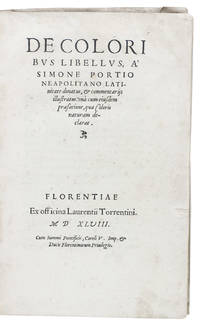
1548642CKI1RIA1QFlorence 1548. 4to. Lorenzo Torrentino Contemporary limp sheepskin parchment straight sewn on 3 wittawed thongs laced through the joints manuscript title down the spine with 4 fragments of a Latin manuscript in an upright humanistic hand on vellum used as spine lining. With 2 large woodcut historiated initials and a vine leaf ornament by Granjon Vervliet 178: 1st recorded in this year. Set in roman types with whole paragraphs in Greek 2 sizes and the dedication and some end matter in italic. 197 3 pp. First edition of one of the earliest printed books about colour translated from the Greek into Latin and with commentary by the Neapolitan physician and philosopher Simone Porzio 1497-1554. Usually attributed to Aristotle it is now thought to be the work of the peripatetic scholar and pupil of Aristotle Theophrastus.''As the author states at the end of the treatise it is intended rather to supply data for a detailed examination into the scientific theory of colour than to expound a complete thesis. He has realized that the development of colour in animals and plants depends to some extent on heat and he seems to suggest that heat and moisture are the controlling factors. It is of more value as a collection of observed facts than for any theory of the origin and development of colour in physical life'' Aristotle Minor Works Cambridge and London Loeb Classical Library 1936 p. 3.With some spotting on the title-page and some marginal tears not approaching the text but otherwise in very good condition and with large margins. Binding with the sewing supports broken a tear in the backstrip and some small stains. An important treatise on colour and one of the earliest.l Adams P1958; Caillet 8881; EDIT16 CNCE 16133; Hoffman I 289 "rare and very important"; Kemp The science of art p. 264; Schwab Bibliographie d'Aristotle 3503; USTC 803281. hardcover
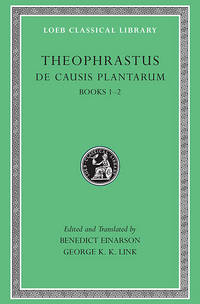
6827412Harvard University Press pp. 368 . Hardback. New. Harvard University Press hardcover
6827415Harvard University Press pp. 480 . Hardback. New. Harvard University Press hardcover
0674995236.Ghardcover. Good. Access codes and supplements are not guaranteed with used items. May be an ex-library book. hardcover
0674995198.Ghardcover. Good. Access codes and supplements are not guaranteed with used items. May be an ex-library book. hardcover
1161547614.Ghardcover. Good. Access codes and supplements are not guaranteed with used items. May be an ex-library book. hardcover
1892265601892 Montpellier : Ricard (1892),38 p. ; in8 broché,non coupé,bon etat.
1161563474.Ghardcover. Good. Access codes and supplements are not guaranteed with used items. May be an ex-library book. hardcover
1161567003.Ghardcover. Good. Access codes and supplements are not guaranteed with used items. May be an ex-library book. hardcover
1161591265.Ghardcover. Good. Access codes and supplements are not guaranteed with used items. May be an ex-library book. hardcover
In folio; due opere in un volume: (8), 396, (28) pp. e 143, (9) pp. Bella legatura seicentesca in piena pergamena con titolo in oro al dorso che si presenta a sei nervi, qualche lieve segno del tempo ma nel complesso in buone condizioni di conservazione. Bella marca tipografica di Guillaume Rouillé (1545-1589) al frontespizio di ogni volume. Alcune pagine leggermente ed uniformemente brunite a causa alla qualità della carta, ininfluente. Un leggerissimo alone ininfluente al margine esterno bianco delle ultime 10 carte del secondo volume e nel complesso ambedue le opere si presentano in buone-ottime condizioni di conservazione. Testatine, iniziali e finalini xilografici. Bell’edizioni stampate da Rouillé di queste due celebri opere del grande scrittore, medico e filosofo originario di Riva del Garda, Giulio Cesare Scaligero, latinizzato in Julius Caesar Scaliger (1484-1558). Di origine italiana, trascorse in Francia parte della sua vita, e la parte più fruttuosa della sua carriera. A dispetto del suo atteggiamento arrogante e incline alla polemica, era alta la sua reputazione tra i contemporanei, che lo giudicavano così distinto nel suo sapere e talento, che, secondo Jacques Auguste de Thou, nessuno degli antichi poteva essere collocato sopra di lui, e che l’età in cui visse non presentò nessun sapiente paragonabile a lui. Nelle proprie note biografiche, Scaligero si spaccia per un discendente del casato dei Della Scala (che furono, per 150 anni, i signori di Verona) e si dice nato nell’anno 1484 a Rocca di Riva, sulle rive del Lago di Garda. Era forse figlio di Niccolò della Scala, a sua volta figlio di Guglielmo.Quando era dodicenne, il suo protettore, l’imperatore Massimiliano I d’Asburgo, lo nominò tra i suoi paggi. Rimase per diciassette anni al servizio dell’imperatore, distinguendosi prima come soldato e poi come capitano. Ma non dimenticava di coltivare né le lettere, nelle quali aveva avuto come precettori alcuni tra i più eminenti studiosi del tempo, né le arti, che aveva studiato con considerevole successo sotto la direzione di Albrecht Dürer. Nel 1512 prese parte alla battaglia di Ravenna. Ma poco in verità è provato della vita dello Scaligero fino al 1525 quando divenne medico personale del vescovo di Agen, in Francia. Definiva i suoi studi classici come un gradevole rilassamento da compiti più severi. Qualsiasi siano state le sue vere faccende nei suoi primi 40 anni di vita, sicuramente queste lo resero un osservatore accurato e ravvicinato, e lo avevano reso edotto di molti fenomeni curiosi e poco noti, che aveva pienamente registrato in una tra le più tenaci memorie della storia. E’ celebre anche per aver in un certo modo anticipato il metodo induttivo. I due trattati qui presentati sono considerati fra i suoi più originali. In essi metteva a frutto le proprie dirette esperienze nel campo della botanica ed erboristeria, esperienze sia maturate nella sperimentazione diretta sia nella ricerca erudita di descrizioni di piante in fonti letterarie e artistiche, tanto classiche che moderne in parte mutate da Teofrasto ed Aristotele. Importante opera di botanica, farmacia ed erboristeria. Due rare edizioni. Good copies, rare. Bibliografia: I opera Pretzel 8090, II opera 8088.
0267356420.Gpaperback. Good. Access codes and supplements are not guaranteed with used items. May be an ex-library book. paperback
0267356919.Gpaperback. Good. Access codes and supplements are not guaranteed with used items. May be an ex-library book. paperback
0364199059.Ghardcover. Good. Access codes and supplements are not guaranteed with used items. May be an ex-library book. hardcover
0364503815.Gpaperback. Good. Access codes and supplements are not guaranteed with used items. May be an ex-library book. paperback
036493476X.Ghardcover. Good. Access codes and supplements are not guaranteed with used items. May be an ex-library book. hardcover
0365971502.Gpaperback. Good. Access codes and supplements are not guaranteed with used items. May be an ex-library book. paperback
0366161741.Gpaperback. Good. Access codes and supplements are not guaranteed with used items. May be an ex-library book. paperback