231 résultats
19862111902153303475Kokusho Publishing Association 1986. Soft Cover. Fine. Number of books: 1 Kokusho Publishing Association paperback
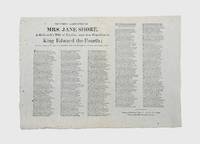
1810174973London: printed and sold by J. Pitts c.1810. An ephemeral broadside ballad detailing the story of Jane Shore a mistress of Edward IV and a popular cultural reference for many centuries. Shore's heavily fictionalized story featured many elements considered to have mass appeal in the era: a sexually voracious woman a relationship that transcended social hierarchies and an ending that punished transgressive behaviour. In Mrs. Jane Shore the eponymous character is described as a married woman who became King Edward's concubine and "lived in the court/With lords and ladies of great sort". Whilst she had influence over the King she ensured "to help the people that were poor" and "sav'd their lives condemned to die". Regardless her infidelity ultimately led to her social disgrace and she died in a ditch in East London. As detailed in the ballad urban mythology claimed that her unfortunate death gave the Shoreditch district its name. Ballads such as this were sung in a variety of communal spaces including pubs lodging houses and the streets and typically took criminal or socially deviant behaviour as their subject. In their own time broadside ballads were believed "to foster immorality and to glorify crime" O'Brien p. 16. More recent interpretations appreciate their literary and social value and consider that "their job was to voice tensions to work over the contradictions of human life" Gammon p. 237. Landscape single sheet 362 x 252 mm printed in columns. A little chipped at the edges but overall a well-preserved copy of a fragile publication. Vic Gammon "Song Sex and Society in England 1600-1850" Folk Music Journal vol. 4 no. 3 1982; Ellen L. O'Brien "'The Most Beautiful Murder': The Transgressive Aesthetics of Murder in Victorian Street Ballads" Victorian Literature and Culture vol. 28 no. 1 2000. unknown
1826014495T. Davison, Whitefriars 1826. 1.Auflage Dieser Ausgabe Goldgeprägter Ganzlederband Gut, Schön, Solide
1277442657.Gpaperback. Good. Access codes and supplements are not guaranteed with used items. May be an ex-library book. paperback
1286482283.Gpaperback. Good. Access codes and supplements are not guaranteed with used items. May be an ex-library book. paperback
1343415365.Ghardcover. Good. Access codes and supplements are not guaranteed with used items. May be an ex-library book. hardcover
1276685017.Gpaperback. Good. Access codes and supplements are not guaranteed with used items. May be an ex-library book. paperback
198953970Time Life, 1989. RRC-G02 CD CD
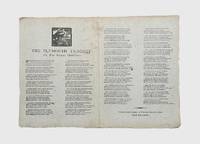
1809174972London: printed and sold by Jennings c.1809. A ballad telling a tragic tale of lovers tricked apart by "cruel" and "covetous" parents. Similar ballads often feature an unfaithful and avaricious antiheroine who suffers a cautionary downfall. Here however Susan is a "harmless maid" and it is families who are warned against prioritizing wealth over the happiness of the younger generation. The love triangle between a woman her husband and a sailor was a common trope in 17th- to 19th-century ballads but most had several key differences to this version. The woman was normally the one to prioritize financial gain unlike Susan who declares that "No wealth nor riches shall make me disloyal". The sailor was typically a demonic character sometimes the Devil in disguise whereas "sweet William" is an honest and faithful man. In most ballads only the woman dies while the sailor-demon escapes; both Susan and William perish here. Such entertaining ballads were an outlet for people "to voice tensions to work over the contradictions of human life" Gammon p. 237. The Plymouth Tragedy reflects an exasperation with the requirements on the young especially women to conform with their parents' desires at the expense of their own happiness. Single sheet 255 x 360 mm printed in columns. Woodcut vignette. A little nicked at edges old centre fold reinforced on verso with paper; overall a well-preserved copy of a fragile publication. Vic Gammon "Song Sex and Society in England 1600-1850" Folk Music Journal vol. 4 no. 3 1982. unknown
1830TH262Nottingham: The Review-Office 1830. Original Ediiton . No Binding. Vg. Folio. Broadslip Ballad 32x13cms 12 3/4 x 5 inces. Attractive half page broadside with a fine and attractive printed border to the verses. Small woodcut to the head of the page depicting a printing press.NO COPY TRACED. Believed to be printed at Suttons Review Office in Nottingham and dated 1830. 8 four line verses extolling the press and reflecting on events of the year just gone.William IV had taken the throne and was welcomed as a Royal Navy sailor and a reformer. Charles and Richard Sutton printers and proprietors of the liberal Nottingham Review <br/> <br/> The Review-Office unknown
1738WRCAM16147London 1738. 7pp. Woodcut frontispiece. Folio. Later wrappers. Minor tears at folds of leaves else good. First edition first issue. An extremely attractive 18th-century British ballad critical of Walpole's dealing with Spain. The full-page woodcut shows the Spanish king pulling the tale of the British lion which is about to mount a cart and be led away by a group of clerics harnessed to the wagon. The text attacks the British conciliation with Spain in 1738-39 and suggests that "you excise them in land I'll excise them by sea" in other words buccaneering. unknown books
1983100133103University of California Press 1983 622 pages 15 4x4 2x22 2cm. 1983. Broché. 622 pages.
56 pages. Colour photos of Frank Mills. Contains piano music, lyrics and chords for the following Frank Mills original piano solos: Storm Warning; On the Move; Reflections; Wish I Weren't Alone; The Happy Song; 401 West; A Children's Song; Ballad on a 'C' Scale; The Country Piper; Breakaway. Few markings. Somewhat above-average external wear. Binding intact. Book
pp. 16; 6 + 24 full page line engravings by Henry Moses. Text printed on one side only. Slight offsetting from plates. Slightly foxed. All edges gilt. Oblong 4to. 310 mm tall x 245 mm long. Original full red leather binding. Front board lettered and decorated in gold. Extremities worn with loss. Spine worn with major loss. The illustrator, Henry Moses (1782-1870) was, with Flaxman, the 19th century's most famous and accomplished engraver in outline. **PRICE JUST REDUCED! POETRY 4
Folded broadsheet (395 x 265mm), 7, [1]pp. Reprint of the early eighteen-century edition by and for W[illiam]. O[nley]. and are to be sold by C[harles]. Batess [sic, i.e. Bates].
43 pages. Includes lyrics, guitar chords and music for the following songs and more: The Aussie Bar-B-Que Song; The Ballad of Henry Holloway; And the Band Played Waltzing Matilda; Birds of a Feather; Bushfire; Goodbye Lucky Country; The Great Aussie Takeaway; Hard Hard Times; He's Nobody's Moggy Now; If Wishes Were Fishes; Just Not Coping; Little Gomez; No Man's Land - The Green Fields of France; Now I'm Easy; Old Friends; A Reason for it All; Safe in the Harbour; Scraps of Paper; Shining River; Soldier, Soldier; When the Wind Blows; Notes on the Songs. Undated. Appears to be circa 1980s. Moderate wear. Unmarked. Binding intact. A sound copy. Book
1333406517.Gpaperback. Good. Access codes and supplements are not guaranteed with used items. May be an ex-library book. paperback
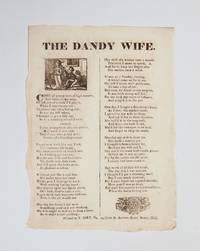
18285421London: T. Birt 1828. First edition. Single sheet measuring 250 x 185mm and printed in two columns to recto. Some edgewear to margins not affecting text; a bit of foxing and toning largely confined to margins. A scarce and delicate survivor OCLC documents only one example at the National Library of Scotland. The present is the only example on the market.<br /> <br /> The Dandy Wife is narrated by a man who aimed "to choose me out a loving wife" at the age of twenty-one but whose experience becomes a warning to "all young men of high renown": "If you want a tidy wife Beware of a boarding school." What unfolds is a satire of how the marriage economy is affected when women have access to knowledge -- intellectual and physical -- and how by meeting a man's superficial expectations a woman can fulfill her own more pressing needs.<br /> <br /> Thinking that a boarding school girl will have the innocence submissiveness and domestic skill he desires the narrator selects a wife from among their ranks. Thinking only of what he can obtain from such a bargain he is unprepared for what an educated woman brings into his house. The Dandy Wife he describes understands the commodity value of her own beauty and material adornment and that these are her key means for acquiring wealth of her own. "She takes one-half of what I earn In drinking gin and tea; Besides such frills and furbelows My Dandy Wife does wear.Her sleeves upon her dandy gown Oh! Lack they're such a size You'd think they were two balloons that in the air would rise." Aside from staying on par with fashion trends her clothing assists her in avoiding domestic tasks she abhors. She refuses to do laundry more than monthly and through ridiculous cooking failures she rapidly establishes that the kitchen is not a showcase for her skillset. Accustomed to a life of learning she is not trained to conduct domestic business. <br /> <br /> By the ballad's end it becomes clear that the Dandy Wife was savvier in managing a marriage than her husband was. For not only does her superior intellect help her carve out a more satisfying role but she also has physical knowledge that predates him: "The day that I was married I thought I'd got a charming maid But I was much deceived.For scarce five months we'd married been When she had a darling son. T. Birt unknown
41475Boston: Sold at the Bible & Heart in Cornhill n. d. Ca 1785. 1st printing thus and evidently the 3rd US edition Evans 19401; Ford 3015; Rosenbach 101. Now housed in an archival mylar sleeve. Edgewear & worming with some minor loss of text. Faint fold lines. Unobtrusive expert tissue mends. In lower margin in a period hand is inked: "Lycia Pratts Verses". A Fair - Good copy. Single sheet verse in thirty-eight stanzas triple column. First line: "Now ponder well you parents dear." Followed by two additional stanzas of verse entitled: "A Word of Advice to Executors." Crude woodcut of the fighting ruffians to the left of the sub-title. Folio. 12-1/2" x 8-1/8" <br/><br/>A popular childhood ballad first registered at Stationers' Hall in 1595 the piece also subsequently published as "The Babes in the Woods." <br /> <br />Shipton & Mooney record the first US edition as 1768 followed by the Heart & Crown imprint of the 1770s no copy located though see Rosenbach 64 then this Bible & Heart version ca 1785 date from Evans. <br /> <br />A quite rare 18th C. US children's broadside. Sold at the Bible & Heart, in Cornhill unknown books
1894j2359aDurham: Thos Caldcleugh. G : in Good condition without dust jacket. Cover rubbed and soiled. 1894. First Edition. Brown hardback boards with blue cloth spine. 260mm x 200mm 10" x 8". 43pp. Line drawings by Rev. N Temple Hamlyn. A poem to celebrate the battle of Hedgely Moor in Northumberland in 1463. Dedicated to the Right Honourable Earl Percy - illustrations undertaken with his Lordship's permission. Illustrations include Alnwick Castle Chillingham wild cattle Eglingham and the armorial bearings of the Percys Nevilles and other noble families recounted in the ballad. . Thos Caldcleugh hardcover
Undated. Appears to be circa 1980. Recorded versions with notes and tab. Authentic record transcriptions with guitar solos in tablature. Songs include: Before You Go; Breezin; Feel Like Makin' Love; Give Me the Night; In Your Eyes; Lady; Lady Love Me (One More Time); Love Ballad; On Broadway; So This is Love; This Masquerade; Turn Your Love Around; Welcome Into My World; We've got the Love. Average wear. Unmarked. A sound vintage copy of this wonderful compilation. Book
First and only edition, 12mo, [2], 45, [1]pp., with half-title, some minor spotting, orig. marbled paper wrappers, cont. manuscript notation of title and author on upper cover "The Battle of Newland 1790, By Benjn. Clarkson, Alverthorpe Hall". ESTC fails to attribute this to an any particular author, however, the contemporary inscription on the upper cover does give strong evidence to Benjamin Clarkson as being the writer of these poems. Benjamin Clarkson (d. 1820), a Wakefield attorney, resided at Alverthorpe Hall. "Several well known circumstances which happened some years ago in the town and neighbourhood of Wakefield, gave rise to the following Ballad". (Advertisement leaf). Rare; ESTC locating 4 copies (all in the UK).
19913119219Cambridge: Harvard University Press 1991. VIII, 317 Seiten. 8° (17,5-22,5 cm). Orig.-Broschur. [Softcover / Paperback].
200617002JLos Angeles: Netflix 2006. First Edition. Small format paperbound 5 1/2†x 8 1/2†112 pages. Specially printed for distribution to members of the Academy of Motion Pictures Arts & Sciences in consideration for nomination of the Best Adapted Screenplay. Shooting script for the film The Ballad of Buster Scruggs written and directed by Joel Coen and Ethan Coen from a story by Jack London starring Tim Blake Nelson Willie Watson Clancy Brown and James Franco. A perfectbound book looking like a trade paperback. The film was nominated for 3 Oscars; Best Adapted Screenplay Best Costume Design and Best Original Song ‘When a Cowboy Trades His Spurs for Wings’ by David Rawlings and Gillian Welch. Paperbound. A little rubbing to covers otherwise a fine copy Netflix paperback
179528043London 1795 1795. The only recorded edition. ESTC T204804 recording a single copy at Cambridge which contains the same apothecary's stamp. OCLC and COPAC record that same copy; Roud Folk Song Index V1851; and see Broadside Ballads Online at the Bodleian Library which also notes the apothecary's stamp. Paper repaired on the verso; some soiling and smudges; chipped in the upper margin with some loss but only to the blank margins; two small remains of mounting tape on the verso in the upper margin; a rare survival. Broadside 36 x 12 cm woodcut headpiece. Nine four-line stanzas. Attractive oval stamp in the lower margin of Peter Henry Chymist. A typical doggerel poem and somewhat bawdy written in the form of a slip ballad which begins "You young men all both far and near / Listen a while and you shall hear / Take care you're not drawn in a snare / By the girls that do love brandy / Wack Fla la &c." And in the fourth stanza: "'Tis on your backs girls you must lie / Pray which of you would this deny / A dish of tea or brandy." Etc. <br/><br/> [London, 1795?] unknown books