9 192 résultats
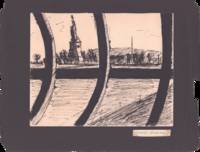
1941List2962New York City 1941. Thirty-three sketches mainly measuring 6 x 8 or 8 x 10 inches affixed to black construction paper. Sketches are pen and ink or pencil some with captions. With seventeen typed pages mainly measuring 6 ½ x 7 inches. In an 11 x 14 ½ inch portfolio. Spine of portfolio missing all pages separated; sketches excellent construction paper with much marginal chipping; typed pages with adhesive verso else excellent. Overall very good to excellent. Bitia Rosendor 1920–2011 was a Jewish artist born in Jerusalem and raised in Antwerp Belgium. Rosendor studied painting and sculpture at the Koninklijke Academie voor Schone Kunsten in Antwerp but her studies were interrupted by the outbreak of World War II. The Rosendor family fled Europe via Portugal in 1941 and were detained at Ellis Island where these sketches were produced.<br /> <br /> The sketches include portraits of other detainees and immigration employees and views from the island. Most have captions including brief notes about the subjects such as “She became hysterical and was taken to the hospital†“A little orphan going all alone to the Dominican Republic†and “‘Liberty’ through barsâ€â€”the latter on an illustration of the Statue of Liberty seen through the bars on the internment center’s windows.<br /> <br /> The typed text describes Rosendor’s experience waiting for the family’s Visa to be approved. The ordeal is mostly one of boredom; she writes:<br /> <br /> “Everyone had the same endless day to pass but everyone passed it differently. There was no possible way to be original but each of us retained her or his personality. The emptiness of the hours was heavy to bear.â€<br /> <br /> The boredom though is punctuated by “incidentsâ€; some negative as when “Once a Chinese girl wept for three days uninterrupted refused to eat refused everything†and some positive as when “A friend seen last time at the Antipodes†disembarks “from a newly entered ship . and suddenly: ‘YOU’! -’YOU’â€.<br /> <br /> Rosendor would live with her family in Brooklyn until the 1950s when she returned to Europe with her husband Jewish-American painter Martin Reisberg a fellow immigrant whom she met in the city. The pair returned to Belgium where they ran a gallery and created exhibitions together until Rosendor’s death in 2011.<br /> <br /> Of interest to scholars of the Holocaust American immigration and the Jewish immigrant experience in the 1940s. unknown
193365755München, Druck: Max Schmidt & Söhne, (1933). Typographisches Plakat auf gelbem Papier (60 x 81 cm).
19229121CFrankfurt/Main:, Omonuth., 1922. (ca. 16 x 16 cm). 12 Blatt / sheets. In Buchtasche / pocket: 5 gefaltete Blatt / 5 folded sheets (23 x 17 cm) und 4 kleine Blatt / 4 small sheets. (7,5 x 5,5 cm). Original-Halbleinen mit Deckeltitel / Original half cloth with title to front cover. [5 Warenabbildungen] Hinterer Deckel tintenfleckig, Blatt 3 mit blassen Tintenflecken, Blatt 10 mit kleiner Tinten-Anstreichung, sonst wohlerhalten. Altersentsprechend guter Zustand. / Rear board ink stained, one sheet with pale inkstains, another with small ink line, otherwi
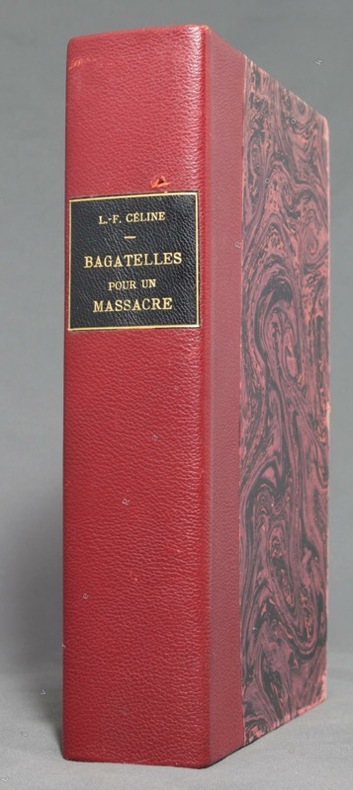
19378979Paris, Editions Denoël, 1937. In-8 broché de 379-[3] pages, chemise, étui avec le dos en chagrin rouge, pièce de titre en chagrin noir (petit choc au dos du-dit étui).
1978036043Tel Aviv (Israel)., Sinai Publishing., 1978. Mit deutscher Übersetzung und Erklärung von A. Sammter, Rabbiner. VI, 174S. Nachdruck der Ausgabe Julius Benzian, Berlin 1876 in einer einmaligen Auflage von 550 Exemplaren, hier Nummer 21. Die Ränder des Schutzumschlags sind minimal berieben, abgesehen hiervon ist das Buch in gutem Zustand. 4°. OKunstleder mit OUmschlag.
197119091971 Atelier Calevaert-Brun, Paris, (1971?). Petit in-folio, 40 xylographies, sous emboitage muet.
192043666Berlin: Fritz Gurlitt 1920. First Limited Edition. One of 100 special copies on handmade paper with each of the eight original lithographs signed by the artist. Quarto 32cm; parchment-backed marbled boards; 88 2pp; frontispiece and seven inserted leaves of plates. Discreet repairs to parchment spine; small stain to front board near crown; mild thumb-soil to preliminary leaves. In all a fresh Very Good or better copy with all the signed lithographs present and in fine condition. Text in German translated from the Yiddish by Alexander Eliasberg. The very uncommon deluxe issue of this illustrated edition of short stories by noted Polish author and playwright translated from the original Yiddish by Alexander Eliasberg. Includes the stories "Zwei Wege" "Der Glasscherben" "Der Kolonist" "Die vierfarbige Laterne aund die vier kleinen Hunde" "Vom Irren in der Wüste" "Messias Zeiten" "Ein Chanukkatraum" and "Die Schwalben." Each story is accompanied by an original lithographic illustration by the German expressionist painter/printmaker Jakob Steinhardt each plate pencil-signed by the artist. Only one copy of the deluxe issue recorded at auction in the past two decades Hauff & Auvermann Berlin 2009; four copies in North American institutions per OCLC. Fritz Gurlitt unknown books
193719628BBHamburg:, Hanseatische Verlagsanstalt, 1937-1941. Gr.-8°. 205; 232; 247; 272; 333; 314 S., Leinen 6 Bände. (Buchdeckel teilweise (leicht) verzogen; teilweise leicht stockfleckig; Stempel auf Titelblatt; Band 2: Ecken oben leicht bestossen; Band 4: Rücken abgeblasst; Band 6: Einband fleckig; insgesamt gut erhalten) (=Sitzungsberichte der Münchner Arbeitstagung des Reichsinstituts für Geschichte des neuen Deutschlands)
195035282btHeidelberg, Schneider, 1950. Leinen, Rahmenprägung, aufgeklebtes Titelschild am oberen Rücken, ca. DinA 5, VII+273 Seiten, 4 Tafelseiten mit 3 sw-Photos und 1 Schriftstück-Abbildung, Originalumschlag / Schutzumschlag / OU (gerahmt, gebräunt/ausgeblichen, Rücken fleckig), Einband mit minimalen Gebrauchsspuren, Rücken oben minimal bestoßen, Rückenschild gebräunt, Schnitt unregelmäßig gebräunt und gering fleckig, Schnitt und Seiten papierbedingt gebräunt, kleiner Eintrag auf dem Titelblatt, abgesehen vom Umschlag insgesamt gut erhalten / insgesamt guter Zustand [14 Warenabbildungen]
19644059FBHanau/Main, Verlag Werner Dausien, [um 1964]. Faksimile: Groß 2°. 52 x 41 cm. Textband: 4°. 35 x 25 cm. [2], 68 Blatt; 112 Seiten, [14] Blatt. Original-Lederband mit goldgehöhter Deckelillustration in Farbe und Original-Halbleinenband mit einfarbig gestrichenem Buntpapierbezug und papiernen Titelschildchen. In Original-Pappkassette. [12 Warenabbildungen]
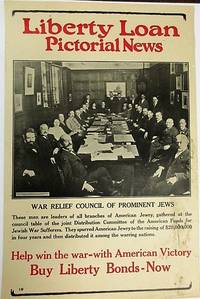
191835880New York Washington 1918. Folio broadside printed in red and black inks photo illustration of about thirty-five middle-aged and elderly gentlemen including Felix Warburg sitting around a long table on which rest many documents. Light soil to a portion Very Good.<br /> <br /> At the outbreak of World War I 60000 Jews in Ottoman Palestine faced starvation. The Joint Distribution Committee was organized at the instance of U.S. Ambassador to Turkey Henry Morgenthau and Jacob Schiff to alleviate the suffering. They raised the necessary funds and turned their attention to the nine million Jews along the Eastern Front. Felix Warburg was chairman; he and his colleagues were kept busy all during the War and thereafter. <br /> Not located on OCLC. unknown
191435880New York Washington 1914. Folio broadside printed in red and black inks photo illustration of about thirty-five middle-aged and elderly gentlemen including Felix Warburg sitting around a long table on which rest many documents. Light soil to a portion Very Good.<br/><br/> At the outbreak of World War I 60000 Jews in Ottoman Palestine faced starvation. The Joint Distribution Committee was organized at the instance of U.S. Ambassador to Turkey Henry Morgenthau and Jacob Schiff to alleviate the suffering. They raised the necessary funds and turned their attention to the nine million Jews along the Eastern Front. Felix Warburg was chairman; he and his colleagues were kept busy all during the War and thereafter. <br/>Not located on OCLC as of May 2019. unknown books
190716003JBoston: John W. Luce & Co 1907. First American Edition. Signed by Max Nordau with a revealing inscription dealing with anti-Semitism: “This play is called Doctor Kohn in the German original. The American editor insisted upon the change of title alleging an outspoken Jewish name would have a repulsing effect on the American reader and buyer. This shows remarkably an American publishers judgment of the degree of racial prejudice among his countrymen. Paris May 3d 1909 Dr. M. Nordau.†Max Nordau was a Hungarian-born doctor who settled in Paris in 1880 where he because a best-selling author not for his controversial works of social and artistic criticism and was a co-founder with Theodore Herzl of the Zionist Movement. Nordau helped draft the Basle Program at the first Zionist Congress in 1897 and played a major role in subsequent congresses. This book is the first translation in English which was originally published in German in 1898 and it concerns the question of intermarriage of Jews and Christians. Bookplate of writer Stephen Caplin. Very good plus to near fine copy in decorated gilt-stamped cloth. A remarkable copy. John W. Luce & Co hardcover books
190716003JBoston: John W. Luce & Co 1907. First American Edition. Signed by Max Nordau with a revealing inscription dealing with anti-Semitism: “This play is called Doctor Kohn in the German original. The American editor insisted upon the change of title alleging an outspoken Jewish name would have a repulsing effect on the American reader and buyer. This shows remarkably an American publishers judgment of the degree of racial prejudice among his countrymen. Paris May 3d 1909 Dr. M. Nordau.†Max Nordau was a Hungarian-born doctor who settled in Paris in 1880 where he because a best-selling author not for his controversial works of social and artistic criticism and was a co-founder with Theodore Herzl of the Zionist Movement. Nordau helped draft the Basle Program at the first Zionist Congress in 1897 and played a major role in subsequent congresses. This book is the first translation in English which was originally published in German in 1898 and it concerns the question of intermarriage of Jews and Christians. Bookplate of writer Stephen Caplin. Very good plus to near fine copy in decorated gilt-stamped cloth. A remarkable copy. John W. Luce & Co hardcover
193757464ABTel Aviv, The Maon Press, 1937. 29,5x21 cm. 31 meist einseitg bedruckte Blätter mit s/w. Abbildungen. Originalbroschur.
197218823ABBad Wildungen, Ars Grafica, 1972. 50 : 35,5 cm. 5 teils kolorierte Original-Radierungen, signiert und nummeriert, von Adolf Frohner. Original Bütten-Umschlag mit halbseitiger Illustration von Frohner und gedrucktem Text.
1938180959Jg. 8, Heft 17: des Saarlandes). Nachrichtenblatt der Synagogen-Gemeinde des Kreises Saarbrücken. Jg.7, Heft 48-53 (18. 1. - 22. 2. 1935) u. Jg. 8 - 11, Heft 1-6 (ab. Jg. 10, Heft 15 unter dem Titel: Jüdisches Gemeindeblatt der Synagogen-Gemeinden im Saarland). Saarbrücken, Saarbrücker Druckerei und Verlag AG (18. 1. 1935 - 27. 9. 1935) und Ludwigshafen, Neubauer, (11. 10. 1935 - 18. 3. 1938). - Beigebunden: Mitteilungsblatt der Israelitischen Kultusgemeinde Wiesbaden. Jg. 4, Nr. 6-25 u. Jg. 5, Nr. 1-6 (ab. Jg. 4, Heft 15 unter dem Titel: Jüdisches Gemeindeblatt der Israelitischen Kultusgemeinde Wiesbaden). Ludwigshafen, Neubauer, 24.3.1937 - 18.3.1938. 2 Bde. Format 35,5 : 25 cm u. 31,5 : 24 cm. Schlichte Halbleinenbände mit Buntpapierbezügen; etw. berieben. [8 Warenabbildungen]
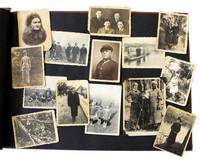
1939187411939. Polish Jewish family photographs created between 1934 and 1939 documenting Jewish life in Poland during the final years before the outbreak of World War II and the destruction of much of Eastern European Jewry. The photographs record members of a Polish Jewish family including men women and children during a period when Jewish communities remained deeply rooted throughout Poland but faced increasing political hostility and anti-Semitic agitation across Central Europe. Poland contained one of the largest Jewish populations in Europe during the inter war period with many families living in small Jewish communities often referred to as shutters as well as in larger towns and cities. The images capture everyday family and community life immediately before the German invasion of Poland in September 1939 a moment that would fundamentally transform the lives of Jewish communities across the region.<br /> <br /> Photo archive consisting of 21 silver gelatin photographs mounted in a photograph album together with 10 additional loose photographs. Images measure approximately 2.5 x 3.5 inches and depict family members in individual portraits group gatherings and scenes of school children assembled in large smiling groups. Several photographs carry handwritten inscriptions on the verso written in Polish and possibly Yiddish indicating personal exchanges between family members or relatives. Among the photographs are two portraits of a Polish Jewish man wearing Polish Army uniform one dated 1939 documenting Jewish participation in the Polish armed forces in the months immediately preceding the outbreak of war. The album pages preserve images of family gatherings and posed portraits reflecting domestic and social life within a Polish Jewish household during the final years of the inter war period.<br /> <br /> The photographs were created during a period of growing political instability in Europe that culminated in the German invasion of Poland on September 1 1939. That invasion followed the collapse of the German Polish non aggression agreement and the signing of the German Soviet pact that divided Poland between the two powers. German forces entered Poland with a large mechanized army supported by aircraft and armored divisions overwhelming the Polish military within weeks despite organized resistance. Jewish citizens served in the Polish armed forces and were present throughout the country's military and civilian life before the war. Album measuring approximately 15 x 11 inches containing 21 mounted photographs and accompanied by 10 loose photographs. Minor edge wear present with occasional cracks to several prints that do not affect the clarity of the images. Many photographs bear inscriptions and dates on the verso. Overall condition very good. unknown
190289547ABParis, Félix Juven, (1902). 34,7x27 cm. Frontispiz, 4 n.n. Bl., 21 s/w. Tafeln (davon 3 doppelblattgross), 3 n.n. Bl. HLederband mit goldgepr. Rückentitel, OBroschurdeckel eingebunden.
19151956-14Wien, Löwit 1915. 8°. 5 Bll., 71 (2) S. farb. Textileinbd. d. Zt. In gutem Zustand. EA
1931223BBZürich, Leipzig, Orell Füssli Verlag, 1931. 8°. 8 S., (english), 7 S. (hebrew). Mit 65 Abb. nach Photos von M. Vorobeichic. Illustr. Orig.-Halbleinenband + Wichtig: Für unsere Kunden in der EU erfolgt der Versand alle 14 Tage verzollt ab Deutschland / Postbank-Konto in Deutschland vorhanden +, 223BB (berieben und bestossen). = "Schaubücher", Bd. 27.
1931223BBZürich, Leipzig, Orell Füssli Verlag, 1931. 8°. 8 S., (english), 7 S. (hebrew). Mit 65 Abb. nach Photos von M. Vorobeichic. Illustr. Orig.-Halbleinenband (berieben und bestossen). = "Schaubücher", Bd. 27.
199617484San Francisco, Arion Press, 1996. 55 Bll. m. einer 2 farb., signierten Origin.-Radierung v. Michael Mazur, Folio, OBüttenkarton in OLwd-Mappe im OLwd.-Schuber (dieser am Rücken verblasst)
196231401BBMonte Carlo, André Sauret, 1962. 4° 211 S., Abb. mit Text, m. 2 Orig.-Lithogr. v. Marc Chagall. (Mourlot Press) OLw., O.-Umschl.., transp. Schutzumschl., im Schuber Su leicht bestossen, insgesamt sehr gut erhalten.
196221947BBMonte Carlo, André Sauret, 1962. 4° 211 S., Abb. mit Text, m. 2 Orig.-Lithogr. v. Marc Chagall. (Mourlot Press) OLw., O.-Umschl.., transp. Schutzumschl. Su leicht bestossen, insgesamt sehr gut erhalten.