29 747 résultats
First English edition of Der Judenstaat, published in German in the same year. [xii], 102, [1] ad, pages. "Let the sovereignty be granted us over a portion of the globe large enough to satisfy the reasonable requirements of a nation; the rest we shall manage for ourselves". - p.25. In his July 10, 1896 diary entry Herzl wrote "Paid the publisher David Nutt 19 pounds and a few shillings for the English edition. He has sold only 160 copies". - p.414 of "The Complete Diaries of Theodor Herzl". Moderate external soiling. Above-average external wear with a variety of small chips from and short openings to the thin paper covers. Binding intact. Prior owner's details in pencil, dated 1896, atop half-title, otherwise unmarked. A sound copy of this profoundly influential work by the acknowledged father of the Jewish state. Emanuel p.53 Book
First appearance of this prescient series of fictional letters, spanning sixteen months between 1932 and 1934, between a Jewish art dealer in San Francisco and his gentile business partner who has returned to Germany in the formative years of the Nazi regime. Simon & Schuster published the first book edition in 1939 and a film noir version followed in 1944. Subsequent stage play performances have continued globally until recent years. The magnum opus of Kathrine Kressmann Taylor [1903-1996], she was assigned the nom de plume Kressman Taylor by her husband and Story's editor Whit Burnett who, per an online reference, felt the concept of murder by mail was too strong to appear under the name of a woman. Occupies pages 20-32 of this 104 page magazine which is clean and unmarked with respectful wear. Front cover beginning to loosen and must be handled gently. Two-inch openings at head and foot of front cover at spine. A quality copy of this stunning literary achievement. Book
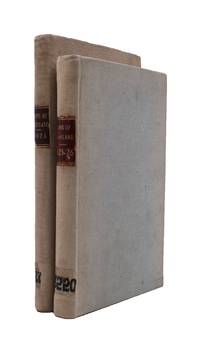
1825338079Annapolis: J. Hughes 1825. 167 1pp. The Jew Bill appearing on pages 154-155. With: Laws made and passed by the General Assembly of the State of Maryland at the Session begun and held at the City of Annapolis on Monday the Twenty-sixth Day of December 1825 which includes the enactment of the Jew Bill on page 21. 2 vols. 8vo. Later tan cloth. Association of the New York Bar inked stamps and blindstamps. 167 1pp. The Jew Bill appearing on pages 154-155. With: Laws made and passed by the General Assembly of the State of Maryland at the Session begun and held at the City of Annapolis on Monday the Twenty-sixth Day of December 1825 which includes the enactment of the Jew Bill on page 21. 2 vols. 8vo. Although Article VI of the Constitution of the United States declares that "no religious test shall ever be required as a qualification to any office or public trust under the United States" at the federal level many states continued to prevent Jews Catholics and Quakers from occupying public offices. Beginning as early as 1797 Jewish citizens of Maryland led by Jewish leaders Solomon Etting and Jacob Cohen had regularly but unsuccessfully petitioned the legislature for equal status. The "Jew Bill" as it came to be known was defeated in 1802 1804 1819 and 1823. In 1824 led by Irish Catholic Thomas Kennedy and with a Democrat majority in the legislature the Jew Bill was once again brought before the legislature passing at the beginning of 1826. <br /> <br /> The present volumes recording the laws passed by the General Assembly at those sessions include both the proposed law - that "every citizen of this state professing the Jewish religion . appointed to any office of public trust shall make and subscribe a declaration of his belief in a future state of rewards and punishments in the stead of the declaration now required." - and the final vote of passage on January 5 1826 ensuring to Jews the same rights and privileges as Christians in the state. <br /> <br /> An important record of a seminal moment in Jewish American history. J. Hughes unknown
39481Philadelphia: Printed by C. Sherman 5605. 8vo 5 volumes. 8 7/8 x 5 1/2 inches. Hebrew and English text on facing pages. Each volume inscribed at the head of the English-language title "To my beloved wife from her affectionate husband" the first volume with a later family annotation. Contemporary purple morocco spine in six compartments with raised bands lettered in gilt in the second and fourth repeating gilt decoration in others marbled edges marbled endpapers.<br/> <br/>Provenance: Solomon Nunes Carvalho each cover stamped in gilt<br/> <br/>Rare large-paper association copy of the first Jewish translation of the Pentateuch into English.<br/> <br/>More than any other person of his time Isaac Leeser 1806-1868 envisioned the development of a major center of Jewish culture and religious activity in the United States. He single-handedly provided American Jews with many of the basic religious texts institutions and conceptual tools they needed to construct the cultural foundation of what would later emerge as the largest Jewish community in the history of the Jewish people. Printed in 1845 this edition of the Pentateuch in five volumes included a vocalized Hebrew text of each of the Five Books of Moses together with an English translation and notes as well as the haftarot prophetic readings. Leeser actually began working on The Law of God in 1838. Among the factors involved in his decision to begin systematically working on a translation was the recent opening of Rebecca Gratz's Sunday School which met for the first time in March 1838 in Philadelphia and was desperately in need of appropriate study material. Students were compelled to use the King James Bible for want of a Jewish alternative. Religiously objectionable passages in other texts provided by Protestant organizations were either pasted over or torn out by Gratz's staff. Leeser who supported the Sunday School and was its chief academic resource person felt compelled to find more suitable texts for the students. The impetus for Leeser throughout was always his desire to provide the Jews of America with an English text of the Bible that was produced by one of their own and was not tainted by conversionist motivations. This copy with provenance to Solomon Nunes Carvalho who was a noted American painter photographer writer and inventor best known for traveling with John C. Fremont on his fifth expedition through Kansas Colorado and Utah. He published an account of that journey titled "Incidents of Travel and Adventure in the Far West; with Colonel Fremont's Last Expedition" 1860 and was considered a pioneer in travel photography. Isaac Leeser the hazzan of Congregation K.K. Mikveh Israel married Carvalho and his wife Sarah Miriam Solis on October 15 1845 in Philadelphia where Carvalho's father had a workshop.<br/> <br/>Rosenbach 569; Singerman 884; Goldman 7; Lance J. Sussman "Another Look at Isaac Leeser and the First Jewish Translation of the Bible in the United States" Modern Judaism Vol. 5 No. 2 Gershom Scholem Memorial Issue. May 1985 pp. 159-190. Printed by C. Sherman unknown books
39481Philadelphia: Printed by C. Sherman 5605. 8vo 5 volumes. 8 7/8 x 5 1/2 inches. Hebrew and English text on facing pages. Each volume inscribed at the head of the English-language title "To my beloved wife from her affectionate husband" the first volume with a later family annotation. Contemporary purple morocco spine in six compartments with raised bands lettered in gilt in the second and fourth repeating gilt decoration in others marbled edges marbled endpapers.<br/> <br/> Provenance: Solomon Nunes Carvalho each cover stamped in gilt<br/> <br/> Rare large-paper association copy of the first Jewish translation of the Pentateuch into English.<br/> <br/> More than any other person of his time Isaac Leeser 1806-1868 envisioned the development of a major center of Jewish culture and religious activity in the United States. He single-handedly provided American Jews with many of the basic religious texts institutions and conceptual tools they needed to construct the cultural foundation of what would later emerge as the largest Jewish community in the history of the Jewish people. Printed in 1845 this edition of the Pentateuch in five volumes included a vocalized Hebrew text of each of the Five Books of Moses together with an English translation and notes as well as the haftarot prophetic readings. Leeser actually began working on The Law of God in 1838. Among the factors involved in his decision to begin systematically working on a translation was the recent opening of Rebecca Gratz's Sunday School which met for the first time in March 1838 in Philadelphia and was desperately in need of appropriate study material. Students were compelled to use the King James Bible for want of a Jewish alternative. Religiously objectionable passages in other texts provided by Protestant organizations were either pasted over or torn out by Gratz's staff. Leeser who supported the Sunday School and was its chief academic resource person felt compelled to find more suitable texts for the students. The impetus for Leeser throughout was always his desire to provide the Jews of America with an English text of the Bible that was produced by one of their own and was not tainted by conversionist motivations. This copy with provenance to Solomon Nunes Carvalho who was a noted American painter photographer writer and inventor best known for traveling with John C. Fremont on his fifth expedition through Kansas Colorado and Utah. He published an account of that journey titled "Incidents of Travel and Adventure in the Far West; with Colonel Fremont's Last Expedition" 1860 and was considered a pioneer in travel photography. Isaac Leeser the hazzan of Congregation K.K. Mikveh Israel married Carvalho and his wife Sarah Miriam Solis on October 15 1845 in Philadelphia where Carvalho's father had a workshop.<br/> <br/> Rosenbach 569; Singerman 884; Goldman 7; Lance J. Sussman "Another Look at Isaac Leeser and the First Jewish Translation of the Bible in the United States" Modern Judaism Vol. 5 No. 2 Gershom Scholem Memorial Issue. May 1985 pp. 159-190. Printed by C. Sherman unknown
1st edition. Period-style gilt tooled Morocco leather. 12mo, various pagination (aprox 475 pages total) . Singerman 1285, Goldman 40. The first Ashkenazi machzor printed in America. Based upon the celebrated Wolf Heidenheim edition, Henry (Chaim) Frank of New York published in 1854 2 prayer-books for the Days of Awe: This volume for the New Year, as well as a volume for Yom Kipur. He issued this set following the Polish tradition and, simultaneously, a set following the German tradition. This enabled the newly rising community of Central European Jews to conduct services according to their own custom, as opposed to that of the Sephardic rite. Frank went on in later years to issue other volumes for other Holidays. A set (New Year and Yom Kipur) of the German tradition set with repairs sold at auction for over $17,000 with commissions in 2012. No copies from the Polish set have ever appeared at major Auction. New Year's Volume has Hebrew title page 1/7 in original in 6/7 in professional facsimile (English title page and all text pages original) in spine professionally repaired with original backstrip attractively laid down; Atonement volume in all original binding with wear, especially at foot of spine. Some foxing as expected. Together a very attractive, very good condition set of this exceedingly rare and important high point in American Jewish liturgical history. (AMR-69-13)
38544Philadelphia: Printed by C. Sherman for the Editor 5605. Five volumes 8vo. 7 1/2 x 4 3/4 inches. Hebrew and English text on facing pages. Contemporary black morocco covers elaborately tooled in gilt spine gilt with raised bands in six compartments yellow endpapers gilt edges expert repairs to joints and tops of spines.<br/> <br/>Provenance: M. Nathans name in gilt on the upper covers<br/> <br/>The first Jewish translation of the Pentateuch into English: in an elaborate contemporary binding.<br/> <br/>More than any other person of his time Isaac Leeser 1806-1868 envisioned the development of a major center of Jewish culture and religious activity in the United States. He single-handedly provided American Jews with many of the basic religious texts institutions and conceptual tools they needed to construct the cultural foundation of what would later emerge as the largest Jewish community in the history of the Jewish people. Printed in 1845 this edition of the Pentateuch in five volumes included a vocalized Hebrew text of each of the Five Books of Moses together with an English translation and notes as well as the haftarot prophetic readings. Leeser actually began working on The Law of God in 1838. Among the factors involved in his decision to begin systematically working on a translation was the recent opening of Rebecca Gratz's Sunday School which met for the first time in March 1838 in Philadelphia and was desperately in need of appropriate study material. Students were compelled to use the King James Bible for want of a Jewish alternative. Religiously objectionable passages in other texts provided by Protestant organizations were either pasted over or torn out by Gratz's staff. Leeser who supported the Sunday School and was its chief academic resource person felt compelled to find more suitable texts for the students. The impetus for Leeser throughout was always his desire to provide the Jews of America with an English text of the Bible that was produced by one of their own and was not tainted by conversionist motivations. This binding is consistent with similar bindings on gift books of the era published and bound by Lippincott. This example with provenance to M. Nathans likely Moses Nathans 1811-1873 a prominent congregant of Philadelphia's Congregation Mikveh Israel.<br/> <br/>Rosenbach 569; Singerman 884; Goldman 7; Lance J. Sussman "Another Look at Isaac Leeser and the First Jewish Translation of the Bible in the United States" Modern Judaism Vol. 5 No. 2 Gershom Scholem Memorial Issue. May 1985 pp. 159-190. Printed by C. Sherman for the Editor unknown books
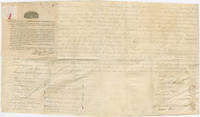
181825466<p>Elaborate receipt for Newport Rhode Island sale of land from estate of Benjamin Seixas 1747-1817 signed by numerous members of his family and members of the Spanish-Portuguese Jewish Congregation who were heirs to the property known now as the Buliod-Perry House at 29 Touro Street to Commodore Oliver Hazard Perry the great naval hero of the Battle of Lake Erie in 1813.</p> <b>EARLY AMERICAN JUDAICA. NAPHTALI PHILLIPS.</b>Manuscript Document Signed 1p folio 14½ x 21½ in. November 30 1818.<p><br /></p><p>This most important historic American Jewish document is signed by the following:</p><p><b>Jachebed Seixas</b> 1746-1828 wife of Moses Mendes Mendes.</p><p><b>Naphtali Phillips</b> 1773-1870. In 1796 Phillips took the first copy of George Washington's farewell address that came off the press of <i>the American Advertiser</i> a leading Philadelphia newspaper. In 1848 this document was placed in the cornerstone of the Washington Monument. On July 5 1797 Phillips married Rachel Hannah daughter of Moses Mendez Seixas a prominent Newport merchant and banker and a brother of Gershom Mendez Seixas known as "the patriotic Jewish minister of the American Revolution." Phillips was elected the first American born <i>parnass</i> of Mikveh Israel at the age of 25; he also helped to draft the new constitution of the synagogue. He soon returned to New York where he became <i>parnass</i>president of Shearith Israel the Spanish and Portuguese Synagogue by 1816 and served for 14 terms. He was prominent in the affairs of the Democratic Party in New York City.</p><p><b>Rachel Phillips</b> 1798-1861 daughter of Benjamin M. Seixas; wife of Naphtali Phillips.</p><p><b>Samuel Lopez</b> probably the son of David Lopez died 1822.</p><p><b>Judy Judith Lopez</b> wife of Samuel Lopez.</p><p><b>Abby Seixas</b> 1784-1860 the second child of Benjamin Seixas to be named Abigail the first died in 1782.</p><p><b>Grace Seixas</b> 1794-1866 daughter of Benjamin M. Seixas. Married Jacob I. Cohen.</p><p><b>Hetty Seixas</b> 1789-1854 daughter of Benjamin Seixas.</p><p><b>S.T. Northem</b> trustee for the Estate of Benjamin Seixas.</p><p><b>Bilhah Seixas</b> 1781-1860 daughter of Benjamin Seixas.</p><p>To the left bottom are signatures of witnesses to those of the Seixas family children and relatives who signed on the right bottom side.</p><p>Attached to the top of the Seixas document is a separate document with the seal of the New York mayor's office guaranteeing the handwriting and signature of a New York Commissioner William L. Morris who has recorded the instrument of property transfer.</p><p><b>Commodore Oliver Hazard Perry</b> 1785-1819 was an American naval commander the older brother of Commodore Matthew C. Perry. Perry served in the West Indies during the Quasi War of 1798-1800 against France in the Mediterranean during the Barbary Wars of 1801-1815 and in the Caribbean fighting piracy and the slave trade; but he is most remembered for his heroic role in the War of 1812 during the 1813 Battle of Lake Erie. Supervising the building of a fleet at Erie Pennsylvania against the British he earned the title "Hero of Lake Erie" for leading the American forces in a decisive victory at the Battle of Lake Erie for which he received a gold medal from Congress. His leadership materially aided the successful outcomes of all nine Lake Erie military campaign victories and the victory was the turning point in the battle for the West in the War. His famous words "Don't Give Up the Ship" were emblazoned on his battle flag and his message to General William Henry Harrison; "We have met the enemy and they are ours…" are two of the most famous military quotes in American history.</p><p>Perry bought the property at 29 Touro Street delineated in this document with the idea of eventually retiring there. Unfortunately in 1819 while commanding the frigate <i>John Adams</i> sailing for the Oronoco River in Venezuela in an attempt to once again discourage piracy in the Americas he contracted yellow fever and died on August 24th 1819 on his 34th birthday. His family continued to occupy the Newport property until 1865 when it became headquarters for a naval training ship aptly named <i>the Oliver Hazard Perry</i>. His body was brought back to Newport and he was buried in the Island Cemetery where his brother Matthew C. Perry is also interred.</p><p>A most important unique and historic Newport document linking one of America's greatest naval heroes and a major Jewish American family.</p><p>Ex-collection: Justin Turner; Dr. William Coleman; By descent to heirs of Dr. Coleman; Bruce Gimelson</p><b>Partial Transcript:</b><p>"<i>Know all men by these Presents that Jachebed Seixas of Newport in the County of Newport and State of Rhode Island and Providence Plantations Widow and Devisee of Moses Seixas late of said Newport deceased Naphtali Phillips of the City County and State of New York Gentleman and Rachel Phillips wife of said Naphtali Samuel Lopez of said New York Merchant and Judith Lopez wife of the said Samuel Bilhah Seixas Abigail Seixas Grace Seixas & Hetty Seixas all of said Newport single women and Stephen T. Northem of said Newport Merchant and Assignee of Benjamin Seixas of said Newport Gentleman in trust for the Creditors of the said Benjamin which said Rachel Judith Bilhah Abigail Grace Hetty and Benjamin are Children and Devisees of the said Moses Seixas; For and in Consideration of the sum of Four Thousand One hundred Dollars to us in hand well and truly paid before the unsealing and delivery hereof by OLIVER H. PERRY of said Newport Esquire the receipt whereof we do acknowledge have given granted bargained sold conveyed and confirmed and by these Presents do give grant bargain sell convey and confirm unto him the said OLIVER H. PERRY his Heirs and Assigns forever a certain Lot of Land situate in said Newport with the Dwellings house and other buildings thereon standing bounded North on Washington Square East on a gangway and on land of Asher Robbins: South on land late of Jonathan Marsh deceased and West on land late of Isaac Senter deceased being the same Estate on which the said Moses Seixas in his lifetime resided. To have and to hold the said granted Premises with the privileges and appertenances thereto belonging to him the said Oliver H. Perry his Heirs and Assigns forever.</i></p><p><i>And the said Naphtali Phillips and Rachel Phillips Samuel Lopez and Judith Lopez Bilhah Seixas Abigail Seixas Grace Seixas and Hetty Seixas for ourselves our Heirs Executors and Administrators do hereby Covenant to and with the said Oliver H. Perry his Heirs and Assigns that at and before the enscaling and delivery hereof the said Rachel Judith Bilhah Abigail Grace and Hetty are lawfully seized and possessed of six individual seventh parts of the said granted and described Premises in their own Right as of an Estate of Inheritance fee simple in remander that We have good right full power and lawful authority to sell and convey the same to the said Oliver H. Perry to hold as aforesaid that We our Heirs Executors and Administrators shall and will forever Warrant and Defend the said six seventh parts of the said granted and described Premises to him the said Oliver H. Perry his Heirs and Assigns against the lawful claims and demands of all Persons.</i></p><p><i> In Witness whereof the said Grantors have hereunto set our Hands and Seals this thirtieth day of November the Year One Thousand Eight Hundred and Eighteen</i>"</p> books
A modern Jew, perhaps for the first time, analyzes western civilization as an expression of the Gentile way of life and shows where this clashes with the nature and spiritual impulses of the Jew. - paraphrased from front flap of replica dust jacket included with this copy. "We Jews, we, the destroyers, will remain the destroyers for ever. Nothing that you will do will meet our needs and demands - The wretched fate which scattered us through your midst has thrust this unwelcome role upon us." - p. 155. "I console myself with the thought that if this book offends by its assertiveness, God knows that the infinite tactfulness of thousands of other Jews seems to have offended no less. Whatever we do we are damned - and I would rather be damned standing up than lying down." - p. 221. "Born in Romania, Maurice Samuel [1895-1972] moved to the United States in 1914. A Jewish intellectual and writer, he is best known for You Gentiles." - Wikipedia. [6], 7-221pp. 7.75" x 5.5". Narrow opening in binding at title page. Unmarked with average wear and soiling. Book
5614 [185354]. 1st edition. Original period deluxe tooled leather, 4to, [iv], 1011, [v] pages [1020 pages total]. COPY BELONGING TO JEWISH COMMUNAL LEADER AND DIPLOMAT BENJAMIN FRANKLIN PEIXOTTO (18341890), WITH HIS OWNERSHIP SIGNATURE ON THE FRONT ENDPAPER ("B.F. Peixotto, Cleveland, O. 1865"). Beautiful original period leather binding with tooled leather boards and board edges and raised bands. All Edges Gilt. The first edition of the first translation of the full Hebrew bible (Old Testament) into English by a Jew. Deinard 847; Singerman 1271; Goldman 12. Vinograd, Philadelphia 21. Very important work, Isaac Leesers magnum opus. In the preface, Leeser here writes of a life-long ambition to do for his fellow Hebrews who use the English as their vernacular, what had been done for the Germans by some of the most eminent minds That is, to present an Old Testament Bible in the peoples tongue which was unprejudiced against Jews. This task took Rabbi Leeser more than 15 years to complete. The Twenty-Four Books..., has remained Leeser's literary magnum opus and his most lasting contribution to Judaism in America. Printed in 1854, complete with "short explanatory notes, " his efforts at biblical translation had actually developed in stages, beginning almost two decades earlier. Leeser's first biblical translation was The Law of God, a Pentateuch (Five Books of Moses) in five volumes, published in 1845. According to Leesers biographer Lance Sussman, one factor convincing Leeser of the need for a Jewish-translated bible into English was the opening of Rebecca Gratz's Sunday School in March 1838, in Philadelphia. The school was desperately in need of appropriate study material, with students using the King James Bible for want of a Jewish alternative: religiously objectionable passages in other texts provided by Protestant organizations were either pasted over or torn out by Gratz's staff. Leeser, who supported the Sunday School and was its chief academic resource person, felt compelled to find more suitable texts for the students. Leeser's Bible, as it has come to be known, quickly became the standard Bible for English-speaking Jews, especially in America. The impetus for Leeser throughout was always his desire to provide the Jews of America with an English text of the Bible that was produced by one of their own and was not tainted by conversionist motivations. In his preface to the present volume, Leeser characterizes this culmination of his long years of endeavor as having finally provided for his fellow Jews "a version of the Bible which has not been made by the authority of churches in which they have no confidence." Benjamin Franklin Peixotto (18341890), the owner of this bible, was a lawyer, diplomat, and important Jewish communal leader. His mother, Rachel Seixas, and his paternal grandfather, Moses Levi Maduro Peixotto (Hazzan of New York's Congregation Shearith Israel from 1820-1828) were both members of important early New York Jewish families. Young Benjamin settled in Cleveland during 184766, writing frequent editorials for the daily Cleveland Plain Dealer. In 1855, Peixotto and [George A.] Davis founded the Hebrew Benevolent Society; Peixotto was its secretary. In 1863 Peixotto helped found the first Cleveland lodge of B'nai B'rith. In 1860, he founded the Young Men's Hebrew Literary Society, four years later convincing it to affiliate with B'nai B'rith as Montefiore Lodge (Ency Cleveland History, 2020). In addition, Peixotto was a follower of Democratic Senator Stephen A. Douglas of Illinois [Abraham Lincolns famous sparring partner in the Great Debates of 1858], under whose guidance Peixotto studied law. A trustee and founder of the Sunday School at Congregation Tifereth Israel (now The Temple), he served as Grand Sar (president) of B'nai B'rith during 186364 and was the prime mover for its Jewish Orphan Asylum (now Bellefaire) established in Cleveland in 1869 .Early in 1870, moved by the Romanian persecution of Jews, Peixotto succeeded in becoming the first U.S. consul in Bucharest, appointed by President Grant through the intervention of the Seligmans. His financial needs in the unpaid position, as well as political support, were provided, not always reliably, by a group of wealthy U.S. Jews, along with the B'nai B'rith, the Board of Delegates of American Israelites, and prominent French and English Jews led by Sir Francis Goldsmid. In Bucharest Peixotto pressed vigorously for Jewish emancipation, to which Romanian Jews were legally entitled by the Treaty of Paris of 1856, and also took the initiative in founding Jewish schools, cultural societies, and Romanian B'nai B'rith, as part of his plan to modernize Jewish life in that country .his well-publicized presence inhibited new antisemitic legislation and avoided or mitigated several pogroms .he continued to endorse emigration privately while serving in Bucharest until 1876. From 1877 to 1885 Peixotto was U.S. consul in Lyons .His son was George Da Maduro Peixotto (18591937), a painter .He became a notable portrait painter, executing portraits from life of Cardinal Manning, President McKinley, Chief Justice Waite, and John Hay, among others .Peixotto's portrait of Sir Moses Montefiore at the latter's centenary in 1884 hung in the Corcoran Gallery, and his painting of [Rabbi] Julius Bien hangs in the National Museum, Washington, D.C. (JewishVirtualLibrary). For more on this work, see: Israel Abrahams, Isaac Leesers Bible," By-Paths in Hebraic Bookland (Philadelphia: The Jewish Publication Society of America, 1920), 254-259. Ephraim Deinard, Kohelet america: yakhil reshimat kol ha-sefarim asher nidpesu ba-america mi-shenat [5]495 (1735) ad shenat [5]686 (1926) u-bikkoret ketsarah kimat al kol sefer, vol. 2 (St. Louis: Moinester Printing Company, 1926), 133 (no. 847). Yosef Goldman, Hebrew Printing in America 1735-1926: A History and Annotated Bibliography, vol. 1 (Brooklyn: Yosef Goldman, 2006), 12-13 (no. 12). Jonathan D. Sarna and Nahum M. Sarna, Jewish Bible Scholarship and Translations in the United States," in Ernest S. Frerichs (ed.), The Bible and Bibles in America (Atlanta: Scholars Press, 1988), 83-116, at pp. 84-92. Lance J. Sussman, Another Look at Isaac Leeser and the First Jewish Translation of the Bible in the United States," Modern Judaism 5,2 (1985): 159-190. Lance J. Sussman, Isaac Leeser and the Making of American Judaism (Detroit: Wayne State University Press, 1995), 150-151, 185-193. The most recent sale of any copy of this work at auction (2018) was for over $16,000 (with premium). Original tooled black leather binding expertly repaired, with some light wear and loss of gilt to boards and edges. Rubbing to lemon endpapers and small repairs to outer margins of some leaves. A beautiful copy of this landmark of American Jewish scholarship with important provenance. Very Good Condition (AMR-39-53-BD)
4to ; 1st edition thus. 18th Century Full Leather, 4to, 4 parts in 1 volume: [148] + [112] + [119] + [128] leaves, with four sectional woodcut title pages within elaborately decorated architectural framework, their first appearance. Steinschneider, M. Cat. librorum hebraeorum, 47, 277; Cowley, 83; VD 16; ZV 17573. The Pentateuch with the Early and Later Prophets and Hagiographa. Pointed Hebrew with cantillation. Title and further information on colophon. Some opening words have woodcut decorated frames. The title page designs were so impressive that they were used again in later editions such as the Frankfurt am Oder Hebrew Bible of 1595. With extensive scholarly notations in Latin in a 17th Century hand to margins and blank rectos of well over 400 pages. Signatures in Arabic and Roman numerals: Pts. 1-2. 1-654 (334 blank, 654 verso blank) -- pt. 3. 1-304 (303 verso blank, 304 blank) -- pt. 4. 1-324 (11 verso blank, 324 verso blank). Haftarot and Pesukim are recorded in the margins. Place of printing from colophon, which is on verso of last leaf: "Nidpas be-mitsvat Yohanan u-Khonrad Ruihl ha-ahim." SUBJECT(S): Bible. Hebrew -- Versions. Haftarot. OCLC: 123017672. OCLC-Worldcat lists copies worldwide (HUC, Yale, Cambridge, Edinburgh Univ, Oxford, British Lib, NLI, Bar Ilan), with only two in the US. Eight leaves missing (91-104). In the final volume, Ketuvim, four leaves show a touch of outer margin loss, with an additional seven leaves showing substantial margin loss but touching only a letter or two of text. Thirteen leaves show enough margin loss that text is affected though never more than the outer portion of the top six lines of any leaf. Three leaves with margin notes are affected. Margin notes predate the 18th century binding and in many cases appear to have suffered some loss with trimming and rebinding in the 18th Century. 16th Century rag paper and internal binding remain very nice. Beautiful 18th Century British binding with leather spine label and armorial bookplate on front pastedown remain outstanding. Very Good Condition thus. No copies appearing at auction in the last 25 years. Rare and important, with significant period marginalia. (KH-10-7)
First edition, first issue as indicated by the closing left flower vignette on the final page. Period Cloth with typical period Polish cloth spine and corners, 8vo, 86 pages. In German. Title translates as, "The Jewish State: The Search for a Modern Solution to the Jewish Question." First edition of Herzl's seminal call for an independent Jewish state. Der Judenstaat "has remained the single most important manifesto of modern Zionism and is one of the most important books in the history of the Jewish People" (Heymann, Bibliotheca Rosenthaliana--Treasures of Jewish Booklore 46:102-03). Insisting that assimilation was not the solution to millenia if suffering by the Jewish people, Herzl proposed instead that "sovereignty be granted us over a portion of the globe large enough to satisfy the reasonable requirements of a nation; the rest we shall manage for ourselves." First published in Vienna in 1896 as Der Judenstaat and in English that same year (in London by David Nutt), this work set forth Herzl's lifes work to "transform Zionism from a weak and insignificant movement into a world organization and a political entity that Great Britain was prepared to accept as the authorized representative of the Jewish people. This in turn led to the Balfour Declaration and eventually to the founding of the State of Israel" (EJ). "It was Herzl's book which really crystallized the idea of a national home for the Jews. Two conceptions had prevailed hitherto: either that of the ghetto, presupposing an unbridgeable gulf between Jews and Gentiles, or that of assimilation, which meant a complete acceptance by the Jews of their environment leading eventually to becoming among whom they lived. Herzl took a different view. By his work he transformed the Jewish people from a passive community into a positive political force" (PMM 381). Shows the acquisition, and then deaccession, stamps of a prominent Eastern European library. Auction sales for this work reached over $10,600 in 2020 and then almost $12,000 (with commissions) in 2021. In sum, Theodor Herzls Der Judenstaat is considered one of the most important texts of early Zionism. Published on February 14, 1896, translations into Hebrew, English, French, Russian, and Rumanian appeared in the course of the same year. Altogether the book was published in 80 separate editions in 18 languages. SUBJECT(S): Jews -- Restoration. Geschichte. Quelle. Zionismus. Zionism. Judentum. OCLC: 4952913. Rubbing to boards as expected. Early number on front board and stamp on title page; modern dime-sized library stamps on obverse of title and on final page. Very Good Condition thus. (KH-10-6-E)
ONE OF THE FIRST AND ONE OF THE GREATEST MODERN ILLUSTRATED BOOKS, WITH 20 ORIGINAL FULL-PAGE HORS-TEXTE LITHOGRAPHS BY HENRI DE TOULOUSE-LAUTREC. First edition of the text by Georges Clemenceau about the condition of Jews in Poland. Illustrated with 10 lithographs by Toulouse-Lautrec printed in black on Arches wove paper, with an additional suite printed in various tones on Chinese paper. The wraps, furthermore, are an original color lithograph: the front cover shows Moses receiving the Ten Commandments; the back cover shows the Golden Calf deposed from its pedestal (and is colored with gold ink). From a total edition of 380 numbered copies, this is one of 355 on fine Arches wove paper. 4to. BEAUTIFULLY BOUND BY MERCHER (fils) IN A PERFECTLY CONCEIVED AND EXECUTED MODERN BINDING: morocco spine lettered direct with plexiglass covers revealing the color lithographs on the wraps. Fine matching morocco- and fleece-lined slipcase. Top edge gilt, other edges uncut. FINE AND BRIGHT, AS NEW WITH ABSOLUTELY NO DEFECTS INSIDE OR OUT. The Artist & The Book 302; Chapon, p. 278; Skira 338; AdhÈmar 240-250; Adriani 213-223; Rauch 16; Stern 108; Strachan, p. 34. AN OUTSTANDING COPY OF A RARE AND IMPORTANT BOOK, IN PERFECT CONDITION.
Signed and inscribed by Jan Karski upon front free endpaper. Karski [1914-2000] recounts his experiences when his homeland of Poland was rent asunder by the joint Nazi and Soviet invasion of 1939, and his harrowing subsequent life as a member of the Polish underground, during which he was captured by the Gestapo and severely tortured. Provides a ghastly eyewitness account of life in the Warsaw ghetto, into which Karski was smuggled so his observations could be reported to the outside world. Firearms advocates will cringe at Karski's account of what happened after he and a large group of Polish soldiers handed over their weapons to their 'comrades' from the Soviet Union. In 2012 Karski was posthumously awarded America's highest civilan honor, the Presidential Medal of Freedom, by President Obama. 391 pages. Moderate wear to publisher's red cloth. Dust jacket now preserved in archival-grade Brodart. Binding intact. A sound copy of this truly unforgettable WWII narrative. Laska 672, Kehr & Langmaid 5407, Weiner Library Catalogue Seven 997, Enser p.343. Book
1st edition. Original gilt-tooled illustrated full leather, 12mo 323 pages. THE FIRST REFORM PRAYERBOOK IN AMERICA, ONE OF TWO VOLUMES (The other volume, Vol I, was Daily Prayers). Singerman 1384; Goldman 41, Deinard 967. 18 cm. On Title page: Revised By Dr.L. Merzbacher, Rabbi At The Temple Emanu-El." Published the year before Merzbergers death in 1856, when he was succeed by Samuel Adler. Leo Merzbacher (1809-1856), a native of Fuerth, Germany, was the first Reform Rabbi in America. His congregation, Temple Emanu-El utilized his prayer book (with revisions by Adler) from 1855 until 1895 whereupon it adopted the Union Prayer Book.Lacks a printers statement; printing by the Jewish Messenger is suggested by Goldman. SUBJECT(S): Judaism -- Liturgy -- Texts. Judai¨sme -- Liturgie -- Textes. OCLC: 19186429. Singerman & OCLC together list only 5 holdings worldwide (JTS, Harvard, Yale, HUC, LOC). Rubbing and some stains to boards, but binding is strong, and gilt tooling and leather remain very attractive. Some spotting, Very Good- Condition. Bookplate on pastedown, Synagogue stamp on blank endpaper, Pencilled 19th Century Jewish gift inscription on blank endpaper. An attractive copy of this very rare and important siddur volume. (AMR-69-12)
1st edition. Period-style gilt tooled Morocco leather. 12mo, various pagination (aprox 475 pages total) . Singerman 1284 (listing only 1 copy anywhere) , Goldman 40. The first Ashkenazi machzor printed in America. Based upon the celebrated Wolf Heidenheim edition, Henry (Chaim) Frank of New York published in 1854 2 prayer-books for the Days of Awe: This volume for the New Year, as well as a volume for Yom Kipur. This enabled the newly rising community of German American Jews to conduct services according to their own custom, as opposed to that of the Sephardic rite. Frank went on in later years to issue other volumes for other Holidays, and reflecting the customs of the Polish Jews as well. OCLC lists only 2 copies of this volume anywhere (Columbia and Yale) . A set (New Year and Yom Kipur) with repairs sold at auction for over $17, 000 with commissions in 2012. No copies have appeared at auction since then. Faint blindstamps on title pages. Exquisite tooled binding, an absolutely stunning copy. (KH-9-9-KK)
149458074Straßburg, [Drucker des Jordanus von Quedlinburg; Georg Husner], 1493-1494. Fol. Tlw. rubriziert u. mit in Rot eingemalten Initialen. 210 (Bll. 200, 201 u. das letzte weiß); 256 (das letzte weiß); 136 (das letzte weiß) nn. Bll. (Got. Typ., 2 Kol., 52 Zeilen), Späterer Pgmt.-Bd. (um 1700; Rücken alt m. weißem Ldr. überzogen) auf vier Bünden m. 2 goldgepr. Rückenschildern.
231, [1] pages. 9.2" x 6.3". Waton (1871-1959) was a Jewish philosopher keenly interested in the works of Marx and Spinoza. In the Foreword, dated 1939, he states "I convinced myself that human society is irresistibly and inevitably moving towards state capitalism and fascism. Further reflection also convinced me that this social transformation would inevitably bring upon the Jews great suffering. How could the Jews face this world situation? This question occupied my mind for the last twelve years. At last I reached the conclusion which I embodied in a program for the Jews. When the Jews declared war against Nazi Germany and fascism (in 1933), I saw that as a suicidal policy. Thus passed more than five years of ever-increasing suffering for the Jews. When the situation became so grave that the Jews themselves began to realize the gravity of the situation, the Spinoza Institute of America asked me to formulate my program." On page 199 he adds "We have to face the fact that the Leader of the German people has no doubt in his mind that the Jewish problem is the centre of all problems, not merely in Germany, but in the world. It is useless to dismiss this as an illusion, because if it is, it demands explanation. But it is no illusion." Brilliant gilt lettering upon front board. Light external wear. Binding tight. Faint patches of soiling to boards. Occasional light pencil marginalia and underlining until page 21. Moderate age-toning to contents. It is left to readers to ponder the impact Waton's program could have had upon twentieth-century history. Book
177734053[Venedig], per li figliuoli del qu. Z. Antonio Pinelli, 1777. XXXIX, (1) SS. Mit Holzschnittdruckermarke am Titel. Weißer italienischer Interimspappband der Zeit. Gr.-4to.
xvii, 301, 32 [ads] pp. 7.5 x 5.3 inches. "The circumstances under which the wealth, the power, and the numbers of the Jewish race domiciled in this country are likely to be indefinitely increased seem to call for more prescience and thought at the hands of our rulers than have yet been bestowed upon them. To make people think is the object of this book. Should they refuse, they will wake up one morning only to discover that they have parted with the realities of national life, and are dominated by cosmopolitan and materialist influences fatal to the existence of the English nation." - Introduction. Chapters include: What is a Jew?; The Problem in Russia; The Jew in Austria/America/France/England/The Argentine Colonies; The Aloofness of Israel; Money Lenders; The Destitute Alien in Great Britain; Zionism; "Darkest Russia"; The Conversion of the Jews; Jewish Humour. Quarter-bound in black leather and olive cloth. Gilt lettering to spine. Top edge gilt. Modest lean to spine. Binding intact. Prior owner's name, dated 1899, inked atop front free endpaper. Large rectangular tanned area upon front free endpaper, presumably caused by an item formerly laid-in. Average wear. Faints spots upon front board, perhaps from water droplets. SINGERMAN 46. Book
Contemporary morocco. 12mo. XXIV, 213 pages. IV, 136; 17 cm. In French. De la religion des Brahmines, first French edition. Apologie Du Spinosa, second printing. A travelogue on the mores, customs, language, religion, and philosophy of Hinduism, contains two folded engraved tables; French translation from On the Origin and Nature of Despotism in Hindostan by Alexander Dow. The translator, Claude Francois Bergier (1721-1784) , was a French Jurist, writer, and English translator (including Fergusons Essay on Civil Society) . An Apology for Spinoza and Spinozism, contains Lettre à M. Helvetius dated 15 juillet 1766: pages [125]-136 (Letter to Helvetius in the 1810 edition, absent from the 122 page Altona 1805 edition) . Bound in contemporary morocco, with gilt tooled edges and spine, decorative endpages. Subjects: Spinoza, Benedictus de, 1632-1677. India - History. Mogul Empire. OCLC lists 17 copies of Apologie Du Spinosa; 8 copies of De la religion des Brahmines, which sold for ove USD 6700 alone at auction in 2011. Light rubbing to extremities of morocco, otherwise fresh and clean. Very good + condition. (KH-1-6)
2nd Revised Edition, edited, revised, and corrected by S. Adler, 1st printing thus. Original gilt tooled leather, 8vo, 396 pages. In Hebrew and English on facing pages. Formerly Singerman 1780, now merged into Singerman 1667 as vol II, variant 1 (Thalmessinger & Cahn). The second of two volumes [vol. 1 Daily prayers & vol. 2. Prayers for the Day of Atonement] substantially reworked by Adler and published 1860 (vol. I) and 1863 (vol. 2, here). Together these comprise the First Edition of Samuel Adlers revised edition of Leo Merzbachers 1855 Prayer-Book. The first prayer-book to contain an English rather than German translation of the prayers. Despite the modest title-page, Adlers production here was not merely a revision, but in actuality he completely reworked it and added to and entirely altered the liturgy. Rabbi Leo Merzbachers original version of the prayers was quite traditional. As resourceful and accomplished a liturgist as Merzbacher proved to be, he seldom sought to willfully turn aside from the traditional cannon (Friedland p. 36). Samuel Adler, on the other hand (Merzbachers successor at Temple Emanu-El of New York) had no such reservations about adopting radical change to the structure of the prayer-book. In his version of the Order of Prayer Adler did not rely on sources in Jewish tradition, rather he changed the prayers according to his subjective views of how synagogue services should be conducted. (See Eric Lewis Friedland, (Brandeis University dissertation) The Historical and Theological Development of the non-Orthodox Prayerbooks in the United States, 1967). Indeed it was precisely this 1860-1863 version of the Order of Prayer that was adopted by Temple Emanuel in New York, and all subsequent issues of the Order of Prayer utilized this version containing Samuel Adlers revisions. The Union Prayerbook itself was largely based on Adlers 1860-1863 revisions. Consequently, this prayer-book was also the cause of much controversy. Orthodox Rabbi Bernard Illowy of St. Louis fumed, that whomsoever utilized this so-called prayer-book was to be entirely excluded from all religious communion (see Michael A. Meyer, Response to Modernity: A History of the Reform Movement (1995) p. 237). Leo Merzbacher (1809-56) received his Rabbinic ordination from the celebrated R.abbi Moses Sofer of Pressburg (the Chasam Sofer), the leading opponent of the Reform movement. Merzbacher immigrated to America in the 1840s and was appointed the first rabbi of Temple Emanuel in New York where he served until his death. He adopted changes in synagogue custom such as the prominent use of an organ and eradicating the observance of the second day of festivals. Samuel Adler (1809-91) replaced Merzbacher in Temple Emanuel in 1857, following the laters death, where he served until 1891. Adlers son, Felix, was the founder of the Ethical Culture movement. SUBJECT(S): Siddurim -- Texts. Reform Judaism -- Liturgy -- Yom Kippur -- Siddour -- Textes. Judai¨sme re´forme´ -- Liturgie -- Yom Kippour -- OCLC: 78354364. OCLC lists 8 copies worldwide (HUC, Penn, Harvard, JTS, United Lutheran Seminary, GWU, UWisc-Mad, Maduro Foundation). A copy of Vol I by itself sold for over $6200 (with commission) at auction in 2016. Lacks top 1 inch of backstrip (spine covering) and rear blank endpaper; wear to boards, some stains, but solid good condition. Rare and Important (AMR-69-11)
174884781ABZürich, Getruckt, in Bürcklischer Truckerey, (Zürich, Verlegts David Herrliberger, Basel, gedruckt bey Daniel Eckenstein), 1748; (1750-1751). 38,8x26 cm. Gestoch. Porträt Picards, gestoch. Frontispiz, 16 S. (Erklärung des Kupfer-Titels, Vorbericht, Vorrede von Johann Friedrich Stapfer Bern, datiert 1758, inkl. Titel in Rot/Schwarz) , 27 S., (1) S. Tafelverzeichnis mit Erklärungen, 36 n.n. S. Register, 2 n.n. S. Verbesserungen. Mit 6 gestochenen Zwischentiteln (1744-1748) und 221 (32 gefalt.) Kupfertafeln mit 606 Abbildungen; 42 S. Text, 12 S. Tafelverzeichnis mit Erklärugen (inkl. 2 Titelblättern in Rot/Schwarz). Mit 13 (1 gefalt.) Kupfertafeln mit 25 Abbildungen. Halblederband des 19. Jhdts. mit rotem Rückenschild.
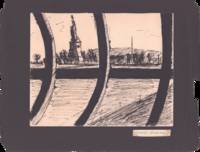
1941List2962New York City 1941. Thirty-three sketches mainly measuring 6 x 8 or 8 x 10 inches affixed to black construction paper. Sketches are pen and ink or pencil some with captions. With seventeen typed pages mainly measuring 6 ½ x 7 inches. In an 11 x 14 ½ inch portfolio. Spine of portfolio missing all pages separated; sketches excellent construction paper with much marginal chipping; typed pages with adhesive verso else excellent. Overall very good to excellent. Bitia Rosendor 1920–2011 was a Jewish artist born in Jerusalem and raised in Antwerp Belgium. Rosendor studied painting and sculpture at the Koninklijke Academie voor Schone Kunsten in Antwerp but her studies were interrupted by the outbreak of World War II. The Rosendor family fled Europe via Portugal in 1941 and were detained at Ellis Island where these sketches were produced.<br /> <br /> The sketches include portraits of other detainees and immigration employees and views from the island. Most have captions including brief notes about the subjects such as “She became hysterical and was taken to the hospital†“A little orphan going all alone to the Dominican Republic†and “‘Liberty’ through barsâ€â€”the latter on an illustration of the Statue of Liberty seen through the bars on the internment center’s windows.<br /> <br /> The typed text describes Rosendor’s experience waiting for the family’s Visa to be approved. The ordeal is mostly one of boredom; she writes:<br /> <br /> “Everyone had the same endless day to pass but everyone passed it differently. There was no possible way to be original but each of us retained her or his personality. The emptiness of the hours was heavy to bear.â€<br /> <br /> The boredom though is punctuated by “incidentsâ€; some negative as when “Once a Chinese girl wept for three days uninterrupted refused to eat refused everything†and some positive as when “A friend seen last time at the Antipodes†disembarks “from a newly entered ship . and suddenly: ‘YOU’! -’YOU’â€.<br /> <br /> Rosendor would live with her family in Brooklyn until the 1950s when she returned to Europe with her husband Jewish-American painter Martin Reisberg a fellow immigrant whom she met in the city. The pair returned to Belgium where they ran a gallery and created exhibitions together until Rosendor’s death in 2011.<br /> <br /> Of interest to scholars of the Holocaust American immigration and the Jewish immigrant experience in the 1940s. unknown
First edition. Original beautifully illustrated broadside showing the hospital and with important names of hospital directors and committees. Mounted and framed in a wooden frame. Picture 11x16.5 cm, frame 22x28. Broadside page appears to be from an event related to the official re-naming of the Jews Hospital in New York to Mount Sinai Hospital. Jews' Hospital (later famously renamed as Mount Sinai Hospital) was founded in 1852 by Sampson Simson (1780-1857) to address the needs of New York's rapidly growing Jewish community. At the time, New York City hospitals often discriminated against Jews - refusing them treatment as patients as well as blocking the hiring of Jewish medical staff. The Jews' Hospital in the City of New York, as it was initially called, inaugurated its first building in 1855, in what was then a rural neighborhood on West 28th Street between Seventh and Eighth Avenues on land donated by Simson. Just a short few years later the 45-bed hospital would be unexpectedly filled to capacity with soldiers wounded in the U. S. Civil War. In 1866 it was renamed Mount Sinai HospitalThe medical staff was primarily Jewish, because until relatively recently, it was difficult for Jewish doctors to obtain postgraduate training or specialist posts at major New York hospitals. (See T. Levitan, Islands of Compassion: A History of the Jewish Hospitals of New York. 1964) . A comparable item but without the important listings of names sold for over USD 6, 000.00 at auction in 2015 SUBJECT(S) : Mount Sinai Hospital. Very minimal markings and wear. Slight toning. Very good + condition. Attractive. (AMR-53-8)