ANACREONBiblio.com

422 résultats
1804AQ16787Yarmouth: Printed by John Beart for B. Crosby and Co. London 1804. 27 1 144pp. With an engraved frontispiece. Contemporary olive green half-morocco marbled boards lettered in gilt. Extremities rubbed. Marbled endpapers later book-label of Ed Grabhorn to FEP offsetting to title-page slight damp-staining to rear blank fly-leaf and RFEP. A provincially published translation by physician and writer Thomas Girdlestone 1758-1822 of the verse of Greek lyric poet Anacreon; first printed in 1803. . Second edition. 8vo. Printed by John Beart, for B. Crosby and Co. London hardcover
19015894New York City: New Amsterdam Book Company. Very Good. 1901. Limited/Numbered Edition. Hardcover. Handsome limited Edition #21/60. Clean brown cloth Brown leather corners & spine decorated with gilt. Text tight clean intact & printed on deckle-edge paper. Top edge gilt. Marbled endpapers. 10 illustrations on plate paper colored by hand. Poetry ; Hand-painted; 8vo 8" - 9" tall; 134 pages . New Amsterdam Book Company hardcover
B9781020498329Hardback. New. hardcover
0484713108.Ghardcover. Good. Access codes and supplements are not guaranteed with used items. May be an ex-library book. hardcover
0267389434.Ghardcover. Good. Access codes and supplements are not guaranteed with used items. May be an ex-library book. hardcover
1385556994.Ghardcover. Good. Access codes and supplements are not guaranteed with used items. May be an ex-library book. hardcover
1357303394.Ghardcover. Good. Access codes and supplements are not guaranteed with used items. May be an ex-library book. hardcover
1358765227.Ghardcover. Good. Access codes and supplements are not guaranteed with used items. May be an ex-library book. hardcover
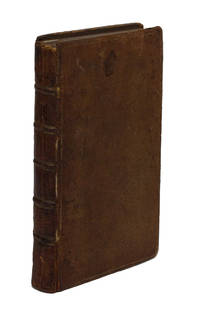
1760r007.063GB: J Newbery; L Davis; C Reymers 1760. Full brown leather with burgundy title label lettered in gold on spine. 165 x 100 mm. 10 and 322 pages. Stamped in lilac "The Goring Hotel Propr." on front end paper and rear pastedown. Circular red stamp for the Whitehall Club on title page. Fairly clean tight text. Spine has been neatly rebacked. . Hardback. G/No DW. J Newbery; L Davis; C Reymers Hardcover
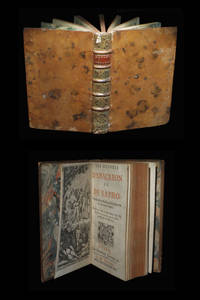
170461700à Paris: Chez Pierre Ribou 1704. Fine. Chez Pierre Ribou à Paris 1704 9.50 x 16.50 cm relié First edition of De la Fosse's translation. Greek text with facing translation. A medallion portrait of Anacreon at the frontispiece. Catalogue at the end. Contemporary full polished brown calf binding. Decorated spine with raised bands. Red morocco title label. Head torn with losses to joints. Upper joint split at tail. 4 corners bumped. Preface on the work and various translations of the odes. Each ode is followed by translator's notes. Following the 55 odes Poems by M.D.L.F. then Discourse delivered in Florence to determine which are the most beautiful eyes blue or black. Chez Pierre Ribou hardcover
173564712London: Printed for John Watts at the Printing Office 1735. First Addison Edition. Small octavo.<br> <br> Original full brown calf. Spine hinges cracked on front and rear but holding. Previous owner's stamp on front free endpaper. Browning to endpapers. Very good.<br> <br> HBS 64712.<br> <br> $400. Printed for John Watts at the Printing Office unknown
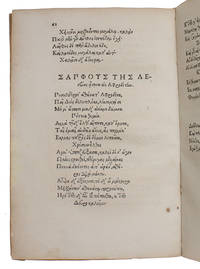
173564712First Addison Edition of Works of Anacreon ANACREON. Works of Anacreon Translated Into English Verse; With Notes Explanatory and Poetical. To which are added the Odes Fragments and Epigrams of Sappho. With the Original Greek plac'd oppisite to the Translation. By Mr. Addison. London: Printed for John Watts at the Printing Office 1735. First Addison Edition. Small octavo. Original full brown calf. Spine hinges cracked on front and rear but holding. Previous owner's stamp on front free endpaper. Browning to endpapers. Very good. HBS 64712. $400 Printed for John Watts at the Printing Office unknown books
6827660Harvard University Press pp. 560 Index. Hardback. New. Harvard University Press hardcover
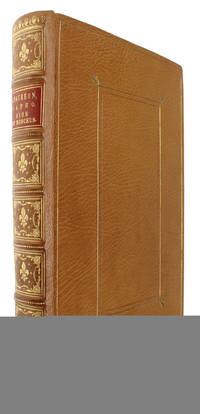
1864WB16253Paris: Ambroise Firmin-Didot 1864. Hardcover. Near Fine. 24mo 140 x 85mm. Pagination: iii-xlvii 158pp. including table. Signatures: a6 b-44 1-204 including final blank. Title printed with engraved border of muses and signed by engravers H. Catenacci - Hercules Louis Catenacci 18161884 and A. F. Lemaitre - Augustin Francois Lemaitre 17971870. 54 photolithograph plates of Girodets compositions illustrating the odes with fine classical figures and settings. Greek text with French prose translation for 64 odes by Ambrose Firmin-Didot. Text printed within red ruled borders with headings printed in red. Finely bound in a French 19th-century crimson morocco covers gilt with central ornament spine with five raised bands lettered in gilt: ODES DANACREON / F. DIDOT 1864 inner gilt dentelles marbled endpapers edges gilt custom cloth case; only slightest wave to a few leaves otherwise a very good and attractive copy. Front pastedown with the typographic bookplate of Robert Percy Alden an American Gilded Age lawyer and collector hailing from Pennsylvania who died in 1909. <br/><br/>Fine French edition of the Odes of Anacreon edited and produced by Ambroise Firmin-Didot 17901876 reusing the illustrations in a reduced scale by the French artist Girodet Anne-Louis Girodet de Roussy-Trioson 17671824. Girodets graceful neoclassic designs were executed in the revived Second Empire style and engraved by his pupil Henri-Guillaume Chatillon 17801856. J. B. de Saint-Victor originally commissioned the Girodet illustrations in 1808 but only two complete designs were published with his translation in 1810. Girodet continued to work on the illustrations privately as well as his own translation of the ancient Greek Odes until his death in 1824. Ambroise Firmin-Didot was an accomplished classicist editor and man of letters within the established line of Didot printers in Paris. This production is an outstanding example of one of the finely printed classics issuing from the renowned Didot press. It maintains the distinctive Didot typographic layout and refined use of red and black inks. The introductory text of a later English edition of the Odes 1869 by Thomas Moore notes that the Firmin-Didot edition was sold at the almost prohibitive price of two pounds. Wonderful copy most likely bound for Robert Percy Aldens American villa-library in the late 19th century. Alden spent several of his Yale post-graduate years in Europe and was married in Paris in 1878 when he likely procured this book. Ambroise Firmin-Didot hardcover books
177749026Glasguae: excudebat Andreas Foulis 1777. 8vo pp. 100; Greek text in large type with Latin footnotes; contemporary paneled calf gilt-ruled borders gilt-ruled spine in 6 compartments with blind-stamped details red speckled edges; spine chipped and label perished later signature on flyleaf a good sound copy. Gaskell 610. <br/><br/> excudebat Andreas Foulis unknown books
17744042Paphos i.e. Paris: Le Boucher 1774. 8vo. 4iv280pp. Plus the cancelled leaf N3 strangely bound following the frontispiece of the second volume see below. Illustrated with an engraved frontispiece by Eisen and numerous engraved head and tailpieces. BOUND WITH: Musaeus Grammaticus and Moutonnet de Clairfons Theocritus and others. HERO ET LEANDRE Poem de Musee on y a Joint la Traduction de Plusieurs Idylles de Theocrite. Par M. M. C. Sestos i.e. Paris: Le Boucher. 1774. xvi104pp. Engraved frontispiece by Eisen. Cont. mottled calf ornately gilt spine rubbed & with small chips at extremities front hinge cracked but still holding soundly. A.e.g. Le Boucher unknown books
1692265151692. A Paris chez Charles Clouzier 1692. Un vol. au format pt in-12 153 x 98 mm de 1 frontispice gravÂŽ n.fol. 9 ff. n.fol. 398 pp. 1 f. de catalogue ÂŽditeur n.fol. in fine et 1 f. bl. Reliure de l'ÂŽpoque de plein veau marbrÂŽ havane plats jansÂŽnistes dos ˆ nerfs richement ornÂŽ de filets gras ˆ froid caissons d'encadrement dorÂŽs larges fleurons dorÂŽs semis de pointillÂŽs et d'ÂŽtoiles dorÂŽs piÂce de titre de maroquin acajou titre dorÂŽ palette dorÂŽe en tÂte et queue dentelle dorÂŽe sur les coupes tranches rouges. L'exemplaire - revÂtu d'une reliure dÂŽcorative du temps - s'ouvre sur un dÂŽlicat frontispice allÂŽgorique gravÂŽ signÂŽ ; rn regard d'une vignette gravÂŽe en page de titre. Edition en grec avec traduction franÂaise en regard par Hilaire-Bernard Derequeleyne Baron de Longepierre. AnacrÂŽon se consacre principalement ˆ la poÂŽsie amoureuse et ˆ la poÂŽsie de banquet. Son style se caractÂŽrise par sa lÂŽgÂretÂŽ doublÂŽ de son charme. Quant ˆ SapphoSolon aprÂs avoir entendu la lecture d'un de ses poÂmes dÂŽclara : Ç mon dÂŽsir est de l'apprendre et de mourir ensuite È. Brunet I Manuel du libraire et de l'amateur de livres 254. Abrasions en marge des plats. Petit manque en tÂte et queue du dos. Feuillets lÂŽgÂrement oxydÂŽs. Du reste belle condition. Peu courant. b42961 unknown
53114Glasguae Glasgow : Excudebant R. & A. Foulis M.DCC.LI. 1751 . A very good full leather miniature binding with slip-case. 81mm x 52mm x 9mm. 4pp./pp.75/3pp. 32mo. Later brown calf probably 19th century with gilt filet border. Spine with gilt titles and four raised bands. Ink spots to spine and rear board. Previous owner's signature to top of title-page: "Arnage 1804." Clean Greek text throughout. Numerous pencil underlinings one page of inked Greek text to rear endpaper. Title transliterated from the Greek preceded by an additional title-page in Latin: "Anacreontis Carmina. Cum Sapphonis Et Alcaei Fragmentis." Contains the songs of Anacreon and fragments of Sappho and Alcaeus. Referenced by: Gaskell 181 - The Foulis Press ; ESTC T085607 "Anacreon 582 BCE�485 BCE was a Greek lyric poet born in Teos an Ionian city on the coast of Asia Minor. He likely moved to Thrace in 545 BCE with others from his city when it was attacked by Persians. He then moved to Samos to Athens and possibly again to Thessaly seeking a safe place to write his poems as his patrons including Polycrates tyrant of Samos and Hipparchus brother of Athenian tyrant Hippias kept being murdered. It is unknown where Anacreon died though he lived to the unusually advanced age of 85. Glasguae [ Glasgow ] : Excudebant R. & A. Foulis, M.DCC.LI. [1751] . hardcover
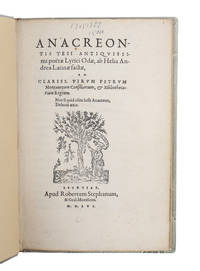
155662303Lutetiae i.e. Paris Robert Stephanum i.e. Robert Estienne & Guillaume Morel 1556. Small 8vo. Lovely newer full marbled paper binding with gilt leather title-label to spine Jens E. Hansen Aarhus. Light brownspotting to a few leaves and somne leaves towards the end with inkspotting at outer blank margin. Early neat handwritten marginal annotations throughout. A lovely copy. 54 pp. <br/><br/><em>Scarce second edition of Elie André’s seminal Latin translation of the Anacreontea – the first complete - which itself is a classic in the history of classical literature. It came to directly influence all later readings of Anacreon. In 1554 Henri Estienne II published the seminal editio princeps of Anacreon which is no less than an outright Renaissance sensation causing the “Anacreaonta†to become the most influential “ancient†Greek poetic text during the Renaissance initiating a poetic revolution in Europe. Simultaneously with this editio princeps Henri Estienne published his own Latin translation of it which constitutes the first translation into Latin. Merely a year later in 1555 Elie André extremely important translation of the Anacreaontea appeared in 1555 printed by Thomas Richard. This translation included additional Odes not in the Estienne edition and was thus the first complete Latin translation of the “Anacreontiaâ€. The following year 1556 Robert Estienne II published his first work namely a second edition of the original Greek Anacreontea that Henri Estienne had published in 1554. Silmultaneously Robert Estienne republished Elie André’s Latin translation which was published separately but which is often found together with the 1556 second edition of the Greek Anacreontea. “The first full translation of CA was again in Latin. It was published by the humanist Elie André 1509-1587 from Bordeaux who was friendly with the Parisian circle around the Pléiade. André’s translation appeared less than a year after Estienne’s edition and comprised the Latin translation only without the Greek text. In a way this can be taken as a signal that the Latin tradition was coming into its own. Accordingly André makes some bolder choices in his translation which already shows in his first lines see Aiijr: Cantare nunc Atridas Nunc expetesso Cadmum: Testudo vero nervis Solum refert Amorem …. In classical Latin the verb expetessere is used only by Plautus and it is extremely rare in postclassical Latin. This brings a somewhat odd ring of comedy to the poem. Here and in a number of other places the translator wishes to strike his readers with an unusual turn of phrase or by some sort of amplification. He does not just imitate ‘Anacreon’ but also competes with him as arguably with Estienne’s translation. André’s willingness to adapt the original text shows also in a certain moralistic tendency not otherwise seen in Latin translations. On the one hand he openly and avowedly changes the text when it comes to unequivocal references to homosexuality: in CA 12 10.8-10 Ï„ µευ καλν νεÏων … φÏπασας Βθυλλον; “Why from my sweet dreams … have you snatched away Bathyllus†for instance he replaces Bathyllus with a puella Cur mane somnianti / Ista loquacitate / Mihi eripis puellam…; in CA 29 17.1-2 ΓÏφε µοι Βθυλλον οτω / τν ταÏον Ï‚ διδσκω “Paint for me thus Bathyllus my lover just as I instruct you†he simply suppresses the word ταÏον “lover†Mihi pinge sic Bathyllum / . Estienne’s translation is: Meos Bathyllum amores / Ut te docebo pinge. Here André proceeds in a way similar to the original Neo-Latin Anacreontics in which homosexual love simply does not occur. On the other hand André makes generous use of a metatextual element which is less conspicuous than his changes but is even more extensive and significant. He includes a considerable number of passages in quotation marks and thus identifies them as sort of sententiae. In CA 4 32 for instance lines 1-6 describe how the poet wishes to lie down on myrtles drink and have Eros as his wine steward. This description of a specific setting is followed by some more general lines about the brevity of life which André includes in quotation marks lines 7- 10: “Cita nanque currit aetas / Rota ceu voluta currus. / Sed et ossibus solutis / Iaceam cinis necesse est†“For hurried life runs along just like a rolling wheel but I shall soon lie a bit of dust from crumbling bonesâ€. The focus of this quotation technique is on lines concerned with the transitory nature of life the uncertainness of tomorrow and the futility of riches. By marking out such lines as sententiae André distinguishes Anacreon the philosopher from Anacreon the drinker and lover and contributes to a larger discourse about the morality of the poet and his poems. While opinions in antiquity were often critical of Anacreon’s morals ‘Anacreon’s’ large flock of modern imitators was united to defend their hero’s virtue. From Estienne’s preface onwards they usually referred to Plato’s Phaedrus 235c where Socrates calls Anacreon “wise†σοφς in matters concerned with Eros. In the 18th century Anacreon the philosopher could even turn into a key-image of enligthened discourses. André’s identification of sententiae in ‘Anacreon’ prepared for this development and could have had a direct influence on it since his translation was widely read until well into the 18th century. The Latin translations of Estienne and André soon became classics in themselves and were the most successful ones in the early modern period.†Tilg: Neo-Latin Anacreontic Poetry. Its Shapes and Its Significance 214. Pp. 177-78. Brunet: I:250; Renouard: I:161. </em> hardcover
180255219London Bulmer et Soc. apud White et Miller 1802. 8vo. Contemp. full morocco. Gilt spine with gilt lettering. Broad gilt borders on covers. Inside gilt borders. Edges gilt. Edges with light wear. 4130 pp. Many fine executed engraved vignettes and endpieces. Finely printed with Greek letters on good paper. The first leaves with light browning further a few minor brownspots. With engraved bookplate of Hen. J. Blakeney and his written name. unknown
177460357Paris Le Boucher 1773 & 1774 4to 228 x 156 mm. Bound in a very beautiful a bit later light brown full grained morrocoo binding with five raised bands richly gilt spines gilt lines to boards inner gilt dentelles and gilt capitals. All edges gilt. Binding by 'Sture Falks Bogbinderi' Lund Sweden. Housed in a slipcase. Ex-libris to pasted down front end-paper Maurice B. Worms and to front free end-paper Per Erik & Ludmilla Lindahl. A very nice and clean copy. 4 IV 280 XVI 104 pp. 2 frontispieces 12 headers and 13 tailpieces by Eisen engraved by Massard and Duclos. <br/><br/><em>First edition of Moutonnet's translation of Anacreon illustrated by Duclos after Eisen - widely considered to be "One of the most charmingly illustrated books of the eighteenth century" Salomons. Sander 17 Cohen 79: "l'un des livres les plus élégamment illustrés du XVIIIe siècleFürstenberg 92: "The Anakreon from 1773 is on the same level as the illustrations for 'Le Temple de Gnide' from 1772 and must also be counted among the most beautiful books of the century." </em> hardcover
51271Argentorati Strasbourg: apud J.G. Treuttel 1786. Third edition. 18mo. pp. ii 149 i. A little toned towards edges some light patches of foxing. Green straight-grain morocco raised bands and gilt title to spine gilt borders a.e.g. Patchy colour fading joints and corners worn some scratches still very good overall. Armorial bookplate of Thomas Sewell to front paste-down. "These are the most beautiful and accurate editions; the latter i.e. this of 1786 was twice published in the same year and has the text of the Roman edition of Spalleti but with corrections: it was a favourite edition" Dibdin. Dibdin 4th edn. I. 264. Argentorati [Strasbourg]: apud J.G. Treuttel, 1786. hardcover
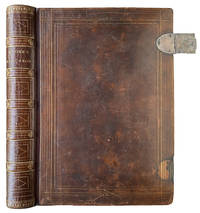
1820TK0328London:: Printed for James Carpenter 1820. 1820. 2 volumes in 1. Tall 4to. xlvii 1 49-175 1; 3-148 pp. 2 frontispieces 26 engraved plates by Robt. Ker. Porter. The plates are full size for the volume whereas the text leaves are all mounted and expanded to achieve the same size as the plates. Original full gilt-stamped calf; rebacked with raised bands gilt-stamped spine compartments 1 of 2 clasps; corners showing lacks the one clasp. Very good. Illustrated by Sir Robert Ker Porter a friend of the author. Sir Robert Ker Porter KCH was a British artist writer and diplomat. Known today for his accounts of his travels in Russia Spain Portugal and Persia he was one of the earliest panorama painters in Britain was appointed historical painter to Tsar Alexander I of Russia and served as British consul in Venezuela. Printed for James Carpenter, 1820. hardcover
155460114Lutetiae i.e. Paris Guillaume Morel for Henri Estienne II 1554. 4to. Contemporary limp vellum with remains of ties to boards. Remains of contemporary paper labels to spine and traces of autor in ink in contemporary hand also to spine.A few smaller worm tracts to boards and a bit of spotting but overall very nice. A large spot to title-page presumably erased ink from the removal of an old owner's name. The spot is in the blank margin close to the printer's device but not touching it. Apert from that internally very nice with only light occasional damp staining or browning. Old ink note in Greek characters to front free end-paper and a small note referring also to "Lyra" on A1r. A very nice copy with large margins. Woodcut printer's device to title-page woodcut headpiece and opening initial. Magnificently printed in all three sizes of the famous "grecs du roi"-type. 8 110 pp. <br/><br/><em>Rare first edition of the groundbreaking Anacreon-volume by H. Estienne being the milestone publication that not only constitutes the first book by the brilliant Henri Estienne II but also the extremely influential editio princeps of the Anacreontea. Furthermore this groundbreaking publication contains Sappho’s now immortal Aphrodite-hymn being the very first of any of Sappho’s poems to appear in print here for the second time in print as well as the magnificent “Midnight poem†fragment 168B establishing for the first time since antiquity the gathering together of poems by Sappho: “A momentous point in her transmission. Yet it is ironic that the first collection of a fragmentary Greek poet known and admired beyond any other today should have appeared as a mere appendix to a book dedicated to another author entirely without even her name on the title-page.†Cambridge Companion to Sappho p. 251. The impact that Sappho - “mother of all women poets†- would eventually come to have upon modern poetry and society was not yet known to Estienne and his contemporaries for whom she was more or less unknown. Estienne however recognized the value of the poems of hers that he had encountered and with the publication of them in the present volume began a tradition that would eventually cause her to become arguably the most celebrated Greek poet of all time. “Estienne’s edition of Anacreon’s poetry was enthusiastically received by the Pléiade poets which considerably boosted Sappho’s influence on western European literatureâ€. van Dijk: I Have Heard about You p. 37. This beautifully printed slim volume constitutes an outright Renaissance sensation. “The “Anacreaonta†became the most influential “ancient†Greek poetic text during the Renaissance and Estienne’s “editio princeps†virtually caused a poetic revolution not only in France but also in Italy and Germany – where this influence culminated in the 18th century with the Anacreontic Poets “Die Anakreontikerâ€.†Schreiber 139. Henri Estienne II – “in many ways the greatest member of the Estienne dynasty and most certainly its most prolific scholar†Schreiber - had travelled extensively through Italy the Low Countries and England in search of Greek manuscripts. It is from one of these that he had printed possibly by Guillaume Morel his first book this editio princeps of the Anacreaontea which is thus also the first book to bear his imprint. Henri Estienne along with his contemporaries believed the work to contain the ancient Greek lyrics of the poet Anakreon 6th century BC whose poems are not extant except for some short fragments. In fact the poems contained in this volume constitute the Anacreontea which is a collection of Greek lyric poems written in the style and imitation of Anacreon at various dates. “Henri’s publication of these “ancient†Greek lyrics caused an immediate literary sensation in France and was celebrated and immortalized by Ronsard in an oft-quoted passage of his “Odesâ€.†Schreiber. Henri Estienne started out his publishing career with this magnificent publication that catapulted him into fame and he went on to become one of the most influential literary and scholarly figures of the second half of the 16th century in Europe; he dominated Renaissance scholarship with his magnificent publications and has arguably not been superseded by any publisher since. The young Henri Estienne had discovered the present poems in Louvain in a manuscript owned by an Englishman named John Clements who was a friend of Thomas More. Their publication “was a sensation of the first class and the starting-point for a new branch of modern literature†R. Pfeiffer: History of Classical Scholarship†p. 109. “This first edition was greeted with tremendous enthusiasm by the members of the Pléiade who like everyone else believed the poems genuine and each of whom immediately translated or imitated some of the “Anacreonteaâ€.†Schreiber. The poems may not have been “genuine†Anacreon-poems but the influence that the publication of them came to exercise was no less profound than had they been; the mark they have left of modern literature is difficult to compare to anything else. The printing of the original Greek text in all three sizes of the magnificent “grecs du roiâ€-type is followed by the first Latin translation of the poems done by Estienne himself and by Estienne’s own commentary. The text of this editio princeps has been followed by almost every subsequent editor and today the name Anacreon cannot be mentioned without thinking of Estienne. After the Anacreon-poems themselves are two leaves containing first poems by Alkaios and second the two famous poems by Sappho: The Ode to Aphrodite fragment 1 and the Midnight Poem fragment 168B also known as “The Moon Sets†constituting a momentous point in the Sappho-transmission namely the first time since antiquity that anyone had gathered together poems by her. Soon after more Sappho-collections would appear causing her to eventually become the most admired Greek poet. “In a recent article R. Aulotte… shows how Sappho’s influence on the poets dates from the time when Henri Estienne published the odes then known along with his famous edition of Anacreon. His first edition published in 1554 contained the “Ode to Aphrodite†and the fragment “The Moon has Setâ€.†Mary Morrison: Henri Estienne and Sappho in: Bibliothèque d’Humanisme et Renaissance T.24 N.2 1962 p. 388. "From time immemorial women poets have had only one norm one touchstone: Sappho the legendary woman poet who lived on the island of Lesbos in the Aegean sea in the 6th century BC. … The Sappho figure is the peg on which views of female poetic genious and female sexuality have been hung century after century.†Suzanne van Dijk: I Have Heard about You… p. 35 . Dibdin I: 258 “A beautiful and rare editionâ€; Schreiber: 139; Renouard: 115. </em> hardcover
177338330à Paphos & se trouve à Paris: Chez Le Boucher 1773. Fine. Chez Le Boucher à Paphos & se trouve à Paris 1773 14 x 22.20 cm relié First edition of this translation by Moutonnet de Clairfonds and first issue of the illustration which comprises a frontispiece 12 headpieces and 13 tailpieces by Eisen engraved by Massard and Duclos. Title page in red and black. Full red morocco binding late 19th century signed Pickering. Jansenist spine with raised bands. Wide inner decorative border. Edges gilt. Small brown stains on upper cover. Despite the minor defects noted a very fine copy. Cohen rightly cites this work as ""one of the most elegantly illustrated books of the 18th century""; Eisen's contribution is indeed delicate and inspired and the headpiece engravings are superbly executed. Chez Le Boucher hardcover