AnacreonBiblio.com
422 résultats
1166491625.Gpaperback. Good. Access codes and supplements are not guaranteed with used items. May be an ex-library book. paperback
1169636969.Ghardcover. Good. Access codes and supplements are not guaranteed with used items. May be an ex-library book. hardcover
1165380781.Gpaperback. Good. Access codes and supplements are not guaranteed with used items. May be an ex-library book. paperback
2009DADAX1104106493Kessinger Publishing 2009-02-16. hardcover. New. 6.00x0.81x9.00. Buy with confidence. Excellent Customer Service & Return policy. Kessinger Publishing hardcover
2009DADAX1120171318Kessinger Publishing 2009-09-24. paperback. New. 6.00x1.36x9.00. Buy with confidence. Excellent Customer Service & Return policy. Kessinger Publishing paperback
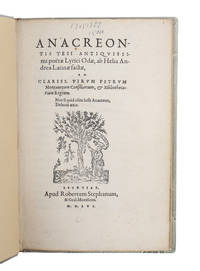
155662303Lutetiae i.e. Paris Robert Stephanum i.e. Robert Estienne & Guillaume Morel 1556. Small 8vo. Lovely newer full marbled paper binding with gilt leather title-label to spine Jens E. Hansen Aarhus. Light brownspotting to a few leaves and somne leaves towards the end with inkspotting at outer blank margin. Early neat handwritten marginal annotations throughout. A lovely copy. 54 pp. <br/><br/><em>Scarce second edition of Elie André’s seminal Latin translation of the Anacreontea – the first complete - which itself is a classic in the history of classical literature. It came to directly influence all later readings of Anacreon. In 1554 Henri Estienne II published the seminal editio princeps of Anacreon which is no less than an outright Renaissance sensation causing the “Anacreaonta†to become the most influential “ancient†Greek poetic text during the Renaissance initiating a poetic revolution in Europe. Simultaneously with this editio princeps Henri Estienne published his own Latin translation of it which constitutes the first translation into Latin. Merely a year later in 1555 Elie André extremely important translation of the Anacreaontea appeared in 1555 printed by Thomas Richard. This translation included additional Odes not in the Estienne edition and was thus the first complete Latin translation of the “Anacreontiaâ€. The following year 1556 Robert Estienne II published his first work namely a second edition of the original Greek Anacreontea that Henri Estienne had published in 1554. Silmultaneously Robert Estienne republished Elie André’s Latin translation which was published separately but which is often found together with the 1556 second edition of the Greek Anacreontea. “The first full translation of CA was again in Latin. It was published by the humanist Elie André 1509-1587 from Bordeaux who was friendly with the Parisian circle around the Pléiade. André’s translation appeared less than a year after Estienne’s edition and comprised the Latin translation only without the Greek text. In a way this can be taken as a signal that the Latin tradition was coming into its own. Accordingly André makes some bolder choices in his translation which already shows in his first lines see Aiijr: Cantare nunc Atridas Nunc expetesso Cadmum: Testudo vero nervis Solum refert Amorem …. In classical Latin the verb expetessere is used only by Plautus and it is extremely rare in postclassical Latin. This brings a somewhat odd ring of comedy to the poem. Here and in a number of other places the translator wishes to strike his readers with an unusual turn of phrase or by some sort of amplification. He does not just imitate ‘Anacreon’ but also competes with him as arguably with Estienne’s translation. André’s willingness to adapt the original text shows also in a certain moralistic tendency not otherwise seen in Latin translations. On the one hand he openly and avowedly changes the text when it comes to unequivocal references to homosexuality: in CA 12 10.8-10 Ï„ µευ καλν νεÏων … φÏπασας Βθυλλον; “Why from my sweet dreams … have you snatched away Bathyllus†for instance he replaces Bathyllus with a puella Cur mane somnianti / Ista loquacitate / Mihi eripis puellam…; in CA 29 17.1-2 ΓÏφε µοι Βθυλλον οτω / τν ταÏον Ï‚ διδσκω “Paint for me thus Bathyllus my lover just as I instruct you†he simply suppresses the word ταÏον “lover†Mihi pinge sic Bathyllum / . Estienne’s translation is: Meos Bathyllum amores / Ut te docebo pinge. Here André proceeds in a way similar to the original Neo-Latin Anacreontics in which homosexual love simply does not occur. On the other hand André makes generous use of a metatextual element which is less conspicuous than his changes but is even more extensive and significant. He includes a considerable number of passages in quotation marks and thus identifies them as sort of sententiae. In CA 4 32 for instance lines 1-6 describe how the poet wishes to lie down on myrtles drink and have Eros as his wine steward. This description of a specific setting is followed by some more general lines about the brevity of life which André includes in quotation marks lines 7- 10: “Cita nanque currit aetas / Rota ceu voluta currus. / Sed et ossibus solutis / Iaceam cinis necesse est†“For hurried life runs along just like a rolling wheel but I shall soon lie a bit of dust from crumbling bonesâ€. The focus of this quotation technique is on lines concerned with the transitory nature of life the uncertainness of tomorrow and the futility of riches. By marking out such lines as sententiae André distinguishes Anacreon the philosopher from Anacreon the drinker and lover and contributes to a larger discourse about the morality of the poet and his poems. While opinions in antiquity were often critical of Anacreon’s morals ‘Anacreon’s’ large flock of modern imitators was united to defend their hero’s virtue. From Estienne’s preface onwards they usually referred to Plato’s Phaedrus 235c where Socrates calls Anacreon “wise†σοφς in matters concerned with Eros. In the 18th century Anacreon the philosopher could even turn into a key-image of enligthened discourses. André’s identification of sententiae in ‘Anacreon’ prepared for this development and could have had a direct influence on it since his translation was widely read until well into the 18th century. The Latin translations of Estienne and André soon became classics in themselves and were the most successful ones in the early modern period.†Tilg: Neo-Latin Anacreontic Poetry. Its Shapes and Its Significance 214. Pp. 177-78. Brunet: I:250; Renouard: I:161. </em> hardcover
180255219London Bulmer et Soc. apud White et Miller 1802. 8vo. Contemp. full morocco. Gilt spine with gilt lettering. Broad gilt borders on covers. Inside gilt borders. Edges gilt. Edges with light wear. 4130 pp. Many fine executed engraved vignettes and endpieces. Finely printed with Greek letters on good paper. The first leaves with light browning further a few minor brownspots. With engraved bookplate of Hen. J. Blakeney and his written name. unknown
0243917090.Gpaperback. Good. Access codes and supplements are not guaranteed with used items. May be an ex-library book. paperback
0282183442.Gpaperback. Good. Access codes and supplements are not guaranteed with used items. May be an ex-library book. paperback
0365876917.Gpaperback. Good. Access codes and supplements are not guaranteed with used items. May be an ex-library book. paperback
0243503156.Gpaperback. Good. Access codes and supplements are not guaranteed with used items. May be an ex-library book. paperback
0428129455.Gpaperback. Good. Access codes and supplements are not guaranteed with used items. May be an ex-library book. paperback
0428117147.Gpaperback. Good. Access codes and supplements are not guaranteed with used items. May be an ex-library book. paperback
0428599303.Ghardcover. Good. Access codes and supplements are not guaranteed with used items. May be an ex-library book. hardcover
B9781165929023New. unknown
0332790746.Ghardcover. Good. Access codes and supplements are not guaranteed with used items. May be an ex-library book. hardcover
1149281111.Gpaperback. Good. Access codes and supplements are not guaranteed with used items. May be an ex-library book. paperback
1149037865.Gpaperback. Good. Access codes and supplements are not guaranteed with used items. May be an ex-library book. paperback
18021007Y35London: J. White and G. Miller 1802. Leather. Good. 7.5" by 5.5". None. A morocco-bound edition of the odes of Anacreon edited by English cleric and writer Edward Forster. With lovely engraved vignettes. An early 19th-century edition of The Odes of Anacreon amended according to the text of Barnes in the Greek text. Bound in full straight-grain morocco with marbled endpapers.With elegant engraved vignettes throughout.Few of Anacreon"s works survive but those that do focus on wine love and the overall pleasures of the legendary Roman symposium. Anacreon used various techniques in his writings including self-deprecation and irony. Edited by Edward Forster 17691828 an English cleric miscellany writer and Fellow of the Royal Society. Bound in full straight-grain morocco with marbled endpapers. Externally quite rubbed to the extremities. Short cracks to the tail of the joints. Internally firmly bound. Pages are marginally toned but generally clean with light spotting to the first and last few pages. Good J. White and G. Miller hardcover
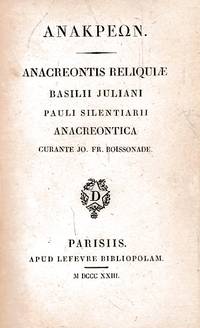
1823c0232Paris: Apud Lefevre. G : in Good condition without dust jacket. Cover rubbed. 1823. First Edition thus. Green hardback half-leather cover with marbled boards. 120mm x 80mm 5" x 3". xii 160pp. In Greek with intro in Latin. . Apud Lefevre hardcover
17321395174Traiecti Ad Rhenum Utrecht: Apud Guilielmum Kroon 1732. Hardcover. Quarto 36 315 1 pages. In Fair condition. Bound in full leather front board is detached has moderate rubbing and shelf wear mild red rot moderate rubbing and bumping to corners. Spine is darkened with moderate cracking loss of leather along the head/tail ends nearly detached end-band at tail of spine lacking the top end-band. Textblock has pencil annotations and a bookplate of "Carberry Tower Library" to front pastedown nearly loose front end page scattered stains and foxing throughout light age toning with more significant age toning around the edges of the end pages. Greek and Latin text. 1395174. Special Collections - Downstairs. Apud Guilielmum Kroon hardcover
110461376X.Gpaperback. Good. Access codes and supplements are not guaranteed with used items. May be an ex-library book. paperback
1165929023.Gpaperback. Good. Access codes and supplements are not guaranteed with used items. May be an ex-library book. paperback
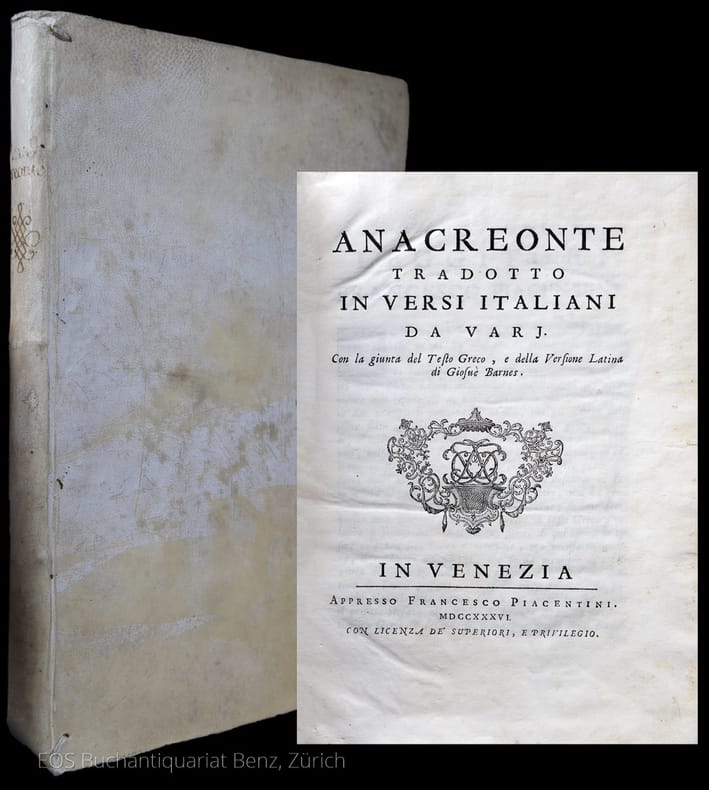
173631357ABIn Venezia, Apresso Francesco Piacentini, 1736. 4°. (3) Bl., 208 S. Mit 1 Portät. Pergamentband der Zeit.
In 8° (16,4x11 cm); XLIV, 186 pp. Legatura coeva in piena pergamena rigida con titolo ed autore manoscritti al dorso da mano coeva in elegante grafia. Ottimo esemplare. Bella vignetta animata al frontespizio con bevitore di vino. Prima edizione di questa traduzione in lingua toscana, dell’opera del grande poeta greco, Anacreonte ( Anakréon; Teo, 570 a.C. circa – 485 a.C. circa) nella versione dell’arcade livornese, Francesco Catalani che fu allievo del marchese somasco Gian Giuseppe Orsi, amico a sua volta di Ludovico Antonio Muratori. L’opera infatti è preceduta dal l’ampio carteggio intercorso tra Orsi e Catalani nel quale il marchese scrive all’amico, proprio da Modena dove era ospite del Muratori. L’opera contiene le celebri poesie di Anacreonte, componimenti dove abbondano il vino, l’amore e gli ambienti bucolici. L’opera di Anacreonte ebbe grande apprezzamento nel XVIII secolo tanto da far nascere un vero e prorpio genere letterario, conosciuto con il nome di “poesia anacreontica” grandemente utilizzato negli ambienti rococò. E’ proprio in questi ambienti che nasce questa traduzione delle opere di Anacreonte da parte di Catalani. Rif. Bibl.: Melzi, Dizionario di opera anonime o pseudonime, Tomo I, Milano, Pirola, 1848, pag. 206.