544 résultats
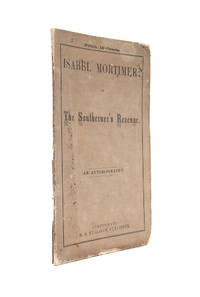
18584036Cincinnati: H. M. Rulison 1858. First edition. Original publisher's printed wrappers with price 15 cents and publisher misspelled on front wrapper Wright II 1328. Wrappers somewhat chipped and soiled with rear wrap tender. 36 pages with 2 woodcuts. The only copy on the market of this scarce and delicate title OCLC reports 7 institutionally preserved copies. Isabel Mortimer last appeared at auction over a century ago in 1916. <br/><br/>Scarce and understudied Isabel Mortimer's sensational tale of seduction and revenge in New Orleans offers opportunities for considering how this popular Victorian form not only dealt with representations of femininity generally but more specifically forms of white Southern femininity. On a general level sensation novels explored the "ideological constructs of female irresponsibility passivity explosiveness and inacapacity" by pushing them to their limits; as female characters encounter or engage in seduction and murder they "undermine the validity of these constructions of womanhood.By linking women's subversive behavior directly to the stifling economic and psychological conditions of their lives the novels reveal women's madness is not the result of their instability as the doctors claimed but of their confined lives" Zahn. In the case of Isabel Mortimer a privileged young woman living in antebellum New Orleans readers witness her response to being taken advantage of by "a professional gambler a married man!" who trifled with her feelings and her virtue "hoping in some covert manner to obtain possession of her fortune." As a commodity on a marriage market Isabel's prospects are ruined. But the story proves that she is not the passive recipient of men's advances; she will not perform shame nor will she accept her current status with genteel docility expected of Southern women. Instead she decides to take her behavior to the opposite extreme: "I resolved like a second Delilah to shear these proud sons of Adam of their boasted strength and humiliate them." Isabel places blame for her situation on a patriarchal system that infantilizes women then punishes them for failing to see and respond to danger. A knowing Delilah now she will punish the representatives of that system. Ultimately the troubling contradictions that exist within the small space of the novel urge readers not to take popular value systems at face value encouraging them to look for tears within the seams of social expectation. H. M. Rulison unknown books
1930List328Boston 1930. Oblong quarto 49 pp. With appx. 1400 photos most measuring less than an inch square with roughly 175 in larger formats up to 3 ½ by 5 inches. Very Good. A wonderful labor of photographic love created by an unidentified young woman with ties to the Cabot family of Beacon Hill. The album composed largely of tiny contact prints glued in neat grids. Off-kilter compositions - a portion of a steeple against the sky the tail of a dog etc. - are mixed in with more traditional landscapes leading one to question whether the photographer had modernist aspirations or just took a lot of pictures.<br /> <br /> The photographer is unknown but our best guess is that it was someone who was a friend of Ellen Cabot of Beacon Hill perhaps while both were students or just after. Ellen Cabot the most frequent subject of the album is shown in a variety of settings often accompanied by her dog Prowler. Aerial photography the New England coastline camping life in Cambridge and equestrian competition are all on display. Other highlights include a dog named Benito Mussolini and artful shots of a monk's torso. A portion of the photos perhaps five or ten percent are not present though the album is otherwise in excellent condition. Handwritten label on the front reads "Newport Races to Topsfield autumn 1930". Overall the album is a testament to the energy and spontaneity of youth and the possibilities of the photographic form as well as an intimate look into Boston's storied upper class. unknown books
16993Photo Album Women Education Album from student at Wellesley College filled with 143 original silver gelatin print photographs. Chronicles a young woman's educational path from high school through college and onto her later work as a teacher. Dated 1911-1919. Photos of various sizes from 2 x 3" to 4 x 9.5". Original black cloth boards. 9 x 12". 100 pages. Many photographs of Wellesley College its campus and traditions. Photo of Lake Waban and the campus chapel. Image of a house labeled "Wellesley 1911-1912" placed in album next to photo with 3 young women with their arms full of books standing outside the same house labeled "Students". 6 women bundles in hats and coats on a snowy street: "Off for math exam". Others show young women reading books and studying outside eating meals together and enjoying campus life. Includes 5 photos of the "Senior Hoop Rolling" tradition on May Day 1912. Photos of friends lovingly labeled with nicknames such as Chub Selina Honey and Marion. Includes photos from many locations around upstate New York including the Hudson Valley and Finger Lakes regions: Frontenac Point Minnewaska Mohonk and Yankee Lake. Also photos from Digby a small town in Nova Scotia Canada. In addition to the images of Wellesley there are photos of several other academic institutions. Images of academic interiors labeled Drawing Room Mr. Wilson's Room Assembly Room Physics Lab Library and Hall at M.H.S. Group photo of a 16 boys wearing "M" shirts and 3 coaches posing with a trophy and banner reading: "OCIAA Relay Race 1912". Building labeled "Harmony Hall" next to a photo of 14 women with the caption "Inmates of H.H. 1913". 2 large group photos with women in white dresses and a banner "ETA Clionian" one labeled 1914. The ETA Clionian Sorority was active on the SUNY New Paltz campus then a state teachers' college. Later photos appear to be from when the album owner transitioned from being a student to working as a teacher. Young groups of children are photographed together with the handwritten captions "Primary" or "Intermediates". One photo shows a school production with many children on a decorated stage wearing Pilgrim costumes. Building labeled Quassaick Hall. I page detached. Very good condition. unknown books
15272Very Rare Photo Archive. 1889-1912. 30 photos dated 1910-1912 of the Native American Sac & Fox village of Chelan Washington with vivid descriptions on verso focusing on the graduates of Carlisle and the other first schools formed for the purpose of assimilating young Native Americans into western culture sometimes with the intentions of expanding their opportunities but too often with a careless disregard for native culture. Approx 2"x4". Also an accompanying letter and 2 news articles from the photographer of the Sac & Fox Indian Agency 1910. A very rare Department of Indian Education ribbon of 1902 and accompanying "Committee" pin. A very rare collection documenting a program which holds a mixed place in history; at once formed in the hope that building bridges between worlds would be the best chance for these children to prosper and at the same time doing so by separating them from their cultural background. This collection vividly portrays the children caught in the middle. <br/><br/>In the Summer of 1896 young William Jones and his father entered Kansas Indian Territory on a contract to bring pupils for the Carlisle Indian School in Carlisle Pennsylvania. Carlisle was the first of its kind a boarding school at once devoted to proving the equality of Native peoples by providing their children with a quality education and opportunities outside the Reservation and to suppressing the signs of culture that white populations viewed fearfully. Purposely located far from any reservation the school was designed to put physical as well as cultural distance between its young students and their past. Again and again Jones' overtures were rejected by tribal chiefs and councils suspicious of their intentions. However Jones who was of one-quarter native blood a happy graduate of a Native American college program and contemplating Harvard medical school for the coming year was able to make the argument to some parents that the best chance of success for their tribes lay in their children learning to read and write in English. On August 15 he picked up teenage Leona Greyeyes from her Sac & Fox village and brought her to Carlisle as a student. There she underwent a process of cultural assimilation similar to the over 10000 students that walked through Carlisle's doors between its opening in 1879 and closing in 1914. One of the greatest risks of sending children to the boarding schools was contracting western diseases to which they had no immunity. The collection includes a very rare red ribbon worn by a member of the Department of Indian Education to the National Education Association convention of 1902 in Minneapolis at a time when the boarding school was still touted as "making a good citizen" of the boys and girls of the Indian nations by westernizing them. The department of Indian Affairs commissioned an inquiry to follow up on the lives of graduates with photos as well as detailed notes. This set of 30 photos document Leona Shelah Lelia as well as other members of their tribe living in Chelan Washington. These young women appear through photos to live as many graduates of their generation did with one foot in each of two very different worlds; we see the enduring tribal customs in a setting of rugged natural beauty contrasted with Edwardian floor-length garb and the inquisitive and ever-present eye of government service agencies. Very rare collection of 37 photos most with handwritten records verso and very rare pin and ribbon. unknown books
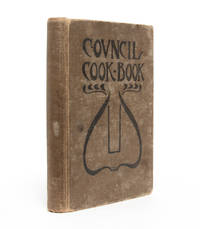
19093212San Francisco: International Printing Company 1909. First edition. Original publisher's cloth binding. Fraying to corners and extremities of spine. General spotting to cloth. In a contemporary hand several names and addresses of women from San Francisco and Atlantic City to the pastedowns and endpapers. Generally toned with occasional staining; in the same hand as the preliminaries occasional additions modifications and annotations to recipes. Quite a scarce community cookery particularly in such presentable condition it has the distinction of being the first Jewish cookery published in California and among the earliest west of the Mississippi.<br/><br/>An excellent early example of women's use of the domestic space as a site for social activism. Organized in 1893 and based out of Chicago the National Council of Jewish Women worked to "shape the destinies" of Jewish women and families by offering community support in the form of assisting immigrants with integration advocating for women's rights and providing support including financial assistance and job training. Under the leadership of Hannah Greenebaum Solomon the women desired to carve out space for Jewish women's identities and contributions operating on a model similar to other national figures such as Jane Addams and Susan B. Anthony. Within seven years the San Francisco section was founded and ran under the leadership of Hattie Hecht Schloss a philanthropist and the wife of a progressive associate justice of the California Supreme Court. With her guidance "the Council established San Bruno Settlement House to aid newcomers to San Francisco with classes for boys and girls.Aiding immigrants and later veterans.these issues at the forefront then prompted petitioning for legislative reforms such as immigration equal suffrage child labor human trafficking abolition and health centers for women and children" NCJWSF. The present text was published at a time when a number of women's groups were realizing that community cookeries were effective methods of fundraising and promotion. Drawing strength and authority from the expectation that they feed and nourish their families the women of the Council could justify feeding nourishing and otherwise supporting the community at large; and the money from this cookery supported a number of their programs. Notably this California chapter of the NCJW did include a chapter on Passover Dishes; yet they also include a range of dishes traditionally not considered Jewish or acceptable in Jewish households including lobster and other shellfish dishes common to the region. An excellent opportunity to research Jewish women's contributions to California culture and the extent to which regional foods shape Jewish households in the West. International Printing Company unknown books
15590WILSON Elisabeth. A Scriptural View of Woman's Rights and Duties in All the Important Relations of Life. Philadelphia: Published by William S. Young 1849. First Edition. 376 pages. This impassioned defense of women's rights faults the oppressive role of patriarchal church and society values. Challenging prominent male biblical scholars Wilson asserted that male and female were created by God as equal co-sovereigns over creation and thus biblical patriarchs and matriarchs exercised equal authority within the marriage relationship. Wilson's most striking example is Abigail who distributed household property an extravagant gift of dressed sheep and other food to David against her husband Nabal's wishes 1 Samuel 25. Wilson uses this example to argue that the bible supports the equal administration of marital property between husband and wife; a radical proposition in 1849 when only 12 US States allowed women to own property. A rare and striking early text arguing for women's rights. unknown books
16759Women's Education Movement. Pamphlet/ Volume 14 of 17: Acts for the State of Massachusetts January 12th Session 1804 Incorporation of Bradford Academy Containing the original incorporation of Bradford Academy. Bradford opened as the first coeducational institution in Massachusetts but due to overwhelming interest from parents of girls with no other option for education Bradford soon transitioned to become the first all-female academy in Massachusetts and among the first in the United States in 1836. Only three examples of these early Incorporation Acts could not be found among Institutional Collections according to OCLC Worldcat. <br/><br/>Women's colleges proliferated in the mid- to late- 19th century to fill the void created by their exclusion from most institutions of higher education. The prevailing notion that women were too delicate for a rigorous academic education was openly challenged when Elizabeth Cady Stanton spoke at the Seneca Falls Convention of 1848 "Man's intellectual superiority cannot be a question until woman has had a fair trial.When we shall have had our colleges our professions our trades for a century a comparison then may be justly instituted." Young women were quick to step up to the challenge; as quickly as female colleges opened they filled up. But this document predates Seneca Falls by 40 years and Bradford was among the very first institutions to educate women in the United States. unknown books
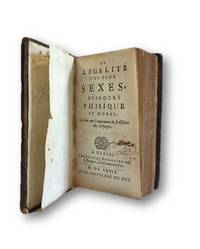
15585De L'Egalite des Deux Sexes Discours Phisique et Moral." Paris 1697. François Poulain Poullain de la Barre b. 1647 in Paris . Rare second edition. In French. Octavo. Contemporary brown calf binding with some edgewear and bumping to corners and spine. Poulain was the first to base his argument on reason alone. Minor chips and tears to pages throughout as well as names and annotations from previous owners. Spine tender. Overall very good condition for such an early and important title. Laying the groundwork for gender equality this text makes a case for men and women's physical and moral equality. While other feminist writers before him called upon religious and philosophical authorities. l'Égalité can be seen not only as a turning point in feminist thought and argumentation but also one of the first truly philosophical feminist works. Albistur and Armogathe much cited scholars of the history of feminism locate Poulain's involvement with Cartesianism as a catalyst in feminism: "Without Descartes there would not have been Poullain de la Barre; without Poullain de la Barre the history of feminism would have gone nowhere for a long time. Undeniably he must be considered the theoretician for women's emancipation the most important that we had from the Middle Ages to the middle of the nineteenth century" Histoire du féminisme français p. 84 as translated in Three Cartesian Feminist Treatises fn. 104 p. 33. Poulain's works were re-issued in French editions during the following fifteen years Alcover: 30 although his name did not appear on the title page of Égalité until 1690. Poulain's Equality had a significant influence in England following its translation in 1677 as The Woman as Good as the Man. Poulain's ideas and even the phrases in which they were expressed were plagiarized initially by an anonymous 'Sophia' in Woman Not Inferior to Man 1739 which appeared in an expanded edition as Beauty's Triumph 1751. Equality was also pirated in a loose translation by an anonymous 'Lady' as Female Rights Vindicated 1758; this was republished in two revised editions as Female Restoration 1780 and Female Rights Vindicated 1833. Thus Poulain's primary text about the equality of the sexes continued to influence discussion of that topic in English throughout the eighteenth and nineteenth centuries although its author's name had lapsed into oblivion and was not acknowledged by those who plagiarized his work. OCLC Worldcat reports no other known copies of this early feminist text in this original form at any library or institution worldwide. unknown books
192639273Tashkent Uzbekistan: Women of the Central Asian Office of the Organizational Bureau of the Central Committee of the Communist Party of the Soviet Union 1926. Quarto 30.5cm.; publisher's white pictorial staplebound wrappers printed in red blue purple and black; 30pp.; text illus. throughout including photographs and a 2-pp. comic strip printed in red blue and black. Some minor wear and dust-soil to wrapper extremities else a Very Good or better bright and unopened copy. Quite an attractive Communist women's liberation journal published in Tashkent in the Uzbek Soviet Socialist Republic promoting women's education and generously illustrated with political cartoons and comics. Women of the Central Asian Office of the Organizational Bureau of the Central Committee of the Communist Party of the Soviet Uni unknown books
169937916Amsterdam: By Jan ten Hoorn boekverkooper 1699. First Edition. In four parts each with half-title and separate pagination and signatures. Engraved pictorial title and eleven plates by J. Luyken. 16 192 4 128 4 159 1 blank 4 198 pp. 1 vols. 4to. Contemporary vellum. Minor soiling to covers engraved title with contemporary repair to lower margin one gathering loosened lower corner of one page torn with loss of one letter in marginal gloss else a fresh fine copy. Luyken J. First Edition. In four parts each with half-title and separate pagination and signatures. Engraved pictorial title and eleven plates by J. Luyken. 16 192 4 128 4 159 1 blank 4 198 pp. 1 vols. 4to. Compendium of short biographies illustrating the rise and fall of princesses women martyrs of the church and other notable women from history. With eleven "curious" plates by Luykens depicting murders executions and other violent deaths. By Jan ten Hoorn, boekverkooper unknown books
46418Liverpool: 1843. Quarto sheet folded once to make 4pp. Signed in three places "Emily Taylor"; marked "Private;" and "for Mrs. Chapman." Mild cover soil; small loss at right margin from opening; slight fading to ink. Very Good. Includes brief introductory followed by an anti-slavery poem of 67 lines "For the Liberty Bell" submitted for publication in the American gift annual of that name. Numerous ink corrections to the text in the author's hand. English poet and hymnist Emily Taylor 1795-1872 was the author of more than twenty books including the book-length anti-slavery poem The Vision of Las Casas 1825. Though best-known as an author of historical works for children she was also a prolific hymnist contributing more than a dozen works to various Unitarian hymnals in the first decades of the 19th century possibly providing her connection to Follen also a well-known hymnist. The present letter is addressed to the prominent abolitionist author Eliza Lee Follen of Boston and opens: "My dear Madam Our mutual friend Harriet Martineau assures me of a kind reception from you and accordingly I transcribe for you a few lines written immediately on reading your Liberty Bell for 1843. If you are to enroll my name among those which I hold so holy & dear as your contributors in the Abolition cause please to accept them." The substantial 67-line poem which follows begins with the prologue: "To a friend who asked the author's aid and prayers for the slave;" and continues: "Pity & prayers and pleading for the Slaves! / Them thou didst ask and soon as ask'd I gave." The poem goes on to extend the by-then familiar argument that the institution of slavery makes slaves not only of its subjects but of its perpetrators as well. Taylor concludes as a postscript on the final leaf: "Would you dear Mrs. Follen forward the enclosed to Mrs. Chapman Maria Weston Chapman editor of The Liberty Bell .I am sorry but do not know Mrs. C's address." <br/><br/>The poem was in fact published without revisions as "To A Friend" in the 1844 edition of Chapman's important anti-slavery gift annual The Liberty Bell; other contributors to this edition included James Russell Lowell Lydia Maria Child Harriet Martineau Amasa Walker William Llloyd Garrison and others. The recipient of the letter Eliza Lee Cabot Follen was herself a prominent and prolific abolitionist author scion of the Cabots of Boston and part of the Boston social circle that included William Ellery Channing Henry Ware George Ticknor and other patrician intellectuals of the period. An excellent and representative letter and manuscript involving three key women figures in the abolitionist movement during a particularly heady period for the cause. unknown books
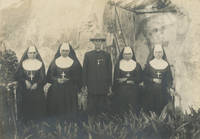
1900List518Most Cuba or Jacksonville 1900. Silver gelatin or albumen photographs various sizes ranging from 3 x 3 to 6 x 8 most captioned to verso. With handwritten manuscript four leaves discussing various diseases. The Spanish-American War was the first war in which nurses formed their own dedicated units as well as the first war in which they were accepted within military hospitals. While no nurses died in battle 153 died during the war from disease. Nurses were responsible for both treating soldiers as well as maintaining sanitary conditions within the camps. Conditions were often poor leading some to work until they were too sick to continue. <br /><br /> The current collection of photographs documents the experiences of a Mrs. Waters who was originally from Groton Massachusetts. The collection begins with a couple early photographs including a portrait as a young woman and a cyanotype of one of Waters' leprosy patients at Johns Hopkins Hospital in Baltimore. The next section shows Waters' training in Jacksonville Florida with either the Fourth or Seventh Army Corps at what was called Camp Cuba Libre both Corps trained there in 1898. The photographs of Jacksonville show life around the military camp and environs with some notable photographs of African-American inhabitants of the region. Three photographs quite notably show the Congregation of American Sisters a small group of American Indian nuns led by Reverend Francis Craft. The photographs taken in Cuba are notable for their portrayal of local life. Several photographs of military installations are taken around the "trocha" or line established by General Valeriana Weyler from Mariel to Majana. Another notable photograph is a cabinet card of a large group of nurses taken by the Havana photographer R. Testar. <br /><br /> The group overall shows very early photographic records of military nurses in training as well as a scarce photographic record from a woman in a combat situation. The photographs are generally well preserved in very good to excellent condition with some light fading. Accompanying the photographs is a four page manuscript essay presumably by Waters discussing leprosy as well as the booklet Spanish Phrase Book for American Soldiers and Sailors published by the National Relief Commission of Philadelphia. <br /><br /> Offered in partnership with Daniel / Oliver Gallery. books
15259Women at Oxford. Archive of papers recording the great debate between the Association for promoting the Education of Women AEW at Oxford and the faculty and students who opposed their entrance. 1895-1896. Total of 50 separate documents ranging from printed single page letters through bound booklets. The majority of these documents are known to exist only in one single additional copy held by the University of Oxford; and several of the papers are not noted to be included even within Oxford's collection as per OCLC worldcat. <br/><br/> This collection of papers is ripe for scholarly research. Forming a cohesive archive of 50 documents it includes synopses of the contents and resolution of meetings of the AEW arguments concerning various aspects of the question of inclusion of women at Oxford and advice for members concerning upcoming resolutions put to vote. The AEW was founded in 1873 to gain the full educational enfranchisement of women at Oxford who had actually been attending classes in small numbers by special permission since 1866. Despite vigorous support for the cause Oxford maintained as nearly the last hold-out against coeducation among British Universities not allowing women to gain the full B.A. degree until 1920. Some documents of the archive include "The Due Recognition of Women by the University of Oxford" 1896; "A Brief History of the Proposal to Admit Women to Degrees at Cambridge in 1887-8" by Thomas Case 1896; "The Value of a Genuine Diploma"; and "The B.A. Degree for Women." Full list available upon request. Individual pages or booklets sizes vary. Some hole-punched a few corner tears light edge soiling and toning. Some stamped with circular stamp "Board of Education Library"; most with numerical markers in red to upper right corner of documents. All in good condition and clearly legible. Full of sagacity and wit this archive evidences the reasoned support of women's right to the diploma over twenty years before it was finally granted.<br/> <br/>A partial List of Publications and some OCLC Worldcat search results: "most" are held only at Oxford University and no other copies at any institutions or library worldwide. 4 items had no copies at any Liabraries as per OCLC not even Oxford. See details below<br/><br/>Oxford University Gazette Tuesday Feb 18 1896 "Memorials and Resultions with respect to the admission of women to the BA Degree laid before the Hebdomadal Council in 1895 and 1896 - OCLC: NONE <br/><br/>memorandum for the committee of council; admission of women to the B.A. degree June 4 1895 by T.H. Grose - OCLC: NONE <br/><br/>Association for the Education of Women meeting flier Clarendon Building Oxford 6thApril 1895 - OCLC: NONE <br/><br/>Report approved by the Council of the Association for the Education of Women at a Meeting held March 6 1895 - OCLC: NONE <br/><br/>A Brief History of the Proposal to Admit Women to Degrees at Cambridge in 1887-8 by Thomas Case -OCLC: 6 Total: only 1 held in US Yale 5 held UK<br/><br/> "The inferiority of the undergraduate course proposed by Resolutions 2 & 4 to the freedom of education proposed by Resolution 5 in the case of women." - March 9 1896 by An Old Liberal - OCLC: Only 1 held at Oxford<br/><br/>The due recognition of women by the University of Oxford : papers by Mrs. Johnson Warden of Merton Warden of Keble Prof. Gardner E. Armstrong A.H. Johnson L.R. Farnell Members of the University against resolutions 1 2 3 & 4 to be submitted to congregation on Tuesday March 3 at 2 o'clock Feb 7 1896 -OCLC: 2 Total 1 Oxford one Germany<br/><br/>"The value of a genuine diploma" - March 9 1896 - OCLC: only 1 Held at Oxford no others.<br/><br/>"The Question of Residence" - J. Wells 1896 - OCLC: only 1 held at Oxford<br/><br/>Resolution II. A grievance and its remedies. By CH Firth -OCLC: only 1 held at Oxford<br/><br/>A noble resolution by Z - OCLC:only 1 held at Oxford<br/><br/>Resolution 5. : "I think it will be found that their exhortations are of two sorts appropriate to these two classes." - OCLC: 1 held Oxford<br/><br/>The due recognition of women in the University. : Reasons for voting for resolution 5. -OCLC: only 1 held at Oxford <br/><br/>Mixed universities: what is the teaching of experience. By Percy Gardner - OCLC: only 1 at held Oxford<br/><br/>An Appeal by HF Pelham -OCLC:only 1 held at Oxford<br/><br/>Resolution 2. Diploma versus Degree by William Anson -OCLC: only 1 held at Oxford. unknown books
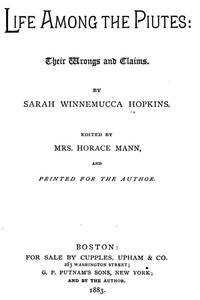
19963406V.p. 1996. A collection of 410 titles concerning Women in the West. Condition Statement: Overall most of the books in the collection are in "good" or "good" condition which typically describes a book that is sufficiently worn the binding soiled scuffed stained or spotted and may have loose joints hinges pages etc. To a lesser extent there are books in "fair" condition namely a well-worn book that has complete text pages including those with maps or plates but may lack endpapers half-title etc. The binding and/or jacket may also be worn. Women in the American West: Books and Ephemera from the Collection of Dorothy Sloan. SEE DETAILED FINDING AID on our website. <br/><br/>Dorothy Sloan b. 1943 is justly considered to be one of great scholar-booksellers of Western Americana Texana and Latin Americana. Dorothy Sloan Rare Books auction catalogues are recognized as models of their kind and feature an unusually broad array of printed books maps manuscripts and ephemera and are particularly strong in 19th-century materials. In many instances Sloan's bibliographic descriptions have become the description of record.<br/>She began her career at John Howell in San Francisco and thence to Jenkins Company in Austin. She issued her first rare book catalogue in 1984 and her first auction catalogue in 1994. Suffice it to say that as a woman she was literally a pioneer in such an endeavor. <br/><br/>Over the years she built a collection of Women in the West which is described in the 29-page Inventory below. Here is a collection of both women authors and women as the subject of historical and literary narrative. Most of the collection was kept in storage for the last twenty-eight years awaiting cataloguing and eventual sale. As we all know "Life" often interferes with our plans particularly as we grow older. <br/><br/>When Dorothy retired last year we acquired the collection of Women in the West. We are pleased to offer it en bloc for the price of $8200 which includes free shipping in the Continental United States. <br/><br/>Of the 410 titles in the collection nearly 25% are more than a century old. The earliest book in the collection is Sally Hastings' Poems on different subjects. To which is added a descriptive account of a family tour to the West. Lancaster 1808. The author describes her travels from Lancaster County to Washington PA. through the Alleghenies and gives an account of the Ohio River at Pittsburgh.<br/><br/>Only a handful of titles in the collection were published in the last 30 years the "newest" one dated 1996 namely: Anne Butler and Ona Siporin Uncommon common women. which contains culturally and ethnically diverse accounts of women who lived in the American West.<br/><br/>The physical size of the collection is considerable. Without any packing material it would encompass 15 large boxes. There are photographs gum cards engravings various inscribed books plays of the California Gold Rush memoirs and captivity narratives travelogues captivity narratives autobiographies Western novels pamphlets private press material a few 'zines journals catalogues and magazines. It is the culmination of decades of labor spanning all genres in the Western Americana tradition. The collection represents women's voices of a myriad of ethnicities including various Native American tribes African and African-American women Hispanic women prostitutes madams cowgirls ranchers pioneers and their struggles in the face of physical social and cultural adversity. <br/><br/>We are reluctant to mention "highlights" as it would suggest that "lowlights" do not merit attention from scholars and bibliophiles alike. We invite readers to peruse the Inventory of the collection capably prepared by Hunter Corb to allow readers to make that determination for themselves. <br/><br/>Included is the first edition of Miriam Colt's autobiography which describes her ill-fated expedition to Kansas Went to Kansas 1862 in which she traveled more than 1300 miles to establish a communal vegetarian colony. Colt provides vivid and frightening details of a family's ordeals on the frontier landscape including severe illness and encounters with lawless gangs. Defrauded of their investment in the Vegetarian Settlement Company the Colts left Kansas in the fall of 1856. Colt's husband and son died en route leaving only mother and daughter to return to New York. <br/><br/>Another work of interest is Sarah Hopkins's Life Among the Piutes an autobiography written at the encouragement of Ralph Waldo Emerson. This is considered to be the first book written and published in English by a Native American woman. It provides "extensive information about pre-White northern Paiute culture the types of foods marriage and other social practices as well as political leadership" Paher while simultaneously increasing awareness and sympathy for the plight of Native Americans. <br/><br/>Melinda Rankin's Twenty Years Among the Mexicans describes her missionary labor in south Texas and Mexico. Herein are depicted the experiences of the first Protestant woman missionary in Latin America. Although laws in Mexico at the time forbade the introduction of any form of Protestantism into the country Rankin traveled there in 1852 and established the first Protestant mission in Northern Mexico continuing her work there for a few decades before returning to the United States due to health problems. This narrative describes not just Rankin's missionary labors but also many dramatic events in Texas and Mexico including revolutionary turmoil the American Civil War and her capture by the notorious military leader rancher and outlaw Juan Cortina.<br/><br/>From early settlers of the West during and shortly after the American Revolution; to ranchers and pioneering women in the early days of the Republic of Texas and the fight for independence; to overland travels in covered wagons on the famed Oregon Trail at the outset of the American Civil War; to excursions into Mexico and Latin America at the end of the 19th and into the 20th centuries. Over two hundred years of women's experiences can be found within this collection and as such there is something for every student and subject matter.<br/><br/>SEE DETAILED FINDING AID ON OUR WEBSITE which enumerates each and every one of the 410 titles:<br/><br/>https://www.michaellaird.com/cat.phpid=307. unknown books
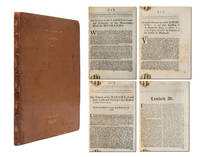
16934178London: Various 1693. First editions. Late 18th - early 19th century full polished calf with gilt to spine and front board. Marbled endpapers. A pleasing square copy with just a bit of rubbing to extremities. Gilt and embossed bookplate of bibliophile Edward Hailstone 1767-1851 to front pastedown. Containing four complete exceedingly scarce pamphlets from the 17th century querelle des femmes debates about women's humanity and place in society interleaved with blanks likely for manuscript glossing although all remain unmarked. Comprised of:<br/><br/>1. Petition of the Ladies of London and Westminster to the Honourable House for Husbands. London: Printed for Mary Want-man the fore-maid of the petitioners and sold by A. Roper in Fleetstreet 1693. First edition. Complete including all four pages called for by ESTC and listing its imprint in the colophon. ESTC records only 8 copies with only 3 listed in the modern auction record since 1940.<br/><br/>2. An Humble Remonstrance of the Batchelors in and about London.in Answer to the Late Paper Intituled A Petition of the Ladies for Husbands. London: Printed for and Sold by the Bookselling Batchelors in St. Paul's Churchyard 1693. First edition. Complete including all four pages called for by ESTC and listing its imprint in the colophon. In all a clean and neat copy of this scarce and important part of the debate on women. ESTC lists only 8 extant copies with only 2 listed in the modern auction record. ESTC R4393.<br/><br/>3. The Petition of the Widows in and about London and Westminster for a Redress of their Grievances. By the Same Solicitor that Drew up The Petition for Ladies. London: Printed for the Use of the Wide--ows 1693. First edition. Complete including all four pages called for by ESTC with the imprint appearing at the rear colphon. A scarce piece recorded at only 7 institutions by ESTC and recorded only twice at auction since 1927. ESTC R25582.<br/><br/>4. Lambeth Ale. London: Printed for Abel Roper 1693. First edition. Complete in four pages with the imprint recorded on the rear colophon. With no listing on ESTC and no appearances at auction a truly scarce piece.<br/><br/>A unique opportunity to trace a string of direct argument-and-response publications rapidly produced within one year of the 17th century querelle des femme pamphlet wars. Brought together in one binding by solicitor and bibliophile Edward Hailstone whose remarkable library at Walton Hall included rare books and antiquities. <br/><br/>The Querelle des Femmes the Woman Question was a debate on women's status that raged across Europe and England through the 16th to 18th century depicted at times in drama and literature but most often enacted through broadsides and pamphlets. While early iterations of the debate focused on whether women were humans or indeed possessed souls emphasis began shifting as an increasing number of women began printing responses of their own. In this collection's first pamphlet "Mary Want-man the fore-maid of the petitioners" the anonymous female author draws attention to the negative impacts that misogynist bolster lectures have had on the general state of matrimony. By labeling women as natural harlots predestined to cuckold their husbands the Petition alleges polemicists endangered women and men alike: the former would lack economic and legal security without a spouse and the former would turn to drink and debauchery. "Mary Want-man" in this sense turns the tables on the terms of the debate. Men are morally weak without a helpmeet and need wives -- and women are placed at social disadvantage by the rules that define them as men's companions. To this end the Petition sets out the demand that men be required to marry much as women have been and that they meet five terms: "First that all men of Quality and Degree soever shall be obliged to marry as soon as they are one and twenty and that those persons who decline so doing shall for their Liberty as they call it pay yearly to the State.Secondly that no Excuse shall be admitted but that of natural Frigidity or Impotence.Thirdly since it is found by experience that the generality of young men are such Idolators of the Bottle.that no person whatsoever shall be privileged to enter a Tavern who is not married.That every Poet or pretender to be a poet or anyone who is hired to write .to the derogation of the Matrimonial State shall be obliged to marry before Lady day ensuing.Lastly.every person of Quality pretending to keep a Miss.must dispose of her in Marriage to his Footman or Groom." Biting and witty this feminist satire suggests that men must be corralled and that marriage is the means by which to do it thus also ensuring stability for women. <br/><br/>Soon after the "Bookselling Batchelors" engaged "Mary" with their own publication -- and in attempting to break down the Petition's satirical arguments An Humble Remonstrance relies on many of the misogynistic commonplaces that the Ladies decried. And in its conclusion Remonstrance teases the possibility that women were right about men's current debauched tendencies shifting The Petition's desire for social instability to one of bawdy fulfillment for men's benefit. "The Ladies are weary of lying alone and so are we: They would fain be advantageously married and so would your humble Servants. The Quarrel on their side is therefore unjustly begun.but because Jacob could serve two Apprenticeships for his Rachel they imagine that we must do the same; not considering that the Race of Methuselahs and Patriarchs is quite extinct."<br/><br/>Unwilling to be outdone the women clap back; and a pamphleteer claiming to represent the interests of the region's Widows joins the printed fray. "Last week a petition subscribed by the unmarried Ladies came before you.Tis true we wondered to find an Army of Maids from whom the world usually expects modesty and silence.Widowes indeed who lye under no such restrictions are allowed to speak for themselves." Thus the Widows point out a crucial and problematic differentiation among women based on marital status: the division of the femme covert unmarried or married women with legal identities subsumed by fathers or husbands under coverture versus femme sole orphaned or widowed women with more independent legal and social status. To this end the widows recognize the need of the Maids to raise concerns about the issues most affecting them; while the more empowered widows can build on this foundation and push for a further expansion of rights.<br/><br/>While the final pamphlet of the group is not a direct engagement with the others it does suggest the collector's own interest in the role alcohol plays in much of the behavior decried by women in these works. <br/><br/>An opportunity unlikely to arise again for acquiring three incredibly scarce directly related arguments released only weeks apart. Various unknown books
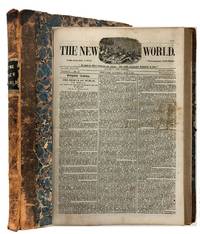
15960The Rights of Woman" Profound Influence on the Seneca Falls Declaration of Sentiments within The New World Vol. II No. 19 May 8 1841. Benjamin Park Editor. New York attorney and legal reformer E.P. Hurlbut's article "The Rights of Woman" appeared in the May 8 1841 issue of The New World newspaper begins p. 289. Hurlbut's article on the reform of marriage laws and married women's rights had a profound influence on women's right's pioneer Elizabeth Cady Stanton. Stanton was the principal author of the Declaration of Sentiments adopted at the 1848 Seneca Falls Convention seven years after Hurlbut's essay. His essay was first delivered as a speech in early 1841 at the Mechanics Institute of the City of New York the city's oldest technical school before being published in The New World newspaper. "The Rights of Woman" was later published in Hurlbut's work Essays on Human Rights and Their Political Guarantees 1845. Foxing to first and last pages and minor water damage to bottom corner of first pages. Very good.<br/><br/>Scholar Ann D. Gordon editor of The Selected Papers of Elizabeth Cady Stanton and Susan B. Anthony writes that Hurlbut's ".criticism included a scathing portrait of male domination that is echoed in the Declaration of Sentiments. . In his chapter on 'The Rights of Woman' he described woman's civil death. Her property is conferred on her husband because 'everybody knows that the dead cannot keep their property-and the wife is legally dead.' The authors of the Declaration followed Hurlbut in all their examples."¹<br/><br/>In ten full newspaper columns Hurlbut's essay develops his conception of the rights of women. His lawyerly arguments derive from the legal principles of Sir William Blackstone and the the common law and interestingly from the tenets of phrenology and physiology. He writes:<br/><br/>Those laws then which in the least detract from woman's intellectual freedom or moral responsibility or restrain the harmonious activity of her faculties after marriage outrage her rights. Her happiness still depends upon the free exercise of her natural powers. Her restraints must be those of her own enlightened nature. The woman and the wife must remain one and the same. She must be deemed capable of moral and legal consent; capable of judging and of acting; of willing and refusing. Her rights must be acknowledged in her wrongs redressed. column 7<br/>Later discussing pending legislation in the State of Missouri Jan. 1841 Hurlbut declares: "Let us carry the principle of equality into the married state and allow the wife to know and feel that she is truly the partner and equal of her husband." column 10.<br/><br/>Winchester's The New World was only published between 1839 to 1845.<br/><br/>Description: E.P. Hurlbut Elisha Powell Hurlbut 1807-; Park Benjamin Editor Park Benjamin Sr. 1809-1864. "The Rights of Woman" Profound Influence on the Seneca Falls Declaration of Sentiments within The New World Vol. II No. 19 May 8 1841. New York: J. Winchester Publisher Saturday May 8 1841. 16pp. Newspaper. 15¼ x 10½ inches. Removed. Illustrated masthead; printed in three columns. First and final leaves separated; otherwise very good. 3726549<br/>Note. 1. Gordon ed. The Selected Papers of Elizabeth Cady Stanton and Susan B. Anthony Volume I In the School of Anti-Slavery 1840 to 1866 Rutgers 1997 2001 p86. unknown books
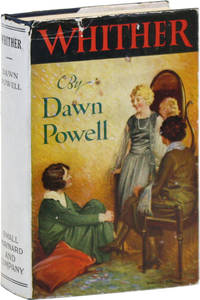
192546542Boston: Small Maynard & Company 1925. First Edition. Octavo 19.5cm; navy blue cloth with titles stamped in gilt on spine and front cover; dustjacket; iv23-3053pp. Spine ends very gently nudged hint of dustiness to upper edge of textblock else a fresh Fine copy. In the dustjacket designed by Harold James Cue priced $2.00 on front flap; light shelfwear touch of dust-soil to spine rear panel and flap edges with a few short tears and attendant creases upper edge of front panel and upper rear joint shallow loss to spine ends none affecting lettering and a dozen small soil spots to panels; still a bright substantially complete and Very Good example unrestored. Attractive copy of Powell's first novel an autobiographical work recounting the story of an idealistic Midwestern girl who moves to New York aspiring to be a playwright. She settles into a boarding house for women surrounded by a cast of characters who are perpetually out of money deeply concerned with their wardrobes and trying to find a man. She finds fulfilling work as a copy writer navigates her way throughout a string of suitors all the while soliciting advice from her housemates quits her job and briefly entertains the idea of taking up with a Greenwich Village bohemian and writing plays full-time; she abandons her dreams after accepting an eleventh hour proposal from a wealthy suitor embarks on a steamship to London with her man and sails off toward her new life with the words "Is the world really so gorgeous as this" <br/><br/>The earlier part of the novel at least somewhat mirrors Powell's own experiences. She led a somewhat unhappy childhood in Ohio where her stepmother took pleasure at burning her early attempts at poetry and fiction; after moving in with a supportive aunt and attending Lake Erie College she moved to Manhattan to pursue a career as a writer finding work as a publicist for several organizations before marrying her husband an advertising executive named Joseph Gousha and settling in Greenwich Village where she would live out the rest of her life. Her marriage allowed her to quit her job and focus on her writing full-time "using the Children's Reading Room of the New York Public Library on Fifth Avenue as the place to write. What became the classic elements of Dawn Powell's work were in evidence from the outset. Her first novel Whither.has the characteristic satiric tone mordant wit and unforgiving eye for the foibles of middle-class Americans whether they lived in the Middle West the setting for her early work or were newly arrived midwestern émigrés to the big city of New York desperately seeking sophistication" Carnes Mark C. "Dawn Powell." Invisible Giants: Fifty Americans Who Shaped the Nation but Missed the History Books p.232. Powell disavowed her literary debut leaving it out of lists of her publications throughout her lifetime and referring to She Walks In Beauty 1928 as her first novel. An uncommon debut published in small numbers and rare in dustjacket; we find no copies for sale in the auction record and OCLC notes a scant 11 holdings in U.S. institutions. SMITH P-576. Small, Maynard & Company unknown books
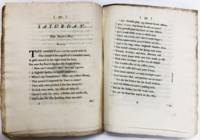
13540Archive on women's crucial role in the creation and development of vaccines especially it's accessibility to children regardless of economic class and the global eradication of smallpox. Containing 3 early and rare pieces that show how women emerged as a driving force in developing and sharing immunization techniques that continue increasing child survival rates today. Includes 2 scarce first edition books by Lady Mary Wortley Montagu with writing about her experiences bringing inoculation to the Western world and her advocacy for mothers using inoculation to save their children's lives. Accompanied by a letter to Lady Mary by Lady Margaret Cavendish Bentinck the curator of an influential scientific collection and a proponent of women's scientific research. By 1796 Lady Mary's work was advanced by Edward Jenner who developed a safer method of immunization using a vaccine derived from cowpox. <br/> <br/>Having witnessed the lifesaving benefits of immunization while traveling in Turkey Lady Mary Wortley Montagu made medical history in 1721 when she had her own children inoculated and became the first person to bring inoculation to the West. As one of the first immunization activists in the West she used her power and influence as a literary pioneer to publish about it promoting the procedure to combat Britain's smallpox epidemic. This archive's two rare books by Lady Mary contain her writing on smallpox prevention: a 1747 first edition of "Six Town Eclogues" never before sold at auction which focuses on the hardships women and girls faced when unable to access inoculation; and an 1803 five volume first edition of "The Works of the Right Honorable Lady Mary Wortley Monagu" describing "the introduction of the art of inoculation into this Kingdom" and her time "dedicated to various consultations" about the procedure. Accompanied by a letter to Lady Mary Montagu written by Lady Margaret Cavendish Bentinck who curated an influential natural science collection and encouraged women's work in science. Lady Mary Wortley Montagu and the thousands of other women who supported Jenner's vaccine were responsible directly and indirectly for saving tens of thousands of lives. Over the following decades women were crucial in helping Jenner provide the vaccine to children around the world and by the 1850's records suggest that in England alone women were responsible for ensuring vaccination for over 30000 children and for soliciting funding to allow Jenner's clinics to rescue even more. 150 years later the World Health Organization finally declared smallpox eradicated in 1980. An important archive revealing women's crucial role in the past present and future of vaccination. unknown books
15274Women's Early Education. Report of the Commission Charged to examine memoirs relative to the education of women. Third Subject. - Morality. By Mr. Philis - Reporter. 1827. Paper boards. Folio size 13 in x 8.5 in. 68 pages of handwritten script in black ink. In this manuscript one of the earliest formal debates on the value of education for women the author radically concludes that formal education for women should be universally accessible: "We think that in whatever condition heaven has placed a woman" the author argues "from the daughter of the Prince to that of the most humble of the subjects there should be a similarity of ideas. When they are wisely explained the elements of Language and Calculations are they not necessary and indispensable to women in all stations" The author then reverses the very argument used against women's education-- that it is unnatural since motherhood is the only suitable destiny for women-- by arguing that education is exactly suited to "what nature formed women to be". "She knows she was created to fulfill duties and penetrated with a sense of those she has to perform she makes all she possesses of enlightened ideas talents and fortune concur in accomplishing them. This is what nature formed women to be and such a well directed education would make her. This is what would make a good mother of a family who would well know how to form daughters worthy of imitating her." Education in fact is as naturally suited to women as motherhood and ought to be the province of adult women and girls alike regardless of age or opportunity-- an ideal still worth fighting for even nearly two centuries later. <br/><br/>It begins with a deceptively leading question: "What is the sort of education most suitable to Woman and the most proper to render them capable of fulfilling their destination as Mothers of families"Although the opening query is limited by modern standards formal education for many children-boys and girls alike-was not considered necessary in this period let alone for adult women with responsibilities in the home. The argument that education would serve women in their motherly duties was a crucial tool for advocates of womens' enfranchisement. The Commission judges three memoirs submitted on this topic and this forms the structure of the manuscript: "The Education Best Adapted to Form A Good Mother of A Family Is That Received at Home"; "It is Well Known That The Bad Education Of Women Does More Harm Than That of Men Because the Want of Good Conduct in Man Proceeds Frequently From The Education They Received From Their Mother ."; and "To Instruct the Children One Must Enlighten the Mothers". Thus the manuscript is valuable not only for its radical ideals but for its historical benefit as an overview of attitudes towards women's education at the turn of the 20th century. Just one year prior in 1826 the first public high schools were opened for girls in New York and Boston; it would be another 13 years until the first woman earned a college Bachelor's degree.  Cover boards worn with light soiling and scattered stains. Even toning and light soiling throughout. Very good to good condition. unknown books