544 résultats
195157788Washington 1951. Hardcover. Fair. photos 128p. Original yellow boards. 28cm. Moderate cover soil and wear. Lacks backstrip. No Jacket. <br/><br/> Washington hardcover books
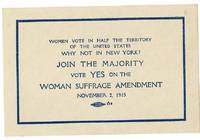
16309Suffrage White calling card with blue ink and border. 2 ¾ x 4 ¼ in. The card states that women can vote in half of the country but not in New York; and it calls upon the reader to "Join the Majority" and "Vote Yes on the Woman Suffrage Amendment." The vote was on November 2 1915 but failed to pass; two years later in 1917 women's suffrage passed in New York on the statewide level. Very good condition. A lovely piece of history documenting the advancement of women's voting rights. unknown books
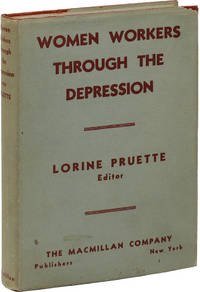
193414429New York: Macmillan 1934. First Edition. Octavo 19.5cm. Red cloth boards spine lettered in gilt; dustjacket; 164pp; tables; 1 chart folding. Tight Near Fine copy in the uncommon dustwrapper mildly toned on spine and with a tiny loss at upper flap-fold otherwise quite clean and crisp. Sociological and statistical study of women's work in the Great Depression conducted under the aegis of the American Woman's Association of New York. Lorine Pruette 1896-1977 was a Columbia-trained social psychologist whose later work included periods at the Bureau of Economic Research and the Office of War Information as a consultant on broadcast propaganda. Macmillan unknown books
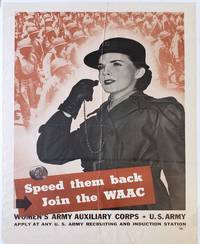
17155WWII military recruitment poster for the Women's Army Auxiliary Corps. 1943. A large poster that documents women who served uniformed auxiliaries roles in the U.S. armed forces. Printed by the Recruiting Publicity Bureau United States Army. 39 x 25.5 inches. "Speed them Back / Join the WAAC". Commanding photo-illustrated image of a woman in military dress who stands confidently and holds a whistle to her mouth. Dozens of marching infantry soldiers are printed behind her. "Women's Army Auxiliary Corps / U.S. Army / Apply at any U.S. Army recruiting and induction station." Spurred on by the attack on Pearl Harbor on Dec. 7 1941 Congress approved the creation of WAAC on May 14 1942 to enhance the US military force and staff non-combat roles with women workers to create a larger male fighting force; they realized that women could supply additional resources desperately needed in both military and industrial sectors. Members of the WAAC were the first women other than nurses to serve within the ranks of the United States Army and over 150000 American women served in the Women's Army Corps during World War II. Given the opportunity to make a major contribution to the national war effort women seized it. They drove trucks repaired airplanes worked as laboratory technicians rigged parachutes served as radio operators analyzed photographs and more. By the end of the war their contributions would be widely heralded and even General Eisenhower felt that he could not win the war without the aid of the women in uniform. "The contribution of the women of America whether on the farm or in the factory or in uniform to D-Day was a sine qua non of the invasion effort." Ambrose D-Day 489. Repaired vertical tear down center. 3 horizontal crease marks. 1 x ½" loss to bottom left corner. ½" closed tear in bottom right edge. In good condition. unknown books
16662Women Sports Education Women's Athletic Council secretary's handwritten minutes written in many hands concerning school teams and fundraisers for basketball soccer volleyball and other sports from academic years 1938-1947. Original boards. 8.5 x 6.5 in. Title on front cover" Composition Book Property of Women's Athletic Council Secretary's Book" . 90 pages. Includes additional loose papers related to the council. "Each W.A.C. girl who fulfills her obligations in officiating and playing during the year 2 semesters in which she plays in two sports and coaches one or vice versa is given an additional star for her council work. If she does not fulfill this she is dropped from the council."<br/><br/>Handwritten entries spanning almost a decade of council business relating to managing and promoting Sports for Women. "The first meeting of the Women's Athletic council was called to order by Miss Helen Wily on September 27. Nominations were opened for new president. Eva Murdock was formally elected to the office. The question of . a coach for freshman hockey was introduced and Wasdine Freedline was appointed to this position. The president made a request of new business and in response to the request freshmen practice days were set for Tuesdays and Thursdays. Sophomore practice days were set for Wednesdays and Fridays. A motion was properly moved and seconded that the meeting be adjourned. Respectfully submitted Anita Brown Sec."<br/><br/>In addition to coaches and rosters for Varsity Freshman and Sophomore teams in basketball volleyball softball and soccer; the council organized various social functions. "New business. There was a discussion of the possibility of a social function before the term ends but nothing definite was decided." "After debating over several different types of social function It was decided that we have a Weiner Roast down by the river Friday Sept. 20. Ruth Barr and Marylou Gourley were appointed by the president to buy the food." They also oversaw tournaments and games for students. "Plans were discussed for the Speedball Tournament." "An intramural tournament including ping-pong shuffleboard badminton to be healed between the five sororities and a team of non-sorority girls." Some wear and loss to lower portion of spine. In very good condition. unknown books
13540Archive on women's crucial role in the creation and development of vaccines especially it's accessibility to children regardless of economic class and the global eradication of smallpox. Containing 3 early and rare pieces that show how women emerged as a driving force in developing and sharing immunization techniques that continue increasing child survival rates today. Includes 2 scarce first edition books by Lady Mary Wortley Montagu with writing about her experiences bringing inoculation to the Western world and her advocacy for mothers using inoculation to save their children's lives. Accompanied by a letter to Lady Mary by Lady Margaret Cavendish Bentinck the curator of an influential scientific collection and a proponent of women's scientific research. By 1796 Lady Mary's work was advanced by Edward Jenner who developed a safer method of immunization using a vaccine derived from cowpox. <br/> <br/>Having witnessed the lifesaving benefits of immunization while traveling in Turkey Lady Mary Wortley Montagu made medical history in 1721 when she had her own children inoculated and became the first person to bring inoculation to the West. As one of the first immunization activists in the West she used her power and influence as a literary pioneer to publish about it promoting the procedure to combat Britain's smallpox epidemic. This archive's two rare books by Lady Mary contain her writing on smallpox prevention: a 1747 first edition of "Six Town Eclogues" never before sold at auction which focuses on the hardships women and girls faced when unable to access inoculation; and an 1803 five volume first edition of "The Works of the Right Honorable Lady Mary Wortley Monagu" describing "the introduction of the art of inoculation into this Kingdom" and her time "dedicated to various consultations" about the procedure. Accompanied by a letter to Lady Mary Montagu written by Lady Margaret Cavendish Bentinck who curated an influential natural science collection and encouraged women's work in science. Lady Mary Wortley Montagu and the thousands of other women who supported Jenner's vaccine were responsible directly and indirectly for saving tens of thousands of lives. Over the following decades women were crucial in helping Jenner provide the vaccine to children around the world and by the 1850's records suggest that in England alone women were responsible for ensuring vaccination for over 30000 children and for soliciting funding to allow Jenner's clinics to rescue even more. 150 years later the World Health Organization finally declared smallpox eradicated in 1980. An important archive revealing women's crucial role in the past present and future of vaccination. unknown books
16748Women's Education Movement. Goddard Seminary Catalog 1877. Pamphlet Catalog for the 1877 class of Goddard Seminary a coeducational school in Barre VT. Including the names of students. Goddard College began in 1863 in Barre Vermont as the Green Mountain Central Institute and in 1870 was renamed Goddard Seminary. Founded by Universalists Goddard Seminary was a four-year preparatory high school primarily for Tufts College. For many years the Seminary prospered. But the opening of many good public high schools made many of the New England academics obsolete. The trustees added a Junior College to the Seminary in 1935 and in 1938 Goddard College was chartered. It remains progressive Universalist institution. There are no copies of this very early female education catalog in any institution or libraries as per OCLC Worldcat. <br/><br/>Women's Academy and Seminary Archive recording the first important movement of women into higher education in the United States seminary was synonymous with "academy" and did not have the religious connotation of today. In the 1800's the Female Academy and Seminary Movement transformed American educational norms allowing women the opportunity to receive secular non-religious college-level education. Women's colleges proliferated in the mid- to late- 19th century to fill the void created by their exclusion from most institutions of higher education. The prevailing notion that women were too delicate for a rigorous academic education was openly challenged when Elizabeth Cady Stanton spoke at the Seneca Falls Convention of 1848 "Man's intellectual superiority cannot be a question until woman has had a fair trial.When we shall have had our colleges our professions our trades for a century a comparison then may be justly instituted." Young women were quick to step up to the challenge; as quickly as female colleges opened they filled up. unknown books
16759Women's Education Movement. Pamphlet/ Volume 14 of 17: Acts for the State of Massachusetts January 12th Session 1804 Incorporation of Bradford Academy Containing the original incorporation of Bradford Academy. Bradford opened as the first coeducational institution in Massachusetts but due to overwhelming interest from parents of girls with no other option for education Bradford soon transitioned to become the first all-female academy in Massachusetts and among the first in the United States in 1836. Only three examples of these early Incorporation Acts could not be found among Institutional Collections according to OCLC Worldcat. <br/><br/>Women's colleges proliferated in the mid- to late- 19th century to fill the void created by their exclusion from most institutions of higher education. The prevailing notion that women were too delicate for a rigorous academic education was openly challenged when Elizabeth Cady Stanton spoke at the Seneca Falls Convention of 1848 "Man's intellectual superiority cannot be a question until woman has had a fair trial.When we shall have had our colleges our professions our trades for a century a comparison then may be justly instituted." Young women were quick to step up to the challenge; as quickly as female colleges opened they filled up. But this document predates Seneca Falls by 40 years and Bradford was among the very first institutions to educate women in the United States. unknown books
16755Women's Education Movement. New Hampshire Conference Seminary and Female College Catalog 1881. Tilton NH. The catalog has 36 pages of courses personnel and other information including tuition and fees. The most expensive were Piano and Voice Culture which were each $12 per semester. The seminary exists today at Tilton School. No copy could be found among Institutional or library Collections according to OCLC Worldcat. <br/><br/>Women's Academy and Seminary Archive recording the first important movement of women into higher education in the United States seminary was synonymous with "academy" and did not have the religious connotation of today. In the 1800's the Female Academy and Seminary Movement transformed American educational norms allowing women the opportunity to receive secular non-religious college-level education. Women's colleges proliferated in the mid- to late- 19th century to fill the void created by their exclusion from most institutions of higher education. The prevailing notion that women were too delicate for a rigorous academic education was openly challenged when Elizabeth Cady Stanton spoke at the Seneca Falls Convention of 1848 "Man's intellectual superiority cannot be a question until woman has had a fair trial.When we shall have had our colleges our professions our trades for a century a comparison then may be justly instituted." Young women were quick to step up to the challenge; as quickly as female colleges opened they filled up. unknown books
16753Women's Education Movement. Western Female Seminary Catalog 1868-1869. Oxford OH. Western Female Seminary was founded in 1853 as a daughter school of Mount Holyoke College in South Hadley Massachusetts. Its first principal Helen Peabody and most of the early faculty had been students and teachers at Mount Holyoke. Mary Lyon Residence Hall on the Western campus is named for Mount Holyok's founder Mary Lyon. It later received a charter and became Western College an all-female institution. Women's colleges proliferated in the mid- to late- 19th century to fill the void created by their exclusion from most institutions of higher education. The prevailing notion that women were too delicate for a rigorous academic education was openly challenged when Elizabeth Cady Stanton spoke at the Seneca Falls Convention of 1848 "Man's intellectual superiority cannot be a question until woman has had a fair trial.When we shall have had our colleges our professions our trades for a century a comparison then may be justly instituted." Young women were quick to step up to the challenge; as quickly as female colleges opened they filled up. No copy could be found among Institutional or library Collections according to OCLC Worldcat. <br/><br/>Women's Academy and Seminary Archive recording the first important movement of women into higher education in the United States seminary was synonymous with "academy" and did not have the religious connotation of today. In the 1800's the Female Academy and Seminary Movement transformed American educational norms allowing women the opportunity to receive secular non-religious college-level education. Women's colleges proliferated in the mid- to late- 19th century to fill the void created by their exclusion from most institutions of higher education. The prevailing notion that women were too delicate for a rigorous academic education was openly challenged when Elizabeth Cady Stanton spoke at the Seneca Falls Convention of 1848 "Man's intellectual superiority cannot be a question until woman has had a fair trial.When we shall have had our colleges our professions our trades for a century a comparison then may be justly instituted." Young women were quick to step up to the challenge; as quickly as female colleges opened they filled up. Not in OCLC Worldcat. unknown books
16752Women's Educational Movement. Chowan Baptist Female Institute Catalog 1877-1878. The Chowan Baptist Female Institute became Chowan College in 1910 when it began awarding baccalaureate degrees. Unique and personal piece of early Female Education history. Women's colleges proliferated in the mid- to late- 19th century to fill the void created by their exclusion from most institutions of higher education. The prevailing notion that women were too delicate for a rigorous academic education was openly challenged when Elizabeth Cady Stanton spoke at the Seneca Falls Convention of 1848 "Man's intellectual superiority cannot be a question until woman has had a fair trial.When we shall have had our colleges our professions our trades for a century a comparison then may be justly instituted." Young women were quick to step up to the challenge; as quickly as female colleges opened they filled up. This document dates 10 years before Seneca Falls.Not copy could be found among Institutional Collections according to OCLC Worldcat. unknown books
16756Women's Educational Movement. Rural Repository News Journal 1841 Poughkeepsie Female Academy Founding Story and Engraving. Large Item. Poughkeepsie Female Academy- Hudson N. Y. This news journal the "Rural Repository" leads with a full page story on the opening of the Poughkeepsie Female Academy and engravings. More than 30 years later Vassar College would open near the same site. <br/><br/>Women's colleges proliferated in the mid- to late- 19th century to fill the void created by their exclusion from most institutions of higher education. The prevailing notion that women were too delicate for a rigorous academic education was openly challenged when Elizabeth Cady Stanton spoke at the Seneca Falls Convention of 1848 "Man's intellectual superiority cannot be a question until woman has had a fair trial.When we shall have had our colleges our professions our trades for a century a comparison then may be justly instituted." This document predates Seneca Falls by 7 years. unknown books
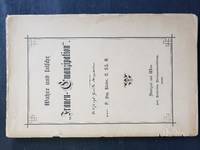
17141Women's Suffrage Germany P. Aug. Rosler. "Wahre und Falsche Frauen Emanzipation Truths and Lies: Women's Emancipation". Written in German. Stuttgart und Wien: Dof Roth'sche Verlagshandlung 1899. Printed by Hieronymus Muhlberger in Augsburg. 60 pages. 9 x 6 in. Original paper wraps. Very rare with 0 institutions or libraries in the US holding this volume per OCLC Worldcat. An early German language treatise regarding popular myths on women's suffrage and the Women's Question die Frauenfrage. The volume lists the Madonna mother of Christ as one example of virtuous women whom all respect. German women were granted the right to vote and be elected from November 12 1918 immediately after the Armistice of WWI. Handwritten ink annotation on front cover. Front and back cover are detached; pages 1-16 detached; pages 49-60 detached. In good condition. unknown books
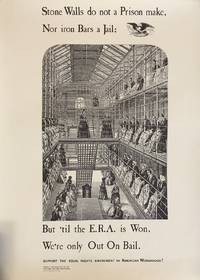
15287Stone walls do not a prison make nor iron bars a jail; but 'til the E.R.A. is won we're only out on bail poster Equal Rights Amendment Santa Monica CA: Helaine Victoria Enterprises 1975. 17.5x23 inch poster very good featuring a vintage image of a women's prison and a stanza adapted from the conclusion of the Richard Lovelace poem "To Althea from Prison." We have examples printed on several different shades of paper; please contact us if the shade makes a difference to you. unknown books
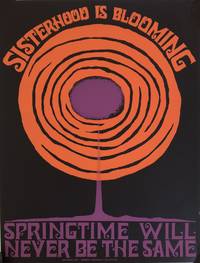
15974Chicago: Chicago Womens' Graphics Collective 1973. 19.75x25.75 silkscreened poster with stylized flower filling most of the page red and lavender ink on black paper fine.<br/><br/>The Chicago Women's Graphic Arts Collective was founded in 1970 by Estelle Carol as part of Chicago Women's Liberation in reaction to the lack of opportunities for women artists and as a way to communicate feminist ideas. Both lesbian and straight women collaborated on the posters as a collective process to set themselves apart from the male-dominated "Great Man" art world. unknown books
16725Denmark Academy Catalog 1876-1877. Denmark Iowa. Pamphlet /Volume 8 of 17: Founded in 1843. Denmark Academy was coeducational from its inception. At first a small local school it reopened in in 1852 with a new building and began to attract students from further reaches. The first graduating class consisted of only 2 students both female. One was Emma Cooper who went on to serve as "Lady Principal." Very rare with no copies of this program in any institution or library as per OCLC Worldcat.<br/><br/>Women's colleges proliferated in the mid- to late- 19th century to fill the void created by their exclusion from most institutions of higher education. The prevailing notion that women were too delicate for a rigorous academic education was openly challenged when Elizabeth Cady Stanton spoke at the Seneca Falls Convention of 1848 "Man's intellectual superiority cannot be a question until woman has had a fair trial.When we shall have had our colleges our professions our trades for a century a comparison then may be justly instituted." Young women were quick to step up to the challenge; as quickly as female colleges opened they filled up. This document dates from 5 years before Seneca Falls. unknown books
197043333Santa Monica CA: Graphic Communications Consultants 1970. First Edition. Quarto 27.75cm.; original pictorial staplebound card wrappers; unpaged; illus. Fine. 1970-1 calendar curiously beginning in July 1970 rather than January and ending in June 1971 each day of the year providing a number of relevant anecdotes quotes and historical events marking the progress of women's liberation. Bibliography provided. Forms part of the Women's Heritage Series. Graphic Communications Consultants unknown books
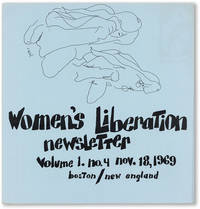
196946193Boston: New England Free Press 1969. First Edition. One-sheet newsletter offset printed on blue stock folded twice to create an eight-panel publication; measures 45.5cm x 43.25cm 17 15/16" x 17" when fully-opened. Hint of sunning to folds else very Near Fine. New England feminist publication printing lengthy statements from Lucia Montague and Diana Gerrity; the newsletter opens into an illustrated poster printing letters quotes poems women's lib news items and movement events. A list of suggested literature appears on rear wrapper. New England Free Press unknown books
15383China WOMEN October League Marxist-Leninist. Chicago: October League 1976. 16 pages. 5.5" x 8.5" illustrated with black and white photos of Women's Day marches the woman are all performing tasks at work on the image. Minor soiling good copy in stapled pictorial wraps. unknown books
197146195New York: Women's Rights Law Reporter Inc 1971-72. First Edition. Two quarto issues 27.5-28cm; stapled wrappers; 71; 55pp; illus. Some trivial dust-soil to wrapper extremities else very Near Fine. First two issues of this periodical dealing with legal issues facing women and women's rights. Includes poetry essays on childcare birth control mental health women in prison education unionizing legal workers etc. Women's Rights Law Reporter, Inc unknown books
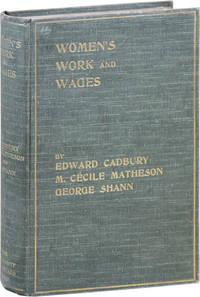
190711384Chicago: University of Chicago Press 1907. First American edition. Octavo. Green cloth boards; gilt spine titles; 368pp. Tight copy externally clean but with moderate foxing to text. Sociological study of female laborers in turn-of-the-century Birmingham. Illustrated with three halftone plates. Not common. University of Chicago Press unknown books
196948862Baltimore: Women: A Journal of Liberation Inc 1969. First Edition. Quarto 28cm; illustrated card wrappers stapled; 64pp; illus. Light wear and foxing to extremities else Very Good to Near Fine. Premiere issue of this key journal the first national publication of the second wave women's movement. The journal was founded in Baltimore MD by four women - Dee Ann Mims Donna Keck Vicki Pollard and Carmen Arbona - with the goal of providing a forum for opinions and expression that were essential to the burgeoning women's movement. The journal was managed by a collective with each issue focussing on a different theme. The publication ran from 1969-1983 ultimately folding due to reduced readership and financial stress. Contents include contributions by Dee Ann Pappas Roxanne Dunbar Donna Keck Janet Russo Peggy White Sheila Michaels and others. Women: A Journal of Liberation, Inc unknown books
197048863Baltimore: Women: A Journal of Liberation Inc 1970. First Edition. Quarto 28cm; illustrated card wrappers stapled; 80pp; illus. Light wear and scattered foxing to extremities; Very Good. Early issue of this key journal the first national publication of the second wave women's movement. The journal was founded in Baltimore MD by four women - Dee Ann Mims Donna Keck Vicki Pollard and Carmen Arbona - with the goal of providing a forum for opinions and expression that were essential to the burgeoning women's movement. The journal was managed by a collective with each issue focussing on a different theme. The publication ran from 1969-1983 ultimately folding due to reduced readership and financial stress. Contents include contributions by Linda Gordon Sharon Wolfson Judy Miller Carol Driscoll Natalie Petesch Evelyn Frankford and others. Women: A Journal of Liberation, Inc unknown books
197048864Baltimore: Women: A Journal of Liberation Inc 1970. First Edition. Quarto 28cm; illustrated card wrappers stapled; 64pp; illus. Light wear and dustiness to extremities else Near Fine. Early issue of this key journal the first national publication of the second wave women's movement. The journal was founded in Baltimore MD by four women - Dee Ann Mims Donna Keck Vicki Pollard and Carmen Arbona - with the goal of providing a forum for opinions and expression that were essential to the burgeoning women's movement. The journal was managed by a collective with each issue focussing on a different theme. The publication ran from 1969-1983 ultimately folding due to reduced readership and financial stress. Contents include contributions by Alix Shulman JoAnn Gardner Karen Lindsey Ellen DuBois Donna Keck Sue Davis Yosano Akiko and others. Women: A Journal of Liberation, Inc unknown books
197048753Baltimore: Women: A Journal of Liberation 1970. First Edition. Quarto 27.75cm; illustrated card wrappers stapled; 64pp; illus. Light wear and toning to wrappers with some mild scattered foxing; Near Fine. Early well-preserved copy of this key journal the first national publication of the second wave women's movement. The journal was founded in Baltimore MD by four women - Dee Ann Mims Donna Keck Vicki Pollard and Carmen Arbona - with the goal of providing a forum for opinions and expression that were essential to the burgeoning women's movement. The journal was managed by a collective with each issue focussing on a different theme. The publication ran from 1969-1983 ultimately folding due to reduced readership and financial stress. Contents include contributions by Alix Shulman Emilie Glen Lynn Bronstein Tillie Olsen Emory Douglas Inez Martinez and others. Women: A Journal of Liberation unknown books