2 006 résultats
0259026824.Gpaperback. Good. Access codes and supplements are not guaranteed with used items. May be an ex-library book. paperback
0483206253.Ghardcover. Good. Access codes and supplements are not guaranteed with used items. May be an ex-library book. hardcover
20012111902154610780Sagashinbunsha 2001. Soft Cover. Fine. The book is in fine condition. Sagashinbunsha paperback
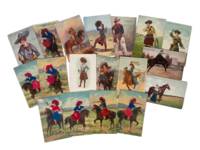
1880194351880. Cowgirl imagery in late nineteenth and early twentieth century American visual culture documents the public fascination with women performers and riders associated with rodeo culture Wild West exhibitions and frontier mythology. Eighteen postcards dating from approximately the 1880s through the early 1920s depict cowgirls mounted on horseback performing actions associated with Western riding culture including firing revolvers and rifles galloping across open terrain and lassoing livestock. The images correspond to a period when female riders and sharpshooters gained national attention through rodeo competitions traveling Wild West shows and early popular media representations of the American frontier. Several postcards depict identifiable rodeo performers including Gene Fisher and Mildred Douglas whose participation reflects the visibility of women riders in Western entertainment and exhibition culture.<br /> <br /> Eighteen postcards dating from approximately the 1880s to about 1920 depicting cowgirls in action poses across Western landscapes. The archive includes both real photo postcards and printed postcards produced using color lithography and chromolithography several of which feature embossed design elements. Each postcard measures approximately 5.5 x 3.5 inches. The scenes portray women riders equipped with bandoliers pistols and rifles while mounted on horseback amid rugged Western environments populated by wild horses and cattle. One image shows a rider firing a revolver with visible muzzle flash as the horse rears back while another depicts a cowgirl swinging a lasso above her head. A real photo postcard shows rodeo rider Gene Fisher mounted on horseback and another image depicts female rodeo cowgirl Mildred Douglas riding a bucking steer. Several postcards contain handwritten messages referencing Western towns and travel including one reading "Dear Uncle Brainard is quite a town and plenty of saloons here."<br /> <br /> Visual representations of cowgirls became an established element of American frontier mythology during the late nineteenth and early twentieth centuries shaped by traveling Wild West shows rodeo exhibitions and early illustrated postcards circulated as souvenirs of Western identity. Performers such as female sharpshooters and rodeo riders appeared alongside male counterparts in popular entertainment challenging conventional gender expectations by presenting women as skilled riders marksmen and performers in public spectacles of frontier life. These postcards reflect the intersection of popular print culture and the romanticized imagery of the American West during the decades when rodeos and frontier reenactments were widely promoted as symbols of national heritage. Eighteen postcards measuring approximately 5.5 x 3.5 inches. Colors remain bright on the printed examples and the photographic postcards retain clear contrast. Minor handling wear typical of early twentieth century postcards. Overall condition very good. unknown
20012111902158501950Sagashinbunsha 2001. Soft Cover. Fine. Number of pages: 598p. Size: 27cm Sagashinbunsha paperback
0265604079.Ghardcover. Good. Access codes and supplements are not guaranteed with used items. May be an ex-library book. hardcover
0282950648.Gpaperback. Good. Access codes and supplements are not guaranteed with used items. May be an ex-library book. paperback
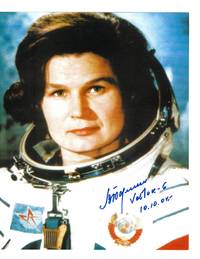
1963153231963. Tereshkova Valentina. Signed photograph commemorating the historic flight of the Soviet cosmonaut who became the first woman to travel into space during the Cold War competition between the United States and the Soviet Union. Valentina Tereshkova launched aboard Vostok 6 in June 1963 completing a three day mission in which she orbited the Earth forty eight times. Her flight followed closely after the first human spaceflight by Yuri Gagarin in 1961 and marked a major milestone both in the development of human space exploration and in the participation of women in aerospace history.<br /> <br /> Tereshkova Valentina. Signed Photograph. Color photograph measuring approximately 8 x 10 inches. The image is signed in blue ink at the lower right corner in cursive Cyrillic and includes the inscription "Vostok 6." The portrait presents Tereshkova as a cosmonaut of the Soviet space program and commemorates the mission that established her international reputation as the first woman to travel into space.<br /> <br /> Tereshkova's flight formed a central moment in the early years of the space race when both superpowers sought technological and symbolic achievements demonstrating the capabilities of their space programs. The Vostok 6 mission represented a milestone not only for Soviet aerospace engineering but also for the global recognition of women's participation in scientific and technological fields traditionally dominated by men. Tereshkova's accomplishment became an enduring symbol of women's achievements in space exploration and Cold War scientific competition. Tiny crease in the upper right corner; otherwise well preserved. Overall very good condition. unknown
1999Q-1579540554Rodale Press Inc 1999-01-01. Hardcover. New. New. In shrink wrap. Looks like an interesting title! Rodale Press, Inc hardcover
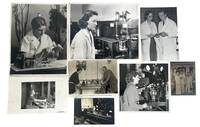
1910231321910. Women in STEM Women's scientific and technical employment photo archive documenting female laboratory labor from the early twentieth century through the 1940s historically significant for showing how women entered academic industrial and commercial research settings in roles that ranged from student and aide to biologist technician and physician at a period when scientific work remained overwhelmingly male and women's access to professional authority was still sharply constrained. The group includes five press photographs and three non press photographs with women pictured not as incidental clerical staff but as active operators of instruments handlers of test animals readers of charts and participants in experimental procedure establishing direct visual evidence of women's expanding place within the infrastructure of American science industrial testing and laboratory employment.<br /> <br /> Photo archive of 8 silver gelatin photographs ranging from 3.5 x 5.5 to 8 x 10 inches various U.S. locations circa 1910 to 1940s. The archive spans classroom laboratory and industrial interiors. One 1910 photograph shows two men and one woman standing in a laboratory identified as "three scientists or science students" an early image of mixed gender scientific training. A 1937 press photo titled "aviation biologist works with hatchlings" shows Dr. Manisera in a lab coat hand feeding two week old canaries with a third bird perched on her head turning animal handling and experimental care into a public image of female scientific expertise. Another press photo shows Sally Wulff identified on the verso as an engineering aide with a science degree from the University of Iowa seated at a control bench calibrating experimental instruments at Wright Field. A 1938 non press image shows Dr. Marie D'Amour and Fred D'Amour studying a chart before a blackboard covered with formulas and technical notations linking the photograph to mammalian physiology research. A Hoboken New Jersey press photo depicts a female technician in the chemical division of the United States Testing Company operating a Fisher titrimeter "for performing volumetric analyses by electronic means" while a 1939 press photo from Newton Massachusetts shows a laboratory worker testing newly developed Permatron tubes used in high frequency welding and power transmission. Another press image captioned "A 'noise machine' used in experiments in the Colgate laboratory" shows a woman and man positioned on either side of the apparatus and a separate 1940s laboratory group photograph places a single woman among five men before a long demonstration bench and blackboard diagrams underscoring both women's presence and their numerical isolation within technical settings. Several versos retain typed caption slips editorial markings and reference stamps consistent with press photo circulation.<br /> <br /> Across the first half of the twentieth century women entered scientific work through normal schools universities wartime research demand industrial laboratories and auxiliary technical appointments yet their advancement was often channeled into subordinate or specialized designations even when their work required substantial training. This archive makes that structure visible through named and captioned examples of women conducting measurement instrument calibration physiological research electronics testing and experimental animal work across corporate academic and applied research environments. Minor residue on versos from former press labels or caption attachments; otherwise clean and well preserved. Overall very good condition. As a record of women's early technical labor the archive supplies concrete visual evidence of the pathways limits and visibility of women's participation in American scientific work before the full opening of postwar professional opportunity. unknown
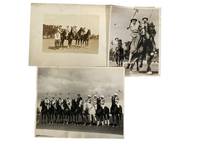
1920219031920. Women in Sports Archive of three photographs documenting women's equestrian sports 1920s-40s. Three original silver gelatin press photos capturing women actively engaged in and preparing for matches-scenes that challenge the male-dominated image of early 20th-century polo. Taken in the United States and Canada these images reflect the increasing public visibility and athletic accomplishments of women showcasing their skill camaraderie and the gradual erosion of gender barriers in elite sporting environments.<br /> <br /> The earliest photograph dated September 26 1928 depicts a historic international match between Canada and the United States-the first known women's international polo game in the U.S. according to the verso text. The players from Alberta are seen poised beside their horses as they await the match's commencement in Rye New York. The image bears the credit "International Newsreel" with annotations indicating it was distributed as a news photo under the slug "Two Teams." The second photograph is captioned "Women Now Play Polo" and is dated March 20 1940. It features prominent players Joan Baker daughter of famed Australian sportsman "Snowy" Baker Mrs. "Willie" Tevis and Yvette Barette at the Riviera Country Club in Santa Monica California. The image highlights how women's polo had begun gaining serious popularity and skill by this time especially in celebrity-adjacent venues like the Riviera. The third undated photograph by Boston-area studio photographer Paul J. Weber embossed stamp: "Paul J. Weber / Dorchester Centre Mass." shows a lineup of women riders mounted and dressed in coordinated attire likely posed before or after a match. Together the photographs capture a pivotal often overlooked chapter in the history of women's sports where gender and athletic prowess intersected in a highly public arena. Verso stamps and original caption slips intact on two press photos with clear studio embossing on the third. Overall very good condition. A compelling archive chronicling the rise of women in polo offering vital documentation of the sport's early gender integration and the public image of athletic women in the early 20th century. unknown
1861174981861. Women's in Sciences Sepia photograph circa 1860-1880 identified in manuscript at the upper left "State Eclectic Medical Society at Worthington" depicting approximately twenty five women alongside male practitioners in Worthington Ohio an early center of Eclectic medical organization just north of Columbus Ohio. The image documents a rare mixed gender professional gathering at a moment when women's participation in formal medical education remained severely restricted under prevailing institutional norms. Within the dominant nineteenth century medical establishment women were largely excluded from training and professional societies; however the State Eclectic Medical Society of Ohio and the broader Eclectic movement created alternative pathways into medical study. These networks were closely tied to reformist traditions that challenged orthodox practice and opened limited but meaningful access to women prior to the broader professionalization of female physicians following mid century breakthroughs such as the graduation of Elizabeth Blackwell in 1849.<br /> <br /> Original Photograph. C. 1860-1880. Sepia. Approximately 6" x 9" Inches. Written in black ink in the upper left corner "State Eclectic Medical Society at Worthington". Photo shows about 25 women along with their male peers. The the first woman graduated medical school in the 1850s. The Eclectic Medical Society was notable for accepting female students before most women were allowed to study medicine.<br /> <br /> The photograph reflects the intellectual and institutional culture of Eclectic medicine a distinctly American medical movement that drew on botanical therapies Native American knowledge systems and the herbal tradition associated with Samuel Thomson. In contrast to orthodox allopathic medicine Eclectic practitioners emphasized plant based remedies and a more flexible therapeutic philosophy which correlated with a greater willingness to admit women into study and practice. The presence of a substantial number of women within this group suggests not only participation but active integration within the society's professional sphere offering visual evidence of gender inclusion within an otherwise exclusionary nineteenth century medical landscape. As a primary source the photograph provides direct documentation of women's early entry into organized medical communities in the United States capturing both the social composition and institutional networks that facilitated their participation. It is particularly valuable for research in women's medical history alternative medical movements and the development of professional education outside orthodox channels illustrating how reformist medical systems functioned as critical entry points for women prior to broader legal and institutional change. Some creasing present; otherwise in good condition overall. unknown
1918166281918. Unidentified compiler. Photograph album of young woman student 1911-1918 documents school life recreation and community activity in Washington State and the Pacific Northwest during the 1910s. The album centers on a female student's progression from school-age years through graduation capturing educational environments organized physical activities and civic participation. The material records the presence of young women in structured school settings alongside informal leisure and public events providing visual evidence of student life and gendered social experience in the years surrounding the First World War.<br /> <br /> Photograph album. Washington State and British Columbia 1911-1918. Oblong format 7 x 10.5 inches containing 209 gelatin silver print photographs mounted across 40 pages supplemented by 12 postcards depicting locations in Washington State and Victoria British Columbia. The images include a graduation portrait of a young woman in cap and gown holding a pennant reading "Haddon H.S. 1911" along with later images referencing "1918" suggesting continued documentation across her school years. Photographs depict female students engaged in organized activities including tennis bicycling and calisthenics with groups of girls in uniform marching in formation across open fields. Additional sequences show camping excursions with tents and forest settings indicating school-sponsored outdoor programs. The album also includes scenes of younger children in school environments at play and participating in staged productions some in historical or theatrical costume including colonial-era dress and one child in a Japanese kimono. Community scenes include parades with extensive displays of American flags and images of shipbuilders at work situating the album within a broader civic and labor context. Scattered captions in manuscript such as "cutie" and "happy" provide limited but personal commentary.<br /> <br /> The album spans a period of expanding public education and increasing visibility of organized physical training and extracurricular programming for girls reflecting broader educational reforms of the early twentieth century. The inclusion of civic events and industrial labor scenes connects student life to wider community structures during the wartime era. The Pacific Northwest setting including references to regional institutions such as the University of Washington situates the material within a developing regional identity shaped by education industry and cross-border movement. Black cloth boards with light handling wear; photographs generally well-preserved with occasional minor wear; album complete and fully populated; overall very good condition. A substantial visual record of female student experience and community life in the early twentieth-century Pacific Northwest. unknown
1555403190.Ghardcover. Good. Access codes and supplements are not guaranteed with used items. May be an ex-library book. hardcover
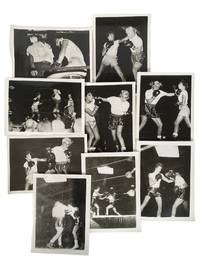
1940206121940. Unidentified photographers female boxing photograph archive late 1940s-1950s documents the emergence of organized women's boxing in the United States supporting research into gender barriers in professional sport postwar athletic culture and the early institutional recognition of female fighters. The photographs capture three central figures in mid-century women's boxing-Barbara Buttrick Phyllis Kugler and Jo-Ann Hagen-whose careers intersected in exhibition bouts and championship contests during a period when women's participation in boxing required legal and promotional negotiation. The material provides visual evidence of competitive matches and ringside moments at a time when women's boxing was only beginning to secure formal licensing in certain jurisdictions.<br /> Nine black-and-white silver gelatin photographs each approximately 5 x 7 inches depicting in-ring action and between-round scenes. Three images show a bout between Hagen and Kugler with both fighters captured mid-exchange in close quarters gloves raised and bodies angled forward in offensive and defensive stances. Five photographs document a match between Kugler and Buttrick likely connected to their 1957 championship contest in San Antonio Texas where the fighters successfully petitioned for a state boxing license for women; scenes include active exchanges as well as ring positioning under overhead lighting. One image shows Buttrick seated in her corner resting between rounds attended by seconds just outside the frame. Across the group the fighters wear standard boxing attire of the period and the ring environment-ropes canvas and audience proximity-appears consistent with mid-century professional venues.<br /> Produced during a period when women's boxing was contested both culturally and legally the archive documents early efforts to legitimize female participation in a sport historically restricted to men. Buttrick's victory in Texas marked a milestone in the recognition of women's championship boxing while Kugler's extensive bout record and Hagen's career-long rivalry with both fighters illustrate the development of a competitive circuit. All three figures were later inducted into the International Women's Boxing Hall of Fame underscoring their role in establishing the sport's foundations. Light surface wear consistent with handling with strong contrast and clear detail throughout. Overall in very good condition. unknown
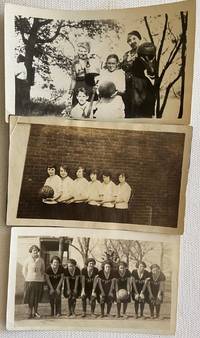
1910178711910. Women in Sports Photo archive of 3 photos of women holding basketballs two with women in early women's sports uniforms. Circa 1910-20s. Small silver gelatin prints. Each measures 4.5" x 2.75" inches. The photos encapsulate the excitement of young women entering the sport. In two of the photos players wear knee-length bloomers as part of their uniform. Women's basketball began in 1892 the year after the invention of the sport. Bloomers were designed in 1896 to preserve the modesty of skirts with the free movement of shorts. One photo shows a team of seven lined up in high school uniforms marked F.H.S their coach standing to one side. Another shows a different group of six girls also in uniforms posing in a line with a ball marked R.H.S. The third photo shows a woman in long dress holding a ball aloft with another woman holding a bucket presumably a stand in for the net and a young girl and boy posing with them the girl holding a basketball. Early photos of Recreational sports for girls are still uncommon. All three photos in good condition. unknown
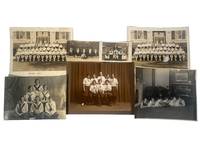
1919185111919. Unidentified photographers photograph archive of women's basketball teams 1919 to 1932 documenting the early development of organized women's athletics in the United States following the introduction of basketball as a women's sport in the 1890s. The material provides primary visual evidence of women's participation in competitive team sports supporting research into gender physical education and the expansion of athletic opportunities for women in the early twentieth century. These images capture institutional and team-based participation during a period when women's athletics remained contested yet increasingly visible.<br /> <br /> Archive of seven silver gelatin photographs depicting formal team portraits ranging from small groups of five players to a large team of approximately thirty-seven individuals. Photographs measure between approximately 3.5 x 5.5 inches and 8.75 x 10.75 inches. Players are shown arranged in rows often with a central figure holding a basketball marked with team initials and year. Uniforms include high-top athletic shoes short skirts and sailor-style tops reflecting standardized early women's basketball attire. Several photographs include handwritten identifications on the verso naming individual players while one larger image on matte paper bears the inscription "Basketball 1931-32" along with a studio stamp indicating production in Boston. The sequence of images demonstrates changes in uniform style and team size over more than a decade while maintaining consistent compositional formats typical of organized team portraiture.<br /> <br /> Seven photographs. Women's basketball introduced by physical educator Senda Berenson shortly after the sport's invention in 1891 became a significant avenue for women's physical activity despite ongoing debates about propriety and health. By the 1920s women's teams were established across schools and regional leagues reflecting broader acceptance of female athletic participation. This archive documents that period of expansion preserving visual records of team organization and identity prior to the formal institutionalization of women's professional basketball later in the twentieth century. Minor edge wear and light foxing to some prints; one duplicate image with tears and surface loss; remaining photographs clear and stable; overall very good condition. A concise visual record of early women's basketball teams and the growth of female athletic participation. unknown
16662Women Sports Education Women's Athletic Council secretary's handwritten minutes written in many hands concerning school teams and fundraisers for basketball soccer volleyball and other sports from academic years 1938-1947. Original boards. 8.5 x 6.5 in. Title on front cover" Composition Book Property of Women's Athletic Council Secretary's Book" . 90 pages. Includes additional loose papers related to the council. "Each W.A.C. girl who fulfills her obligations in officiating and playing during the year 2 semesters in which she plays in two sports and coaches one or vice versa is given an additional star for her council work. If she does not fulfill this she is dropped from the council."<br /> <br /> Handwritten entries spanning almost a decade of council business relating to managing and promoting Sports for Women. "The first meeting of the Women's Athletic council was called to order by Miss Helen Wily on September 27. Nominations were opened for new president. Eva Murdock was formally elected to the office. The question of . a coach for freshman hockey was introduced and Wasdine Freedline was appointed to this position. The president made a request of new business and in response to the request freshmen practice days were set for Tuesdays and Thursdays. Sophomore practice days were set for Wednesdays and Fridays. A motion was properly moved and seconded that the meeting be adjourned. Respectfully submitted Anita Brown Sec."<br /> <br /> In addition to coaches and rosters for Varsity Freshman and Sophomore teams in basketball volleyball softball and soccer; the council organized various social functions. "New business. There was a discussion of the possibility of a social function before the term ends but nothing definite was decided." "After debating over several different types of social function It was decided that we have a Weiner Roast down by the river Friday Sept. 20. Ruth Barr and Marylou Gourley were appointed by the president to buy the food." They also oversaw tournaments and games for students. "Plans were discussed for the Speedball Tournament." "An intramural tournament including ping-pong shuffleboard badminton to be healed between the five sororities and a team of non-sorority girls." Some wear and loss to lower portion of spine. In very good condition. unknown
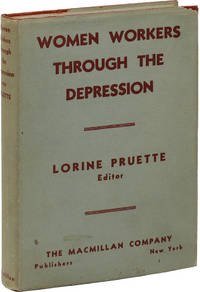
193414429New York: Macmillan 1934. First Edition. Octavo 19.5cm. Red cloth boards spine lettered in gilt; dustjacket; 164pp; tables; 1 chart folding. Tight Near Fine copy in the uncommon dustwrapper mildly toned on spine and with a tiny loss at upper flap-fold otherwise quite clean and crisp. Sociological and statistical study of women's work in the Great Depression conducted under the aegis of the American Woman's Association of New York. Lorine Pruette 1896-1977 was a Columbia-trained social psychologist whose later work included periods at the Bureau of Economic Research and the Office of War Information as a consultant on broadcast propaganda. Macmillan unknown
1896101854Montreal: John Lovell & Son 1896. Hardcover. very good. 1st printing. xv617pp. Octavo in full blue morocco all edges gilt marbled endpapers some minor wear to edges. Not illustrated. Very scarce. very good Proceedings of the Third Annual Meeting and Conference of the National Council of Women of Canada with an Appendix. Being the Reports and Discussions on the Laws for the Protection of Women and Children and on Pernicious Literature. 1896 John Lovell & Son hardcover
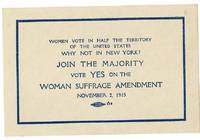
1915163091915. Women Suffrage White calling card with blue ink and border. 2 ¾ x 4 ¼ in. The card states that women can vote in half of the country but not in New York; and it calls upon the reader to "Join the Majority" and "Vote Yes on the Woman Suffrage Amendment." The vote was on November 2 1915 but failed to pass; two years later in 1917 women's suffrage passed in New York on the statewide level. Very good condition. A lovely piece of history documenting the advancement of women's voting rights. unknown
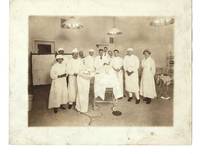
1900162081900. Women in Sciences. Original vintage photograph of operating room and surgery team. Photograph shows eleven figures dressed all in white standing around a patient in an early operating room. While most of the medical workers are men two women stand at the edges of the group and the woman standing on the left is shown wearing an operating apron and rubber gloves. 8 x 10 in. sepia photo. Photo is in good condition with light scuffing to photo surface two water marks in bottom left quadrant and some dirt and stains to the image border. Light crease in top left corner and small tear on lower right edge. Image remains crisp and clear. An important photograph that shows women's involvement in the medical field and the development of surgical technology throughout the 20th century. unknown
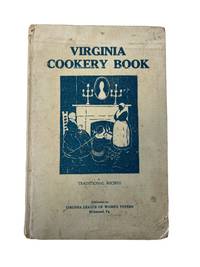
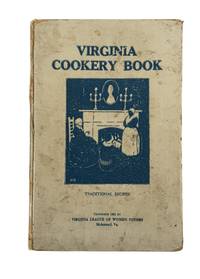
1921200801921. Suffrage Cookbook Virginia League of Women Voters. Virginia Cookery Book: Traditional Recipes. Richmond VA: Virginia League of Women Voters 1921. First edition. 192 pages. Cream illustrated boards. 9.25 x 6.5 inches. "Believing that our spirits are strengthened by well nourished bodies we have collected with care the recipes contained in this volume." The Foreword reads: "The Virginia League of Women Voters offers this book of Virginia Cookery in the hope that those who use it will find it helpful and will have the added satisfaction of knowing that by purchasing a copy they will have contributed to the fund of the League for education in good citizenship." The Virginia League of Women Voters was organized to help women attain and exercise their right to vote after the 19th Amendment which gave women the right to vote was passed in Congress in 1919. Virginia however was one of the nine southern states that opposed the amendment and refused to ratify it. Virginia women at last won the hard-fought right to vote in August 1920 when the Nineteenth Amendment became law and exercised that right soon after in the November elections. Recipes are attributed to members of the community with local advertisements giving the reader a genuine feel for the community. Binding is tight. Text pages and illustrations are crisp and clean. Minor cracking to board at spine fold edge wear corner creasing and foxing to cover. Overall very good condition. unknown
1921208321921. Suffrage Cookbook Virginia League of Women Voters. Virginia Cookery Book: Traditional Recipes. Richmond VA: Virginia League of Women Voters 1921. First edition. 192 pages. Cream illustrated boards. 9.25 x 6.5 inches. "Believing that our spirits are strengthened by well nourished bodies we have collected with care the recipes contained in this volume." The Foreword reads: "The Virginia League of Women Voters offers this book of Virginia Cookery in the hope that those who use it will find it helpful and will have the added satisfaction of knowing that by purchasing a copy they will have contributed to the fund of the League for education in good citizenship." The Virginia League of Women Voters was organized to help women attain and exercise their right to vote after the 19th Amendment which gave women the right to vote was passed in Congress in 1919. Virginia however was one of the nine southern states that opposed the amendment and refused to ratify it. Virginia women at last won the hard-fought right to vote in August 1920 when the Nineteenth Amendment became law and exercised that right soon after in the November elections. Recipes are attributed to members of the community with local advertisements giving the reader a genuine feel for the community. Pencil inscription to the front paste-down stating who the book belongs to dating Aug. 8 1929. Covers somewhat worn Three quarters of spine missing but binding is still tight. Text pages and illustrations are crisp and clean with minor foxing to blank area of some pages. Some edge wear. Overall good to very good condition. unknown
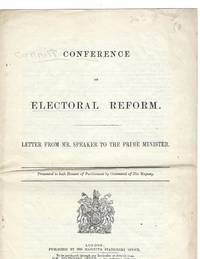
1917167571917. English Women Suffrage Pamphlet. Pamphlet: Conference on Electoral Reform1917. Letter from Mr. Speaker To the Prime Minister Presented to both Houses in Parliament by Command of His Majesty. London: Published By His Majesty's Stationery Office. At the time that this description is being written no copies are recorded in American institutions. OCLC search results are at best an estimate and can vary over time. unknown