FeminismBiblio.com
70 résultats
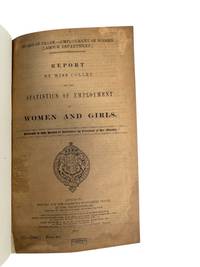
1894221311894. Women's EmploymentLaborFeminism Collet Clara Elizabeth. Report by Miss Collet on the Statistics of Employment of Women and Girls. London: Her Majesty's Stationery Office 1894. First edition. 153 pages. Rebound with blue cardstock wrappers with blue cloth spine. A foundational document in the history of women's labor rights in the United Kingdom this government-commissioned report by feminist economist and civil servant Clara Collet presents a rigorously detailed statistical study of female employment across various industries and regions in late 19th-century Britain. The report was produced under the auspices of the Board of Trade's Labour Department and presented to both Houses of Parliament by command of Queen Victoria. Collet's work documents an early official recognition of gender disparities in wages labor conditions and occupational distribution.<br /> <br /> Clara Collet was a pioneering advocate for working-class women. In this report she compiles extensive census and wage data comparing the years 1881 and 1891 with particular focus on textile and manufacturing sectors including cotton wool and worsted mills. The report also explores regional patterns in employment rates of marriage and widowhood and the social consequences of low female wages. Appendices provide granular data segmented by occupation and geography highlighting for instance employment patterns among married women and child laborers. Of note is Collet's contextual analysis of women's roles in both domestic and industrial economies and her subtle but pointed criticism of systemic inequalities in pay and opportunity. Her work prefigures later feminist labor studies by over half a century and has been cited by scholars as foundational to the evolution of state labor policy in Britain. Pages toned with scattered foxing binding stable and professionally renewed; textblock complete. Overall good to very good condition. A landmark primary source in the history of women's labor advocacy and feminist economics and a rare survival in its first edition. unknown
18017Three Addresses to Girls at School" J.M Wilson. Percival and Co: London 1890. 7" x 5" inches. 74 pages. Soft cover pamphlet. A series of speeches delivered by the vice president of the Clifton High School for Girls in Covent Garden 1890. The speeches were given on "Education" "High School Education for Girls" and "Religion" in 1887 1889 and 1890 respectively. In them Wilson the school's vice president and late head master addresses the female students on the value of their education"You are living in a great age when changes of many kinds are in progress in our political and social and religious ideas. There never was a greater need of trained intelligence clear heads and earnest hearts. And the part that women play is not a subordinate one." Whereas in 1840 60% of British women were illiterate that number dropped dramatically to 40% by 1860 and the momentum for female education picked up considerably through the end of the nineteenth century into the twentieth. Wilson's speeches delivered to high school girls give fascinating insight into both the vision and anxiety bound up in educational reform during the time. "We earnestly desire that women should be highly educated" he writes. "And yet is there not a type of educated woman which we do not wholly admire I am not going to caricature a bluestocking but to point out one or two real dangers. Education is good; but perfect sanity is better still. Sanity is the most excellent of all women's excellences.It is a small matter that you should protest against some small maladjustment or folly; but it is a great matter that you should be perfectly sane and well-balanced. Now education helps sanity." The addresses both promote women's education and caution against radically upending existing social structures. Wilson advises the girls throughout to be gentle humble and sane and celebrates the role educated women play in supporting men in positions of power. Front soft cover detached. Textblock is partially detached. Text block clean and bright. Overall good condition. unknown
1890220271890. Women's Education Three lectures on women's education in Victorian England. Wilson J. M. Three Addresses to Girls at School. London: Percival & Co. 1890. First edition. Original printed brown paper wrappers stitched binding no dust jacket as issued. Delivered between 1887 and 1890 these addresses by Reverend J. M. Wilson-former Head Master of Clifton College and Vicar of Rochdale-offer a pointed reflection on the role of education and religion in shaping the intellectual lives of young women in late Victorian Britain. Each speech was delivered at a girls' high school: the first at Clifton High School 1887 the second at Bath and Clifton 1889 and the third at St. Leonard's School St. Andrews 1890. While framed within the conservative moral expectations of the period Wilson's lectures nonetheless emphasize the legitimacy and value of female academic achievement and make a case for structured standardized education for girls-a relatively progressive position for its time. Notably Wilson defends the Higher Certificate Examination as a measure of "absolute merit" asserting that these certificates serve as proof of both academic competence and institutional rigor.<br /> <br /> In one significant passage Wilson explains how girls at Clifton High School were permitted to pass examinations in stages-two subjects one year and two the next-unlike boys who were expected to complete all four at once. This practical concession reflects both the social constraints placed on girls and an evolving acknowledgment of their academic seriousness. His emphasis on certificates as both a pedagogical guide for teachers and a tool for public accountability is central to his educational philosophy: "They help to make your work definite and sound: and that if it is slipshod you shall at any rate know that it is slipshod." Though clearly reflective of the gendered assumptions of the time the text offers valuable insight into the advocacy for women's structured schooling during the late 19th century.<br /> <br /> Front cover moderately soiled with edge wear and a small numeric marking to the lower left corner. Front wrapper and end pages detached. Internal pages clean and unmarked aside from a faint institutional stamp on the title page. Overall fair condition. A scarce record of late Victorian attitudes toward women's education notable for its firsthand account of the evolving role of girls' high schools in Britain. unknown
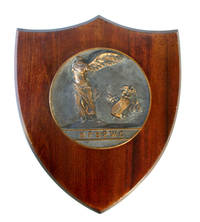
1919149951919. A large Wood Mounted 1919 NFBPWC Plaque The National Federation of Business and Professional Women's Clubs. Bronze embossed large seal. Dated one year Before National Suffrage. the National Federation of Business and Professional Women Clubs Inc. have been working to empower women through our mission which is to develop the business professional and leadership potential of all women through education advocacy mentoring networking skill building and economic empowerment programs and projects. unknown
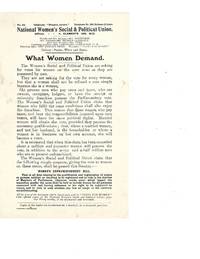
1908163971908. Women Suffrage National Women's Social & Political Union. No. 25. What Women Demand. 1908-1909. 1 page. 8 ½ x 5 ½ in. At the time that this description is being written no copies are recorded in American institutions. OCLC search results are at best an estimate and can vary over time. Handbill calls for voting rights for women on the "same terms" as men.<br /> <br /> The WSPU was a women's voting group that became famous for its radical and sometimes violent tactics. This leaflet outlines some of their demands in measured reasonable and language and emphasize that they believe "a woman shall not be refused a vote simply because she is a woman." They go on to list prerequisites for voting which men in the UK had to achieve & assert that there are over a million women who meet these same standards and would become enfranchised. Light scattered stains. Handling creases along left edge and crease in bottom right corner. unknown
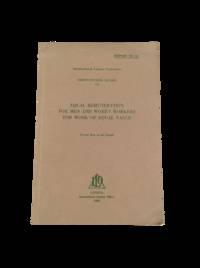
1951228591951. International Labour Conference. Equal Remuneration for Men and Women Workers for Work of Equal Value 1950 documents the formal development of international labor standards addressing gender-based wage inequality in the immediate postwar period. Issued in advance of the adoption of the Equal Remuneration Convention the report supports research into women's labor history international law and the institutional mechanisms through which gender equity policies were articulated and debated. The publication situates wage discrimination as a matter of economic justice and human rights presenting coordinated efforts by member states and labor delegates to establish enforceable standards for equal pay across national economies.<br /> International Labour Conference. Equal Remuneration for Men and Women Workers for Work of Equal Value Report VII 1; Thirty-fourth Session 1951. Geneva: International Labour Office 1950. First edition. Octavo. Original printed wrappers. The report opens with proceedings from the 33rd session of the International Labour Organization outlining debates over gendered wage structures and the economic implications of pay inequality. It includes excerpts from committee reports and plenary discussions alongside a comparative survey of member state legislation and labor practices concerning women's wages. The latter portion presents the full draft convention text proposed for adoption defining "equal remuneration" to include both wages and supplementary benefits as well as an alternative recommendation for countries not prepared to ratify binding measures. The document frames unequal pay as both structural discrimination and a violation of fundamental rights establishing terminology and policy frameworks that would shape subsequent international labor standards.<br /> 57 pages. Original printed wrappers. Octavo format. Mild toning to margins faint crease to lower front wrapper light wear at spine ends and small pencil notation at upper corner of title leaf; internally clean and secure; overall very good condition. Produced during a period of expanding international governance through organizations such as the International Labour Organization the report provides direct evidence of early multilateral efforts to codify gender equality in employment offering substantial value for the study of global labor policy and the historical foundations of equal pay legislation. unknown
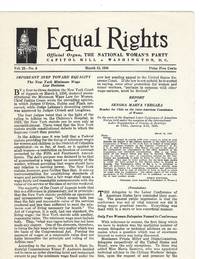
1936160251936. Feminism and Women's Rights Labor National Woman's Party Newsletter. Lucretia Mott Amendment; Protecting Women and Children in Workplace. THE NATIONAL WOMAN'S PARTY was formed in 1916 by Alice Paul and Lucy Burns to fight for women's suffrage. Offered is the March 15 1936 edition of Equal Rights official organ of The National Woman's Party Vol 22-No.6 8 ½ xl 1 4 pp featuring articles on the New York minimum wage law decision when the New York Court of Appeals declared unconstitutional the minimum wage law for women. The Equal Rights Treaty signed by Cuba Ecuador Paraguay and Uruguay is also highlighted. Very interesting article on hygiene includes children. The Fair Labor Standards Act of 1938 had not been enacted when this article was written. The resolution stated that 1 Employers must provide separate and appropriate quarters in work centers to enable women to wash change clothes and for their general use. 2 Employers must provide seats necessary to facilitate the work of women and children provided that the nature of the work does not necessitate that they remain standing. In excellent condition and a great example of the Women's Rights Movement. unknown
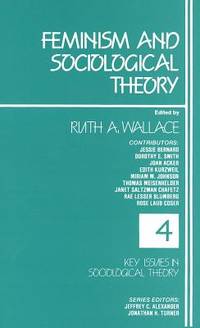
1989x-0803933983Sage Pubns 1989. Paperback. New. illustrated edition. 216 pages. 8.75x5.75x0.75 inches. Sage Pubns paperback
198583357Adelaide: Research Centre for Women's Studies University of Adelaide to Number 22; Carfax numbers 23-45; and Routledge numbers 46-51 1985. First Edition. Paperback. Very Good. Adelaide Research Centre for Women's Studies University of Adelaide to Number 22; Carfax numbers 23-45; and Routledge numbers 46-51 1985 to 2006. Octavo to Number 22 and large octavo the rest 49 issues in total Number 7/8 is a double issue. Original card covers; in excellent condition. At the time the journal was published bi- or triannually. 49 items. Research Centre for Women's Studies, University of Adelaide (to Number 22); Carfax (numbers 23-45); and Routledge (numbers 46-51 paperback
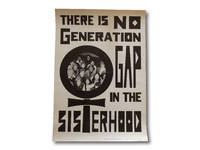
1974003028Monterey California: National Organization for Women 1974. Single sided printed poster approximately 445mm x 630mm in size. Creased very slightly browned couple of pin holes to top corners small scuff to foot otherwise quite bright and clean. Produced by J. Johnson P.M. Leeper and J.N. Mercier for the Monterey Peninsula group of the National Organization for Women. First Edition. Unbound. Good. Atlas Folio. Poster. National Organization for Women Paperback
19319766London: Jonathan Cape 1931. First edition. 8vo 158pp. Signed in full by Mitchison on the ffep. Publisher's patterned cloth boards spine lettered in red. Former owner's bookplate to ffep spine toned. Very good. <br /> <br /> Early collaborative play co-written by socialist novelist and feminist thinker Naomi Mitchison and Lewis Gielgud writer and humanitarian worker. Set amid revolutionary tensions the play follows characters forced to choose between loyalty love and ideology where "freedom" comes at the expense of personal compromise and strained relationships. Mitchison's influence brings a notable emphasis on women as active participants in political life rather than bystanders and reflects her ongoing engagement with questions of political freedom socialism and gender. The book itself is unaccountably scarce in the trade and represents an early dramatic work from Mitchison written during her most politically engaged period. Jonathan Cape unknown
1972207652Chicago: Chicago Women's Graphic Collective 1972. A few surface wrinkles from having been rolled; bright and without tears. Silkscreened poster 23-1/2 x. 17-3/8 in. printed in blue green and purple on brown paper. A bold poster depicting a faceless woman holding a rifle and with a baby on her back next which appear nine lines of verse by the Japanese poet Akiko Yosano. This is variant state of the print without the imprint of the CWGU. A later offset litho edition was also produced. Chicago Women's Graphic Collective unknown
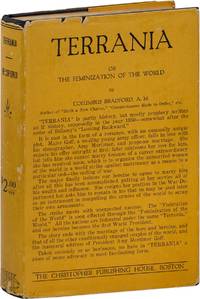
193088437Boston: Christopher Publishing House 1930. First Edition. First printing. Octavo 19.5cm. Publishers blue cloth; gilt spine and cover titles; dustjacket; 208pp. Tight clean and unmarked with some mild darkening to endpapers; Near Fine. In the original printed dustwrapper priced $2.00 on spine panel; gently rubbed and worn with shallow losses at head at foot of spine panel and a small 1/4" chip to rear panel; Very Good. <br /> <br /> Future utopia set in the year 1950 in which the women of the world go on strike against matrimony using abstinence as a lever to take control of world government and eliminate war. The theme of "lysistratic nonaction" i.e. the "sex strike" is a recurring one in Progressive Era utopias appearing for example in George Noyes Miller's The Strike of A Sex 1891; Begum Rokeya's Sultana's Dream 1908 and less directly in Charlotte Perkins Gilman's Herland 1915. In the current iteration written by a Missouri Methodist minister and issued by a religious publishing house the sexual implications of "non-matrimony" are left more or less to the reader's imagination. What the author does not shy away from is the validity and importance of women's recently-won political influence: "Feeling a real humiliation in the messed-up condition of world affairs brought about by my own sex I share the faith expressed by Mrs. J. Borden Harriman.that 'women may yet find some way to lead the race away from self-destruction'.and with Carrie Chapman Catt.that it is 'the task of women to demilitarize the minds of the world'" from the author's Preface. A somewhat uncommon and generally unrecognized feminist utopia rarely seen in dustwrapper; this a very clean copy. HANNA 407. SARGENT p.96. LEWIS Utopian Literature p.24. Christopher Publishing House unknown
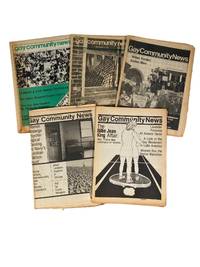
1978220741978. Gay Community News a major grassroots LGBTQ newspaper published in Boston between 1973 and 1992 documenting lesbian and gay political activism feminist organizing anti-racist solidarity movements and state surveillance during the post-Stonewall era. Produced collectively and distributed nationally through activist and community networks the publication served as one of the most influential independent queer newspapers in the United States during the late 1970s and early 1980s. The archive reflects LGBTQ political and cultural expression within the underground press illustrating how queer activists responded to institutional discrimination media hostility police violence and internal community debates through journalism photography and movement reporting. The issues preserve contemporary coverage of major developments including the White Night Riots anti-lesbian military investigations attacks on queer institutions and lesbian visibility in sports and public life providing important evidence of the political priorities and cultural language of LGBTQ activism before the AIDS crisis transformed queer organizing in the United States.<br /> <br /> Gay Community News. Boston Massachusetts 1978-1981. Five tabloid-format newspaper issues printed on newsprint each approximately 16-24 pages and illustrated throughout with black-and-white photography activist graphics and bold typographic layouts. 1 Gay Community News. Vol. 5 No. 48. Boston: June 17 1978. Includes a Lesbian & Gay Pride Calendar coverage of the expulsion of two gay seminarians from a Methodist institution reporting on tax-exempt status controversies affecting queer organizations and continuation of a fire safety project focused on LGBTQ households. Front cover features a pride march photograph prominently displaying a "Women Unite" banner. 2 Gay Community News. Vol. 6 No. 8. Boston: September 16 1978. Documents the fifth break-in and ransacking of the newspaper's offices that year alongside reporting on Anita Bryant's canceled Boston appearances and a feature discussing the poetry of Adrienne Rich. 3 Gay Community News. Vol. 6 No. 44. Boston: June 2 1979. Covers the White Night Riots in San Francisco following Dan White's manslaughter conviction in the killings of Harvey Milk and George Moscone accompanied by front-page protest photographs outside City Hall. Additional articles address the Thorpe trial and legal challenges to anti-gay legislation in Oklahoma. 4 Gay Community News. Vol. 7 No. 48. Boston: June 28 1980. Reports on anti-lesbian investigations within the U.S. Navy under the headline "Women Undergo Psychological Testing in Navy's Lesbian 'Witchhunt'" while also covering discrimination cases involving Black lesbians in Chicago and aid efforts supporting Cuban refugees. 5 Gay Community News. Vol. 8 No. 42. Boston: May 16 1981. Features extensive coverage of Billie Jean King's public outing and the media response under the headline "Yes There Are Lesbians in Tennis" alongside articles on Latin American gay activism antiwar protest movements and women participating in the Boston Marathon.<br /> <br /> The archive captures a critical period in LGBTQ history marked by expanding queer political visibility alongside escalating backlash from religious institutions employers law enforcement and government agencies. Gay Community News distinguished itself from commercial gay publications through its sustained emphasis on feminism anti-racism labor activism antiwar politics and coalition-building across social movements. Coverage of the White Night Riots military anti-lesbian purges attacks on queer institutions and lesbian representation in public culture demonstrates the newspaper's role as both activist platform and documentary record of late twentieth-century LGBTQ organizing. Edge wear creasing moderate toning and occasional closed tears consistent with the fragility of newsprint; interiors remain generally clean and legible throughout. Overall good to very good condition. An important archive of underground queer journalism documenting political struggle lesbian feminist activism and community self-representation during the post-Stonewall decade. unknown
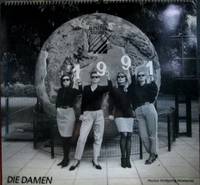
022563Vienna/Wien: Austria Tabak/Die Damen presumed Publishers. Spiral Bound. Very Good. Folio. ca 1990. Spiral bound 19 ½ by 20 ½ inches. 15 glossy sheets and cardboard backing. A conceptual art piece created by Die Damen and commissioned by the Austrian tobacco company Austria Tabak. Die Damen was a feminist art collective founded in 1987 by ONA B Evelyne Egerer Birgit Jürgenssen and Ingeborg Strobl. Their work consisted mostly of performances and staged pieces that highlighted gender stereotypes and roles exaggerating their sexuality through costumes/clothing that were associated with gender stereotypes. Most of their work was based on performance or action thus little paper artwork was produced. As the Generali Foundation website states better than we can: "Their themes were seemingly banal but in reality subversive. Taking an ironic perspective they exaggerated the predominant clichés pertaining to gender roles. . Body language and gestures as well as the design and styling of outfits and accessories were the important forms of impression in these actions. DIE DAMEN usually performed wearing identical costumes. They always emphasized their feminine sexuality by using various clichés such as classic business dress or kitchen aprons thus presenting a socially critical view of the passive roles traditionally apportioned to women. . DIE DAMEN also addressed everyday domestic scenes at home and the tough reality of down-trodden housewives. With their staged parodies and caustic humor they reflected back the male gaze and also supremely demonstrated the "cool" distance typical of the 1980s." This calendar was commissioned by Austria Tabak creating a subversive look at advertising and women depicted in advertising. Rather than portray glamourous scenes of smoking and cigarettes DIE DAMEN subtly displayed evidence of smoking or cigarettes among scenes of housework and everyday activities. VERY GOOD condition. Minor bumping and curling at the corners. Austria Tabak/Die Damen, presumed Publishers unknown
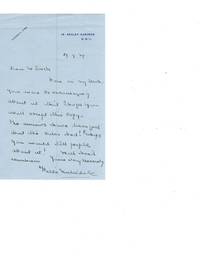
1939153491939. Feminism and Women's Rights Hilda Martindale. Autograph Letter Signed. Dated April 24 1939. 1 page. 7 x 4.5 in. Black ink on light blue paper. In her hand Martindale writes in thanks of a friend's encouragement and sends a copy of her recent work. In full: "Here is my book. You were so encouraging about it that I hope you will accept this copy. The review have been good but the sales bad! Perhaps you would tell people about it" Martindale was an important advocate for women's employment rights in her day; she made history as one of the first woman factory inspectors in Victorian England and rose to become the Deputy Chief of her department. In 1938 she published a book on the history of women civil servants likely the book she references in the letter and upon her death her estate established a foundation dedicated to assisting British women working in male-dominated fields. Very good. unknown
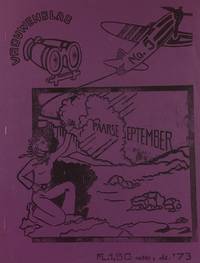
102381<p>Amsterdam 1973 - 1974. Size: 215 x 275 cm. 17; 23; 22 10 pp. Illustrated in b/w. Stencilled. Stapled.<br /><br />This short-lived radical feminist magazine was published from 1972 to 1974. Only six issues saw the light of day. It is an important source for the history of feminism and gender studies. Copies are extremely rare and complete sets impossible to find. I have only found three complete sets in libraries all in Amsterdam. Paarse September conisted of four women who became soon famous for claiming in the first issue of their magazine that feminists that stayed heterosexual were not real feminists and could even be considered anti-feminists. Their motto was "Being lesbian is a political choice" Lesbisch zijn is een politieke keuze. After six issues Paarse September stopped in 1974 because they thought their ideas were well known by then.</p>
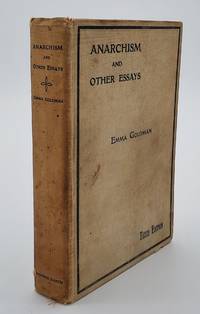
191168600New York: Mother Earth Publishing Association 1911. Third edition Second revised edition on title page. Hardcover. Good. SIGNED. 277pp. plus 8pp. of publisher's advertisements at the rear. Duodecimo 19 cm Beige cloth over boards with a black ink stamped title on the backstrip and front board and black ink stamped single-ruled borders on the front board. Reproduced photographic frontispiece portrait of the author by T. Kajiwara. Prominent toning to the spine and a large section of the rear board. Cloth a bit frayed at the edges with the underlying boards at times peeking through. Endpapers split along the hinges. Text block cracked at the title page. Name in pencil on the title page. Very occasional brief markings mostly in the form of hatching in pencil and colored pencil. With two newspaper clippings pertaining to Emma Goldman "Red Emma" laid in. A classic of radical literature. Third edition printed on front cover. Emma Goldman was once viewed as "the most dangerous woman in America" and was a thinker so far ahead of her time that even today her views seem strikingly revolutionary. This collection of essays is a magnificent introduction to her thoughts: ranging from her views on women's suffrage and emancipation patriotism's menace to liberty the psychology of political violence the prison system "a social crime and failure" the hypocrisy of Puritanism and the strategies of dissent. These writings all reflect her fearless joyousness her radical dedication to the idea that life is meant to be a source of delight- and that avoiding the meaningless grind of everyday life must be achieved in any way possible.<br /> <br /> This copy is inscribed not to a specific person by Emma Goldman on the front free endpaper: "Emma Goldman / Portland August / 1916."<br /> <br /> Emma Goldman 1869-1940 was born in Kovno now Kaunas Lithuania. She grew up in what is now Kaliningrad Russia and in St. Petersburg. Her formal education was limited but she read widely and in St. Petersburg became involved with a radical student circle. She immigrated to the United States in 1885 first settling in Rochester New York then in New Haven Connecticut where she worked in clothing factories and came into contact with socialist and anarchist groups. Subsequently she moved to New York City where in 1893 she was jailed for inciting a riot when a group of unemployed workers reacted to a fiery speech she had delivered. In 1895 upon her release Goldman began lecturing throughout Europe and the United States and later in 1906 Goldman founded Mother Earth a periodical that she edited until its suppression in 1917. Goldman's naturalization as a U.S. citizen was revoked by a legal stratagem in 1908. Two years later she published Anarchism and Other Essays.<br /> <br /> An early edition of Goldman's famous essays signed by the much revered revolutionary activist author just under a year before she was sentenced to two years in prison for her opposition to the U.S. involvement in World War I and for agitating against mandatory military service. Mother Earth Publishing Association hardcover
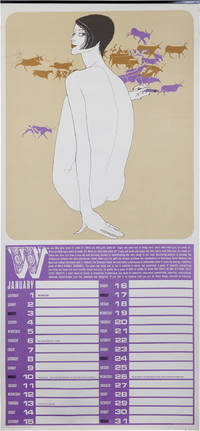
1965157435San Francisco: Determined Productions 1965. Vintage wall calendar for the year 1966 composed of twelve calendar sheets illustrated with twelve lithographs held together at the top edge with a metal rod. <br /> <br /> Designed and illustrated by noted fashion artist Betty Brader best known for her work for San Francisco specialty store Joseph Magnin as well as her freelance work for Neiman Marcus in Dallas. <br /> <br /> Bay Area publisher Determined Productions was founded by Connie Boucher in 1961 largely creating licensed products-including some of the first Peanuts merchandise. The company quickly expanded producing books and ephemera on a variety of topics including astrology the occult and alcohol. With a vibrant feminist overtone the calendar on offer here features illustrations of women from around the world posed in bright and nationally specific garments with text focusing on the way language is often used to discriminate against women. <br /> <br /> Not found in OCLC.<br /> <br /> Housed in the original pictorial paper tube. 19 x 14 inches rolled as issued. Calendar sheets Fine. Paper tube Near Fine with light wear at the right end of the tube. Determined Productions unknown
000059<p><strong>Huda Sha'rÄwÄ« 1879–1947</strong><br /><strong>Collection of 19 Photographs</strong></p><p>A group of <strong>nineteen individual photographic prints of varying sizes</strong> depicting <strong>Huda Sha'rÄwÄ«</strong> the pioneering Egyptian feminist leader nationalist and founder of the Egyptian Feminist Union.</p><ul><li><strong>Four photographs are signed by Huda Sha'rÄwÄ«</strong> including <strong>two dedicated and signed in Paris to Majd ed-Din Nasif</strong>.</li><li>Approximately <strong>fourteen are studio photographs</strong> taken predominantly in <strong>Paris</strong> with several examples from <strong>Cairo</strong>.</li><li>One notable photograph shows Sha'rÄwÄ« in <strong>Egyptian local dress</strong> <strong>signed by the photographer Lekegian Cairo</strong>.</li></ul><p>The photographs document Sha'rÄwÄ« in both European and Egyptian contexts reflecting her transnational life and public persona during the early twentieth century.</p><p><strong>Biographical Note:</strong><br />Huda Sha'rÄwÄ« June 23 1879 – December 12 1947 was a leading figure in Egyptian feminism and nationalism. Born into a wealthy family in Minya she was the daughter of Muhammad Sultan the first president of the Egyptian Representative Council. Raised in the seclusion of an upper-class harem she married her cousin Ali Pasha Sha'rÄwÄ« at the age of thirteen. A later separation allowed her to pursue formal education and develop an early sense of independence. Educated in Quranic studies Arabic Turkish and Islamic subjects she also wrote poetry in Arabic and French. Her memoir <em>Harem Years: The Memoirs of an Egyptian Feminist 1879–1924</em> remains a key source for understanding her life and era.</p>