30 287 résultats
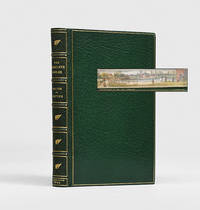
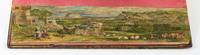
1788ST19954London: Printed for the Author and sold by Edwards in Pall Mall; Also by Edwards's in Halifax 1788. FIRST EDITION quarto issue with the etchings printed directly above the text. 257 x 205 mm. 10 1/8 x 8 1/8". iv 27 1 pp. 25 leaves; 11 1 pp. 25 leaves. Two parts bound in one volume. <br/> HANDSOME ORIGINAL ESTRUSCAN CALF BY EDWARDS OF HALIFAX covers with central panel of tree calf enclosed by a gilt Greek key border and a frame of stenciled dark brown palmettes on light tan calf this surrounded by graceful gilt ivy roll on dun-colored calf all within a gilt pentaglyph-and-metoped border smooth spine divided into panels by strips of inlaid black morocco tooled with gilt Greek key roll panels with inlaid central oval medal featuring an Etruscan vase calligraphic gilt flourishes at corners black morocco label bright pink endpapers all edges gilt expertly rebacked preserving original spine. WITH A FINE BRIGHTLY COLORED FORE-EDGE PAINTING OF THE CRAIGMILLAR CASTLE RUINS WITH EDINBURGH IN THE DISTANCE. WITH 50 ENGRAVED VIGNETTES 60 x 85 mm. of the ruins of Scottish castles and abbeys. A Large Paper Copy. Front pastedown with engraved armorial bookplate of Christopher Turnor Stoke Rochford Library. Lowndes 370; ESTC T153718 but with a variant title page. Front cover with a couple small areas of lost patina from insect activity rear cover just slightly marked upper corners a bit bumped faint freckled foxing in the margins more noticeable on the first two leaves slight offsetting of engravings on facing blank versos. A few condition issues but still a very attractive book the lovely binding retaining virtually all of its antique appeal and the contents with nothing approaching a significant problem.<br/> <br/> This is an excellent atypically large example of an Edwards of Halifax binding enhanced with a most appealing early fore-edge painting depicting one of the castles pictured in this attractive quarto edition. Scottish surgeon and antiquary Adam de Cardonnel 1746/7 - 1820 wrote and illustrated the present work "to preserve from oblivion the ancient remains of Caledonian splendour." Originally intended as a supplement to the popular "Pennant's Tour" of Scotland it appeared in four parts the first two in 1788 in a few different forms including an octavo edition and the second two published in 1793. The fore-edge painting features Craigmillar castle a Medieval fortress located a few miles from Edinburgh whose most famous guest was Mary Queen of Scots. One of her stays resulted in the so-called "Craigmillar bond" which set in motion plans to dispatch Mary's husband Henry Stuart. By the late 18th century the castle had fallen into disrepair and it appears in the present painting as an idyllic ruin with sheep and cows grazing in the fore-ground and the city with Edinburgh Castle rising in the distance. The Edwards of Halifax bindery was founded by William Edwards 1723-1808 and continued by several of his brothers half-brothers and sons by far the most important of the sons being Thomas who lived from 1762-1834. This famous firm produced a number of important innovations in binding design the most significant being the idea of concealing a painting under the gilt of the fore edge. This hidden treasure could be revealed once the edge was fanned out as a special surprise element of the volumes the Edwards firm bound--typically in Etruscan calf as here or in their patented transparent vellum. Although bindings produced by the Edwards workshop are almost never signed the present item is surely Edwards' work as indicated by the characteristic binding style and by the fact that our volume was actually sold by the Edwards firm. As usual there is no clear way to assign a precise date to the painting; while it is not done in the soft grays that can be firmly associated with the earliest Edwards examples it clearly is a painting done before 1850. While fore-edge paintings likely produced at the Edwards bindery and especially produced by their imitators appear in the marketplace with some regularity most offered are octavo or duodecimo in size. Of the fore-edge paintings attributed to Edwards of Halifax that have appeared in RBH over the past 65 years fewer than one in 10 were on quarto volumes. This copy was previously owned by the MP Christopher Turnor 1809-86 a member of the House of Commons and owner of more than 20000 acres in Linconshire where he built the grand Stoke Rochford Hall. Printed for the Author, and sold by Edwards, in Pall Mall; Also by Edwards's, in Halifax unknown
1800227046Edinburgh: Printed by Sir J.H. Blair and J. Bruce 1800. 1 vols. 18mo. Near contemporary blue cloth with floral gilt tooled border rose silk endsheets with gilt tooled braid borders title page with ornamental gilt tooled border a.e.g. wih a vertical fore-edge painting of a flower. Provenance: Ownership signature of "Mary Lister May 18 1804" on first blank. 1 vols. 18mo. An early cloth binding with the unusual addition of gilt tooling on the endleaves and title page. Printed by Sir J.H. Blair and J. Bruce unknown
05168Edinburgh: Archibald Constable and Company 1811. Day set on Norham's castled steep.<br /> And Tweed's fair river broad and deep. "<br /> Bound by Taylor & Hessey and with a Fine Fore-Edge Painting <br /> by the "Double-Line Painter"<br /> <br /> FORE-EDGE PAINTING. TAYLOR & HESSEY binder. DOUBLE-LINE PAINTER artist. SCOTT Sir Walter. Marmion: A Tale of Flodden Field. The eighth edition. Edinburgh: Archibald Constable and Company 1811. <br /> <br /> With a very fine early twentieth century fore-edge painting by the "Double-Line Painter" showing a view of Norham Castle in Northumberland depicting the opening lines of the poem.<br /> <br /> Octavo 8 1/4 x 5 1/4 inches; 210 x 133 mm. viii 1-377 1 blank i-cxxviii pp. Additional engraved vignette title-page and nine engraved plates. The title-page and plates with old water stain at top left corner some occasional and light spotting otherwise near fine.<br /> <br /> Handsomely bound ca. 1811 by Taylor and Hessey Booksellers London. Stamp-signed in gilt on the fore-edge of the front board "Bound by Taylor & Hessey". Full dark blue straight-grain morocco covers elaborately paneled in gilt spine with five raised bands three of them double elaborately decorated and lettered in gilt in compartments decorative gilt board-edges and turn-ins ochre watered silk liners and endleaves all edges gilt. With the engraved bookplate of Isabel Beckwith Closson on front blank. A lovely example.<br /> <br /> The "Double-Line Painter" was an English artist name unknown possibly active in the 1920s. The most identifiable feature of this artist's work is the label for the painting. The artist labels his own paintings on the the front fly-leaf. If you look carefully you will see a neat light penciled double-line above and below the written title like an architect would do. The painting title itself is also neatly written in tiny letters. This artist is highly skilled painter with high productivity." Jeff Weber. Annotated Dictionary of Fore-Edge Painting Artists & Binders pp. 95-96. Jeff Weber cites eight examples of the "Double-Line" artist in his book on pp. 96-97.<br /> <br /> 'Norham Castle' is in Northumberland England overlooking the River Tweed on the border between England and Scotland. In the nineteenth century Norham Castle became well known far and wide from the paintings of J. M. W. Turner. He first painted the castle in 1797 but returned to paint it many times.<br /> <br /> "Taylor & Hessey were busy throughout these fifteen years 1808-1823 not only in publishing and in binding but also in re-binding books published by others. They issued among other works Pope's translation of the Iliad and Thomson's Seasons; but they also put fine bindings upon books by Milton Crabbe Cowper Scott and others published by Johnson or by Sharpe or by Hatchard or by Reeves or by Longman. Taylor & Hessey usually bound their fine books in morocco-red blue brown crimson green-and "signed" their bindings by stamping their name in gilt in the fore-edge of the binding not the leaves note whenever the boards inside the leather were thick enough to carry the name of the firm. C.J. Weber Fore-Edge Painting pp. 106-7.<br /> <br /> Provenance: Isabel Beckwith Closson 1907-2004; Weber. 1001 Fore-Edge Paintings. Maine 1949. P. 152; Randall Moscovitz. Edinburgh: Archibald Constable and Company, 1811 unknown
05172London: Printed for W. Bent 1833. With an Exquisite Fore Edge Painting of St. Giles's Church Cripplegate<br /> By The "Dover Painter"<br /> <br /> FORE-EDGE PAINTING. The "DOVER PAINTER" artist. ALLESTREE Richard. The New Whole Duty of Man Containing The Faith as well as Practice of A Christian: Made Easy For the Practice of the Present Age. London: Printed for W. Bent 1833. <br /> <br /> With an exquisite fore edge painting beneath the gilt of St Giles's Cripplegate Fore Street London <br /> by the "Dover Painter". The painting is full of Dickensian style characters.<br /> <br /> Octavo 8 1/2 x 5 3/8 inches; 218 x 136 mm. ii i-x 1-542 pp. Engraved frontispiece of Moses with the Ten Commandments. Neat ink name and date on top blank margin of title-page "Hugh William Williamson/--April 13th 1838".<br /> <br /> Bound ca. 1900 in full maroon straight-grain morocco covers decoratively bordered in gilt and blind spine with four shallow raised bands decoratively tooled and lettered in gilt in compartments decorative gilt board edge and turn-ins blue marbled endpapers all edges gilt. With the armorial bookplate of Walter Edwin Frew on front endpaper. <br /> <br /> The fore-edge painting which we believe was executed sometime around 1925 depicts St. Giles's Cripplegate and exhibits an unusual degree of detail art and craft; the coloring is quite extraordinary. <br /> <br /> St Giles-without-Cripplegate is an Anglican church in the City of London located on Fore Street within the modern Barbican complex. When built it stood without that is outside the city wall near the Cripplegate. The church is dedicated to St. Giles patron saint of lepers beggars and the handicapped. It is one of the few medieval churches left in the City of London having survived the Great Fire of 1666. John Milton author of Paradise Lost was buried in the church in 1674.<br /> <br /> The "Dover Painter" an unknown English artist - probably worked on commission exclusively ca. 1920-1930 for Marks & Co the London booksellers. By 1928 Dawson's Book Shop in Los Angeles headed by Ernest Dawson began a relationship with Marks & Co. "a reciprocal agency agreement" that included sending crates of books to America via the Panama Canal. Several hundred fore-edges came to Dawson's. Sesslers' in Philadelphia bought and sold examples of the "Dover" painter's work as fore-edges by this and other artists turned up in the B. George Ulizio collection at Kent State University. Other fore-edge paintings were imported via J.W. Robinson Company department stores Los Angeles. The Robinson Co. books came with added new Sangorski & Sutcliffe slipcases made especially for them and sometimes included a typed identifying slip mounted on the end-leaves.<br /> <br /> Provenance: Walter Edwin Frew 1864-1941. President Corn Exchange Bank New York City. London: Printed for W. Bent, 1833 unknown
1944053400ALS Manuscript 1944. No Binding. Very Good. Original two manuscript ALSs and one manuscript autobiography including 30 lines. 1 p.; 2 p.; 2 p. In Ottoman script. Only one letter with date and letterhead of 'Vecih Bereketoglu'. In his first letter dated April 26 1944 he talks about the painting and oil painting he is working on. He states that he has met Fazil Bey since 1923. Another paper includes a two-pages autobiography. Second ALS includes 19 lines. Hasan Vecih Bereketoglu was a Turkish painter influenced by impressionistic aesthetics who took painting lessons from Halil Pasha and at the Julian Academy in Paris. He is one of the painters of the 1914 Generation. He was the son of Kazasker Bereketzade Cemil Bey. Since his father was a civil servant he completed his primary education in Egypt. He completed high school in Rhodes. He studied at Istanbul Darülfunun Law Faculty. He took his first lessons in painting from Halil Pasha between 1916 and 1920. He became one of the names that supported the establishment of the Fine Arts Union. He was in Paris between 1922-1923 and continued at the Art Academie Julian. Upon his return to Turkey in 1923 he became the Chairman of Kadikoy Halkevi. When he moved to Ankara in 1943 he became the Presidential office manager. During these years he produced still life works. He produced such works by adopting the impressionist understanding of his art life in general. It was seen that he was influenced by Halil Pasha Hikmet Onat and Nazmi Ziya Güran in his works on Istanbul. He was mostly remembered as an 'open-air painter' with his paintings with the views of Fenerbahçe Kurbagalidere and Göksu. In these paintings he did not see the light element as the element that determines the color and presented it with the reflection it's created in nature. <br/> <br/> ALS Manuscript unknown
1834180996London: Allan Bell & Co.; Simpkin & Marshall; Fraser & Co. Edinburgh; W. Curry Jun. & Co. Dublin 1834. The Doris Louise Benz copy A fine Zaehnsdorf binding with a detailed fore-edge painting from 1925 depicting an 18th-century riverside view of Broxbourne. Traditionally fore-edge paintings did not represent subjects or scenes relevant to the books they adorned but this depiction appropriately celebrates the pastoral life characterized in Walton and Cotton's piscatorial masterpiece. The Compleat Angler was first published in 1653. Provenance: Stephen C. Massey. Duodecimo 164 x 101 mm. Engraved frontispiece and 3 plates further illustrations in text. Early 20th-century green morocco by Zaehnsdorf spine lettered in gilt compartments with gilt central tool of fly fishing hook gilt rule to spine covers and turn-ins Dahlia pattern marbled endpapers edges gilt fore edge with colour fore-edge painting by C. Wain 1925 their stamp on rear turn-in. Blue morocco book label of American philanthropist and book collector Doris Louise Benz 1907-1984. Superficial split to front inner hinge sporadic foxing a couple of neat pencil annotations a fine copy. unknown
18112110502150908589Hanmoto fumei 1811. Soft Cover. Fine. Number of books: 1 Hanmoto fumei paperback
18112110502150908881Hanmoto fumei 1811. Soft Cover. Fine. Number of books: 1 Hanmoto fumei paperback
18112110502150908882Hanmoto fumei 1811. Soft Cover. Fine. Number of books: 1 Hanmoto fumei paperback
18112110502150908590Hanmoto fumei 1811. Soft Cover. Fine. Number of books: 1 Hanmoto fumei paperback
18812110502150906869Kuma Fukuda two good editions 1881. Soft Cover. Fine. Number of books: 1 Kuma Fukuda two good editions paperback
2110502150901861Nagoya student painter 6th year student N.A. Soft Cover. Fine. Number of books: 1 width Nagoya student, painter, 6th year student paperback
19262092902141000803Darumaya Bookstore 1926. Soft Cover. Fine. Number of pages: 1 quires Size: 30x44cm Darumaya Bookstore paperback
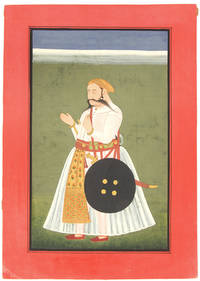
117474Rajasthan India circa 1840. . Single illuminated miniature on card ink and gouache heightened in gold depicting the ruler standing proud with his sword and shield in the holster full leaf 298 x 215 mm miniature 235 x 150 mm; leaf double-ruled in black with borders painted red reverse blank a bright and attractive example.<br /> Maharana Sangram Singh also known as Maharana 'Sanga' 1482-1528 was an important ruler in sixteenth-century India. He was the ruler of Mewar from 1508 to 1528 and his territories included parts of present-day Rajasthan Gujarat and Madhya Pradesh. He is known for being a defiant leader turning Mewar into a formidable state in the eyes of the Indian subcontinent with the Fortress of Chittorgarh standing as a symbol of Rajput resilience and pride.<br /> Rajasthan, India, circa 1840. unknown
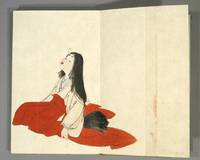
8588618. PAINTING ALBUM TOSHINDO artist. A HUMOROUS ALBUM OF INDELICATE LADIES c. 1880 22 x 13.8 cm Orihon folding album in raw silk covered boards. Shibata Toshindo was married into the Shibata family her original family name was Niwa and birthplace Nagoya. The brother of one artist and married to another she became a student of Tsukioka Yoshitoshi and developed her skills as a painter of beautiful women. In this album she has turned her brush to a more humorous angle. In a series of 12 double page paintings she has recast the traditional "farting scroll" genre to the feminine side. Feats of strength wrestling games even the ultimate farting contest performed by robed and hopefully perfumed ladies. Fun and obviously irreverent. In very good condition. Quite skillful with a sure line. unknown
200631142ABGraz, Akademische Druck- u. Verlagsanstalt, 2006. Folio. LXXXII Blatt mit farbigen Illustrationen, 397 (Text) und 413 Seiten (Kommentar). Ledereinband mit zwei Messingschließen im Holzschuber, Leinenbände. + Wichtig: Für unsere Kunden in der EU erfolgt der Versand alle 14 Tage verzollt ab Deutschland / Postbank-Konto in Deutschland vorhanden +, A|B|C 3 Bände. [3 Warenabbildungen]
14-Go.J. Öl, über Bleistift, auf Leinwand. 15:20,3 cm. Literatur: Ausst. Kat.: Kunstlandschaft Rhein-Main. Magie des Augenblicks - Skizzen und Studien in Öl, Museum Giersch, Frankfurt am Main 2009, Nr. 81, Abb. S. 185.
18382110502150906722Sanso-ban 1838. Soft Cover. Fine. Number of books: 1 Sanso-ban paperback
19062110502150902985Matsuki Heikichi-ban 1906. Soft Cover. Fine. Number of books: 1 Matsuki Heikichi-ban paperback
19072110502150903323Matsuki Heikichi-ban 1907. Soft Cover. Fine. Number of books: 1 Matsuki Heikichi-ban paperback