257 résultats
19972091202133200900Gyosei 1997. Soft Cover. Fine. Volume: 1 Gyosei paperback
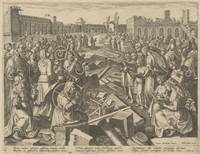
159038903Antwerp: Philip Galle 1590. Solomon takes the Tabernacle into the Temple the Levites singing. 2 Chronicles v 4-6. Plate 9.<br /> <br /> The engraving depicts a biblical scene and incorporates an illustration of trumpets timbrel harp horns drums flute rebec and cymbals with reference in Latin text beneath the image to the musical instruments depicted. Ca. 220 x 285 mm with narrow margins. <br /> <br /> Minor wear; occasional foxing; laid down to mounting paper. In very good condition overall. The Encomium Musices Eulogy of Music is an important set of highly detailed late 16th century engravings published in Antwerp ca. 1590 by Philip Galle 1537-1612 best-known as a publisher of Old Master prints; the engraver of this particular plate Collaert was Galle's son-in-law. The suite of engravings is thought by some to commemorate the rededication of Antwerp's churches to Roman Catholicism following the capture of the city by Alexander Farnese in 1585. Philip Galle unknown
159038907Antwerp: Philip Galle 1590. Inauguration of Jerusalem's Walls by Nehemiah. Nehemiah xii 27-39. Plate 13.<br /> <br /> The engraving depicts a biblical scene and incorporates an illustration of cymbals harps trumpets and horns with reference in Latin text beneath the image to the musical instruments depicted. Ca. 220 x 285 mm with narrow margins. <br /> <br /> Minor wear; occasional foxing; laid down to mounting paper. In very good condition overall. The Encomium Musices Eulogy of Music is an important set of highly detailed late 16th century engravings published in Antwerp ca. 1590 by Philip Galle 1537-1612 best-known as a publisher of Old Master prints; the engraver of this particular plate Collaert was Galle's son-in-law. The suite of engravings is thought by some to commemorate the rededication of Antwerp's churches to Roman Catholicism following the capture of the city by Alexander Farnese in 1585. Philip Galle unknown
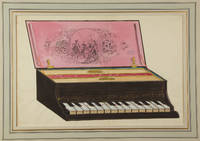
37111Executed in ink pencil and gouache highlighted in gold. 294 x 443 mm. On wove paper.<br /> <br /> The drawing depicts a 2-octave piano in a wooden case the interior of the hinged top decorated with a scene of performing musicians.<br /> <br /> Slightly worn and soiled; creased at central fold. In very good condition overall. <br /> <br /> Most likely of German or Austrian provenance ca. 1860-80. unknown
2240452 x 40 mm. With Beham's initials in the plate to upper left. <br /> <br /> A fine impression on laid paper with thread margins. A rare contemporary version in reverse of the print first published in ca. 1537. Pauli: Hans Sebald Beham Ein Kritisches Verzeichnis 191a. Bartsch 190. Kinsky: Music in Pictures p. 80 no. 2 the original version. unknown
175755793London: Printed for T. Heath and J. Nourse in the Strand: J. Hodges on London-Bridge and J. Fuller in Ave-mary-Lane 1757. 8vo. xx 188 pp. With 1 large folding copper-engraved frontisp. of mathematical instruments 8 copper engraved plates occasional minor closed tears creasing to the fore-edges of the plates couple of the joints starting in the folds. Nineteenth-century half-calf over marbled boards marbled endpapers hinges repaired minor thumbing and darkening to some leaves otherwise a VG copy. Second edition of this well-written mathematics instrument manual incorporating a short history of 44 previous works on mathematical instruments spanning 200 years with specific descriptions of particular instruments and their development. This work which is considered by Erwin Tomash to be “one of the most complete descriptions of a set of portable mathematical instruments extant†was expanded by over a third to detail the use of Gunners Calipers or a Gunter’s scale for navigation purposes into a type of slide rule which were made and sold by Nairne & Blunt in London. Robertson 1716-1776 who is perhaps best remembered for his Elements of Navigation considered one of the finest English-language navigation education manuals of the 18th century Tomash & Williams R100; Cajori A History of the Logarithmic Slide Rule and Allied Instruments pp. 32-33; See: Ellerton & Clements Samuel Pepys Isaac Newton James Hodgson and the Beginnings of Secondary School Mathematics: A History of the Royal Mathematical School within Christ’s Hospital London 1673-1868 2017 pp. 50-52 110 146 218. Printed for T. Heath and J. Nourse in the Strand: J. Hodges on London-Bridge, and J. Fuller in Ave-mary-Lane, hardcover
1539ST20126Pavia: Giovanni Maria Simonetta 1539. FIRST EDITION Second Issue. 210 x 147 mm. 8 1/2 x 5 3/4". 215 leaves. <br/> Restrained 19th century crimson morocco by Trautz-Bauzonnet stamp-signed on front turn-in raised bands spine with gilt text wide turn-ins gilt marbled endpapers all edges marbled and gilt. A small leather label with the year affixed to the spine. With two woodcuts depicting the "phagotus" instrument. Title with an attractive pictorial woodcut border. Printed in black and red. Occasional early ink marginalia; early ink ownership inscription to lower margin of colophon: "Hieronymi Pinzoni Cantoris Cremonensis et praepositi." An Armenian alphabet is inscribed in ink on the rear flyleaf dated March 28 1540. Mortimer 20; Adams I 957; Brunet I 229; Graesse I 59. Spine and edges slightly darkened joints a bit rubbed but without any cracking and the wear skillfully retouched. Only scattered very minor stains and soiling--quite a clean copy internally the leaves very fresh.<br/> <br/> This volume features one of the strangest combinations of a gravely serious treatise and an oddball curiosity: it comprises a landmark study of linguistics as the first European work concerning Syriac and Armenian--along with 36 other languages; and incongruously it also describes and pictures a contemporaneous musical instrument whose design was sufficiently peculiar to limit its interest to just one person the book's dedicatee. Our work originated when Teseo Ambrogio degli Albonesi 1469-1540 a lawyer scholar and canon of the church of Saint John of the Lateran was tasked with the publication of a Syriac manuscript psalter brought by a Maronite contingent to the Fifth Lateran Council. This was not merely a minor exercise in church outreach: 16th century scholars believed Syriac as a derivative of Aramaic to be the language of Christ. While the present work is of great interest because of its Syriac and Armenian content Ambrogio did not limit himself to those tongues: the text includes in particular short studies of Samaritan Arabic Coptic Cyrillic and Ethiopic. Of these some alphabets are provided in print in types specifically designed by Ambrogio and others are supplied in manuscript in spaces left in the text for that purpose. Ambrogio's sample texts range from simple alphabets to biblical passages to a letter purportedly from the Devil! In addition to the serious work done by our volume the text here deviates to include a fascinating musical surprise. Dedicated to the author's uncle Afranio degle Albonesi ca. 1465 - ca. 1540 a fellow church canon and apparently something of an eccentric the work includes an illustrated section on the "phagotus" a musical instrument of Afranio's own invention. Described by composer John Pickard as a "remarkable monstrosity" the phagotus combined features of the bagpipe and the bassoon. It never gained widespread popularity though not for lack of trying on Afranio's part--he once even performed with it for the duke of Ferrara Alfonso d'Este at a banquet in Mantua. Our copy in a pleasing though unassuming binding by one of the foremost 19th century French workshops was owned during its early history by yet another prominent churchman--Girolamo Pinzoni d. 1554 canon of the church of San Leonardo in Cremona. Giovanni Maria Simonetta unknown