88 résultats
183918051101London: Chapman and Hall 1839. First Edition. Hardcover. Very good. Browne Hablot K. 'Phiz"; Meadows Kenney. First printing mixed state octavo size 707 pp. This was writer Charles Dickens' 1812-1870 third novel widely anticipated and loved. He is often considered the greatest of the Victorian era novelists blending drama and comedy into compelling stories. In this novel Dickens explores the social issues that his works are known for such as harsh boarding schools the privilege of royal title and wealth social customs of the day and the plight of the working class. The plot focuses on the hardships courageously navigated by young Nicholas Nickleby after his father passes away. <br/><br/>The extra illustrations provided were drawn by Joseph Kenny Meadows 1790 - 1874 best known for his drawings published in Punch magazine. He was a friend of Charles Dickens and several other writers of the period. These caricatures add a visual element to the characters depicted by Dickens n.b. above information from Wiki. <br/><br/>___DESCRIPTION: Half red morocco leather over marbled paper boards six compartments on spine five with gilt title and author in gilt to one compartment embossed decorative and gilt borders to front and rear boards all edges marbled frontis of a young Charles Dickens supplied thirty-nine plates by Hablot K. Browne "Phiz" and twenty-four plates of various characters in the novel by Kenny Meadows the extra plates. This is a mixed state in that two of the first four plates have the Chapman and Hall imprint further the correction on p.123 has been made but "latter" for "letter" still appears on p.160 line 43. Octavo size 8 1/2" by 5 1/2 " iii-vii viii-xvi 1 2-624. <br/><br/>___CONDITION: Overall very good internally this volume is quite clean the text block is square the hinges are sound and the gilt on the spine is bright. Rubbing to front and rear joints corners rubbed rubbing and slight loss to marbled papers on front and rear board both front and rear hinge have been professionally repaired prior owner bookplate with inscription of "To David from Dad" vintage bookseller stamp and prior owner notes in pencil to the front pastedown offsetting from turn-ins to front and rear endpapers 1/8" tear to margin of frontispiece not affecting the image lacking the half-title hence our pagination begins with romanet iii slight damage to the foredge of plate between pages 174 and 175 not affecting the image the images have slight toning and foxing which is common. Even with these few flaws a better than very good copy with extra illustrations by an artist whose work complements that of Phiz and adds interest to the story.<br/><br/>___CITATION: Podeschi A41 Eckel p. 64.<br/><br/>___POSTAGE: International customers please note that additional postage may apply as the standard does not always cover costs; please inquire for details.<br/><br/>___Swan's Fine Books is pleased to be a member of the ABAA ILAB and IOBA and we stand behind every book we sell. Please contact us with any questions you may have we are here to help. Chapman and Hall hardcover books
18463650Paris: J. Hetzel 1846. First edition. Two large octavo volumes 10 3/8 x 6 7/8 inches; 263 x 175 mm. Contemporary half black hard-grain morocco ruled in gilt over black morocco-grain paper over boards. Smooth spines decoratively tooled in gilt and blind and lettered in gilt. Marbled edges and endpapers. Minor rubbing to extremities head of spine of Volume II expertly and almost invisibly repaired front hinge of Volume I cracked but sound. Minimal foxing and soiling. Small area of surface abrasion to upper blank margin of plate Artistes —6 facing page 160 in Volume II where it was once adhered to the facing page. Bookplate Bibliothèque de A. Vautrain on front pastedown of each volume. Collating 4 xxxii 380; 4 lxxx 364. Wood- engraved title vignette in each volume 212 wood-engraved plates 208 after Gavarni and four after Bertall with tissue guards and numerous wood-engraved head- and tail-pieces vignettes and initials. This copy with a duplicate of the plate facing in Volume I. Music. Overall an excellent copy.<br/><br/>"The book appeared in part-issues at the rate of one or two a week between April of 1843 and December of 1845. The major attraction of Le diable à Paris resides in Gavarni's plates which are of even greater interest than the 320 wood engravings of his Oeuvres choisies 207. The engraving is superior for the most part and they are new conceptions not versions of his lithographs. He limits himself almost entirely to single figures or pairs evoked with his usual concentration and psychological subtlety. He had a free hand with his subjects since his designs are quite unrelated to Hetzel's text. As usual he arranged them as series some of which those devoted to writers and politicians for example are largely unprecedented in his previous repertory. He invaded Daumier's world with success in the fifteen plates of ‘Bourgeois' exampled in the self-satisfied worthy reproduced II 328" Ray.<br/><br/>Hiler 237. J. Hetzel unknown books
149584None Stated: None stated nd. Hardcover. Ex-library copy with usual marks. Plates mostly clean but a few have minor-to-mild foxing. Two plates have perforation stamps on lower margins not affecting plate images. Front end pages ffep detached and laid in contain 2 library plates 2 personal book plates and one additional plate. Some wear to spine mostly at head/tail and to leather corners but nothing terribly offensive. Ex-lib. sticker on back cover. Dark green 3/4 leather with complementary medium green cloth. Gilt edging lettering and 3 bands not raised. AEG. No text. 20 pp each with an individual bw etching / engraving. With bookplates by prominent people. The title page is hand-lettered and there is no printed publication information. This is a unique and important item of Cruikshankiana. Ex-library copy with minimally offensive marks given the importance of each one. This volume contains ONLY the 20 engravings used as illustrations for Eccentric Tales. The original sketches were by Alfred Henry Forrester under the pseudonym of Alfred Crowquill. The actual book illustrations then were done by George Cruikshank. This particular book contains Forrester's personal book plate. Another book plate is of Albert M. Cohn who wrote a catalogue raisonne of Cruikshank's works in 1924 a small label on the fep makes reference to this catalogue #471. And a third book plate is of William Hartman Woodin Secretary of the Treasury under Franklin D. Roosevelt in 1933. The final bookplate present is that of the Brooklyn Public Library. Plates No. 8 and 15 have remarques. The Cruikshank illustrations in Eccentric Tales were apparently hand-tinted but these images are in b/w with no tinting and appear to be etching proofs for the final illustrations. Both Crowquill's and Cruikshank's names appear under each etching. Delightful and humorous illustrations done in great detail. Unique and rare. None stated hardcover books
19043810London: John F. Shaw 1904. First edition. Publisher's quarter decorated cloth over full-color glazed pictorial boards corners a little worn.Small quarto 9 5/8 x 7 1/8 in; 245 x 180 mm. A few illustrations hand-colored by a child. Closed tear to bottom edge of page. 17. Early ink presentation dated "Christmas 1905" on front paste-down. Illustrated throughout in black and white and color with fifteen drawings by Louis Wain and an unrecorded text drawing by Arthur Rackham so initialed on page 40. Unrecorded and scarce with no copies noted in the Wain or Rackham bibliographies.<br/><br/>Anytime an unrecorded book illustration by Arthur Rackham comes to light it's an item for collectors to note. Buried within this book unheralded on page forty is a black and white text illustration of four chickens in various states of distress as they observe in high dudgeon and with no little annoyance a cat within their food bucket chowing down the chicken feed. And at the lower left of the bucket as small as can be are Rackham's initials as typically drawn. Latimore and Haskell and Riall make no mention of this illustration in their Rackham bibliographies and the Arthur Rackham Society expressed no knowledge of it when we inquired. A true scarcity -- a previously unknown Rackham during his transitional period when his fairies and goblins were emerging but had not yet fully vanquished the simple pay-the-bills work of his early years.<br/><br/>Cf. Dale 34 and 35. John F. Shaw unknown books
19202558Paris Mishan Publishing Co. Editions d'art "La Cible. 1920. Dvenadtsat. Khudojestvienoe izdatelstvo "Michen". Art Editions "The Target". 13 rue Bonaparte. Paris. 1920. 8vo 24 x195 cm 27 ff. : flexible printed card covers. This book contains the two most famous poems of Alexander Block One of Russia's most famous poets. Two plates by Gontcharova six plates and a small illustration by Larionov refined typography. Natalia Gontcharova 1881-1962 was one of the most famous artists of the Russian Avant-garde. Trained in Moscow where she met Larionov 1881-1964 he was to become her life companion. She contributed to a great number of important exhibitions and both Gontcharova and Larionov played a crucial role in the development of Russian art. They settled in Paris shortly before the present edition became French citizens in 1938 and were married in 1955. Larionov exhibited his Rayonnist works at The Target exhibition in 1913 in Moscow. . The illustrations by Larionov showed his freedom in changing from one style to another within the same book as he liked to do in 1912-1913. Name chosen by the bookseller Jacques Povolozky for his publishing house. The most striking work of the symbolist poet Alexandre Block 1880-1921 the twelve red guards representing the new world. Printed by "Union" The most outstanding work of the poet ALEXANDRE BLOCK 1880-1921 were The TWELVE Red Guards and THE SCYTHIANS Both are poems announcing the revolution. REF:Goncharova Larionov. Centre Pompidou. Paris. 1995. Mishan Publishing Co. Editions d'art "La Cible. paperback books
1935277439Budapest: George Vajna 1935. Limited. hardcover. near fine. Translated by Frances Shires. Ten original colored etchings by Lidia Farkas and Zoltan Poharnok. Thin 8vo unpaged bound in linen with an embroidered decoration. Budapest: Dr. George Vajna & Co. n.d. ca.1935. Limited Edition.<br/><br/> Number 103 of 250 copies signed by both artists. The etchings are printed by hand-press and are hand-colored. Small damp-stain on the upper corner of the binding otherwise a fine copy of this exquisite and quite rare book printed in Hungary.<br/><br/> George Vajna unknown books
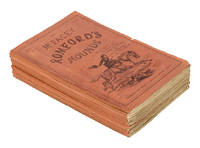
18653790London: Bradbury & Evans 1865. First edition. Third issue with Part I's title Mr. Facey Romford's Hounds in solid lettering in the original twelve monthly parts May 1864-April 1865. Octavo 8 3/4 x 5 5/8 in; 223 x 144 mm.Collating vi 2 391 1 with twenty-four hand-colored steel-engraved plates two to each volume heightened with gum arabic. The illustrations to Parts VIII-XII are unsigned but by Hablot K. Brown aka "Phiz." The woodcut on the upper wrapper is by Hablot K. Brown. Advertisements collate per Schwerdt save Part VI which lacks the Note of Lever's Martin and Part VII lacking the slip for The Belle of the Village. Publisher's original red-brown pictorial wrappers. Minimal restoration of spines to a few volumes tiny chip to fore- edge of Part I otherwise an excellent and quite lovely set. Chemised and housed in a red cloth clamshell case with black leather spine label lettered in gilt.<br/><br/>"Although Surtees approached his publishers in July 1861 with the idea of bringing out 'Mr. Facey Romford' they preferred not to undertake the matter until Mr. Leech's services were definitely secured and there would be no questoin of such delays as had occurred in the illustrations of 'Handley Cross.' Leech promised however to being in January 1862 and the situation seemed sufficiently secure to set up the type but just at this time the artist held his first exhibition of oil paintings which proved so successful and diverting that the 'Facey Romford' illustrations were again postponed. Surtees in despair at last offered the book in August 1864 to The Field where is was refused. In March of that year Leech finally undertook the drawings but never lived to complete the work which was carried on byPhiz" Field.<br/><br/>Field 225. Tooley 475. Schwerdt II 237. Podeschi 207. Bradbury & Evans unknown books
001956Bruges and Ostende: J. Buffa. Half Morocco . Very Good. Cham Victor Eeckhout H. Borremans van Cuyck Gerlier F. Stroobant J. Van de Putte Baldisseroni de Nestele spellings of these names somewhat elastic. N.d. circa 1860. A fabulous collection of hand-colored plates of the popular Belgian beach resort with a mix of character studies mostly of the local non-fashionable citizenry humorous genre scenes and views of the beach the architecture the beachgoers the sea. 52 plates in all all but one of which is hand-colored the final plate is a folding tinted panorama of the beach looking in from the sea . Some of the beach scenes are evocative of Boudin. The mix of humor and more sober portraits lends a balance from which we can better approximate the culture and atmosphere at this early destination resort. And through the pictures we can sense the uneasy embrace of the vacationing bathers with the sea. The colored plates are all 13.5 by 10 inches or 34 by 25 cm including their margins. The plates are mostly clean but there is some finger soiling and the like in the margins and a few plates have chips and small chunks of card missing never affecting the images. Rebacked with attractive green morocco. The contemporary cloth boards are soiled with a few minor edge dings. No title and no evidence there ever was one. <br/><br/> J. Buffa unknown books
48566Tallinn: "Aktsiooni" Kirjastus 1927-1933. Octavos 16.3 x 12.5 cm. Original pictorial wrappers by Peet Aren Märt Laarman and Jaan Vahtra; 28 4; 60 4; and 63 I pp. Very good or better. Antson 1899-1945 was an Estonian teacher journalist and writer who participated in the "Aktsioon" "Action" literary group and co-published the eponymous series of almanacs 1926 1927 and 1929. In addition to his travel writing Antson was known for his plays which were often leftist and pacifist in orientation. Much of his work was influenced by expressionism and detailed the horrors of war and revolution. This collection of satirical epigrams in three volumes published over six years a final fourth volume appeared in 1946 takes sharp aim at the literary cultural but also political establishment not only in Estonia but in Europe at large witness the "Hitler" epigram in the 1933 collection!. The set also represents a striking cross-section of Estonian modernist design of the late 1920s with one wrapper each designed by Peet Aren 1889-1970 Märt Laarman 1896-1979 and Jaan Vahtra 1882-1947. Laarman was one of the outstanding followers of cubism and constructivism in Estonia. His "numerous book-covers and illustrations present the possibilities of applying such a method in the field of book graphics that is based upon the constructive rhythm of simple and expressive planes. Moreover Laarman was the first to apply the principles of Elementary Typography new at that time in the design of architectonically expressive and homogeneous books" Rein Loodus 21. In addition to his own work Laarman was also instrumental in furthering public awareness of avantgarde art: "Laarman edited and published The Book of New Art 1928 the group's programmatic almanac which helped the public develop a better understanding of the avant-garde" Art of the Baltics 38. Rare; KVK OCLC show a single copy of vol. I at Göttingen of vol. 2 at Helsinki and of vol. 3 at UCLA. unknown books
1821003813London: R. Ackermann 1821. First edition. Contemporary Full Morocco. Very Good. 4to. 34 by 29 cm. vi 2 286 pp. Hand-colored title vignette and 48 hand-colored engraved plates. The plates capture the poetic beauty of the legendary lake region exquisitely. TEG. Moderate rubbing to contemporary red morocco along edges faint dampstain markings and a few other scuffs and other indicia of wear but still a very handsome binding. Dampstaining to the edges of the endpapers. Foxing of a few early leaves as well as the final ones. Faint dampstaining affecting the margins of perhaps a dozen plates and also visible in the fore-edge when the pages are fanned. However most leaves are clean and the plates themselves come off generally as quite fresh and vibrant. <br/><br/> R. Ackermann unknown books
1882WRCAM36493BWashington: text: Government Printing Office; atlas: Julius Bien & Co. of New York for the Government Printing Office 1882. Quarto text volume with folio atlas. Text: 1p. advertisement series title title as above. Forty-two plates maps and charts including two chromolithographed views by Sinclair after Holmes seventeen wood- engraved views eight after Thomas Moran nine after Holmes four "Heliotype" plates ten double-page. Atlas: Mounted on guards throughout. 1p. letterpress text otherwise lithographed throughout. Title-leaf twelve double-page map-sheets after Dutton eleven printed in colors ten double-page sheets of views after Holmes 9 and Moran 1 five chromolithographed and five printed in tints all printed by Julius Bien & Co. Text: Original cloth neatly rebacked to style. Minor shelf wear. Atlas: Original cloth titled in gilt on front board. A bit of shelf wear corners bumped. Ink stamp on titlepage. Text and atlas both very clean internally. A very good set. "One of the grandest publications of the scientific expeditions in the American West.depicting the Grand Canyon in a series of magnificent panoramas" - CREATING AMERICA. The work includes illustrations by arguably the two greatest American topographical artists to record this era of westward expansion: William Holmes and Thomas Moran. The handsomely illustrated text volume was intended to accompany Dutton's impressive atlas of maps and panoramas of the Grand Canyon. Many of the plates in the text volume are from drawings by W.H. Holmes. <br> <br> The atlas includes eight beautifully executed maps of the region on twelve sheets as well as the ten sheets of views. The views include a number of images that are designed to form larger continuous panoramas. The greatest of these is Holmes' view from Point Sublime in the Kaibab: the three chromolithographed sheets numbered XVI- XVII if joined would form a single panoramic view with an image area measuring approximately 17 x 90 inches. It is interesting to note that the first of these sheets includes what may be a self-portrait and portrait respectively of Holmes and Dutton: two figures are visible at the edge of the canyon one is seated and clearly sketching Holmes while the second figure bends down to examine his companion's work Dutton. William Goetzmann calls W.H. Holmes "the greatest artist-topographer and man of many talents that the West ever produced.his artistic technique was like no other's. He could sketch panoramas of twisted mountain ranges sloping monoclines escarpments plateaus canyons fault blocks and grassy meadows that accurately depicted hundreds of miles of terrain. They were better than maps and better than photographs because he could get details of stratigraphy that light and shadow obscured from the camera.his illustrations for Dutton's TERTIARY HISTORY OF THE GRAND CANON DISTRICT are masterpieces of realism and draftsmanship as well as feats of imaginative observation." <br> <br> The team assembled to carry out this geological survey of the Grand Canyon included some outstanding talents: C.E. Dutton the scientist; Jack Hilliers the photographer; and Holmes and Moran as artist- topographers. The intention of the survey was strictly scientific but as Dutton wrote in his preface "I have in many places departed from the severe ascetic style which has become conventional in scientific monographs." This is also true of Moran and Holmes: both were clearly inspired by their subjects. The overall result is of a quality that would not be possible today. As Wallace Stegner wrote in his introduction to the 1977 reprint: <br> <br> "Later specialization has eliminated from scientific publications most of the elements that make THE TERTIARY HISTORY so charming. No report written as this one is written would now be published by any government bureau. No illustrators like Moran and Holmes would be permitted to illustrate it.A great book.THE TERTIARY HISTORY has kept its value precisely because it does not specialize." FARQUHAR BOOKS OF THE COLORADO RIVER & THE GRAND CANYON 73. Goetzmann EXPLORATION AND EMPIRE pp.512-13. REESE & MILES CREATING AMERICA 40. REESE BEST OF THE WEST 197. [text:] Government Printing Office; [atlas:] Julius Bien & Co. of New York (for the Government Printing Office) hardcover books
188228652Washington: text: Government Printing Office atlas: Julius Bien & Co. of New York for the Government Printing Office 1882. 2 volumes quarto text and folio atlas. Text: 2xiv264pp. plus forty-two plates plans and maps including two chromolithographed views by Sinclair after Holmes seventeen wood-engraved views eight after Thomas Moran nine after Holmes four "Heliotype" plates ten double-page. Atlas: 2title leaf1p. letterpress text otherwise lithographed throughout with twelve double-page map-sheets after Dutton eleven printed in colors ten double-page sheets of views after Holmes 9 and Moran 1 five chromolithographed and five printed in tints all printed by Julius Bien & Co. Short horizontal tear to outer margin of one leaf pp.101-02 slightly longer tears to outer margins of pp.165-66 and pp.245-46 just touching a few words. Repaired tear to front blank of atlas volume a few instances of minor marginal thumb-soiling. Publisher's cloth gilt atlas rebacked with original cloth laid down. Spine ends of text volume chipped with a few small nicks to the cloth along the joints spine lightly sunned corners rubbed<br/> <br/>"One of the grandest publications of the scientific expeditions in the American West. depicting the Grand Canyon in a series of magnificent panoramas" Reese & Miles. `Depicting America.' The work includes illustrations by arguably the two greatest American topographical artists to record this era of westward expansion: William Holmes and Thomas Moran.<br/> <br/>The atlas includes eight beautifully executed maps of the region on twelve sheets as well as the ten sheets of views. The views include a number of images that are designed to form larger continuous panoramas. The greatest of these is Holmes' view from Point Sublime in the Kaibab; the three chromolithographed sheets numbered XVI-XVII if joined would form a single panoramic view with an image area measuring approximately 17 x 90 inches. It is interesting to note that the first of these sheets includes what may be a self-portrait and portrait respectively of Holmes and Dutton: two figures are visible at the edge of the canyon one is seated and clearly sketching Holmes whilst the second figure bends down to examine his companion's work Dutton. W.H. Holmes whom William Goetzmann calls "the greatest artist-topographer and man of many talents that the West ever produced.his artistic technique was like no other's. He could sketch panoramas of twisted mountain ranges sloping monoclines escarpments plateaus canyons fault blocks and grassy meadows that accurately depicted hundreds of miles of terrain. They were better than maps and better than photographs because he could get details of stratigraphy that light and shadow obscured from the camera.his illustrations for Dutton's Tertiary History of the Grand Canon District are masterpieces of realism and draftsmanship as well as feats of imaginative observation." The team assembled to carry out this geological survey of the Grand Canyon included some outstanding talents: C.E.Dutton the scientist; Jack Hilliers the photographer and of course Holmes and Moran as artist-topographers. The intention of the survey was strictly scientific but as Dutton writes in his preface "I have in many places departed from the severe ascetic style which has become conventional in scientific monographs." This is also true of Moran and Holmes: both were clearly inspired by their subjects. The overall result is of a quality that would not be possible today. As Wallace Stegner wrote in his introduction to the 1977 reprint "Later specialization has eliminated from scientific publications most of the elements that make The Tertiary History so charming. No report written as this one is written would now be published by any government bureau. No illustrators like Moran and Holmes would be permitted to illustrate it. A great book. The Tertiary History has kept its value precisely because it does not specialize."<br/> <br/>Francis P. Farquhar The Books of the Colorado River & the Grand Canyon Los Angeles: 1953 73; Goetzmann Exploration and Empire pp. 512-513; W.B. Reese & G.A. Miles Creating America New Haven: 1992 40. [text:] Government Printing Office, [atlas: Julius Bien & Co. of New York (for the Government Printing Office)] unknown books
186935984Boston: Bradlee Whidden 1869. Folio. 15 chromolithographic plates after Frederic Remington A.B. Frost Fred Cozzens R.F. Zogbaum Henry Sandham and others. 32 ff. letterpress. Expertly bound to style in full dark purple straight grained morocco.<br/> <br/>A rare large-format work on sport in late 19th-century America including Frederic Remington's first two published prints in color a rare A.B.Frost image of deer-hunting and images from Fred. S.Cozzens and other top illustrators of the day.<br/> <br/>The present work includes six angling plates three of fly-fishing four plates of game-bird hunting and five of hunting larger game. Each of the fifteen subjects is first described in general terms on a single leaf of text followed by a second leaf giving a first-hand account of catching or shooting the subject followed by a chromolithograph illustrating the first-hand account. According to Gould's preface the plates are all from water-colours especially commissioned for the work which were subjected to the critical scrutiny of a group of anglers/sportsmen who judged them for technical accuracy. The plates are as follows: 1. Killing the Salmon. Henry Sandham. 2. A Moose hunt. Henry Sandham. 3. Trout fishing. Henry Sandham. 4. Fly-fishing for Black Bass. S.F. Denton. 5. Hunting Antelope i.e. Prong-horn. Frederic Remington. 6. Catching a Tarpon. Fred. S. Cozzens. 7. Mallard shooting. S.F. Denton. 8. Catching a Mascalonge. Frank H. Taylor. 9. A Wild Turkey hunt. R.J. Zogbaum. 10. Sailing for Bluefish. Fred S.Cozzens. 11. Hunting the Virginia Deer. A.B. Frost. 12. A day with the Prairie Chickens. R.F. Zogbaum. 13. A hunt above the timber-line Big-horn. Edward Knobel. 14. Canada Goose shooting. Frederic Remington. 15. Stalking the Wapiti. Henry Sandham. The two plates by Frederic Remington Hunting Antelope Hassrick & Webster 434 and Goose Shooting Hassrick & Webster 435 are also listed by Peggy and Harold Samuels Remington The Complete Prints New York 1990 pp.152-3 with the comment that they are the first and second Remington prints to appear in color. They were preceded only by a series of four monochrome photogravures for John Muir's Picturesque California 1888 and two other individual prints both black and white. Arthur Burdett Frost is now perhaps best known for his sporting pictures and prints but an aversion to deer-hunting meant that he rarely pictured shooting scenes that featured anything other than small game. His image Hunting the Deer is recorded and illustrated in Henry M.Reed's The A.B.Frost Book Charleston 1993 pp.101 104-5 but the author was apparently unaware that it was issued as part of the present work which is not included in the extensive appendix of books illustrated by Frost.<br/> <br/>Phillips p. 141; Wetzel p. 146; Sherwin sale 1946 lot 238; Bruns G120; Heller 1:502; Bennett p.48; Tyler Prints of the West pp.127 & 174; not in Reese Stamped with a National Character. Bradlee Whidden unknown books