68 résultats
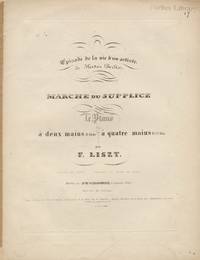
184123488Paris, Richault, o. J. (1841). 15 S. in Kupferstich. 4°. OBrosch. (etw. lädiert, gebräunt und stark fleckig, Rückenbereich mit Klebeband verstärkt).
183317381BBerlin, Enslin (Ferdinand Müller), 1833. 8°, 4 Blatt, 262 Seiten Original-Ganzleinenband der Zeit (angeschmutzt, Rückenvergoldung teils abgeblättert; Rücken mit kleiner Fehlstelle)
1896106391Torino Bocca 1896 . Volumi 2 in 8° piccolo tela con titoli oro ai dorsi. Pp. XI 332 324 piccola precedente proprieta' Torino, Bocca hardcover
188022872Leipzig: Breitkopf Und Hartel. Very Good. 1880. First German Edition. Hardcover. Bound in three-quarter leather with paper covered boards. Text is in Old German. I believe this is the first German edition. ; Small 4to 9" - 11" tall; 215 pages . Breitkopf Und Hartel hardcover
184031569Braunschweig: G.M. Meyer PN 361 1840. SCHUBERT Franz 1797-1828. Folio. 1 title 2-19 1 blank pp. Engraved.<br /> <br /> Contents: <br /> - Erlkönig D 328<br /> - Sei mir gegrüsst D 741<br /> - Du bist die Ruh D 776<br /> - Auf dem Wasser zu singen D 774<br /> <br /> Musicseller's handstamp to foot of title.<br /> <br /> Slightly worn; very minor soiling offsetting and foxing throughout. An early edition. LW A42. Searle 558. Raabe 243. <br /> <br /> Liszt transcribed nearly 150 songs for solo piano including 44 of Schubert's Lieder. <br /> <br /> "His response to poetic imagery his conviction that purely musical images of poetic ideas are capable of projection to the listener and his belief that he could illustrate such imagery without words are keys to understanding Liszt's lifelong aesthetic. The musical image of the idea the true symphonic poem thus had its genesis in concept and form in Liszt's adoration of Schubert." Derek Watson: Liszt p. 214. G.M. Meyer [PN 361] unknown
188748693Breitkopf und Härtel, Lpz. 1887. Gr.-8°. 298 S.; 328 S. OHldr. auf 5 Bünden mit Lederecken u. Goldprägung. St.a.Vors. Gering fleckig. Schöne Exemplare.
183940937Berlin: Ad. Mr. Schlesinger PN S. 2224 1839. Folio. Disbound. 1f. recto title verso blank i blank 4-13 i blank pp. Engraved. With secondary pagination to rectos in manuscript.<br /> <br /> Formerly in the collection of the Forbes Library in Northampton Massachusetts with their handstamp to upper outer corner of title and several pages.<br /> <br /> Slightly worn and browned; outer leaf separated at spine; narrow strip of early paper tape to inner margin of title. First Edition later issue. Searle 470. Raabe 134. Ad. Mr. Schlesinger [PN S. 2224] unknown
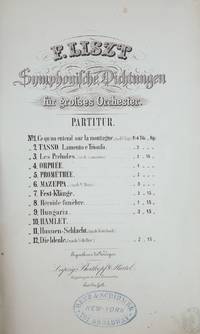
187441065Leipzig: Breitkopf & Härtel PN 9056 1874. Octavo. Original publisher's dark ivory wrappers. 1f. recto title verso blank 1f. recto preface in German verso preface in French 1f. recto composer's note in German on performance practice verso same note in French dated "Weimar Mars 1856" 97 i blank pp. Title preface and note lithographed; music engraved. <br /> <br /> Small B & H stamp to lower outer corner of title.<br /> <br /> With publisher's catalogue to verso of lower wrapper. <br /> <br /> Wrappers slightly worn and soiled; spine lacking. Occasional small stains; dampstaining to lower outer corners of first leaves; one signature partiallky detached. Re-issue from first edition plates. Searle 97. Raabe 414. Sonneck p. 266. <br /> <br /> Liszt was a distinguished Hungarian composer pianist conductor and writer.<br /> <br /> "Sketchbook evidence points to 1846-7 as the years when Liszt began to conceive the idea of a series of programmatic orchestral works. Of the four works he named all based on French poetry Ce qu'on entend sur la montagne and Les Préludes eventually became symphonic poems. . <br /> <br /> Liszt's concentration on the symphonic poem largely coincided with his tenure as Kapellmeister in Weimar where he had an orchestra at his disposal and provided music for performances at the Court Theatre. The Grand Duke commissioned Liszt's 'overtures' to preface specific dramas which thereby determined the subject matter of what were to become a number of his symphonic poems. Cormac F2017 argues that Liszt's approach to the overtures and their transformation into symphonic poems was influenced by his experience of an array of dramatic media opera plays melodramas tableaux vivants and by his interaction with staff and actors involved in the dramatic productions in Weimar. A New German School acolyte Felix Draeseke writing about the symphonic poems in a series of essays from the late 1850s acknowledged the influence of dramatic music especially opera on Liszt's Festklänge. Draeseke also addressed the issue that continues to interest scholars - the symphonic poems' engagement with sonata form. .<br /> <br /> Looking at the 12 Weimar symphonic poems Vande Moortele . views all but three Orpheus Héroide funèbre and Hunnenschlacht as using sonata form as one of the central principles guiding their large-scale organization. Furthermore Liszt seems to have attempted the same merging of sonata form and sonata cycle evident in the B Minor Sonata in Tasso Les préludes and Die Ideale and possibly Ce qu'on entend sur la montagne. .<br /> <br /> Some of the symphonic poems include mimetic representation of scenes and actions such as Hunnenschlacht's depiction of a battle and Prometheus's evocation of a voice followed by a storm. The inclusion of such passages drew criticism that a number of the symphonic poems seemed formless and could not be understood without access to a programme. In other symphonic poems such as Les Préludes and Orpheus Liszt responded to a philosophical programme without compromising musical logic. In these cases critics recognized Liszt the 'tone poet' who could capture a poetic stimulus in an expressive evocative musical flow unified by a single theme that underwent transformations. In general Liszt's sumptuous orchestral colorings were the dominant focus of critics' positive reception of his symphonic poems and programme symphonies." Dolores Pesce Maria Eckhardt and Rena Charnin Mueller in Grove Music Online. Breitkopf & Härtel [PN 9056] unknown
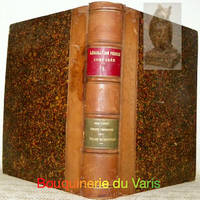
189455718Berlin - Paris : Otto Liebmann - Pedone-Lauriel 1894. 265x175mm. XXVI- demi-basane dos ˆ nerfs piÂce de titres rouge et verte cuir par endroit frottÂŽ cachet de bibliothÂque sur la page de titre cuir tachÂŽ sur un bord. 1821 Otto Liebmann - Pedone-Lauriel unknown
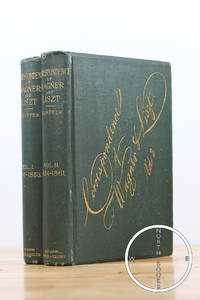
188932321New York: Scribner and Welford 1889. Hardcover. 5.5 x 8in. xvi. 352pp.; 340pp. Publisher's cloth boards with gilt titling. Both volumes are in VERY GOOD condition showing the extremities shelf rubbed former owner gift inscription of the period at each second blank otherwise the bindings are strong and tight the text-block are clean and unmarked and the boards remain bright and distinct. As pictured. Scribner and Welford hardcover
186631560Paris: S. Richault PN 15383 R 1866. BERLIOZ Hector 1803-1869. Folio. Original publisher's light green printed wrappers. 1f. title 7 1 blank pp. Engraved.<br /> <br /> From the collection of pianist Mario Feninger 1923-2016 with his small handstamp to upper wrapper "Ex Mario Feninger de Rogatis Libris" and head of first page. Publisher's handstamp to foot of title.<br /> <br /> Wrappers detached. Somewhat worn and soiled; minor offsetting. First Edition co-published with Biedermann in Germany. LW A205. Searle 475. Raabe 142. LC Catalog 152.<br /> <br /> Liszt was a fervent champion of Berlioz while in Paris and transcribed a number of his works for piano. It was Berlioz who first introduced Liszt to Goethe's Faust. <br /> <br /> "A lucid and delicately laid-out scherzo of charming effect." Derek Watson: Liszt p. 201. S. Richault [PN 15383 R] unknown
1880066737Leipzig: Breitkopf & Härtel 1880. 215 S.; aus dem Französischen von La Mara d. i. Ida Marie Lipsius; Privateinband etwas späterer Zeit; Titelblatt mit Besitzerstempel stellenweise mässig stockfleckig Kanten teils etwas berieben u. bestossen stabiles Expl. Erste deutsche Ausgabe. Halbleinen. Gut. 249 cm. Privateinband. Breitkopf & Härtel Hardcover
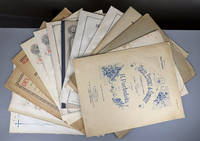
190043963097219114St. Petersburg Moscow Paris Berlin Leipzig: P. Jurgenson A. Gutheil V. Bessel 1900. Paperback. Good. Collection of 14 rare pre-revolutionary and early Soviet sheet music editions. St. Petersburg Moscow Paris Berlin Leipzig: 1880s–1919. 1. Henryk Pachulski — Two Concert Études Op. 7 No. 2. Phantom. — Moscow–Leipzig: P. Jurgenson. 2. Leopold Godowsky — Renaissance. Vol. II Book 7 — Menuet by C. P. E. Schobert. — Berlin: Schlesinger 1906. 3. Camille Saint-Saëns — Bacchanale from "Samson et Dalila". — Paris: Durand & Fils. 4. Carl Lütschg — School of Études. Book 7. — St. Petersburg: V. Bessel & Co. ca. 1900–1910s. 5. Franz Liszt — Valse-Caprice after Schubert. — Moscow: A. Gutheil ca. 1900–1910s. 6. Franz Liszt — Grand Galop Chromatique Op. 12. — Moscow: A. Gutheil ca. 1900–1910s. 7. Franz Liszt — Valse-Impromptu. — St. Petersburg: A. Johansen ca. 1890–1910. 8. Camille Saint-Saëns — Romance sans paroles. — Moscow: A. Gutheil ca. 1900–1910. 9. Robert Schumann — Novelette in D major Op. 99 No. 9. / Ed. by Rubinstein & Balakireff. — Moscow: P. Jurgenson. 10. Robert Schumann — Aufschwung Op. 12 No. 2. / Ed. by Rubinstein & Balakireff. — Moscow: P. Jurgenson. 11. Frédéric Chopin — Two Nocturnes Op. 48. / Klindworth edition. — Moscow 1919. 12. V. Selivanov — A Little Joke Op. 3 No. 3. / Ed. by M. Pressman. — Moscow: P. Jurgenson ca. 1910–1920. 13. Frédéric Chopin — Polonaise in C minor Op. 40. — St. Petersburg: T. Stellowsky ca. 1880–1890s. 14. Frédéric Chopin — Polonaise Op. 71 No. 2. / Klindworth edition. — Moscow: P. Jurgenson ca. 1900–1915. This extensive collection of fourteen large folio editions represents the cosmopolitan heart of the European and Russian musical worlds at the turn of the century. The text provides a deep dive into the internal logic of the piano virtuoso tradition including the arrangement of Leopold Godowsky’s complex "Renaissance" transcriptions and Franz Liszt’s dazzling Grand Galop Chromatique. These scores document the high editorial standards of pre-revolutionary giants like P. Jurgenson and A. Gutheil as well as international prestige imprints like Durand Paris and Schlesinger Berlin. Notable highlights include scholarly editions of Schumann edited by the pillars of Russian music Anton Rubinstein and Mily Balakirev and an exceptionally rare 1919 Soviet-era Chopin printing from the very early nationalization period. The physical identity of these scores is marked by their large folio dimensions and original covers many featuring the elegant Art Nouveau and late-Victorian graphic design of the 1890s–1910s. The lot includes vital pedagogical materials used in the St. Petersburg Conservatory such as Carl Lütschg’s School of Études and virtuosic concert repertoire that once filled the imperial concert halls. From Stellowsky’s mid-Victorian Chopin imprint to the modern "Phantom" étude by Henryk Pachulski these volumes are essential primary sources for musicologists pianists and collectors. They preserve the exact musical texts and tactile presence of a lost era where Moscow and St. Petersburg stood as equal capitals alongside Paris and Berlin in the global dissemination of classical art. P. Jurgenson, A. Gutheil, V. Bessel paperback
1855125775Druck: Weimar, Hof-Buchdruckerei 1855. * 29 Seiten. 16,5 x 13 cm. Bedruckte graue Original-Broschur (fleckig).
185040941Leipzig: Breitkopf & Härtel PN 8090 1850. Folio. Unbound as issued. 1f. recto title verso blank 3-29 i blank pp. Engraved.<br /> <br /> Small oval handstamp to blank lower margin of title.<br /> <br /> Slightly worn browned and foxed. First Edition. Searle 414:3. Raab 223.<br /> <br /> Liszt made numerous transcriptions from the operas of Meyerbeer including L'Africaine Le Prophète Les Huguenots and Robert le Diable. Breitkopf & Härtel [PN 8090] unknown
188128117AB1881. Nouvelle édition. Leipzig Breitkopf & Haertel 1881. Gross-8°. 1 Bl. 4 538 S. 1 Bl. Illustr. silbergeprägter Orig.-Leinenband Um 200 S. erweitere Neuauflage über die von Liszt beschriebene Volksmusik der Roma und der Juden in Ungarn und Russland. - Mit getilgtem Namenszug auf dem Halbtitelblatt. Einband berieben und bestossen. unknown
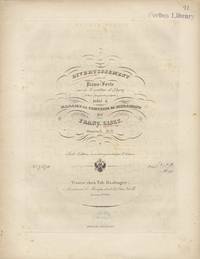
183840939Vienne: Tob. Haslinger PN T. H. 7573 1838. Folio. Disbound. i title 2-23 i blank pp. Engraved. With secondary pagination to rectos in manuscript.<br /> <br /> Small oval handstamp of P.K. Weizel Brooklyn NY to lower margin of title. <br /> <br /> Formerly in the collection of the Forbes Library in Northampton Massachusetts with their handstamp to upper outer corner of title and several pages.<br /> <br /> Very slightly worn soiled and foxed; outer bifolium separated at spine; small blank piece of ivory paper laid down to final blank page. First Edition. Searle 419. Raabe 230. Tob. Haslinger [PN T. H. 7573] unknown
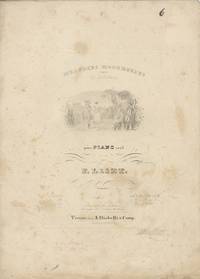
184040936Vienne: A. Diabelli & Comp. PN D et C No. 6959 1840. Folio. Unbound. 1f. recto title with vignette of dancing couple and group of musicians 3-1. i blank pp. Engraved<br /> <br /> Some wear and minor foxing; outer bifolium separated at spine' 6" in contemporary manuscript to upper outer corner of title.<br /> <br /> Indecipherable signature in pencil to lower outer corner of title with several annotations in purple ink. First Edition. Searle 425. Raab 250. Auman and White 124a. A. Diabelli & Comp. [PN D et C No. 6959] unknown
186241066Leipzig: Breitkopf & Härtel PN 9056 1862. Octavo. Original publisher's blue printed wrappers. 1f. recto title verso blank 1f. recto composer's note on performance practice in German verso same note in French dated "Weimar Mars 1856" 1f. recto preface in German verso preface in French 97 iii blank pp. Title note and preface lithographed; music engraved. <br /> <br /> With publisher's catalogue to verso of lower wrapper. <br /> <br /> With Beer & Schirmer New York and Musik-Antiquariat Doblinger handstamps to upper wrapper; Beer and Schirmer and publisher's handstamp to title.<br /> <br /> Wrappers worn soiled chipped and torn; spine reinforced with paper tape with small pieces of same tape to verso of upper wrapper. Minor internal wear. First Edition later issue. Searle 97. Raabe 414. Sonneck Orchestral Music p. 266. <br /> <br /> Liszt was a distinguished Hungarian composer pianist conductor and writer.<br /> <br /> "Sketchbook evidence points to 1846-7 as the years when Liszt began to conceive the idea of a series of programmatic orchestral works. Of the four works he named all based on French poetry Ce qu'on entend sur la montagne and Les Préludes eventually became symphonic poems. . <br /> <br /> Liszt's concentration on the symphonic poem largely coincided with his tenure as Kapellmeister in Weimar where he had an orchestra at his disposal and provided music for performances at the Court Theatre. The Grand Duke commissioned Liszt's 'overtures' to preface specific dramas which thereby determined the subject matter of what were to become a number of his symphonic poems. Cormac F2017 argues that Liszt's approach to the overtures and their transformation into symphonic poems was influenced by his experience of an array of dramatic media opera plays melodramas tableaux vivants and by his interaction with staff and actors involved in the dramatic productions in Weimar. A New German School acolyte Felix Draeseke writing about the symphonic poems in a series of essays from the late 1850s acknowledged the influence of dramatic music especially opera on Liszt's Festklänge. Draeseke also addressed the issue that continues to interest scholars - the symphonic poems' engagement with sonata form. .<br /> <br /> Looking at the 12 Weimar symphonic poems Vande Moortele . views all but three Orpheus Héroide funèbre and Hunnenschlacht as using sonata form as one of the central principles guiding their large-scale organization. Furthermore Liszt seems to have attempted the same merging of sonata form and sonata cycle evident in the B Minor Sonata in Tasso Les préludes and Die Ideale and possibly Ce qu'on entend sur la montagne. .<br /> <br /> Some of the symphonic poems include mimetic representation of scenes and actions such as Hunnenschlacht's depiction of a battle and Prometheus's evocation of a voice followed by a storm. The inclusion of such passages drew criticism that a number of the symphonic poems seemed formless and could not be understood without access to a programme. In other symphonic poems such as Les Préludes and Orpheus Liszt responded to a philosophical programme without compromising musical logic. In these cases critics recognized Liszt the 'tone poet' who could capture a poetic stimulus in an expressive evocative musical flow unified by a single theme that underwent transformations. In general Liszt's sumptuous orchestral colorings were the dominant focus of critics' positive reception of his symphonic poems and programme symphonies." Dolores Pesce Maria Eckhardt and Rena Charnin Mueller in Grove Music Online. Breitkopf & Härtel [PN 9056] unknown
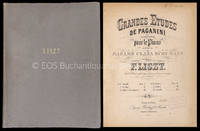
186030660AB1860. Leipzig Breitkopf & Härtel um 1860. 4°. 51 S. Moderner Einband. Platten-Nr. V.A. 484. 6 Etüden «seule édition authentique entièrment revue et corrigée par l'auteur» Titelbatt. Ders.: Zwei Episoden aus Lenau's Faust für grosses Orchester Piano zu zwei Händen. Leipzig J. Schuberth um 1860. 26 S. Ders.: Etudes d'exécution transcendante pour le piano par F. Liszt. Cah. 1. Leipzig Breitkopf und Härtel um 1860. 54 S. gestochene Noten. Ders.: Légendes. No. 1 St. Francois d'Assise. Piano. Pars Ménestrel um 1870. 13 S. Platten-Nr. H. 4612. Papier gebräunt zum Teil mit hinterlegten Einrissen. Mit handschr. Namenszügen auf den Titelblättern. unknown