Eugene, Prince of SavoyBiblio.com

415 résultats
1709001484Naples Italy: Domenico-Antonio Parrino 1709. Paperback. Near Fine. Title page continued: "Colla Copia della Lettera che scrive il Sereniss. Principe Eugenio di Savoja In data de' 10. del caduto Decembre Iu cui da raguaglio che la Cittadella di Lilla con nuovo e rarissimo esempio prima di cominciare à batterla; senza lo sparo ne meno di un Cannone abbia chiesto di Capitolare e siasi resa agli 8. del medesimo Decembre à patti di buona Guerra. Capitata detta copia di lettera a' S. Emin. il Cardinal Grimani . . . In Napoli per Dom. Ant. Parrino e Camillo Cavallo." 8 p.; 22 cm. Signatures: A4 4to. Caption title. Woodcut initial. Original or early marbled stiffened wrappers. Endpapers are laid paper with partial watermark: "D. Giovanni Di G. M." Pages are untrimmed. Dura Catalogo di Libri Antichi e Rari Vendibili in Napoli 1861 14645. This rare pamphlet contains a report of military success in Flanders with a letter written by hero of the War of the Spanish Succession Prince Eugene of Savoy on 10 Dec. 1709 and a letter by Cardinal Grimani Vincenzo Grimani 1653-1710 an Italian diplomat and opera librettist best remembered for having supplied the libretto for George Frideric Handel's early operatic success Agrippina. As a diplomat in Austrian service Grimani had played a major role in the expulsion of the Spanish from Naples. An extremely scarce pamphlet from the War of the Spanish Succession no copies in Worldcat; 1 copy in OPAC SBN. In Near Fine Condition: edges of stiffened wrappers lightly rubbed; title page lightly foxed; otherwise clean and bright. Domenico-Antonio Parrino paperback
Roy. 8vo., First Edition, with lithograph frontispiece, 8 lithograph plates, 9 tinted lithograph topographical sketches on 4, engraved illustrations in the text and large folding map in pocket at end, plates mildly spotted, text-block clean, neat inscription on blank preliminary; original terracotta cloth, boards elaborately framed and blocked in blind, neatly rebacked in cloth to style with original gilt label laid down, dove-blue endpapers, a very good, bright, firm copy. With the nineteenth-century engraved armorial bookplate of Sir Hugh Hume Campbell of Marchmont. Robust copy of an alpine classic. VERY SCARCE. Neate *274.
63-7272London: Savoy Hotel 1891. Single Letter sized Page Typed Menu Good with marginal tears. Provenance: Michelin Archives. Collection Guy Legay. Clermont-Ferrand France. London: Savoy Hotel, 1891. unknown
Due grandi stampe (76 x 54 e 74 x 54 cm.) incise da Belmond su disegno di Francesco Martinez nell’occasione dei funerali di Maria Teresa di Lorena: le stampe rappresentano il duomo di Torino (pianta, spaccato e soffitto la prima, prospettive la seconda). La firma interna alle prospettive è Alfieri, del quale Martinez (che figura invece al margine, in entrambe le stampe) era collaboratore.
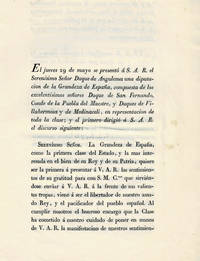
182399089<p>Madrid: Imprenta de D. Miguel de Burgos 1823. 1823. Very good. - Small folio 11-3/4 inches high by 8-1/4 inches wide. Softcover bound in plain brown wrappers. There is a short tear to the tail of the spine and the corners of the covers are creased. 6 unnumbered pages followed by a blank leaf. There are a couple of light spots to the front margin of the first leaf. A clean & bright pamphlet.</p><p>RARE First only edition.</p><p>When King Ferdinand VII of Spain returned to power in 1814 he repealed the liberal constitution of 1812 the Constitution of Cadiz. In 1820 soldiers preparing for an expedition to reclaim Spanish colonies in South America pledged loyalty to the 1812 Constitution and led by Rafael del Riego revolted against the King's absolute rule. On March 9 1820 Ferdinand accepted the constitution and gave power to the liberal ministers. The 3-year period that followed is known as the "Trienio Liberal". This period of liberal rule in Spain was marked by instability and a faltering Spanish economy. In January of 1823 a secret treaty was signed at the Congress of Verona by the United Kingdom France Russia Prussia and Austria. The treaty gave authority to France to invade Spain and restore Ferdinand VII as the absolute monarch. The King of France Louis XVIII put the Duke of Angouleme in charge of the Army of the Pyrenees also known as the "Hundred Thousand Sons of Saint Louis". It was his mission to overthrow the Constitutional government of Spain and restore Ferdinand VII to his full powers as was agreed to at the Congress of Verona. Angouleme and his army entered the capital of Spain on May 23 1823. There he formed a royalist regency presided over by Carlos Maria Isidro de Borbon the Infante of Spain. The pamphlet at hand is an exposition addressed to the Duke of Angouleme by the Grandee of Spain represented by 36 members of the Spanish nobility who have signed at the end. It is worthy of note that the Grandee's statement is dated May 27 the day after the regency was installed. The statement praises Angouleme and calls for him to quickly unite the King with the nations of Europe. "Ahora la oportunidad de desahogar nuestros pechos oprimidos y de reunir nuestros deseos y nuestras fuerzas para lograr la suspirada restauracion era el dia venturoso en que un hijo por el amor y heredero por la sangre del poderoso rey cristianisimo de Francia ha aparecido en esta capital misma rodeado de tantos miles de valientes anunciando el grandioso designio de poner en libertad a nuestro Rey y de hacer que reine de nuevo entre nosotros el orden la paz y la justicia.Acabad senor pronta y felizmente el desempeno de vuestro noble encargo; juntad la libertad de un Rey de vuestra sangre a las justas esperanzas de una nacion amiga de la Francia; que de los esfuerzos reunidos de estos dos pueblos generosos resulte el bien Comun y un nuevo y duradero lazo de amistad y de alianza; que ahuyentadas las mezquinas y funestas pasiones para hacer lugar a la benefica concordia formada una sola familia con un solo espiritu en rededor del regio trono; puestos enfin los Espanoles en honrosa y sabia armonia con las naciones cultas de la Europa tan lejos de las intrigas de la arbitrariedad precursora siempre de desastres como de la inquieta y destructora anarquia podamos un dia mas dichoso y puedan nuestros hijos decir con inefable y permanente jubilo."</p> Madrid: Imprenta de D. Miguel de Burgos, 1823. paperback
2013106586De Gruyter. New. 2013. Hardcover. 3110298805 . FREE UPGRADE to Courier/Priority Shipping Upon Request - IN STOCK AND IMMEDIATELY AVAILABLE FOR SHIPMENT - Flawless copy brand new pristine never opened - -- with a bonus offer-- . De Gruyter hardcover
201094906Prestel-Verlag. New. 2010. Hardcover. 3791350889 . FREE UPGRADE to Courier/Priority Shipping Upon Request - IN STOCK AND IMMEDIATELY AVAILABLE FOR SHIPMENT - Flawless copy brand new pristine never opened -- Text in German. 384 pages; 411 illustrations including 378 in color. -- with a bonus offer-- . Prestel-Verlag hardcover
2012100141Yale University Press. New. 2012. Hardcover. 0300167970 . FREE UPGRADE to Courier/Priority Shipping Upon Request - IN STOCK AND IMMEDIATELY AVAILABLE FOR SHIPMENT - Flawless copy brand new pristine never opened -- 152 pp. ; 203 illus. 152 in color. -- with a bonus offer-- . Yale University Press hardcover
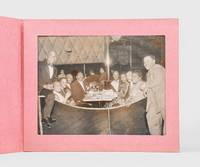
1930190332New York: The Savoy Ballroom 1930s. Chic memento of Harlem's greatest nightspot From the collection of Rolling Stones drummer and jazz aficionado Charlie Watts with his posthumous bookplate: a striking souvenir of the fabled Savoy "the World's Greatest Ballroom" situated on Lenox Avenue. Langston Hughes surely had it in mind when in "Juke Box Love Song" he referred to "Harlem's heartbeat". Entirely unsegregated from the beginning this was a ballroom not a night club - they came to dance. The long narrow dance floor known to the regulars as the "Track" was not a place for the faint-hearted it was every bit as competitive as the Savoy's dual bandstands where the Battles of the Bands or Cutting Contests took place and for which the venue became famous. Through the 1930s until his unfortunately premature demise in 1939 the great Chick Webb the original King of Swing held sway with his hard-driving band defeating all comers of the stature of Benny Goodman and Count Basie the winners chosen by the dancers of course. The folder contains the original table photograph which shows a booth with four African-American couples in their thirties and a couple of hangers-on outside the booth all of them sharply turned out and ready for a good time. And - if the debris on the table is anything to go by with at least one champagne bottle in evidence - on their way to having one. This is a wonderfully evocative piece of jazz ephemera from the Charlie Parker and Night Club Memorabilia collection of Norman R. Saks. Pink card photo-folder 238 x 278 mm superb graphic of a dancing couple to front panel. Original silver gelatin table photograph in the window mount. A little rubbed and soiled some minor stripping at the spine and lower edge of the front panel short split to the window-mount the photograph slightly mottled. Ken Vail The Norman R. Saks Collection 292 unknown
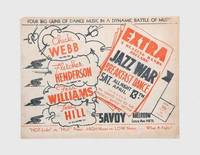
1935190330New York: Savoy Ballroom 1935. Four Big Guns of Dance Music in a Dynamic Battle of Music From the collection of Rolling Stones drummer and jazz aficionado Charlie Watts: impossible to ignore handbill for a sensational "battle of the bands" at the celebrated Savoy Ballroom the scene of many such encounters but in this instance boasting a particularly stellar line up: Chick Webb "I'll Kill 'Em" Fletcher Henderson "I'll Murder 'Em" Fess Williams "I'll Slay 'Em" Teddy Hill "I'll Slaughter 'Em". The artwork certainly buttonholes the eyeballs: on the left four "big guns" blast out the names of the participants and on the right a mock-up of a newsstand headline declaims "EXTRA - 4 Blazing Bands Declare - JAZZ WAR - Breakfast Dance - All Night Sat. April 13th. 5 pm to 8am - 50¢ Admits You to the Musical Battle Sector". A flavour of the atmosphere of these famous sessions is captured by jazz historian Lewis A. Erenberg: "When the curtain came down on Benny Goodman's Carnegie Hall concert of 1938 the Count Basie band and many of the other musicians present raced uptown to the Savoy Ballroom in Harlem for the momentous battle of the bands with the Chick Webb Orchestra. 'That was one hell of a battle' recalled Buck Clayton Basie's trumpeter. 'All concerned were putting down some heavy swing' Webb's orchestra the house band at the Savoy all through the late 1930s and the winner of numerous battles against visiting hopefuls aimed its 'sensational whirlwind barrage chiefly at the ears and head with resounding arrangements'". A genuinely remarkable survival from the heyday of Swing advertising "Four Big Guns of Dance Music in a Dynamic Battle of Music" when "Hot Licks" were pitched against "Hot Piano" and "High Notes" went toe-to-toe with "Low Notes" - as the strapline says: "What A Fight!" From the celebrated jazz ephemera collection of Norman R. Saks. Handbill 210 x 280 mm. Printed on recto only in red and black. Neat ownership inscription in green ink of one "Chas Roy" straddling the printed name of Teddy Hill; remains of paper on verso where once pasted into an album short closed tear into lower edge general creasing and signs of handling overall light toning yet remarkably well preserved. Lewis A. Erenberg Swingin' the Dream: Big Band Jazz and the Rebirth of American Culture 1998. unknown
In -4°, pp. 16, cb, 394, (2), cb, legatura alle armi di Ramiro Felipe Núñez de Guzmán, duca di Medina de las Torres, pieno marocchino, con nervi e titolo al dorso, tagli dorati. Marca al frontespizio e al colophon, iniziali e finalini. Prima edizione di questa che è considerata l’ultima delle cosiddette “cronache sabaude”. Manca una tavola. Esemplare con note manoscritte di Paolo Ramusio. 2 The first edition of this work, considered the last of the so said “Savoye chronichles”.
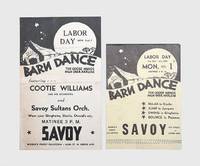
1941171093New York: Savoy Ballroom 1941 & 1942. The Goose Hangs High Over Harlem From the collection of Rolling Stones drummer and jazz aficionado Charlie Watts: a conspicuously uncommon pair of handbills for the celebrated Savoy Ballroom both advertising Labor Day celebrations that for the 1942 party featuring Cootie Williams and His Orchestra and the Savoy Sultans. The jive talk strapline of the day requires attendees to "Relax in Slacks Jump in Jumpers Swing in Ginghams Bounce in Pajamas". The sub-title of "The Goose Hangs High Over Harlem" derives from an old expression whose rather obscure meaning may have origins in the superstition that if geese were seen flying high then evil spirits were gone and good times were at hand. What may have been uppermost in the mind of the Savoy organisers however was Woody Herman's 1936 vocal version of the song of the same name also recorded by Eddie "Lockjaw" Davis in 1958 as a "honker" with a tight bouncing groove. "Special events by Afro-American community associations and the booking of Latin bands sustained the variety of the Savoy ballroom's dances. Fancy-dress events were the one enduring feature of the original cabaret-style entertainment that remained popular enough to survive Perhaps the reason for this popularity was the opportunity that fancy dress provided Harlemites to indulge a sense of what seemed to be the 'exotic' such as Arabian Russian and Chinese nights or the annual Barn Dance on Labor Day Authenticity was not a great concern when attempting square dancing but complaints were voiced on occasions if real bales of straw were not used to decorate the ballroom!" Malnig p. 137. From the celebrated jazz ephemera collection of Norman R. Saks. Two handbills 190 x 135 mm; 240 x 148 mm. Printed on recto only both featuring the image of a rustic skyline harvest moon and barn labelled "Savoy Hay Station". Some creasing and light signs of handling but in very good condition. Julie Malnig ed. Ballroom Boogie Shimmy Sham Shake: A Social and Popular Dance Reader 2009. unknown
1930SAVOYCOC013282Constable London. 1930. First edition first issue with the half-title and title-page paginated and with the errata slip at page 25. Octavo. 287 pages. Colour illustrations and decorations by Gilbert Rumbold. Art deco cloth-backed boards decorated in green grey and black as well as gilt foil. The design of this classic work was intended to complement the art deco of the American Bar at the Savoy. The author the most famous cocktail barman of the twenties and thirties was an American who had come to London in 1920 to escape from Prohibition.Spotting to edges and prelims. Much less rubbing to the boards than is usually seen. Very good indeed. Constable, London. hardcover
1885108605Folio. Paris: J. Savoy & Co. 1885. Folio plate list and 110 plates color lithograph plates heightened in foils many two-page spreads. Loose plates housed in a four-fold red pebbled-cloth porfolio with marbled paper boards. Portfolio is a bit shaken with some fraying and chips plates are very good. § A beautifully illustrated survey of Islamic arts and decorative traditions from the 12th to 18th centuries including wall decorations ceilings mosaics tiles woodwork stained glass fabrics rugs bindings crockery and miscellaneous ornaments the plates rendered in bright colors and heightened in foils. J. Savoy & Co hardcover books
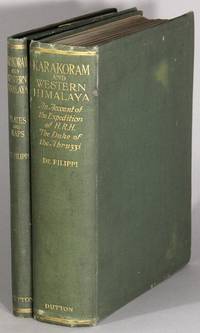
191267573New York: E. P. Dutton and Company 31 West Twenty-Third Street 1912. First edition in English American issue English sheets with a new title page; 4to pp. xvii 1 469 1; 24 mounted photogravures after Vittorio Sella 5 photographic panoramas on 4 plates 2 colored plates of minerals; original green cloth gilt-stamped spine; covers with a few smudges but overall very good sound and clean. Accompanied by the supplemental atlas volume containing 18 plates on 17 sheets all folding plus three maps and the plate list and index. A detailed and profusely illustrated account of the explorations of the Baltoro region by the Duke of the Abruzzi during which he made multiple attempts on K2. The Abruzzi Spur on that peak is named for him and is the standard route today. He ascended that to about 6250 meters. He also climbed Chogolisa but was driven back by bad weather about 150 meters from the summit. Vittorio Sella's photographs of the region from the expedition are among the finest of the period. Neate 266 for the London edition; Yakushi F71b. E. P. Dutton and Company, 31 West Twenty-Third Street unknown